

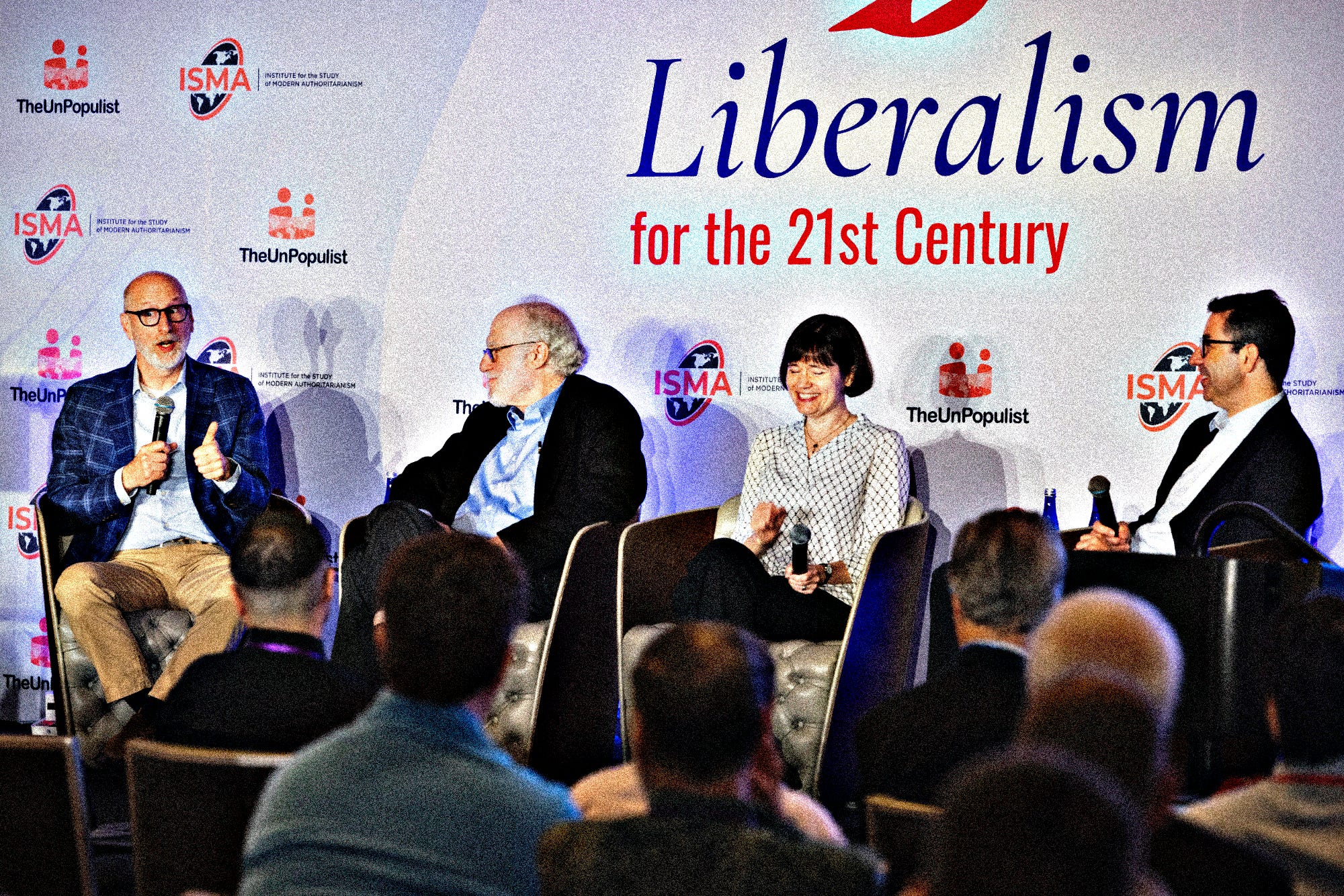
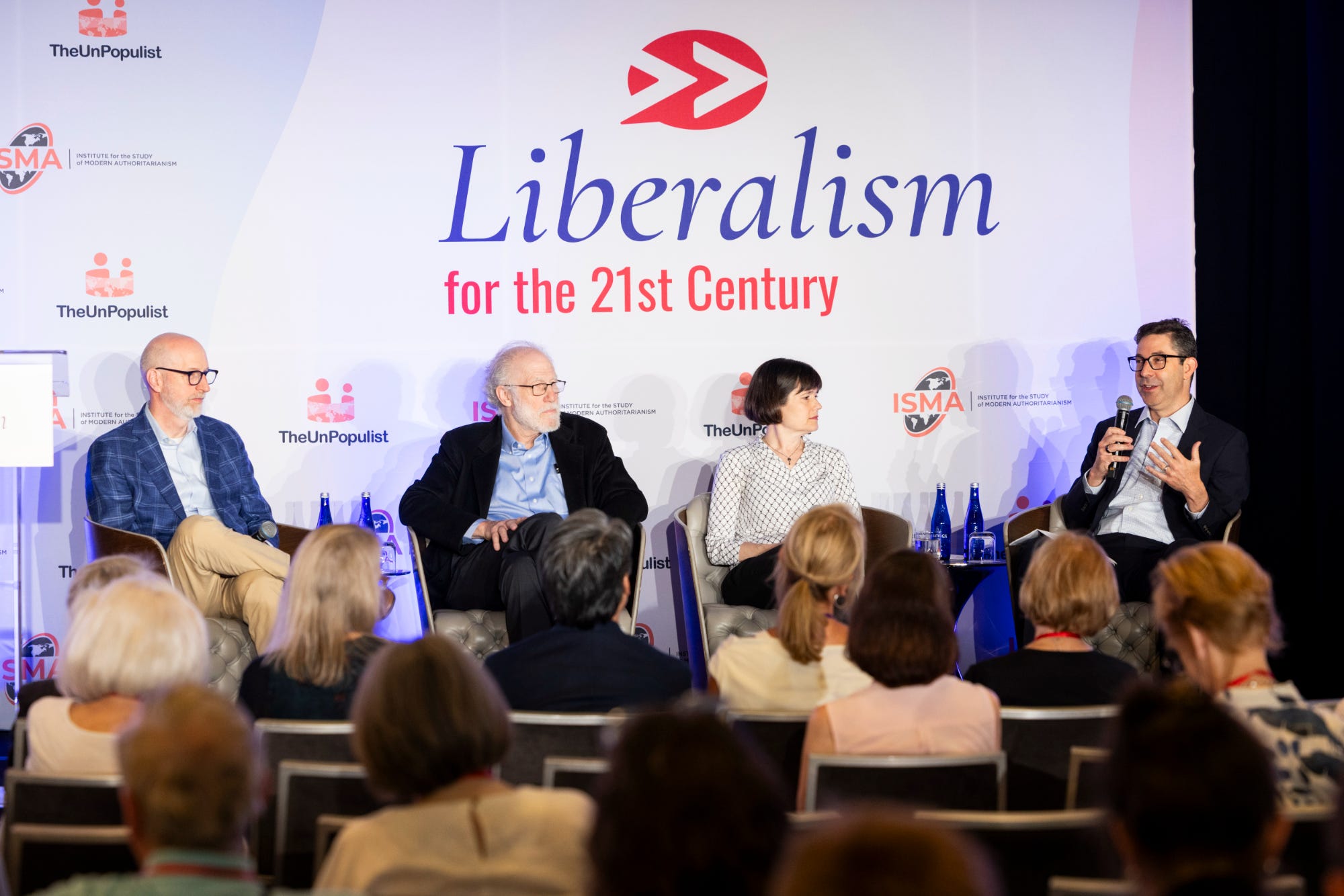
Today, we’re sharing the full video and transcript of LibCon2026’s panel “Checking the Imperial Presidency,” including the Q&A with the audience that followed. The panel was moderated by Protect Democracy's Justin Florence and featured NYU's Bob Bauer, The New York Times’ David French, and the Brennan Center's Elizabeth Goitein. You can find every LibCon2026 session on our YouTube channel, and we’ll continue posting the videos and full transcripts right here at The UnPopulist.
The transcript has been lightly edited for flow and clarity.

Andy Craig: Today we have, first up, our panel on “Checking the Imperial Presidency.” And with apologies to Ronald Reagan, in our present crisis the presidency is not the solution to our problems, the presidency is the problem. We’re going to have to think long and hard, when we talk about reconstruction and what comes next, about checking the presidency.
Fears about this office go all the way back to the Constitutional Convention. If you read Madison’s notes, which of course is our best source on the convention, it’s mostly pretty dry. He just records what was said, what was voted on; there’s not a whole lot of color. But there’s one moment when they reach the topic of: “How are we going to design the executive branch? And are we going to vest all this power in one man?” Where, as he put it, “a considerable pause ensued,” until eventually Ben Franklin piped up and demanded they at least discuss it, even though George Washington was right there looming over them at the head of the room. And Edmund Randolph said that this office that they were creating would be “the fetus of monarchy.” Charles Pinckney said it would be the worst kind of monarchy, “to wit an elective one.” And I think we’ve seen, even though they didn’t carry the day, that a lot of those objections have come to fruition.
So as with most things, Donald Trump did not begin the imperial presidency and the concentration of power, but he has taken it to the extreme, and he has swept away a lot of the limits and a lot of the checks we did have. How we reconstruct a presidency that is under the rule of law is going to be a top agenda item. So today we have some of the most thoughtful thinkers on this topic who are going to discuss this. First up, Justin Florence is going to be our moderator. He’s the co-founder and senior advisor at Protect Democracy. He previously ran the legal advocacy program there. Of course, Protect Democracy is one of our partner organizations that does some of the most important work on these issues for the past few years. They’ve been somebody we’re very happy to work with, and very happy to have you here today, Justin.
Next up we have Bob Bauer, who’s a professor of practice at NYU and was previously the White House counsel under President Obama—so somebody who’s very much been in the room on exactly these kinds of discussions. And he’s the author, with Jack Goldsmith, of After Trump: Reconstructing the Presidency. It’s a popular word, in the air these days, it seems. But that’s one of the most detailed reform plans about concrete actionable specifics. So we’re very glad to have him today participating in this discussion.
David French is, these days, an opinion columnist at The New York Times. He was previously co-founder of The Dispatch, one of our fellow publications, and a constitutional litigator. He was president of FIRE, back when it was still “education,” not “expression” as it is these days, and also served as a Judge Advocate General in the Army, where he spent tours in Iraq.
And last up is Liza Goitein, Senior Director of the Liberty and National Security Program at the Brennan Center, and a leading authority on emergency power—which is something we’ve certainly seen a lot of recently, and is something that merits a lot of thinking about how we’re going to check those and make them both suitable to the genuine emergency needs but not a way to abuse the presidency’s power. And she was previously counsel to Sen. Russ Feingold. So with that I will turn it over to Justin, and have a great conversation.
Justin Florence: Good morning, everyone. Thank you, Andy, for that introduction, and thank you to this excellent group of panelists for joining us this morning. Good to see everybody today. I think whether folks took up the invitation at the end of the day yesterday to watch the president’s speech or to drink together with fellow liberal democrats in this room, there is likely a very broad consensus here, consistent with what Andy shared, that the office of the presidency that we have now is autocratic, imperial, dangerous, and not what we need in a liberal rule of law democracy. And so I take our charge on this panel as not just to bemoan that, or to catalog all the ways that things have gone wrong, but to really dive in on what it will take to change that and to create a different presidency. And that means not just a different occupant in the office, but a different set of rules and structures that govern the office.
A foundational text that Andy didn’t mention from the Federalist Papers is the line in Federalist 51, that if men were angels, no government would be necessary. And I think we need to be prepared for the situation where the occupant of the White House is not an angel. So I want to start our conversation with Bob. In the course of this conversation, we’re going to look at what each of the branches can do on this challenge. But I want to start with the executive branch itself, and if and when we are beyond this presidency and we have a pro-democracy president in the White House, what should their approach be towards executive power?

And I want to get a little specific. In particular, I think one of the most dangerous things we’ve seen in this administration is the constant interference with the Justice Department’s investigation and prosecution powers. And so, what should a future president do, who is committed to rule of law and democracy, with respect to powers of the presidency and in particular around DOJ?
Bob Bauer: Well, thank you, thank you for having me here. And I’m delighted to be with these particular co-panelists and with Justin. Let’s begin with the often-beaten-into-the-ground word “norms.” The Department of Justice is not an independent department. It has never been an independent department. It’s a cabinet department like any other. And it is charged with helping the president fulfill the executive responsibilities of the office and meet the commitments that the president has made to the electorate. And for that reason, there’s just a fundamental tension between the independence we say we expect of the Department of Justice and the president’s accountability for how the Department of Justice performs—accountability to the public at large and accountability to those who elected him or her.
I think we’ve seen, just over the last two administrations, how this has played out. For example, Merrick Garland, who had been a chief judge for the United States Court of Appeals for the District of Columbia, had served for 21 years in that position before becoming attorney general; and the appointment with Garland was meant to signal a particular kind of independence, a really meaningful independence. And yet by the time the Biden administration had concluded, there were those on the left who were very critical and thought that Merrick Garland had been too much the judge, and too little the attorney general, responding to the requirements of the moment, if you will, and particularly the response to the challenges that Donald Trump presents in the Jan. 6 matter, as well as the classified documents case.
So there’s always this tension over how much independence does the president give the Department of Justice? And the answer is that a president has to take responsibility for the department—and I think that goes a lot farther than some people are comfortable with—but also has to adopt a set of standards that are entirely discretionary: norms, fundamental precepts of conduct, if you will, that allow for the public to have confidence that the government will not be, or the Department of Justice in particular will not be, politicized and weaponized in the way that we see today.
I’ll just conclude by saying: This will not prove to be easy. We’re not going back. The norm of absolute crystalline independence has been shattered, and there are some who are prepared to pick it up and restore it fully, but they may not be in the majority.
Florence: So I’m going to take it, from that, that you think it is reasonable, appropriate for—in a particular investigation—a future president to weigh in with an attorney general on “I think this, not that.” Is that a fair extrapolation of where you were?
Bauer: Yes, and you can put it in a progressive setting that makes it more comfortable for people to imagine. Take for example a president who has campaigned against corporate irresponsibility, corporate misconduct, corporate criminality; campaigned on it, and promised that corporations would be held to account, whichever sector of the corporate community we’re talking about, whatever misconduct we might have in mind. And [the president] says to the attorney general, “I really need to fulfill that commitment. I need you to go and take a hard look at the following industries, and maybe based on newspaper reporting, at the following corporate leaders, and tell me that there has been a thorough going review of whether they will be held responsible for their conduct.” The attorney general of the United States comes back and says, “Sorry, it’s a really close call, but on balance, I don’t think we have a case against X.” Will that president be persuaded at that point to drop it because the attorney general has said “it’s a close call and I’m going to resolve it one way,” when the president would like to see it resolved, on a close call, the other way, having made the commitments publicly that the president made, commitments that the president takes seriously, and the public at large takes seriously?
“Life sucks without the norms. And if you’re against the norms, you’re for life sucking. ... I want to be on the side that wants life better, and norm-busting makes our lives worse.” — David French
So I’m not minimizing how hard this is. I’m just saying it’s a lot harder than some people suppose.
Florence: Liza, let’s bring you in. How much of an aneurysm does that give you?
Liza Goitein: Well, of course, if we imagine a scenario we’re all comfortable with, then we’ll all be comfortable with it. I think we need to imagine the scenario on the other side where a president says, “hey, I campaigned on going after all those election officials who committed fraud in the last election. And so I want you to go after those people.” And then when the attorney general comes back and says, “but there’s no evidence,” that guy gets fired and a new attorney general comes in and then the same conversation happens again. Are we comfortable with that?
I think the question of whether we adhere to norms—when I say “we,” what I mean is the pro-democracy side—whether the pro-democracy side should adhere to long-standing norms that have now been broken, or even laws that are no longer laws because the Supreme Court has struck them down, depends entirely on whether we believe that those norms are important to ensure democracy and protect individual liberty. And I think we would all agree that an apolitical Department of Justice is important for democracy and individual liberty. And so a pro-democracy president should adhere to that norm.
Now, what that means in practice is complicated and nuanced. And it is true that presidents have traditionally articulated policy priorities, essentially, and priorities in terms of the kinds of things that they would like the Department of Justice to look at … things like “we’re going to prioritize violent crime over other crimes that are not violent, low-level drug offenses, things like that.” The problem is that there are cases where it’s going to be very hard to articulate whether you’re talking about a policy priority or political control.
So for example, let’s say we get a pro-democracy president, and that president were to say to the Department of Justice, “I want you to prioritize investigations of Trump administration officials who broke the law.” Is that a policy priority or a political priority? Is it going to be perceived as a policy priority or a political priority? So I think there are absolutely very difficult questions in the execution, but what we should not do is imagine the scenario that’s comfortable for us. We should imagine the scenario that’s uncomfortable for us. And the rule has to be the same rule for both sides.
Florence: David, let me bring you in and—two things: I both invite you to weigh in on the beginnings of the debate here, but to take it forward also. What are the things that a future president can best do to create a more constrained and accountable-to-law presidency as we go forward?
David French: Yeah, that’s a really good question. First, I want to say, just really briefly note that there are signs of hope in the liberalism movement, because for a long time we have been accused of being the nerds who are less fun and transgressive than the illiberal right … you know, norms … but last night I will have you know that our liberalism party was shut down by hotel security. So the tide is turning. This is where the party is now, okay?

But on the bigger point, this is a really good question. And I actually do think, given the primacy of the president in culture, in political culture, that both parties tend to … Congress tends to view its role as either supporting or opposing a president, rather than acting as an independent branch of government. I’m a longtime free speech advocate, longtime free speech attorney, and I do not like the term trigger warning, but there is one phrase that exists in the English language that I do need a trigger warning for. I don’t like to hear it. It is “co-equal branches of government.” No. No. It’s Article I for a reason.
Congress is—however you want to say—“should be,” “supposed to be,” first among equals, so to speak. But we have an absolute primacy of the president right now in American political culture. And so I do think you asked the question in the right way. It will take presidential leadership to remove presidential power. What I can imagine as a healthy reconstruction and reform movement would be a president who runs in part to restore the constitutional balance. What would that look like? In the DOJ, I think it’s a lot harder than in some of the other areas.
I’ve thought, in some other areas, we can think about “make legislative agencies great again.” We don’t have to have all rulemaking in the executive branch. That’s a problem. But while the executive branch does retain a lot of its rulemaking authority, one of the ways you can start to try to set in and to cement norms within the executive branch is use the executive branch’s rulemaking authority over itself. And so creating regulatory reform within the executive branch that binds—at least until those regulations are removed, repealed, or ignored—would have some binding effect going down the line.
But I ultimately think that accountability for the Department of Justice is going to depend on political accountability for a president for abusing the Department of Justice. And this is where, if I had to get into the one constitutional reform that I actually think has a ghost of a chance, the one constitutional reform that I think would be indispensable to making our republic less vulnerable in the future to a man like Donald Trump, we have to do something about the pardon power.
Look, I’ve written about this many times, But you go back and you read the Virginia ratification debates and you have George Mason—we got some folks from George Mason University here. He was right! He stands up and he says, this pardon power is extraordinarily broad and dangerous. And Madison responds, but we can impeach. We can impeach. But the other hidden check was actually not a constitutional provision, it was a person: George Washington. This was a job description, in many ways, for George Washington. And some of the smarter anti-federalists realized the vulnerability in the system, that when you fashion a job for a man of his moral character, what happens when his moral character is no longer present?
“The office of the presidency that we have now is autocratic, imperial, dangerous, and not what we need in a liberal rule of law democracy.” — Justin Florence
I can’t remember if it’s in “An Old Whig No. 4” or “An Old Whig No. 5”—these are anti-federalist essays, An Old Whig, which as I’ve said before is a great name for a bourbon, “An Old Whig No. 5, the constitutional bourbon”—and he said, look, a person with the character of George Washington does not come around all the time. And just as scripture says that there arose a king of Egypt who knew not Joseph, there is now, there arose a president of the United States who knew not Washington. And we are suffering the consequences as a result.
Florence: I love that you put on the table all the different things I want to talk about this morning, including constitutional change and what Congress can do. I want to hover for one or two more minutes on the presidency and then move on to these other topics.
This concept of accountability has come up in what everybody said. And it has been a very political and voter-centered sense of accountability: accountability to the polls, to the voters, to the electorate. I think there’s also another view of accountability to the rule of law, to the Constitution, to the acts of Congress. Would you speak a little bit about what those two different accountabilities each do for a president, and is one more important than the other? I think the Supreme Court these days is very much leaning into the political accountability, but what is the role for accountability to law and Constitution?
Bauer: First, in response to Liza, I completely agree with her. I think these are complicated questions and we should make ourselves uncomfortable. But to go to what David French has said, one of the complications is going to be—and we’re going to see this in the Democratic primary debate—people on the stage being asked to make extraordinary commitments about what they’re going to do when they become president of the United States. And in order to make extraordinary commitments and keep them, you have to be prepared to exercise extraordinary power, and then the question is how far do you go? How extraordinary is the power that you propose to exercise?
Imagine those yes or no questions. “Are you prepared to put the following people in jail? Yes or no, raise your hand.” And then they all look nervously at each other to make sure that their hand is either raised appropriately or not raised appropriately, or prudently, from a political point of view.

The question is, within the culture of the White House, whether a president in thinking about the reconstitution of norms is able to communicate that complexity to the staff, to create standards and procedures. For example, contact policies that can control who can call the Department of Justice within the White House on what issues, through what processes, through what review—these take time, requires discipline, and I completely agree with David French, requires presidential leadership. But I think we have so much in the political culture pulling in the opposite direction that it is going to require very imaginative and strong leadership to exercise restraint where everybody on your side is asking you not to exercise restraint.
Florence: Let us move from Article II to the non-coequal Article I, and look at what can Congress do to constrain an imperial presidency. My guess is there’s pretty broad consensus that that is something Congress should do, if it can build the political will. Liza, let me turn to you. If you could make Congress do some things to better constrain the presidency, where would you start? What would your agenda look like for what Congress should do?
Goitein: Well, I’m a little biased because I’ve spent the last eight years or longer focused on presidential emergency powers. So I think I’d start with emergency powers. And I think that’s a good place to start because Congress has delegated just an extraordinary amount of power to the president during emergencies, on the assumption that presidents would exercise self-restraint and that they would use these powers responsibly and judiciously. These powers include the power to take over and shut down communications facilities, the power to exercise control over domestic transportation, the power to freeze Americans’ assets without judicial approval, and the like. So what should Congress do about this? A few things.

Congress should, first of all, be a little more specific about the criteria for invoking emergency powers in the first place. Right now, for example, the president can declare a national emergency pretty much when he wants to, because there’s no definition of national emergency and no criteria for declaring one. And then that declaration unlocks more than 130 different powers that the president can access. Now, I don’t think Congress should micromanage what an emergency is. The whole idea behind emergency powers is that an emergency is unforeseeable and unforeseen, so the president has to have pretty wide latitude, but it shouldn’t be completely unlimited. There should be some general principles that Congress can articulate about what an emergency is, which, if nothing else—and this is important—would give judges something to review when they are determining whether this was a legitimate exercise of emergency power.
Then I would say that there are some powers that are simply too broad. No president should have the power to shut down communication facilities. There just shouldn’t be such a power. It either needs to be repealed or just dramatically narrowed. And then there are going to be some powers that are inherently just vulnerable to abuse, even if it’s called for, in that instance, for them to be used. And something like domestic deployment of the military is, I would say, such a power.
For a lot of emergency powers, Congress should consider time limiting the authority, so that the president can exercise the power for a short period of time, and then that authority expires unless Congress votes to extend it. That would give the president flexibility in the immediate aftermath of the crisis, but then Congress would be able to step in and act as a backstop in case there was overreach or abuse. So those are the main categories of reforms for emergency powers.
I want to surface one other category … I think there’s a feeling of helplessness around the unitary executive theory, and that’s the Supreme Court cases basically holding that the president can fire political appointees, and Congress cannot restrict, in most cases, cannot restrict the president’s ability to fire a political appointee. So Congress cannot say that these people can only be fired for cause, and obviously that very much undermines the independence of these officials who are in positions where they’re supposed to be acting somewhat independently, these independent agencies that Congress has created. So nothing you can do, Congress can’t pass laws now saying, “the president can’t fire these people for X, Y, or Z reason,” but the Supreme Court was careful to distinguish Congress’s power to approve appointments. That’s in the Constitution. The Senate gets to approve nominations, to confirm nominations. So what Congress could maybe do to try to bolster the independence of appointees, or I should say make it less likely that the president can appoint a political hack, is to be more intentional about establishing qualifications for officials in these positions. Congress does that sometimes, usually doesn’t. When Congress has established qualifications, they’re often quite general.
So I think there is more Congress could do to think about what kinds of qualifications would best ensure that the person in that role—and we’re talking about these agencies that really should be somewhat independent—is the right person to be in that role.
Florence: David, let me turn to you on your congressional agenda to constrain the presidency.
French: How much time you got? Okay, let’s just do the layups that should happen. Number one layup—and if we don’t do this, we’re total idiots, and we deserve whatever is coming to us because we’re just too dumb to continue to exist—the Insurrection Act has to be reformed. It cannot be the case that a president, on his own authority, can decide to deploy active-duty troops into United States cities on the basis of criteria that do not exist in the statute. And the argument right now is the statute is so broadly written, I really despair of the opportunity of judicial review in the event of an Insurrection Act invocation, especially compared to the National Guard case that the Supreme Court just decided, which had nothing to do with the Insurrection Act. So we’ve got to amend the Insurrection Act.
“If you take the immunity decision and you add to that self-pardons, then the president is above the law. Because the combination of the two means the president is not accountable for any criminal conduct whatsoever. In office, the president cannot be investigated, cannot be prosecuted. Out of office, with a combination of the immunity decision and the pardon power, the president is completely immune from criminal liability if the president can self-pardon.” — Bob Bauer
I’m in complete agreement with Liza on the emergency powers, creating specific defined criteria that are judicially reviewable is absolutely critical. Then the other thing is: Congress needs to take power back. If you look at some of the most controversial cases of the last several years at the Supreme Court, again and again and again you have the same phenomenon. Congress took power that existed within Congress and then delegated it to the executive branch with extraordinarily broad language. Think all the way back to the travel ban case. What was the statute that Trump used to impose a travel ban? Well, it’s a statute from the Cold War era that basically says the president, on his or her own, can choose any immigrant or class of immigrants to exclude from the country. Well, that’s so … not smart.
Think about the TPS case we just had. A lot of people are very mad at the Supreme Court. And look, I get that there are arguments to circumvent the statute, but the real fault here is Congress, which wrote a statute that said TPS revocation is not reviewable in court. What are we doing? And just time and time again, especially in the Cold War era, we had these massive delegations of power to the president in areas in which Congress, trusting presidents, wanted the president to have that immediate exercise of authority; often thinking these big national emergencies can occur in a moment, in a flash, and a president will need to be fully empowered. And they’ve turned into, “well, we don’t have a big national emergency, but we have something that’s a national priority, so I will declare an emergency.” And that’s a different thing. And so, pulling power back.
Now, here’s another thing that I’ve not heard people talk about very much at all. What if the Senate restored the filibuster for presidential appointments? Because right now what we have is a situation, both in cabinets and judiciary, that if the president’s party controls the Senate, there’s that Senate check … given the way in which the congressional dynamics work now that your job as a senator is to support the president of your party, and when you two are aligned, it’s very difficult to keep unbelievably incompetent people off of the cabinet, see for example, the cabinet.
So we’re in a position right now where the elimination of the filibuster, the judicial filibuster and the filibuster for cabinet appointees has led to the creation of a system where the judiciary is extraordinarily vulnerable. Are we going to be able to stop a Justice Aileen Cannon? Are we? I don’t know. And [the Senate] has already proven to be incredibly weak when it comes to checking the power of the president in cabinet officials. I say bring back the filibuster, to where you’re going to have to get votes from the other side unless you’ve won a monumental landslide to fill your cabinet. You’re just going to have to.

Those are just a few things, but again, as Liza said, we have to define emergencies. We have to limit presidential discretion. And this last thing is, let’s not forget, a lot of this regulatory state was created when Congress believed it had a legislative veto. Congress sent a lot of power to the presidency, but kind of kept its hands in it. And then when the legislative veto was struck down in INS v Chadha, that was a giant, giant gift of power to the presidency. Well, let’s rethink administrative agencies, and maybe the rulemaking authority comes through legislative agencies, as I was just saying earlier, and the executive … the actual rule enforcement retains with the executive, but the rulemaking is in a legislative agency context, and not an executive agency context. So these are just a few thoughts.
Florence: Let me turn to you, Bob, and first feel free to disagree with any of the ideas for reforms that the panelists have shared. But my sense is there is really broad consensus on things like National Emergencies Act reform and Insurrection Act reform. And lots of us have been working on those for years, back multiple presidencies. The harder question I think I have is: Why haven’t those succeeded yet? And what will it take in terms of building political power behind those ideas to sufficiently change the dynamics that, instead of them just being things that our advocacy organizations lobby for and develop policies on, Congress actually passes and a president signs?
Bauer: I’m glad you put that … I will first of all say I don’t disagree with any of the reforms that were suggested here. I have a couple to put on the table, but before I do, one question is, why doesn’t Congress do some of the things that it seems obvious, that David French correctly says it is stupid for Congress not to do? Why doesn’t it? Because there are deep structural incentives and disincentives that are horribly misaligned and that causes Congress to be unable to act appropriately. That’s a really complicated question. Congress discussed as an abstract entity should be taking power back. The question is, why doesn’t it take power back? And there are … I think we can identify factors, multiple factors of various degrees of depth and significance that account for that. But it’s a very, very knotty problem.
And first and foremost, I suppose I should say, we have what colleagues of mine at NYU long ago wrote was a separation of parties, not powers, where the parties within Congress have a very thin institutional commitment, but they have a very powerful partisan commitment. That goes to the point that David made about how the loyalty to the president is primary among the obligations that they experience.

So let me just put two other reforms on the table. One of which may seem fanciful, but I don’t think it is: Vacancy Act reform. This president has shown how easy it is to manipulate the Vacancy Act that permits circumvention of the “advice and consent” process. He has said, for example, that he likes—he said this in 2017, 2018—he prefers an “acting government.” He literally would like to avoid, for obvious reasons, the advice and consent process. And he’s demonstrated that, he has pushed to the limits how that can be done under a statute that, in many respects, permits that. It would not be difficult for Congress to amend that statute to make it harder for presidents to circumvent it. But once Congress takes itself—speaking of the filibuster—entirely out of the advice and consent process, it has certainly undermined itself constitutionally in a very significant way.
The second one may surprise you a little bit, but—just like Liz says she’s worked a lot on emergencies reform, and so naturally she wants that at the top of her agenda—I’m somewhat obsessed with pardon power reform, both at the constitutional level, but also steps that I think Congress can take. Congress can put a constitutional marker down, in particular, on the self-pardon. I think that presidents should not be able to pardon themselves. I think there’s a very strong constitutional argument, although there are counterarguments, that presidents cannot pardon themselves. There’s no reason why Congress cannot enact a statute that effectively prohibits self-pardons, understanding perfectly well it’s going to go to court and it’s going to get tested.
Why do I think that it’s useful? First of all, Congress should lay the marker down because the president’s weaponization of the Department of Justice has a particular role in undermining the separation of powers, because presidents can threaten Congress, individual members of Congress with whom he or she disagrees with criminal prosecution, and the president can extend clemency to the members of Congress that the president wishes to maintain a relationship or reward for their loyalty. So these are separation of power issues as well as fundamental rule of law issues and Congress can lay a basic principle down on the table.
Why do I think they might get favorable court review? I think this is where the immunity decision has been very helpful. In the much-maligned immunity decision, the court has said repeatedly, in two places, the president is not above the law; that they created a range of standards for determining when the president could claim immunity, and private activities are among the categories of activity for which immunity doesn’t apply. But overall, the court said somewhat defensively, the president is not above the law. But if you take the immunity decision and you add to that self-pardons, then the president is above the law. Because the combination of the two means the president is not accountable for any criminal conduct whatsoever. In office, the president cannot be investigated, cannot be prosecuted. Out of office, with a combination of the immunity decision and the pardon power, the president is completely immune from criminal liability if the president can self-pardon.
“The reason why [norms] had force when they did is because presidents observed them. And so if we want to rebuild them, presidents are going to have to adhere to them. ... If the pro-democracy side decides we are going to out-Trump President Trump, the game is over. We have given it away.” — Liza Goitein
So I think there’s an opening here for calling the Supreme Court’s bluff, if you will, or calling it to keep its commitment. I think the Congress should enact a statute prohibiting self-pardons. And it can do so by stating that no federal court in any criminal prosecution can accept a self-pardon. As a jurisdictional matter, given their jurisdiction over the courts, they can provide that pardons cannot be introduced in criminal prosecutions of presidents to in any way affect the outcome of the proceedings. So that’s one thing.
And then the second pardon-related point is the bribery statute could be amended. So it is very clear, and this is another way that Congress can put a marker down, that a pardon is something of value for which a president can be prosecuted. A president who provides a pardon in return for some benefit ought to be prosecutable, so that would be some additional limit on the abuse of the pardon power.
Florence: So we’ve moved to our final topic that I wanted to spend time on, which is the role of the Constitution in constraining the presidency and the ways the Constitution has been changing here, and can continue to change. Liza, let me turn to you on what type of constitutional change would you like to see around the presidency, and is that something that should best happen through formal Article V amendment or through the types of doctrinal constitutional change that we’ve seen in Slaughter and the Trump immunity case and various other cases from this court?
Goitein: I think the area where Congress is going to have the most difficulty reining in the president, and therefore we need to look at constitutional amendments, is where the president has or claims to have some constitutional authority of his own or of her own. And well, there’s the unitary executive, right, which the Supreme Court has now held, that this is the president and only the president’s role to decide to fire an executive employee; to fix that we would need a constitutional amendment. But I’m talking more about situations where there is a claim, by the president, of constitutional power that hasn’t been tested by the courts, and that happens quite a lot. And I think we need probably three amendments to deal with that. I’ll try to be quick.

The first one, I would love to see an amendment to codify and strengthen the Supreme Court’s ruling in Youngstown—that is a 1952 case involving president Truman’s attempt to seize steel mills during the Korean War—and what the Supreme Court held was that Congress can constrain the president’s exercise of his Article II power as long as Congress is acting within its own Article I powers. So only if the president has a power that is “conclusive and preclusive,” only if the power belongs only to the president, can Congress not act to constrain the president. And there are, or should be, very few powers of the president that are exclusive to the president. Most of the president’s powers under Article II are to some degree shared with Congress. So that amendment, I think, would be useful, for it to actually spell out which of the president’s powers in fact belong solely to the president. Again, there’s not many of them.
Second, there are certain powers in Article II that presidents, going back quite a ways now, have construed so incredibly broadly that I think there needs to be some clarification. And that includes the commander in chief power and the “take care” clause. So I would love to see an amendment clarifying that the commander in chief power entails the tactical control of troops when Congress has authorized hostilities, and the authority to repel sudden or imminent armed attacks
As for the “take care” clause, which has been construed to mean everything and anything—that’s the clause that says that the president has to take care that the law be faithfully executed—I think that should be clarified to say that we’re just talking about the laws passed by Congress, and that this power does not include within it the power to deploy troops domestically.
Finally, the last thing that I would like to see is some kind of mechanism for judicial resolution when the president and Congress have different interpretations of the law and of the Constitution. Too often these differing interpretations never get resolved, either because the court holds that there’s no legislative standing, members of Congress can’t sue, or the court says that the political question doctrine … that it’s a political question and the courts can’t review it. But the appropriate interpretation of the Constitution is not a political question, it is a legal question. And so I think I would like to say, an amendment that makes it possible to get judicial review in those cases.
Florence: David, I would love for you to jump in on war powers and commander in chief power. And as I read the series of OLC [Office of Legal Counsel] opinions that have built up over a generation, it is kind of hard for me to see what the conflict is that the executive branch lawyers would not allow a president to get us into unilaterally, and what can be done to redefine war powers.
French: Well, as proof of what you’re saying, remember George W. Bush had legal opinions before the Iraq war that he could have invaded Iraq without congressional authorization. And thankfully, President Bush neglected his own legal advice and went to Congress anyway to get the congressional authorization. He did the right thing, and I think he should get credit for this—going through the constitutional steps—even though he had OLC opinions saying he doesn’t necessarily have to do that.

And so, yes, I think the war powers issue, as we’re living right now, is absolutely critical. I don’t have the precise legal language about how to amend that in my mind, as you’ve thought about this, like the actual language much more than I have, but I’m absolutely with you in concept, that what this is supposed to be is tactical control over the military in a war Congress has declared. That’s the obvious intention here, is the president commands the armies once Congress has ordered them into the field. So how do we codify that? It’s not impossible. We can do this.
The other thing though … one of my professional goals is to lead the league in quoting anti-federalists. And I think I’m winning because … there’s nobody actually competing with me. Well, I will say Jamelle Bouie, my colleague, he competes with me in mentioning anti-federalists. But I want to go back to something that we believe this was George Clinton said in writing under the name Cato. He said, “The first paragraph of Article II is vague and inexplicit.” And what he was referring to in large part was the opening language, the opening words of Article II, “the executive power shall be vested in a president of the United States.” Well, that raises the next question, what is the executive power? And this is something we’ve been fighting about for centuries, and now to quote the American cinematic classic, Blades of Glory, starring Will Ferrell, “the executive power. Nobody knows what it means, but it’s provocative. It gets the people going.”
I would support an amendment—and this is something that is not original to me, this is in … the National Constitution Center had a sort of “amend the Constitution … “ [and] had a libertarian version, had a conservative version, had a progressive version, and this was part of the libertarian argument—which was that the first sentence should be amended to read something along the lines of, “A president of the United States of America shall execute the law.” And so what that does is it removes a sort of freestanding, undefined executive power and then says, “What you’re doing is you’re executing the law.” And then a lot flows from that.
This would remove some of the controversy around the War Powers Resolution. It would allow Congress to do things like set up independent executive agencies. It would unlock congressional power to a much greater degree, and put the presidency back where … my friend Yuval Levin says, really, if you want to see what the presidency was supposed to do and be, think of it as this way: the president was supposed to steward the laws passed by Congress. That was the envisioned role of the presidency. Well, if that was the envisioned role, how do we make it the explicit role And this is a super reach goal, guys. I know that the prospects of this happening … but I think it’s a helpful intellectual exercise to think it through. And I think the purpose of the presidency was to execute the law passed by Congress. And the more we can jam the president back into that box, the better off we are, but that’s not what the text says.
Florence: So I love all of these ideas for constitutional amendment, I’m all in. And also, it has been a very long time since we have amended the Constitution with respect to checks and balances certainly, and yet I think the law, the constitutional law of the presidency has changed dramatically over the last 40 years because of advocacy within the conservative legal movement, because of a set of Supreme Court decisions. Why can’t the law of the presidency and the constitutional law of the presidency change in these types of directions over the next 40 years without formal amendment but through doctrine that implants all of these concepts into the Constitution?
“Some of the smarter anti-federalists realized the vulnerability in the system, that when you fashion a job for a man of [George Washington’s] moral character, what happens when his moral character is no longer present? ... And just as scripture says that there arose a king of Egypt who knew not Joseph, there is now, there arose a president of the United States who knew not Washington. And we are suffering the consequences as a result.” — David French
And I think other than some of the pardon power limits, nothing that anybody said here is inconsistent with the text is inconsistent with original understandings and public meanings. And can that be a more fruitful path to constitutional constraints on the presidency? And I’ll let anybody who wants jump in on this.
Bauer: Can you clarify the question again?
Goitein: Why shouldn’t we wait for the courts?
Florence: So in the way that over the last two generations, the judiciary has come in that has embraced a particular view of executive power and has imprinted that onto the Constitution without formal amendment, why couldn’t we also imprint onto the Constitution this more kind of democratic checks and balances oriented, constraint of abuse of powers, approach to the presidency over the next generation?
Goitein: In theory we could, right? But some of the dysfunctions of the current presidency have led to dysfunctions in the Supreme Court. And the Supreme Court has its own dysfunctions. We haven’t talked about Supreme Court reform, but that should be on the table as well.
Florence: Next panel.
Goitein: Right, so I think if you’re talking about which comes first, I think it’s … probably the logical sequence would be to make some changes to the presidency and to the Supreme Court before you would expect to see that kind of doctrine emerging. And then the question is, should those changes include constitutional amendments?
Bauer: Very briefly, I think we’re back to a fundamental political cultural problem, which is, you’re talking about constraining the powers of an office in which the public reposes extraordinary faith and expectation and hope. We have the heroic, probably … [we] talk about strong presidents all the time. I’ll never forget, at one point I worked for President Obama, there were stories expressing frustration with his legislative style that went along the lines of, why can’t he be more like Lyndon Johnson? It could be like, just bulldoze the opposition, beat a few people up along the way. And that’s not how he operated.

And yet the view was: a strong, powerful president inserts himself or herself, dominates the public dialogue, exhibits all the energy that Hamilton referred to in the Federalist Papers, and that’s how change in the United States takes place. And unless we have a very different view of how change takes place in the democracy, if it’s going to be presidentially centered, then I don’t actually see how we imprint these limitations from a progressive perspective.
French: Think of it this way: we, I believe, we need another George Washington in this sense. A person who will exercise vigorous presidential leadership to not exercise all the powers of vigorous presidential leadership. Because Washington comes in—remember, this is a guy who is referred to as Your Excellency—he could have held power for the entire rest of his life, he could have poured into the presidency all of the power that the ambiguity of the document gives him, and he did none of that. He did none of that, and that example lasted for a very long time. So it’s just an irony of the moment that the presidency has become so culturally powerful that it will take a culturally powerful president to relinquish presidential power.
Florence: I’ll give you the last word on this, and while you do, we have a little bit of time for questions from the audience so if folks want to line up at the microphones and we see … wow, so many questions. Whoa. But Liza, weigh in and then we’ll bounce back and forth between microphones.
Goitein: So I think that exactly what Bob and David were saying is that we need a president who is strong about limitations. Obviously that’s not very sexy. So they have to put it differently, right? They have to be strong about the rule of law. They have to be strong about our democracy, restoring our democracy. They have to frame it in a positive way, and they have to connect it to the day-to-day issues that are so important to people.
And frankly, the pro-democracy side … has not done a good job of drawing that connection. The connection is there. We all know that Trump isn’t just violating the law and ignoring courts for the heck of it. He is doing these things in part to enrich himself and his cronies. He is using authorities and resources that should go toward making the lives of people in this country better to consolidate his own power and to line his own pockets. So the sort of corruption that we’re seeing is happening at the expense of the American people and of their day-to-day needs. And that connection has not been drawn, I think, enough. And so that needs to be part of the political discussion, I think.
Florence: OK, let’s start over here.
Audience Member: Given the current predominance of partisan commitment over institutional commitment, abetted by rampant polarization, what needs to happen in order to induce Congress to try to win back the power they’ve surrendered? And what can we do to help encourage those things that need to happen?
French: Just real quick on that. I think we have to think of this thing, and we have to be double-minded in this sense, I think you have to be thinking very hard about how do we hang on by our fingernails in the present moment. Because there are a lot of urgent issues that are going to be arising, gosh, just between now and when the midterms are finally counted, certified, and new members are seated. We’re going to have a lot to do in the very short term.

But we also have to think very carefully and deliberately about when this moment ends, because moments of polarization in the United States of extreme polarization have tended to resolve themselves with one side or the other kind of winning and governing for a while. So what is it, if we can hang on by our fingernails and push through this populist reactionary extremist moment, is there a program that we have on the other end?
And I think it’s very encouraging if you look in the pro-democracy movement … and I cannot agree more, we have to connect it. So here’s one of the ways to connect it: every time you drive by a gas station right now and you look at the pump, just think “executive authority.” This is a president gone into berserker autonomy, and you’re paying the price. Like quite literally, this is why you … inflation, or even before that, as your goods from Amazon were more high-cost, executive authority, the tariffs. But we have to connect it to bread and butter, but I do think we have to be double-minded. One, hang on by our fingernails now, and number two, have that … post-Civil War you had the Reconstruction Amendments, the Civil War Amendments; Post Watergate, you had Watergate Reform. Post this crap, what’s coming next? We have to have a plan.
Florence: Good work for getting Watergate in your answer, which I’m embarrassed that we had not done yet on this panel. Let’s switch over to this microphone.
Audience Member: Proposition: the conservative majority of this Supreme Court is dangerously aggressive in consolidating and expanding power in the executive branch. Discuss.
Goitein: I know David has a theory on this … yes and no. So I think the majority is dangerously anti-democratic, and I think we’ve seen that in various ways, especially with the decisions on the Voting Rights Act and redistricting. That’s slightly different from presidential power, where I would say in some ways presidential power has been expanded, if nothing else by limiting the power of the courts to rein it in. So the Supreme Court struck down nationwide injunctions, that is something that actually gives the president a lot more power, and the courts in other cases basically held or confirmed that judicial review is not available in certain ways. The exception, the notable exception, has been in the emergency power space. So the four cases that the Supreme Court has heard on emergency powers have all gone against President Trump. There’s two Alien Enemies Act cases that upheld the due process rights of the detainees and deportees, and those decisions were nine to zero and seven to two, and the Alien Enemies Act is a war power essentially, it’s a wartime authority, so it’s an emergency power. Then the Supreme Court struck down the federalization of National Guard troops in Chicago and then finally the Supreme Court struck down the worldwide tariffs that were imposed under an emergency power, the International Emergency Economic Powers Act. So Trump is 0 for 4 on emergency powers cases.
“There are deep structural incentives and disincentives that are horribly misaligned ... that causes Congress to be unable to act appropriately. ... We have what colleagues of mine at NYU long ago wrote was a separation of parties, not powers, where Congress has a very thin … institutional commitment, but ... a very powerful partisan commitment.” — Bob Bauer
Now they were all for slightly different reasons. The two Alien Enemies Act cases were the same, that was about individual rights, constitutional rights. The tariffs case turned on the major questions doctrine, which is a doctrine that this court has applied selectively and has basically acknowledged is not going to apply in a lot of areas. And then the domestic deployment case had to do with interpreting one of the triggers for deployment. I don’t want to say it was a technicality, I think it was about a lot more than that, but it wouldn’t be replicated. The rationale for that case would not apply in an Insurrection Act invocation, for example. It’s hard to say how significant those cases are in terms of generalizing about the Supreme Court and presidential power, but notable.
French: The way I’ve always put it is—or not always, because this is relatively new—the way I’ve been putting it of late is that the Supreme Court has given the president more power over a diminished presidency. In other words, the Supreme Court gives the president more power to control an executive branch, but the executive branch itself has been constrained by a number of cases going back to the Obama administration, the Biden administration, and the Trump administration. So this is a little bit difficult for people to wrap their arms around, because on the one hand you read that Humphrey’s Executor is overruled, the Slaughter case … you have much more control over independent agencies, but on the other hand, what can the independent agency do? Well, going back from student loans, to the OSHA vaccine mandate, to tariffs, to Trump v. Illinois, the National Guard case, you’re seeing a lot of that power of the executive branch being clipped back. And I think if you give the president more power of the executive branch, but do not clip back the presidency and do not clip back the power of the executive branch, that’s extremely dangerous. But if the president has more power over a diminished executive branch, I think that’s more constitutionally sound.
Goitein: If I could add just one thing super quick to that. I didn’t mention the unitary executive cases because I knew that David was going to, but that’s obviously one area where the president now has more power. But if we’re looking at not just this term in the Supreme Court, but if we’re going back a little bit, I think you see in Trump v Hawaii, which was basically the Supreme Court’s ruling on the Muslim ban in the first Trump administration, the major questions doctrine that is one of the doctrines that this court has used to rein in, to diminish the presidency in some ways, is not going to apply in areas of national security or immigration or foreign relations or any of the host of areas where, frankly, a would-be authoritarian is going to exploit exactly those kinds of powers to consolidate his or her own power.

So those are some of the powers I’m most worried about, and for those the Supreme Court has, I would say, expanded the president’s power through an extraordinary degree of deference. We saw something similar in that case TPS cases in this term where there was absolute incontrovertible evidence that the president’s action was motivated by racial animus. And in both cases, the Supreme Court said, “well, as long as he at some point remembered to say words that are not tied to race, we’re good.” And that I think is a very, very dangerous doctrine of deference that this court has espoused.
Bauer: Two things. First of all, I always pause when people refer to “the court.” This is a complicated court, and it’s very difficult to generalize about this Court. I view the wing of the court that consists of, say, the three—I’ll use this term for the moment, just colloquially—the three progressive or Democratic appointed judges, plus Roberts, plus Coney Barrett on some issues, plus Kavanaugh on some, as very different than when you throw Thomas and Alito into the mix, and Gorsuch. So I think it’s complicated in that sense. So I’m worried about generalization.
I do want to do one thing. I want to—this is taking a step back from a topic we discussed earlier—term limits on Supreme Court justices is oftentimes discussed as a way of trimming back the power of the court. I also think it is a critical limit on presidential power because we have presidents who serve, say, for four to eight years, who shape the court for 30 to 40 years and more. And speaking of the kinds of reforms that you’ve characterized as “why in the world wouldn’t we do it? We’d be stupid not to”—for the life of me, I don’t understand the argument against term limits. Just don’t understand it. We’re the only democracy in the world that has neither term limits nor mandatory age requirements limits. And it is, if you take the absence of term limits together with the growth in presidential power and the decline of Congress in an institutional sense where you have separation of parties not powers, the Supreme Court then functions in a way that only augments presidential power rather than actually operates the way it needs to as a check on presidential excess.
Audience Member: David’s podcast partner, Sarah Isgur, likes to quote Justice Scalia on the need to make it easier to amend the Constitution. Have any of the panelists thought about amending the Article V amendment process itself, and how would you do it?
French: It’s funny you raised that. I taught what my college calls a lifelong learning class, where it’s just open to anybody to come join, and I taught a class this past semester called “Five Constitutional Amendments to Save America.” And number one was: amend the Constitution to make it easier to amend the Constitution. Because I think the founders would be somewhat surprised that it has been as stable as it has been. And they might be gratified to some extent, but I also think kind of puzzled as well. And so I would be in favor of that. I think it’s a simple constitutional amendment. It’s one of those that wouldn’t necessarily have some extreme partisan valence to it. But again, when you’re talking about amending the Constitution, it’s all reach goals. It really is.
But I think the debate and the argument about amending the Constitution can help facilitate and spur attainable and achievable change. But I’m with you. I would like to see it easier to amend the Constitution. Not as easy [as] in some states where it can be majority vote in the legislature, majority vote in a referendum, boom, done, but easier than it is now.
Audience Member: I’m currently running for Congress in Virginia’s Fifth District. So this panel is super hyper relevant to what I’m doing. And I was glad to hear David say we should point to the signs, the gas stations, say “that’s executive authority,” because that’s exactly what I’ve been doing. But my question is short, which is, do we need to make the American government more parliamentary?
Goitein: I don’t think that’s happening. I’m not equipped to answer that question, I’m just not. But I am equipped to say that I think it’s not happening. So it’s interesting, and we’re here to talk about interesting questions, but when we talk about amending the Constitution, that’s one amendment that I don’t see going anywhere.
Florence: I will jump in and say my organization has done a lot of work on proportional representation as an approach that could be used to elect Congress. And that could allow for a broader diversity of representation within Congress, and kind of change some of these dynamics about how Congress relates to the presidency and maybe avoid some of the total partisan presidency. But I know our next panel is on Congress and so maybe we’ll get more into that question.
Audience Member: “Cadres decide everything.” That’s Comrade Stalin, but maybe people will like the one from Reagan’s administration a little better, “personnel is policy.” And we heard a lot yesterday about the importance of control over personnel in the executive branch. And so I’d like to hear a little bit about that from the panel, and in particular how you balance three different problems: on the one hand the need for democratic political control over personnel in the executive branch, but also the need for genuine technocratic professional expertise, and on the other hand the danger of personal aggrandizement via control over personnel that we’ve seen under Trump.
French: I draw a distinction when we’re talking about presidential control over personnel—which I completely agree, there has to be democratic accountability ultimately—as a difference between policy-making officials and what we normally would think of as, say, a line prosecutor in a U.S. attorney’s office, or the folks who are out there, the hundreds of thousands of federal employees who are out there just doing the work of the job with a civil service protection. And I have generally tended to favor greater political accountability and greater political control over the agencies, the executive agencies. For example, I want the next president to fire Brendan Carr. I’m glad that they can do that. However, if we have a system where the civil service protections are stripped, then we’re stampeding back to the spoils system. We’re stampeding back into this, in a way that our nation … we can’t function like that. We just can’t do it. Could you imagine your local Social Security office turning over every four years, based on who won, and you get the local Democratic Party committee in to the Social Security Office, or the local Republican Party committee into the Social Security, that cannot work. It cannot work.

So I think we have to retain civil service protections even as we have presidential control, which is politically accountable control over the leadership of executive agencies. That’s my position, that’s how I draw the distinction, but others obviously differ.
Audience Member: The administration has taken the position that administrative judges within executive and independent agencies are bound by OLC opinions, and fireable at will. What solutions do you propose—statutory or constitutional—to insulate administrative judges within Article II, and I’ll add Article I, courts from the presidency?
Bauer: An excellent question, and I don’t have an answer to it. This is the point at which you step back and you say, you know, I don’t know the answer to that question, so … but it’s an excellent question. (audience laughing)
Goitein: What I would say is, if you look at the spectrum that David was talking about, and on the one side you have people who are in charge of policy and on the other side you have the technocrats who are in charge of implementation, and who house the expertise on the substance, probably an administrative judge is way on the end of the spectrum where they are not making policy, right? And they are … they shouldn’t be making policy, and they shouldn’t be responding to political pressers. So to the extent any part of the executive branch should have some independence, it is that part. Now, we’re going to bump into potentially some issues, maybe with the Supreme Court, certainly when it comes to firing them, maybe, I don’t know.
So I think they are among the executive branch employees who really do need strong protections, but the other aspect of your question was about OLC opinions. OLC opinions are considered binding on the entire executive branch. It was not just administrative judges, but we absolutely need to be able to see them, right? Because we need to know what kind of marching orders these administrative judges, and the rest of the executive branch, is getting, are getting when it comes to basic interpretations of the law. And so those should be public. And that way, if they interpret the law in a way that Congress never intended, Congress can react and can change the law if it needs to.
Audience Member: I’d like you to react to the case for not holding back in 2029. So: expand the court, put five justices on it that will take a narrow interpretation of the pardon power, that will support the legislative veto, that will reverse Shelby v. Holder and Callais, and be a partner to the prosecution and imprisonment of many of the Trump administration officials as a step towards a permanent political settlement afterwards. Will Republicans go along with or support long-term DOJ reform if they believe that political control over DOJ will only ever be used against Democrats, and never against them, for example? Will they be more likely to go along with further reaching reforms if their actual criminals in office are at risk of having a DOJ used against them?
Bauer: The first question was about court expansion?
Florence: To repeat back the question, it was: should the next president, with the support of Congress, take a very aggressive approach, expand the court, and then use that to rework executive power and be able to aggressively do on one side things that have been done on the other side, in order to force—per some game theory—a kind of future settlement that applies to all.
Bauer: Yes, look, from my perspective, I think court expansion—as the term is used by those who favor it—or court packing, the term used by those who oppose it, is a very bad idea. And I don’t think we should … I think the progressive movement should step far, far away from that. It is not, first of all, practical, because it is going to set a cycle of appointments that is going to turn the court into a body that has to meet in a coliseum. And we’re worried enough that we really can’t follow what the court is doing and that it’s suffering from a loss of public credibility, and this certainly will not help.
“Trump isn’t just violating the law and ignoring courts for the heck of it. He is doing these things in part to enrich himself and his cronies. He is using authorities and resources that should go toward making the lives of people in this country better to consolidate his own power and to line his own pockets.” — Liza Goitein
And this is an example … it will be very interesting to watch through the Democratic primary debate, this is an example … I understand the reasons why people would like to see it, and I understand they want to harken back to what happened in 2016 to the nomination of Merrick Garland. And this discussion of court expansion is potentially a limited remedial step to address that particular injury. I understand that argument.
The problem is, of course, the step that you take is one that is extremely hard to control. I think it is one that has long-term, very damaging institutional consequences. So the question is going to be, in a Democratic primary debate, particularly given what you would hope court expansion could accomplish, how many of those candidates are prepared to say, “no, I’m not going to do that, even if that would permit us to achieve certain ends that are extraordinarily important.” And that goes again to the question of leadership. It goes to the question of who’s going to run for president on what sort of commitments about how they are going to lead, the powers they’re going to exercise, and the congressional collaborations that they’re prepared to actively participate in.
Goitein: Can I say something quickly? So a few years ago when there were some Democrats who were talking about expanding the court, Professor Dakota Rudesill, who is someone I very much admire and work with frequently, posted a tweet that is still my favorite tweet ever—this is back when I think it was still Twitter—and what he said, and I’ll see if I can get this right, is: “the right response to norm-busting and institution-bashing, or institution-smashing by one party is not bigger busting and smashing by the other. We will leave nothing but rubble to our kids.” And I’ve heard some folks on the pro-democracy side would say, “well, we can’t unilaterally disarm.” The alternative is an arms race, and it is a race to the bottom. It is a race to an authoritarian society. We are better than that.
French: I would say if you start a court-packing cycle, you’ll start a cycle that will lead to the dissolution of the country.
Audience Member: This is a question for Liza. You said that … imagine a scenario that’s uncomfortable for us, when we’re talking about reforming institutions. We don’t have to imagine that. We’re living in it right now. You just open your phone, go to [the] news. So the problem is that we already had things set up to prevent this, and Trump just went through it. So, sorry … my question has two parts. What is the utility in following norms—you kind of just spoke on this—what’s the utility in following norms if only one side is? And second, can you make rules for rule breakers?
Goitein: Those are such great questions. So the utility of following the norms, of following a pro-democracy norm, is because it is a pro-democracy norm. A president who does not follow pro-democracy norms is not a pro-democracy president, okay? Now, the reason why … I get it, a lot of these norms in this administration have been shattered; once norms are shattered it can be very, very difficult to put them together, back together. But the reason why they had force when they did is because presidents observed them. And so if we want to rebuild them, presidents are going to have to adhere to them.
Yet I’m not naive, that in the beginning this probably will be one-sided. And frankly, of course, there’s no guarantee that the pro-democracy side adhering to those norms means that those who are seeking to undermine democracy are going to give up their ambitions. It’s not going to be sufficient, but it is going to be necessary because the one thing I can promise is if the pro-democracy side decides we are going to out-Trump President Trump, the game is over. We have given it away.
Audience Member: So I’ve given a lot of thought to the question of what it means to be apolitical. And my question is how we can have an apolitical judiciary, and within the executive as well have an apolitical view on certain elements, without being agnostic on the question of perpetuating democracy, of … without treating an opposition party that still believes in the American experiment the same as one that is actively trying to dismantle it. Thank you.
French: When I think about the Supreme Court, and I am talking to people—and I defend the Supreme Court, I’m a defender of the Supreme Court, I think all nine justices, all nine of them, are people of integrity who are not perfect, but as a general matter—one of the questions that I ask myself when I’m looking at a judge is, are they deciding a case consistent within a legal philosophy that you can discern and that they articulate and that they apply consistently? And I would say that nobody’s going to be perfect on that. No justice or judge is ever going to be perfect on that, but is that, in the main, true? Can you draw the throughlines … and to such an extent that, where you will see a Supreme Court justice rule against something a very important political initiative from their own party? And we have seen all nine justices do that in various ways to various degrees.

So I strongly object to people who claim that the Supreme Court is illegitimate, that it is entirely outcome-driven. I think they have legal philosophies that you may agree with or disagree with, but in the main they are deciding their cases consistent with their legal philosophies.
And one thing about the norms I just want to say—and I hear this all the time, “why … ?”—here’s my short answer: life sucks without the norms. And if you’re against the norms, you’re for life sucking. I want to be on the side that wants life better, and norm-busting makes our lives worse. Repairing norms makes our lives better. I think it’s just that simple.
© The UnPopulist, 2026
Follow us on Bluesky, Threads, YouTube, TikTok, Facebook, Instagram, and X.
We welcome your reactions and replies. Please adhere to our comments policy.