


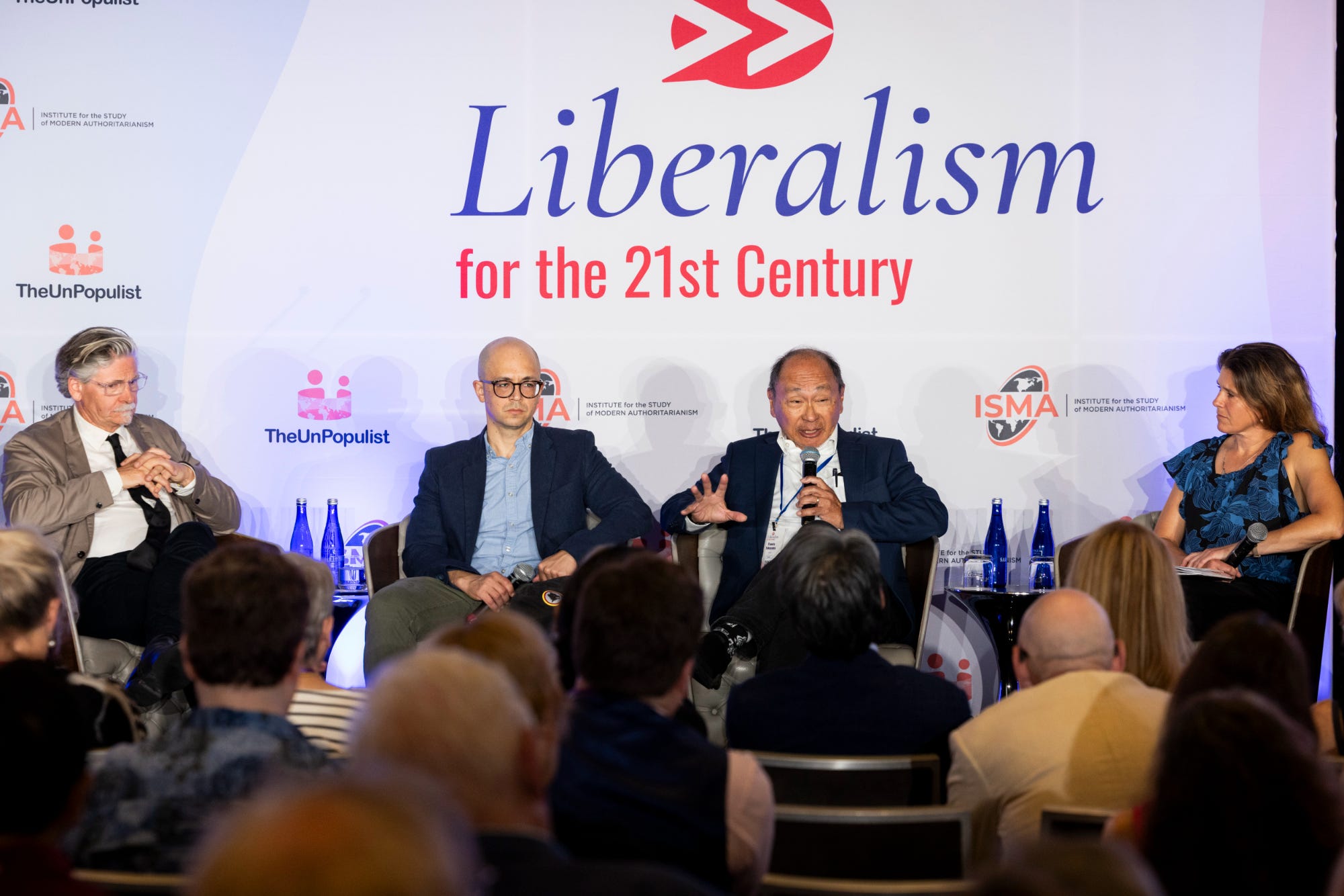
Today, we’re sharing the full video and transcript of LibCon2026’s kickoff panel, “The State of the Union: Authoritarian Consolidation in the U.S.”—including the Q&A with the audience that followed. The panel was moderated by Michigan State’s Erica Frantz and featured Princeton’s Jan-Werner Müller, Stanford’s Francis Fukuyama, and The Atlantic’s Adam Serwer. You can find every LibCon2026 session on our YouTube channel, and we’ll continue posting the videos and full transcripts right here at The UnPopulist.
We hope you find the conversation informative and insightful. The transcript has been lightly edited for flow and clarity.

Shikha Dalmia: The first panel is a situational assessment of the state of American democracy. I covered much of the ground, in my opening speech, about what we are going to talk about: the abuses of executive power, the attacks on civil space, abuse of prosecutorial discretion, and many of the things we’ve been horrified by over the last few years.
We have here with us Princeton’s Jan-Werner Müller, who wrote one of the defining tracts on populism, called What Is Populism?, which has been deeply influential to me as I’ve thought about populism and actually set up my institute. I’ve been trying to get him for LibCon for the last three years, but have been thwarted by his spam filter. But this time, I’m very glad I was able to reach him.
We also have here Adam Serwer of The Atlantic. Adam is one of the most incisive observers of our current political moment. He wrote an essay in 2018, during the first Trump administration, called “The Cruelty Is the Point,” and the essay went viral because it made sense of something that seemed absolutely senseless to all of us, from both a political and moral standpoint. He subsequently turned it into a book, which became a New York Times bestseller.
Frank Fukuyama is a veteran of LibCon, and no LibCon is complete without him. He has a problem that none of us in this room will ever have, which is that his book, The End of History, was such a global sensation that he winces every time it is mentioned now. That’s just intel for his panelists, if you bring that up. Frank has been doing, as usual, the most thoughtful yeoman’s work on defending liberal democracy, and he makes me think more clearly every day. So I’m very grateful to have Frank, not just at the stage, but on our side in this very crucial battle.
We also have here Erica Frantz, who is the moderator of the panel. Erica is a professor at Michigan State University. She has done work on authoritarianism all across the world. She’s not just a brilliant scholar, but also a brilliant teacher. She received the Michigan State University Social Science College’s Outstanding Teaching Award a few years ago. But, honestly, her most outstanding trait is that she and my husband were colleagues at Michigan State. Take it away!
Erica Frantz: Thanks so much for the wonderful introduction. And thanks, everyone, for being here. It’s a treat to be a moderator and not answering the questions, and I’m very much looking forward to this discussion.

So, we are the kickoff panel, and the goal of this panel is really to make sense of what the state of American democracy is. The title of our panel is “The State of the Union: Authoritarian Consolidation in the U.S.” We’re going to go through a number of things, covering how democracy is doing in the U.S., how we got here, what the path forward might look like, and then—where possible—get some insights from comparative cases.
I have three pretty incredible experts on the stage with me, which is very exciting. Each of them offers a very unique lens for making sense of our current political moment.
I wanted to start with a question for each of you—really, the big question for our panel: How do you rate the state of democracy in the U.S.? I’m particularly interested in what sort of things factor into your assessment. What are the big red flags for you in terms of assessing how we’re doing? Why don’t we start with Jan and then make our way forward?
Jan-Werner Müller: Thank you. So, as you’ve already hinted, we’ve had many comparisons between the U.S. and other cases where so-called aspiring autocrats try to consolidate—sometimes helpful, sometimes not so helpful. Maybe not everybody here agrees, but I think one of the most important recent contributions by colleagues in social science to understand autocracy is the book by Daniel Treisman and Sergei Guriev called Spin Dictators. If you’ve read the book, you know they draw a contrast between what they call “fear dictators” in the 20th century—who were openly repressive, didn’t have any hesitation to commit mass human rights violations—and “spin dictators” in the 21st century, who want to keep up the facade of legality, democracy, and so on.
I think that diagnosis to some degree also applies in the U.S., where the regime has been practicing what colleagues in law now tend to call “autocratic legalism.” Which is to say, pass laws in a way that is procedurally correct—the egregious SAVE Act being an obvious example, but also we’ve now learned, I think the hard way, that Trump has spent the years ‘21 to ‘25 digging up preexisting laws that would give the executive maximum power. So all that applies here as well.
But there’s one important difference that is both structural and also has something to do with the person of the president: the fact that unlike in all these other cases, the government is prepared to do things which are openly illegal. And it’s obvious to everybody from the get-go.
“I think the conservative view of the deep state is 180 degrees wrong. That narrative says ‘bureaucrats are unelected, and they are out of control, they all have left-wing opinions and are pushing policies that the American people would never agree with.’ I think it’s 100% wrong, because I think actually the problem with our bureaucrats is they are over-controlled.” — Francis Fukuyama
The structural reason is that people like Orbán had to care about international public opinion, German public opinion, “What does Brussels think?,” et cetera. He had to do what he famously called “the peacock dance” to convince people that things were still okay. In this country, international public opinion, international institutions [don’t function as constraints], so for structural reasons, the government is much more unconstrained.
And then there’s the person of the president, who’s now doing government the way he’s always done business, way back in the ‘70s already: do something totally illegal, create facts on the ground, and then see what happens. Maybe the other side settles out of court; in any case, you’ve done something. You’ve sometimes done things which are simply irreversible.
So that’s the reason why I’m worried that if we simply go through the usual indices, if we simply say, “oh, compared to Turkey, Hungary, etc., we know what’s going on,” all that is not sufficient to orient ourselves because—trying to finish on an optimistic note, but I can’t—this case is different.
Frantz: Thank you. Adam?
Adam Serwer: Well, I would describe what’s happening the way that my colleague Fred Kagan once described it: this is an aspiring autocratic regime that is attempting to consolidate itself. And it has had some success in certain areas and has been pushed back in others. The Trump administration has lost a lot of cases in the lower courts, even against judges that it appointed. Now, these are lower court judges, so they try to apply the law. They’re not the Supreme Court, which can just decide to ignore 150 years of American law because they feel like it. But the lower court judges are willing to apply the law. So that just tells you: in every place there is a sort of optimistic sign.

I think there is a culture of republican civic virtue in the United States—but there is also a culture of tyranny. And that is tied to the nature of the founding of the United States, which is this liberal democracy that is founded on slave labor. So you inevitably have a hybrid regime that is part tyranny and part democracy. And those tendencies are still with us today. On some level you can see this rebellious refusal to accept what people believe is unjust. You can see it in Minnesota. You can see it in protests all over the country. But on the other hand, you can also see, I think, a significant strata of America’s elite class, its leadership class, that is simply willing to roll over for a bully.
Now whatever culture we created that selected for putting these people in leadership, that culture was not conducive to resistance to a strongman. And you could see that, to give another example, in Congress. To a certain extent what we’re dealing with is not simply a legal problem—it’s a cultural one. Congress is willingly giving up its power to the president. The president is ignoring congressional appropriations. He’s trying to shut down departments that Congress didn’t authorize him to shut down. He’s ignoring black-letter laws about not putting the president’s face, a living president’s face, on currency.
The thing that is supposed to check that, in the Founders’ design, are the other branches of government. But what do you do when the other branches of government are controlled by people who simply do not have that kind of civic virtue within them, to engage in that kind of defiance? I don’t know the answer to that question. I think, on the one hand, the Trump administration has faced a tremendous amount of resistance from ordinary people. But it has not faced the kind of resistance that I believe we should expect it to face from people who have been given the responsibility to check that kind of power grab. And I think that’s really disappointing.
The other thing to understand is that this time around, much more than in the prior administration, there is an attempt to change and to silence that culture of civic republicanism. They’re trying much harder with this now, in terms of Brendan Carr jawboning networks about airing criticisms of Trump or comedians who make jokes about Trump, about trying to have allies of the administration buy media companies to make sure that those companies produce media that changes Americans’ view of the administration—there is much more attention paid to altering the culture, American culture, in a way that it’s much more obedient and subservient to the cult of personality that is the Trump administration.

So I think we’re in a very dangerous moment. For a lot of reasons, and for some of the ones that Jan just mentioned, it’s very hard to look abroad at examples of other countries, because the structure of our government is different and because we have things that are culturally specific to United States. But again, I would describe us as being in a very pivotal moment, and I think it’s not clear how successful the Trump administration is going to be in consolidating itself as an authoritarian regime. But I think it’s very clear that it has allies in places that perhaps we did not expect.
Frantz: Frank, I’d like to hear your take.
Francis Fukuyama: So I agree with Adam and Jan-Werner that this is an aspirational authoritarian regime. We can get into all the checks and balances, and which ones are working and which ones aren’t. But I want to add one thing to this [profile], which is: an unbelievable level of incompetence. In a certain sense it makes the authoritarianism a little bit less bad, because the authoritarian doesn’t actually understand how to carry out policies correctly. There are various illustrations of this: it’s been remarkable that a whole bunch of grand juries all over the country have failed to return indictments from federal prosecutors. It’s unheard of. The saying was that you can indict a ham sandwich in front of the grand jury and it’ll work, but actually a ham sandwich was rejected in one of those famous indictments.
Where it’s really worrisome, however, is when you have this kind of incompetence at the top of the world’s most powerful country. I think that we are seeing the results of this right now in this war with Iran. President Trump has a lot of self-confidence about his own judgment. I was talking to an old friend of mine who worked for him in his first administration and sat across the table from him in the Situation Room and that sort of thing. I said, “well, what’s it like to talk to President Trump?” And he said, “well, the first thing is he doesn’t listen.” He will try to explain a complex situation in another part of the world, and the president will immediately interrupt with his own opinion about what’s going on in that part of the world. He does not read memos. He does not read briefing books. And he has really hollowed out a lot of the diplomatic corps, intelligence agencies, the national security establishment. So he is not getting good information about what’s going on in the world. And so you can make a decision like, “well, let’s join Israel in attacking Iran, and we will get it over with in 24 hours the way we did in Venezuela,” … and there wasn’t anybody in his circle to say, “Mr. President, maybe there’s this thing called the Strait of Hormuz that you might want to think about before you engage in this.” It just doesn’t happen.
So when the world’s most powerful country is led by somebody who completely dispenses with procedure, any kinds of constraints that are not necessarily to stop dictatorship, but just to make good policy decisions based on good information, that leads us to the situation that we are now facing in the Persian Gulf.
So to all the other indictments, I would add this one of just sheer personalistic, incompetent decision-making at the top.
Frantz: So, not really a rosy portrait of the state of affairs in the U.S. Jan, I’ve also struggled in similar events to find an optimistic note to end things on. But zooming out, in terms of your expertise of other cases, how does the U.S. compare with these other backsliders in the news? Is there—you got into this a little bit—something distinctive about our method of democratic erosion that sets us apart, or are we just part of the broader global pattern?
Müller: So I think within this general framework of illegality I was talking about, the administration has developed four governance techniques, which on the one hand can help consolidation, but which also create unique vulnerabilities. Number One, we’ve learned the hard way that one scandal per year can be politically deadly; 10 scandals a day, nobody seems to care. At the same time, you never know whether eventually there might [come] the one thing that symbolically condenses everything that is wrong with a particular regime. It might be the reflecting pool—it might be something else. But it’s the kind of thing that eventually happened to Viktor Orbán: there was one particular scandal, and all of a sudden all the other dissatisfaction crystallized around that, and then an opposition party was able to link the scandal to people’s daily experience of increasing poverty, failing public services, and so on.
Secondly—not new exactly, Frank has already alluded to it—for every aspiring autocrat there’s a trade-off between competence and loyalty. I don’t need to explain to you which side has been picked by this administration. On the one hand, it consolidates autocracy, but it can also create unique vulnerabilities if things really, really go wrong.
Thirdly, the corruption is obviously out of control. As in other cases, it can help to consolidate a particular regime. I would say that here, yes, it’s systemic by now. At the same time, it doesn’t feel like they’re building a system in the way that others had a long-term plan and they said, “OK, even after four years, this is going to work.” In the Hungarian case, that ended up being called a mafia state, which had a—it pains me to say this—certain internal coherence. Whereas here [in the U.S.]—again, I’m not telling you anything new—it just feels like everybody is grabbing whatever they can on any particular day, with any insider trading, whatever they can get away with on any particular day. It doesn’t feel like somebody is building a system. And that maybe conveys a certain nihilism, a certain expectation, that, actually, this is not really going to last and it’s not meant to last.

And lastly, not to coin a phrase, but the cruelty is the priority in the sense of, “yes, we need to show people these scenes.” It’s so telling that Trump personally says, “no, we have to do these vehicle stops because we need to produce these images that are going to put fear into people in a certain way.” Again, on one level that’s consolidating the regime; on another level—given that, as we’ve all also learned, these scenes are really not popular with the American people in general—it’s also clear that it creates a certain vulnerability.
I think this finally allowed me to say something slightly more optimistic in the sense that, yeah, this is happening, it has a certain analytical structure, it’s not all random stuff. At the same time, it does create particular weaknesses for this regime.
Frantz: So, Adam, I wanted to dig into, a little bit, your take on how the architecture of our political system might either contribute to consolidation or make it more difficult. As kids, when you learn about the American political system, you hear that there are all of these checks and balances built in: we have the Senate, we have federalism, we have the courts. And in theory, this should make us more protected from executive power grabs. So, from your perspective, in what ways does this counter-majoritarian architecture that we have either prevent or open the door for consolidation of power?
Serwer: I think there are certain places where it does one, and there are other places where it does the other. For example, the fact that we have 50 states that run their own elections makes it very difficult—and Trump has failed so far at trying to do this—to nationalize the elections in a way that he feels like he can control the outcome. He’s losing in the courts because of this, in part because, again, even the judges that he appointed see this as lawless.
On the other hand, you look at something like the Supreme Court … I think Jan is right about the Trump administration’s myopia as an organization—but the Supreme Court, I don’t think, is myopic at all. I think this court actually has a very long-term view of what it wants the country to look like. You can see it in some of the recent decisions that have been made. When you look at Louisiana v. Callais, the undoing of the Voting Rights Act, those laws were passed because multiracial democracy in America didn’t really exist until 1965. It’s actually very young. So when you take away those guarantees of multiracial democracy, you reshape the electorate in such a way so as to make certain politicians unaccountable to the groups that they are trying to oppress. If you look at the passage of the 14th and 15th Amendments, the point of those amendments was to prevent white supremacy from reasserting itself in the aftermath of the Civil War. It did not work, so we had to have a second reconstruction in the 1960s.
That second reconstruction put in place these safeguards to prevent the very culture of tyranny that has been a part of America since its founding, that culture of racial stratification, of a kind of color caste system, from reasserting itself. We see the Supreme Court removing those safeguards because an electorate without those safeguards—and you can see this with the end of Reconstruction—becomes an electorate that doesn’t question certain premises. It’s conservative in nature—and I don’t mean conservative as in republican, as in the sort of standard conservatism, but in the way that it preserves this regime of racial injustice. The Republican Party was the party of Black rights until Black people could no longer vote, and then there was no constituency for Black rights. So the party begins to move away from defending democracy, multiracial democracy in a broad sense, the second that disenfranchisement in the South is complete. We cannot forget that that happened, or the way that that happened, because without that, we are unable to see the obstacles ahead of us in the future.
“I think there is a culture of republican civic virtue in the United States—but there is also a culture of tyranny. And that is tied to the nature of the founding of the United States, which is this liberal democracy that is founded on slave labor. So you inevitably have a hybrid regime that is part tyranny and part democracy. And those tendencies are still with us today.” — Adam Serwer
So I think there are things that are slowing down authoritarian consolidation, but there are other things that are accelerating it, and they are accelerating it with a view towards the long term even if the Trump administration itself does not have that long term view. I think it goes back, to a certain extent, to the erosion of this culture of republicanism. When the people who are leading the institutions that are supposed to push back against authoritarian consolidation decide that they’d rather kiss the president’s rear end, then those antibodies are being compromised.
Frantz: So I think a lot about how personnel choices make really big differences, in that your checks and balances are only going to serve that capacity if the people in those positions use that tool. And you mentioned Congress rolling over and giving away its powers. So, somewhat relatedly, Frank, I’d like to hear your thoughts on whether, as observers of democracy, we are missing something in terms of our assessments of how things are going.
Fukuyama: Sure, there’s a lot of things that fly under the radar. My long-term concern has been the state of the American state, that is, the federal bureaucracy. And a lot has been going on in that sphere that people are not aware of. So, for example, everybody knew about DOGE when Elon Musk was appointed to rampage through the American bureaucracy, fire people arbitrarily, close down entire agencies. Everybody understood that that was happening, and that was wrong. But there’s a longer-term effort to take control of the entire executive branch under this doctrine of the unitary executive.
Now, I actually think that the value of that doctrine is a little bit ambiguous, because there are good reasons for actually thinking that in a democracy no part of the federal government should be beyond democratic control. On the other hand, I actually think that the executive branch needs an internal separation of powers in order to protect expertise. You see this in the exception that the Supreme Court just made in its recent decision to rescind Humphrey’s Executor—the [1935] decision that had protected senior members of the bureaucracy. They made an exception for the Federal Reserve, because they figured even the most diehard Trumpists wouldn’t want the Fed to lose its independence. But that’s not the end of the story.
I think that you can make a case for getting rid of Humphrey’s Executor: the president can fire the head of an agency that has a single head, so why shouldn’t he be able to affect the leadership of a multi-member commission? It’s not that big a difference in terms of the way things are managed. If you go back to the intellectual origins of this, it lies in Project 2025. There’s a very long section on the federal bureaucracy. To me, somebody that’s looked a lot into the history of our bureaucracy, it’s kind of mind-boggling. So, in the 19th century, we had this thing called the patronage system, where virtually every federal official was the result of a political payoff to a politician. No standards for education, for expertise, in the federal bureaucracy. So that document, Heritage’s Project 2025, actually praises the patronage system, says, “oh, it wasn’t so bad. Democracy was able to control who worked in the federal government.” And that shoe hasn’t dropped yet.
But they are not going to stop there. They published an executive order at the end of the first Trump administration that created a Schedule F—it’s now been resurrected as a Schedule P/C—that would then give the president the authority to fire every single federal official all the way down to your local postmaster. And They’ve now replaced Schedule F with something they call Schedule P/C. And I guarantee you, in the next year or two, they are going to unroll this thing, where the several tens of thousands of people who work for the federal government are going to be replaced by political appointees. And so, we’re going to really be set back to the period before 1883 and the passage of the Pendleton Act. It’s part of a much broader politicization of the entire executive branch.

Another thing that flew under the radar was an OMB directive that was issued about two or three weeks ago, where every single federal grant cannot go through unless it is approved by a political appointee. So scientific grants at NIH, defense contracts for complex weapons systems, every single one of them has to be vetted by a politically loyal person. This is not going to be good for expertise in our government. This is an ongoing agenda of this administration and it’s going to lead to very bad government.
Frantz: I wanted to shift gears slightly. The rest of this conference is going to be on reconstruction, we know that pushing back against authoritarianism is really challenging, but there are cases where civil society and pro-democracy groups have been successful. So, Jan, thinking from a comparative perspective, what insights can we learn from other cases of when these sorts of mobilization efforts have been successful, and could they potentially work in the U.S.?
Müller: So on April 13th this year, the day after the elections in Hungary, we saw an avalanche of op-ed pieces that were a little bit like these cheap ads you get on the internet: “just do this one weird trick and autocracy will magically disappear.” And in particular people went for this narrative that said, “oh, look, the center right can defeat the far right, because look, the candidate for prime minister stayed away from the pride parade in Budapest and was tough on immigration and was a little bit Euroskeptic and so on.”
I think these are all, with all due respect, the wrong lessons. That one case wasn’t about policy content. It was about two other things. Number one, as old-fashioned as it sounds, it was about retail politics. Péter Magyar went to 700 towns and villages, often several times, to talk to people. Now, obviously that lesson doesn’t easily translate to a country of a very, very different size. Nevertheless, it’s no different from the Mamdani lesson, you might say: It really matters to have an incredible army of volunteers and to establish a certain on-the-ground credibility in the face of a profoundly hostile media system—which, however, was also, tiny footnote to that, slightly changing. I think it’s too early to draw grand lessons from this, but it seems that in Hungary people eventually really tired of the government propaganda. Nobody was watching the news channels anymore, and instead a number of basically independent YouTube channels became very, very important. I don’t want to be rosy-eyed about this, but I think in the end, colleagues in social science will find it did matter.
And the second lesson is that in terms of content, what was really crucial was the ability to connect the incredible corruption to people’s everyday experience, and say these two things are not dissociated. We’ve had many, many other cases where corruption was very, very obvious, and you would have thought as a naive observer, “look, these populists very often run initially on an anti-corruption ticket and then they get into power and it turns out they are ten times as corrupt: Jörg Haider in Austria, Erdogan in Turkey, et cetera, et cetera.” But it’s only when you manage to connect the corruption to people’s experience, and when the rival narrative—which is, “oh yeah, but they did it for us, they do speak for a certain part of the country that was neglected and dismissed, etc., before, and it’s OK if they get a little bit as well”—if you break through that and the narrative becomes different, then all of a sudden the game changes profoundly.

Again, I don’t want to say that we can generalize from one case, a country of 10 million people, where it’s easy to get around and speak in 700 villages. But I think that’s ultimately the lesson. It’s about political methodology and less about specific policy ideas.
Frantz: So, looking forward, what to you stands out as really important, something that we should all be paying attention to, in terms of what could potentially steer the trajectory of democracy in the U.S. in one direction or the other? What are you thinking of as something we should all really be attuned to? Let’s start with you, Frank, and then hear from the others on this.
Fukuyama: I think one of the big questions that will have to be addressed by a successor regime is really about the limits of executive power—because that’s the thing that has been the most challenged by Trump. They came into office thinking that they had to consolidate power, not just within the executive branch but within the White House, and then control the rest of the sprawling executive. Now, quite frankly, some of those powers actually needed to be consolidated, because one of the problems—the American bureaucracy was not working all that well before the rise of Trump in his second term, and there are certain things that need to be corrected—it was actually extremely hard to remove a poorly performing bureaucrat. There’s too many rules and protections. But one of the decisions that’s going to have to be made by the next administration is which of those consolidated new executive powers do you actually want to keep?
Now, nobody would recommend being lawless and just simply ignoring statutes, but to what extent do you actually want to be able to reshape the government to do good things, as opposed to simply kill undocumented migrants and so forth, because a future president actually has to have a positive agenda. I personally am all in favor of the Abundance agenda—America needs to get back to building things. But in order to do that you actually are going to need a little bit more consolidated authority when you’re doing something like planning an infrastructure project. And so that’s something I think is really important to think through ahead of time rather than, for example, just going back to the old status quo ante.
Frantz: Adam?
Serwer: I think one of the most important questions is to what extent the free-for-all that we’ve been seeing, particularly with regards to corruption and self-dealing, is going to be held accountable. And I think if you do not do that, you incentivize a similar thing to happen again. We all saw Jan. 6—we all saw what happened. There was no accountability for that, and now we are back here. And precisely because of the absence of accountability there, this administration has been acting as though the law doesn’t matter—because they’ve gotten away with everything.

So I think a big question is: To what extent are the people who commit crimes on behalf of this administration going to be held accountable for those crimes? And if you don’t hold people accountable for that—and I don’t mean necessarily prison time; whether it’s civil suits, clawbacks, whatever, there has to be some kind of accountability for people who broke the law in service to an administration that was attempting to end American democracy—they’ll keep trying again very soon.
Müller: I’m glad we have three hours left because I’ve prepared a list of 47 things for this occasion. I’ll just agree very much with what Adam just said. There needs to be a way of dealing with what has become a real culture of impunity, where the president already promises everybody around him, “just do it, I’ll pardon you in good time.” Obviously, that has a systemic quality. If you go back to the Federalist Papers, of course they were worried about the situation of a bad president, but at the time, they assumed there weren’t going to be political parties. So they said, “before that can even happen, this person will be impeached, and it’s going to be game over for a bad president of this sort.” So we need to find a way of dealing with that scenario. Other countries really don’t allow a single head of state to have that level of concentrated power which can be abused to create this kind of culture of impunity. So as you can see I don’t have a solution, but we have two days left.
Frantz: I noticed that none of you mentioned the upcoming midterm election. Does that mean that you’re fairly optimistic that it will be freely and fairly run?
Fukuyama: Well, we’re going to have a [Trump] speech tonight, right? That’s going to lay out an agenda for how to subvert that election within the bounds of possibility, so we’ll have to wait and see. I think that the one good thing about the nature of the country is it’s very big, and especially in terms of election administration it is incredibly decentralized, and therefore it is difficult to manipulate a midterm election compared to a presidential election. But they are trying to do everything they can to make sure they don’t lose in the midterms. And that’s going to require a lot of vigilance and a lot of pushback on the part of all of these decentralized authorities that actually make elections in this country run.
Serwer: I was discussing earlier about how the majority on the Supreme Court is operating on a long-term agenda to reshape the electorate to be more conducive to Republican goals, and we’ve already seen that. They break their own rules when there’s an opportunity for the Republican Party to take advantage in the redrawing of districts, even if they are drawing those districts deliberately to disenfranchise Black Americans, who they don’t think the party should have to be accountable to. But to be honest, I didn’t mention the midterms because I don’t know what’s going to happen. And I think an electorate that elected Donald Trump twice … I don’t know what that electorate is going to do. And, obviously it’s a different electorate every time, but I just don’t want to make any assumptions about how Americans are going to vote come November.
Müller: That’s why I don’t do predictions, especially not about the future. But I think, again, there might be a larger structural point here, and that is about decentralization. This is something we’ve learned the hard way also over the last 10 years, maybe also particularly on the left, where federalism was of course often seen as simply a shield of racist practices from the federal government: all of a sudden people realize, look, when the chips are down, this actually gives you some institutional foothold, some focal point for resistance for opposition.
“I think a big question is: To what extent are the people who commit crimes on behalf of this administration going to be held accountable for those crimes? And if you don’t hold people accountable for that—and I don’t mean necessarily prison time; whether it’s civil suits, clawbacks, whatever, there has to be some kind of accountability for people who broke the law in service to an administration that was attempting to end American democracy—they’ll keep trying again very soon.” — Adam Serwer
I think other countries are learning that lesson, too. Some have learned that if you have a highly centralized country—again, forgive me for bringing in Hungary one more time—it’s much easier to consolidate autocracy. Other countries which used to slightly be dismissive of federalism—example, Germany, where federalism is actually in the so-called eternity clause in the constitution, something that can never be amended, together with democracy and basic rights—people sometimes said, “Oh, come on, federalism. If Bavaria disappears tomorrow, there will be less folklore or less Oktoberfest stuff, but it doesn’t really matter.” Now all of a sudden people realize when the chips are down, it’s very important that there is that wider structure that allows an opposition, that allows a resistance to do things. So I would agree with what Frank said earlier: decentralization on the whole is on the side of preserving democracy on this occasion.
Frantz: We have time for Q&A. Anybody who would like to come up to the mic, go ahead.
Audience Member: You’ve really covered the waterfront as far as all the ways the regime is trying and failing, but the subject that hasn’t come up is the subject of capital. And the thing that’s been most concerning to me, being involved in the capital markets and finance and things like that, is: Trump got put in with the support of capital, in the same way Putin did and the same way Hitler did. What is the plan to make that stop? And what is the role of capital and capitalists in withdrawing consent from this regime?
Serwer: I think the problem is that there are so many different things that you need to do with capital. If you want to prevent its ability to influence American politics in this way from coming back, it’s not just one thing. I think we should probably ban prediction markets and online gambling completely. I think that we should probably make it easy to make direct auto sales, to put all the auto dealers out of business. There’s a number of things we could do. I think we should probably break up a lot of these big internet companies. I don’t think that one company should be able to own CNN, Paramount, CBS, all that stuff, at the same time. It’s just too dangerous. So I think to some extent you can do things with antitrust, you can do other things with regulation. But I think the bigger problem is, liberal American democratic capitalism has been very good for these people, and yet they have all conspired to help destroy it in pursuit of short-term profits. I think people have to take the lesson from that, and protect the capitalists from themselves. Doing that is a very complicated project that requires more than doing one thing, or one weird trick.
Audience Member: I wanted to go back and ask about a strategic posture that Shikha mentioned in her speech, which is the dilemma of when faced with authoritarianism, does one work through the system—when it’s been abused by the authoritarian and the authoritarian may once again easily beat the system working against him or her—or does one fight fire with fire? There are many people who will tell you they’re a liberal and they say, “no more Mr. Nice Guy. We absolutely have to be Trump-like to get rid of Trump.” I’m just curious, and I’m sure we’ll come back to a version of this question in these two days: What’s your gut stance about that question? Is the system strong enough to be worked with to overturn what we have, or will some non-constitutional ways be required?
Serwer: Yes.
Fukuyama: No, I don’t think so.
Serwer: To be clear, my answer was yes to both questions.
Fukuyama: Just following up on what Jan-Werner said, you look at the example of Hungary. If you’ve got a system where you can actually have a reasonably free and fair election, that is the route you need to take. You need to do all the hard, boring work of mobilizing people, making arguments like the ones we’re making in this room, getting people to vote, building coalitions, making compromises in order to make that possible. That’s the way you stop it. You don’t go to illegal methods if you still have the kind of democratic system that I believe we still have in this country.
Serwer: I will disagree with that in the sense that I think voting is necessary, but I don’t think it’s sufficient. And I think when you look at some place like Minnesota, defiance of the law in some cases is justified and necessary. ICE is sitting there trying to do deportation operations, and there are people following them around with whistles and sometimes these people are getting killed because they’re risking their lives to protect their neighbors. Now, when you say extra-constitutional, I suppose for some people that means violence, but I’m not talking about violence. I am talking about defiance of the law. There have been times when activists in the past, American activists, have been proudly celebrated for being willing to defy unjust laws. There are going to be times when an aspiring authoritarian regime is going to attempt to prevent people from exercising their constitutional and lawful rights, and that is going to be seen as criminal, but I don’t think we should see it that way. So that’s why I say it’s not either/or. You have to work through the system, and you have to use methods that are outside of the system, but that are still appropriate.

When people say you have to act like Trump, I don’t believe that. I don’t think what you want is a liberal ICE walking around en masse and gunning people down. No, that’s obviously what people are fighting against. But I do think that it’s not enough to say you can only work through the system.
Müller: So, far be it from me to sing the praises of game theory, but there’s a reason to think that, at least sometimes, tit for tat can work. It doesn’t happen in isolation, though. So if you break the rule in response to other rule breaking, you have to explain what you’re doing and why you’re doing it. And if you convince your audience that this is a one-off to get the other side to play properly again, that’s different from simply saying, “oh, now all bets are off.” The problem, of course, with this lesson is that it depends on the other side having a long-term horizon. And one of the things that, of course, again, is so peculiar about the situation we’re in is that we have a leader who doesn’t even care about his own political party in the way that normally somebody would say, “look, I have a program, a long-term set of ideals, I want to survive for this project, beyond particular elections.” In that sense, it’s also very risky because all bets are off in terms of what would really incentivize other people to go back to the rules.
Audience Member: I think there’s a temptation sometimes to see authoritarians as kind of stupid, and acting according to an unchanging nature of “what do authoritarians do?” But I think it’s helpful to see them as adaptive, as trying to learn from successes and failures either here or elsewhere, and to try to improve their regime’s ability to do authoritarianism. So my question for the panel is, do you see that in the Trump administration? Do you see them trying to learn and adapt their authoritarian aspirations over time? Are there places that they failed and they’re trying to come back in a new and different way, and how should that impact how we see their future trajectory?
Müller: That’s a very good, difficult question. I agree that we should never underestimate autocrats. I think one of the great illusions of the 1990s—don’t worry, I’m not going to say “the end of history”—was precisely to say that, “okay, all autocrats end like the Soviet Union. They don’t understand their own societies, they don’t learn anything, et cetera.” And clearly, we’ve seen a lot of learning across borders in the last couple of years. And the fact that so many autocratic systems, so many playbooks and scripts, look similar is not because of the fact that all the underlying causes of these autocrats coming to power are similar—is it immigration, is it the working class, or whatever—it’s because they constantly learn from each other. So it’s a very important point, I think in general, to bear in mind.
To actually answer the question, I think they are trying very hard to learn in terms of PR—to make certain things look more palatable. I think that was, just to use an obvious example, the recent move in terms of DHS leadership: continuing to do the same thing, but don’t produce images all the time that make it look like, OK, she’s going to a horrible place, a gulag in El Salvador, and is being filmed and produces images that are really going to be putting people off big time. So I think they’re trying. But I would not say that, systemically, there really has been a lot of learning. And I would go back to the earlier point that it doesn’t look like there is any real long-term system building in the way you would have seen it in other countries in terms of, yes, there really is a long-term plan. Of course there is Project 2025, but in terms of structures being put in place that show that kind of learning, I’d be more skeptical.
Serwer: I would say the focus on control of the media is an indication that they have learned from the last time around. Again, they are really trying to reshape American culture to be more pliant, more obedient, more accepting of authoritarianism as something natural and homegrown and just. And I don’t know if that’s going to work. These things don’t always work out the way people plan to. But I would say the focus on reshaping the media in their image, as opposed to just having powerful media outlets like Fox News on their side, does indicate that they’ve learned some lessons from last time around, where I think they felt like they lost control over the narrative, particularly around COVID and the protests over the George Floyd killing.
Fukuyama: Yeah, I don’t think they’ve been successful at all. If you look at the more than 70 million people who voted for Trump in 2024, it was a coalition. He’s got these hardcore MAGA people that will vote for him no matter what. But if he wanted a successful presidency, he would have to focus on those groups that voted for him that didn’t vote in the previous election. And he’s done absolutely nothing to win those people over. He’s done everything he can to alienate … there are African American men, there are Hispanics, there are a lot of groups that were skeptical of the Democrats and they were willing to take a chance with him, and I don’t think he’s done really much of anything to convince them. This is a typical strategy of a learning autocrat, a would-be autocrat—to move to the center and try to convince people that you’re actually a moderate while keeping your autocratic aims. I just don’t see that he’s pulled anything like that off.
Audience Member: I study how the American tech industry, and in particular the tech oligarchs associated with the idea of effective accelerationism—like Musk, Andreessen, Thiel, etc.—contribute to democratic regression and to authoritarian consolidation. And I’m curious how each of you thinks about this issue.
Serwer: I think the return of turn-of-the-century race science is in large part something that the tech oligarchs have embraced in order to justify their outsize wealth and power and influence over the American system. I think it’s in some sense ironic because a lot of the people who support that racial pseudoscience don’t understand that it applies to them as well, in the minds of the oligarchs who are using them. But I do think these are people who have decided that liberal democracy did not give them enough and they are hoping for a type of government that makes them even more unaccountable than they already are.
Fukuyama: So, I wrote an article a few years ago called “Silvio Berlusconi and the Decline of Western Civilization,” and I updated it with a new version about Elon Musk and the decline of Western civilization, because I really do think Berlusconi was an oligarch that invented something new. He realized that he had a business empire, but if he used that to buy a media empire, he could get political power. And once you had political power, you could use that to protect your business empire. There are a lot of oligarchs in Eastern Europe who did something very, very similar to that. All these old media properties, TV, newspapers, were declining because of the internet—they snapped them up. Not because they’re valuable but because you could get political influence through them.

That’s what Elon Musk did with Twitter, and that’s why … Adam made a comment about antitrust, but I think that one of the most important areas where you have to apply competition laws is in the media. You should not allow any company to amass the kind of concentrated media power that we’ve seen. Now you’ve got Paramount as a competitor, another big oligarchic empire on the right, and I think that’s really what’s dangerous and what we ought to focus on.
Audience Member: My question is related to what Frank just said, which is: Given that the current media environment has been driven by a kind of public psychosis that’s been driven by algorithms that select for sensationalism rather than mundane truth, and given the robust protections of the First Amendment, is there a viable solution to fixing the problem of sensationalist media creating wholesale parallel realities that drive a lot of these autocratic delusions about the state of our politics?
Serwer: Well, look, to give an example, Elon Musk has monetized racism and misogyny and antisemitism on Twitter. To some extent, I think the First Amendment is a pretty insurmountable obstacle in terms of trying to define the limits of free speech on some of these platforms, because whoever owns the platform has a right to define what that space is like. That’s a First Amendment right. But I do think you can deal with the problem to some extent if, as Frank said, you break some of these companies up so that they don’t control like five social media companies that gives them outreach to a billion people and controls whatever they happen to see whenever they open their phones.
And at the core of what you’re talking about, that incentive towards extremism on social media, there’s a data economy underlying that. The more time you spend on your phone, whether it’s getting angry or laughing at something or whatever, the more money that they make by mining your personal habits and then selling them. So they have a bottom line that relies on people being hypnotized by their devices. But their ability to influence American politics relies in part on being able to control what you’re seeing on those devices at all times. And the fewer people have that kind of control over that many different outlets, the less of a problem I think it ends up being—it’s always going to be something of a problem. Propaganda was a problem when we only had newspapers, so there’s no getting around the fundamental human nature of wanting to believe things that aren’t true about people we don’t like. But I do think that you can get rid of a situation where a few people who want to kiss up to a head of state have the power to control everything that we see and hear.
Müller: Just one pedantic footnote to that: I think it’s important to resist the temptation of a certain kind of technological determinism. So, it’s always possible to tell a story that is basically a mono-causal explanation of certain political pathologies: printing press invented, boom, next thing we see is wars of religion; radio invented, Hitler; TV, McCarthy; and so on. This is not totally wrong, but it’s clearly also far too simplistic. Some of us might be old enough to remember a time, 10 years ago, when everybody said, “Oh, filter bubbles, echo chambers,” and so on. And now we know a little bit more about what actually happens. We have understood that, actually, no, that wasn’t really the problem. And in fact we were all, in a certain way, in an echo chamber about echo chambers, because we all told ourselves the story that this explained the catastrophes of 2016, Brexit, Trump, et cetera. And it’s really important to be much more precise about what the truly novel thing might be.
“This is something we’ve learned the hard way also over the last 10 years, maybe also particularly on the left, where federalism was of course often seen as simply a shield of racist practices from the federal government: all of a sudden people realize, look, when the chips are down, this actually gives you some institutional foothold, some focal point for resistance for opposition.” — Jan-Werner Müller
So just as one thought in this context, you might say that the one thing that social media really has contributed is a new form of political mobilization. Because up until now, we only had to, put it bluntly, clientelism—vote for me, I promise you benefits, bureaucratic favors, and so on—or the great invention of the 19th century, the bureaucratic mass party. Now you can have somebody like Bolsonaro, who for a while, when he was president, didn’t even have a party and had been switching parties eight or nine times, but initially, he was able to stand in his backyard with a not-even-particularly-good phone and was able to mobilize people. Then, of course, Brazilian business also swung behind him, so that made, in the end, the difference.
Nevertheless, that is something new. But that is not the same as populism. That does not predict automatically autocracy. The only thing that might be associated with it structurally is that if this is your only way of mobilizing people, you always have to rile up people more. You always have to say, “this is the election where everything is at stake, they’re trying to take the country away from us, you must come out,” and so on. So in that sense, there might be a somewhat inbuilt radicalization dynamic. But that’s really not the same as saying, “oh, social media is fascism” in the way that some of our colleagues have actually said in various op-ed pieces.
Frantz: We have time for one last question.
Audience Member: Jan-Werner, I wanted to thank you. I think you captured the essence of liberalism, which is to not fall prey to the one-weird-trick thinking that seems to be the increasingly American way of approaching things. And I want to ask you, all of you, about the example of Humphrey’s Executor. So if you had asked any administrative lawyer over the last several years, none of them would really have been surprised that the Supreme Court decided the case of Slaughter exactly the way it did. I think they would all be frustrated that the discourse, since that decision, has been people throwing their hands up to complain that the court got it wrong—people who frankly know nothing about the underlying law—and then to suggest that all we have to do is somehow reverse the Supreme Court decision, instead of having the much more difficult conversation about how we create other mechanisms for overseeing the way that these administrative agencies exercise their powers. How we, for example, rewrite the Administrative Procedure Act, the way that was done after the Second World War, how we examined the mistakes and abuses of the Nixon administration … those are hard questions. And my question for you is, how do we epistemically reshape American politics so that there’s a will to get into those hard questions, so that there’s a political willingness to invest time and effort into the work … Congress has to be actually writing real legislative reform, examining the abuses of this government, trying to reshape the media, etc., trying to reinvent the administrative state.
Fukuyama: So that’s a big question, one that I’ve been giving a lot of thought to in recent years. I think your point about Humphrey’s Executor is right. There was a panic reaction to it, which I don’t think was justified by the underlying decision. As you said, it’s been in the works for a long time. And there’s a real, I think, legitimate argument in favor of abolishing it, which I try to explain in terms of multi-member commissions and so forth. I think that the administrative state needs to be rethought. I’ll just state this, an argument I’ve been trying to make in a lot of different fora: I think the conservative view of the deep state is 180 degrees wrong. That narrative says “bureaucrats are unelected, and they are out of control, they all have left-wing opinions and are pushing policies that the American people would never agree with.” I think it’s 100% wrong, because I think actually the problem with our bureaucrats is they are over-controlled.

The burden of proceduralism lies the heaviest on any federal agency that actually wants to try to do something, and the reason we don’t get good outcomes is that they have to follow too many rules, like the Federal Acquisition Regulation if you want to buy an office desk in a federal agency. And actually, if you want to rethink the administrative state, what you’ve got to do is figure out how to deregulate it and allow actual authority: people can use their judgment, they can use discretionary authority, within legal limits, to actually focus on outcomes and not the following of procedures. That is the way that you really get at the core of what is wrong with today’s administrative state.
Frantz: I want to thank the panelists for a really thought-provoking and great kickoff to this conference. Thank you so much.
© The UnPopulist, 2026
Follow us on Bluesky, Threads, YouTube, TikTok, Facebook, Instagram, and X.
We welcome your reactions and replies. Please adhere to our comments policy.
I'm writing twice because like Mueller I have 47 items. First Adam Serwer has pinpointed the root of this several times: a liberal democracy founded on slave labor, culture of racial stratification and a color caste system plus conservative in the way SCOTUS preserves this regime of racial injustice. It's not so much that people forget it happened or the way it happened, it's that they did not experience it first hand, which I did as a White person marrying into a Black family in the 60s. You have to live here, work there, shop over there..... all that was a shock to me and I won't forget but even now I get the "I didn't know that that happened," but they were present but not in it.
Disappointment in the failure of business to stand up, and in many cases the law itself.
Frantz asked 2 questions that were actually great questions: our we missing something in our assessments and what insights can we pick up on from other countries. Also, the two audience questions were very good: creating the mechanisms and reckoning with media.
Everything is happening all the time everywhere all at once i.e. flood the zone with shit- familiar?
The New Right has built in tension between the idealogues and MAGAs. Maybe not an explosion but a collapse is coming, more a drifting away rather than a fight, the former to read a book and the latter to start a fight. The former is addressed by Serwer when he says SCOTUS has a long-term view of what those people want the country to look like. Yassa, Col. Culpepper!
Serwer again strikes the note: accountability. If "these people" are not held accountable they will try again because they are true believers; they truly believe in an essentialist hierarchy of humans. Serwer's "don't think the party should have to be accountable to" captures it, the caste system. The business people, the capitalists, the Chamber of Congress could withdraw support but we've seen this before elsewhere. FDR and TR cleaved (clove?) the iron grip to save America for free enterprise. To cap this: I sat chatting with an old man (the age I am now) who had been a frogman in WWII. Lean, bronzed, shock of white hair, Mr. Republican, I thought. At one moment he changed the topic by rearing back in his chair and saying, "I don't know what your politics are..." and I thought, uh oh, Mr. Republican, but he went on: "If it hadn't been for Roosevelt this country would've gone Communist!" Wow. He knew because he had experienced it.
"10 years ago, when everybody said, “Oh, filter bubbles, echo chambers,” and so on. And now we know a little bit more about what actually happens. We have understood that, actually, no, that wasn’t really the problem. And in fact we were all, in a certain way, in an echo chamber about echo chambers, because we all told ourselves the story that this explained the catastrophes of 2016, Brexit, Trump, et cetera"
I have researched this phenomenon extensively for an article.
1. If we were in a certain way in an echo chamber of our own, I think that is Q.E.D.
2. When people started talking about it 10 years ago, it wasn't because it was a fad but because of whistleblowers such as Christopher Wylie, Brittany Kaiser, Frances Haugen; and the Cambridge Analytica expose by Carole Cadwalladr (@carolecadwalla). Cambridge Analytica was founded by Steve Bannon. So I wouldn't say that it was a one-trick pony that cannot explain a lot. I could go on and on about this, but it would turn into the article that I wrote after researching it deeply, just when Trump was elected for the second time. My assignment was to write on fake news; it quickly became apparent that everything that happened on social media that falls under the department of fake news in the past decade is deeply connected to the political machine.
3. The consensus among media and sociology researchers is that understanding the new manipulative options that socials platforms offer is still vital for understanding politics.