


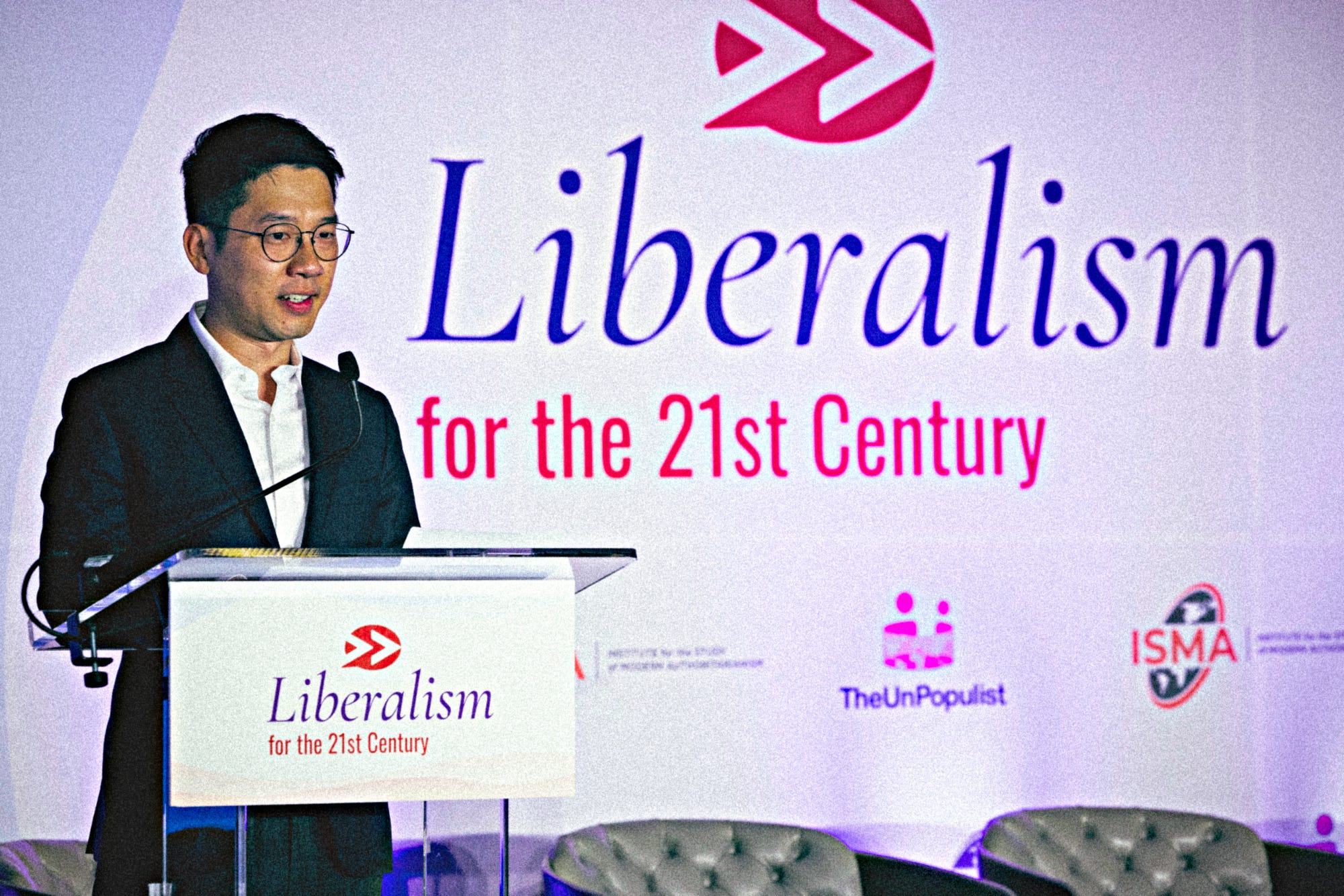
Today, we’re pleased to share exiled Hong Kong democracy advocate Nathan Law's thoughtful dinner keynote at LibCon2026. (If you missed last year's similarly moving address by Vladimir Kara-Murza, you can watch or read it here.) Below is the video, followed by the full transcript: Berny Belvedere’s introduction, Nathan Law’s remarks, and the Q&A that followed. For more from LibCon2026, visit our YouTube channel—this playlist contains every session in one place.

Berny Belvedere: Good evening. When Shikha bestowed on me the honor of introducing our dinner speaker, it meant a lot to me. It meant a lot because of who the speaker is. I’ve been thinking a lot about liberal courage, a term that, in most of the places where liberalism has taken root, can seem almost ill-fitting. Don’t get me wrong, liberalism has obviously faced down real enemies, fascism chief among them. But in the places where it has won, it won so completely that courage stopped being a muscle that it felt it needed to cultivate. To invoke David Foster Wallace’s “This Is Water,” our perspective—the broadly liberal perspective—became the water that we all swim in. Most people can affirm its values and principles, but they also didn’t know any other [social configuration]. That meant they didn’t know how to defend it. They didn’t know what was at stake. They didn’t know what to do when a rival ideology comes along—because, for decades, nothing seriously required them to defend it. It was just the status quo. That’s actually not a weakness in liberalism, but rather evidence of its success. But it means courage is a virtue that liberalism, for long stretches, simply hasn’t had to practice.
Nathan Law, our dinner speaker tonight, is a liberal hero. He’d never describe himself that way, but I’m the one with the microphone, so he’s going to have to take it.
In 2014, Hong Kong police fired tear gas and pepper spray into a crowd of student protesters. They were merely demanding the right to elect their own leaders. These protesters raised umbrellas to shield themselves. The standoff that followed became known as the Umbrella Movement. Nathan, a college student then, became one of the student representatives chosen to sit down with the government officials on TV and make the protesters’ case. He didn’t even tell his own family he was involved. His mother found out he’d been arrested when she looked up at the TV and saw her son taken away.
Two years later, he turned that fight into a political movement. He co-founded a new pro-democracy party and ran for Hong Kong’s Legislative Council. He actually won. At 23, he became the youngest lawmaker ever elected in Hong Kong’s history. But of course, the Chinese government—famously tolerant of people asserting their rights, just super chill and relaxed whenever anyone says that state repression is bad—of course the Chinese government was going to respond the way you predicted they would. Within a year his seat was stripped from him, and it got worse: he was imprisoned for the same 2014 protests that made him a leader in the first place. Hong Kong’s highest court did overturn that [prison sentence], but the message had been sent.
Now, most people watching their movement become steamrolled by the state would have taken the hint and gone quiet. Honestly, it gives me no joy to admit, amidst a room of people I admire and look up to, that in that situation, I might have taken just that course. I might have shrunk back from that moment. But Nathan Law went all in.
In 2020, Beijing imposed a sweeping new security law on Hong Kong. Nathan left for London rather than wait and see what that law would do to him. The state put a bounty on his head and officially branded him a fugitive for life. That bounty hasn’t shut him up. Police raided his family’s home. They brought his parents and his brother in for questioning. But Nathan is still speaking out, still writing, still insisting that the Hong Kong he grew up in is worth returning to and that one day it will be free.
In the liberal tradition we have some heroes in this vein, but not enough. We have brilliant thinkers. We have commentators. We have coalition builders. We even, God help us, have influencers. But we also have a natural skepticism of canonization, of Mount Rushmores, of Pantheons, which admittedly can be a healthy thing. But for the same reason that my faith tradition has the concept of a cloud of witnesses—made up of those who lived a life of faith in a way that can inspire others—and for the same reason that, more secularly, Aristotelian ethics, or virtue ethics, talks about moral exemplars being critical to our moral actions, we in the liberal tradition can do a better job of—need to do a better job of—valorizing and lionizing our liberal heroes.
So, I’ve been thinking a lot about liberal courage. My eldest daughter is 17, my son is 15, and my deepest parental desire is that they grow up understanding, and then living out, what really matters. And one of the first people I think of when I think about what that looks like for a young person is Nathan Law. He has fought, and he is still fighting, for a free and open society against authoritarian repression. When the moment asked everything of him, he leaned in. Please join me in welcoming a man who chose exile over silence: Nathan Law.
Nathan Law: Good evening, everyone, and thanks so much, Berny, for the very touching and overwhelming introduction. It also encapsulates what a lot of friends call me—they call me a man against the currents. I have led one of the largest civil disobedience movements in Asia. I was elected member of the Hong Kong Legislature at the age of 23. I was unseated and jailed and served prison time in a big cell with 20 other people. And I fled to the U.K. to be able to speak again as a political refugee. Because of my activism I’m wanted under a heavy bounty by the Hong Kong government.
I’ve been fighting against one of the most powerful dictatorial regimes in the common pursuit of democratic freedoms with many other Hong Kong people. Hong Kong saw more than a quarter of its population—two million people—march for their rights to elect their leader, and self-determination, at the peak of the 2019 protest movement. Eventually the government cracked down on the protest and turned close to 2,000 people into political prisoners. I would be one of them if I decided to stay. I’m truly lucky and grateful to be speaking to you all in Washington, D.C., the capital of the U.S., where democracy—against all odds and challenges—still persists.
Democracy should be a system where people elect their leaders, criticize the government without fear, and live with dignity. These are ideals pursued by people around the world, throughout history, in one form or another. When I think about that, I think of my father, who also fought against the current to survive—but in a literal sense. He escaped China to Hong Kong in the late 1970s. Before the Chinese Communist Party decided to open up the country and gave up the economic communism project, the people and the country were torn apart and suffered severely from political and economic turmoil. The magnitude of death and misery was beyond imagination.

The Great Leap Forward movement initiated by Mao Zedong—the dictator who killed more people than anyone else in human history, responsible for at least 20 to 30 million deaths of Chinese people—destroyed the country’s rural economy and led to great famine in the late ’50s. After a round of political reshuffling, Mao then started the Cultural Revolution in 1966 as a means to regain power. He destroyed the best part of Chinese culture and artifacts, as well as generations of the bravest and the brightest. Southern China saw some of the worst factional violence in the country that lasted until the late ’70s.
My father lived through the development of the Cultural Revolution and the horrors of life under extreme conditions. This experience led to his conviction that escaping to Hong Kong—by then one of the fastest growing and most prosperous Asian cities—was the only hope of putting food on the table and having a future. It was a popular, yet dangerous, move. Somewhere between several hundred thousand to two million people attempted to escape in similar situations from the 1950s to the 1970s. Estimates of death in the water, from sharks, drowning, and other risks, run into tens of thousands. My father’s experience echoed that statistic. He told me that every young man in his village wanted to leave, and he saw many floating bodies on the open sea.
Eventually, as you’ve guessed, my father was among the lucky ones. His comrades from the same village assembled a rough raft with materials from their homes. For example, their blankets were woven into sails that led them through the treacherous and dangerous water. After three days of sailing, with only a few jars of peanuts to be shared by roughly a dozen people … in order to hide from water patrol, all passengers had to jump out to the water and swim for hours to reach the shore in the dark. He practiced swimming for years before he made a move. He swam against waves and waves of currents, those glittering on the open sea, and those assigned to him for being born in a Chinese peasant family in the early 1960s.
He eventually found a place where his kids could grow up with a free mind and a future, none of which would have been possible had he stayed in China. When he got his residency in Hong Kong in the late ’70s, he worked as a construction worker earning more in a day than in a whole year in mainland China, which was still torn by political violence and instability.
“Democracy should be a system where people elect their leaders, criticize the government without fear, and live with dignity. These are ideals pursued by people around the world, throughout history, in one form or another.” — Nathan Law
Decades later, the story turns out to be a historical irony. His son had to leave the city that once granted him refuge, and become a refugee in another part of the world.
I grew up in a public housing unit, blue-collar household with what I called refugee mentality. My parents always taught me to “keep my head down, don’t rock the boat.” My life goal, as they taught me, was to be a good student, get into a good college, find a good job, and climb the social ladder. Being as rebellious as I am today most certainly contradicts what my parents expected of me. In fact, these actions had tangible consequences for them. They were both questioned by the police after I was wanted based on the draconian Hong Kong National Security Law.
These collateral punishments are used to silence critics. Many Hong Kong activists’ families have been harassed, or even jailed, simply for being connected to the loved ones that a government calls “troublemakers.” The collateral punishments we once thought only happened in China have already extended to Hong Kong. In recent years, the party’s machinery of repression has migrated wholesale from the mainland to the city I love.
Just days ago came another vivid example. Police raided two independent bookstores and arrested five booksellers for selling seditious books. Reportedly among the seized titles is Let Only Red Flowers Bloom by NPR’s China correspondent Emily Feng, a book that tells the stories of people crushed by state repression in mainland China. A book about repression is now is a casualty of repression it describes. The regime has done what no other reviewers could do: proven every page true.
As long as the dictatorial country is powerful, it is contagious. It needs to expand, not only in territorial terms but also in ideological terms, to maintain control and superiority over its people. At the international level, it needs allies who adore and legitimize it. It also needs countries, on the facade of international collaboration and national interests, that choose to not criticize it. More and more countries nowadays are falling into that category, and it has material impacts on the advocacy work that we are advancing, because more and more countries try not to upset the BRICS brothers anymore.

That seems to be the world that we, as freedom and democracy activists, are swimming in. Some people are joyfully riding this trend: demagogues in both democracies and autocracies who aim to secure their power by attacking political pluralism, moral universalism, checks and balances, and the importance of ethical leadership. For now, I don’t feel as supported in the struggle for democracy in Hong Kong and China because of that. This sentiment is shared by the larger activist community in the world.
The narratives that bind democratic fighters and democratic countries together—the idea that we all deserve freedom, liberties, and individual rights, and that strengthening democratic traditions around the world has intrinsic merit for the most powerful democratic countries—these narratives have been shaken.
My father and I both swam against currents stirred up by the same communist regime eager to exert maximum control and stay in power. And the story of Hong Kong shows how quickly freedoms can be lost if an unchecked power acts freely. When I boarded the flights from Hong Kong to London six years ago, I wept at the sight of the most gorgeous city nightscapes I’ve ever seen, not knowing when I would see them again. I did not expect I was about to swim into a rising tide of illiberalism.
The room to hold diverse political beliefs, engage in open conversations, and reason our way to making informed decisions is so important to the health of democracies. But with the evolution of clickbait, the attention economy of social media, backlash against globalization, revival of nationalistic politics, and the impulse of labeling in debates, in public discussion, the platform that holds these liberal tenets has been destabilized.
“The narratives that bind democratic fighters and democratic countries together—the idea that we all deserve freedom, liberties, and individual rights, and that strengthening democratic traditions around the world has intrinsic merit for the most powerful democratic countries—these narratives have been shaken.” — Nathan Law
The Greek philosopher Heraclitus said, “No man ever steps in the same river twice.” And “everything flows—the only constant is change.” Perhaps I was so naive that I thought my only mission as an exile activist was to campaign against the authoritarian expansion of the Chinese regime, but now I am also in the fight to build the foundations that keep liberal democracy thriving. I want to reflect on my experience in movement building and campaigning to help this magnificent and important work.
I realized that even though we are in a world of intense political polarization, I still believe in the power of persuasion and the power of human connection. The only Chinese Nobel Peace Prize awardee, Liu Xiaobo, whose books I learned a lot from, famously said, “I don’t have enemies.” He did not hate people who hold different opinions, or even those who enabled the brutalities of the Chinese Communist regime. He fought against the regime, and the ideologies that enabled the violence. In the face of the illiberal waves, I want to re-conceptualize the idea to address the challenge that we all face. The enemy is not the political opposition. The enemy is apathy. It’s the state where people don’t care, live in their half-baked stereotypes about the world, and stop thinking deeply about anything.
A few months ago, I had my knee ligament surgery. I ruptured the ACL playing football—I mean, soccer, the sport that everyone’s watching now. Movement and water are good for my rehab for my knee. So I recently got into swimming. I actually never learned to swim before—I learned it in a swimming pool at my gym a couple weeks ago. Kudos to my patient partner who taught me about that. Learning to swim was about persistent practice, like everything else in life. You need to keep finding the right stroke, rhythm, and courage to fight off the fear of drowning. Trust me, for someone who’s not particularly into water, it is not easy. The same truth applies to how we change politics. We need to strengthen our muscles when swimming against currents.
In terms of fighting for political ideals, that is the ability to persuade. To others who don’t care about politics or are disengaged from public life, or whose life experience led them to different conclusions, or those who are just upset about their surroundings, we need to engage in difficult conversations, not to pursue gotcha moments, but to continue refining your stance to make your arguments able to pierce through ideological lenses. We don’t have the luxury of believing that the world is bending to our way, or being too self-righteous—that drives people away.
Even if it means that you are going to be attacked, traumas will be exposed, stress is piling up, and you’ve already suffered a lot and feel like the world is so unfair: I’m sorry. If you choose to hang on and engage in these conversations, it is our responsibility to go through these tiring rehab sessions, and grow our muscles, persuade people, and grow our camp—not just talk to the most hardcore supporters.
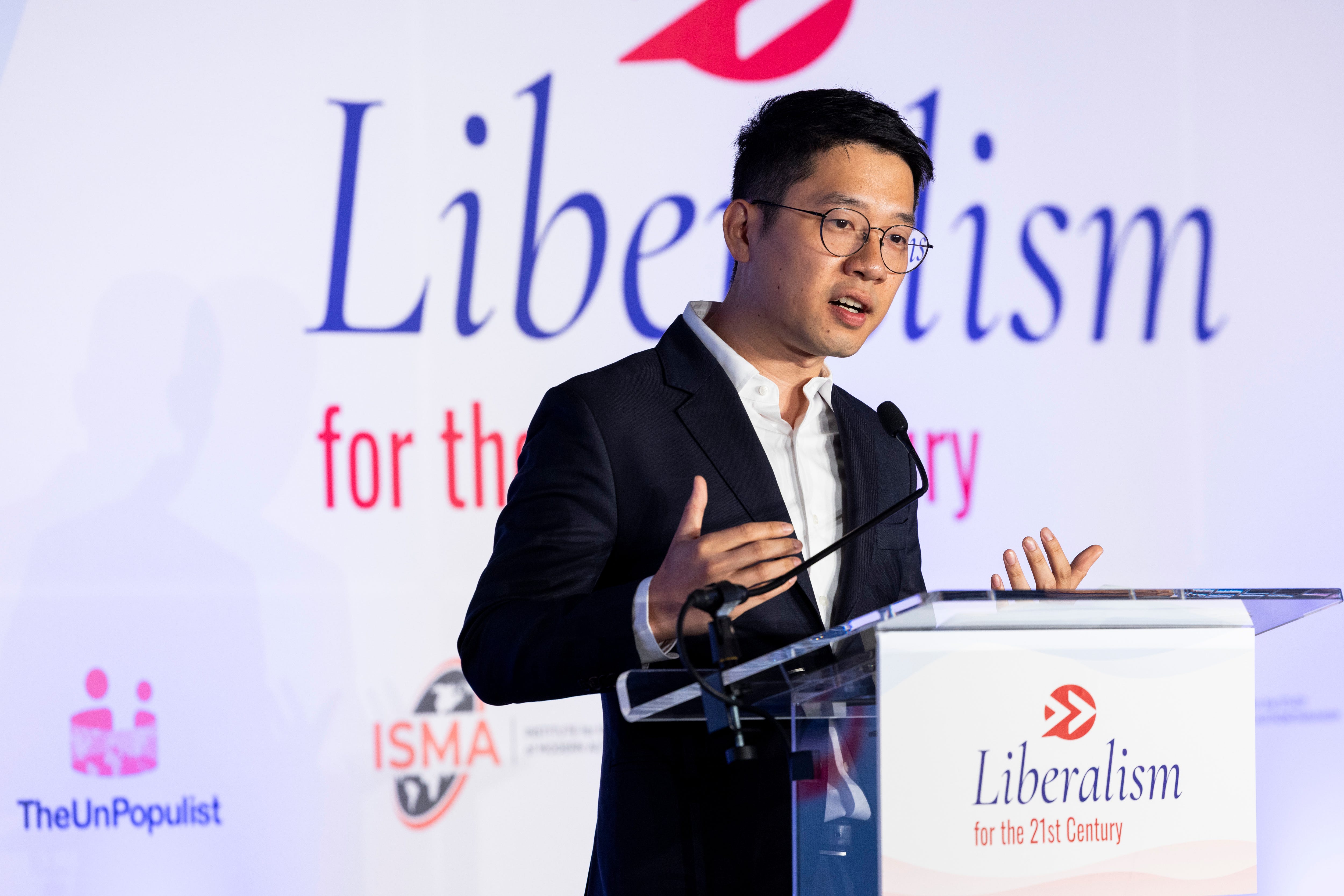
Next year, I will be able to obtain my British citizenship after six years in asylum as a political refugee. Living in Europe and occasionally traveling to the U.S. for all sorts of events, I’ve come to the conviction that my fight is not only for the freedom in Hong Kong and China, but also for the democratic institutions in the West. I have put my thoughts into action.
I learned from reports and studies that young people are becoming more detached from democratic and social norms, and are more dissatisfied with the state of democracy worldwide. Last year, I founded a democracy education project called Civic Square, which brings refugees and immigrants who fled from three countries into the U.K.’s classrooms. I believe in the power of storytelling and in driving impact by building interpersonal connections. There is so much potential we can activate through the marriage of these two.
I invited a North Korean defector who now works at a Korean restaurant in Chinatown in London to share his journey crossing mountains in China to reach the immigration facilities in Thailand. I invited a Myanmar refugee whose father remains in military captivity to share his stories of being smuggled out of the country. I saw the immediate impact these stories and connections had on the students, and the students’ reflection on their own privilege and rights.
Many people, especially young people who have never been through big moments of democratization, lack the imagination to see what could go wrong, what could be—and is—at risk. Now, when students think of North Korea after they heard about the stories, they may stop thinking of Kim Jong-un as just a cool dude who talks to Donald Trump and plays with nuclear weapons, but as a dictator who executes the families of someone that they know, and many other innocent North Koreans.
This is what we, the people who successfully obtain safety here, can offer using our stories to protect the democracies here. I don’t think there are better people than those who truly fled political violence to remind everyone how terrible authoritarianism could be, and why democratic institutions are so important. We are in this together. It is time to take action and support people who are building these relationships and the trust needed to make change happen.
For anyone who is upset about the situation now, just go out there and put yourself in a position where you will face pushback, challenges, uncomfortable conversations, but reason with compassion and grace. We have an active duty and responsibility to persuade more. Freedom is not free; the price of freedom is eternal vigilance. May we all find the ways to navigate these currents and reach the shore we are promised. Thank you so much.
Audience Member: Thank you, Nathan, for that very compelling and moving account. You keep in touch with folks back in Hong Kong, even though your whole family—immediate family—has now moved to London. Tell us about how day-to-day life in Hong Kong has changed after the takeover by the Chinese authoritarian government.
Law: It is a very difficult question to answer. There are still economic activities, people live their lives. Many friends who travel there came back to me and said, “Oh, it is still a vibrant city, good for tourists.” But I know that, and many other Hong Kong people know that, the soul of the city has already been sucked up.

There were a few interviews by international media based in Hong Kong. They wanted to ask people on the streets about their impression of the politics and the draconian Hong Kong National Security Law. The reactions of the people were … they don’t want to answer that. They just flee the scene. They told the journalists that they were unable to talk about it. The same scene that you would see in China, in Russia, in other authoritarian places, happens in Hong Kong.
A lot of my friends … they have to live their life. They have to sort of go back to the normal. But I think the things that are so fundamental in the city have already changed. It’s very difficult, and very dangerous as well, to do any political stuff or voice opinions that are different from the government, and, as I said, there are close to 2,000 political prisoners in Hong Kong. That sheer number matches some of the most authoritarian countries around the world. So, it has become something that is strange that not that many Hong Kong people recognize.
Audience Member: Thank you, Nathan, for that wonderful speech. I’m wondering, so you talk to young people in rich democracies, and you introduce them to stories of people who have lived in autocratic countries or dictatorships. You’re talking to a generation who are in many ways open to anti-democratic ideas, who are blasé, who take for granted the benefits of democracy. What kind of stories do actually change their minds? What’s the thing that they hear that makes people think, “hey, you know what, actually liberal democracy is something we should care about and try to preserve?”
Law: Yeah, the largest [group] I work with is North Korean defectors. And they share about, from their growing up, they learned at school that Kim Jong-un was pretty much like a god. Like he could drive a tank at three, and he invented the hamburger, all sorts of mythical stories about him. And then those high school students, they are in the education system and they start questioning what it would look like if they were to live in those systems.
I think there are a lot of parallels in these stories—elements these high school students, in their formative years, are going through, which I think has an impact on them. And the way that we approach it is to just ask questions, or ask them to reflect on the rights and privilege that, to be honest, they’re born with. I think there’s value in just putting someone, a real person, to share their own stories, and to have that interpersonal connection. It turns abstract theories real. And, as I said, whenever someone sees news about North Korea, it is no longer something that is so far away and just happening in the other half of the world, it’s something that their friends have been through.
“The enemy is not the political opposition. The enemy is apathy. It’s the state where people don’t care, live in their half-baked stereotypes about the world, and stop thinking deeply about anything.” — Nathan Law
We talk about the importance of persuasion—it is very difficult. And I think one of the first steps is to just build that connection, to build that resonance and trust so that we have more impact to help people to overcome the apathy of politics and to invite them to think and reflect.
Audience Member: Nathan, thank you for this wonderful message. As you know, one of the programs for the World Liberty Congress is to try to support dissidents in exile. And for many, many years, exile has been seen as a defeat. When a dissident, a pro-democracy activist, a political leader, is forced into exile, some people think that that’s the end of their journey. But you are a wonderful, inspiring example that exile can be another frontline to promote freedom. What message can you give to the millions of activists from around the world that have been displaced, forced into exile? Nothing wrong with driving Ubers, by the way—we were just talking about wonderful activists from many parts of the world who are forced into exile and have to look for a way to live and, if not, they cannot continue what they do. But you’re a successful case. Some practical advice for democrats in exile?
Law: So first of all, thank you so much, Félix [Maradiaga], for your contribution, courage, and bravery on your journey and for your own country. I think there are a thousand faces of how exiled activists and refugees could live their own lives. One of the big mottos in the Hong Kong pro-democracy movement is “be water”—a quote from the master, Bruce Lee. Water takes different shapes and forms; it can be air, it can be solid, it can be liquid, in reaction to different circumstances and different situations. Exiled activists are facing a lot of different difficulties and circumstances. Sometimes their host country puts a lot of restraints and difficulties; sometimes their personal conditions are not optimal, and they have to figure out a lot of questions by themselves. Being adaptive is really important.
I’ve lived in London for almost six years. Gradually, I have grown an attachment to the country, to the city, and I’ve also felt there’s another set of responsibilities and obligations that I have to follow. I think having that recognition is really important. It helps you be more settled and helps you think more not only on doing the activism that you’ve been doing and you’re supposed to do and people expect you to do, but elevating it into something that you can also help your host country. You can also be part of the larger struggle on the common pursuit that everyone is asking for.
So I think, for me, I don’t have good advice, but I’m the kind of person that, as I also quote, “the only constant of a river is change.” The world is changing and we just have to be adaptive. I also really do feel it’s time for people who have really fled political violence to step up and be visible.
There are so many narratives describing people who fled to other countries that suggest they did it for economic reasons. These are untrue. There are [such] really strong and good liberal traditions that these countries decided to have a system that helps people who fled, not only because they have a certain obligation, but because people who fled political violence, they indeed are sharing the same mission and same belief that all these countries are pursuing. So I think having these programs to make them more visible, having them to really say that they’re here not for any other reason but to flee political violence and they’re very grateful to the safety that we see, I think it is a great project to help combat some of the really nasty narratives that are in these countries.
Audience Member: Thank you for your speech and your activism. I’m an American, and we live in a very unsettled time. So, forks in the road are on my mind a lot these days: possibilities, contingencies. I wanted to ask you, the crackdown in Hong Kong was pretty horrible, horrific, really. But there are also many years between the crackdown and the handover. Do you feel that what happened was always coming? Or do you think that the trajectory or the nature of China changed in that time?
Law: It is a really good question. I think you can look into the development of Hong Kong politics through many different lenses. Some may be very critical about the world leading China, or having that wishful thinking that, China was stepping into the classic modernization path, where it would get wealthy, the middle class would grow, and then it would ask for rule of law and property rights, and democracy would emerge.
So that was in the ’80s, in the ’90s, there were people who were proponents of engaging with China, and that was wrong. That was wrong. They have used their power, the growing economy, to consolidate their dictatorship. And they used Hong Kong as a facade of also playing into the narrative that they are opening up, they’re becoming more politically liberalized, et cetera. So, I would say that there was an element that the Chinese Communist regime always had plans, and they have always been trying to move Hong Kong into a more authoritarian direction.
But on the other hand, there are also elements that Xi Jinping has changed the game a little bit. After he came into power, he drastically shrank the civil space in mainland China and also started to intervene in Hong Kong more and more. The confidence that he developed in China’s system, the ideology that he encoded in the constitution, really [fueled] a lot of repression in Hong Kong. So I would say that it comes both ways. It was a long trend and then there is still a dictator that accelerates everything.
Audience Member: I appreciate the work you do with young people specifically. It’s really needed and I’m curious, I think a lot of people don’t realize that for anyone under 35, “liberal” has become a derogatory term on the internet. If you’re called a liberal, that’s a bad thing. And I’m curious what you think maybe both the old guard and the spare few young guard of liberalism can do to undo that narrative, and remind people of the beauties of liberalism as a concept and a movement.
Law: I think definitely there are people much more qualified than me to talk about that in this room. My two cents, and this was also conveyed in my speech, is just … don’t have that complacency that believes the world is bending towards us, towards liberalism. In fact, it is not. It is a hard-won fight, and the fight does not come with just sitting there or being mad at people, it comes with reaching out, having difficult conversations, having the courage and having the patience, compassion, and grace to engage in these conversations, try to convince, and try to build a relationship.
I do feel like there was a period of time these virtues have been lost in the public discussion, for many different reasons. And I think that is something that each of us can contribute, and start our own projects, and start doing that.
Audience Member: There was always, in the West, a lot of fatalism about Hong Kong’s ability to ultimately resist the domination of Beijing. Were there occasions when things could have unfolded differently, when resistance could have succeeded, are there opportunities that were missed in the West that would have changed the trajectory, or was this unavoidable in your view?
Law: It is an excruciating question, and I don’t have a good answer for that. I think there are many times in the history of Hong Kong we can ask, “What if?” What if the British government, when they were planning the retreat from Hong Kong, had been more forceful and asked for larger autonomy, self-determination rights in Hong Kong? What if Western governments had been more forceful with the Chinese regime after the Tiananmen massacre, and pushed harder to incentivize China toward democratization or at least liberalization?

I don’t have a good answer. I think a lot of people also turn to the idea that, “oh, the whole protest accelerated the whole takeover thing, and then it contributed to the severity of the crackdown.” And as someone who organized, who built a movement, a lot of these things are actually difficult to control. This is an explosion of public anger, and this is something that is not engineered. And I think this is also—for people who haven’t had the experience working with the people—this is a rather important lesson to learn, which is: we have to meet them where they are, we have to have the instinct and the capacity, and we have to step up when the time comes.
It’s very difficult to say when or whether or what if Hong Kong could change. I am not a very optimistic person about these things, so my answer would lie on the spectrum of, yeah, there are a lot of moments that we didn’t really have any choice or capacity to change the situation in its entirety. But I think what we can do, if we truly believe in what we are pursuing and we truly uphold those values, there are difficult times when we knew that there will be an explosion of anger, there will be an explosion of people going down to the streets, push something very far, we will still be there for them in one way or another. And I think this is probably something that, as an activist or a type of leader, we need to have that instinct and have the capacity to do. Thank you so much.
© The UnPopulist, 2026
Follow us on Bluesky, Threads, YouTube, TikTok, Facebook, Instagram, and X.
We welcome your reactions and replies. Please adhere to our comments policy.

I'm always inspired by those who fight for their own lives and the freedom to live it. Freedom doesn't come for free, it need to be argued for and fought for. Complacency is a sure-fire way to serfdom.
But there's a pre-requisite: education. The fundamental cause of complacency and loss of freedom is the lack of understanding of what freedom is and the moral, political and philosophical ideas that it depends on.
It's easy to see the evil of a dictatorial state oppressing its citizens; it's much harder to see the philosophic and moral ideas that makes this possible. It's easy to see the evils of Nazi Germany and Fascism; it's harder to grasp the ideas that gave rise to this. And these are not superficial political discontent or tribal alliances, they are deep, philosophic ideas.
This is what needs to be understood. Learn about the moral ideas at the root of freedom and fight for those. Learn about the opposing moralities and fight against those.
The argument that liberal democracy is not self-sustaining is compelling because democratic institutions depend on informed citizens, transparency, and public accountability. Access to reliable public information helps people better understand their communities and participate meaningfully in civic life. Resources such as https://lakecountypropertyappraiser.org can illustrate how accessible records contribute to transparency and informed public discussion. Ultimately, a healthy democracy requires citizens who remain engaged, question institutions, and actively support the principles that allow democratic systems to endure.