

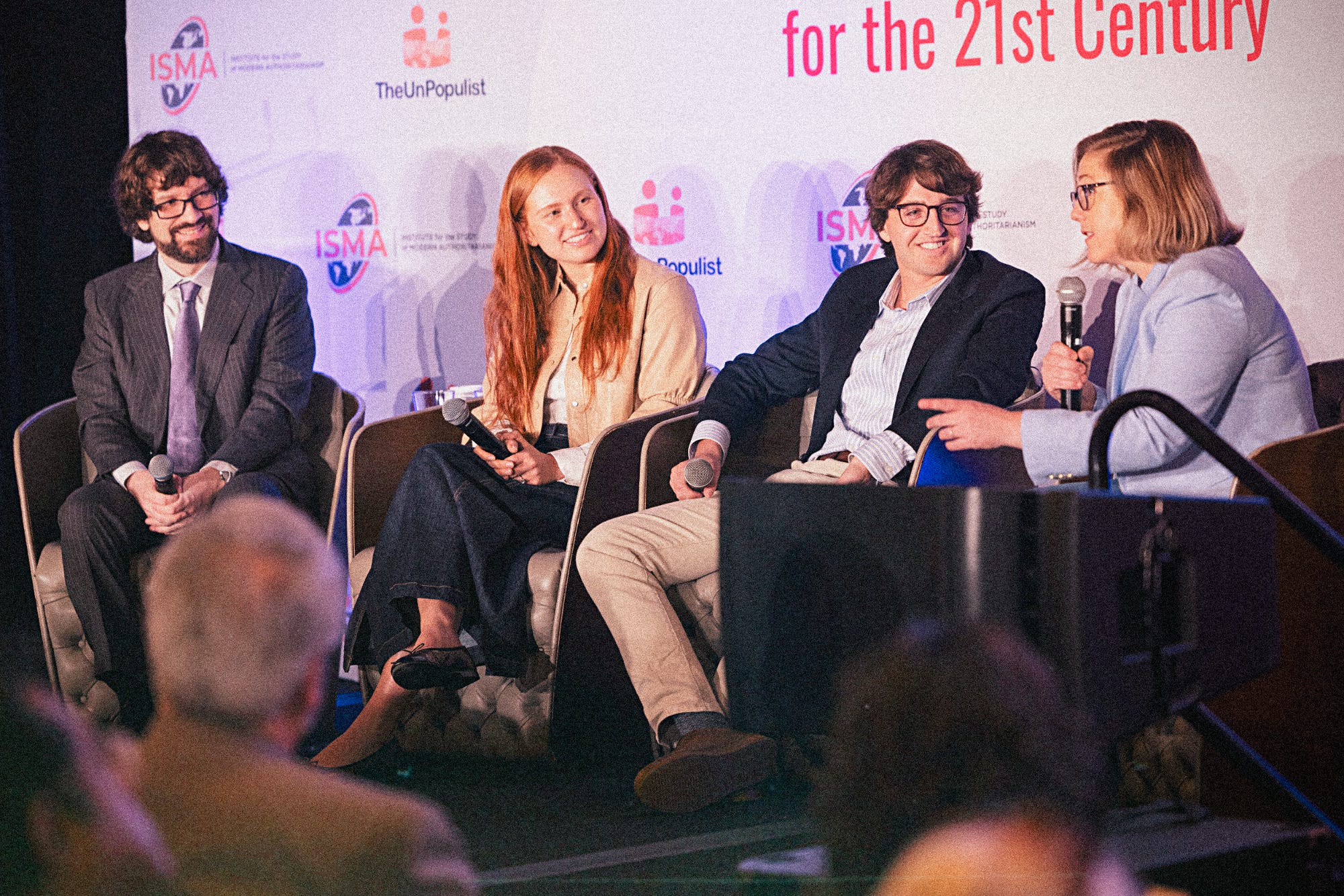
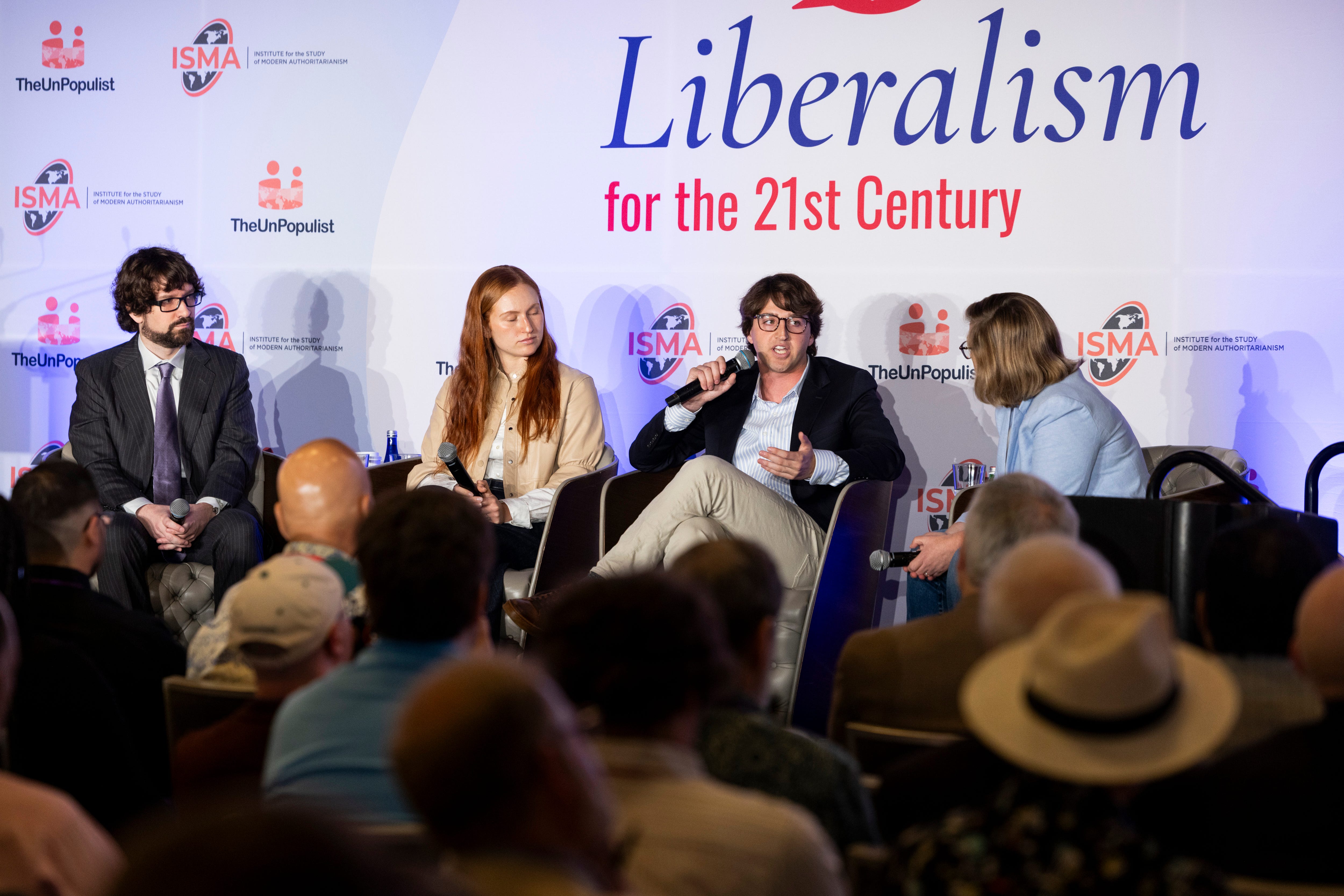
Today, we’re thrilled to share the full video and transcript of LibCon2026’s panel on Gen Z—including the Q&A with the audience toward the end. The rest of the panels will follow soon: we’ll be publishing every LibCon2026 session on our YouTube channel, along with the full video, transcript, and photos right here at The UnPopulist.
We hope you find the conversation informative and insightful. The transcript has been lightly edited for flow and clarity.

Berny Belvedere: Good morning. Every generation of adults has said some version of the same thing about the generation coming after: “we don’t get them.” They’ll go on: “Their music sounds like noise. Their slang is a foreign language. Their memes are … we don’t even know what the hell memes are.” Look, I don’t want to overstate things: usually that kind of cluelessness is harmless—it’s fodder for comedians, rather than a genuine problem. Here’s when “we don’t get them” is a genuine problem, though: when the people doing the not-getting are the people leading a political movement, and when the group being misunderstood and unreached is arguably the demographic it most needs to activate. That’s when “we don’t get them” stops being funny and starts being a liability. And that’s unfortunately where liberalism finds itself with Gen Z in a lot of respects.
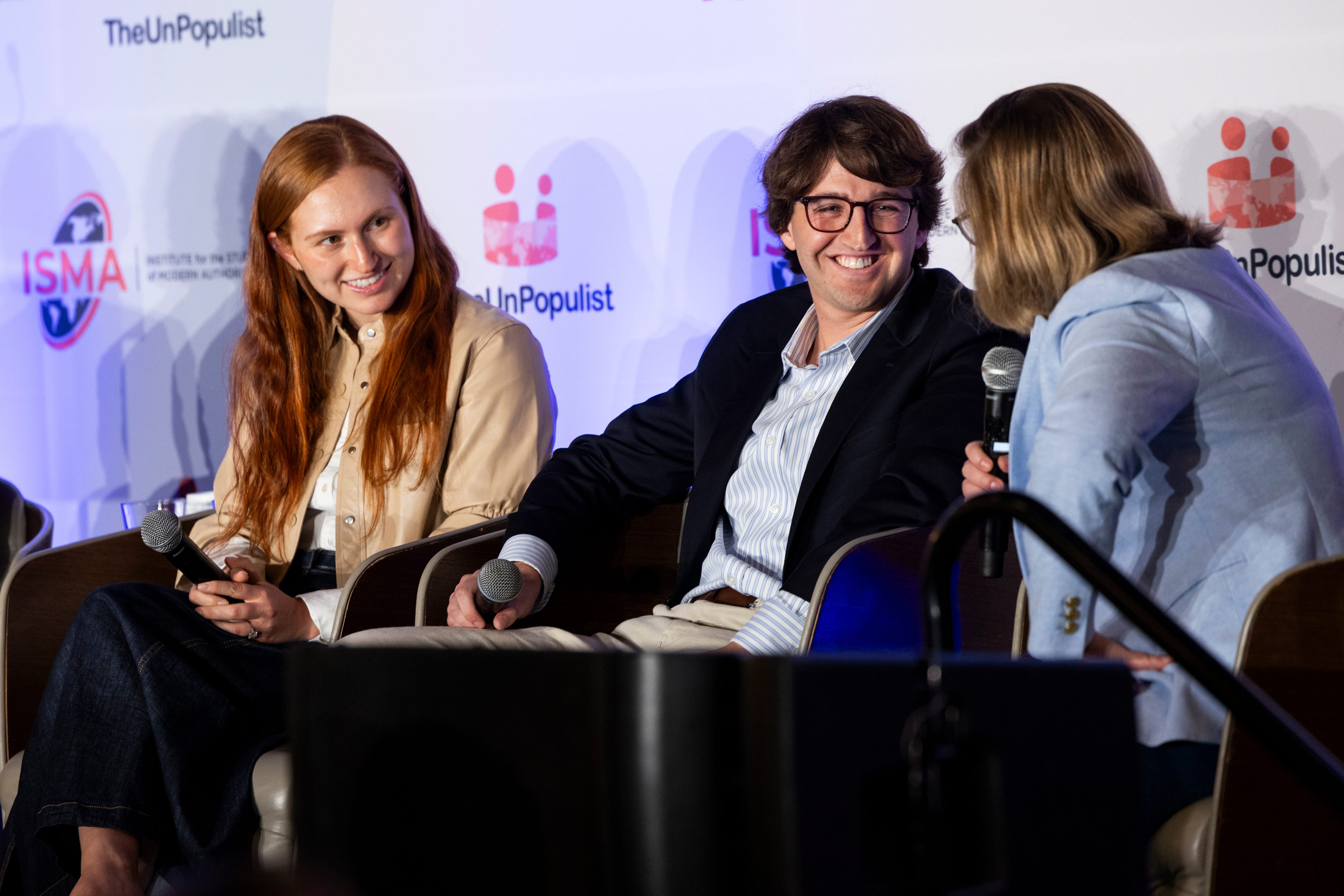
That’s why the panel you’re about to see is so important. To moderate it, we have one of the leading figures in our entire movement, a genuine superstar in our ranks, Sarah Longwell, who has probably spent more time listening to how American voters actually think than anyone else in politics. She’s joined by Rachel Janfaza, who’s built an entire research and media outlet, The Up and Up, around a single question: How does Gen Z actually see the world? We also welcome Gabe Fleisher, who’s been writing about politics since he was nine years old—at nine, I wasn’t doing anything like that—and now reaches tens of thousands of readers who trust him to explain Washington to them. And last but not least, we have Steven “Destiny” Bonnell, a liberal streamer, debater, intellectual brawler, who’s built one of the largest youth-facing political followings anywhere on the internet. So without further ado—and apologies for the glazing—but over to the Rizz Queen herself, Sarah Longwell.
Sarah Longwell: That’s funny. Thank you. Hey, guys, how are you? So, first, I’m going to have each of the panelists do something that older people would never tolerate: tell me how old you are right now.
Steven Bonnell: 37.
Longwell: You’re not a Gen Xer. You’re like a grown man.
Bonnell: Well, aren’t Gen Xers older than me? What?
Longwell: Wait, wait, wait. I meant … what’s the new generation? Gen Z. So, you’re a millennial.
Bonnell: I’m absolutely a millennial, yes.
Longwell: OK, how old are you?
Rachel Janfaza: 28.
Gabe Fleisher: I’m 24.
Longwell: This kid, right before the panel, sells me this thing about being nine years old when he starts writing. I have a nine-year-old. My nine-year-old is having a birthday this weekend where he’s going to turn 10. And he asked his parents for a helicopter drone spelled like D-R-U-N. So I don’t believe you.
Fleisher: I’ve got the receipts!
Longwell: OK, so here’s the thing. I just wrote a book based on all of the focus groups that I’ve been doing over the years to try to figure out what we do to get out of this mess. It’s called How to Eat an Elephant: One Voter at a Time. I have a whole chapter—I actually had a couple chapters about Gen Z, but I ended up having to cut it down and condense them, because it was like 100 pages of “What the hell is wrong with these kids?” So that is my opening question to you guys. The chapter of my book is called “The Kids Aren’t All Right.” So can you explain, just to set the stage, why aren’t the kids all right, right now?
Janfaza: Well, I push back on that a little bit. Because I think that there are a lot of misconceptions about our generation, and a lot of media headlines that actually, if you dig a layer deeper and listen to young people as we do, you realize that there are things to be hopeful about. Young people do want to be active participants in democracy. They just feel like they’ve grown up in a world where it’s been one chaotic disaster after another.

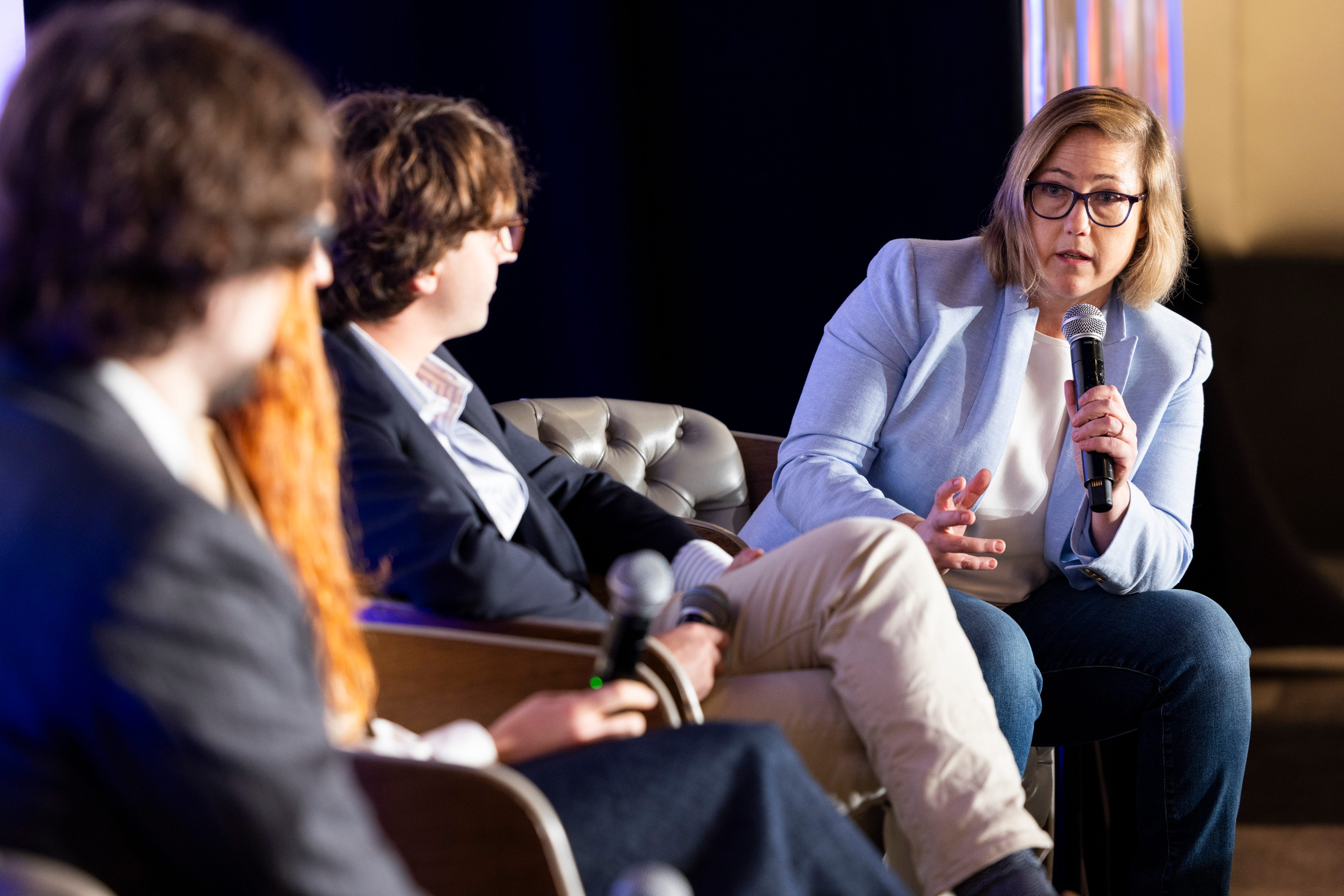
When you look at Gen Z, which spans anyone who was born in 1997—which is the year I was born—through roughly, they haven’t exactly set the cut off yet, but 2012, you think about: this is a generation that was born just before or after 9/11, that came of age during intense political debate here domestically, but also abroad. There’s been climate disasters and gun violence and a pandemic and the rise of social media, and now the rise of AI, and a million other issues. And, meanwhile, they’re absorbing it all—we are absorbing it all—through our phones in real time, getting breaking news alerts or notifications from our friends and family, ping-ping-ping every second of every single day. It’s really overwhelming and hard to make sense of. And then you add in the political context of the Trump era of politics. This is a generation that has literally only known a political environment dominated by one man. And the intensity of that, and the making sense of it all, has been very difficult. So I think with all that said, there are reasons to be hopeful about our generation. They want to come out on the other side of this and they’re actively looking for ways to do it. Unfortunately, there’s been a leadership vacuum and people are ready for what comes next.
Longwell: All right, so I want to push back on some of that. Rachel and I have this conversation frequently, where she tells me all about what’s going on with Gen Z. And it often sounds to me like … you know how sometimes people are like, “every generation thinks they invented sex?” I don’t know, there are some old people in here … you guys remember the ’60s? Like, that was chaotic, right? I mean, I don’t know if there’s anybody old enough to remember the Civil War— but there was a changing information environment there. So, books were invented at some point … turmoil is not new. The technology through which the turmoil exists might be new.
You are part of a new brand of … I didn’t say this earlier, but I’m 46, and this idea of streaming is like the most preposterous thing I’ve ever seen. I didn’t know what streamers were until pretty recently—I just thought it was people who played video games, and then people watched them. It turns out that now people will talk about politics for hours and hours and hours, and people chat to them, and they sit there with you forever and you become this orchestrator of a huge audience. So what is streaming all about, and why is it a new medium through which people are engaging in politics?
Bonnell: What is streaming all about? I mean it depends on, like you said, what you’re watching. Some people play games, some people do politics, some people will stream going to water parks or vacationing or whatever.
I would say, on the politics side of things, streaming has become such a hotbed for political discussion because it represents the direction that media has taken, in that the average viewer of somebody online has so much more access to the entertainment they’re consuming than you did 50, 60, 70 years ago. If there’s a Beatles concert, you might get to attend once or twice in your lifetime. And then you go forward [in time] and you’ve got people who have—I think, Linkin Park had it—you can text a number and maybe get a response back. And then you can email people and get a response back. As things have progressed technologically, now if there’s a person that you like online, you could be in the chat and you could type a thing, and maybe they’ll see you in real time. That back-and-forth live engagement is probably one of the more alluring aspects right now, which is the direction social media has been heading in over the past several years: more and more access to more and more people, all the time. In some ways this, I guess, works out well for me. In other ways, it’s horrific because we see the endless thought-stream from our president every single day on Truth Social. The greater access is what leads people to watch and consume so much content for so long.
Longwell: Yeah, I have a bunch of follow-up questions about streaming, but I actually want to go back to something you said when we were prepping for the panel, where we were talking about whether or not young people today are somehow different. It goes to the question that I always debate with Rachel: Are young people different than they used to be? There is something different about this moment, as opposed to it simply being that the mediums in which politics is [now] expressed [are] different. But is there something fundamentally different about young people?
Bonnell: There’s a mental exercise I like to do. As you get older, you think, “man, why don’t they make movies like they did when I was a teenager? Why don’t they make songs like they did when I was a teenager?” And then after repeating this enough, I think, “Okay, well, every single generation before me has said literally the exact same thing.” If I can’t find some specific mechanism of action, then it’s probably just a matter of getting older.
I do think in some ways the craziness of young people today is a bit exaggerated. People will talk about how these guys all quit politics—they were so insane about Bernie, and then Bernie lost. I was a Ron Paul supporter in 2008. He didn’t have anywhere near as much hype as Bernie did, and we felt just as devastated. When you’re a college kid, this is the most radical time in your life. If you think about it, dispositionally, it’s the least amount of money you’ll (hopefully) ever have—you have student loan debt, you’re coming out of high school, you’re switching up to go into college. A whole bunch of the most important things in your entire life have happened. You might move away from home for the first time. You might end your first relationship. It might be the first time you leave your state. I’m from Nebraska, so going to college on a coast is a big deal. All of these things are happening. But the one different thing today is that the environments were a little bit more contained. So, college kids would rant at colleges. If something big happened, maybe it made a local paper. People would argue in their different areas. But now, if you were to go on to social media, somebody might read a tweet about politics from Sarah from The Bulwark, and then from a politician who’s a senator of 50 years, and then a 19-year-old who has an opinion on what mortgage rates should be, who hasn’t worked a job before—not to take anything away from the 19-year-old …
Longwell: … Yeah like bro was tweeting when he was nine years old.
Bonnell: I think it’s harder when all of this stuff gets mixed together. Everything starts to seem equally valid. And not to sound like the old guy saying, “I understand what you’re saying, but you’re going to feel differently in 10 years,” but I think it’s important for kids to have the space to be kind of crazy. But then it’s important for everybody else to recognize that, yeah, they’re kind of crazy. They’re 20 years old. What do you expect? You were the same way, even though every person denies it when they were 20.
Janfaza: Can I add one follow up to that? I think the other piece of the fact that young people can go on any platform, that anyone can become a creator—Gabe is one example of that—is that it’s often the loudest voices who resonate at the top, who get to the top of the social media feeds. And then that is what is seen as the perspective of young people when it was just what the algorithm happened to pick up. Part of the reason why Gen Z’s politics have a certain perception—a perception that has flip-flopped back and forth now a number of times—is because we are paying attention to the loudest voices of young people. Often, those are the most politically active, when we know that on the whole, most young people aren’t that politically active. It’s just worth noting that we often see young people’s politics through those very vocal voices and not the average young people across the country.
Longwell: All right, you’re up, guy. So, you’re going to have to explain this nine-year-old thing to me, and then I’m going to ask a harsh follow-up, which is: I don’t think nine-year-olds should have political opinions that we take seriously. I mean, my son the other day, after watching The X-Men, there’s a scene where one character says to the other character, “you’re a dick.” And my kid in the car the other day just says out loud, “Donald Trump’s a dick.” And I said, “do you know what that means?” And he was like, “no, I don’t.” I was like, “do you know what that is?” And he was like, “no.” And I told him, and then he laughed for 10 minutes. But he didn’t know. So OK, go ahead. You’re nine, and you’ve got political opinions, and we’re supposed to listen to them. Go.
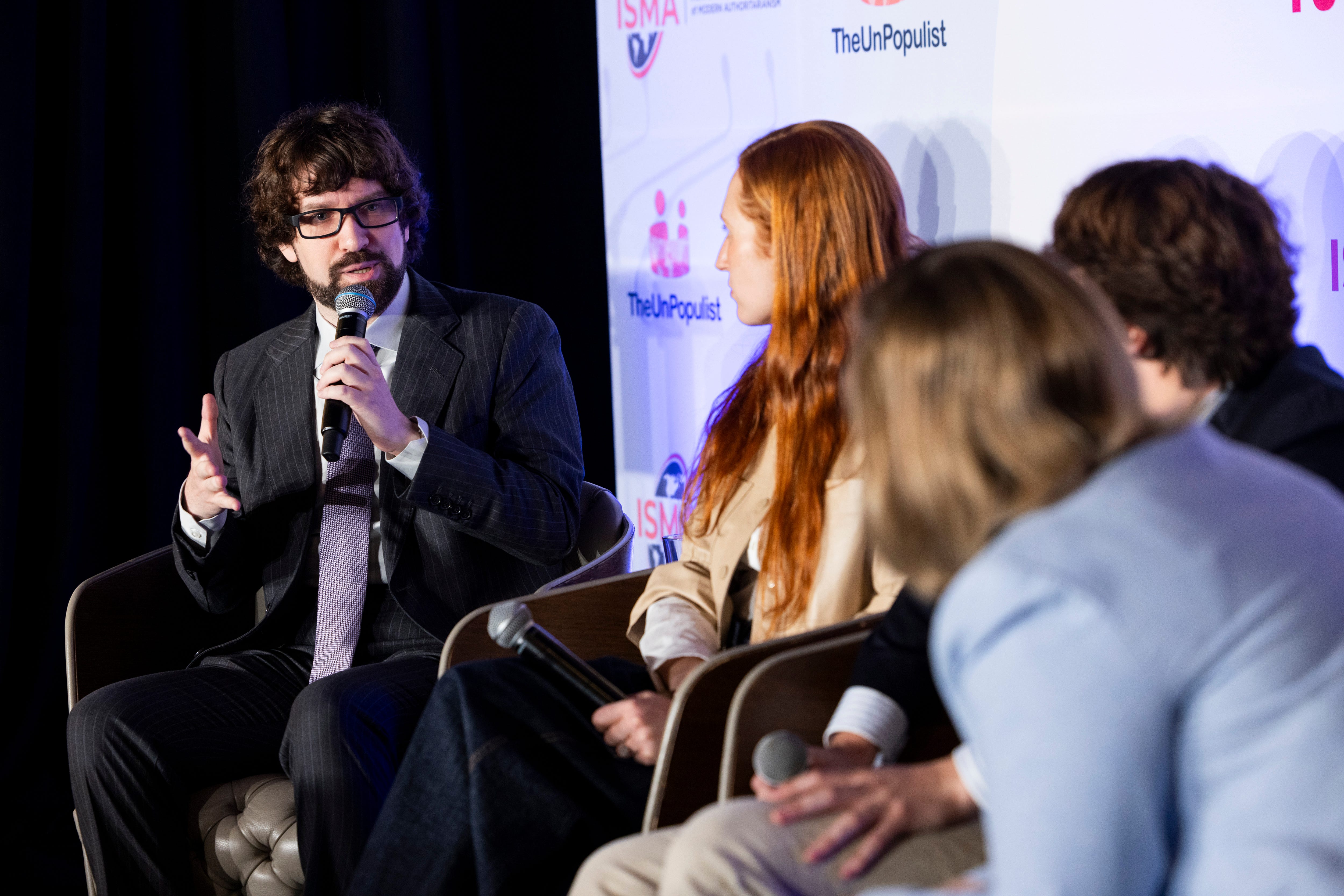
Fleisher: It’s a fair question. To be honest, the story of my newsletter is … to this day it’s a nonpartisan newsletter. I wasn’t trying to share an opinion. I agree with you. I mean, I’ve written some opinions that I think could be listened to, but don’t necessarily need to rise to the top of someone’s feed or anything like that. But it was a nonpartisan newsletter, and the goal wasn’t to share my opinions but to try to explain politics. There are a lot of places, of people of all sorts of ages, trying to give their opinions and tell you what to think. And the point of my newsletter has always been, for the entire time I’ve been doing it, much more aimed at trying to look behind the scenes of politics and how it works, and try to give people a view into the processes and systems that undergird our politics—much more explanatory than opinionated.
“I get in fights with people who are just like, ‘we’re, we’re cooked. It’s over. Everybody wants performance art. Everybody wants something bad.’ No man, it’s still in there with people. And I think that if somebody shows up and offers a fierce but kind way of doing this—whatever is authentic to them—I do not think we’re in a permanent state of horrible people. And I do think that there can be real appetite with the right leader for something that is good and substantive again. I do not think this is always how we’re going to be.” — Sarah Longwell
I think one reason the newsletter was able to get the reach it did was because it was something a lot of people felt was missing. A lot of people feel as though there are a lot of opinions coming at them from all different directions, but people were looking for somewhere that they could trust. And that was how I built trust, even though I was very young. [The idea] was that you can read my newsletter and, hopefully, if I’m doing my job right, can’t tell if it’s coming from the left or the right. That was the way, over years and years and years, I built trust. Is it something I recommend every nine-year-old do? I don’t know. I’d read your nine-year-old’s Substack if he wants to write one.
Longwell: It would be terrible, he’s dyslexic.
Fleisher: I don’t know that mine was particularly good at the beginning, but at this point, I’ve been doing it 15 years now. That is a long time to have been practicing journalism year-in and year-out, and hopefully I have gotten a lot better.
Longwell: Okay, I’m going to get back to you with my questions about how one develops trust and builds expertise around something when you are so young and have done nothing. And we can get back to that. But I’m going to be mean to Destiny first.
So the thing with streaming … I got in a fight with one of these streamers who I had never heard of until I was on a panel with him—this guy Hasan Piker. I was on a panel with him, and before I went on, I was like, “Who is this person?” And they were like, “he’s a streamer.” And I was like, “well, that’s why I don’t know who he is.” But then I ended up getting in an argument, actually with my colleague Tim, about something Hasan had said. And then Hasan started attacking me, and then before I knew it, I had the most death threats I’d had since I got in a fight with Ric Grenell online. It was like, “I’m coming to your house,” all of these followers came after me. And that’s just life in our business now—everybody can get to you. But is it a healthy way to engage in politics, the streaming and the back-and-forth? Like, to me, it felt like this is a pretty toxic space. And yet, everyone assures me that, actually, this is the key to reaching young men; and that we—Democrats especially—have a problem with young men. They can’t seem to reach them, and there’s this whole “manosphere,” and so people seem to think left-wing streamers of different stripes is the future. Is it?
Bonnell: God, I hope not. I think that this is a question that seems unique to the streaming space, but if you [zoom] out, it’s unfortunately not. This is just where politics is right now. The tone has been set from the top. I don’t think it would be surprising to anybody to see how toxic that environment has gotten, when you look at the direction we get from the White House right now on how we should treat our political adversaries on social media.
One of the biggest issues that I have, when I’m trying to describe to the center-left where the current environment is, is that you can’t really choose the level that you fight on. You have to fight on the lowest level that the other party decides to, because if you don’t—we can have a lot of honor and integrity and be self-critical and all of this, but I don’t know if there’s much virtue in that if it ultimately means you lose the fight. So at some point, I think the center-left in the United States is going to have to figure out how to elevate the discourse on the other side. Otherwise, it’s just going to be scenario after scenario where you have a moderate left that’s trying to govern the country, that’s trying to hold itself to some standard, but then other political factions—right now: the MAGA movement and the far left—very much thrive on this death-threat-level politics that, for all of the nastiness of it, you can see that it does mobilize people. It does energize people.
At the very least, in the short term, it seems to yield some big political gains and big political power. It discourages some people from having conversations. It helps you bolster your own side’s political opinion and get your issues more to the front and center. You talk to voters on your show that I imagine are more representative of normal people than what you see on social media; if I opened my social media feed, I would imagine the three most important issues to Americans today are student loan debt, legalizing marijuana and crime, and—I don’t know—some other third thing that only young people really care about, when the average older voter—for better or worse—isn’t really interacting with the police much, maybe doesn’t have student loan debt, and they own their home, they don’t want to see housing prices go down. They like the fact that they’re sitting on a big nest egg, and they just want to get rid of the property taxes for it.
So yeah, it’s kind of a crazy world. And there have been some political factions in the U.S. that have found a way to weaponize it, because they can dig so deep and then use that for their own kind of political end. But it works for them. It has been working for them. So there’s no reason we should expect it to stop unless we can either make them stop or play at a similar level, as horrible as that is.
Janfaza: On the question of, Is streaming and streamers the way to reach young people and young men in particular? … I think it’s one tool in a toolbox. There is no silver bullet for how to reach young people. To your point, these are very tuned-in, online people, and that is not who we hear from in focus groups. Certainly, sometimes in a focus group, you’ll have one or two people who are watching streamers or are getting their news on Twitch. But it’s not everyone. And I think the media ecosystem is so crowded that the reality is that there is not one single person who is the voice of reason with young people. It is a very crowded space. There are any number of people who young people are listening to.

When it comes to ways to work with streamers, or ways to build coalitions that include different types of online personalities, I think every candidate is going to have to grapple with what that looks like for them individually and what they are comfortable with and how to build that. But it is not the only answer. If you look at candidates who are resonating with young men right now, I think there are ways to do it. And it doesn’t have to be just that you team up with all of the streamers.
Longwell: Sorry, what’s the way to do it?
Janfaza: Zohran Mamdani had a very creative media strategy, and he did go on every different show. I think that is an important strategy. You have to be everywhere, always, at once.
Longwell: Everything, everywhere, all at once. It’s like a terrible movie, but a good communication strategy!
Janfaza: Yes, we’ve discussed this before.
Longwell: Because it’s a line I use all the time, yeah.
Janfaza: But you also have to be charismatic yourself, and you also have to have your own social media channels where you can communicate your message and your vision articulately. We talk a lot about the different mediums, and the different creators you can team up with, and shows you can go on. But ultimately, it comes down to your message and your vision. And what someone like Zohran Mamdani did successfully—and it’s also something that President Donald Trump did very successfully—was they had a really clear and simple message. And they went everywhere they could and shared that single simple message. And it worked.
Fleisher: To me, the thing that people get most wrong about Gen Z is they just over-particularize Gen Z too much. There are real generational differences between all age cohorts—but certainly politically with Gen Z, they’re a lot less there than you think. You were talking before about, if you log onto a Twitch stream, the issues you’ll see the most people talking about … but we have polling, and we can see what are the issues that Gen Z—not just the more unrepresentative few who are really checked into politics and on Twitch streams and following politics closely—that matter most to young voters broadly. The Harvard Youth Poll is the best long-running poll—John Della Volpe runs it—and they’ve been studying young voters for decades. They have a question: “What are the issues that matter most to young voters?” When you can look at the chart, you look at the rankings, the ones that are dead at the bottom are all the ones that I think get the most attention as “young people issues”: student loans, Israel-Palestine, climate change is fairly down low, and things like that. And then what are the issues at the top? It’s cost of living. “Can I afford a home? Can I afford gas? Can I afford food?” … which, by the way, are the same exact top issues for every age cohort.
Are young voters really tuned out? Are they really tuned in? The reality is the engagement numbers are also not that much different when you look at: how closely are young people following politics? How likely are you to donate to a political candidate? Things like that. There are some differences that you might expect, as people get older naturally. But certainly, going back to the historical question, no difference in terms of youth participation over a broad sweep of history. So I think there is this over-particularization, and every generation has those sorts of unrepresentative places. For us maybe it’s Twitch streams and things like that. For a lot of older voters, you know, cable news—the median ages of the three cable news networks are like 60, 61, and 62 … I think even like 67, 68.
Longwell: Does anyone you know watch cable news?
Fleisher: No, and I think it’s the same thing. It’s very unrepresentative. Only a couple million people watch any of the cable news networks. It’s a really tiny slice of Americans, just like the slices that are on streaming for young people.
Bonnell: I was going to agree and disagree with a couple things. The first thing is, I would 100% agree that you’re only seeing a particular slice of stuff online. I’ve been invited to do events at very left-leaning places like Yale or Oxford, and then even at Dartmouth. I’ll ask these students, “So, you guys have a reputation for being a super radical activist campus—what percentage of the students here are out marching and demonstrating, like 50%, 60%?” And even at Yale, these people tell me, “I don’t know, maybe 1% or 2% of the students are super politically active.” Most people just show up. They want to go to class. They want to do their thing. And that’s it.
“This is a generation that has literally only known a political environment dominated by one man. And the intensity of that, and the making sense of it all, has been very difficult. … That said, there are reasons to be hopeful about our generation. They want to come out on the other side of this and they’re actively looking for ways to do it. Unfortunately, there’s been a leadership vacuum and people are ready for what comes next.” — Rachel Janfaza
So yeah, the idea that there’s this huge, mobilized youth … I mean, how many politicians on the left have done this, “we’re going to turn out the youth vote, and this is going to be the thing that finally carries us over,” and lo and behold, like it’s been in all of human history, they just don’t really show up to vote that much, because they’re really not as activated as people think they are.
Sometimes people make a mistake when they look at the importance of a certain medium … like, I personally think cable news is still probably the most important platform for media right now. It’s not just about the people watching cable news, it’s … I don’t know if you’ve ever seen, I won’t go into details, but there’s a horror movie called The Human Centipede. And cable news is the front person in that centipede. All of the stuff that gets talked about there makes its way down to the podcast people, which makes its way down and eventually winds up in the “for you” page of everybody’s social media feed. So you might be a person that’s never seen anything in your entire life on cable news, but you know every single thing that Tulsi Gabbard has said to Sean Hannity about how Obama tried to rig 2016—because it started there, it made its way down to Joe Rogan, and then it made its way down to your YouTuber person that you watch, and then now that’s in your brain because of it.
Longwell: Yeah, can I just throw this out, because I write about this in the book and I talk about the rise of the “vibes voter.” And part of what creates vibes is … the narrative dominance of Donald Trump means that he dominates the attention economy, which means that everybody’s always talking about him, which creates the vibes.
But I do think this is true that cable news—and the human centipede, I also use that exact phrase in the book about a few different things—but part of it is because there’s a really symbiotic relationship. The cable news is clipping the streamers and what the streamers said and reporting on it, and the streamers are taking what’s said on cable news and they’re reporting on it. So, people have this very segmented way of thinking about information, like, “well, you’ve got to do this, or you’ve got to do this.” And instead, you actually have to see the way these things layer on to each other to create overall narratives, and that a big part of Donald Trump’s genius has just been knowing—that’s why he gave this insane speech last night that contained no new information and was just lies, and in fact most of what he actually put out refuted the things that he actually said in the speech—but it is about the attention economy. It’s about owning narratives.
And so I guess knowing this, I am constantly shocked at how bad Democrats are at communicating in this environment, at winning on this battlefield in the attention economy. So what can Democrats do to help change the vibes?
Bonnell: I don’t think people on the center left realize how intentional that environment is. And I challenge people, when there is a new administration talking point, look at how that talking point is planted at the very top. You’ll get a person from the White House, you’ll get a Cabinet member, that will begin to make the rounds on all of the cable news shows. And in all of those interviews, the only point there is to pilot the idea and to have it out there in the least confrontational, most harmonizing, resonating way possible. So, every single interview is going to be agreeing wholeheartedly. It’s going to be bolstering the point.
By the time it’s gotten through all of that, it percolates to the podcasters who see every single media person on cable news talking about it, and they more or less repeat the same point. And you have this top-down tuning fork that resonates with that message.
I’ve asked Democratic leaders, “if I wanted to know what the Democratic Party’s position is on Israel-Palestine, where do I go?” The only people who would tell me what the Democratic Party thinks are the Republican Party—who’s not telling you what they think—or it’s the people on the far left right now, who’ve actually done a really good job at emulating this right-wing media apparatus.
But if I was to ask you, what does the Republican Party think? You can ask my mom. My mom is ride-or-die MAGA. She will tell you every single thing that the Republican Party establishment has. Every podcaster knows. They’ll repeat the talking points, even if they don’t even know where they came from. Every media figure knows. They’re so good at creating that environment.

And one of the biggest weaknesses … this goes back to what I was talking about earlier, where we have some traits that we consider virtues, but they’re used against us, and I think about this every time Jake Tapper writes a new book on Biden’s senility, or whatever else on CNN they want to cover about the weakness of the last administration. The Democrats pride themselves on being self-critical and on being able to analyze their own faults and flaws, which is great—but there is no way that you can ever successfully pilot a Democratic idea and have it ring from top to bottom like they do on the right. Because the very first interviews you get with the Democratic idea are going to be critical ones, and it’s impossible to take an idea and to get it out as much into the media environment as it is when the Republicans can pilot an idea and have it completely accepted before launching it out. On the left, we just don’t have that apparatus and infrastructure.
Fleisher: I think there’s a lot of truth to what you’re saying. I will note—I spend a lot of time reporting here in Washington—and I think both parties are intensely jealous of the other parties’ communications apparatus and spend a lot of time focusing on “they’re so much more united than we are, they communicate so much better than we are.” I think it somewhat misses the point. I think when you talk about Zohran Mamdani, who is obviously a master of short-form video, and then suddenly you see every Democratic candidate doing short-form video—and there’s no downside, in this day and age where a lot of people are getting their news on TikTok and Instagram reels, to be doing short-form video—but I think the message is ultimately a lot more relevant than the medium.
There’s no question President Trump is a master at the attention economy, like you’re saying. And the Cabinet sectaries go out and say whatever, and the speech last night. But the reality is at the end of the day, Donald Trump’s [approval] rating is incredibly low. So all the attention he’s sucking up has not done very well for him electorally, or at least politically right now.
Longwell: Dude overturned an election and still got reelected.
Fleisher: Well, didn’t overturn an election, but either way.
Longwell: I mean, he tried violently to …
Fleisher: …he got reelected, but then immediately (both times he was elected) became incredibly unpopular, almost instantly. And you look at the election speech …
Longwell: That’s also a typical function of politics right now, right?
Fleisher: Of course it is.
Bonnell: He won the elections, though. When I look at the elections, if Kamala would have won all seven swing states in the last election, I still would have considered that a monumental failure for the left and a monumental success for the right, such that: how is this guy not losing in a 49-state landslide?
And then just as a quick point, Zohran messages well, but if I think about, “how do I figure out what Zohran Mamdani believes? Who does his messaging?” It’s Zohran Mamdani. But think about it: he’s the mayor of New York City. He doesn’t have anywhere near that entire right-wing apparatus that’s working against him, because they’re not going to be mayor anytime soon in New York City, so they don’t care. And then the far left is endearing to Mamdani, they want to ride on the DSA stuff. So Mamdani is allowed to go out and message well, but nobody’s challenging it. So he can go out, he can make a video on potholes, and people are like, “oh, that’s really cool.” If he was in a more competitive area, though, you better believe that every single Republican would be playing “oh, well, while Mamdani is fixing the pothole, they’re putting holes in your trans children…” or “while Mamdani is out here doxing people and where they live, they’re trying to take away your home.” Like, he doesn’t have to fight with any of that. He controls his own branding.
And a final point on Donald Trump: Donald Trump is not a genius. I hate it when people say this. Donald Trump inherited a Republican media empire that has been destroying the Democratic Party on messaging for 30 years. I grew up a hardcore Republican, I listened to Michael Savage. I listened to Rush Limbaugh, I listened to Bill Cunningham, all these guys—this idea that the Republicans are just now engaged in this kind of personal attacks or whatever … I mean, look at all the Hillary Clinton stuff. They spent decades attacking this woman. We got the Benghazi hearings. We got the emails. We got everything else. Sometimes, I don’t think it’s about the message, because I see things that Donald Trump will say or do … what is the genius messaging in mixing up Japan’s government with the Islamic Republic of Japan or whatever he said? It’s not genius messaging. It’s just an entire Republican media establishment that’s willing to co-sign anything he says, and he inherits all the infrastructure and then works through there.
Janfaza: There are a lot of threads going on here, and I think there are really …
Longwell: Yeah, I’m not controlling this panel.
Janfaza: No, no, no, very legitimate points that both of you have made, especially when it comes to Mamdani and the environment that he exists in. But I do think [it’s] less about the message, it’s about—as you mentioned, Sarah—vibes. Recently, I’ve been asking in our focus groups with Gen Z Americans, “name a politician you think is doing a good job right now.” They say, “Zohran Mamdani.” I ask them, “Can you tell me a policy that he has implemented or that he ran on that appeals to you?” The vast majority of people can’t. Some say free buses, some say lowering the rent. And then I ask, “do you align with democratic socialism? Do you consider yourself a democratic socialist?” No one raises their hand. It is not about that.
First, Gabe, you mentioned some of the issues that matter most to young people right now. They have economic anxiety. It is their personal experience with finances and with the economy. And I think for a lot of older Americans, it’s hard to actually envision what that feels like. I had young people last week telling me that they’re using student loan refunds to actually finance their lives, to buy books for school, to pay for their rent. They’re working multiple jobs at once. They’re paying for their parents’ rent, using their student loan refunds—it’s a mess. And that is the thing that is driving, undergirding all of their political opinions. And it’s also intersectional with every other political issue. They’re looking for leaders who are willing to talk about that. That is underlying the rise of democratic socialist candidates, along with the idea that they actually are presenting a vision and sharing what they believe in rather than what they just stand against.
In mainstream establishment Democratic politics for the past many years, most candidates have run on simply opposing Donald Trump and not actually offering a vision of what they do stand for. We’re certainly starting to see that change. You have people like James Talarico, Jon Ossoff, even Josh Shapiro … there are examples of more maybe moderate or progressive Democrats who are doing this well, who are not identifying as democratic socialists.

But I think ultimately what young people are looking for—and this is true of young people on the left, on the right, and everywhere in between, because the vast majority of this generation is actually independent, and this is a very swingy voting block—is someone to say, “here’s what I’m going to do to make your life better.”
Longwell: Can I just … I want to co-sign on this really, really hard, because I also listen to voters all of the time, and this idea that you’ve got to message to the kids differently—whatever. This is why I want to poke on this “medium versus message.” Because if you do a focus group of anyone, doesn’t matter the age, but includes young people, and you say, “how are things going in the country?” The answer is: “bad.” You ask, “OK, tell me.” And then after they say “bad,” do you know what they talk about? They talk about the cost of living. They talk about not being able to buy a house. They talk about gas. Like, that is everybody. And so, people get obsessed … the internet is not real life. But I wanted to know from you two, and maybe even more you, since you sort of live a life with an audience on the internet, do you think that’s true?
Bonnell: I fight with my audience all the time on this. It’s my least popular take. My audience is slightly younger than me, so I always say that the fixation on student loans and cost of living is high. I guess my issue is that—I don’t know if we come from different backgrounds—college sucks financially. That’s always going to be the case. You’re not really working a real job yet. You’re taking on a ton of debt. Ideally, it’s like a slingshot, right? You’re pulling it back, and you get back to this position before you let go. And then hopefully, once you get into the world, you have your career, then you start to grow. And not to say that we shouldn’t do anything to make affordability and to make, especially college education, accessible to everybody that has the ability to go and learn and study. But sometimes I think there’s this issue that pops up, especially with younger people—and I don’t fault them, it’s a young person’s thing—where they look at the past and think that things were so much better at some point in the world. Like, if you were to poll the average young person—well, I don’t know [about] poll, but talk to the average young person who talks about cost of living so much, the feeling I get, and maybe this isn’t reflective of actual [reality] but it feels, [to them], that in the 1970s a man could go to a gas station, work a job, have a 401k pension, have two cars, send all of his kids to school, the wife is at home working … and this has never been the average life in America.
I got hit the hardest with this a couple years ago, because I’m finally at that age now, where I saw somebody who was online complaining about how the minimum wage is unlivable, that 20 years ago you could be working a minimum wage job and you could pay for school and everything else. And then it hit me—I was like 35 when I read that, and I was like, “OK, 20 years ago, I was working at McDonald’s getting $5.15 an hour, and I had a roommate, and I had to get married so that I could get Pell Grants to qualify for education so that I could pay for my rent and go to school. And I still had to drop out of school because I was working too much.” So the idea that life used to be supported by a single earner at a high-union, high-pension job … I just don’t think it was ever like that.
But when you have those rose-tinted glasses looking back at the past, and then you do have, understandably, some things right now that are becoming more and more unaffordable—I think with housing, there are unique issues we need to address—he expectation and the reality are so mismatched that of course young people are going to feel like they’re getting completely and totally screwed on everything.
Janfaza: At the end of the day, though, whether or not in reality, 20 years ago, was it easier or harder to be a young person or was it the same … does that really matter if this is how young people feel today, and they’re the ones who you need to vote for you?
Longwell: Well, I guess my only point is that people think now in terms of segmentation of audiences, as though they’ve got to treat every single audience as though they’re different. And so, like, young people are this unique thing that they’ve got to engage with. And I’m like, “actually, no.” Somebody said this earlier, and I think it’s really true, that their problems—you [Gabe] said it, great for a nine-year-old, very intelligent—that their issues are the same, that a politician can reach all of these people with a message that doesn’t have to be curated specifically for young people. Maybe that politician needs to go through a medium that is better for reaching young people. But I don’t know. Tell us.
Fleisher: I agree with a lot of what you said. I think a lot of people’s economic sentiments have become pretty unmoored from the economic data that exists, whether it’s people trying to compare to decades past, or just to present-day data. But I agree with Rachel, I think politically it’s mostly a moot point.
“Donald Trump is not a genius. I hate it when people say this. Donald Trump inherited a Republican media empire that has been destroying the Democratic Party on messaging for 30 years.” — Steven Bonnell
We’re in basically the second consecutive presidency of someone dealing with this—and to be fair, that’s really frustrating: to be staring at economic data and economic sentiment and say, “guys, don’t you see things are better than you think?”—but yelling that into a microphone doesn’t really work to convince people. Politically, at the end of the day, I don’t think that is a fairly effective strategy—just being like, “things are a lot better than you think.”
Perhaps with the right communicator, it could be. And I think if you look at the 2012 election, for example, economic statistics were arguably, in some ways, worse—not inflation, but employment and GDP growth—than in 2024. But with a better communicator, Democrats are able to overcome that. So there is a degree to which candidates can matter, and that can have a difference. But I don’t think for young people, or for any demographic, the kind of strategy of just telling people, “actually, things are fine” has been very politically successful.
Janfaza: I wrote a piece in 2024, before the election, on how young voters aren’t so different from older voters after all. It talked about exactly this. The fact that it’s the same issues. You just have to talk about it in a slightly different way.
And when it comes to, is it the message or the messenger or the medium through which the message is delivered? … I know I keep coming back to him, but it’s just because his name keeps coming up so frequently, but one of the reasons why Mamdani is doing well in New York with young people specifically is because they actually see him in the neighborhood. So many times I hear someone say, “oh yeah, I actually bumped into him” or “I saw him.” And if they didn’t see him, they see a video of him in his community acting like a normal person and a human being.
I don’t buy into the idea that every campaign needs to be run like a content studio, but I do think that every campaign needs a content studio. And every campaign needs to be turning their organic moments when they are in the community into content that gets distributed so that, yes, you’re at a town hall and you’re talking about an issue that is resonant with voters of all ages, but if the young person wasn’t in the room to hear you talk about what you’re going to do to bring down the cost of living, or maybe it’s something to do with energy prices, they are able to then see that on social media in a way that feels organic to them, and it’s something that comes in their “for you” page.
Longwell: All right, just a quick test on a thesis. I do think there are a lot of older voters right now who think young people are more MAGA, because Trump did better with young people than most Republicans do, or they think young people today are more DSA socialists. I think neither of those things are true. I do think, much like Donald Trump talked about a wall as a stand-in for, “I am going to take immigration seriously,” Mamdani’s specific policies—free buses, lower rent—are not the point. It’s the projection of, “I’m going to take affordability seriously, which I know you all care about.” Do we think, with younger people, that there is an attraction, though, to more social policies … more specifically, socialism versus democracy? Like, are people rejecting democracy in your generation?
Fleisher: Pew Research Center recently did a great typology of the American electorate, which everyone should check out if you didn’t see, and divided American electorate into [nine] different groups based off of how they answer different policy questions. You can look at how the generational breakdown of that is, and we can answer that question.
On the right, there’s pretty clear evidence that the farthest right segment—that we might think of as like MAGA—there’s actually fewer, is actually less represented among, Gen Z Republicans than among older Republicans. When you ask people, in polls, “Are you a MAGA Republican?” [it’s] much more likely that those are older, cable news-watching kind of people who are maybe Tea Party voters.

On the left, the association with the farthest left group is definitely significantly higher among young voters than it is among any other group of voters. I don’t think it’s necessarily the case that most of Gen Z is DSA, but most of DSA is very young. So when you’re looking at that segment, it’s mostly coming from the youth; but it still, in that poll, was like 15%.
And on both parties, the largest segments of young voters were these people in this mushy middle, of people who maybe are economically liberal but socially conservative, or vice versa. Places that aren’t super represented by very many politicians today, very many media outlets. I think Joe Rogan, honestly, is the kind of person who maybe represents it best, this kind of heterodox mix of views that I think, in fact, a lot of Gen Z Americans have.
Janfaza: I agree with that, Gabe. I think that Gen Z is very swingy. They hate labels. They don’t want to be labeled anything. They don’t want to be labeled Democrat, they don’t want to be labeled Republican, they don’t want to be labeled MAGA, they also don’t want to be labeled DSA. They don’t want to be associated with any of it. This is a very liberal idea, that they want to have their own political identity that they themselves come to on their own.
The one thing that does unite young people across their ideologies is that they’re anti-establishment. If they have felt that their life has been one chaotic event after another, and that the systems that are in place aren’t serving them, then yes, they’re going to be against the systems. But that doesn’t mean that they are then finding a home or a political identity in one of these buckets.
Instead, I think it’s something that’s a lot more malleable and that also hasn’t really been formed yet. And I think a lot about, will this generation’s politics just continue to sort of ping-pong back and forth because of how quickly social media moves, and Gen Z moves at the speed of the internet and the internet moves rapidly? We don’t know the answer to that question yet. But I wouldn’t be surprised.
One thing that has come up as well is we hear young people saying that they wish they could go back to a time when it was okay to vote for one party one year and a different party the next. And they also think it would be cool if we lived in a world you could take some policies from one party’s platform and some policies from the other party’s platform and come up with your own assortment of policies that matter, or issues that matter, to you.
Longwell: I’m just going to push back in one area on this quickly. I agree that they are swingy; I don’t know that I think it stays that way. I think young people are always swingy because they haven’t made up their mind about a whole bunch of things yet, because they haven’t lived that much life. And I think that their policies will change over time as they have to engage in more real world situations. But sorry, you were going to say?
Bonnell: Yeah, one thing I would want to fixate on too, because we talk about young people having these strong ideas, and then they lead to these, I guess we’ll say anti-establishment movements … I think that we play a dangerous game sometimes when we look at the vibes. And I understand that at the end of the day, it really only matters how people feel. Even if the economy is good, if they feel it’s not good, then you have to address that.
But when the feelings become so separated from reality … one thing that I’ve seen playing out over the past couple decades is, you have all of this anger that manifests itself into these political movements and then when these movements exercise that in the form of these massive protests … for a heart to beat blood, there’s a particular rhythm that both sides have to work in, and in V-Fib it’s just kind of like fluttering around and nothing is happening. I see that V-Fib pattern every single time you have these protests, because everybody goes out, everybody protests, there’s so much anger, there’s so much political something … and then nothing happens.
We had the Occupy Wall Street movement, “corporations shouldn’t be people.” And then nothing came from that. Obviously, Citizens United still stands; we’ve got so much money that’s being poured into our political entities, our (c)(4)s, our SuperPACs, everything else. And then I think of also the whole BLM/Defund the Police movement, where you have a bunch of anger about police or something, and we want to defund the police, but not really, and we want to abolish them all, but not have something similar. And then we play some gains in some states, and all of it gets rolled back, and then we have nothing.
Just to bring this home, I’m sympathetic with the vibes-based point. But at some point, you vote based on the vibes, and then you have this feeling, and then nothing happens. And then we go back to the vibes, and we’re repeating this pattern over and over and over again. And you don’t ever actually get to have any good conversations about, what can we do to improve the state of campaign financing in the U.S., or how we deal with police in the U.S.? We just go back to these huge vibe movements that are protesting on policy positions that either don’t exist or aren’t understood by the people protesting.
Longwell: Well, this is fascinating, because I’ve been to some protests … the first ones in my life because I didn’t protest when I was young, because I was a young Republican and that’s not a thing that we did, but now I guess I’m a boomer lib, and you know who’s out protesting? Boomer libs. I never see young people—it’s like people with folding chairs because they’ve got to sit down, because you can’t stand up the whole time while you’re protesting.
Janfaza: I talk a lot about how Gen Z has been split in half based on how old you were at the time of the pandemic. I call it at Gen Z 1.0 and Gen Z 2.0, and Gen Z 1.0 and Gen Z 2.0 have very different relationships to activism. Gen Z 2.0 looks at Gen Z 1.0—who were on the forefront of the Black Lives Matter movement, of the March for Our Lives, of climate strikes, fighting at the Supreme Court for reproductive health care access—and they in Gen Z 2.0 looks at all of that activism and says, “Where did it get us?” Gen Z 2.0 is the one who is constantly scrolling, has grown up with TikTok, which Gen Z 1.0 did not grow up, and it moves so quickly, and it’s like “this didn’t get us anywhere.” They’re much more like … they want it to be real and clear and actually lead to something, and it hasn’t. And so I don’t think that they’re a very activist-y sub-generation.
Longwell: Alright, we’re going to turn it over to questions. Even though I just moderated this whole thing and I’ve had a microphone the whole time, I still didn’t get to the Israel or the AI of it all. So if anybody’s got questions on those, please …
Audience Member: Hi, I’m Elizabeth Rosen, a senior communications director at Future Caucus. So a lot of these conversations when we’re talking about Millennials and Gen Z, it’s about them as consumers of politics, at best commentators. But my organization wouldn’t exist if they weren’t also elected officials. Granted, not in Congress … they’re like 75 total. But I wanted to start with this question to Rachel, because she was instrumental in a report that we put out on the challenges that young elected officials face to staying in office. So just kind of broadly, we’ve talked a lot about young voters and commentators, but I’d just love to hear your take on young elected officials—not Zohran Mamdani, we’ve covered that ground—but in a legislative capacity.
Janfaza: Yeah, thank you so much. So as mentioned, I did work on this project with Future Caucus, it was called “The Exit Interview,” and it was about the barriers that young state elected officials face when serving in office. What we found was that the cost of living, compared to what they make as a salary—if there is a salary—as a state elected official, it doesn’t add up. And political violence is a really real threat, and it’s really scary for people who are raising young children and don’t want to have to have that be a conversation they’re having with them. They’re having the conversation anyway, but it’s really challenging. That was another piece.
“The thing that people get most wrong about Gen Z is they just over-particularize Gen Z too much. … The Harvard Youth Poll is the best long-running poll—John Della Volpe runs it—and they've been studying young voters for decades. … It's cost of living. ‘Can I afford a home? Can I afford gas? Can I afford food?’ … which, by the way, are the same exact top issues for every age cohort.” — Gabe Fleisher
And then there is a gender and race component, too. It’s still much easier to be a white man in politics than it is to be a woman or a person of color, let alone a woman and a person of color. I think these are some of the barriers that young state elected officials are facing, and there’s little incentive structure for them to actually continue to serve.
To go back to the voter side of things, young people want to see themselves reflected in political offices and also the local level—they are paying attention to local politics—do not sleep on that—because the issues that affect young people local issues and they feel it in their communities. So when they see a young person in their local state house, that matters. And when they don’t see them there, that also matters. And so, this is a very important question.
Audience Member: A significant portion of the news that Gen Z consumes comes from [alternative] media spaces that don’t have the same integrity standards as legacy media. Many of these spaces are filled with bad faith actors, misinformation, and agitation propaganda, some even from foreign nations. My question is, how should liberals deal with this emerging problem?
Fleisher: I think it is an important problem, and as someone who did come up in media without any credentials—as we’ve established, it is true that you can do that—that can be done for good, hopefully. But then there’s also obviously a whole host of actors that are doing the same thing to spread misinformation.
The one thing I will note, in the Gen Z context, is this has been studied pretty rigorously. And there’s actually little evidence to suggest that Gen Z is particularly susceptible to that sort of misinformation. If anything, it’s the opposite. And if anything, you see a lot more older voters susceptible to that—voters who are perhaps less native to the internet, more trusting. I do think a lot of young people have grown up with a much greater skepticism—as Rachel talked about—towards everything: towards the Democratic Party, towards the Republican Party, towards the presidency, towards the Supreme Court, towards Congress, towards every institution, and towards anything they’re seeing online. And for that reason, I do think it’s an important problem. I would note, though, that I don’t think it’s necessarily a Gen Z problem. I think it’s, if anything, [a bigger problem among] more older voters.
There’s a whole host of ways different social media platforms have tried to address that. My guess is Elon Musk is not the most popular person at this conference, but the Community Notes feature on X has been beneficial on X. Facebook has tried similar things in the past. And those kind of ideas, of it being from, not from some establishment elite fact-checker telling you what’s true and what’s not, but from hopefully what’s a diverse group of users … studies have shown that’s going to be more likely for users to then trust the outcomes of that sort of fact-checking process.
Bonnell: In the streamer world, a lot of the stuff that I learned on YouTube is apparently real-life politics now. In the YouTube world, if there’s a guy who is criticizing you a lot, all you have to do is say, “Bro, why are you so obsessed with me?” And it kind of disengages them completely, because anytime they criticize me—no matter how horrible the things I might be doing—I say, “Bro, why are you so obsessed with me? Why are you covering me so much? Get a life.” Trump has managed to do this, in the form of Trump Derangement Syndrome. And I think it has done almost irreparable damage to the liberal mind from the 2016 presidency, in that the liberals were covering Trump in a more honest way, but they ended up getting so mind-destroyed by these accusations of, “Why are you so deranged about Trump? It’s not fair.” And we’ve walked away from that time period with all these ideas, like “Russiagate, Russiagate,” like … that really happened! The stuff with [Roger] Stone, the Mueller report, that really happened! There are so many things that happened in the past that liberals have just abandoned—because they got accused of being too obsessed with Trump—and now won’t address.

And then coming to our modern day, you have this issue where I think the average person will look at two people and no matter what their position is, they assume the truth is somewhere in the middle. On the right, you have people who are willing to tell you why liberals are the demons attacking Tucker Carlson in his sleep. And then on the left, you’ve got a bunch of guys who are like, “well, I don’t want to be politically partisan, so I’m going to try to be equally critical of the right and the left so that I can be fair and balanced.” And when you have these people on the left who are constantly playing this game of, “well, I’m going to be critical of both sides so that I can be fair and balanced,’ while the Republicans are only playing one side, the conversation moves so much more into fantasy-land. I don’t think that should be allowed to happen anymore. I think that people who are center-left should be a little bit less afraid of coming off as partisan and being a little bit more concerned with being factually accurate when they’re trying to diagnose the magnitude of the issues between what’s happening on both sides of the aisle right now. I think that would go a long way in solving all of that.
Audience Member: So I was 16 years old when Trump was first elected in 2016, and now in 2028 we’re going to have first-time voters who were 10 or 11 years old at that time. As we try to right the ship post-Trump, how do we deal with a growing electorate that thinks that all of this outrageous behavior is normal, or even presidential, and may still vote that way? Any potential strategies? How do we elevate that discourse?
Janfaza: This is a great question. It’s something that I think about literally every day. Recently, I’ve been asking young people, “What are you looking for in a politician?” And a few words have come up over and over again. One is character, and others are accountability, transparency, vision, and hope. There are going to be primaries that play out on both sides of the aisle, and those core values are things that, hypothetically, we should all be able to get behind. These young people are looking for that accountability and that transparency. So when it comes to righting a ship, it’s still worth asking for that, and it’s still worth fighting for that, because there is an appetite for it.
Longwell: I’m going to answer this really quickly, too. First of all, we should never think about the state that we’re in as a permanent one. We also have agency, all of us. I think sometimes we conduct these things as though we’re outside observers to a phenomenon that we have no control over, and I don’t believe that that’s the case. And so, actually, to the person who asked a question about the media ecosystem: you know guys, get a phone and—you’ve got one, right?—and a microphone, whatever, make a podcast, build a media ecosystem.
The right invested—they felt shut out from the universities and from mainstream media, and so they built their own media ecosystem. Okay, I was there for this. It has never been easier in the world to build something new. So people are going to go out there and build something new, and build trust. I was too busy making jokes to you [Gabe] to say something about what you said, about you and your audience—you built trust. That is essential. People want to trust the people. And when I say things aren’t a permanent state, people start to crave the thing that they lack. We have lacked decency. We have lacked leadership.
I get in fights with people who are just like, “we’re, we’re cooked. It’s over. Everybody wants performance art. Everybody wants something bad.” No man, it’s still in there with people. And I think that if somebody shows up and offers a fierce but kind way of doing this—whatever is authentic to them—I do not think we’re in a permanent state of horrible people. And I do think that there can be real appetite with the right leader for something that is good and substantive again. I do not think this is always how we’re going to be.
Audience Member: I was wondering, should politicians be expected to be more active communicators, kind of like Mamdani? Or do they need to be both hybrid legislators and influencers?
Bonnell: I repeat this talking point so much, and I’m going to repeat it again: it cannot be understated how inorganic the Republican Party moves, when it comes to doing messaging for their side. If you ever hear somebody ever … you close your eyes and imagine somebody immediately saying, “X politician has had a lot of trouble with messaging lately,” that person is always going to be on the center left. You’ll never hear somebody on the right say that, because they understand their job is to message.
Nobody on Fox News is saying the Trump administration hasn’t conveyed this point accurately, because they understand that it’s their job to convey the point. So when we ask these questions like, “Do we expect our politicians to be influencers?” I mean, it almost looks like that’s the standard that’s kind of being set with Gavin Newsom and his podcast and everything else. But look at the difference: when Gavin Newsom does a podcast—Jesus! Not only does the entire right wing try to find clippable moments to attack Gavin Newsom on; you’ve got The New York Times writing articles about how Gavin Newsom is now throwing trans people under the bus and his Twitter is too homophobic; you’ve got the far left that will hate Gavin Newsom no matter what, because he’s the governor of California and they hate this guy for a variety of reasons.
Meanwhile, you have people like Benny Johnson, whose media outfit Tenet took Russian money through illegal wire transfers, who was shooting episodes of his podcast out of the White House … these guys are getting invited by the president to go to the White House and shoot these podcasts. So I think that messaging is important, but that messaging is, as an entire responsibility on the right, is handled by every single aspect of the right. But on the left, politicians can try to message, but man, they’re fighting against literally all sides every time they step out of their house to do anything, which is an unwinnable battle, in my opinion.
Longwell: I also have a riff on this, and I agree with that completely, but I just want to frame it this way: politicians do not have to be influencers in the online sense. They do have to create content. The thing that he’s talking about is that there is a pipeline of information, and the Democrats need their own influencer community that can be grabbing the things that … when I say create content, I mean be legislators, be public, say what you stand for, talk about the things that need to happen as politicians. But there needs to be an ecosystem that is there to distribute and engage with those clips. And I do think that that is a gap right now on the center left.
Audience Member: I’ve been in these political online spaces for about the last 10 years. I’m 30, I’m probably as young as you can be while still remembering the before-Trump era. So I personally know that it can get better. But when I’m online, I’m seeing people that are younger than me, they don’t know that it can. And in these spaces, it feels like the political apparatus doesn’t know that we exist. So as they get more angry, they don’t really know what they can do to get involved, because they’ve never been involved before. They don’t know where the places to go are. Do you think that, to tone down the conversation, one of the strategies could be trying to connect with these young liberal online communities to get them involved and actually make a difference in real life?
Janfaza: I think that you’re in a really great position to be a messenger to the very people that you’re talking about, because we know that young people are looking to their peers as the most trusted messenger. So I think there’s an opportunity. I study, I talk to young people who are a part of these communities, but I personally am not a part of an online community in that way. But if you just think about the natural inclination to trust someone that you’re in close proximity to, that you have shared experiences with, that you feel you’ve gone through similar life moments with, that’s where the trust is built. So I think it’s sort of incumbent upon the people in those spaces to show the more pessimistic, and maybe inclined to kind of say “I don’t know how to get involved,” … to show them ways that they can get involved. Maybe I’m hopelessly optimistic, but …
Bonnell: I also think as a quick add on to that, there’s a book I read called Politics Is for Power by Eitan Hersh, and he goes through several stories where there are different collections of people who are fighting for power at the local level. One kind of structural disadvantage we’re up against is, I think, liberals tend to be a bit more … I don’t want to say “worldly” or “travel oriented,” but if I think of a liberal from my hometown of Omaha, he’s more likely to go to a coast and move. And the idea of getting them really invested in a local political scene is more difficult, I think, than somebody who plans to be there for a long time, maybe even from a younger age. And when you’re so fixated on national level politics, I mean, you feel hopeless because, geez, I mean, what can you do to influence the president of the United States?
If you can get people more fixated on a local level, there is a ton of power available at the local level. Any city council has one 60-year-old guy or woman who shows up and is able to hold up a whole housing development project for months just because they know every single person on the city council. They show up to every single meeting. There’s so much power at these local levels, but often it feels like—and I think one of you said earlier that young people are more fixated on local politics than we realize, which is good if it’s true—having a more local fixation feels better because there’s something that’s a little bit more in your grasp that you can see that you can have an impact on. And nothing feels worse, I think, than having all this energy that you’re throwing at a thing and seeing it not change at all.
Audience Member: I’m a YouTube person. I wanted to ask about seriousness and Gen Z. I think there’s a lot of talk about Gen Z preferring people who are, I guess, not serious. In my own content, I attract an audience that’s mostly men under the age of 30. It’s like 70% that demographic, for my videos. And we’ve talked a lot about Zohran Mamdani on this panel: he’s always wearing a suit, at the very least, he takes politics seriously, I think in a way, and he treats people seriously. So maybe this is a question for Sarah, since that’s what you were sort of alluding to earlier about the people desiring what they feel like they maybe lack right now, but I wondered if I could get the panel’s response to the question of Gen Z and seriousness.
Longwell: I think you guys should answer about your peers. I think sometimes what happens is people think they want a thing, and then they get it. So people got John Fetterman, and they’re like, “look, this guy is authentic. He wears a sweatshirt and jorts to the Senate.” And then that was like, “actually, this guy sucks, and this isn’t a serious thing. And I don’t want this for my future. And look at this bright young man who’s put on a suit. And then he got in a pool in a suit. Great!” I genuinely think that there is a hunger.

I’m looking at what Jon Ossoff’s doing right now. Jon Ossoff is not playing a game, of the attention economy, in the way that Gavin Newsom is. He says, “I’m going to give serious speeches. I’m going to write them myself. They’re going to be authentic to me. Somebody’s going to shoot them and distribute them for me.” That is, to me, that is like an example of what we’re talking about. Pete [Buttigieg] is a similar way. I think people are going to take a bunch of bad lessons from Trump. And some people are going to realize that actually what they need to do is the opposite of Trump, and that people will be hungry for that. And we’ll see which one wins.
Audience Member: So my question is, as a young Gen Z guy that grew up primarily online, unfortunately, I’ve seen a lot of Republicans—the Republican Party and a lot of conventional political institutions on the right—reach into traditionally non-political spaces online, kind of pop-culture spaces like gaming or fitness or martial arts, as well as signal-boosting right-wing voices that already existed online. How can liberal institutions and the Democratic Party support liberal voices, like the people that are on the stage, but also engage with these traditionally non-political spaces that the right is obsessively gobbling up?
Janfaza: I was going to bring this up earlier because I think when Sarah was talking about creating media ecosystem and just “create a podcast, do a thing” … the benefit that Republicans, or really MAGA, I guess, has had over the past few years, is that they have cultural touch points that are, you know, in a right-leaning area. And the left doesn’t really have that in the same way. Like, to a certain extent—I think Hollywood used to have that, and it doesn’t have the same cultural cachet that it did, because it’s wrapped up in sort of the institution of it all—but I think that this is a fantastic question, and all of politics is culture. Part of Democrats’ massive struggle over the past few years was that they lost touch with that sense of culture and what actually was resonating with people, not just young people.
I think Democrats need allies who are not untouchable, who are normal people who speak in plain English, who are part of more niche communities. It doesn’t have to be the big, fancy … someone who’s going to be at the Oscars. Like it can be something as simple as someone … I mean we saw the MAHA movement do this so, so well, where it’s moms, it’s food bloggers, it’s lifestyle influencers. And there are a lot of issues that are more left-of-center issues that people in many different cultural niches align with, who could be great allies for Democrats. It’s really important that I think Democrats start trying to ally with those people, and not just go there and be themselves on their show but actually encourage them to take the microphone themselves.
Bonnell: Touching on that real quick, sometimes I think that when we’re analyzing media … in my mind, there’s a lot of inorganic stuff at the top of the conservative funnel, and there’s a lot of organic stuff that results at the bottom, and sometimes people mix that up. So the Joe Rogan question was the one that was asked so many times over the past couple of years. I don’t think that Joe Rogan was a person who was inorganically created by conservatives that went to talk to him and forced him to be conservative, but it was rather the media ecosystem was so effective on the conservative side that Joe Rogan ends up becoming part of it, because he absorbs so many of those talking points. So when Joe Rogan advertises for the conservatives, it’s like an authentic, organic thing that he’s talking about for a whole program. And it hits a lot different than when Harris’s campaign will go to Taylor Swift and ask for an endorsement, and there’s like a single Instagram story and then that’s kind of it.
Longwell: All right, guys, we’ve got to leave it there. I hope you all feel very educated about the youths. But we’re going to go, we’re going to get off your lawn. Thanks guys.
© The UnPopulist, 2026
Follow us on Bluesky, Threads, YouTube, TikTok, Facebook, Instagram, and X.
We welcome your reactions and replies. Please adhere to our comments policy.
> I personally think cable news is still probably the most important platform for media right now. [...] there’s a horror movie called The Human Centipede. And cable news is the front person in that centipede. All of the stuff that gets talked about there makes its way down to the podcast people, which makes its way down and eventually winds up in the “for you” page of everybody’s social media feed.
> If he was in a more competitive area...every single Republican would be playing “oh, well, while Mamdani is fixing the pothole, they’re putting holes in your trans children"
Destiny is killing it here!
> I don’t think it’s about the message, because I see things that Donald Trump will say or do … what is the genius messaging in mixing up Japan’s government with the Islamic Republic of Japan or whatever he said? It’s not genius messaging. It’s just an entire Republican media establishment that’s willing to co-sign anything he says, and he inherits all the infrastructure and then works through there.
Right, so few people understand this. Traditional Republicans who have worked with him know he's an idiot. So why did he win anyway? My theory:
First, because in 2015-16 he exploited the differences between high-brow and low-brow Republicans. The other candidates were saying high-brow Republican things; Trump swoops in and repeats whatever low-brow Republican influencers are saying, sometimes garbled but with the Right Vibes. He won the nomination by being, in some sense, the average Republican voter.
Second, the Republican machine is completely reliable. JD Vance said privately in 2016 that "I go back and forth between thinking Trump is a cynical a**hole like Nixon who wouldn't be that bad (and might even prove useful) or that he's America's Hitler." Is he now Trump's biggest fan like he pretends? I don't think so. But Republicans instinctually stand behind the leader. He tells a thousand lies a month? No, a thousand TRUTHS a month! Can't think of a single verse or book from the Bible? He's doing God's work! Making billions of dollars as president? He's just a savvy businessman! Violating the law and constitution in hundreds of unique ways? You'll never be on Fair And Balanced News again, radical left lunatic!
Are they sacrificing their integrity for the sake of loyalty? Maybe they think loyalty IS integrity.
> I grew up a hardcore Republican
Oh, I would love to hear more about the culture and how beliefs work in that zone!
> And you don’t ever actually get to have any good conversations about [how to solve problems]
1. Legalize more housing construction including mid-rises (follow the YIMBYs); cut red tape
2. Corporate profits are at record highs and AI tech will push profit margins even higher. Raise taxes on corporations and work with other countries on ways to impose minimum tax rates / neutralize tax shelters. Lower taxes on humans to make them more competitive vs AI (or rather, less uncompetitive).
3. Don't just ask for campaign finance reform + electoral reform (semi-proportional representation, approval voting for president, NPV compact): work on building momentum
4. Crime problems? More prosperous people tend to do less crime, so raise the floor.
5. Health care? To reduce industry pushback, change the system gradually by lowering the eligibility age for Medicare by 5 years per year until everybody is eligible. When the Republicans block the one-page bill about this policy, make a deal with them for 1 or 2 years per year instead.
> people who are center-left should be a little bit less afraid of coming off as partisan and being a little bit more concerned with being factually accurate
Damn straight, especially that second part. Be a partisan of facts and reason. Prove yourself wrong before anyone else (because almost no one will bother correcting you, and even when they do it'll probably be in the most obnoxious way possible!) Argue fiercely but care more than anyone about the truth, not about truthiness or "your truth".
It's a good question. What's the measure of illiberalism?