


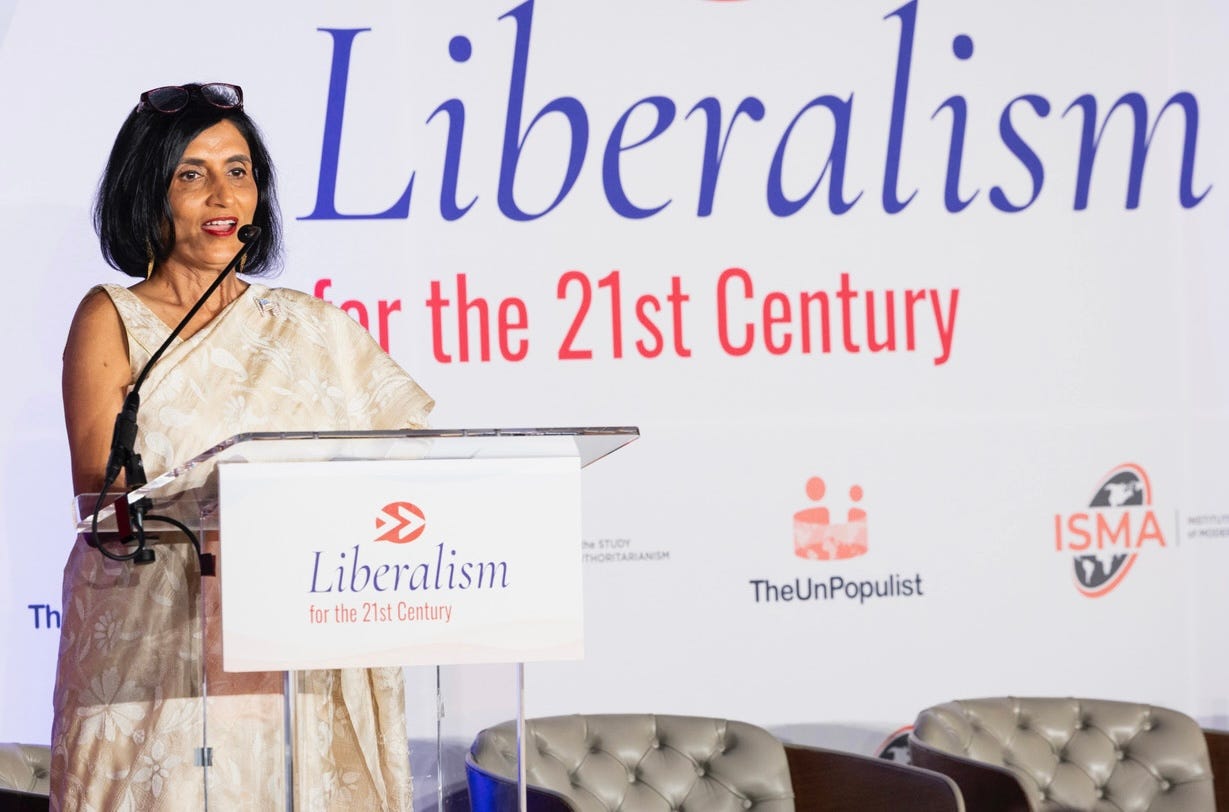
The following are Shikha Dalmia’s opening remarks today at the “Liberalism for the 21st Century” conference, which has been convened by the Institute for the Study of Modern Authoritarianism. The conference runs July 16–17, 2026. You can also read her opening addresses for LibCon2024 and LibCon2025.

Happy 250th, everyone. I don’t think I am being a technological pessimist in claiming that none of us here today are likely to be around to celebrate our personal 250th. But it is great to be here, in the capital—to celebrate this milestone of this extraordinary nation.
I am Shikha Dalmia, president of the Institute for the Study of Modern Authoritarianism and editor of The UnPopulist, a great substack devoted to defending a market-based liberal democracy that you should all subscribe to if you don’t already. Welcome to ISMA’s third annual “Liberalism for the 21st Century” conference, or LibCon2026 for hashtag purposes. Thank you all for coming. LibCon has grown every year since its launch, but we are especially moved—and humbled—by your response this year. We sold out weeks in advance despite adding capacity and had to turn away a long waiting list. Next year, don’t wait to sign up!
It is truly gratifying to see so many people from so far and wide. We have guests from Canada, England, continental Europe, Eastern Europe, Latin America, Hong Kong, other parts of the world and all over the country. We have here citizens—both heritage and naturalized—and noncitizens. We have conservatives, progressives, libertarians, and classical liberals. And bridging the rapidly growing cultural divide of the moment, we have brought together: vegetarians, pescatarians, paleos, vegans, keto fanatics, and pasta apologists. We have very good data on this divide given the dietary stipulations on your registration forms.
Our aim with LibCon was to replace the old left-right divide with a new liberal-illiberal divide and to build a global intellectual liberal movement without the illiberal extremes on both the right and the left. We wanted this movement to be powered not just by furrowed-brow intellectuals and pundits but people from all walks of life. We wanted diversity in all its resplendence—religious, national, ethnic, cultural, economic. We wanted all ages and all sexualities. Basically, anyone willing to set aside their policy quarrels and party allegiances and focus on the emergent threat of populist authoritarianism is our comrade. If you look around, you’ll see we are succeeding.
We are not here to endorse any party or candidate. We do not take positions in any electoral battle. We are here for one thing and one thing only: defend and advance the broad institutions and values of liberal democracy. In this endeavor, we are very grateful for the support of a host of diverse organizations: Hewlett has been ISMA’s mainstay; Packard has been particularly generous; Stand Together Trust has been with us since our inception; and Protect Democracy—especially our planning partner Justin Florence—has been invaluable. We’re thrilled to welcome MacArthur Foundation as a major sponsor this year, and deeply grateful for the Institute for Humane Studies’ liberalism.org’s support along with that of Kettering Foundation, Knight Foundation, and Johns Hopkins’ Agora Institute.
In the previous two years, LibCon’s gaze has been global—we’ve tracked the rising threat of populist authoritarianism in its many forms, examined how demagogues rally dark passions and capture institutions once in power, and we’ve responded to the postliberal ideologies providing them intellectual fuel. Many of their ideologists, incidentally, wouldn’t have had the luxury to sit around complaining about the boredom and meaninglessness of bourgeois life had it not been for the unprecedented peace and prosperity—and intellectual freedom—that liberalism provided.
This year, however, we will focus inward—at America—and forward—toward reconstructing its badly maimed liberal democracy and making it more resistant to future authoritarian assaults. This isn’t a solipsistic exercise: if we lose liberal democracy in the country where it was conceived and birthed, we’ll have little hope of saving it elsewhere—at least not for many generations. And not without things going terribly dark in ways predictable and unpredictable in the interim.
What happens in America doesn’t stay in America—it reverberates around the world. American liberal democracy has never been perfect, but it was the best the world had. As the University of Hong Kong’s Alejandro Reyes noted last year, “For decades, U.S. democratic ideals—however flawed or inconsistently practiced—served as a global reference point. America’s constitutional architecture, civic pluralism, and free press, though deeply imperfect, represented a kind of aspirational horizon.”
This aspirational horizon for others consisted of features Americans took utterly for granted. Until a few years ago:
The loser of an election accepts the results. He shows up at the Capitol steps for the peaceful transfer of power—the closest thing this country has to a sacred political ritual—rather than inciting insurrection or spending years beating the drum of a “stolen election.”
The law protects everyone equally, regardless of political affiliation or closeness to power—never weaponized against opponents or critics.
The rule of law holds everyone accountable—even the most powerful person on the planet, imposing real consequences for corruption and abuse of office.
The press functions freely and fearlessly, without being hounded by presidential defamation suits or DOJ subpoenas.
Expertise and tenure determine who keeps their post—not fealty to the strongman in power.
Individuals are granted due process—the core principle that keeps state terror at bay. No one is kidnapped by masked men, disappeared, detained, or deported to a foreign gulag without so much as a hearing. Armed state agents don’t kill first and make up fake stories later, something that has happened twice just in the past week.
Pulling out of international alliances or neutering the Voice of America has not done as much damage to liberal democracy abroad as America giving up on its own principles at home. America grew richer and more peaceful as it vanquished slavery and segregation—because it unlocked the potential of those stuck in an unfree and unfair system. We still need to do more to confront the legacies of the past. But the undeniable progress we have made has shown the world that oppression and exploitation are not the way to riches.
America’s rambunctious democracy has also been a beacon for holding corrupt rulers accountable. This hotel’s very name is synonymous with the idea that even the most powerful man on the planet isn’t above the law. Indeed, the Watergate scandal was a watershed moment against public corruption not in America alone but everywhere, inspiring journalists the world over.
Here’s a fun story: I was hired as a cub reporter at a national newspaper in New Delhi, India, right after college, in the heyday of the so-called non-aligned movement, when every serious person was a socialist and being pro-America was seriously uncool. I recall a conversation with a young colleague, both of us fretting about the sorry state of the Indian press. At one point, he channeled his inner Herbert Marcuse and said: “You know, there is no truly free press in the world—in the Soviet Union, government controls the media; in America, profit-seeking corporations do.” “So who are your journalistic heroes?” I asked. Without hesitation: “Woodward and Bernstein.” He couldn’t name a single Soviet journalist he admired; he went on to build a famous career as a commentator on a major, private cable channel that subsequently became the object of a hostile takeover by the prime minister’s rich lackeys.
Billionaires buying independent, private networks and replacing them with regime propagandists is a script that is now becoming familiar in America as well.
But before all this happened, America, the world’s most successful liberal democracy, provided the yardstick to judge other polities—not because it was the global hegemon, but because it was a global example. It didn’t need nation-building abroad to spread liberal democracy. It just needed to be itself.
If America could deliver enviable living standards while striving for social justice and equal dignity, Russian and Chinese autocrats had to explain why they needed to resort to brutal repression. America’s very existence forced them to justify themselves.
None of this depended on America being perfect. In fact, watching America face its defects was in many ways a more powerful example. Our civil rights struggle, our campaign against police brutality, our constant striving for a more perfect union—these have inspired democracy activists, human rights advocates, and anti-corruption crusaders everywhere.
America’s retreat from its liberal principles and practices has been profoundly demoralizing for all of them. When America brutally cracks down on anti-ICE protesters, reformers everywhere are put on the moral defensive, mocked as naïve idealists by their fellow citizens—and branded as anti-nationals by their government.
This is the exact opposite of what many of us thought would happen when the democratic world entered in 2005 what Larry Diamond called a democratic recession. We assumed that this recession would be short-lived. So long as America stood firm, like Atlas, the sheer force of its example would pull the world out of its authoritarian morass. Few of us expected that America itself was one golden escalator away from slipping into that morass, and that too at breakneck speed—a story our first panel will take up.
Still, although we are surprised, our Founders would not have been. They understood the American experiment wouldn’t be undone by external enemies, but internal populist demagogues, the great bane of democracies. The Framers used the word “demagogue” 21 times in the 1787 Constitutional Convention.
Alexander Hamilton was especially worried about them. He wrote to President Washington in 1792:
When a man unprincipled in private life, desperate in his fortune, bold in his temper, possessed of considerable talents … despotic in his ordinary demeanour—known to have scoffed in private at the principles of liberty—when such a man is seen to mount the hobby horse of popularity—to join in the cry of danger to liberty … it may justly be suspected that his object is to throw things into confusion [so] that he may “ride the storm and direct the whirlwind.”
Does that description remind you of anyone?
America’s constitution has no exceptional immunity to populist authoritarianism. What it has are exceptional antibodies to fight that infection—generated from the hard-won Revolutionary War, the bloody Civil War, the peaceful civil rights struggle, and the post-Nixon reforms. Those chapters built up America’s inner resources and resilience.
Here is why I’m optimistic authoritarianism will ultimately fail in America, even as it has been rapidly normalized in backsliding democracies like India, Turkey, Israel, Brazil, and, until recently, Hungary.
America Has a Native and Authentic Vocabulary Against Tyranny: Unlike the old world, where the state is a benign, paternal presence, here it has never been trusted as a friend, only tolerated as a necessary evil. Frank Fukuyama might say that sentiment goes too far. But that founding mistrust gave us an elaborate rights-based vocabulary that’s coming in handy now: the No Kings protests were swimming in placards quoting the Declaration of Independence, demanding respect for due process, invoking the First Amendment.
America Has an Opposition That is Flailing, But Not Failing: A demagogue poses an impossible prisoner’s dilemma for the opposition: play by the rules while he flouts them, and you lose; abandon the rules yourself, and you become just like him, losing your moral credibility. Either way, the demagogue wins. That dilemma, compounded by the usual disagreements over strategy, fractures and discredits an opposition. America’s opposition party, lord knows, has made its share mistakes and missteps—but isn’t finished, a spent force, like, say, India’s Congress Party. It’s flailing, but still in the game, standing. The flailing isn’t unusual; the standing is.
America Has Deep Pockets That Citizens Dig Into: America is not just a wealthy country—it is a generous one. In other backsliding democracies, activists often depend on foreign funding, which authoritarians can sever with a single stroke of a pen—as Hungary, India, and Georgia have all done. America’s robust civil society, a fruit of its republican spirit that so impressed Alexis de Tocqueville, doesn’t have that same level of dependency and vulnerability. Homegrown, independent, private philanthropy—from foundations to small donors—has quietly built an entire ecosystem, worth billions of dollars every year to defend democracy, that is much harder to choke off.
America Has Citizens Who Protect Neighbors, Not Look Away: Americans don’t just contribute their treasure to stop authoritarianism, they risk their lives. Protests exist in every backsliding democracy, but they’re populated by the persecuted groups directly affected and their advocates, not average citizens. But ordinary Americans rise in the immortal spirit of Harriet Tubman and her Underground Railroad. Renee Good and Alex Pretti paid with their lives for standing up for their immigrant neighbors. Also strikingly, during last year’s ICE crackdown in Illinois and Chicago, neighbors formed circles of protection around vulnerable immigrants. In open defiance of the government, they ran errands, delivered groceries, built rapid-alert systems to warn of ICE sightings.
That’s the true American exceptionalism.
But even if American liberal democracy survives this bout of authoritarianism—and I’m cautiously optimistic it will—we must ensure both for its sake and the world’s that we don’t face another one for at least another 250 years. You can’t “keep a republic” if you have to remain in a constant state of mobilization. And to avoid that, we cannot go back to the old status quo. Our checks and balances had eroded over time. Congressional power had weakened and the presidency was already reaching imperial levels, making it easier for a demagogue to swoop in. But simply repairing these branches will not be enough. We need to build a new foundation and more pillars—in short, a Reconstruction.
Authoritarians can destroy institutions; they can’t build them. Liberals must take up that job while the wreckage is still fresh enough to see clearly. Delay will put us down the same suicidal path that spelled the end of previous civilizations.
So, over the next two days, we will look at what it takes to reconstruct an executive branch that upholds the law over loyalty to a strongman, a Congress that governs rather than rubberstamps, and a court that refrains from handing abusive executives get-out-of-jail free cards.
We will confront the core issues driving our culture war that has poisoned our politics for a generation, seeking on free speech and immigration answers compatible with a liberal framework. And we will discuss how to keep Gen Z in the liberal column while reckoning honestly with the challenges that lie ahead: a party that condemns the abuses of executive power right now, when it’s out of office, but resorts to the same tactics when it controls the Oval Office—and an ousted party that will cry “weaponization” the moment it faces accountability.
The good news is that the American public seems to be waking up to the urgent need for reforms. ISMA’s second national survey of populist sentiment in America, conducted in late June, found not only that Trump’s hardcore populist supporters had declined by about a third, but that a likely reason was that they disapproved of his extra-constitutional exercise of his executive power. We’ll release the results next week, so stay tuned.
This Reconstruction, like the first one, will not be self-executing. It will have its challenges—but for the sake of this country and the world, we have no choice but to begin.

© The UnPopulist, 2026
Follow us on Bluesky, Threads, YouTube, TikTok, Facebook, Instagram, and X.
We welcome your reactions and replies. Please adhere to our comments policy.
How about adding a few items ...
"The press functions freely and fearlessly, without being hounded by presidential defamation suits or DOJ subpoenas" and also commits to tell the truth, the whole truth and nothing but the truth.
"Expertise and tenure determine who keeps their post—not fealty to the strongman in power", and not membership in a group which may or may not have been historically disadvantaged.
"The rule of law holds everyone accountable—even the most powerful person on the planet, imposing real consequences for corruption and abuse of office", and everyone agrees to uphold laws duly enacted by duly elected representatives, whether they agree with them or not, since the laws as enacted are a compromise, which all of us agree to make in a democracy, and this includes upholding immigration laws with which we may or may not agree.
Great opening remarks. I am looking forward as the panel discussions and presentations filter into our reading here at "The UnPopulist."