


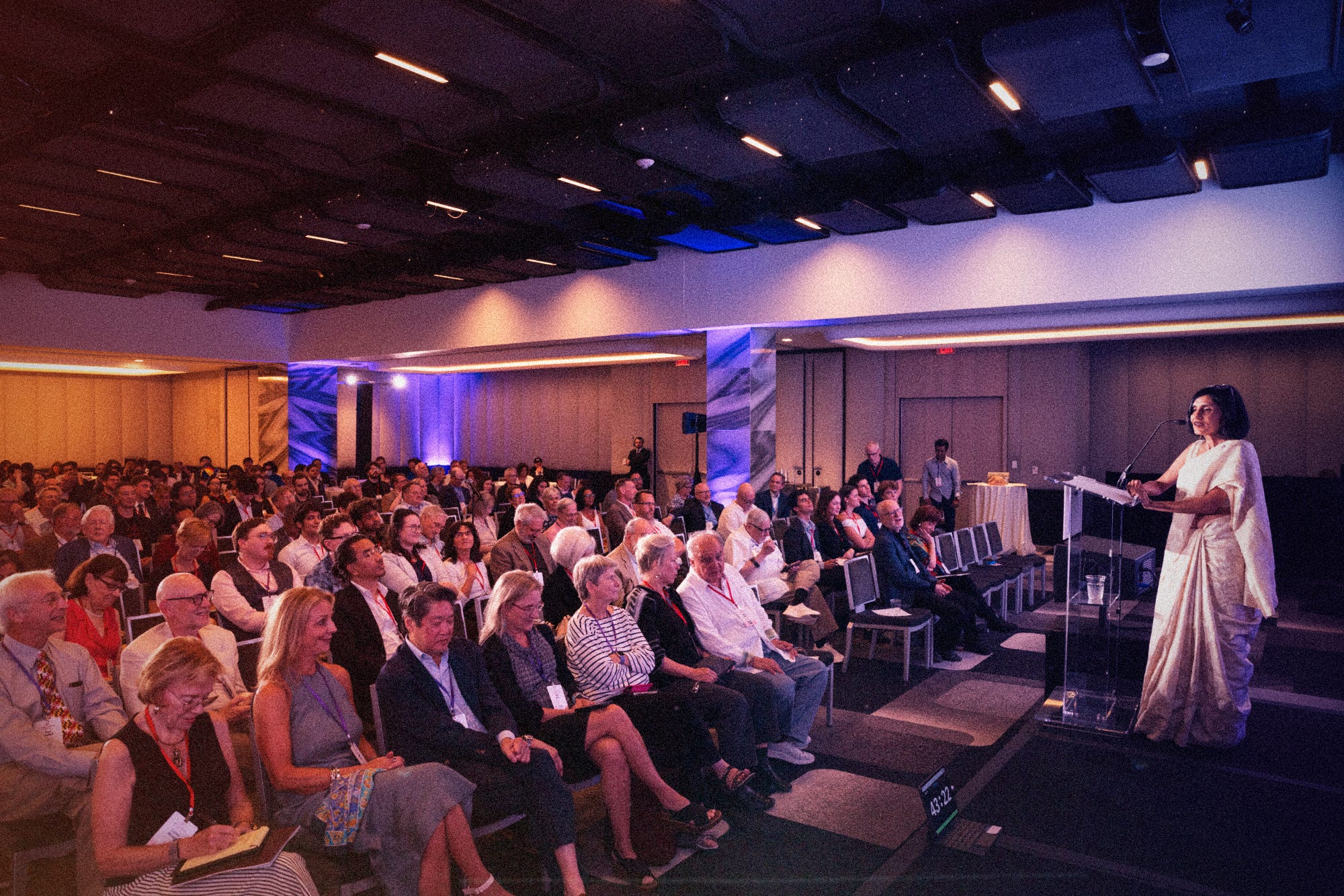
Last week, on July 16 and 17, the Institute for the Study of Modern Authoritarianism (ISMA) held its third annual “Liberalism for the 21st Century” conference in Washington, D.C. This year’s theme, the Reconstruction Agenda, took stock of the damage done to America’s core institutions as the nation marks its 250th anniversary and asked how we might rebuild confidence in the rule of law, the courts, and the other structures that liberal democracy depends on. Tickets sold out weeks in advance, and everyone from featured panelists to first-time attendees left the conference more resolved to keep fighting for liberal democracy.

One measure of how badly LibCon is needed: we’ve gotten request after request to keep the conversations going. So we’ll soon be launching a Discord channel where you can join in and keep the discussion alive. Stay tuned.
LibCon2026 was a great success—but don’t take our word for it. Here’s a sampling of the reactions we’ve received.

Alex Abdo, litigation director at the Knight First Amendment Institute at Columbia University, said:
The conversations at LibCon gave me hope in our ability to work together to mend our democracy. For a day and a half, we focused not on what divides this country, but on a shared commitment to self-government that should unite it.
Danielle Allen, James Bryant Conant University Professor at Harvard University and author of the Renovator newsletter, wrote:
Loved the chance to learn from people who have fought authoritarianism elsewhere. Loved to see how the community ready to defend liberalism is growing bigger and more confident.
Anne Applebaum, staff writer at The Atlantic and Pulitzer Prize–winning author of Gulag: A History, said:
There’s nothing more important than seeing, in real life, the people you read and follow online. This conference makes so many meetings like that possible.
Zack Beauchamp, senior correspondent at Vox, said:
LibCon is always one of my favorite events of the year, and 2026 was no exception. There’s something vital about being in a space where other people are asking the same questions that you are, and hoping to find the same kind of answers. An irreplaceable new fixture of the calendar.
Steven “Destiny” Bonnell, liberal streamer and commentator, said:
I enjoyed the conference a ton! It’s always awesome to gather a bunch of like-minded people together who are solidly liberal without constantly having to caveat statements for more radical elements to find acceptable. It was also awesome to have a bunch of people in the same area focused on how to fight the current administration, without just blindly accepting the large, populist front that America is confronting right now.
Linda Chavez, vice chair of the Renew Democracy Initiative and host of the podcast Older/Wiser, said:
“Liberalism for the 21st Century” drew from some of the best minds in the world to address how to preserve liberal democracy here and abroad. But what was particularly refreshing was that it introduced new, young voices who will lead the next generation, including human rights activist Nathan Law who fled Hong Kong when China targeted him for his role in leading protests there. Participants and presenters stretched the philosophical and political spectrum, but their common point of agreement is that liberal democracy is at risk in the United States under Trump and around the world.
Kristie De Peña, president of America’s Competitive Edge, told us:
What stood out to me was how rare it’s become to sit on a panel with people I don’t agree with on everything and still walk away with a genuinely constructive conversation. That’s exactly why conferences like this matter: liberal democracy is only as strong as its ability to hold together people who arrive at it from different directions.
Renee DiResta, an associate research professor at Georgetown University's McCourt School of Public Policy and author of Invisible Rulers: The People Who Turn Lies into Reality, said:
I had a great time, it was a thought-provoking event as always, with bold and brave speakers. I particularly loved that you had the streamers and alt-media there.
Laura K. Field, senior fellow at the Niskanen Center and author of Furious Minds: The Making of the MAGA New Right, wrote:
For many decades now liberal democracy has been taken for granted, and so it has become stagnant, inarticulate, and vulnerable. Today it is under siege all around the world. The “Liberalism for the 21st Century” conference brings together a burgeoning group of people, from all over, who recognize these problems and are fighting for liberal reconstruction and renewal, for big-tent coalition building, and for a better, free and equal future for all. I’m so grateful for the work Shikha and her collaborators are doing. 2026 was the best LibCon yet.
David French, opinion columnist at The New York Times and author of Divided We Fall: America's Secession Threat and How to Restore Our Nation, said:
LibCon is like a family reunion for defenders of American liberalism and pluralism. It is the singlemost important and unifying gathering of the year for the cross-ideological coalition that’s defending American democracy.
Justin Florence, co-founder and managing director of Protect Democracy, said:
The conference reinforced how deeply broken our political system is, and how much work we have to do in order to build a truly representative democracy. That will require developing fundamentally new and different institutions—and getting comfortable moving away from old norms and assumptions. We’re not going to return to the democracy of 2016 or 1996, so we need to get creative about how to achieve the more perfect democracy we want to see by 2036 or 2046.
Erica Frantz, associate professor at Michigan State University, said:
Despite the divisiveness of today’s times, events like LibCon offer an important reminder that liberalism is an ideal that we can all get behind. It could not have come at a more critical moment.
Elizabeth Goitein, co-director of the Brennan Center's Liberty and National Security Program, said:
Working in the pro-democracy field these days can feel like constantly putting out fires. This conference gives us the chance to slow down and think more deeply about the principles animating the work. I’m grateful to ISMA for that opportunity and for the many meaningful connections I made.
Robert Guest, deputy editor of The Economist, offered:
Liberal democracy is under siege. The way to save it is to persuade people that it is worth saving. That’s why liberals of all stripes need conferences like LibCon. By stress-testing our arguments, we can prepare for the struggle of our lifetimes. Also, the canapés were great.
Aziz Huq, Frank and Bernice J. Greenberg Professor of Law at the University of Chicago Law School, said:
At a time when knee-jerk skepticism about vital ideals of free speech and toleration, LibCon worked as a place to reaffirm, celebrate, and advance the things that make it possible for our diverse American communities to live together.
William Kristol, editor-at-large at The Bulwark and host of the Conversations with Bill Kristol podcast, wrote:
I’ve gone to a lot of conferences. But from its intellectual quality to its spirit of liberty, this was one of the best.
Jacob T. Levy, Tomlinson Professor of Political Theory at McGill University, wrote:
LibCon gets better and better at bringing together people in the broad pro-freedom coalition across differences: different generations, different particular ideologies, different strategic visions, and different professional approaches to politics, movements, and ideas. This year saw the most-ever younger grassroots activists as well as the most-ever leaders in freedom movements from around the world. It offered an important moment for thinking together about possibilities for a better future.
Felix Maradiaga, president of the World Liberty Congress and Professor of Global Democracy at the University of Virginia and Johns Hopkins University, said:
Much of the global democratic backsliding we are living through traces back to ideological polarization, which corrodes the civic dialogue that every liberal democracy depends on. That is exactly why liberalism—in its precise sense as the defense of individual liberty and free markets, but also of tolerance within genuine pluralism—is under such heavy attack from both extremes. In an illiberal climate so hostile to civic debate, LibCon was a breath of fresh air. It brought together a wide community of people who do not agree on everything, yet who share the essential commitment to defending the founding principles of liberal democracy.
As president of the World Liberty Congress, a global network of dissidents and pro-democracy leaders from the world’s most closed societies, I found in the LibCon community a natural ally in the work of combating polarization and rebuilding the pillars of a free society. You can count on me personally, and on our organization, to help this community grow. It matters not only for liberalism but for the future of democracy itself.
Jan-Werner Müller, Class of 1943 University Professor of Politics at Princeton University and author of What Is Populism?, said:
No liberalism without respect for pluralism. It’s essential to have an event during which, against the backdrop of a common purpose, one can sincerely and with due seriousness explore disagreements and conflicting views about a post-Trump America.
Gregg T Nunziata, executive director of the Society for the Rule of Law, said:
At a moment when our liberal traditions and constitutional system face extraordinary challenges, it’s more important than ever that people with differing political perspectives engage seriously on how to restore checks and balances, strengthen the rule of law, and renew our constitutional institutions. This conversation reflected the liberal tradition at its best: a commitment to reasoned debate amid profound political disagreement and a shared determination to preserve the constitutional order that makes democratic self-government possible.
Walter Olson, senior fellow at the Cato Institute, wrote:
One of the most important messages a conference like this can send is: You are not alone. Not alone in wanting to cooperate across old ideological lines. Not alone in looking for fresh inspiration, talent, and ammunition in the battle for liberal principle. Not alone in wanting to glimpse what might come afterward if we win.
Devin Pendas, professor of history at Boston College, said:
This was my first time attending LibCon but it will not be my last. It brought together a remarkable group of speakers to analyze and discuss where we are as a nation, how we got here, and how we might do better moving forward. It was political without being partisan, thoughtful without being dogmatic, and provocative without provoking offense.
Bob Rae, former Canadian ambassador to the United Nations, said:
It was great to hear so many encouraging stories about the vision and energy behind the American fight, as well as the connection to so many global challenges.
Jonathan Rauch, senior fellow at the Brookings Institution and contributing writer for The Atlantic, wrote:
The range and quality of the presentations and conversations at LibCon 2026 were exceptional. Presenters came from Hong Kong and Poland and many places in between; public intellectuals shared platforms with activists and strategists; younger people, including Gen Z, showed up in force. The side conversations and networking were just as rich. Best of all, for me, was the reminder that liberalism is still generating energy, innovation, and inspiration.
Aaron Reichlin-Melnick, policy director at the American Immigration Council, said:
It was a pleasure to be surrounded by so many people who understand the importance of grounding policy in our shared vision of an America that respects its foundational values and ensures that due process matters.
Adam Serwer, staff writer at The Atlantic and author of The Cruelty Is the Point, wrote:
I was struck by the broad ideological coalition of people at LibCon who fall under the anti-authoritarian banner. As grim as the times may be, there is something hopeful about so many people who disagree substantively on so much nevertheless coming together to reassert the importance of principles like democratic self-determination, due process, equality under the law, and free speech.
Manisha Sinha, the James L. and Shirley A. Draper Chair in American History at the University of Connecticut, said:
Very rarely do I get a chance to be in a room not just with academics but public intellectuals, those involved in the non-profit world, politicians, and journalists and this conference was unique in bringing together these different constituencies for a common purpose. What stood out to me was how many different thought leaders and activists are committed to upholding our democracy and the rule of law at a fraught time in the American republic’s history. I left the conference far more hopeful than I came to it, and I am grateful to The UnPopulist and ISMA for facilitating this important conversation.
Sonja Trauss, executive director of YIMBY Law, wrote:
LibCon 2026 was an incredible collection of interesting and accomplished people. Anyone who appreciates the pillars of liberalism—free speech, due process, pluralism—and is inspired by the story of America’s founding should come next year, even if they’re not sure what role they would play in a movement to protect and restore our Constitution. LibCon and The UnPopulist are important elements of the mission before liberals today: creating an attractive, hopeful, and exciting political identity around the principles that animated the creation of our nation. Luckily, for tens or hundreds of years, this political identity wasn’t necessary, because these principles were so widely shared they went without saying. But now they’re under attack—or in dispute—and it’s time for people to reclaim the label.
Stan Veuger, senior fellow at the American Enterprise Institute, said:
LibCon is a great forum to discuss the nation’s most challenging problems. It brings together an ideologically diverse group of friends of liberal democracy with a genuine desire to understand the issues and find common ground.
Kathrina Szymborski Wolfkot, senior counsel and manager of the Brennan Center’s Judiciary Program and managing editor of the Center’s State Court Report, told us:
One thing I found incredibly valuable was the diversity of thought among the attendees. I heard a wide-range of opinions on the paths toward true freedom, equality, and inclusion—I chatted with professors, folks from places like Cato, a former Polish justice minister, 21-year-olds brimming with anger and disillusionment (an important perspective that I don’t always get firsthand), and everyone in between. For me, the opportunity to talk to young people looking for solutions was perhaps the most illuminating and inspiring part.
Cathy Young, writer at The Bulwark, wrote:
As always, I’ve been incredibly impressed by the diversity of viewpoints and perspectives offered by LibCon. A wide range of people with different and sometimes conflicting ideas, all united by their passion to preserve liberal society at a time when its survival often seems to hang in the balance. It’s a great place to encounter thought-provoking ideas—and talk to other people who share that passion!
That enthusiasm wasn’t confined to the prominent guests or the people on stage. Our younger attendees found a conference that matched their energy.
Kevin told us that he loved the atmosphere and that he grew “both intellectually and professionally” from the event.
Cameron was “blown away at the size of our coalition in support of liberal democracy,” reassured to see that liberal thought “is alive and well in America.”
Shea called it “a wonderful reassurance that liberalism is being championed, studied, and protected by so many people.”
Rafi said he relished the chance to talk to “multiple types of people we may have never gotten to speak” with otherwise.
Art was struck by how the conversations on authoritarianism resonated with volunteers “who come from different cultural backgrounds.”
Whick praised an event whose energy and “real defenders of liberal values” made clear the void left by the Trump administration wouldn’t be filled by “equally pernicious actors”—adding, simply, “I cannot wait for next year.”
And for at least one first-time attendee, the panels were only half of it—the real draw was “talking to people between the panels and at my table,” disagreeing at times but discovering, as this attendee put it, “the beauty of liberalism.”
This echoed the sentiments from some of the recaps already out. Kevin D. Williamson’s beautifully written dispatch for … well, The Dispatch, ended on a hopeful note: “Here I am—and here we are—looking for alternatives and allies. And this, I am more confident, is the beginning of something rather than the end of something.” Daniel Drezner’s recap was a touch more skeptical about whether a reconstruction agenda exists that can “get the blood pumping in the public sphere,” but he too found reason for hope on the ground: ordinary Americans, he wrote, have turned out to be “a little more democratic and liberal than elites feared.”

This was only a sampling of the reactions we received. The common thread? LibCon2026 did exactly what it set out to do: bring together the world’s leading liberal thinkers, journalists, advocates, and everyday citizens to chart a course forward for liberal democracy at a moment when it needs defending more than ever.
And we had a blast doing it!


Stay tuned for more content from LibCon2026.

© The UnPopulist, 2026
Follow us on Bluesky, Threads, YouTube, TikTok, Facebook, Instagram, and X.
We welcome your reactions and replies. Please adhere to our comments policy.
Fantastic theme and speakers. Will there be a replay of some of the speakers or transcripts for those who couldn't attend?
LibCon2026 is receiving rave reviews for bringing together insightful discussions, fresh ideas, and a highly engaged community. The event has created plenty of excitement among attendees and continues to generate positive conversations. Those interested in related property information can also explore https://shelbycountypropertyappraiser.org for useful resources. Overall, LibCon2026 appears to be making a strong impression and setting a positive tone for future events.