

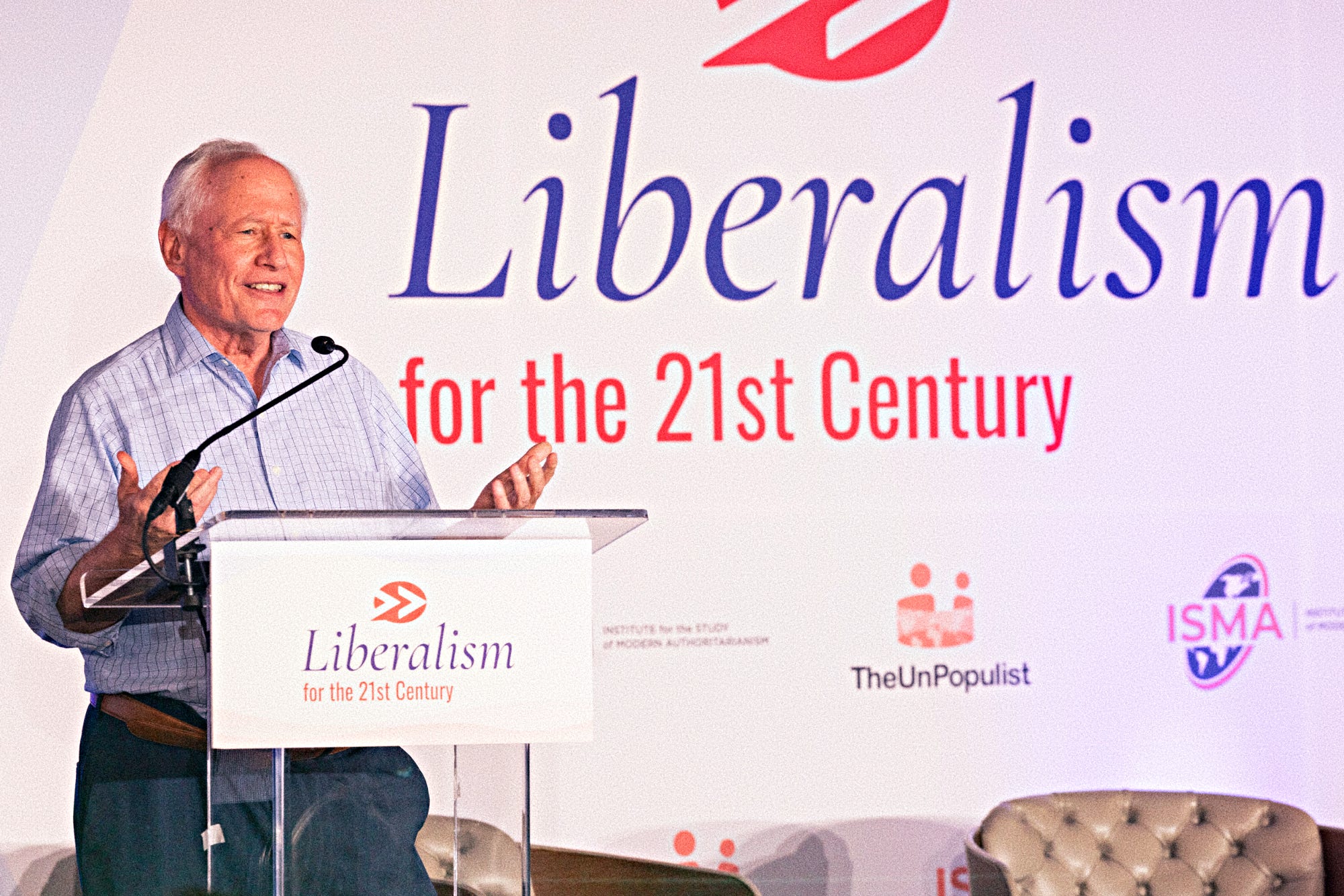
To close out a wildly successful LibCon2026, ISMA board member Bill Kristol reflected on the last 18 months of authoritarian consolidation. He lauded the resistance effort to Trump that has held up far better than he expected it to, offering hope that American liberal democracy will survive this moment.
Below is the video and a lightly edited transcript from Bill’s address.
For more from LibCon2026, check out our YouTube channel, and this playlist in particular.

Bill Kristol: I’m Bill Kristol. I’m at The Bulwark. I’m also a board member of the Institute for the Study of Modern Authoritarianism, which put on this conference. I’m really proud to be associated with ISMA. I think being a board member’s good, but you don’t have to do very much work. Shikha does all the work, and the others who work there and volunteer there do the work.
We should thank them for putting on a really terrific conference.
We should also thank the excellent panelists. I had a talk in Chicago last night that I couldn’t get out of, so I flew in this morning pretty early. But then I ran into some of the people I knew, or knew of, or followed on Twitter, or where they followed me, or they didn’t know me but were interesting … that I ended up spending much of the conference in the hall, which is good, actually, and cheered me up. Because it seemed like things had gone very, very well here, just judging from their conversations. And part of the point of this, obviously, is to let people meet each other and talk and exchange ideas informally, as well as the panelists. But I do want to thank the panelists—so many of whom came from far away and have really contributed a lot. And thank all of you for coming.
I’ve been to too many conferences over the years, and I’m a little bit of a conference skeptic, I’d say, generally. So when Shikha three, four years ago said, “I want to do this annual conference,” I was a little, “Eh, The UnPopulist is great … podcast is great. Why don’t you just keep on doing that?”
But I was wrong.
I mean, the human contact—in real life, as they say—really matters. And I think Shikha’s certainly been vindicated in her vision for this. So again, thank you all for coming.
Fear not, I am going to be very brief. There’s been a lot of talking that you’ve been subjected to, and it’s getting kind of late. Shikha asked me to reflect on where things stand in a very, very brief wrap-up. Then I’ll say a word about why I actually do feel cheered up by the conference.

The way things stand, I think the authoritarian threat is a little worse than I expected, or has progressed further than I expected. And I was pretty pessimistic in the second term! So I think the notion that, because Trump’s approval numbers are down—which is good—and because they’ve messed up various things—which is good—and because he’s 80 years old and is narcissistic and kind of foolish about various things, and indulges in various conceits, which probably don’t help him in his project—that’s good.
But all in all, the threat is real. I think there’s a bit of a tendency in some of our circles to miss the forest for the trees on this, and think that, because [Trump’s] speech last night [about China’s alleged interference in the 2020 election] was kind of a bust, it doesn’t mean that it’s still not one step in an attempt to subvert our elections. And that attempt is broad and deep.
When I was in government, there was this phrase that had recently become fashionable: We need to address this with an “all-of-government policy,” “all-of-government solution.” And it doesn’t mean anything except we, all parts of the government, should work together on rebuilding Kuwait after the 1990-91 war, or helping Eastern, Central Europe after the Cold War. That’s how long ago I was in government.
Now, Trump has flipped that, though. They have an all-of-government assault on liberal democracy: on democracy, on respecting election results, on the rule of law, on political and civil liberties, on telling the truth about our history. And it’s happening all over the place.
The truth is, the federal government is powerful. The executive branch is powerful, especially when Congress doesn’t check it, when the president controls entirely the party that, for now at least, is the majority in Congress. Courts can do some good, and are doing some good, especially at the district court level, but that’s reactive and limited in all kinds of obvious ways. Just the body weight of the authoritarian effort worries me—having the Justice Department, and the Department of Homeland Security, and parts of the Department of Defense, and everything down to the United States Postal Service and the Federal Communications Commission, and all these kind of not-important or not-central parts of the government, but they’re all on board, and they’re all doing their bit. And it adds up. And the amount of actual oppression—but also intimidation, and sort of second-order effects of suppressing opposition and dissent and challenges, shouldn’t be minimized.
So I’m, on the one hand, worried about the real threats to our freedoms and to our democracy. But again, we shouldn’t exaggerate it. They’re not 10-feet tall. They’ve had setbacks, but we should be concerned.
I would also say, just outside of government, they’ve been pretty shrewd about co-opting huge institutions—especially businesses, but also parts of the media. Also, intimidating institutions that they thought would be hostile, and were hostile, like universities, and made them much less forceful, I would say, in many cases, in standing up against the administration’s efforts. Or where they stand up, they do it quietly—who needs to be the first to pick a fight?

And, look, I respect that—these people have their own institutions to worry about. But the net effect of that is that the authoritarianism is both deeper within the government, broader across the government, but also comes out from the government and affects many other institutions in this country.
So in that respect it’s been a bad 18 months. We’ve never seen anything like this in modern America. We’ve seen it at the state level, obviously, in the South, especially on race, but not as a national, all-purpose kind of assault on our liberties.
The final point I would say that’s worrisome is that while the public has reacted against it in the second term, in an important way (I’ll come back to that in a second), elites have not really reacted particularly forcefully, in my opinion. I don’t see a heck of a lot of people who say, “I tried to get along with Trump early on, but I can’t deal with him now.” There’s a little bit of that—a few law firms worried, but they’re not willing to be quoted on the record. Maybe some businessmen that were so great to give millions of dollars to every stupid project to try to curry favor [are] privately a little uncertain. But mostly, they seem to be continuing to do that.
Elites were worse than I expected, I’d say, in America. The public was—is actually— okay.
Trump won 50% of the vote—18 months later, he’s got 40% approval, basically. So that’s 10% out of 50%—losing that, that’s a lot. One in five Trump voters, almost by definition, disapproves of what he’s done as president in the second term. Now, there are other things they’re upset about besides democracy, obviously: prices, the war, and all that. But I think people underestimate how much the underlying anti-democratic, anti-liberal, but also just anti-the-basic-virtues Danielle [Allen] was talking about, like honesty and decency … how much that has led to that erosion of Trump’s support among the public.
Ranging from issues like immigration, ICE, where Trump was so strong allegedly at the beginning … and I remember being at all these events a year ago speaking to Democratic donors—not the people I hung out with for most of my political life—and they were being told by these operatives, “Okay, we gotta stay away from the immigration issue” early on. That was when Trump was getting the money for ICE and announcing the crackdowns, but stuff hadn’t happened yet the way it has now. “That’s not a good issue for us.” It was really such a childish view of politics, first of all. And I remember having to explain to them: “You know, if Trump starts at 60% on an issue and you knock him down to 50%, that’s as important politically as finding an issue where he starts at 45% and you knock him down to 35%.” It’s maybe not quite as important for various reasons of what issues people vote on, but it’s not unimportant.
Karl Rove—whom I otherwise am not on great terms with—used to say this: “You should go after the opponent’s strongest issues as well as his weakest issues. It’s important to reduce his strength on the issues where he is strong, as well as to exploit his weaknesses.” And that’s something that Democrats, for whatever reason, were very scared of after ’24.
I think we’ve seen that on other issues as well. But I think there, Democrats did step up—events happened, people saw what was happening, and they didn’t want it. So I think the public turns out to be a little more democratic, a little more liberal, a little more interested in decency and honesty and basic liberties than I feared. I wish it were more than 60% of the public, but at least 60 is better than 50.
If you wanted to do a thought experiment: What if Trump’s approval were 55% now? Which, incidentally, is not a ridiculous proposition. The economy’s been decent for his presidency. We fought a very stupid war in Iran, but the military casualties have been minimal across his presidency. It’s not like we’re in the middle of Vietnam, or even Iraq, right? And yet the country—most people aren’t being bothered too much, in their day-to-day lives, by all the things that bother people in this room quite a lot. And yet 10% of the public, 20% of his supporters—10% of the public—has deserted him. What if they hadn’t? I mean, we would really be in trouble.
The other thing I would say—this sounds impolite, but I’m not Danielle [Allen], I can say this—we’re lucky that Trump is 80 years old. Really! I mean, if Trump were 55 years old, it would be very, very, very, very different. There’s zero chance he wouldn’t run for a third term. There’s zero chance the Republican Party would deny it to him—I think there’s a limited chance the courts would actually step in forcefully, or Congress, for that matter. And then we’re in a whole different—Orbán (Orbán 2014, not Orbán now) or Putin (in the early part of the century)—type situation.
I’m not sure he won’t do it or try to do a version of it with family members and others who are totally indebted to him, and some are semi-controlled by him—but I think it’s harder just because of his age. So that’s kind of one piece of good luck we have, in what hasn’t been a great 10 years of good luck.
But having said all these somewhat depressing things, such as that the authoritarianism is strong—the resistance is also strong. I mean, the way I think of it is both forces have been stronger than I expected. The authoritarian effort has been stronger, and the popular liberal-democratic resistance has actually been stronger. The main evidence for that is obviously the polls, but there’s plenty of actual empirical evidence—ranging from popular mobilization, No Kings sorts of things, to conferences like this, the more elite efforts, if you want to call it that, to revive liberalism, people coming together from different past persuasions in a pretty good way, honestly, a pretty seamless working together, at least in the things I’ve been involved in, but also a certain amount of arguing, which is totally good and legitimate.
I don’t think you look at this opposition and think, “Oh my God, they’ve become Trumpy in their opposition”—mostly you don’t think they’ve become too dogmatic or unwilling to criticize each other. It’s good, actually, that there remains that willingness to do that. So I think, in that respect, the opposition has a fair amount to be proud of, actually.
This conference has been about the reconstruction side of things, which is awfully important, and really has to be addressed side by side with the resistance side of things. But I would say that, on the resistance side, there is a tension: resistance is where the rubber hits the road, and where you can’t give up your principles, and even your views and preferences about policies. On the other hand, you do have to work together in constructive ways. And that’s been true of resistances throughout history, and it’s always been a challenge.

The reconstruction stuff, in a way, is not easier—in practice it could end up being even harder—but I think it’s psychologically easier to get into that kind of thing. It’s fun: Here’s my pet proposal for reforming health care. Here’s my YIMBY housing thing, or whatever—and that’s great, and I’m going around pushing it. It’s sort of an upbeat thing to do. Resisting, one after another, these authoritarian thrusts and efforts, and doing so in alliance with people you didn’t know well a few years ago, and you disagreed with on a bunch of things, and you still find slightly odd sometimes when you work with them, and they find you odd, and your work habits and assumptions and stuff. The resistance has been an impressive thing.
So the authoritarianism is more dangerous than I expected. The resistance has been more impressive, honestly, than I expected. And here we are. I don’t know where this all ends up. I’m moderately, mildly optimistic, but I don’t want to also sugarcoat it.
I thought I would end by actually reading something. So, on this question of the resistance—well, just one word: really, this kind of conference, with people from different backgrounds, of different views and different generations, genuinely trying to think—to argue—both to be tough in terms of what we oppose, but to be constructive in terms of what we would like to see, and to be willing to argue with each other and among each other—but also have these arguments in a civil way—make clear that there’s a bigger picture in which we are not united exactly, really but are part of a coalition of resistance and opposition that cares a lot about the fundamentals of this country and of liberal democracy … I think that’s awfully important and impressive. I personally have been buoyed and cheered up by being here. And that’s not nothing when engaged in these struggles.
I thought I’d read something that captures, I think, both what I feel, but also what I think we all should feel. James Carville wrote a piece for The Bulwark. Because I know James, and I’ve known him a long time, he called up and said, “I want to write a piece.” It was October 2020. It was his idea. And he wrote it in his voice. The Bulwark was much smaller than it is now, and he wanted to put it in The Bulwark, not because he had to—obviously James can get a piece into The New York Times, or wherever he wants, basically, at any time—he wanted this to be in The Bulwark.
And the first part, which I won’t bother you with, is sort of … “it’s great that all these people I’ve debated for years, like Kristol and everything, and disagreed with, and fought against in election campaigns—it’s great that we’re all working together.” And that’s all true and fine. But then James goes on to say—let me find this here—he talks about the movement of the moment, why, for him, this has been such an important moment.
And he says: “What this moment has done for all of us—for all of us who maybe have never been presented with such a grave threat as we now see—is that it has given us, for this moment we’re living in right now, a sense of common purpose. Common purpose”—and then it gets a little florid, but still, nice—“common purpose of which we will be able to recall forever that when our country and our republic were on the brink of collapse, when our fellow Americans needed us, we took a blowtorch to our past differences, our former conflicts, and our old rivalries, and we fought together.”
And then James continues: “In less than two weeks, I will be 76 years old”—a little older than I am—“I was a boy raised near some of the poorest banks of the Mississippi River.” (I was raised near the banks of the Hudson River—very similar background, really.) “And I’ve now had the overwhelming honor,” James says, “to help elect senators, governors, my friend Bill Clinton as president of the United States. I’ve seen my face flash across the silver screen, and I’ve flown around the world practicing the profession I love.” And he’s got this nice ending: “All of this was wildly unimaginable,” he says, “to that little boy skipping rocks in Louisiana 70 years ago. But as I sit here, wonderstruck in retrograde, I can say, with certainty, that in all my years, joining in this crusade to take America back from the brink of destruction is the greatest thing that I have ever been a part of in my life. This crusade is something noble.”
I remember how moved I was when I saw the piece. I remember thinking: You know? That’s right—we’ve all been involved, and some of us who are older have been involved, and some of you who are younger will be involved in interesting things, and we hope important things, meaningful things … but I really do feel like this moment—the fight we’re in at this moment—is, as James says, a noble crusade.
And we should be proud of it. Thank you all for coming.
© The UnPopulist, 2026
Follow us on Bluesky, Threads, YouTube, TikTok, Facebook, Instagram, and X.
We welcome your reactions and replies. Please adhere to our comments policy.
Good speech! If I had been there I would probably be pestering, "Hey! why did you want to invade Iraq so much??" But I certainly appreciate your support of democracy wherever it is under threat, whether that be Ukraine or the United States.