

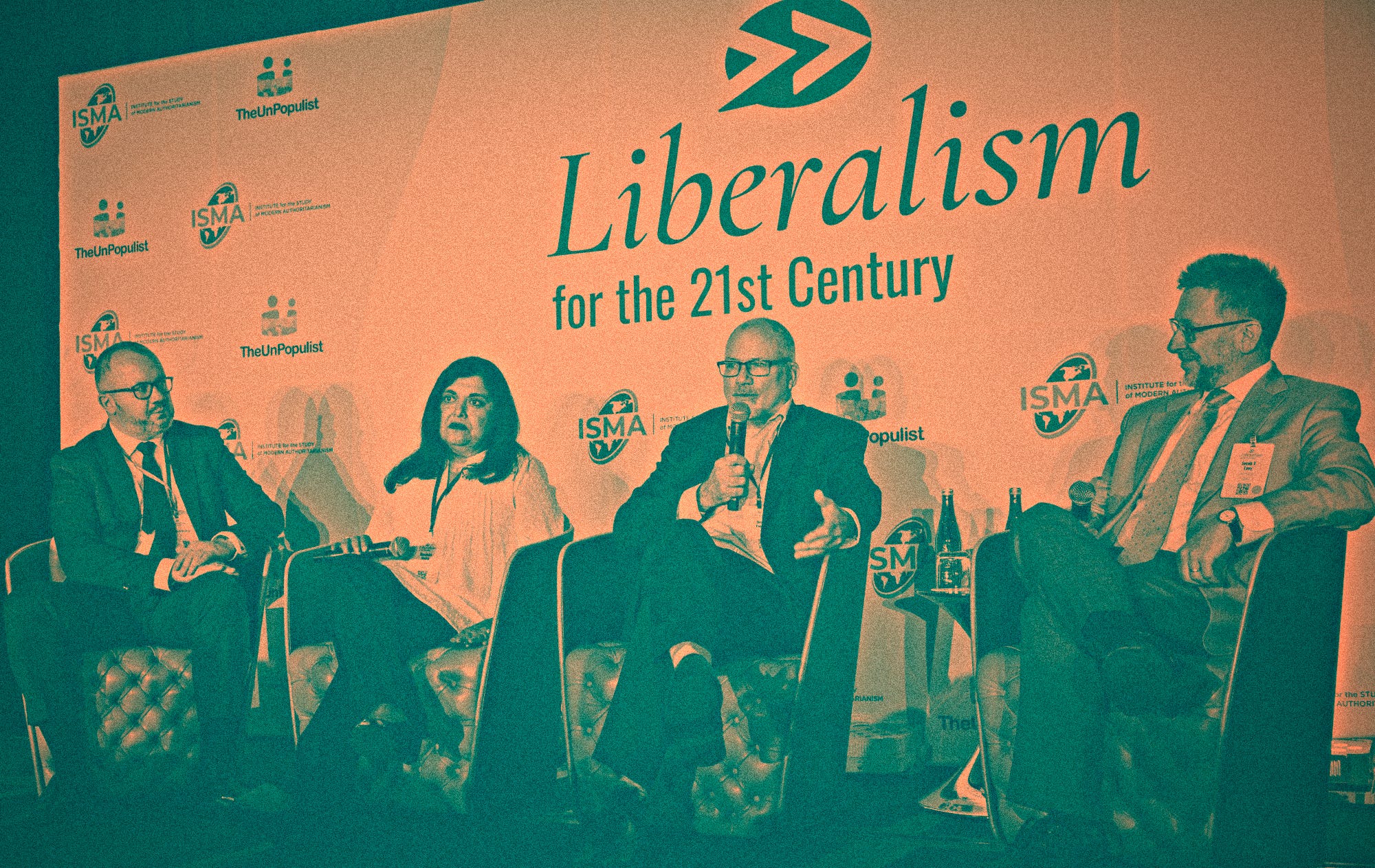
Today, we’re sharing the full video and transcript of LibCon2026’s panel “Past Liberal Crises and Lessons: Overcoming Hurdles to Reconstruction,” including the Q&A with the audience that followed. The panel was moderated by McGill’s Jacob T. Levy and featured UConn’s Manisha Sinha, Boston College’s Devin Pendas, and Adam Bodnar, Poland’s former minister of justice. You can find every LibCon2026 session on our YouTube channel, and we’ll continue posting the videos and full transcripts right here at The UnPopulist.
The transcript has been lightly edited for flow and clarity.

Andy Craig: We’ve talked a lot about what needs to be done in terms of reconstruction and rebuilding liberal democratic institutions, but a key piece of that is accountability for the abuses, for the crimes—not just for the sake of justice, as important as that is, but because it’s important to reestablish deterrence.
I’m a big believer in the value of comparativism, which our moderator will no doubt provide some perspective on. We wanted to look at some of the historical examples that are important, trying to find not just what worked but also what didn’t work, and what is driven differently by the different circumstances we face. Obviously, we’re not entirely in the same situation as all of these historic cases of needing to handle transitional justice and reconstruction, but there are some important principles we can derive and also some important errors to avoid.
In running down that spectrum, the one that obviously comes to mind for Americans—and the word a lot of us have been bandying around—is Reconstruction. To cover that angle, we have Manisha Sinha, the Draper Chair in American History at UConn and one of the foremost historians of Reconstruction. Her most recent book, The Rise and Fall of the Second American Republic, extends Reconstruction all the way to 1920, looking at not just the moment we think of in the 1860s and 1870s, but how that whole framework rose and, unfortunately, fell. That speaks to both the things to emulate and, hopefully, the things to avoid as we’re looking forward.
Another big example that comes up, particularly if you spend time on Bluesky instead of Twitter (which is my recommendation), is Nuremberg—what happened in 1945. Obviously, we are not living through, thankfully, something as extreme as that, but there are important lessons. To address that, we have Devin Pendas, professor of history and of law at Boston College and a leading historian of transitional justice. His works include The Frankfurt Auschwitz Trial and Democracy, Nazi Trials, and Transitional Justice in Germany, 1945–1950. I think that’ll be an important perspective for this discussion.
The other big example, of course, is what happened in Eastern Europe after the fall of communism and the Berlin Wall. For one thing, it’s the most recent of these examples, so we have somebody with actual practical experience with it—in particular, with the system of lustration laws that a lot of these countries brought in to provide some measure of accountability for people who were involved in the secret police and the human rights abuses under communism. For that, we have Adam Bodnar, who served as Poland’s minister of justice and prosecutor general from 2023 to 2025 and, before that, as the country’s commissioner for human rights. He has real practical experience in dealing with this.
Last but not least, we have our moderator, Jacob Levy, a good friend of The UnPopulist, the Tomlinson Professor of Political Theory at McGill, and, most recently, the author of Rationalism, Pluralism, and Freedom. He will be leading our discussion. Over to you, Jacob.
Jacob T. Levy: In addition to the three cases that Andy just mentioned, I’m going to hope that our conversation also includes more recent cases in which Adam has direct experience: transitions in the course of competitive authoritarianism. We want to pay attention not just to 1989, but also to the parties that win elections and take power after, or sometimes in between, the terms of authoritarian parties.
One reason in particular for us to spend some time with that is that the other cases on our agenda here—Reconstruction, post-Nazi transitions, and post-communist transitions—all involved a degree of comprehensive defeat, and all involved, in either a positive or withdrawal kind of way, a tremendous external change in the security environment: military defeat in the American South, military defeat of Germany, and withdrawal of Soviet armed support for the communist regimes in Eastern Europe. None of these are on the horizon in any way that is immediately applicable to the U.S.

We’ve been asked throughout this conference to draw attention back to lessons for the United States. So we’re not going to have just an open-ended conversation about lessons for reconstructions and democratic transitions in general. But I’m going to ask our panelists to start off by reflecting on exactly that question: What is it like to be drawing lessons for the United States from the range of cases in which they have expertise? That is to say, don’t start off with lessons. Start off by saying some things about how much or how little you think this kind of reasoning by analogy, this kind of moving toward lessons, is going to help us. For the first question, I’ll start with Dev.
Devin Pendas: That’s always a tricky question, I think, for historians, because historians are committed to the idea that every case is specific, every case is its own thing. The whole point of studying history is to study a given event on its own terms and for its own sake. So this kind of question of drawing lessons from it is always complicated and at least one step removed from the actual research and analysis process that most historians would engage in. But it’s obviously also the thing that makes history interesting to non-historians. So it’s something that, although we might be uncomfortable with it methodologically speaking, we do all the time. We do it in the classroom. We do it when we talk to journalists.
When you were asking me what it’s like to be drawing lessons for the United States from these other transitions from authoritarian rule, the word that leapt immediately to mind was “depressing.” If you had told me 12, 15, 20 years ago that this would be a relevant conversation for the United States, I would have asked you to have your head examined. But it is, I think, a relevant conversation for the United States.
One of the things that I, as a historian—or historians as a profession—can bring to the table is this sense of unpredictability. That’s another thing historians tend to emphasize. Nobody in the past knew what the future looked like; we can only see that in retrospect. And we don’t know what the future looks like. The future is unknown, is unpredictable, is uncertain. So you have to have a really significant degree of modesty, I think, in thinking about what the path forward looks like, because we can’t predict the obstacles. We don’t know what the election in 2028 is going to bring. We don’t even know for sure there’s going to be an election in 2028. That level of uncertainty is something historians try to reconstruct for the past, even when the future is known. And we absolutely need to be aware of it in the present moment.
Manisha Sinha: I want to reiterate the fact that historians get very irritated when people tell us “history repeats” or “history rhymes,” because we are in fact very attentive to the particular moment in history that we study or that we are going through. But I will say that our present is really informed by our past, especially our fraught present today in the United States, where people are shocked to even learn that the U.S. has its own authoritarian tradition. That authoritarian tradition had to be vanquished on the battlefield, but it won the peace for a long time, and we’ve had instances in American history when we have lost our democracy and our rights for a significant period of time.
Those are some of the ideas that I think people need to grapple with today in order to confront the very fraught challenge of the resurgence of authoritarianism, which many times uses symbols from the past, whether it’s Confederate icons or monuments or names, or even ideas of citizenship as being demarcated by race, by ethnicity. And those are the things that Reconstruction, of course, tried to overturn.
“What is the purpose of accountability? Is it for the purpose of integrity, decency in public life, equality before the law, or is it just about political revenge?” — Adam Bodnar
I’m one of those people who feel—and this is why, I guess, these amendments and these laws are still being debated today—that if we simply enforced the 14th Amendment and all its sections, our democracy would be in a much more stable position than it is today. The same goes for the first federal civil rights laws—what I call the first hate crime laws—the Enforcement Acts against the Ku Klux Klan. I really think it’s important to understand that the history of American republicanism has not been linear. American democracy needed to be reconstructed, was challenged at different times, and had to be reconstructed again in the 20th century. If you look at the title of the Voting Rights Act, it says its purpose is to enforce the 15th Amendment, which was ratified in 1870. Today, the Voting Rights Act has been gutted.
So it’s not as if the expansion of rights and democracy has marched forward in U.S. history without really strong challenges from reactionary authoritarian forces. And there have been moments when those forces have won. I don’t call Reconstruction a failure, because in fact it succeeded spectacularly. It was literally overthrown by a campaign of domestic racist terrorism, and by really awful decisions by the Supreme Court. I think if we understand historically the various twists and turns in American democracy, we will be better equipped to confront the challenges that we have today.
Adam Bodnar: I think it’s a tricky question, because it was always like this: When Polish people were coming to the United States, or when American experts were coming to Poland or to Eastern Europe, they were there to instruct us on making democratic systems. And we’ve managed to do this. Poland these days is a pretty secure democratic state, with a lot of different problems.
But referring to your question, especially this differentiation between transitional justice after ‘89 and right now, I think I can say one thing: It is not the same. This model from ‘89 does not really fit what you may experience one day. On the other hand, when we are looking at the situation of getting out of a democratic crisis, after a system of competitive authoritarianism, you see a lot of different problems and models that could be used in terms of accountability.
Basically, I represent the side of the discussion that is, on the one hand, trying to look at this from a certain perspective, but on the other hand, I’m a practitioner, observing on a daily basis from the inside what works and what is not working. Moreover, I think history teaches us that when we are talking about those issues, the question is: What are the conditions for transitional justice? And to be honest, it is a different condition when you are just transitioning from one government to the other as a result of typical democratic means.

But note that this transition may also look different, and I think a good example is Hungary, where Péter Magyar not only gained a constitutional majority, but even in his first speech, compared his situation to the Spring of Nations of the 19th century and to [‘56], and said that this date is one of the most important dates in the history of Hungary. So his room for maneuver is much bigger because of the legitimacy that he has for making this transition.
Levy: One of the recurring questions about democratic transitions—including but not limited to what gets called transitional justice—is how to think about and how to treat members of the regime, the party and movements that supported it, after the regime has been defeated or overthrown. There are trade-offs between engaging in retroactive punitive action—whether that be criminal punishment, whether that be expulsions, whether that be purges and lustration—and trying to secure the political stability of the new regime by getting enough buy-in from politically consequential or powerful parts of the old order.
For an extreme case that people here will remember, think about how destabilizing it was for the post-U.S.-invasion Iraqi regime that the army was excluded. The urge to say that Saddam Hussein’s army should have no part in the future state didn’t make all of the armed men go away. It changed their relationship to the new regime.
At the same time, there’s a very powerful urge and demand to take seriously that the defeated regime needs to bear consequences, that those who upheld it should bear at least stigma or moral responsibility or the deprivation of public honors, if not actual criminal punishment. I’m going to ask people not to, at this stage, directly say, “And here’s the lesson for the U.S.,” but give some framing about the cases you know best in these terms. What was it that worked well or badly about the question of how to treat, and whether to incorporate, members of the old and defeated regime and its party and movements? Manisha, could you start this one?
Sinha: If you look at the history of the United States and the history of Reconstruction—and it’s one of the reasons, actually, I expanded the timeline of my book right up to 1920, because I didn’t want to just look at the rise of Reconstruction, but also how that political project was destroyed—it really shows us that the need for reconciliation trumped accountability and justice.
And you can see this with the high command of the Confederacy. This was the American Civil War: More American lives were lost in it than in the First World War, Second World War, Vietnam War, and the Korean War combined, and with a much smaller national population. So it was a huge event. And the high command of the Confederacy was first pardoned by Andrew Johnson, whom I have compared to the current occupant of the White House in a number of op-eds in The New York Times—not to make a straight-out analogy, but to say that when you start pardoning people wholesale for crimes committed and there’s no accountability, it’s a real blow to a functioning democracy.
“It’s really important when you prosecute people for authoritarian crimes that the prosecutions themselves be quite fair, scrupulously fair in terms of due process, and be seen to be scrupulously fair in terms of due process. The problem is, if you have a fair trial in a forest and there’s no one there to watch it, did you have a fair trial?” — Devin Pendas
And we see this during Reconstruction. Even after Johnson, you have the 1872 Amnesty Act that [restores the right to hold office to nearly all] Confederates. As I write in the book, never has the hand of justice in the law been felt so lightly by traitors and by people who really did upend the American Republic. And it’s, again, this need to have reconciliation versus justice in the United States. Had there been an attempt at reconciliation on Lincolnian terms, you would have had a very different scenario.
The 14th Amendment bars anyone who has committed insurrection against the government of the United States, or aided and abetted an insurrection, after having sworn an oath of office to uphold the U.S. Constitution, from running for federal [or state] office. These men were not imprisoned—Davis was for a little while. They did not suffer any grave consequences. They didn’t even lose their right to vote. What they did lose was the right to hold federal [or state] office. And that bar is a constitutional bar. It’s [rarely] been implemented, just like other sections of the 14th Amendment have not been implemented.
And that question came up recently—in the Trump case. And we as historians suddenly find our works being cited and ourselves being asked to join some … my day was made when Justice Ketanji Brown Jackson cited my book in her [opinion]. I was like, oh, okay, it does make a difference to write history.
But I think it is important, actually, to understand that the 14th Amendment bar was a solid bar against those people—unless you’re pardoned by two-thirds of both houses of Congress, which did not happen. And in the Trump case, even the liberal justices sided with the conservatives. It was a 9-0 decision. It was not your typical conservative-liberal split.
I think it’s really important to understand that the lack of accountability is what gives us the era of Jim Crow, disfranchisement, sharecropping, the convict lease system—basically racial apartheid in the American South. And if indeed those provisions had been upheld and Congress had not pardoned these former Confederates, we would not in fact have that era of Jim Crow. You would not have the need even for the civil rights movement, because those very federal laws would have been enforced, those amendments would have been enforced.
And what was worse about these people is that even after having won the peace—this is when all those Confederate monuments go up—they’re not satisfied. You’d think that racist violence in the South would go down. In fact, it ticks up. Things get even worse, even at that moment of the height of Jim Crow and lynching and racist violence.
So I am one of those people who, looking at the history of Reconstruction in this country, believe that without accountability, we have really suffered. And those very people are back in power. The vice president of the Confederacy from Georgia, Alexander Stephens, is back in Congress, and he’s voting against the Civil Rights Act of 1875, which would have outlawed segregation before Southern states actually implemented it. Eventually, the Supreme Court says it’s “unconstitutional,” and that leads straight, of course, to Plessy v. Ferguson.

But again, accountability is really needed in democratic transitions and for any modicum of political justice. I think you can see that at the end of the Second World War; maybe one can see that a little bit with the fall of communism in the East. And then there’s the South Africa pattern, where accountability and reconciliation went hand in hand. And I think it was a really missed opportunity in U.S. history not to hold those people to account. Instead, they came right back holding high office. And in the recent past, of course, we have seen that happen again.
Levy: Manisha, to push on that a bit: Take the Second Reconstruction, the civil rights era, which in some ways launched something that was more durable. It did not last forever, but it lasted longer than the First Reconstruction did, and was accompanied by no accountability for the Jim Crow era. No truth and reconciliation commissions, no criminal trials, no exclusions from office—Strom Thurmond continued in office across the whole transition. Is that a case for, well, you want the old elites to be bought into the system, and you can get more success that way?
Sinha: It’s interesting that you ask that question about the 20th century, the late 20th century, because in a way, Jim Crow was a legally sanctioned system, just as slavery was. And of course, despite “massive resistance” put up by white supremacist groups in the South, you didn’t have anything comparable to the Civil War itself. It would have been interesting for us to criminalize that system in retrospect and say, “okay, these people need to pay a political price for that.”
What I’d like to suggest, though, is that these forces don’t sit back and say, “Oh, okay, the Voting Rights Act is passed, the [Civil Rights Act], and we are done.” They continue to fight. They play the long game. They continue to fight against it. And you’ll see that in the first reconstruction of American democracy and in what I call the civil rights revolution, the second reconstruction of American democracy. That game is a long-term political and legal strategy.
And when the Voting Rights Act was gutted in Dobbs and recently in Callais, as a historian, I’m reminded of the 1870 moment, the 1965 moment, and now this moment that we are living through. It’s really—I’m sorry, I said Dobbs, I meant Shelby County v. Holder. But reproductive freedom is also in my mind, ’cause that also comes from the 14th Amendment.
So I think it’s really important for us to understand that what was needed was maybe not criminal prosecution, the way they attempted with the old Confederacy, but some sort of reckoning with that Jim Crow era. Because you’re right, these people come right back. They go from being Dixiecrats to the Southern strategy of the Republican Party. And it’s pretty brazen. They don’t show any remorse or compunction; they continue to fight.
Levy: Adam?
Bodnar: I think that I will come back to this differentiation between the transition from communist times and contemporary times. Sometimes people ask me why we cannot do things the same way as we did in 1989. First of all, there is no general public support for massive radical changes, because the political world is very much polarized.
“I don’t call Reconstruction a failure, because in fact it succeeded spectacularly. It was literally overthrown by a campaign of domestic racist terrorism, and by really awful decisions by the Supreme Court.” — Manisha Sinha
Note that in 1989, when the communists lost power, [there] were, as a result of the so-called Round Table Talks, the first free elections. And, as you said, there was the departure of Soviet troops. Interestingly, communists or post-communists were also interested in the process of forming democracy, because they kind of felt guilty, and they thought that maybe they would legitimize themselves and regain some kind of political sympathy.
And it is quite interesting to mention that Polish president Aleksander Kwaśniewski, who was president between 1995 and 2005, is still regarded today as one of the best presidents after the transition. But he’s in fact a post-communist. He was a minister in the communist government—the youngest minister in that government—but he managed to get Poland a new constitution and to join NATO and the European Union. Why? Because somehow he felt and he thought that it was good for Polish democracy, for the Polish state, to go together with the Solidarity movement and to make proper changes.
When we look right now at the situation after the elections of 2023, of course those elections were won by the pro-democratic, pro-European majority. But at the same time, you couldn’t feel this omnipresent, general moral condemnation of the previous illiberal regime. Why is that? Of course, this government was risking a lot regarding Polish [EU] membership, regarding relationships with a number of states, regarding protection of the rights of different minorities, vulnerable groups, women’s rights, and so on. So you can make a long list of different abuses.
But from the point of view of a regular human being, we are still in the EU. The United States is a major ally. We are investing in our arms industry, which means that we are becoming more and more secure in this difficult geopolitical situation. But most importantly, there was, more or less—except for the pandemic—economic growth and better social distribution. So the Law and Justice party, which was—and still is—a populist party, was not regarded as some kind of communists, but just as a party that was providing a completely different agenda. So in such a situation, and especially when the victory was just 54%, it was extremely difficult to think about solutions that would resemble the period just after communism.
But I really like your question concerning personal accountability, and maybe I will share with you some of my thoughts. In December 2023, I started my job as minister and attorney general at the same time—we have this combination of those two functions, a little bit like here. So, of course, you start to work with people associated with the previous regime who were contributing to creating the system of illiberalism, and you start to ask yourself: Okay, what can you do with them?
Some of my decisions were pretty easy, because we have this very strange system in which regular judges could be delegated to the Ministry of Justice to work as experts. And the previous government was really using it extensively, because it was about creating bonds of loyalty; it helped with promotion and so on. So it was quite easy for me to basically send them back to the courts, just to cut their delegations. That was a pretty simple decision.
But still, you had this problem that, for example, you have a specialist in a very important aspect of family law, and basically there is nobody else who is an expert in this field. You cannot find a good academic or some other civil servant. So you start to think, “Okay, should I send this judge back? Or maybe she should stay a little bit longer to help me with things.” So you are getting into this dilemma: Okay, how can you work further? How can you steer the ministry in a situation when you might have some people who were compromised?

But maybe just two more points. So that was delegated judges. Another interesting issue was the position of court presidents. In the Polish system, if you are a court president, you have a certain impact on judicial careers, on how a given local court operates. And it is not that easy to dismiss a court president, but it was obvious to a number of people that some of them were politically compromised. So for me, the most important decision was to enter into some kind of local cooperation with the judges sitting in a given court to move forward with the procedure, and altogether I managed to dismiss 120 court presidents.
The trickiest thing was prosecution, because the previous government had passed legislation that prevented almost any individual dismissals in the prosecution service. Under the Polish system, prosecutors have a strong level of autonomy and independence. So even if you are the prosecutor general, you do not have the possibility of dismissing them. They are protected by all means.
I thought that by starting different disciplinary cases against them, somehow we would clean the system of those people who were compromised. But over those eight years of the illiberal regime, the system of promotion, the system of career advancement, was so strong that even today you may feel that prosecutors—some prosecutors, at least—are waiting for [the old] times to come back. So they are using all different possible tricks in order to prolong disciplinary proceedings or to interfere in the administration of the prosecution system.
And here I come to maybe my last point. I thought—and it was also an idea—that disclosing certain facts, certain cases of abuse of power, including by judges, would contribute to changing people’s perspective about them. And of course, people on the center-left side of the political scene have a proper conception of what they did. But interestingly, in this world of polarization, if you disclose different abuses, they become heroes to the right side.
Just to give you one example, we have a judge who was formerly deputy minister of justice, who was responsible for orchestrating a hate campaign against his fellow colleagues, fellow judges. That was a regular campaign orchestrated from the level of the Ministry of Justice to cast a negative shadow on judges. A case against him has started, and he has just been selected by the Law and Justice party, this populist party, as a representative in one of the major constitutional bodies, which is the National Council of the Judiciary.
So basically, from the point of view of this populist party, it is not a sin; it is rather a virtue that he was the one who was serving this political purpose. So of course, polarization is making it much more difficult to pursue accountability for those people who were abusing power for political purposes.
Pendas: Two points to start. One is, I think it’s important to distinguish between what you might call popular authoritarianism and coercive authoritarianism. A military junta that comes to power in a coup is a different kind of authoritarianism than one that’s elected into office by popular vote. And so the question of accountability, I think, has to be treated very differently in those two cases.
So looking now more specifically at the German case: Yes, Hitler never won a majority of the vote—proportional representation, all that. But a majority of Germans in 1932 did vote for parties that were anti-democratic. Between the Nazis, the nationalists, and the communists, a majority of Germans voted for parties whose sales pitch was, “Vote for me and you’ll never get to vote again.” That is a very different kind of circumstance. And the Nazi Party remained deeply popular really right up until the end of the war—despite the bombing, despite the violence, despite the horrors.
“One of the key things for a democratic transition—especially coming out of popular authoritarianism—is to show that democracy works better than authoritarianism, because the sales pitch that authoritarians often make is, ‘Vote for me, because voting is actually really messy and it leads to failed governance. If you vote for me, you’ll never have to vote again, but I’ll make the trains run on time.’ And you have to show people that democracy can also make the trains run on time, while also throwing fewer people in prison.” — Devin Pendas
So the question of accountability in that context is made difficult by the fact that a majority of the population was in favor of this. You cannot purge a majority of the population in a democracy. And when one of the key swing votes in Germany in the 1950s and 1960s is the ex-Nazi vote, that puts real limitations on how many people you can throw in jail, how many people you can kick out of their jobs, how many people you can bar from university education, all of those kinds of things.
The Allies come in at the end of the war, and initially it’s, “We’re going to throw thousands of people in jail. We’re going to bar hundreds of thousands of people from any kind of public employment. We’re going to extend denazification to the private sector.” It’s just not remotely workable. The country would turn into a failed state, and you would have a massive political backlash.
So in that kind of instance, where you have widespread popular support for the authoritarianism, yes, I think you do need accountability, but I think that accountability has to be very targeted. And it has to be, effectively, at the end of the day, symbolic rather than thorough. You have to find key actors who stand in for a wider set of actors and who can be held accountable, without having to purge literally the entire Justice Department, for example. That’s not feasible practically, for the reasons that you outlined, and it’s also politically suicidal, because it will turn everybody—or not everybody, but a critical mass of the population—against the new democracy.
One of the key things for a democratic transition—especially coming out of popular authoritarianism—is to show that democracy works better than authoritarianism, because the sales pitch that authoritarians often make is, “Vote for me, because voting is actually really messy and it leads to failed governance. If you vote for me, you’ll never have to vote again, but I’ll make the trains run on time.” And you have to show people that democracy can also make the trains run on time, while also throwing fewer people in prison.
Levy: Great, that gets us over the bridge into explicit analogies to a possible future transition and reconstruction in the U.S. With all of the framing that we’ve done now in mind, I’m going to ask each person to name something positive and something negative from the cases you know: lessons about what to do and lessons about what not to do.
In the ways that we’ve now all been talking about, you’re engaged in a transition with people who are still there and are not going away, a transition in a divided and polarized system. You aren’t, for example, Nelson Mandela coming to power in a transition that now makes you the leader of the 85% that had been disenfranchised, able to deal with the 15% or the 12% minority in a different way. Given everything you know, what informed judgments do you bring to the question of what comes next in the U.S.? Adam, start us off.
Bodnar: I will start with the positive ideas and examples, because in my opinion, they were quite crucial in terms of further consequences. What I really respect regarding accountability is that Polish prosecutors during this illiberal period were courageous enough to create their own association and to be involved in criticizing different legislative and institutional changes in the prosecution service, but also in reminding people that prosecution should respond to the basic needs of fighting for criminal justice. And even the name of the association was quite important: Lex Super Omnia, “the law above all.”

Why do I mention them? Because they were risking, to be honest, everything in their lives: If we had lost the elections in 2023, most probably they would not be prosecutors any longer. So that is one lesson. I will come back to this lesson in a minute.
The second one, which is in my opinion quite relevant today, is that there was a really massive effort by all different civil society organizations to document different forms of abuse of power, including international cooperation and cooperation with investigative journalists. My mentor, Wiktor Osiatyński—he was in fact affiliated for a certain period of time with the University of Connecticut—said, when he was still alive, that basically we should be responsible for documenting everything, for [archiving] information, because it may become relevant later on.
And basically this job was done. Later on, after 2023, when we started this process of accountability with quite limited resources, first of all, I could rely on those prosecutors who showed courage in those difficult times. So it was not a question of finding people who would be eager to do this or that case. You had people who had shown courage. It was the sense of their professionalism and integrity to go into this.
But at the same time, interestingly, they were very much—and they still are—against this kind of thinking in terms of political revenge. They keep repeating: We were not fighting for all those eight years for the independence and integrity of the prosecution office in order to serve some politicians and some political interests once again. So here is the important question: What is the purpose of accountability? Is it for the purpose of integrity, decency in public life, equality before the law, or is it just about political revenge?
And the second point refers to those materials, to these archives, because they allowed us to come back to a number of cases—not only the most visible, high-profile cases, but also some tiny cases somewhere in local cities where abuses also happened. So in my opinion, any process of accountability should not be just about the big cases. It should go as a kind of avalanche that brings back justice. What is, in my opinion, a painful lesson, also for me a little bit?
Levy: I do want to note that for all of the ways the Biden administration now clearly represents a failed transition, what we get from the Jan. 6 [committee] and from the indictment documents against Trump across the various Jan. 6-related cases does count as a meaningful building of the historical record, in ways that, in some countries, have taken whole truth and reconciliation commissions to do. And that’s an accomplishment to hold onto. One set of lessons.
Pendas: So I would say that when you’re talking about accountability, especially in a context where it’s on a mass scale—and 95,000 Germans were convicted of Nazi crimes after World War II in various courts, so this is a massive undertaking—it’s most important to go for the top. I think that if you don’t go after senior leadership, if you don’t go after the people who were giving the marching orders, if you create this impression—and this happened in the denazification and the lustration process—that basically the small fry burned while the big fish got away, that’s very politically damaging.
“I think it’s really important to understand that the lack of accountability is what gives us the era of Jim Crow, disfranchisement, sharecropping, the convict lease system—basically racial apartheid in the American South. And if indeed those provisions had been upheld and Congress had not pardoned these former Confederates, we would not in fact have that era of Jim Crow.” — Manisha Sinha
For various reasons we could discuss, the Biden administration was very successful at prosecuting Jan. 6 rioters and very unsuccessful at prosecuting Jan. 6 organizers and instigators. I think that’s really unfortunate. I think that one of the successful things about Germany after the war is that what was left of the senior leadership was prosecuted—mostly successfully. Some of them were even hanged. And yes, a lot of ordinary Germans who committed violent crimes were also prosecuted and were also convicted. But I think it was more important, honestly, what happened with that senior leadership. So I would say, for me, one really crucial lesson is that a fish rots from the head, and therefore I think prosecutions have to start there too.
Sinha: If you look at the case of Reconstruction, I think it’s a bit of a myth that there was some solid white Southern resistance to Reconstruction. In fact, there were many Southern Unionists who joined these Reconstruction governments. There were states like South Carolina, Louisiana, Mississippi that had 50% to 60% Black population. So it was not as if you were suppressing the massive amount of people who actually were supporting the other regimes. I just wanted to get that in, because the authoritarians tend to rely on anti-democratic tactics to win elections. It’s not as simple as, oh, 50% is for this and 50%. … In fact, we increasingly see meddling in elections in illegal, violent, and intimidating ways—and you see that all through the history of Reconstruction.
So what was successful about Reconstruction were these constitutional amendments and those first federal civil rights laws ever passed in the history of this country, so that even in the nadir of American democracy and Black freedom, you could have a Wong Kim Ark, and the very same Court that gave you Plessy would uphold his citizenship. It was important to have those amendments and laws in place. And then, of course, with the civil rights revolution, they could [invoke] that legal structure. I think that’s what was successful.
What was unsuccessful was something very basic, that I think the legitimacy of all governments and states depends on, which is the complete breakdown of the rule of law in the South. You had Senate investigation committees—and this is why archiving is so important; I agree with you—who interviewed former slaves, and today we historians can look at those investigations and quote them just to reveal the extent of racist terror in the South. You had federal prosecutors being sent. The Department of Justice is formed at that time—what’s happening now, I will not comment on—to bring to account these men, and sometimes women, who were literally upending the rule of law and creating a crisis of legitimacy for many of these Reconstruction state governments.

And I think that’s the biggest lesson from the failure of Reconstruction: You have to uphold those basic ideas and uphold what matters in terms of fact—not what the racist demagogues are saying in Congress, but those reports that we still have. I think those are very important steps in trying to create and reinvigorate what we call the second founding, or the second American Republic, constitutional democracy in this country.
And again, it’s not the majority. Lincoln was asked about this: So why not let the people of the state [vote it up or down]? And he said no—when it comes to certain things, like human rights, the white man’s democracy will not decide that up and down. There should be a prohibition on enslaving your fellow human beings. And I think that’s what we need to understand about democracy: It’s, on the one hand, the popular will, the electoral process, but also these safeguards that we have in terms of the Constitution and our legal system. Those need to go hand in hand. Otherwise a majority could …
I think the Germans are actually dealing with this right now with the AfD, the Alternative für Deutschland. I was just in Germany before coming here, and you can see how they are winning elections, but also how the government is trying to figure out what parts of that party actually cross the line in terms of the postwar constitution of Germany. So I think we need to keep all those things in mind. Perhaps the biggest success is not just prosecuting people, but those foundational amendments and laws that were put into place. And the big failure was not just the failure to uphold them, but the complete breakdown of the rule of law in the South.
Levy: Great, thank you to our panelists, and now the microphones are open for questions.
Audience Member: Devin, you’ve talked about the importance of prosecuting ringleaders, prosecuting elites. Looking at the Trump administration, I think you can see several different groups operating there. There’s Trump and his family, who seem to be driving everything, and also engaging in corruption on this kind of immense scale. There are cabinet officers, other appointed leaders, who are driving pretty brutal, murderous, lawless campaigns against Americans. There are corporate leaders who are engaging in or complicit in the other end of this corruption. And arguably, maybe there are other kinds of MAGA politicians or influencers who are engaged in this in some way. Which of those groups do you think we should prioritize? And is there somebody I left off the list? Let’s talk about actual specifics here.
Pendas: So yes, maybe to all of those in some ways. I think it’s going to be very difficult in the American case because of the immunity ruling. I think the Supreme Court preemptively foreclosed a lot of legal remedies for this, quite intentionally. I’m not a prosecutor, but I think the kinds of private corruption we’re seeing from Trump and his family would be hard to place under this penumbra of official acts, and should, I think, still be susceptible to criminal prosecution. I think it’s going to be a lot harder with cabinet officers, for instance, and then there’s, of course, the question of whether Trump issues preemptive pardons. So I think that some of this is going to be very difficult in the American case.
“For all of the ways the Biden administration now clearly represents a failed transition, what we get from the Jan. 6 [committee] and from the indictment documents against Trump across the various Jan. 6-related cases does count as a meaningful building of the historical record, in ways that, in some countries, have taken whole truth and reconciliation commissions to do. And that’s an accomplishment to hold onto.” — Jacob T. Levy
Another thing I would just quickly say about this is I’ve been very struck by the ways in which the fragmentation of the media ecosystem means that the perceptions of this are very different. It’s really important when you prosecute people for authoritarian crimes that the prosecutions themselves be quite fair, scrupulously fair in terms of due process, and be seen to be scrupulously fair in terms of due process. The problem is, if you have a fair trial in a forest and there’s no one there to watch it, did you have a fair trial? If you have a media system where you’re being told, “Oh my God, this is lawfare, this is a witch hunt, this is the evil Democrats out to get us,” it doesn’t matter how scrupulously fair your prosecution is or isn’t. It might not have the intended kind of pedagogical consequences for the public. So I think it’s going to be very tricky in the American case, which is why I think this kind of truth-finding, truth-telling side of things might end up looming larger in the next administration than actual criminal prosecutions.
Audience Member: From your discussion and from the opening video yesterday, it seems like we’re talking about reconstruction this way: There was a First and Second Reconstruction in the United States that were based on race, and now we’re talking about one that would be based more on the attempted destruction of our democracy. But I want to suggest that another way of looking at this is as a third reconstruction based on race. This is white Christian nationalism. This is not just a random attack on our democracy. It’s a very explicit attack on who belongs as an American and who does not. And having just come from the panel on immigration, I’d say this is still anti-African American, but specifically anti-Hispanic American, or anti-anybody who’s not from a white Christian country.
I want to ask the question, but tie it to the last panel on Gen Z. Next year, all Americans under 30 will be roughly 49% European American and 50% non-European American: 25% to 30% Hispanic, 15% African American, and then people from everywhere else. So I just want to ask you, if we’re really talking about reconstruction, and we’re talking about reconstruction as the people who are going to be living that reconstruction imagine it, isn’t it really just as much about race?
Sinha: I think you’re right when you say that the reconstruction of American democracy, from the first after the Civil War to the civil rights era, was prompted by the fight for Black rights, around race. So it’s “race, color, or previous condition of servitude,” to quote the exact language. But it was also a real leap for American democracy. So with the First Reconstruction, you get services for poor whites. The South didn’t have a public school system before the Civil War. So it was also the case that Black freedom was tied to the cause of American democracy, including that of immigrants, as the Chinese Exclusion Act was opposed by those who had supported Reconstruction.

Similarly, the Second Reconstruction—I wouldn’t be here as an immigrant, as a naturalized Indian American citizen, without the civil rights revolution and the new immigration act. So I think you’re right, it does begin with race, but it is a broader democratic transformation. And that’s why we call it the reconstruction of American democracy.
And a couple of us besides me have been arguing for a third reconstruction of American democracy, mainly because at this moment, it’s not just Black rights and immigrant rights. And people forget the 14th Amendment. The first section says citizenship by birthright, which we talk about all the time, or naturalization. That’s there too, in the 14th Amendment. So it’s a broader case for the reconstruction of American democracy that we need to be making right now.
There is a concerted attempt, as we know, at what I argue—I’m writing an essay right now—is the dismantling of the Third American Republic, which begins with the establishment of the New Deal state—the administrative state—and then is completed with the civil rights revolution. So even though we see it mainly in racial terms—and I think authoritarians want us to see it only in simple racial terms, because then it is easy to divide and to play up all those old ideas from the early 20th century, the replacement theory, and The Passing of the Great Race and all that—I think we need to, on the other side, make not simply a racial case; we need to make that broader case for democracy.
Audience Member: My question is related to the Second Reconstruction, post-civil rights movement. In the wake of the civil rights movement, we saw a pretty aggressive campaign by federal law enforcement against white supremacist terrorist organizations, like the Ku Klux Klan. What can we learn from what I would describe as somewhat successful campaigns by law enforcement to pursue some of these extremist groups, and how can we do something like that in this media environment, which aggressively normalizes a lot of what I would characterize as racial terrorism?
Sinha: This kind of both-siding when it comes to matters of fact and truth is a problem. I always tell my students you can have your own opinions, but you can’t make up your own facts. I think what we can learn is—and I think that has been mentioned earlier here—that the rigorous prosecution of the first Ku Klux Klan actually killed the Klan. The second Klan that arose in the 1920s was a different organization. But then that enforcement dropped, and then you had the Red Shirts and the White Leaguers and the White Liners come up.
Similarly, with Jan. 6, I think we were playing the institutional game instead of realizing what an existential threat that attempted insurrection, that attempted coup, was for American democracy. Right now, the Department of Justice is so tainted that I can’t even imagine it as the Department of Justice that was formed under Grant. But if we can take any lesson from that, it is that you do need to actually hold people accountable. Now we have wholesale pardons. Many of those people are getting convicted again of all kinds of crimes. So again, the basic idea of enforcement cannot come to pass unless we actually [have] what I would call regime change at this point in the United States.

Levy: Is there anyone currently in line who has a question primarily for Adam?
Audience Member: I’m in my second stage of elderhood, and I’m doing all kinds of things to help voters get smarter about being citizens. In my career of 50 years, I worked primarily on very large-scale change efforts, big corporations, and also in South Africa. I lived in South Africa through all of the ’90s. I worked there for seven years before that and for the 15 years afterwards. I was also the chair of the Desmond Tutu Peace Foundation, so I knew the archbishop quite well.
Now, with all that background in mind, I’m looking at this from a little bit different perspective and thinking about two questions I’d like you to consider together. One is that in South Africa, the reconciliation process actually started before Mandela was released. It was a process, and I’m wondering if there’s an opportunity for us in the United States to begin a process of reconciliation now. Why wait? I know there are some groups that are doing that, but I think the population is ready—everybody’s sick and tired of all of this that’s going on.
The second thing is the use of process. In South Africa, there was real use of process—facilitated meetings, underground meetings, people getting together, people coming from all over, bringing ideas and having an open forum. As I look at how our government operates, I think we have very weak and old-fashioned processes. And we don’t have processes at the level of our issues. So I’m wondering how you would react, and what you would see in a reconstruction process that would begin earlier, including now, and that would also begin to bring processes together that are at the level of the problems that we face.
Bodnar: I would like to respond to your question, but to be honest, I would like to give a third example from South Africa, which is very much relevant, in my opinion, to your discussion. Exactly one year ago, there was a big congress in Warsaw, organized by the World Justice Project, the organization that produces the Rule of Law Index. And I had the pleasure to give a short laudatio and to present the award to Judge Raymond Zondo, who was the chief justice of South Africa’s Constitutional Court.
But interestingly, he got this award not for being a justice of the court, but because he became the head of the so-called Zondo Commission, which is a new form, a new structure, for accountability. In short, this commission was about investigating state capture by the president and the presidential administration. It collected thousands of testimonies from witnesses. But interestingly, it was based on legislation and on his personal authority as [deputy chief justice]. So it was not relying on traditional prosecutorial authorities; he employed investigators, journalists, and civil servants who were helping him.

So it is quite an interesting example of how you can respect [fair] trial rules and at the same time create a commission that investigates the institutional capture of the state. And interestingly, the results of this commission were later passed on to the prosecution service, so that on the basis of them, prosecutors could prepare bills of indictment and so on. So South Africa is a good country to look at from the point of view of different solutions for the future.
Levy: With that, we are at four seconds before the end of the session. So please take those seconds to join me in thanking our panelists.
© The UnPopulist, 2026
Follow us on Bluesky, Threads, YouTube, TikTok, Facebook, Instagram, and X.
We welcome your reactions and replies. Please adhere to our comments policy.