

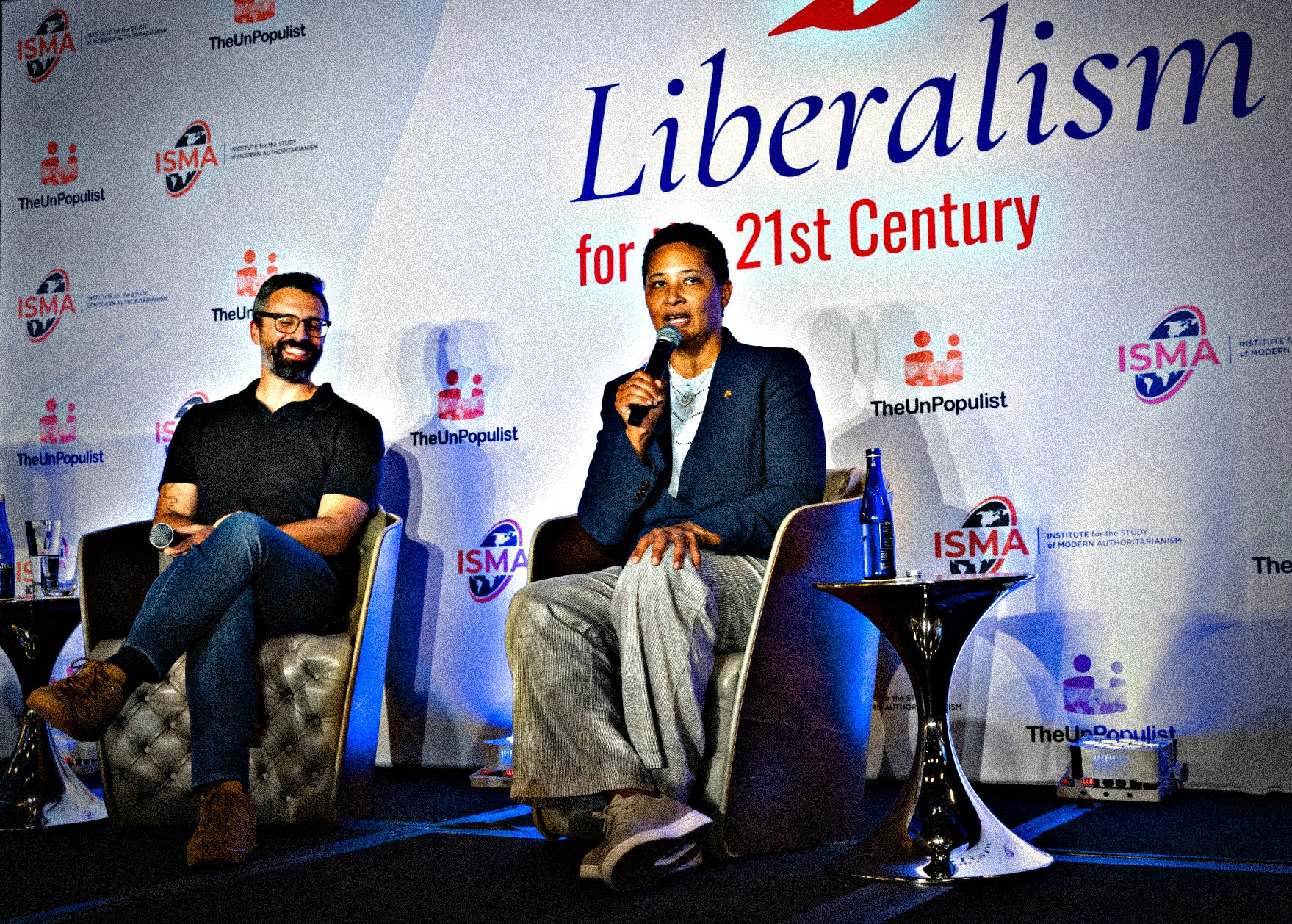
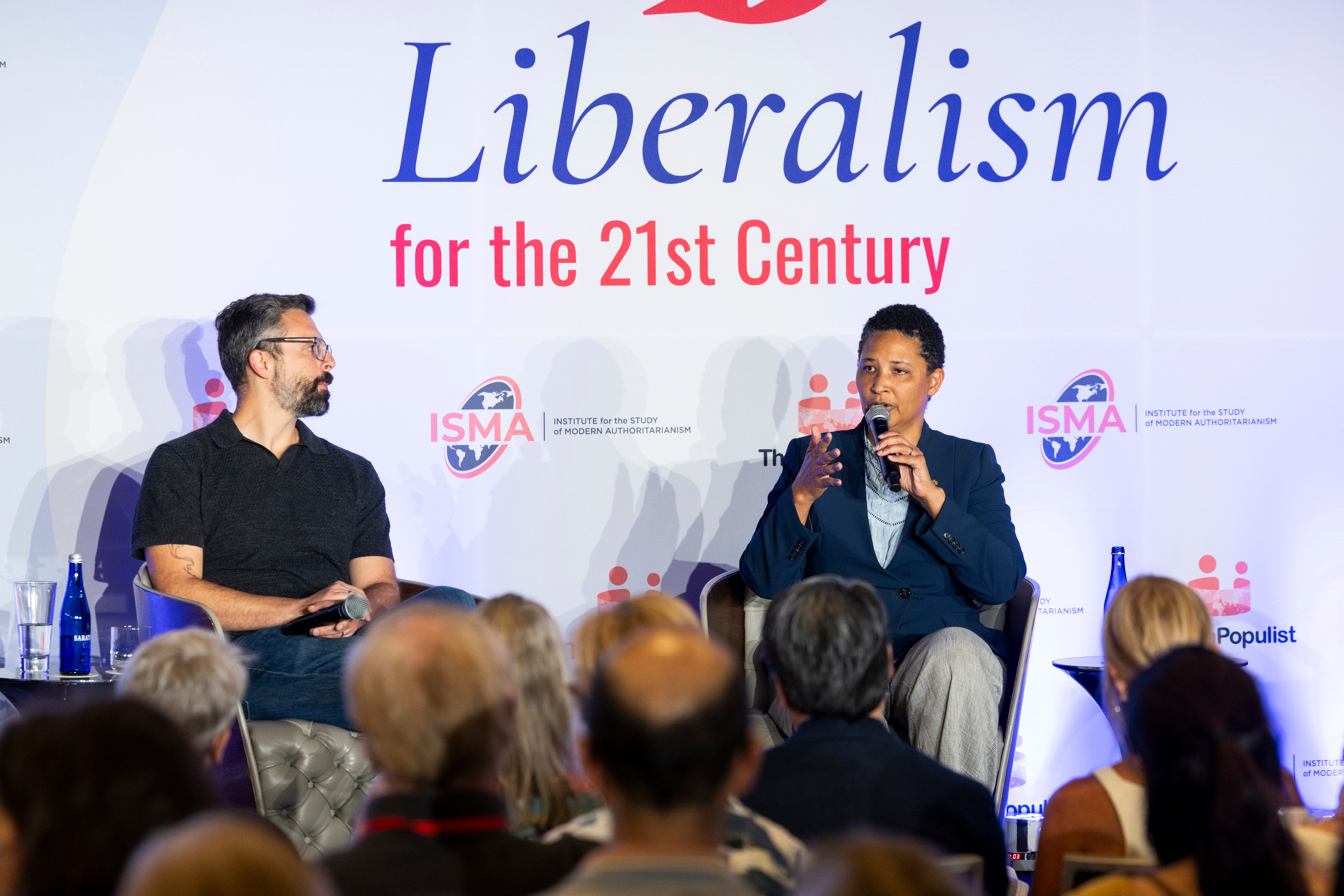
We are thrilled to share with you today the full video and transcript of LibCon2026’s keynote closing conversation, “What Is Freedom?,” including the Q&A with the audience that followed. The session featured The New York Times’ Ezra Klein and Harvard’s Danielle Allen.
You can find every LibCon2026 session on our YouTube channel, and we’ll continue posting the videos and full transcripts right here in these pages.
The transcript has been lightly edited for flow and clarity.

Shikha Dalmia: We have a lot of disagreements among liberal democrats—some of which have surfaced at this conference in the last two days. But I think I can safely say that there are very few who disagree that we’ve had an amazing lineup of brilliant speakers so far, yes? They are going to be a tough act to follow, but I’m pretty confident that our fireside speakers up next are up to the task. No pressure. They come from very different fields, but it is no overstatement to say that they are two of the most formidable liberal thinkers of our time.
Ezra Klein is a New York Times columnist and the host of The Ezra Klein Show. And he is a true American success story. Graduating from high school with a 2.2 GPA, as per his Wikipedia page (don’t worry, I failed math in 10th grade), and then working his way up the journalistic ladder. He became an influential blogger before blogging was a thing. He’s now running the country’s most influential podcast. At a time of hot takes and gotcha journalism, Ezra’s podcast is genuinely broad-minded. He wades into controversial topics with controversial guests, always in the spirit of open inquiry, dialogue, and discovery.
That last bit, the spirit of discovery, I observed firsthand when we were on a press trip with other American journalists to China about 15 years ago. We traveled to several Chinese cities over the course of 12 days, and every evening, he and Matthew Yglesias would evade our Chinese handlers and go romping around town on a mission to discover the best local dumpling joint.
Danielle Allen is a political theorist at Harvard. She’s a brilliant scholar who has written roughly six books ranging from political philosophy, American constitutional history, race and citizenship, memoir, democratic theory, and most recently, a fascinating account of Charles Lennox, the third Duke of Richmond, who secretly worked with Thomas Paine to push radical reform, including universal manhood suffrage in Britain. She was a columnist at The Washington Post and now publishes a lovely and lively Substack newsletter, The Renovator.
But she doesn’t just push words from her keyboard sitting in a Boston ivory tower. She’s an engaged citizen. She ran for governor of Massachusetts and has been tirelessly championing primary reforms in her state. She grew up in a household where that was deeply religious, conservative, and learned. She considers herself a progressive, but all of these strains are reflected in her work, making her one of the most interesting thinkers of today.
I’m truly looking forward to this conversation because I have no idea what is going to unfold, except that it’s going to be fantastic. Ezra politely ignored all my suggestions for topics. And when we all hopped on a prep call to discuss, the conversation took really weird turns. They started with Aristotelian conception of eudaimonia or happiness, went on to talk about virtue, freedom, and flourishing, citizenship, et cetera, et cetera, et cetera. In other words, every big question that philosophers have been grappling with for the past 4,000 years.
So we settled on the title “What Is Freedom?” Partly to give them the freedom to explore what the heck they wanted. So without further ado, Ezra and Danielle.
Danielle Allen: Thank you, Shikha.
Ezra Klein: It’s a pleasure to be here. Thank you for that both beautiful and embarrassing introduction. Always like having my high school GPA trotted out!
We’re very happy to be here to solve liberalism today, and we’re pretty sure we can do it in the next 44 minutes.
I was thinking, being here over the past bit, and having been in other conversations like these recently, there’s a real cottage industry of: How do we save liberalism? Right now, when liberals gather, they have this quality of people standing athwart history asking what the hell happened. There isn’t self-confidence either about how we got here, much less about where we’re going.
For all that we can talk about procedural guardrails and the design of systems, ultimately, if nobody wants to come to your party, if people don’t like you, if they don’t believe in you, you are not going to be successful in politics. And the core weakness of liberalism to me, the reason when we got on this call, we were talking about all these big questions of citizenship, is that there’s very little blood in modern liberalism. There’s a lot of what we don’t want and not enough of vision that people can feel pulsing in the things we say.
Liberalism is about many things—Danielle knows them better than me. But one of the things it is about at its core is freedom. And I think one thing Danielle and I agree on is that both our definition of and vision for freedom has gotten really thin. And a liberalism that cannot articulate a freer world, a liberalism that does not have a theory of progress that excites people, is not going to be a healthy or competitive liberalism. So we’ll start you with the big question. What is freedom?
Allen: Well, so I promised Ezra that I wasn’t necessarily going to answer his questions. And this is exactly what happened on our prep call. As Shikha said, we just went a bunch of different directions. I am going to pick up on some of the things Ezra said, and we will eventually, I am sure, both throw out some answers to the question: What is freedom? But I want to start where you also started, which is this issue of what is the experience people have of encountering liberalism or conversations about liberalism.

What I want to suggest is that liberalism as a project of freedom gets real when you do politics. It’s not real when you talk about it. So this is where I’m going to bring in my experience running for office, bring in my experience now chairing a ballot initiative in Massachusetts. Both of those enterprises were in many ways efforts to make concrete and real, what here in this room we call liberalism, in people’s lives. But to do that, you actually have to form relationships with people, build coalitions that people didn’t know could be coalitions previously. And you actually discover the vocabulary for it in the doing of it.
So just to try to crystallize this a little bit more, from my point of view, and this will answer a little bit the question of what is freedom, liberalism boils down to the last four words of the Gettysburg Address. But I do them backwards: For the people, by the people. It is for the people—our government, our society, is actually for the people when it is by the people. We could dig into that in all kinds of deep ways—that by the people part is a freedom story.
But what does it mean to ask whether our society is for the people? Right now, just listen, open your window and listen out your window all over this great land, voices are crying out saying this is not for the people. It is prices, it is opportunity and stagnant mobility. It is challenges with healthcare, it is challenges with childcare. Those are all the elements of safety and happiness that liberalism is supposed to deliver. Government is not for the people. Lincoln would require us to ask, well, if it is not for the people, then where are the places that it is not by the people? Because that is why it is not for the people. Right now, it is by small groups, concentrations of power, concentrations of capital, they have co-opted the institutions and therefore they are no longer for the people.
So that’s the core of it. And so those are the conversations you have to have. And so then if you are out and about, in the world trying to build a coalition, it’s pretty simple. You ask people, is this government for you? The answer is generally no. Is it by you? No. What would it take for it to be by you? Those changes then actually activate people. Do you want to be listened to? Yes, here’s how you’re going to be listened to. That’s actually liberalism right there, OK? Building popular sovereignty in the context of institutional contestation.
Klein: I don’t buy that as an answer. And here’s why. In my time reporting politically, among many very well-meaning politicians you would understand as liberals, they understand what they are doing as on some level by the people—they were elected. They went out and did the practice of politics, did it well, and believed themselves as doing things for the people. And then you’re right, if you went and asked the people, they’d first be like, who? The number of people who actually know who their representative is, to say nothing of a state senator or an assembly member, is not that high.
And then often what? We all want to believe, I want to believe, with my background as an endless policy wonk trying to foist charts on an unsuspecting population, that if you just do good policy, you get these policy feedback loops. Obamacare, right? Obama’s elected, he does something big for the people. So, Obamacare goes horrendously unpopular early on. A huge millstone around the neck of Democrats.
“What I want to suggest is that liberalism as a project of freedom gets real when you do politics. It’s not real when you talk about it. … To do that, you actually have to form relationships with people, build coalitions that people didn’t know could be coalitions previously. And you actually discover the vocabulary for it in the doing of it.” — Danielle Allen
So there is something happening here that I think requires some real attention between what it is that our elected representatives do at their best. I don’t deny, in fact I completely agree, that much of it is corrupted by money, by power, by concentration of power, by paperwork, by procedure, by a million things that we could all name. But even working at its best, what people know about what is done and how they feel about what is done has a tremendous amount of disconnect.
And so I think what I want to push into this conversation is one place where I think liberalism is failing completely. It is thinking through and being vibrantly part of the cords of information and attention that connect people to what is done.
When liberalism was at its apex in my lifetime, which is probably Obama, what it did was it picked the most generationally talented communicator that had emerged in politics in a long time and made him their leader. And Obama got a lot right and some wrong, but after that the successor leaders of the Democratic Party were institutional players. They were not superstars of attention and communication. And I would submit that’s not like a superficial thing. That is a breaking of the practice of politics in which there needs to be a deep attentional connection between the people we elect, the people we have the opportunity to elect and what they’re doing. And liberals, much more so than the left, much more so than the populist right, are failing at taking that seriously or doing it well.
Allen: So I agree actually with where you ended up, but I would probably get there in a somewhat different way. And I would get there in a different way, I think, because of having a somewhat different conception of liberalism. So we can take a little bit of a detour to dig into that for a moment.
So in fact, and I would want to think that I was going to ask you to talk about as you’ve been on this voyage, digging back into the history of liberalism and looking for new versions of liberalism here and looking there and so forth, and I think we’d love to hear you … I know you often talk about it on your podcast, say more here, too, about what you have found in that process of spelunking, essentially, for liberalism. But as I have listened to that conversation a bit, it’s only partial, so I’m sure I’ve missed things.
There is a version of the concept of liberalism, which is about the power of government to do good things. That’s actually how I use the concept of liberalism. I do believe in government doing good things, but that’s not for me the actual definition. For me, the definition is anchored in the concept of freedom. So here we are getting to our official assignment. And it is essentially the project of ensuring that none of us are ever dominated by the arbitrary will of another. And to avoid that domination, you have to have functioning legislatures. That’s the very simple core formulation of liberalism from my point of view. And those functioning legislatures represent a way for the people to participate, but then they also have to be responsive back to the people.

Now, we haven’t had functioning legislatures in a long time. So in that regard, when you call Obama the apex of liberalism, and I worked for the Obama campaign, ’07, ’08, I was really early on the ground as a field organizer for Obama. So I loved that campaign, super supportive of Obama, but I wouldn’t actually call him the apex of liberalism because we were watching executive power grow under him too. It’s not as if it’s just happened with Trump. So we have, from my point of view, seen the erosion of liberalism for a very long period of time. That’s not just the dysfunction of legislatures. It’s also the fact that we, the people on the whole, have in many ways, I think, abdicated our claim on experiences of self-government. So from my point of view, those things have to be reanimated.
And yes, that is a kind of project of institutional reform. But at the end of the day, it doesn’t have to be a wonky project. It’s a very simple project of asking people, do you want to be listened to? Do you want to be listened to, by the way, folks? Yeah? All right. So here’s the pathway to having institutions that are going to listen to you. And you’re right, because there’s a whole other what comes down that pathway. Which are the highest priority problems? Is it housing? Is that the thing we’re going to solve first if we have institutions that actually listen?
What I’m trying to say is I agree with you about the need for a powerful communicator. And I agree with you that Obama had that and that we haven’t had that for a spell. But I think the thing that we need that communicator for is a little different, actually, than what Obama exemplified.
Klein: I think that’s right. Here’s my one sentence on what went wrong and what is continuing to go wrong: First, liberalism captured the institutions, and then the institutions captured liberalism. That for me … everything spins out of that.
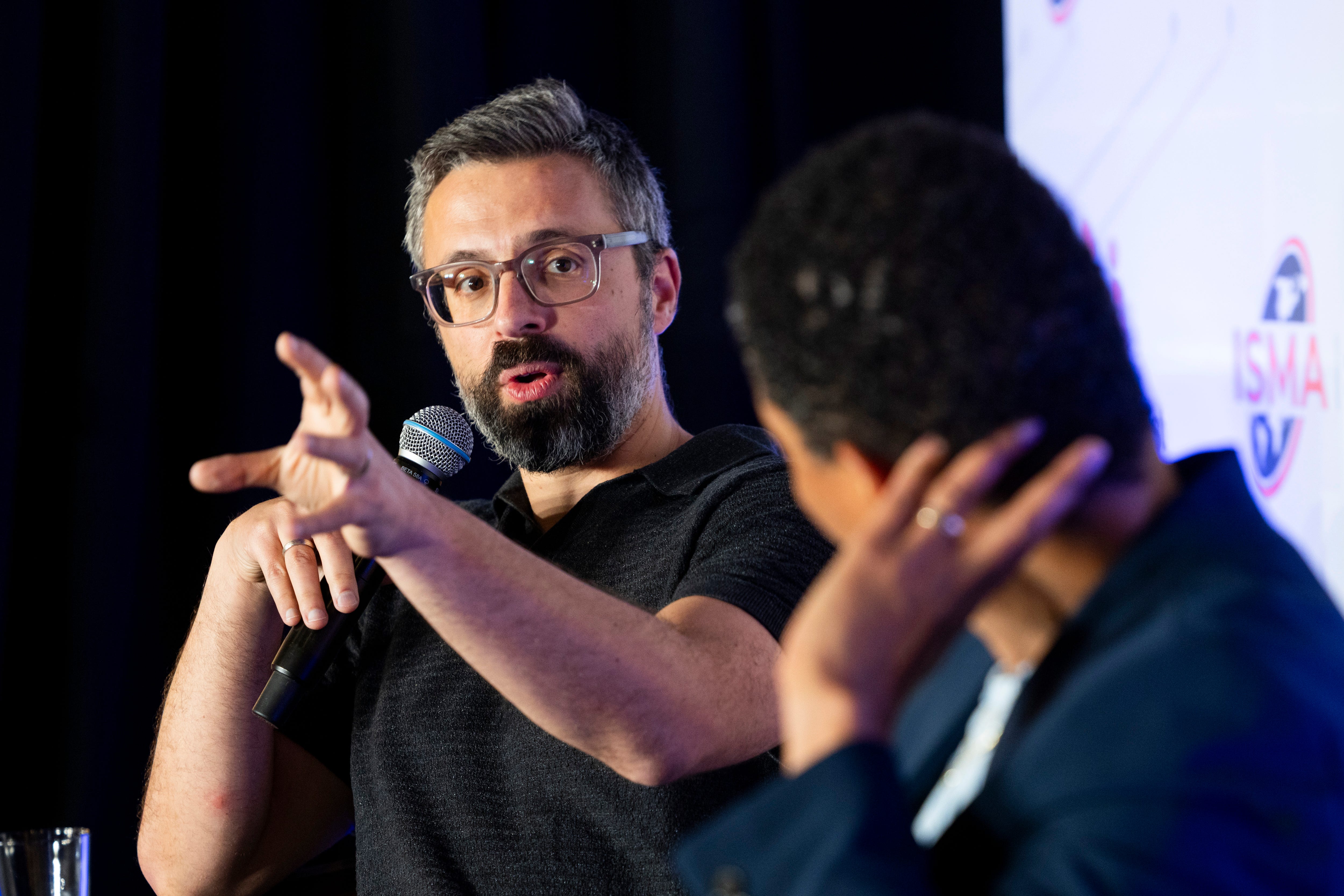
That liberalism was optimized for an age of institutions that it partially built, ranging from the U.N. internationally to all kinds of agencies, and by the end of the 20th century and the early 21st, had the commanding heights of power in America. And there was a moment, and I think it was around the Obama moment, when most of the major institutions in American life, from universities to government, were run and staffed largely by liberals. And then Donald Trump actually furthered that polarization. The Democratic Party became the party of institutions and institutional defense. The Republicans became the kind of anti-system party. I think that’s been very, very unhealthy for both sides.
So I am a very big believer in institutional reform. Both of my last two books, Abundance and then Why We’re Polarized before it, are fundamentally about how do you reform institutions so they can deliver. I have also come to the view that, one, it’s not enough. You can reform institutions and how much that makes people feel listened to is a very attenuated process. That’s not like anybody knows the bill that would lead to people suddenly saying when you ask that question, yes, I am being listened to.
But the other is it, I think that the institutional capture of liberalism has led to really bad habits among liberals. We think, too many of us, we think and talk like institutions. Our vision of what can and should be done is limited by what institutions can and are able in their currently corroded form to do. We too often then limit the imagination.
“For all that we can talk about procedural guardrails and the design of systems, ultimately, if nobody wants to come to your party, if people don’t like you, if they don’t believe in you, you are not going to be successful in politics. And the core weakness of liberalism to me … is that there’s very little blood in modern liberalism. There’s a lot of what we don’t want and not enough vision that people can feel pulsing in the things we say.” — Ezra Klein
One of the things I think is fascinating about Mamdani in New York is, look, it’s not like until him, nobody had the idea that if you told people their rent is not gonna go up and childcare is gonna be free, that would be popular. The reason the other people in the race didn’t say that is they didn’t think they could deliver it or they didn’t think it would be a good idea. But largely, they didn’t think they could deliver it. And now there’s this world of people who are like, well, he’s governing as a kind of normal liberal, which is largely true. But it is the fact that his vision is unbounded by his sense of how narrow the institutional possibilities are that has made him an inspiring figure to many.
So I guess this is the question I would ask. I think often when we start talking about institutions, liberals begin thinking a lot about how we can tweak procedure. And I am a deep believer in my bones about tweaking procedure. I love a good procedure tweak. I wanna get rid of the filibuster, I wanna redo the Administrative Procedure Act, I got a million. If you want to sit here and talk administrative change, I’m all for it.
But we also have to free ourselves from institutions. I think one of the core failures of liberals in this age, and this goes to my spelunking maybe, is that there are values undergirding liberalism. And we can talk about what they are. Freedom is one of them. And there are the institutions we use to make those values into something real.
And as the institutions have begun to fail, to ossify, as we have become the people who run them, staff them, and believe in them, we’ve become more allied to the institutions and we keep telling people why they’re not getting more than they are out of them and explaining it away. We’ve become more committed to our institutions than to our values. And so when they fail, instead of being ripshit about those failures, we explain them away.
Allen: Yep, no, I agree with that 100%. And so here actually for me, this is again, the power, the power of those four words from Lincoln, again in reverse order. For the people, by the people. The first question is, is it for the people? That’s the Mamdani question. And Mamdani is saying, no, it is not. And this dimension, this dimension, and this dimension. And here’s what for the people would look like. And then, I think this is a place where Mamdani would part way from a liberal, the by the people question.
So if it’s not for the people, then one of the reasons it’s not, is because it’s not by the people. And that’s the problem of corruption. It’s the problem of whether or not people’s votes are actually meaningful. The question, the link between the for the people and the by the people is a question of how institutions are structured.

Now, that doesn’t mean that you should just take institutions as they are and defend them. To the contrary, it’s an invitation to be radical in your imagination about the institutions you need to deliver a real structure of by the people. But the point of that, that focus on the structure of by the people, is that that is where you do get constitutionalism operating, you get the sturdy protections of rights, sturdy protections of effective or fair markets and things like that in that desirable institutions that count as by the people.
Klein: What happens when the people disagree about whether or not an institution is for them?
Allen: Yeah, that’s what politics is for. That is where you need people who are carrying that case and say, OK, in order to get these things that we’re trying to do here on issues of housing, issues of affordability, we actually need governing attention that is attuned to this, not to corruption and capture and cronyism.
Klein: No, no, no, but that’s not what I’m asking. When we can blame it on corruption, and there’s a lot of corruption, that’s the easy case on some level. It’s hard to solve. But once we can say the thing is corruption and get agreement on that, then yes, we agree that it should not be doing the corrupt thing.
I’m saying, let’s take housing as the example. There are a lot of fights in housing. My last book is partially about these, where what is going to make people feel the institution is for or against them is whether the apartment complex gets built on their block. And if it does, they are going to be furious at the institution no matter how many meetings they were listened to in it.
Now you can do things on the margin that ameliorate this, but I think one reason I’m a little bit skeptical of this case when you keep saying for the people, by the people, as if there is this one people that’s going to agree if we just get the procedures right, the institution is for them, and that’s not my experience of politics.
Allen: That’s not what I’m saying, so I want to clarify. The by the people question is a big question, it’s not about procedural tweaks. Corruption is about institutions that are not by the people, and that’s a big deal. It’s not a small thing, and again, it’s not just a procedural tweak. Sixty million Americans no longer have a meaningful vote in federal elections. Ensuring that 25% of the electorate has a meaningful vote again is not a procedural tweak. Now those are pretty significant radical reforms.
When you look over the course of 18th century through the 21st century, the points where we have, in fact, gotten major forward movement, including on things like economic policy in ways that are good for the people, have also been places where there have been breakthroughs, for example, around voting rights and the suffrage and so forth. So it’s at that level of institutional structure that I have in mind I’m talking about the by the people concept.
Klein: One thing I’ve been asking, I’ve been in D.C. this week obviously, and been talking to people in Congress and elsewhere, and I keep asking them, “Okay, let’s say that Democrats want a trifecta. What would you do? What would be your great crusade?”
“Liberalism boils down to the last four words of the Gettysburg Address. But I do them backwards: For the people, by the people. It is for the people—our government, our society, is actually for the people when it is by the people.” — Danielle Allen
When Obama ran in ’08 … I would say the Democratic Party at that moment was fundamentally about eventually delivering what Europeans had, which was universal healthcare here. We didn’t get all the way there, but it got close enough that it is probably no longer the animating force of the Democratic Party’s long-term ambitions. So then it became climate. And Biden passed the IRA, which has been somewhat undone, but not totally. I don’t think the next one would be climate.
I think a way to ground this conversation is to say, what are you saying it should be? If there was the power to do something big, what is the big thing that they should do that you feel would make people feel that this country was for them again?
Allen: I think you’ve got to do more than one thing at once. So I think we need a constitutional amendment. There’s one out there called the For Our Freedom Amendment, back to the theme of freedom, to end the power, the effects of Citizens United, to make, in fact, it possible to regulate money and politics.
And I think we also need what I call first jobs guarantee, which is a combination of take national service, think about how we do higher ed, funding and the like, and connect that to the structure of other service structures that exist in order to make that universally available, supporting job transitions and investing in rising generations, as opposed to, we’ve done huge amounts of good work, reducing uncertainty for older generations, we have significant amount of uncertainty facing rising generations, we have not taken that seriously as a country. You have to have the kind of governing capacity to deliver on that.
So I guess the third thing I’ll put on the table is ending gerrymandering and/or passing the Fair Representation Act, which would give us a structure that’s gerrymandering proof that would re-enfranchise that 25% of Americans who no longer have a meaningful vote in federal elections.
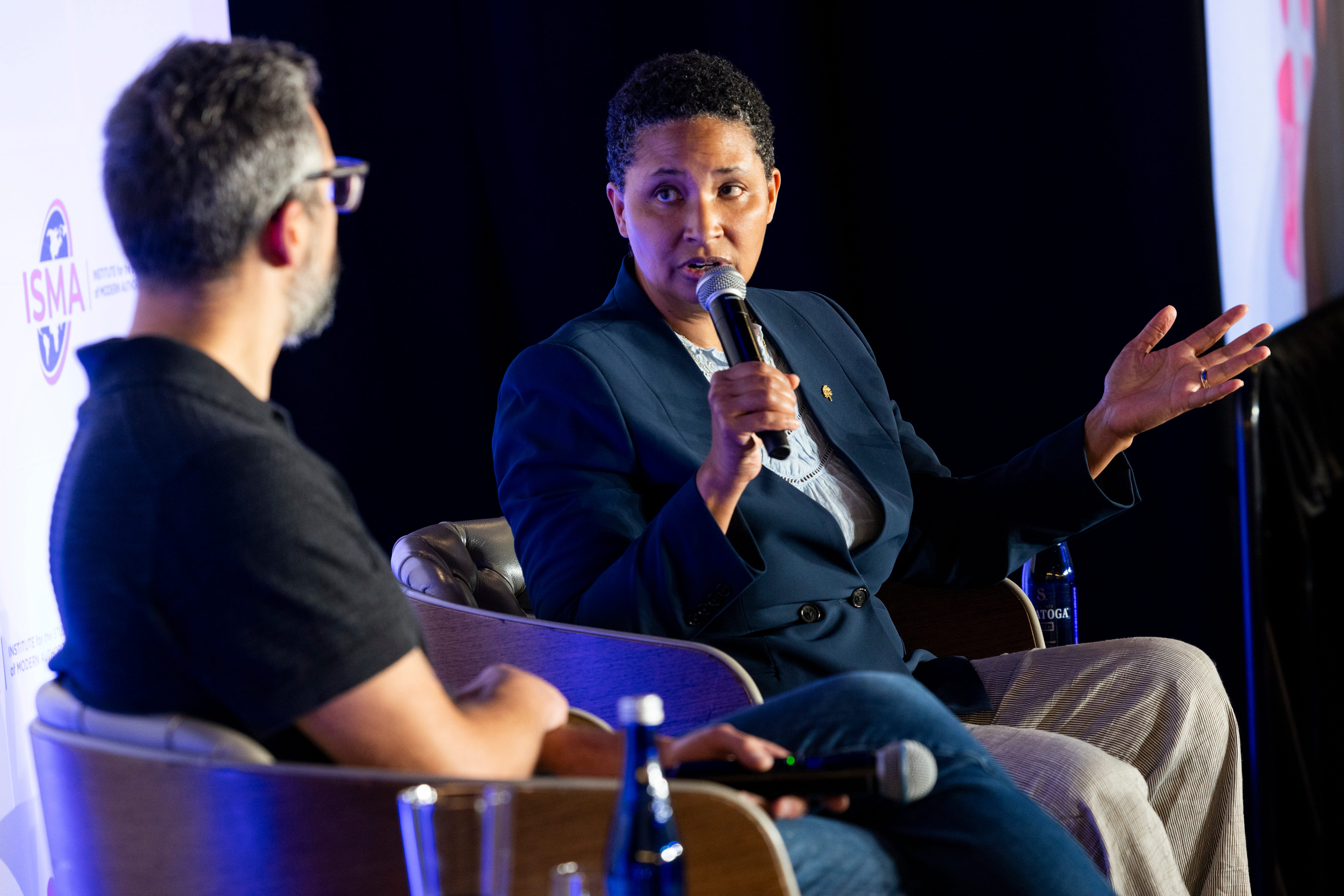
So those three things, which are about immediately responding to the problems that people are concretely facing, but also redesigning the institutions so they are genuinely capturing the voices of all Americans and requiring all candidates to face all voters all the time, avoiding partisan capture, rooting out some of the other structures of capture by minoritarian interests in our institutions.
Klein: I am a huge fan.
Allen: I was just trying to give us something to talk about, okay people? We have to have something concrete to talk about and everybody here for the last few days has been saying what’s the positive vision? So I’m giving you one, all right? It’s done. You don’t like it? No, no, it’s okay. I’m just saying that’s what it looks like to try to spell out a positive vision. So anyway, there you go. We can chew on it now.
Klein: So I think this is actually very valuable. I think I would have a very similar, in some ways, initial agenda. I think the first thing you actually do have to do is make institutions work. The constitutional amendment is very hard to pass, but I agree that the only way forward on campaign finance is to make a constitutional amendment on it, a not just immediate, but possibly a generational project of the Democratic Party of liberalism. I think where I would go, though, is then once you got that less stopped up, corrupted—I would add filibuster elimination to this.
Allen: I’ll take that one, too.
Klein: Because you’re not going to get any voting rights done with the filibuster. Once you do that, then what do you start passing that shifts the experience that people have in their life?

So you asked me a little bit ago what I have come up with going back into liberalism. And so this is a little abstract, but I think there’s some truth to it. I think liberalism at its best has these three things it is operating with. One is its vision of progress. Where it wants to go. Liberalism is a forward motion. It has to know where it’s trying to go to expand human freedom, to expand justice. It has its vision of pluralism or liberality. How do you live in a country or a place driven by difference and disagreement? And how do we live amidst each other, knowing we will not all be on the same plane of vision? And then its relationship to institutions. How does it turn things into laws, regulations, into actual change?
And a lot of the failures I see tend to be when you get two of the three operating. So if you have pluralism and institutional power, but not moral vision, you get a tepid centrism. That’s Joe Manchin, in my view. If you have institutional power and a strong vision, but you don’t have pluralism, you get overreach. People get angry. You could say some of that happened in the wokeness era. But you can look at it in other ways, too. And in more totalitarian or authoritarian societies, it can get much worse than that, obviously. And if you have the vision of progress and the vision of pluralism, but not the capacity to do enough institutionally, you get something that works really well in campaigns. I think you’d call that the Obama ’08 campaign. But then you’re not able to really deliver.
And so the question is how you get these three things operating all at once. I think of pluralism as a political practice. I think of progress as the vision, the sense the society can be fundamentally different than what it is today. And I think then of institutions as requiring a constant commitment to your values and what you are trying to get done, not to the institutions themselves. And the work of avoiding institutional capture is actually constant and it is difficult and is frankly very, very underrated at every level of government.
And so to me, the revitalization of liberalism is not any one thing. It is rediscovering a balance of these three things, which will come both in leaders and in movement culture.
Allen: Yeah, I would agree with that. I think that’s very beautifully put, and that speaks to the difficulty of the project. And so I think there you go. I think Ezra’s given everybody a charge. We put these three things together. At the point about institutions, I will say is really drawing out the work of governance. Governance is about always building and rebuilding your tools not being captured by them. So that’s the really important point. I would agree wholeheartedly about that. I want to put another problem on the table and maybe you could solve this one too.
So I played hooky this morning, Shikha. I wasn’t here. I went to a different conference in D.C. this morning—I went to the AFT convention, the American Federation of Teachers, so union convention. And the folks in the room and the folks in this room, there’s definitely a different vibe in the two rooms. Two different communities, different conversations, and yet, I’d say 85% of the conversations in the two rooms has been the same. Authoritarianism, democratic backsliding. What can we do as unions who know how to organize in our neighborhoods about democratic backsliding. When we think about the upcoming elections, how should we really think about our work so that what we’re helping to do is reverse democratic backsliding?
So same city, two big conferences, they have about 3,000 people at their convention from all over the country, 31 states, I think. And yet, I sat there, I thought, I cannot imagine how I would get these two groups in the same room.
Klein: Why?
Allen: I’m trying to figure that out. I don’t know why. So I don’t know if it’s just that, we just don’t know each other. It’s at that level of social networks and who knows whom to invite whom to what. Or if it’s that, for example, fights over vouchers and charter schools have gone so deep in terms of driving a divide among different political communities that even where there is actually this kind of bedrock shared commitment to the values of liberalism. And I would say to all three things that you just named, there’s no even attempt to bridge the divide. I don’t know, what do you think?
Klein: I’m not sure that I feel there is as much divide on that as you do. You were saying earlier that maybe we have different conceptions of liberalism. And I think it’s true, I think of it, when I talk about liberalism, this is endlessly confusing and we in America have made this very confusing, but … oh, I’m falling out of my chair, I’m so excited about liberalism! I mean the American political movement. And my concern is that it has gotten too weak to contain or outcompete the political movement of illiberalism.
“First, liberalism captured the institutions. And then the institutions captured liberalism. That for me … everything spins out of that. … Too many of us, we think and talk like institutions. Our vision of what can and should be done is limited by what institutions can and are able in their currently corroded form to do.” — Ezra Klein
And in my definition of that political movement, and also in my personal experience of it, the AFT is a core member and is not just in good standing, but is quite close to the center of it. And the fact that you’re moving between the two conferences and you and I both have friends at both conferences. So to me, I don’t feel the divide. Now maybe I don’t know all of you in this room. I’m sure people have their arguments. I have my arguments with the AFT on certain policies, but that’s just being in a political movement.
Allen: Well, I guess, what would it take for libertarians and unions to proactively work on the same political project?
Klein: Oh, you see this room as libertarian. That’s what you’re saying …
Allen: Well, just part of it.
Klein: How many here are libertarians? See, there are only a couple of them. They can come!
Allen: Anyways, just wondering—I love libertarians. There’s not a knock on libertarians at all. I’m just trying to get real about the question of what does it take to actually build the kind of supermajority coalition that is necessary to fight illiberalism?
Klein: So I think that this, the place I thought you might be going with that, and maybe the place I’ll then take it, is when I am out, one of I think the most live debates inside the Democratic Party, inside the vehicle of American liberalism, is this question of what is its relationship to its own interest groups and power centers?
And this is where I think things get much trickier because I think that the liberal view of power is power can pool and be ill-used anywhere it pools and by anyone who has enough of it. And so that is very comfortable for us to talk about when we’re talking about a small group of billionaires, when we’re talking about Elon Musk, when we’re talking about corporate concentration in the meatpacking sector. We can come up with it. But what happens when there is group capture among the people we are fundamentally sympathetic to? And so that is a thing that I think the Democratic Party is negotiating out with itself right now.
In the Obama era, right, there was a lot of tension between the Obama administration and the AFT. Now there wasn’t a breach between them. I would say it was a very productive tension. I don’t think Obama was anti-teachers unions, but they also did things towards charter schools, race to the top, etc., that caused friction with teachers unions. But I think that was a good tension. I think the teachers unions are critical, important, valuable, beautiful as a group that is adding power to the voice of America’s teachers. And of course, that cannot be the only equity at the table. But so I don’t find that so distressing, although of course things can always fall out of balance.
But to the extent that I think the rooms have trouble with each other, the question I hear debated, is, is one failure of the liberal movement that instead of becoming attached to a vision, it became attached to its constituent coalitional parts at the expense of vision.
There was a study recently that just asked what would make people feel better about various politicians, and the moderation that people wanted actually was not on the topics that we talk about, like transgender rights or whatever it might be. It was the strongest things had to do with performance pay for teachers, and it was much more bread and butter issues. And I think that stuff is uncomfortable for the Democratic Party, but in some ways, I find that discomfort to be constructive and just part of politics.
Allen: So interesting—this is another place where I think our terms are moving a little bit in some different ways. So you’re understandably, and one reasonable approach one could take, taking the Democratic Party as the vehicle of liberalism, I would have said, in fact, that liberalism has had its affiliates in both the Democratic Party and the Republican Party until the recent era.
Klein: I would have said that, too.
Allen: All right. Because it’s not that the Democratic Party for decades is the vehicle. In other words, the reason I’m saying that is because the vision of liberalism then, which folks who say center right, Reagan Republicans, that kind of thing, subscribed to whatever that vision was that was shared with people in the Democratic Party, that’s not been captured by groups. The Democratic Party has been captured by groups, yeah?
Klein: Yeah, we are now talking about different things. When I talk about the American liberal movement, I agree that there have been periods of time when the Republican Party stood for more, or had more overlap in values, and also periods where the Democratic Party was very fundamentally illiberal itself. Think of the Dixie Democrats, of course.

But I am talking about American liberalism as a movement that is representing traditionally ideas associated with the left side of the American political spectrum. I am not talking … I am not here primarily as a defender or even interested in the question of … I think classical liberalism, as people describe it, is a very important thing. But I am interested in things that are better understood as American liberalism, which is not merely classical liberalism.
Allen: Got it, all right. So now just so that the audience is clear, we have multiple conceptions of liberalism bouncing around on this stage. And I definitely have been talking from what I would call a 21st-century version of classical liberalism. So updated, my own work, I focus on what I call power sharing liberalism. But that’s why for me that conception of freedom is at the center of it. And the question of government doing good things for people is a secondary piece. It’s also necessary but secondary, as opposed to the other way around. I would say I think the kind of American liberalism tradition that you’re thinking of starts with the government doing good things for people component.
Klein: Well, maybe it brings us here, because we have 11 minutes left, back to the question of freedom. Because I don’t wanna get into the hoary freedom from/freedom to distinction. But to me, you are not going to build or rebuild political power based on a procedural or even rights-based conception of freedom alone. You need that. That is part of it. People do want to be free from masked ICE agents bursting into their home in the middle of the night. People do want to be free from an unjust surveilling government. Not only do we want that, we need it.
But they also want to be free from forms of economic coercion. They, I think people should be free from just-in-time scheduling. I think fundamentally the autonomy over one’s time to a certain extent has to be understood as a core constituent of being a free human being. I was talking to somebody here today about when do you feel most free? And he was like, when my kids go to sleep at night. Because he has authority over his own time at that moment.
And so when I said at the beginning, I think we need to be developing a thicker vision of freedom. That is largely what I’m talking about. We now have to, we have lost ground on freedom, but I think that is in part because, people did not elect Donald Trump to rip up due process for immigrants. That’s not been a popular move.
But there needs to be something we can talk about, and particularly an era of AI and an era of endless attentional fracking, manipulation. I think that there are frontiers of freedom we are not talking well about. I would say one of them, and this goes back to maybe older ideas of freedom as a capacity for self-mastery, is freedom from certain kinds of constant manipulation. And it’s in these spaces … freedom, a structure in which I can be a freer person, but not just free to online gamble, or free to doomscroll on Twitter, but free to develop into the best version of myself.
That older liberalism, that’s been a place I have been looking for something that can be turned into something modern because I think people feel very deeply, not just that they are unfree but they are manipulated and that the world in which they and their children even more so live is not a world that is built for their flourishing and that’s not just because of the absence necessarily of due process for some Americans, it is also about something larger about the world that our minds now inhabit, the world that assaults us when we open our phones, and even what is asked of us.
I think we went really off track, making freedom fundamentally about maximum consumer choice. These are the places where I think a new, not just conversation, but a new definition, or maybe a very old definition, of freedom would have a lot of political power in it.
Allen: I agree with you 100%. I think the question I would have is, in your comments, I hear a reduction of the freedom and the by the people case I’m trying to describe to procedural tweaks to due process. That’s not it at all. It is the “capacitating” freedom, the broad concept of empowerment that’s about steering your own life privately. It’s also steering together with others in public. But yes, it is also having ownership of your own development, your own attentional resources. That’s a hugely important part of it.
“If you have pluralism and institutional power, but not moral vision, you get a tepid centrism. If you have institutional power and a strong vision, but you don’t have pluralism, you get overreach. People get angry. And if you have the vision of progress and the vision of pluralism, but not the capacity to do enough institutionally, you get something that works really well in campaigns. But then you’re not able to really deliver.” — Ezra Klein
One way of explaining how some of these pieces come together, I often tell stories about my own family’s long history of civic engagement. My granddad who helped found one of the first NAACP chapters in northern Florida in the ’40s and great grandparents who fought for women’s right to vote.
And I had one occasion—I had done this at a public event. Part of a political effort, young woman called me a couple days later and said, “Danielle, I was sitting there listening to you and thinking, why, I have those histories too in my life. I also have family histories of engagement and changemaking and the like, but I realize I’m not involved. I don’t vote, I don’t participate, and I thought to myself, well, why not? Why don’t I build on that tradition the way Danielle does? And I realized, well, it’s because my rent is incredibly high and I know I’m going to move before the year is out, and then move again before the year is out. So it doesn’t make any sense for me to actually invest in the place that I’m in.” That’s unfreedom, all right?
So that is exactly the same thing that I’m talking about, what I’m talking about, whether or not we actually have institutions in place, foundations for flourishing for people so that they can actually be fully empowered to steer their own lives, to develop themselves, yes, but then also to be able to share with their community and steering their community. So at any rate, I think, I guess, it’s just it’s a kind of curiosity that I have as to what gets heard as being a kind of concern mainly about due process and procedural tweaks and things like that.
Klein: Where you ended there is maybe where I would begin. I think the place where it gets, I don’t dismiss these things, I talked about procedural tweaks earlier but when we talk about things like the Voting Rights Act or the filibuster I don’t consider those small. Those are not tweaks. But they’re also not going to make people, in my view, feel free. They are, as you say, constitutive of a better political system. But the question of whether the rent goes down, of whether her rent is affordable, will not be answered by that.
There are perfectly workable political systems that have made housing prices extremely high, not because they are highly corrupt, but because people were passing policy they thought was good policy because people who were the people—it was by the people, for the people that they restricted growth in certain communities because they just didn’t want more of it and it wasn’t always for bad reasons, maybe because they loved the way it felt or the trees.
So for me first, it has to cash out, not in terms of how people participate politically, but how even somebody who has no interest in participating politically lives. So that’s maybe one dimension of it. And also I think for me there’s a dimension that needs to go broader than politics. There are just a lot of people who just don’t want to be involved in politics. And I think actually part of being in a well run society is hopefully if that’s who you are and where you are, you can be engaged in your community in deeply different ways.
So one place I would look for freedom and maybe going back to your comment about the AFT, we’re in a period where the question of what is education for is profoundly unsettled. And I think everybody understands that the way we have created and composed education right now is not going to be functional for very long. Arguably is not functional already at the college level.
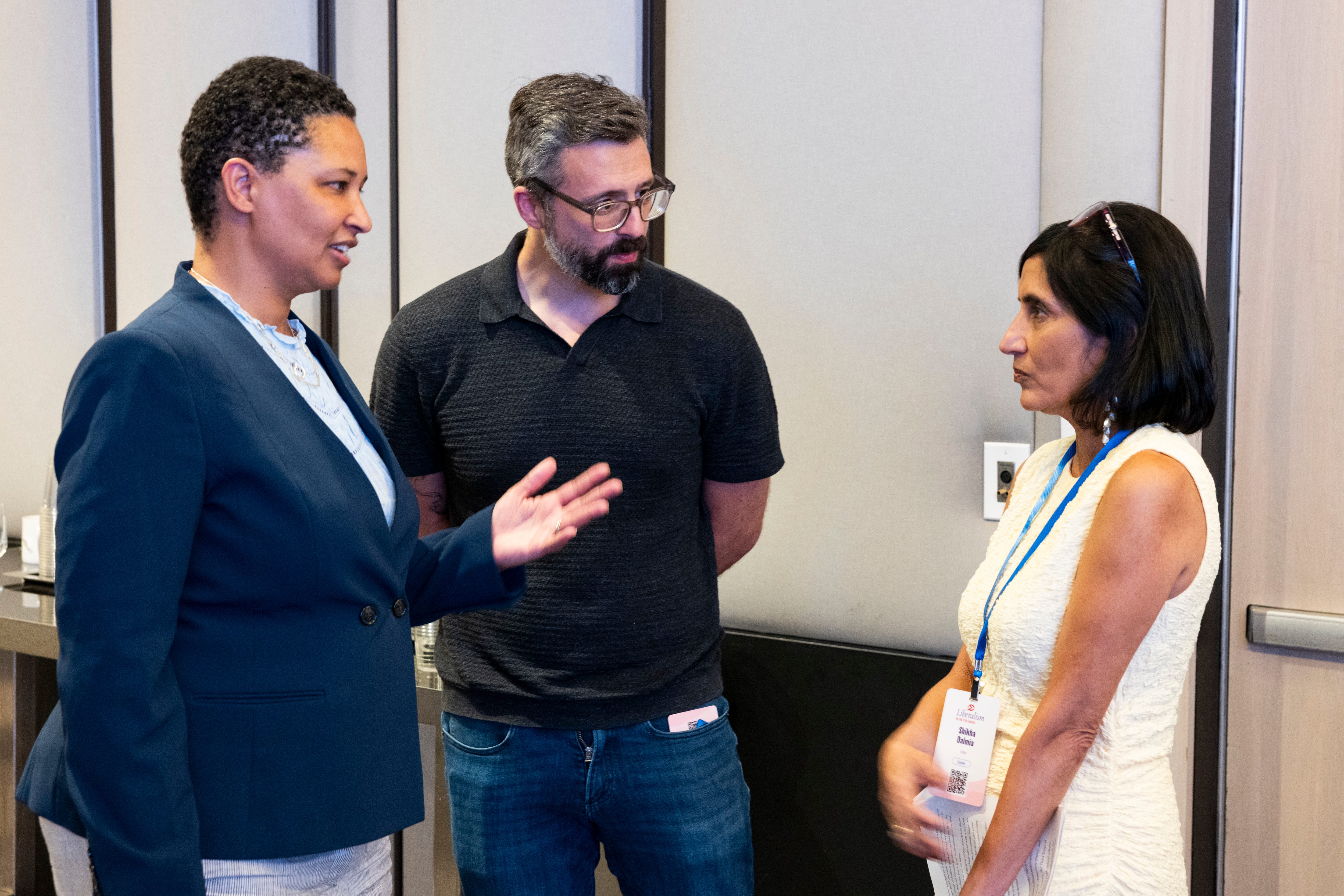
And there are, the “liberal” in liberal arts used to be about constructing an education system that was not about making sure people just got paid well, it was about equipping them to be free, to be free citizens, to act with a level of virtue and agency in a world where that was considered a hard or rare thing to do. I think there’s a lot of inspiration right now in the older vision of liberals. What would it mean if we said education was to make people, not just make sure they could get a job, but in a world where we didn’t know what jobs are gonna be there to get, education is much more about equipping people to be free and be free well than other things. I think when I talk to people about that, they’re very inspired by that, but none of us exactly know what it means or how to do it.
And that to me is where the ideas of freedom get thicker. Yes, we need a political system that works, but then we’re gonna have to do the right things through that system. And it’s only if we do those, and if we’re able to communicate those to people in a way that they feel excited by, that they feel thrilled by, that they feel a future in, that they will care about what we say on anything else, or that they should care about what we say on anything else.
Allen: No, 100%. So this is, I think, a good place to be coming, as we head towards the conclusion here. You named pluralism; governance—essentially, effective capacity, how you use institutions to actually deliver; a moral vision as a package of things. What you didn’t say as a part of that was liberalism is about culture. It is about practices of self-development and community development. It’s in addition to being about institutions. Yes, in my remarks, I really focus on the institutional component of it, and that is only half at best. If one wants to try to make a very simple culture institution setup and relationship there.
So I think early on I said something about a concern about we, as Americans, have walked away from the project of self-government. That project of self-government is one that is personal. That’s not just about politics. It is exactly that experience of mastery that you just described. One needs conditions of freedom in order to experience self-government. That is that rich conception of freedom that you are articulating. So I agree with that 100%.

So in that regard, I think the question that you’re implicitly posing to me is then, well, why focus so much on the institutional piece? Don’t we need to actually really reanimate that urgent inner desire for that cultural experience of empowerment and enablement and being equipped for self-development? I think we do need all of that. I think, though, at the end of the day, you need both culture and institutions together. So we have our lanes.
Klein: I don’t disagree on a lot of the institutional side. I think what I’m saying is that, and I say this as somebody who is throughout my career focused very intensely on institutional reform, institutions are means, not ends.
Allen: For sure.
Klein: And we need to talk about them as means not ends, and we need to treat them as means not ends. And I think that liberals, in part because of how institutionally formed we are, tend to get very caught up in the question of institutions. And that’s a good thing. None of this is gonna work if our institutions fail, but we need to articulate not what we want to do to the institutions, we need to articulate what we want the institutions to do.
Allen: Agreed. And so maybe I’ll just add one last thing as we come to the close, because I wanted to put this on the table. This is why I think it’s just so important to actually pay attention to where people are building new and winning coalitions on the ground. And that can be Mamdani and things to learn from that. It can be Alaska where people achieved election reform, but when people are winning, they’re not winning because they’re saying the system’s broken and you want to help me fix the system, they are saying, do you want people to listen to you? Here is how people will listen to you. And then the results two years later have to actually show that people listened in order for them to keep it against a fight to repeal the thing. So that’s the point I wanted to make.
“For me, the definition is anchored in the concept of freedom. … It is essentially the project of ensuring that none of us are ever dominated by the arbitrary will of another. And to avoid that domination, you have to have functioning legislatures.” — Danielle Allen
And so people are actually literally discovering in communities all over this country how to reanimate the project of liberalism. They are actually spelling out the way forward and they’re not getting credit for it. I just really, really want to drive that message home. People are actually solving this problem. Not at the national scale that we’re all hungry for, not yet, but they really are. And so I just invite everybody to take around—they can look around for those victories, because they are the answer that everybody keeps saying they want.
Klein: All right. I think we have some space for Q&A now. Come on, somebody must have a question.
Audience Member: Hi, my question is there was a bit of a riffing about eudaimonia at the beginning of the talk. What virtues should one aspire to if they were to achieve quote unquote “liberal eudaimonia”?
Klein: You’ve got America’s expert here.
Allen: What’s the short answer to that question? Courage, honesty, prudence, wisdom.
Audience Member: I try to think: How can we be free in this society? And I keep going back to Brandeis in the curse of bigness. It’s not something that I think gets talked about a lot. But with the new encyclical that the Pope put out, the principle of subsidiarity. And I think that that is something that I feel like isn’t talked about enough as something that maybe we really should be engaging in. Like Chesterton’s distributism, Fred Harris’s new populism, like bringing a lot of things down towards the person, the local community.
And I know we talk about it, but then, for, I think for a long time, liberalism has been thinking too much about increasing the public sector and the federal government. And then we have this backlash with neoliberalism, making the business sector really huge. And then now it’s now I think is the time for maybe civil society to steal from Robert Putnam for it to make a comeback. And that be the thing that we are most focused on building up as opposed to the federal government.
Klein: There’s a lot in there, a lot of different ideas you’re pointing towards. The only thing I’ll say on the question of bigness, which I think about a lot and I really love what Louis Brandeis has to say, is that I don’t think there is a version of the modern world that is not afflicted by bigness.
The second thing I’ll say is that when you really get into it, people are not much freer when they are working for small businesses. They tend to make less money, they often have less control over their time, they get less vacation.

Right now you can impose, through the bigness of the federal government more on them. But I don’t think in practice how people are doing maps cleanly onto you’re in a small firm, it’s great, you’re free, you’re in a big firm, you’re screwed. And so we have, I think, a common problem across different layers of society of how do you create a humane economy, an economy for human beings?
I did find the Pope’s encyclical really beautiful on this point. I think the ideas of big is our smallness. There are issues of concentration, monopoly, power. You have to take those very, very seriously. But you can have good and bad big businesses, and you can have moral or predatory small businesses. And then so I think the question doesn’t map cleanly onto size.
Audience Member: Ezra, you talked about how we can be limited by old institutions. I agree. Old institutions are by definition not focused on new media or young people. I feel that this has made it hard to pass the torch to empower the next generation of young liberals. And I worry if that torch doesn’t get passed to us, a generation of young radicals will show up, they will bring their own torches and pitchforks to match, and they will teach us how our friends at The Bulwark felt when they lost their party to lunatics. My question to you is how successful have liberals been at passing the torch to the next generation and what concretely can they do better?
Klein: We didn’t really get into it too much in this conversation, but I think attention is at the core of politics. I think it’s at the core of human life. Our lives are the sum total of what we pay attention to. So, on some level, are our politics. And I think a lot of the problem in the politics right now—I’m not talking about philosophical liberalism—comes from being unable to compete, unwilling, uninterested in competing in the modern attentional environment.
And so what you have had is a liberalism or liberal politicians, liberal figures, also conservative ones. This is more like the center-right, center-left issue, who were optimized for an era when money bought attention and institutions controlled attention. And so the kind of person optimized to get booked on Meet the Press or a newspaper editorial board, et cetera. That was a certain kind of person, a person very well-formed by institutions and well-formed for appealing to institutions. And then you go to algorithmic media, where what matters is your ability to compete for attention and to create sensation and engagement and interest. And those people are completely non-competitive and you get Janet Mills versus Graham Platner. And for all of Platner’s flaws, he swept the sitting governor of Maine off of the table.
So there’s going to be right now a period of either regeneration or fracture. You are seeing liberals who are getting good at this. Talarico is a good example. Jon Ossoff is a good example. But I agree with your passing the torch analogy here. You cannot—you are not going to win the future with a party whose—or a movement whose relationship to communication is optimized for the past. And so it’s the people who were not built for institutional attention, who have always been competing for attention from the outside, from Trump to the DSA, who are currently eating the lunch of the more establishment dimensions of the two parties. Yep.
Audience Member: Democracy, good government in democracy depends on the majority of the people supporting the results of politics. The, we have done a maximum effort to eliminate that possibility. We have, for example, eliminating the filibuster would mean that there’s less pressure to cooperate. Or, again, if you have primaries in which the independents are excluded, you have a very broad middle not being represented and there’s no pressure to do that. Or again in Congress you have eliminating the supermajority for confirming judges means you get overturning Roe v. Wade because you get a very partisan court eventually. What we have done a great deal to eliminate the possibility of actually a majority being represented. The party platforms don’t represent the majority opinion in many cases. How can we solve this?
Allen: So that’s what I meant when I said, 60 million Americans no longer have a meaningful vote in federal elections. That’s only one aspect of it. The filibuster as you raised is another aspect of it. And we have to build movements to change that.
So I’m chairing a ballot initiative in Massachusetts right now to introduce an all-party primary, get rid of conventional party primaries. And its purpose is exactly to ensure that all candidates face all voters, and all voters see all candidates every time. It is reconnecting the whole electorate to the institutions. We have the fewest competitive elections of any state in the country. So people definitely experience not being listened to by politicians. It’s quite immediate. We don’t have any results either on housing, affordability, transportation, but even at, leaving aside those outcomes, quite viscerally, people know that their politicians are not listening to them.
“You are not going to win the future with a party, or a movement, whose relationship to communication is optimized for the past. And so it’s the people who were not built for institutional attention, who have always been competing for attention from the outside, from Trump to the DSA, who are currently eating the lunch of the more establishment dimensions of the two parties.” — Ezra Klein
So anyway, the point is, yes, every single state that’s got a ballot initiative has the capacity to change these fundamental dynamics in our politics, get out of the capture by shrinking parties, enrollment in parties just keeps declining, yet they have full control over our institutions. Our institutions are rigid and sclerotic and paralyzed, so it’s not that we want to just capture them back again and then use them as is. They need a pretty fundamental overhaul. So I 100% agree with Ezra on that, and we need space of imagination opened up for us again.
Audience Member: When I look at the MAGA movement and rising illiberal movements on the left, like socialists or communist factions in American politics, the thing that strikes me is how it’s built around community and social incentives that drive a powerful group identity and group loyalty. What animates the group identity isn’t even really a particular ideology. It’s not like a lot of these people think about things axiomatically. That’s not really how most people think. It’s not ideologically coherent. It seems to be motivated by spite, a kind of antagonism toward liberals as custodians of the status quo.
So my question is, do liberals need some kind of antagonist to organize our community around so that we move with solidarity toward our progressive vision for the future? If so, what would the antagonist be? And can we do that without losing ourselves to the spite in a self-destructive way the same way that these movements tend to?
Klein: Liberals have that antagonist. His name is Donald Trump.
Allen: Exactly.
Klein: And that is motivating them. The question is, does it motivate them well?
Allen: And does it motivate them to bridge? So AFT is motivated that way, this room is motivated that way, so there is an opportunity there.
Klein: There’s always a question of, even when you have your antagonist, how do you react? One of the ways it does not reflect certain liberal virtues and liberal practices is to react with what I think of as oppositional mirroring. They do this, we’re gonna do that, but from the other side. Donald Trump comes in, comes down the golden escalator, and it says we’re gonna build a wall, and Mexico’s gonna pay for it, and we’re gonna deport all these people. And in the next election, liberals spend their primary debating whether or not they should fully decriminalize unauthorized border crossings. And what that reflected was a kind of mirroring. They’re gonna go all the way over there. We’re gonna go all the way over here.
When I think now you see something different has happened, having now over a series of elections recognized that that was not representing enough of the public, now liberals are trying to, and I know there was a panel on this here today, absorb that the country wants an orderly border and it wants humane treatment and to be a place where refugees can come properly. And how do we balance these different interests and incentives into a policy that makes sense.
So you can have your antagonist. The question is, does your antagonist turn you? Are you able to respond to that with a kind of awareness and a pluralism? Or does your antagonist talk you out of your pluralism and into becoming a smaller, narrower version of yourself so that you don’t have a big enough coalition to beat them?
Audience Member: This is a question for Ezra. I’m a big fan of the pod. I’m also not a liberal, uppercase liberal. I’d say the main reason that is is because at my university campus, I’ve seen the excesses of the left and the professors that I’ve had who’ve seemed most interested in reforming higher ed are the more conservative professors who really wanna go back to a more virtue-based and classically liberal education. So what would your pitch be to students like myself, besides for just pointing out the excesses of the Trump administration?
Klein: I think we have to listen to you a bit here. I can’t believe we fucking let the right take liberal arts from the liberals. It drives me crazy. Now, did Rufo and the right do a great job rebuilding New College of Florida? No, that’s not going that well. That’s not where you wanna go.
Audience Member: I would say about that being, at the University of Florida, there’s the new civics center, the Hamilton School, where there’s a great program there and they’re doing the same at UNC and UT, so there is real institution building going on in the right that you don’t see on the left right now in the same way.
Klein: Well, that I don’t agree with. I think if you look at what is happening at a lot of universities, and actually Danielle knows a lot more about this than I do, there’s a lot of experimentation and fermentation on this.
But what I would say, my approach to politics, and you hear it on my show a lot, is I try to listen to the critiques that have a lot of energy. And I often think there is, even if I don’t always agree with the answer those people come to, I often think there’s a question in there that needs to be responded to. And on this I really do think there is and I think that liberals should treat this as competition and they actually do need to build and rebuild better and more inspiring and intellectual visions and pluralistic visions of higher education. But Danielle’s done more writing about this than me so I think she should take at least some of this.

Allen: I would just offer a somewhat different picture of the landscape, the best of those programs are all very pluralist in their orientation. The first one, Arizona State University’s School for Civic and Economic Thought and Leadership, that is at this point fully bipartisanly supported. Republicans and Democrats in the state house are supporting that program in Arizona. The University of Tennessee, one as well, is exemplary in that bipartisan fashion.
And that actually makes the point about these different definitions of liberalism. That pluralism, that again, the best of those, the Hamilton School does a great job as well, being pluralistic in its approach. I just would not draw that hard cut between conservatives and liberals there. It is the sort of liberalism in the big picture of philosophical sense, not the kind of left American sense that is exemplified by those schools of civic thought. They are a really important renovation of America’s universities.
Klein: I think we are out of time now, correct? One more, okay.
Audience Member: I’m wearing my philosophy hat when I ask this question. So, Danielle, you and some of our other leading political thinkers, I’m thinking of Michele Moody-Adams and Martha Nussbaum, have written about the role of positive emotions and positive affective states, whether it’s political friendship or humane regard or love—in serving as both motivational and stabilizing factors in liberal societies.
And unfortunately right now there’s someone else who’s rather famous that’s talking a lot about love and it’s JD Vance. And he’s using the idea of the Ordo Amoris or the Order of Loves precisely to justify an illiberal and an exclusionary political project. So I’d like to invite you or ask you to say something about both what people like Vance get wrong about positive emotional states and what we as liberals need to do to regenerate that as a motivational point in our moral psychology.
Allen: Well, I appreciate that question. And that, it’s a good one too because it indicates the way I left off a key virtue on that first list after I gave you four and there’s another one that I’ve spent 25 years writing about political friendship, as you indicated. That virtue, Aristotle famously first articulates in his account of virtues, there’s one that’s unnamed, it’s the virtue for interacting with strangers. But the thing that’s interesting about it, and this is what’s always been important for me about it, is he says, it looks like friendship, it has, but there’s no name for it, he says, but it looks like friendship, it has all the habits of friendship, but not the emotions. It’s not actually about positive affect.
And I suppose it’s like fake it till you make it virtue, essentially. It doesn’t matter who’s out there in your society with you, you can treat them as a friend. We all know those habits of friendship deeply because we practice friendship all the time and those habits are actually separable from the emotions.
It requires a fair amount of personal self-regulation, but in my case, just to make it very concrete. I get nowhere near as much as Ezra, I’m sure, but loads of over the transom nasty emails and nasty things of various kinds. And I always answer by saying, thank you so much for your kind message. It sounds like you’re concerned about X, and try to extract whatever the grain of substance might be in it. And lo and behold, they write back, say, you’re right! It is X I’m concerned about. And then there’s another long vent, and I will send one more response.
And basically, this is a completely ridiculous practice on my part. But it does yield apologies from people for how they’ve spoken to me nine out of 10 times. Kid you not. It’s like that’s civic friendship. I don’t like those people. OK, I’m not going to pretend I do. But I use the habits of friendship for interacting with them.
Klein: Is this the virtue of liberality, this ethic of mutual generosity towards one’s fellow citizens?
Allen: That’s actually another one on Aristotle’s list. You’re close. They’re very close in order. But yes, it’s related to liberality. Absolutely, but it is its own distinct virtue and the thing that is most precise that Aristotle says about it is it’s about the practice, the habits of it. It’s not actually about the positive affect.
Klein: Thank you to all of you who have treated us with both positive affect and civic friendship.
© The UnPopulist, 2026
Follow us on Bluesky, Threads, YouTube, TikTok, Facebook, Instagram, and X.
We welcome your reactions and replies. Please adhere to our comments policy.
Part 3
George Washington's Farewell Address is a version of the Golden Rule of Politics.
George Washington's Farewell Address
https://avalon.law.yale.edu/18th_century/washing.asp
"Observe good faith and justice towards all nations; cultivate peace and harmony with all. Religion and morality enjoin this conduct; and can it be, that good policy does not equally enjoin it - It will be worthy of a free, enlightened, and at no distant period, a great nation, to give to mankind the magnanimous and too novel example of a people always guided by an exalted justice and benevolence. Who can doubt that, in the course of time and things, the fruits of such a plan would richly repay any temporary advantages which might be lost by a steady adherence to it ? Can it be that Providence has not connected the permanent felicity of a nation with its virtue ? The experiment, at least, is recommended by every sentiment which ennobles human nature. Alas! is it rendered impossible by its vices?"
INTERNATIONAL MONETARY FUND
Externalities: Prices Do Not Capture All Costs
https://www.imf.org/en/publications/fandd/issues/series/back-to-basics/externalities
The leading cause of death globally is negative externalities.
CONGRESS SHOULD NEGOTIATE TRADE AGREEMENTS WITH FOREIGN NATIONS THAT INCLUDE TARIFFS AND GRADUATED SALES TAXES TO HELP REDUCE THE NATIONAL DEBT, HELP REDUCE NEGATIVE EXTERNALITIES, HELP FUND SOCIAL SECURITY AND MEDICARE, HELP FUND FREE CHILD CARE, FREE ELDER CARE, FREE LIFETIME JOB TRAINING, FREE K-PUBLIC GRADUATE SCHOOL EDUCATION. PROVIDING THEM FOR FREE WILL HELP INCREASE TAX REVENUES FOR GOVERNMENTS WHILE REDUCING NEED FOR MEDICAID AND FOOD STAMPS. FREE CHILD CARE AND FREE ELDER CARE WILL MAKE IT EASIER FOR BOTH PARENTS TO WORK IF THEY WANT. I WANT SOME OF THE REVENUES FROM THE TARIFFS AND GRADUATED SALES TAXES TO GO TO LOCAL GOVERNMENTS AND STATE GOVERNMENTS.
The United States of America would have stayed a poor country if not for Tariffs and intellectual property theft from Europe.
Over $2 trillion of national debt is owed to Social Security.
Our national debt was under $1 trillion when Reagan became President and took us over 180 years to get. Democratic Party controlled US House of Representatives for over 20 years before Reagan became President and while Reagan and Bush 1 were President.
Over 20 trillion of national debt is because of out of control military and homeland security spending. No Air Marshals flying domestically on 9/11 and Congress refused to harden cockpits. FAA in 1990s said as airport security and airplane security improves the threat posed by surface to air missiles against planes will increase - think firebombing of Germany over highly populated areas of USA and Europe on same day. Ever discuss threat posed by White Christian terrorists to airplanes in USA and Europe?
Over 15 trillion of national debt is because of idiotic and insane deregulation of banks, investment companies.
China wants revenge against Europe and USA because of Opium Wars of 1800s. USA had been led by the dumbest political and business leaders of past 2,000 years who turned China into a military and economic superpower after murdered people at Tiananmen Square.
Golden Rule of Politics - when a nation causes major harm to a country that has not caused it any harm it should not be surprised when countries it has never harmed cause harm to it at a time of their choosing
USA has nationalized industries in peace time and War. Coal and steel may have been nationalized when Harry Truman was President. Eisenhower used CIA to overthrow Iran because of oil and Guatemala because of fruit.
USA has wasted trillions of dollars on useless weapon systems while not giving soldiers the rifles, body armor, armored vehicles, etc. they need. Have you often discussed this? Sgt. Giunta's Troubling Fight that was in Washington Post discusses topic.
How often have you discussed lousy VA Health Care?
2014 Restoring Trust in VA Health Care
New England Journal of Medicine
Kenneth Kizer
When a Nation does not care about Social Security and VA health care, it should not expect people to want to be soldiers.
When will people care about the lives of soldiers, Veterans, their families? Are they going to care about safe drinking water for them? How about quality schools for their children?
Ever discuss how Functional Illiteracy harms national security?
President Jimmy Carter supported competent deregulation of industries.
Reagan supported idiotic deregulation which led to Savings and Loans Crisis. Bill Clinton and others supported even more insane deregulation which led to 2008 financial crisis and suicides dealing with housing crisis. Bankers went to prison when Bush 1 was President but did not when Obama was President because of bribes Obama and Democrats took.
Want to make things better - allow billionaires to get Medicaid and food stamps. Allow people to get Medicaid and food stamps when they do not work. Do not have a work requirement for Medicaid and food stamps.
The last competent President of the United States of America was President Jimmy Carter. He realized how important energy security is to the USA as part of national security and he was attacked for it. If people had saved money on energy like he asked people to do, this would have saved us probably $10 trillion in energy costs, $10 trillion in health care costs caused by negative externalities, over $15 trillion in military costs not needed, and saved the lives of a lot of soldiers.
President Jimmy Carter believed in competent regulation of businesses. Reagan, Bill Clinton, Obama, etc. have not believed in competent regulation of businesses. I figure incompetent regulation of businesses has cost us over $15 trillion in national debt.
Congress should back our currency with gold, silver, other valuable commodities, and federal government owned lands. Gold coins and silver coins minted in the USA should be treated as currency and not taxed.
The best type of taxation and the most progressive type of taxation are sales taxes because people are held accountable in part for the harm their buying decisions cause themselves and others.
George Washington in his Farewell Address discusses the importance of taxes to pay off debts.
Not having sales taxes as high as we need has increased Social Security disability costs, Medicare costs, Medicaid costs, health insurance costs, prescription drug costs to be about $25 trillion dollars higher than they would have been if they had been if put in place when Reagan became President. Not having sales taxes as high as they need to be I figure has killed tens of millions of people since Reagan became President.
The sicker people are the less productive they are likely to be. The sicker people are the less taxes they are likely going to pay.
If you want to significantly grow the economy and pay down national debt faster, treat females as well as or better than males.
If you want to significantly grow economy and pay down national debt faster, treat black people, Hispanic people, people of Asian ancestry, etc. as well as or better than white males.
If we have far better Civilian Conservation Corps, Works Progress Administration, Marshall Plan for USA and World, our economy and other economies would grow faster.
The easiest way to pay off the national debt is to increase exports. The easiest way to grow the economy of our country is via foreign aid to other countries. The greatest economic multiplier is foreign aid. The greatest economic multiplier inside of USA is buses followed by education and prescription drug research.
I figure we could spend less than $400 billion dollars a year on military and national security and be lot safer. WE will be destroyed if we keep not caring about Golden Rule and Golden Rule of Politics. When a country harms countries that have never harmed it, it should not be surprised when other countries choose to destroy it.
Congress should fully fund Post Office and Patent Office. Post Office should haver Savings Accounts again. I would like Postal Savings Accounts to pay people interest.
The largest banks and investment companies should be broken up into 4 or more equal pieces each, a stronger version of Glass Steagall should be adopted, RICO should be used against bankers and banks.
The largest companies should be broken up into 8 or more equal pieces each - defense, high tech, farming, food, health care, energy, cable, prescription drugs, etc. Many of these companies became huge because of government created oligopolies and federal government research spending over many decades.
I read about the March in Rights of the Bayh Dole Act in 2002 in the Union Leader which allows the federal government to license patents of things based on federal government research spending to other companies when the prices are high. This may help to significant reduce the prices of prescription drugs, medical equipment, high tech, etc.
Congress should be in control of VA, VA hospitals, military hospitals?
Congress and not the President/executive branch is supposed to be regulating the economy. FDA, USDA, DEA, EPA, FCC, SEC, National Labor Relations Board, etc. should be under control of Congress.
It is not constitutional for President to choose members of Federal Reserve. Would it be constitutional for Congress to create a Declare War and Military Draft Board with 12 members picked by President, US Senate just have Advice and Consent dealing with Declaring War and Military Draft, US House of Representatives having no say on Declaring War and Military Draft? NO
Sincerely,
Ken Stremsky
part 2 - People need to know what the Constitution says and why it says what it does. Most people do not vote or vote for the worst person.
Having each State choose a US Senator that the state has the ability to fire will make it easier to reduce harm caused by a megalomaniac.
Giving State legislatures the ability to fire the President will make it easier for state legislatures to reduce harm caused by megalomaniac.
Giving the people the power to fire Representatives to US House of Representatives and US Senators increases the odds they will take on megalomaniacs.
Popular vote for President would increase the odds megalomaniacs will become President. Current electoral college system makes it easy for megalomaniac to become President by stealing one congressional district in a large population state.
If judges on US Supreme Court are worried that State legislatures may fire them, they are less likely to be corrupt.
I have been thinking about how to deal with megalomaniac Presidents for many decades.
Electors to Electoral College are supposed to keep tyrants from becoming President. They are not supposed to vote for the person the people want if the person is a tyrant. Electors to Electoral College have often failed to do their job.
Sincerely,
Ken Stremsky