


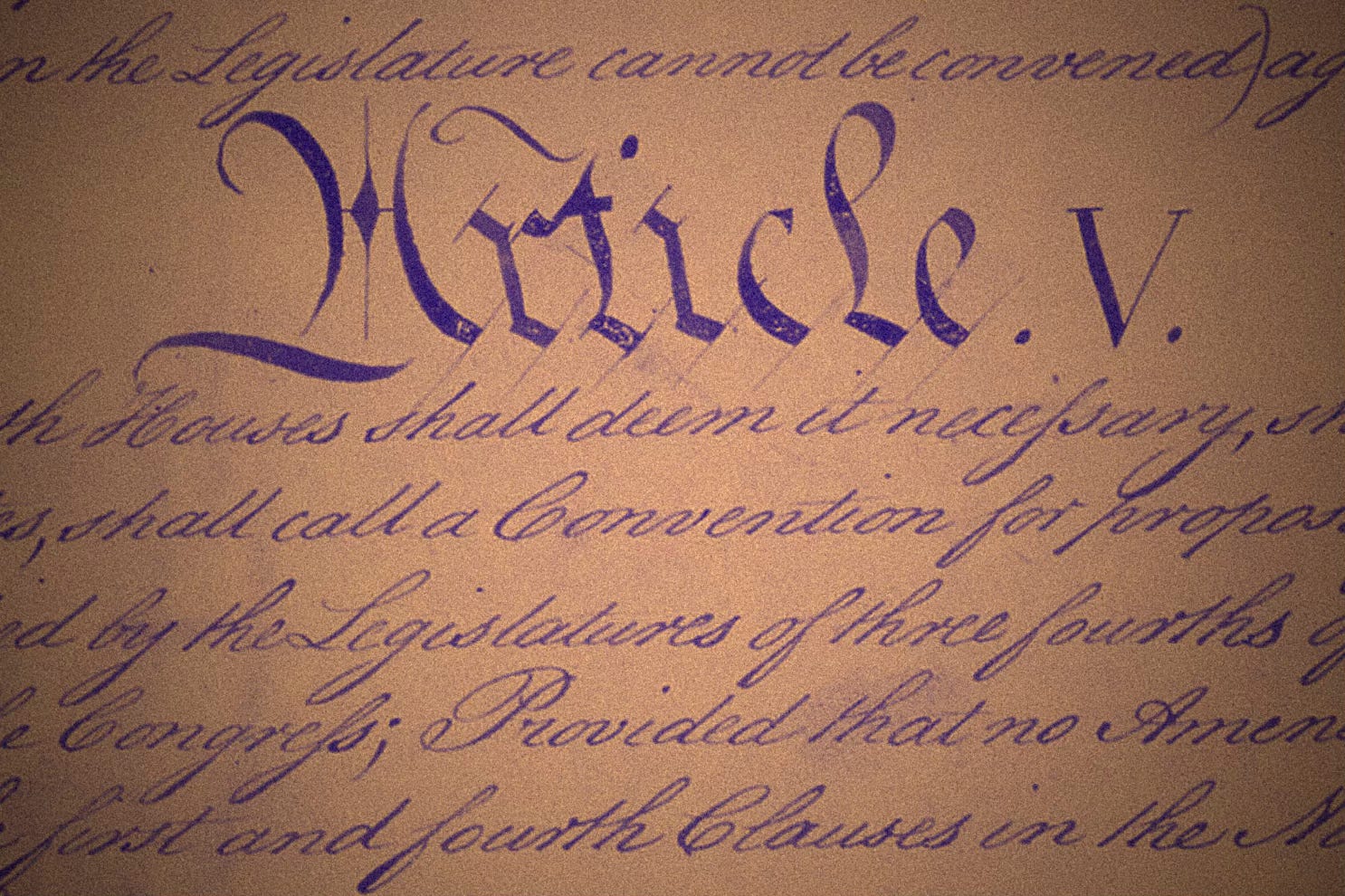
In the United States, constitutional amendments are notoriously difficult to adopt. They require two-thirds in both houses of Congress, and then ratification by three-quarters of the states. The process was last used successfully more than 50 years ago.
That’s why formal amendments are often dismissed as unrealistic. Structural reforms, including those we at The UnPopulist have been explicating as part of a post-Trump reconstruction of America’s shattered institutions, instead tend to focus on statutory legislation, executive action, or court rulings. The actual text of our written Constitution becomes a background assumption, a set of immovable constraints. But it need not be so, and we ignore the need for constitutional amendments at our peril.
The lawless authoritarianism and democratic backsliding of the current moment amount to a systemic failure of the constitutional order. Illiberal ideas and populist demagogues will always be present in any democracy, but the system must be able to safely defuse those impulses before they produce an existential crisis. Even at a time of rising right-wing populism, the United States has proven exceptionally vulnerable for a long-established democracy. Democratic institutions and norms which were already functioning poorly have now completely broken down. Rebuilding those constitutional pillars, putting them back on firmer foundations, requires an honest reckoning with how they have failed so spectacularly.
In many cases, our problems come from a failure to follow the Constitution as written, or attempts to directly violate the text—for instance, presidential usurpation of congressional war powers, or the assault on the plain text of the 14th Amendment’s birthright citizenship guarantee. But some problems are baked into the constitutional text itself. The broad scope of the presidential pardon power, the impracticality of the impeachment mechanism, an unchecked gerontocracy, and lifetime tenure for the Supreme Court all come directly from unambiguous constitutional mandates. Each of these has contributed, in concrete ways, to our present crisis.

The Constitution is not set in stone. It is our framework for self-governance, how we decide as a people to structure our institutions. This is properly placed beyond the reach of simple majorities, with their passing whims and passions. But we must grapple seriously with the ways the Constitution as written has brought us to this point of chaos and collapse. Dancing around the need for amendments will not be sufficient. We are long overdue for some constitutional housekeeping.
Past
Article V’s amendment process was not meant to be impossibly hard. The Framers expected later generations to make both technical and substantive corrections, and that happened immediately with the Bill of Rights, promised to secure ratification. Early amendments also fixed practical problems: the 11th clarified federal court jurisdiction, and the 12th repaired the Electoral College process after the 1800 election, in which Thomas Jefferson almost lost to Aaron Burr, who was supposed to be his vice president.
As party politics hardened, amendments became possible only with broad bipartisan support. The next major use of Article V came only under the extraordinary conditions of the Civil War and Reconstruction. The 13th, 14th, and 15th Amendments transformed the Constitution by abolishing slavery, defining citizenship, and protecting voting rights, though they were adopted under the unusual circumstances of rebellion and Southern readmission.
After another long lull, amendments were revived in the Progressive Era. The 16th authorized a federal income tax in 1913, the 17th established direct election of senators that same year, the 18th imposed alcohol prohibition in 1919, and the 19th extended voting rights to women in 1920. These changes followed decades of pressure and often built on reforms first tested in the states.

Later amendments corrected mechanics (the 20th shortened the lame-duck period in 1933 and the 25th clarified presidential succession in 1967), reversed failures (the 21st repealed Prohibition in 1933), codified norms (the 22nd limited presidents to two terms in 1951), or expanded democratic participation (the 23rd granted D.C. electoral votes in 1961, the 24th ended poll taxes in 1964, and the 26th lowered the voting age in 1971). The 27th, which restricts congressional pay raises, was first proposed by Congress in 1789 but not ratified by the states until 1992.
Present
In light of this history, it would seem we have a reasonably solid track record to build on. Yet talk of amendments is usually taken as a frivolous distraction, a performative gesture more than a genuine attempt. Partly, this is because many dream of imposing narrow partisan policy positions and legislative agendas via constitutional entrenchment.
On the left, these include campaign finance regulation. These proposals fail to seriously grapple with the potential for abuse in carving out a broad new exception to the First Amendment, as noted by groups such as the ACLU. Others propose a right to universal healthcare, or to codify gun control laws favored by Democrats. On the right, a balanced budget amendment is a perennial favorite, despite being broadly disfavored by economists. The push for an amendment to permanently prohibit same-sex marriage was popular during the Bush-era height of Republican gay-bashing. Bans on flag burning and allowance for prayer in public schools reflect a focus with culture war issues of the day.
These amendment proposals fail because they make no real attempt to engage with the necessity of bipartisan support. Instead, they amount to a wishlist with negligible appeal on the other side of the aisle. Some don’t even muster universal support within their preferred party or ideological camp.

Understandably, the difficult supermajorities for Article V have themselves come under criticism, and not just from progressives. Antonin Scalia once complained that the Constitution is too difficult to amend. But securing an amendment under any realistic system would require fairly broad bipartisan support. Lowering the thresholds from three-quarters to two-thirds of the states, or from two-thirds to three-fifths in Congress, would make little difference in practice. The current process is difficult, but not impossible.
There are several worthwhile amendments which could plausibly secure broad consensus if shorn of overtly partisan goals. We also should not fall into a failure of imagination that assumes the current party system and political divisions will be entrenched in perpetuity.
Future
If amendments are to succeed under Article V, they must address structural problems rather than ordinary political disagreements. The Constitution should not be used to lock in temporary partisan victories. But it also should not be treated as untouchable scripture. Our governing charter is the work of human hands, not set in stone. When parts of the constitutional system no longer function as intended, amendments are the proper remedy.
Several reforms meet that standard. They respond to clear institutional weaknesses, and they have attracted support from across the ideological spectrum. That combination—structural necessity and bipartisan plausibility—is worth taking seriously.
Age Limits for Congress and President
The Framers imposed minimum ages for federal office, emulating the classical Roman republic: 25 for House, 30 for Senate, 35 for president. They believed maturity and experience were prerequisites for responsible governance. What they did not anticipate was the opposite problem: a political class that can remain in power indefinitely into extreme old age.
In modern American politics, leadership in both parties is dominated by figures well into their 70s and 80s. And people are sick of it: 79% agree there should be a mandatory retirement age for high political office, according to one Pew survey. You’d be hard pressed to find any policy proposal with broader popular support.

An age limit amendment would provide a predictable, bright line rule. Just as the Constitution requires presidents to be at least 35, it could reasonably require them to be below a certain age when assuming office. A similar standard could apply to Congress. This would not impose arbitrary term limits, which have disadvantages well-documented in the political science literature. Nor would it target any individual politician. It would simply acknowledge a biological constraint the Framers could not foresee.
A comparable political precedent would be the 22nd Amendment, adopted in 1951, after Franklin D. Roosevelt had been elected to four terms. This did not require any particular animosity to Roosevelt, who remained broadly popular after his death in 1945. But Americans across the political spectrum were convinced that the old two-term tradition associated with George Washington should be formalized in constitutional law. Similarly, with the Biden administration relegated to the history books and Trump’s soon to follow, an amendment could be forward-looking, not tied to any particular incumbent.
The main difficulty lies not in ratification by the states, considering the overwhelming popularity of the idea, but in overcoming the selfishness of members of Congress. But here, too, there is a hopeful precedent: the 17th Amendment, providing for direct election of senators, was long blocked by the Senate itself until popular demand became overwhelming. And for ambitious members of Congress, there is real opportunity to attach themselves to an idea the American people are clearly keen to support.
Fixed Terms for the Supreme Court
Lifetime tenure for federal judges was intended to protect judicial independence. But in the modern era, it has increasingly produced perverse consequences. Justices cling to their seats well into unreasonably advanced age, and the morbid game of chance has produced a Supreme Court majority well out of kilter with the long-term results of presidential and Senate elections.

The consequences have been thoroughly corrosive. Supreme Court vacancies have become rare and enormously consequential events. Each appointment carries the potential to shape constitutional law for generations. The timing of vacancies is effectively random, allowing some presidents to appoint several justices while others appoint none. Worse, the pressure is immense for justices to strategically time their retirements based on which party controls the White House and Senate, making their last act on the bench a nakedly partisan one. Unsurprisingly, this has turned judicial nominations into political warfare and is costing the court its credibility.
Term limits for Supreme Court justices have attracted unusually broad support as a remedy. Biden’s Presidential Commission on the Supreme Court (which notably did not endorse more radical ideas like court packing) noted that proposals for limited terms have “enjoyed considerable, bipartisan support.” A cross-ideological group of scholars convened by the American Academy of Arts and Sciences likewise concluded that fixed terms offer the most viable reform. Support for term limits comes from both sides of the legal academy and the legal profession. Scholars such as Yale’s Akhil Reed Amar and conservatives such as Federalist Society co-founder Stephen Calabresi have endorsed versions of the proposal.
An amendment would not need to immediately upend the current court, either. By phasing the schedule in by descending order of seniority (the longest serving justice goes first, then the next two years later, and so on), all of the current justices would end up having served a full term of nearly two decades or more. Nobody’s time would be unfairly cut short, and the gradual turnover would ensure no predictable advantage for either party.
The mechanics are simple. If justices served single 18-year terms, vacancies would occur at regular intervals: one up every other year, or in other words, two per four-year presidential term. Every president would expect to make a predictable number of appointments. The court would remain insulated from day-to-day political pressure, but it would no longer be frozen in place for decades. And the incentive for partisan brinksmanship would be minimized when everyone knows the shoe will soon be on the other foot.
Pardon Reform
The presidential pardon power is one of the least constrained authorities in the Constitution. The president may grant pardons for federal crimes for any reason and at any time. Historically, the legitimacy of the power depended less on legal limits than on political norms. Those norms have eroded.

The pardon power itself serves legitimate purposes. It allows mercy where the law is too rigid and provides a mechanism for correcting injustices that courts, whose job is to enforce existing laws, even unjust ones, cannot remedy. At times it has been used on a large scale to good effect: the amnesty for draft dodgers after the Vietnam War, first by Ford and then expanded by Carter, and Biden’s wide-ranging clemency for marijuana offenses. But those functions do not require the power to remain completely unchecked.
In recent decades, this prerogative of mercy has been used in increasingly disreputable ways by presidents of both parties. Ford’s pardon of Nixon, though perhaps understandable at the time, set a terrible precedent and took a disastrous step toward our current culture of elite impunity for criminal wrongdoing. George H.W. Bush pardoned those involved in the Iran-Contra scandal, and his son later commuted the sentence of vice-presidential aide Scooter Libby (who later received a full pardon from Trump). Bill Clinton left office with a flurry of questionable pardons, including financier and major Democratic donor Marc Rich. Biden, after repeatedly swearing he would not do so, pardoned his son Hunter on the way out the door. And of course, Trump entered his second term with a mass pardon for those who had attacked the Capitol at his behest, and since then has been openly selling pardons to the rich and well-connected.
A constitutional amendment could preserve clemency while imposing basic guardrails: an explicit prohibition on self-pardons, nullification of any pardons obtained through bribery, and carefully defined restrictions on pardons connected to the president’s own offenses or associates, as well as officeholders more generally. These changes would not eliminate presidential clemency altogether. They would simply ensure that the power cannot be used as a tool of corruption and self-dealing.
The basic framework should be one of conflicts of interest: When the president has too close a personal or political stake in the matter, the power should be vested elsewhere, perhaps in the Senate. Procedural changes could also delay the effect of a pardon, allowing a window during which Congress could override the decision, or bar presidents from issuing reprieves during the lame-duck period between a presidential election in November and the inauguration in January.

While the fine details would have to be hammered out, the broad goals of a pardon reform amendment are clear enough. It would fix a real problem, and members of both parties could embrace it, affirming their longstanding complaints about misuse by the other side.
Foundational Fixes
None of these proposals would solve every problem in the American constitutional system, nor is this an exhaustive list of amendments that might be worth pursuing. But each addresses a genuine structural weakness that has become increasingly visible in modern governance. Just as importantly, none of them are inherently partisan. They are institutional reforms aimed at strengthening the durability and legitimacy of the constitutional order itself. Each of these proposals is fundamentally procedural rather than dictating policy outcomes—regulating how and by whom power is exercised—and so carry none of the risk of locking in today’s partisan preferences at the expense of tomorrow’s civic needs.
The Constitution has been amended before to correct the mistakes and oversights of earlier generations. There is no reason to believe that the present generation is uniquely incapable of doing the same. Treating the Constitution as untouchable is not fidelity to the Founders; it is a refusal to govern ourselves as they expected and intended.

© The UnPopulist, 2026
Follow us on Bluesky, Threads, YouTube, TikTok, Facebook, Instagram, and X.
We welcome your reactions and replies. Please adhere to our comments policy.
The SCOTUS term limits would make the branch far less effective, which would be bad because it's the only one working fairly well. If every president could name two justices then they would name the justices during the election and they would campaign for the candidate. The justices selected through that process would be much worse than the ones we can currently expect. No way thoughtful jurists like Kagan or Gorsuch would be selected if there were term limits.
I think this is a good well reasoned argument. However, reforming the Supreme Court is an extremely urgent matter and while requiring term limits would be great for the long term, it would not help the current extreme threat to Democracy and to the Constitution itself. So besides this good idea about non partisan amendments, it is urgent that as soon as Democrats take over Presidency and both houses of Congress (hopefully 1/20/29) they must immediately expand the Court (which does not require amending the Constitution) by at least 4 justices and ideally much more than that--all appointed and confirmed (get rid of filibuster) right away. Minority voters greatly harmed by the destruction of the voting rights act, women greatly harmed by the Court's Roe overturn, and all Americans greatly harmed by many other outrageous decisions cannot wait generations for term limits to change the Court!