


Book Review
In March of last year, Donald Trump issued two unique presidential pardons that, amid the firehose flow of presidential malfeasance, have been largely overlooked. One was of HDR Global Trading; the other was of OZY Media. This was the first time in American history that corporations convicted of wrongdoing have been issued pardons.
HDR Global Trading, incorporated in the Seychelles, was the operator of a cryptocurrency exchange. It pleaded guilty to money-laundering violations and had been fined $100 million. The pardon went into effect just hours before payment was due. Also receiving clemency along with the corporation were four officials of the company, all convicted for violations of the Bank Secrecy Act and who had, when charged, faced long years in prison.
OZY Media, a media and entertainment company headed by journalist Carlos Watson, along with him, was convicted of conspiracy to commit securities fraud and wire fraud—and aggravated identity theft. Watson had been sentenced to 116 months in prison and his company ordered to pay tens of millions in fines and restitution. Watson had his sentence commuted and his company was pardoned hours before he was due to commence serving his sentence. As with HDR Global, the multimillion-dollar penalty was forgiven.
These novel pardons have hardly been the only ones to deprive the U.S. Treasury of substantial payments from purveyors of fraud. One of Trump’s pardon recipients last year was Trevor Milton, convicted of defrauding investors in his electric vehicle startup, for whom prosecutors had recommended penalties of $680 million. With the stroke of a pen, Trump wiped away the whopping sum. Milton had donated $1.8 million to Trump’s 2024 presidential campaign, reaping (along with his freedom from a four-year prison sentence) a huge return on his investment.
The Pardon Power’s Troubled Origins
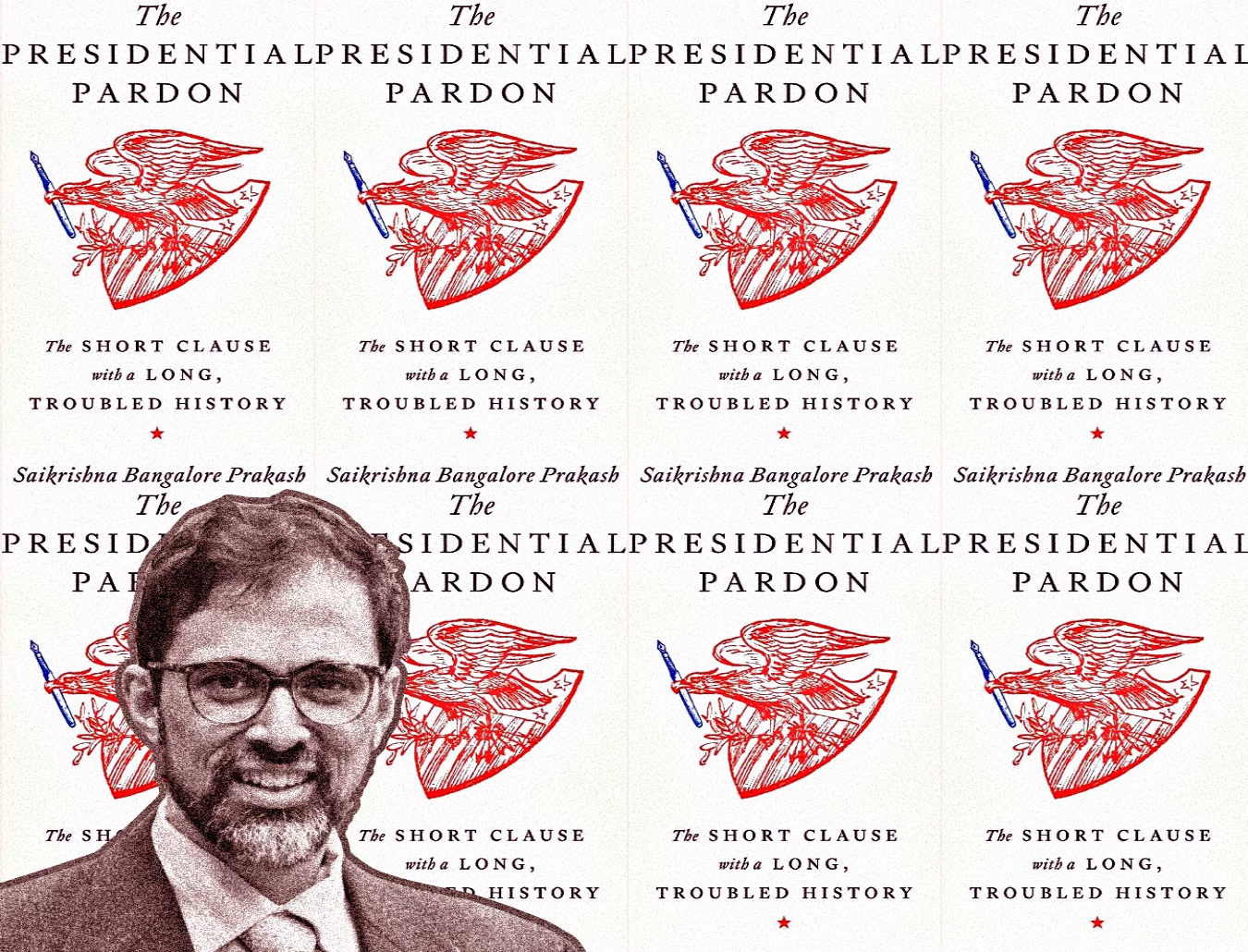
We are living in what Saikrishna Bangalore Prakash calls a “pardon dystopia.” Prakash, a conservative constitutional law professor at the University of Virginia, is the author of The Presidential Pardon: The Short Clause with a Long, Troubled History, a new book that covers the territory of what is arguably now the most controversial provision in the U.S. Constitution.
Prakash takes readers through the 18th-century history of the pardon power, along with its British antecedents. In the far-reaching and fierce debate over ratification of the Constitution, the pardon power was a ready target of the Anti-Federalists. One such particularly prescient Anti-Federalist was Luther Martin, who quit the Philadelphia Convention because he opposed the Constitution as a whole. In a speech to the Maryland legislature, Martin called the pardon power “extremely dangerous.” A president, he argued, “might attempt … to assume powers not given by the Constitution and establish himself in regal authority.” By issuing pardons to co-conspirators, he could “secure from punishment the creatures of his ambition, the … abettors of his treasonable practices.”

That is almost precisely what occurred two centuries later when Trump, on his first day in office in his second term, issued pardons to the approximately 1,500 rioters who stormed the Capitol four years earlier on Jan. 6, 2021, including those convicted of violent attacks on police officers and those convicted of sedition. Trump, as Martin foresaw, had pardoned the abettors of his treasonable practices.
Past Pardon Power Problems
Trump’s abuses of the pardon power are off the scale in scope and extent. Indeed, a veritable industry has arisen around his pardons, with lobbyists accepting millions in fees to help mostly white-collar criminals escape the consequences of their crimes.
But Trump’s transgressions are hardly the only ones reprised by Prakash in his history. We are introduced to forgotten controversies of our past, such as John Adams’s grant of amnesty to those involved in Fries’s Rebellion, a violent uprising from 1799 to 1800 against a property tax whose value was determined by the number of windows in a home. John Fries, a leader of the rebellion, and others were arrested and convicted of treason and sentenced to death. “It was impossible to commit a greater error,” wrote Alexander Hamilton of Fries’s pardon in a public letter. “Everything loudly demanded that the Executive should have acted with exemplary vigor, and should have given a striking demonstration that condign punishment would be the lot of the violent opposers of the laws.” Death, per Hamilton, was the appropriate sentence.
In our contemporary era, there have been a slew of controversies surrounding pardons, often issued by lame duck presidents. Gerald Ford’s pardon of Richard Nixon is the most famous of these, but there is also George H.W. Bush’s pardon of the Iran-Contra defendants, Bill Clinton’s pardon of the financier Marc Rich, and George W. Bush’s commutation of I. Lewis “Scooter” Libby (subsequently granted a full pardon by Trump).

Joe Biden does not escape scrutiny and judgment. It is not merely his pardon of his wayward son Hunter and other relatives on his last day in office that raises a stink—although a case can be made that the pardons were reasonable attempts to preemptively thwart an incoming president chomping at the bit to enact a retributive agenda. But Prakash looks closely and skeptically at Biden’s campaign pledge to expunge convictions for marijuana possession, a pledge aimed at attracting young voters, and which was realized in 2022 and 2023. Prakash calls this development “momentous,” writing that “as far as I know this was the first pardon grounded on the president’s disagreement with a federal law and the policy behind it.”
If the matter ever does come before the courts, the issues, write Prakash, are murky: “After all, the president is not formally suspending the law, as English kings used to do. In this case, the executive is issuing one (or more) pardons that collectively have the effect of suspending those laws that the president finds objectionable on policy grounds.” Prakash judges that this conflicts directly with the Take Care Clause—the president “shall take Care that the Laws be faithfully executed.”
Can the Pardon Power Be Reformed?
Is there anything that can be done to help us exit our pardon dystopia? As Trump’s second term proceeds, things are likely to get far worse. His departure from the stage in 2028 is likely to be accompanied by a “Pardonpalooza” encompassing hundreds if not thousands of underlings, associates, and family members, not to mention the corruption-ridden Trump Organization itself.

Prakash concludes his elegantly written book by surveying various potential reforms. One appealing idea, at least superficially, would be to abolish the pardon power entirely. This would certainly end the possibility of abuse. But there should be a place for mercy—legitimate mercy—in our criminal justice system. While the pardon power has been grossly abused, we should not lose sight of the myriad cases in which clemency has been warranted and granted, as in commutations and pardons for severe sentences for mere drug possession and the like. Complete abolition is too severe a solution.
Another approach considered by Prakash is to establish internal checks in the executive branch, such as restricting the pardon to only those individuals recommended by the pardon attorney in the Department of Justice, or by the attorney general. But this reform seems like a Band-Aid on a gaping wound. A corrupt president—the kind we have in office today—could appoint a slavishly subservient pardon attorney (as in Ed Martin, the current occupant of that job), or a slavishly subservient attorney general (as in Pam Bondi). Little would be accomplished with such a reform.
Alternatively, Congress could pass a statute that limits the pardon power in desirable ways. But as Prakash points out, there is great doubt that any such congressional restrictions could pass constitutional muster.
The Supreme Court has already been absolute on this question. In 1870, Chief Justice Salmon P. Chase ruled that the “legislature cannot change the effect of such a pardon any more than the executive can change a law.” This was reaffirmed by the court in 2024 when it noted in its infamous immunity ruling in Trump v. United States that the president’s authority is “conclusive and preclusive,” thereby “disabling the Congress from acting upon the subject.” Curiously, as Prakash notes: “The Supreme Court’s reading of the Constitution and its pardon clause makes the president more powerful than the British Crown of the 18th century, for while Congress cannot regulate the presidential pardon power by statute, the British Parliament certainly could do so.”

This leaves as the best route for reform a constitutional amendment. One approach might be to require Senate concurrence in a pardon. Another course would allow for a legislative veto on pardons. Additionally, it might be wise to outright bar pardons of family members, executive officials, and self-pardons.
All of these would go some distance in reining abuse. The trouble is, enacting a constitutional amendment requires a two-thirds vote in both chambers of Congress and approval by three-fourths of the states. Given how unlikely we are to see the passage of such an amendment in our polarized era, we are seemingly stuck.
By endowing the U.S. president with unrestricted pardon power, the brilliant framers of our Constitution made a serious mistake.

© The UnPopulist, 2026
Follow us on Bluesky, Threads, YouTube, TikTok, Facebook, Instagram, and X.
We welcome your reactions and replies. Please adhere to our comments policy.

One of the things I had hoped for from the Trump DOJ was challenging the whole notion of a preemptive pardon. The precedent set by Gerald Ford and exploited by Biden has never been tested in court. Pam Bondi Should indict (assuming there are actual grounds) of someone preemptively pardoned by Biden. They would of course appeal to their preemptive pardon to have charges dismissed but it would be interesting to see if the Courts would not find them by definition not within the pardon powers of the President. In fact such pardons do damage to the entire meaning of the pardon power and opens the door to great mischief. No one acting on a Presidents power could ever be held to account again because he just waves a magic wand before he leaves office and trials and convictions (which are the subject of pardons) would just go away altogether. It as absurd as the notion of pardoning oneself. Amnesty is very different from clemency and pardon.
Of course this is a card that Trump would never want to give up from his bag of tricks.
Would be nice to have a limit of 100 pardons per calendar year, too. Or 10. Whatever.