


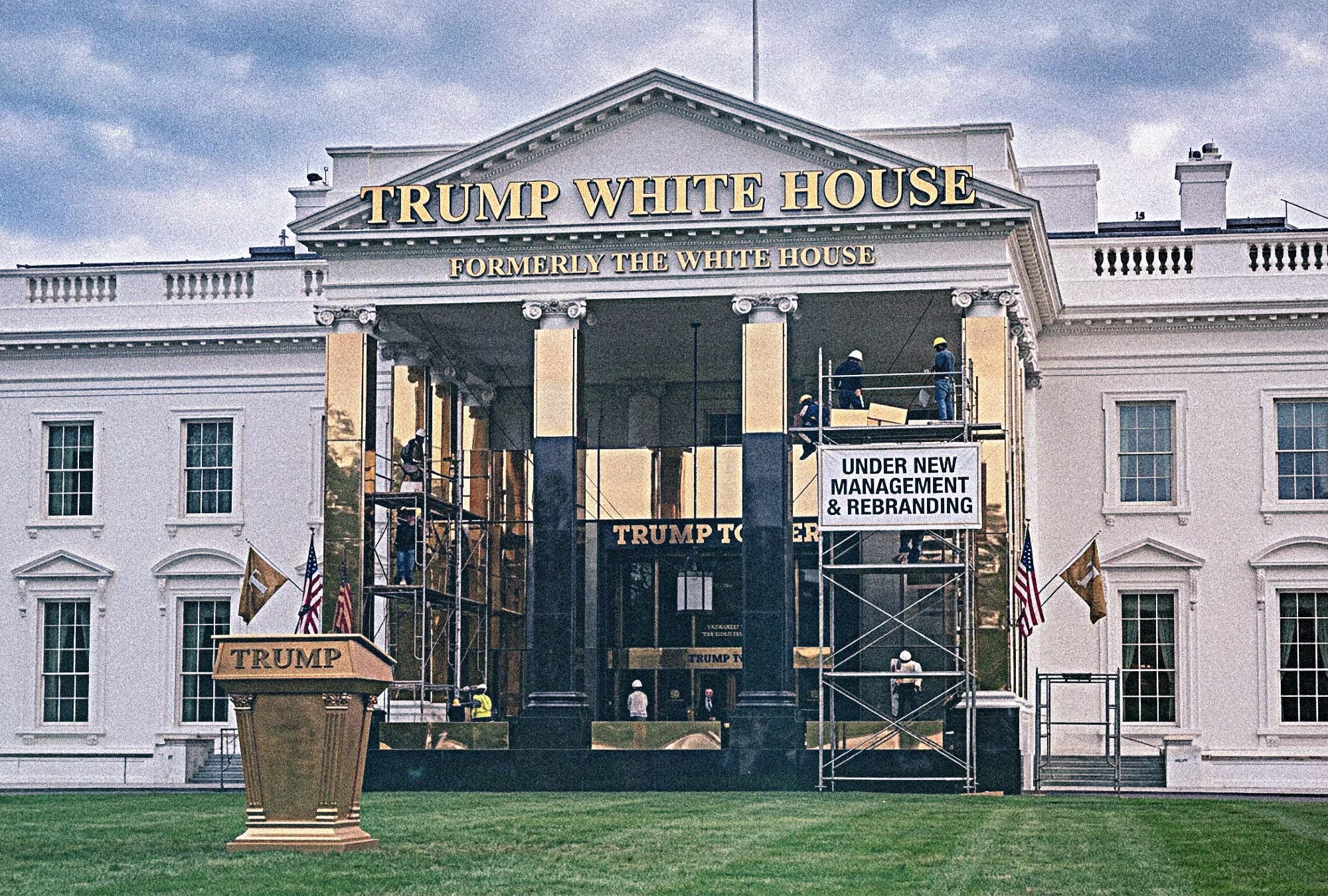
The cult of personality has always been central to Trumpism. Now it is the official policy of the United States government. Donald Trump’s name has been affixed to the Kennedy Center. The U.S. Institute of Peace, without any irony, has been renamed after him. His face hangs in enormous banners on the facades of the Departments of Justice, Labor, and Agriculture. His portrait appears on National Park passes. His signature will appear on dollar bills, and coins bearing his likeness are being planned. Government programs carry his name: “Trump Accounts,” “TrumpRx,” the “Trump Gold Card.” A new class of Navy warships will be “Trump-class,” with concept art featuring his image on the hull. The Air Force’s new sixth-generation fighter jet has been designated the F-47, named for Trump, the 47th president.
The sheer volume of it can make the eyes glaze over. That is part of how it works. Each item taken alone might seem like an obnoxious but relatively minor show of vanity. Taken together, they amount to something that the American constitutional tradition has guarded against for a quarter of a millennium.
Americans do, of course, name things after presidents. Airports, aircraft carriers, federal buildings, highways. Arguably a bit too much: the insistence on almost every modern president getting an aircraft carrier gives us the absurdity of a USS Bill Clinton and USS George W. Bush. But this is done after a president leaves office, and usually after he is dead or at least elderly. The honor reflects the judgment of posterity. It is bestowed, not seized.
Gerald Ford vetoed a bill to name a courthouse in his own hometown after him, writing that naming federal buildings after sitting presidents was not a precedent he wished to establish. Harry Truman explicitly declined to have roads or buildings named for him. George Washington refused to have his face put on coinage.
This norm is not a minor point. The symbolism matters. It is an expression of the foundational distinction between republican and autocratic government. In an autocracy—most vividly in overt monarchies but also many modern dictatorships—the state is embodied in the sovereign ruler. Their face is on the money; institutions and governments are denominated “royal”; infrastructure projects are named in their honor; and their birthdays are public holidays. The nation is, quite literally, theirs. “L’État, c’est moi.”

To be sure, for our cousins under the British crown and other constitutional monarchies, this is a tradition they have successfully adapted to democratic norms. The role is explicitly ceremonial, stripped of any real political power, harmless in its impotence. Charles III is not Charles I. But in the United States, we did not tame monarchy, we abolished it.
A republic, with symbolism tracing back to antiquity, deliberately inverts these trappings of personal rule. The institutions belong to the public—res publica, in which all have a stake. The people, and not the rulers, are sovereign. The officeholder is a temporary steward, not a proprietor. When a president stamps his name and likeness on federal buildings and government programs and the national currency, he is asserting the monarchical claim: that these things are extensions of himself.
This is not something to be shrugged off as incidental. It is corrosive of America’s fundamental principles.
Dictator Perpetuo
That understanding did not originate in Philadelphia in the summer of 1787. It goes all the way back to Rome. Like America, Rome was a people consciously rooted in having overthrown a monarchy. In 44 BC, Julius Caesar had his portrait placed on the coinage of the Republic. It was a shocking statement. Roman coins had never before carried a living man’s portrait at the Rome mint. Much less one bearing his newly claimed, unprecedented title: dictator perpetuo, the dictator for life. To put your face on the money was to claim a status above that of a citizen, to assert that you were not first among equals but something closer to a sovereign. It was emblematic of his concentration of power, consolidating his rule into an open autocracy. Within weeks of issuing the “CAESAR DICT PERPETVO” coin, he was assassinated.
Though the Roman Republic fell, the ideal survived. Public institutions exist apart from the men who lead them, and conflating the two is the hallmark of tyranny. That ideal profoundly shaped the generation that designed the American constitutional order. The Founders created a Senate, placed it on a “Capitol Hill,” and embraced neoclassical architecture. They modeled their concept of civic virtue on Cincinnatus, the farmer-general who, having defeated a foreign invader, relinquished his dictatorial powers after just 15 days and went home. The Federalist Papers were published under the pseudonym “Publius,” while others posed as “Cato” or “Brutus.” Washington’s voluntary departure from the presidency after two terms, and his earlier resignation of his military commission, were modeled on that Roman example.

When Congress debated the Coinage Act of 1792, an initial version of the bill called for the president’s portrait to appear on U.S. coins. Washington rejected the idea, and James Madison successfully had it removed, arguing that stamping the president’s head on the money was un-republican. British minters had already struck pattern coins featuring Washington’s portrait in hopes of winning a contract, but Washington refused those, too.
It was a distillation of the republican tradition he and his contemporaries cared about deeply and considered a core value of the American Revolution. The whole architecture of the presidency—limited terms, enumerated powers, an oath sworn to a document rather than a dynasty—was designed to ensure that the office would never become a vehicle for the personal glorification of its occupant.
Now, the treasury secretary proclaims “there is no more powerful way to recognize the historic achievements of our great country” than putting Trump on our dollars and cents. That elision—between the nation and its leader, between public accomplishment and personal vainglory—is precisely what constitutional republicanism aims to prevent.
Every program that carries the president’s name sends a message that the benefits of government flow from him personally. Not from Congress, or the Constitution, or our collective project of self-governance. When Americans were asked about “TrumpRx” without being told its name, support ran nearly three to one. When they were told the name, support collapsed. The polling makes the purpose plain: the program exists to attach his name to a benefit, not to deliver one. In the State of the Union he boasts about “Trump Accounts” and “TrumpRx”—then implausibly adds “I didn’t name it.” The disavowal is a page straight from the modern dictator’s playbook. No matter how transparent the ruse, the official line is that this must all appear spontaneous, as though the country simply could not help itself. The adulation must seem organic and authentic even when it is fabricated from above.
The banners on the federal buildings are the most vivid example. A president’s face, stories tall, draped across the Department of Justice. It’s not yours, it’s his.
Seizing the Symbols
Some might argue that the symbolism is entirely beside the point—that a president could plaster his face on every federal building and still faithfully execute the laws. The flipside, the argument goes, is also true: a president can govern with solemn—even monastic—modesty all the while systematically dismantling every check on his power. But this view relies on the mistaken idea that symbolism is merely decorative, when it is actually one of the primary ways regimes legitimate themselves, and it is how citizens come to understand what kind of government they live under.

In the hierarchy of threats to the constitutional order, this is admittedly not the most urgent. The weaponization of the Justice Department, the evisceration of congressional spending authority, the assault on the rule of law and civil liberties—these are graver and more immediate crises. Nobody is going to restore the Republic by passing a law about signs and coins. But reversing the drift will require many reforms to executive power, the electoral system, and all the institutional checks that proved too brittle under stress. This is one of the smaller ones. It also happens to be one of the easiest, the low-hanging fruit of repudiating Trumpism.
The SERVE Act, introduced in January, would prohibit naming federal buildings or land after a sitting president. The Change Corruption Act, introduced last December, would codify in law the longstanding norm against living presidents appearing on currency, extending it explicitly to coins.
Congress should enact a law that categorically prohibits, for any sitting president or even for any living ex-president, the use of the president’s name, image, likeness, or signature on federal buildings, programs, websites, currency, military assets, or public lands, and prohibit the expenditure of any federal funds for such projects. It should apply retroactively, a wholesale revocation of all Trump’s improprieties. The reasonable exceptions should be narrow and strictly defined, such as publishing documents and photographs through the Executive Office of the President (that is, “the White House” as such). And it should be written broadly enough that future presidents, of any party, cannot find novel ways around it.
Symbolism matters for any form of government. It’s not just platitudes and manners. It’s how we affirm the values we care about, how we embed a reminder of the virtues we choose to aspire to. Despots do not adopt cultish, personalist symbolism out of simple egomania but because they know it is the basis of their regime. Republics must do the same, adopting a coherent sense of civic imagery if they are to survive.
Ultimately, laws must be backed by norms and Trump should be roundly shamed for his brazen aggrandizement. Presidential hopefuls should pointedly reject Trump’s vulgar displays and pledge to restore class and gravitas to the office through personal austerity.
The institutions of self-government do not belong to the person who temporarily leads them. The Founders understood this. They had read their Plutarch. They had lived under a king. They built an entire constitutional system on the premise that it would not happen here. Where norms and basic decency have failed to maintain this principle, we should write it into law, and hold accountable those who break it.

© The UnPopulist, 2026
Follow us on Bluesky, Threads, YouTube, TikTok, Facebook, Instagram, and X.
We welcome your reactions and replies. Please adhere to our comments policy.
I cannot appreciate this enough.
I would go further and prohibit public things from being named after current political office holders, period. Nancy Pelosi Drive and Dianne Feinstein Elementary School, among many others, set bad precedents (not picking on those particular pols, those are just the examples closest to where I live).