


Listen to The Reconstruction Agenda from The UnPopulist in your favorite podcast app: Apple Podcasts | Spotify | Google Podcasts | RSS | YouTube
A transcript of today’s podcast appears below. It has been edited for flow and clarity.

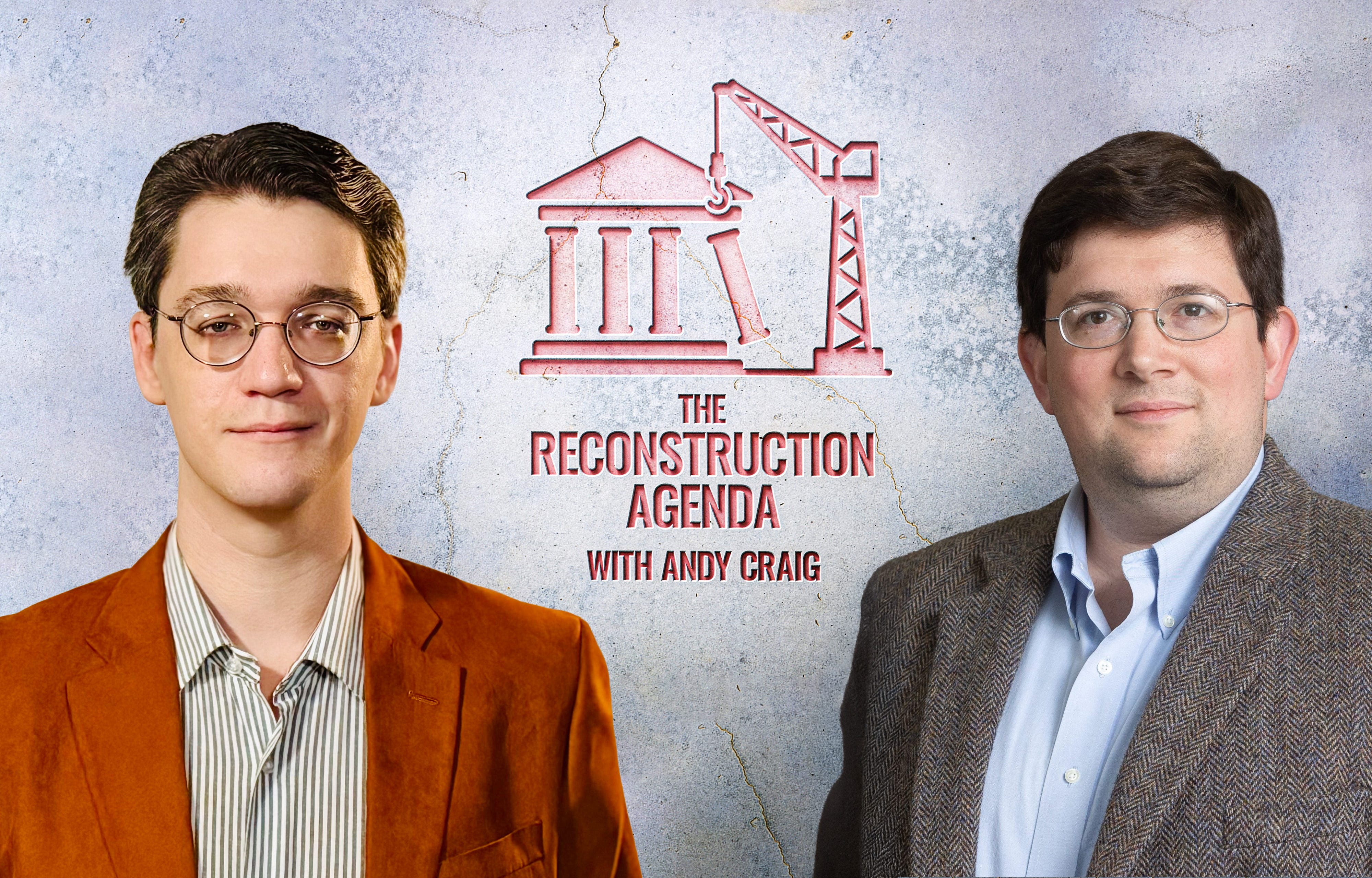
At the heart of our constitutional system is Congress. In thinking about how to repair our broken government, and in particular the runaway imperial presidency, the role of Congress is essential. So to discuss this, I’m happy to have one of the leading scholars of congressional power and the history of congressional reform. Josh Chafetz is a professor of law and politics at Georgetown, and the author of Congress’s Constitution: Legislative Authority and the Separation of Powers.
Andy Craig: When we’re thinking about the history and the context in which the Constitution was written, a lot of that really goes back to the English history: the English Civil Wars and Charles I and all that. So how did that inform not just the broader Anglo-American tradition, but particularly how the Framers were thinking of it when they sat down to write the Constitution?
Josh Chafetz: The 17th-century English context is very consequential and very present to the founding generation. Throughout most of the 17th century, you have Stuart monarchs. This new, in some sense foreign, Scottish line has come to the English crown starting in 1603, and is very quickly at loggerheads with Parliament, and in particular, mostly with the House of Commons. And that leads to the English Civil War.
After the Restoration in 1660, it leads to the Glorious Revolution [in 1688]. So, two of the four Stuart monarchs are deposed in the 17th century. And, actually, in some sense the American colonists view that as more similar to their own situation than the English, and then British, governments that arise in the 18th century. Because in the 18th century, in Britain itself, you have the rise of ministerial responsibility to Parliament. So you have the rise of the system that they still have to this day, where the government actually answers directly to Parliament.
But when the American colonists, and New World colonists more broadly, look to their own situation, what they see is that they have elected colonial legislatures—but they have both judges and executive officials that are imposed on them by London—by the Board of Trade, by the Crown. So, in some sense, they actually see Parliament’s fights against the Stuart monarchs as being more similar to their own situation than they see the, for them, present-day relationship between the Hanoverian monarchs and Parliament. So it’s actually very present to them. It gives them this language that you see the colonial legislatures really picking up on, starting in the 1760s, of legislative supremacy and of using all of the tools of the legislature to push back against royal officials.
Craig: So we’re often used to thinking of this as presidential versus parliamentary systems. I mean, if you take a political science class today, you’ll learn about how America is a presidential system. But, of course, these concepts didn’t really clearly exist yet at the time.
The presidential model, as it came to be, was something they were kind of making up as they went along. And the parliamentary system, the Westminster system as we know it, didn’t really fully exist yet. One of my favorite little tidbits about that is that the first motion of no confidence was actually the one that toppled Lord North, that brought the American Revolution to an end. So that kind of intertwined history of American and British democracy is great.
But I think that goes to how they weren’t thinking in the terms we would come to think of it, as three strictly separated branches of government. You read the Federalist Papers, they thought they were trying to make the executive weaker than the existing British system. But it really was, in that context, parliamentary supremacy that infused these ideas. That’s what they were thinking about as the purpose, the central role of the elected legislature. Is that right?
Chafetz: Yeah, and I think one way to think about it, instead of trying to think in terms of parliamentary versus presidential systems, is simply whether the executive answers directly to the legislature or not. In the American constitutional system, the executive doesn’t answer directly to the legislature. We have a separate system for electing the president. There’s no such thing as a motion of no confidence. There’s impeachment, of course, but that sort of presupposes not just policy disagreements but a certain level of actual malfeasance or non-feasance.
In some sense, that is similar to a system in the 17th century, where the executive was the crown. It was not chosen by parliament; it was hereditary. That starts to change in Britain itself in the 18th century, when the crown ceases to mean the monarch or even people who answer directly to the monarch, but rather means the government that gets put in place, because it’s sort of responsive to the parliamentary majority. That’s why I say that the Americans in the founding generation actually thought they had, in some ways, more in common with the Englishmen of the 17th century than with the Britons of the 18th century. Part of what that means is that they’re picking up on this language of legislative power in pushback against overweening executive power. And that’s actually really present and really important to them.
Craig: So I want to set up the history in very broad strokes. I know this is a big question, but over the course of the early Republic and throughout the 19th century, you had some presidents who came in and were stronger and more dominant. But for the most part, Congress was much more central as the main political arena where the big decisions were made—particularly, famously, in the latter half of the 19th century. These were very politically weak presidents. How and why should that change over the course of the 20th century and into the 21st? Because it doesn’t seem like it’s necessarily a natural evolution that you had an institution with this much power and centrality, and over time it bled power to primarily the presidency but also, to some degree, the courts.
Chafetz: You’re absolutely right. Congress was, for almost the entirety of the 19th century, certainly the prime mover in domestic politics, the prime mover in distributive politics and in all of the normal things we think of as the day-to-day functioning of the government. It was really Congress making these decisions.
A big part of what the presidency was understood to do was actually dispensing patronage, keeping their party together by bringing as many of their supporters into government—and therefore onto the government payroll—as possible. But presidents for most of the 19th century weren’t really directing policy in any particularly strong or meaningful sense. That was happening in Congress.
I think part of it is a story about the rise of the administrative state. Part of it is a story about at the end of the 19th, beginning of the 20th century, Americans want the federal government to be doing more and more things. And that creates almost inexorable pressure towards creating administrative agencies. There’s only so much of that work that actually could be done in Congress. As the workload picks up, it needs to create more administrative agencies.

But even then, the agencies were largely seen as creatures of Congress. They were not seen as the sort of things that necessarily answered to the presidency. And it’s really actually a far more recent story than I think a lot of people think. But you get an ideology [that] now is called unitary executive theory, an ideology of presidential control that really, as a lot of recent research has shown, is largely a creature of the 1970s—this idea that you’d have centralized presidential control over these agencies.
It’s a much earlier story that these agencies are exercising more and more power, but these agencies saw themselves not as directly responsive to the president. And presidents didn’t see themselves as having direct supervisory power over these agencies really until the ‘70s. And then that grows through the ‘70s, ‘80s, and is continuing to grow today. That sort of idea increasingly captures the judiciary as well, which beginning in the 1980s and continuing right through the present day begins to treat presidential control over the agencies as being constitutionally required in a way that it had not been understood to be before.
Craig: Yes, and I’ll do a quick plug for our last episode with Noah Rosenblum, in which we were discussing, in particular, the history of the removal power in that story.
Chafetz: And Noah’s done just some of the best work on all of this.
Craig: Definitely. But one other historical point I want to hit before we move on to the present context is this decision, INS v. Chadha, that really had the effect of gutting some of the post-Watergate reforms. Because there was that moment of things like the National Emergencies Act, there was the Church Committee. It felt like in the mid-’70s there, after Nixon resigned, that there was a little bit of an effervescence of congressional pushback. But a lot of these laws aren’t working as intended because of this court decision. So what exactly did Congress try to do, and what did the court find in that? And what was the reasoning?
Chafetz: So INS v. Chadha is a 1983 decision of the Burger court. There are these family of mechanisms that go under the name of the legislative veto that had been used by Congress since the early 1930s, and it’s not coincidental that it starts in the 1930s.
This goes along with the rise of the administrative state, and Congress has this idea that, well, we understand the necessity of delegating power to administrative agencies. But if we can’t make all of these sort of granular decisions ourselves, and we know that we can’t, we want to at least maintain a post-hoc check on how the agencies use that power.
And so they start creating these things called legislative vetoes, where the basic idea is, in any particular statute that’s delegating some authority to an administrative agency, they would say, when you promulgate the rules that you’re authorized to promulgate under this statute or something like that, you have to send those rules to Congress, and we basically get to say if we don’t like them. And there were different forms this could take.
Sometimes it was a one-house legislative veto. If either the House or the Senate says, “We don’t like it,” then it doesn’t go into effect. Sometimes it was a two-house legislative veto. If both houses say they don’t like it, it doesn’t go into effect. Sometimes it was even a committee veto. You have to send this to the Agriculture Committee in each chamber, and if either Agriculture Committee doesn’t like it, it doesn’t go into effect.
There were hundreds and hundreds of these provisions in federal statutes passed from the 1930s, continuously thereafter. And then suddenly, in 1983, the Supreme Court comes in and says, “These are all unconstitutional.” This is a case called INS v. Chadha. The particular legislative veto in that case was a one-house legislative veto over suspension of deportation decision. So it was an immigration law case.
“In the 18th century … the crown ceases to mean the monarch or even people who answer directly to the monarch, but rather means the government that gets put in place, because it’s sort of responsive to the parliamentary majority. That’s why I say that the Americans in the founding generation actually thought they had, in some ways, more in common with the Englishmen of the 17th century than with the Britons of the 18th century. Part of what that means is that they’re picking up on this language of legislative power in pushback against overweening executive power.” — Josh Chafetz
There were all kinds of ways that Chief Justice Warren Burger, who wrote the majority opinion, could have written a more modest opinion. But instead, he goes big, and he writes an opinion that basically says, “Nope, all legislative vetoes are a congressional usurpation of executive power. They’re all unconstitutional.” So that’s one important thing that happens there.
And then the other important thing that happens is what’s called severability. This sounds like a technical, lawyerly thing, but it’s actually really important. So when the courts decide that some particular statutory provision is unconstitutional, they have to decide how much to strike down. Do you strike down the entire statute that it’s a part of, or what smaller unit of it do you strike down?
What Burger says in that opinion is, “We’re just going to strike down the legislative veto itself. That’s it.” So the effect was to undo the deal that Congress had struck, because the way Congress passes these legislative vetoes, it’s always the pairing of a delegation of power and a legislative veto. So we give the executive branch, we give the agency, this power, but we reserve the right to veto it.
So what the court could have said, even if the court was going to strike down the legislative veto in Chadha, is, “Well, there’s this suspension of deportation provision that gives the attorney general discretion, and there’s a legislative veto in case Congress doesn’t like how it uses that discretion. If we think the legislative veto is unconstitutional, we’re going to strike down not just that, but also the attorney general’s discretion.” It could have said that, but it didn’t.
Instead, it says, “We’re going to allow the attorney general to keep the discretion, but we’re going to take away Congress’s post hoc check.” That turns out to be hugely consequential, not just in, or not even primarily in, the suspension of deportation scheme that’s an issue in Chadha, but in all of these post-Watergate reform statutes that you’re mentioning.

So it turns out, not coincidentally, that there are legislative vetoes in the War Powers Resolution, the Impoundment Control Act, the Arms Export Control Act, the National Emergencies Act, the International Emergency Economic Powers Act. These are many of the most consequential post-Watergate reforms. These are all passed between 1973 and 1977, and they all contain legislative vetoes, and those legislative vetoes are all wiped off the book by INS v. Chadha. And in four of those five, in all but the Impoundment Control Act context, the legislative veto is wiped off the book, but the delegation of power remains. And that is hugely consequential because all five of those statutes have been the source of major controversies in the first five years of the Trump presidencies.
Craig: And the kind of perverse thing about that, and we see these votes all the time, is you can have Congress, by majorities, by pretty healthy majorities in some cases, saying, “You know, we disapprove of this emergency declaration or that tariff or whatever the case may be. But under the holding of Chadha, this has to go to the president to be signed or vetoed.” By definition here, you’re overriding what the president has done. And as we’ve seen in other contexts, given partisan incentives, it’s very difficult for a president to ever have less than at least one-third in at least one house who are willing to back him on whatever the issue may be.
Chafetz: Exactly. And we’ve seen this play out in the Trump presidency. With the border wall emergency, where the disapproval resolution passed both houses of Congress overwhelmingly, but not by two-thirds supermajorities, and Trump vetoed it. In the current Trump administration, with tariffs, where the Senate has now three times voted to disapprove various tariffs under IEEPA, and it’s clear the votes are there in the House too, but it doesn’t matter because Trump would veto it. We’ve seen it in the Arms Export Control Act context in the first Trump administration, where both houses of Congress passed a disapproval resolution over an arms sale to Saudi Arabia, and Trump vetoed it.
And in all of those contexts, pre-Chadha, the mere passage through Congress would have been enough. It wouldn’t have needed to go to the president for his signature. Post-Chadha, the only way these things can be disapproved is if you send them to the president for his signature and he signs them into law like any other statute.
But, of course, the whole point is that you’re trying to disapprove of the things the president has done. Of course he’s not going to sign them into law. And so you’ve left the president with these tremendous delegated powers, and taken away the check that Congress had reserved for itself. You’ve undone the deal that was struck, but you’ve only undone one side of it.
Even in a situation in which Republicans control both chambers of Congress like they do now, we still see it having an effect. We still see situations in which some Republican members would be willing to push back against the president, but they’ve been deprived of the tools for doing so.
Craig: In addition to all these legislative veto schemes that were struck down, this is also how regular legislation works. And that’s what we’re used to thinking of as the main power of Congress, making laws. And, you know, we all remember our Schoolhouse Rock. It goes through each house and then the president signs it or else it takes two-thirds in both houses to override a veto.
This setup is pretty favorable to the president in a way that took a long time to evolve. Because early on it was the norm … I mean, relatively early, they broke this. Andrew Jackson was the one who broke it. But initially, the president would only do that for constitutional objections. And now, of course, it’s become a very freestanding policy tool.
“One power that individual chambers and indeed individual committees of chambers have is oversight power: the ability to demand information from the executive branch, but also from private actors; the ability to stage oversight hearings in such a way as to command public attention. And these can have significant electoral consequences, if nothing else, right? It’s a way of focusing people’s attention on an issue. It’s a way of putting on a demonstration of what’s wrong. It’s political theater, but theater is a good thing, right? Politics is about performance.” — Josh Chafetz
So in the immediate context of the constitutional omni-crisis that is the second Trump administration, we’re looking at the midterms. Certainly from the elections we had earlier this month, things are looking pretty good for the Democrats. They’re probably going to take the House. They have an outside chance of maybe taking the Senate. But then what?
Because they can’t pass anything that he’s going to veto unless they peel off a lot of Republicans, which is difficult and unlikely in most cases. We’ve seen a lot of funny business on the power of the purse in terms of their control over spending. And the administration is violating that, frankly, sometimes in ways that don’t seem to have any great remedy.
But in your book, you make the point that this is not the only power Congress has, and even post-Chadha, that there are things Congress can do, sometimes just one house acting alone, sometimes even just an individual member. So let’s start with the one house, and I suppose also, in some cases, a particular committee of the house, which is acting for the house. What can they do against a really aggressive, power-grabbing executive branch in this sort of situation?
Chafetz: One power that individual chambers and indeed individual committees of chambers have is oversight power: the ability to demand information from the executive branch, but also from private actors; the ability to stage oversight hearings in such a way as to command public attention.
And these can have significant electoral consequences, if nothing else, right? It’s a way of focusing people’s attention on an issue. It’s a way of putting on a demonstration of what’s wrong. It’s political theater, but theater is a good thing, right? Politics is about performance. And so I think the most successful example of this that we have in recent years is the Jan. 6 committee in the House. That really commanded a tremendous amount of public attention. Some of the primetime hearings they held got more or less the same audience as a Sunday Night Football broadcast. So these were huge focal points. Polling shows that a lot of people paid attention to them.
And they actually had a significant impact on the 2022 midterm elections. There’s a decent amount of political science research showing that Republicans who were identified as election deniers or identified with the Jan. 6 insurrection did worse than other Republicans in the 2022 midterms. There was an electoral penalty for being associated with that. And I think a good part of that can be traced back to the way in which the Jan. 6 committee made its case.
So I think that can be a model for Democrats if they take either chamber, much less both of them, to try to think about, “Okay, how are we going to stage hearings that capture the public’s attention? How are we going to demand information and present that information to the public?” In some sense, we see echoes of this, even literally today, with the Epstein files. Congress demanding information.
Another way that an individual chamber can make its views efficacious is, of course, the Senate’s role in confirmations. The Senate can simply either refuse to confirm nominees, or force the president to appoint nominees that are more acceptable to the Democrats if the Democrats were to control the Senate. It can use confirmation hearings to make its concerns known and also extract promises from nominees. That’s a significant source of power in the Senate.
And then another way that individual chambers can press their policy positions is through the appropriations process. So part of that might be funding the things they want funded, but part of it can be defunding the things they want defunded. Government shutdown, like the one we just came out of, is at the extreme end of that.
But imagine that the House puts a rider in an appropriations bill that basically defunds the White House Counsel’s office. And if that provision gets through both the House and the Senate, now you say, “Well, Trump could veto it.” That’s true, but we don’t have a line item veto at the federal level. If Trump vetoes that bill, he’s choosing to shut down some … you know, depends how much of the government that particular bill funds, right? We’re in an age of omnibus or minibus statutes, so it might well be that that funds a third or a quarter of the discretionary functions of the federal government.

So then you present Trump with a choice: Either accept this provision defunding the White House Counsel’s office, or you are choosing to shut down a bunch of the federal government. And shutdowns are not popular. So there are all of these levers of power that even an individual chamber, much less both chambers, if they’re in the same party’s hands, can use against a president, and can try to really press their positions that way.
Craig: I want to come back to the Senate confirmation process in a moment. But on that oversight point, the Jan. 6 committee in some sense had an advantage in that Joe Biden was in the White House, so they weren’t getting fought nearly as much on subpoenas. There were other people who fought subpoenas. I mean, this is what Bannon and a couple others actually got some short jail time for. But that’s because the executive branch, Biden’s Department of Justice, was willing to take up those prosecutions.
So during the actual first Trump term, and I think we’re seeing already some of it now, there was a sense that protracted litigation and refusal on the part of the executive branch, various Cabinet agencies, the White House, to provide responses to these demands for information, these subpoenas that were issued by these committees.
So there’s different ways Congress can try to enforce when it has a subpoena power. I mean, one, it can do its own kind of civil litigation against somebody, and usually a committee is empowered to do that. But ultimately, it refers it to the Department of Justice, and they have to either prosecute or not, which gets to the problem of who’s in control of the White House. But there is a third little-known option that hasn’t gotten a lot of use in a long time, and this is the inherent contempt power.
If I understand this right, it has happened before, where a house of Congress can literally just throw somebody in jail, the same way a judge would for defying a judge’s orders. So how would that work, and is that a possible thing that needs to be revived and taken a little bit more seriously in this situation, in this context where you have a recalcitrant executive branch?
Chafetz: Yeah, absolutely.
So, one thing I will say is about the way that the chambers now try to go about enforcing their subpoenas to the executive branch when the executive branch doesn’t want to comply. If we’re talking about subpoenas to private parties, even when there’s different parties controlling [Congress and the White House], those will often get prosecuted by the Department of Justice, often because they’re not in politically divisive situations.
But in situations where DOJ doesn’t want to prosecute under the contempt of Congress statute—which, by the way, it has a legal requirement that it prosecute; It says that they “shall” prosecute. Nevertheless, they frequently choose not to when the subpoena is directed at someone in the administration.
So the other thing that Congress has been doing in recent decades is civil litigation. And civil litigation, I think, is a complete fool’s errand, and I’ve been arguing this since 2008 for two reasons. One, it’s just an outright statement of congressional weakness. When Congress issues a subpoena, the target of the subpoena has an obligation to comply. But here, Congress is saying, “We’re going to issue you a subpoena that you have an obligation to comply with, and then we’re going to go run to a federal judge and make that federal judge tell you you have an obligation to comply”—which suggests that even Congress is saying, “Well, people may not listen to us. We’re just Congress. But they’ll listen to some federal district judge.” That’s turning our constitutional scheme upside down already. Congress is Article I.
“Inherent contempt was more widely used in the 19th century. It has been used at least twice against executive branch officials. So in the late 19th century, it was used against the United States minister to China, who Congress thought was engaged in corruption. In the early 20th century, it was used against a U.S. attorney in New York. But in both cases, Congress actually arrested an executive branch official itself. And Congress still has that power. Now, I think there are also other ways that Congress could go about enforcing its subpoenas itself. And again, these all come back to the mechanisms we’ve already talked about. The Senate could refuse to confirm executive branch officials as long as some executive branch official was in contempt of Congress. Congress could also pass riders refusing to pay salaries of officials who were in contempt of Congress, or perhaps even defunding the sort of subunit that those people work in.” — Josh Chafetz
But on a more practical level, attempts at civilly enforcing congressional subpoenas never work. The reason for that is that they just take too long. Even when the ultimate decision is in Congress’s favor, it always comes too late. So in the George W. Bush administration, there were the subpoenas to Harriet Myers and Josh Bolton. That case doesn’t get resolved until the Obama administration. In the Obama administration, there’s the subpoenas to Eric Holder. That civil litigation doesn’t get resolved until the Trump administration. In the first Trump administration, there are a whole bunch of subpoenas. None of those cases get definitively resolved until the Biden administration.
There is no example in the 21st century of civil litigation of a subpoena actually occurring in a timely enough fashion to allow Congress to oversee the administration that was in power when the subpoena was issued. They’re simply not working even when Congress, quote unquote, “wins” the court case.
So I think that does bring us to inherent contempt. Inherent contempt was more widely used in the 19th century. It has been used at least twice against executive branch officials. So in the late 19th century, it was used against the United States minister to China, who Congress thought was engaged in corruption. In the early 20th century, it was used against a U.S. attorney in New York. But in both cases, Congress actually arrested an executive branch official itself. And Congress still has that power.
Now, I think there are also other ways that Congress could go about enforcing its subpoenas itself. And again, these all come back to the mechanisms we’ve already talked about. The Senate could refuse to confirm executive branch officials as long as some executive branch official was in contempt of Congress. Congress could also pass riders refusing to pay salaries of officials who were in contempt of Congress, or perhaps even defunding the sort of subunit that those people work in. It wasn’t a coincidence that my example earlier was defund the White House Counsel’s Office. It could go after the entity that’s making up these specious reasons for denying congressional power. It could defund the White House Counsel’s Office as long as it’s making these ridiculous arguments about why executive branch officials don’t have to comply with congressional subpoenas.

So even short of sending the sergeant at arms out to arrest someone, it could use other tools at its disposal. It could tie them into the subpoena power and use them as a means of making congressional oversight more effective.
Craig: Definitely, though the sergeant at arms going out and arresting, you know, Pam Bondi or Kristi Noem would certainly have entertainment value. It’d probably attract public attention. But no, that’s a good point that all these other avenues need to be taken more seriously because that was a big frustration in the first Trump administration—the way that litigation dragged on to the point where it’s moot. There’s a new president now, so who cares?
Chafetz: You could even imagine a standing rule in, say, the House of Representatives that makes it out of order to appropriate any money to pay the salary of any executive branch official who’s in contempt. Now, the point of order can be waived. That could happen, but it would require people on the House floor to affirmatively vote to pay the salary of someone who was in that moment in contempt of Congress. And I think that at the margins might have some effect.
Craig: That’s pretty potent, too.
So, on the Senate confirmation powers, we’ve seen a lot of disappointment in terms of the current GOP majority. There was hope for some of the more moderates, Susan Collins or Bill Cassidy or Lisa Murkowski or John Curtis or some of these people would at least be more of a brake on the worst of the Cabinet picks. And a lot of those went through, but there has been some success.
I mean, even right now, as broadly subservient as this Congress has been to Trump, there have been some nominees that have failed and had to be withdrawn because the Senate was pushing back on them. But we’ve seen a lot of shenanigans—and this is one of those things that predates Trump but has now gotten worse under Trump—of using acting or interim appointments under the relevant statutes that allow for that, like the Vacancies Reform Act.
We’ve seen them do things like toy with the timeline so that you can stack together these 180-day—or whatever it is—appointments, and just keep these offices going without subjecting them to Senate confirmation. So other than reforming the law, which obviously also needs to be done at some point when you have either a trifecta or a veto-proof majority, how can the Senate act on this? Particularly the Senate, but I guess the House could potentially take an interest in it, too—to deal with this problem where they’re just doing this end run around the Senate in terms of who’s actually in all these various executive offices that are supposed to be confirmed by the Senate.
Chafetz: Yeah, I mean, it’s a huge problem. And there are really very limited ways that Congress can deal with it.
You know, one interesting thing that has happened for most of the 21st century, regardless of who’s controlling the chambers, is the use of pro forma sessions to basically take away recess appointments as a presidential tool. That’s been a really interesting bipartisan consensus that we’re just not going to allow presidents to do recess appointments. So that was one way of trying to push back against this.
But then, you’re right, what presidents have done is turned to acting and interim appointments. Frankly, there are real limits to what Congress can do about this, short of … I think one piece of a post-Trump reform package needs to be serious reform of the Federal Vacancies Reform Act. And I would commend to all of your listeners Anne Joseph O’Connell’s work on this.
But in the interim, the tools that Congress has available to it are the same ones we’ve been talking about. So you can imagine an appropriations rider saying no funds shall be used to pay the salary of an acting director of any agency who’s in an office for more than 60 days, or something like that. But in some sense, there’s fairly limited power that Congress has by itself to sort of stymie these end runs.
Craig: So when you read the Framers, the Federalist Papers and sources like that, you see they really thought and talked a lot about impeachment as a live, viable, active check on both presidents and other executive officers.
“Impeachment remains a really important political tool. One reason for that is simply that even when the person is acquitted in the Senate … let’s just focus on presidential impeachments for now. Even when the president is acquitted in the Senate, it takes a significant toll on their administration. So, Andrew Johnson winds up cutting a deal, probably a just straight-up corrupt deal to get acquitted in his Senate trial, but it hangs over the rest of his presidency. He basically makes himself irrelevant for the last part of his presidency after his acquittal. Bill Clinton, his administration is sort of tied up in knots, and he never really recovers the policy momentum that he had had before that. Even in the Trump impeachments, I think they did exact a meaningful toll on his approval ratings and on his presidency.” — Josh Chafetz
But, of course, we’ve seen in practice that that two-thirds supermajority to convict has made it very difficult with partisan dynamics. I mean, no president has ever been convicted in an impeachment. I guess you can credit Nixon’s resignation to it. And there have been only two impeachments of other executive branch officials, Cabinet secretaries, and both of those failed. One of them was just [in the] last Congress of Mayorkas. And the Senate shot that down, which we might agree with on the merits.
But still, assuming we don’t have the will yet or the ability to pass a constitutional amendment, to kind of completely overhaul impeachment and make it more viable, what do you think about the argument that has been made that it’s still valuable as a political tool in ways that can and should be used? And I guess hanging over that is the implicit context of: Should Dems impeach Trump again, or maybe impeach somebody else in the executive branch next time.
Hypothetically, if you were going to move forward with that to maximize the political value of impeachment as a stick to hit the president with when he’s misbehaving, even if he ultimately gets acquitted by the Senate, what are some of the options there for what Congress can do?
Chafetz: I do think that impeachment remains a really important political tool. One reason for that is simply that even when the person is acquitted in the Senate … let’s just focus on presidential impeachments for now. Even when the president is acquitted in the Senate, it takes a significant toll on their administration.
So, Andrew Johnson winds up cutting a deal, probably a just straight-up corrupt deal to get acquitted in his Senate trial, but it hangs over the rest of his presidency. He basically makes himself irrelevant for the last part of his presidency after his acquittal.
Bill Clinton, his administration is sort of tied up in knots, and he never really recovers the policy momentum that he had had before that. Even in the Trump impeachments, I think they did exact a meaningful toll on his approval ratings and on his presidency.

Now, that possibility is even greater when you have majorities in both chambers. Because if you have a majority in the House, but don’t have a majority in the Senate, then the Senate can hold only a very cursory trial and basically short circuit the process. But if you have majorities in both chambers, then this will be a drawn out, months-long public proceeding with everyone watching it.
And this goes back to what I was saying about the Jan. 6 committee. These things are going to draw a huge amount of attention. If you stage manage them right, they can really have a significant impact on the political standing of the president and of the president’s co-partisans. So I think it can be a useful tool against a president, even if you don’t think you’re going to get a conviction.
The other thing I would say about impeachment, and this goes more to Cabinet officers, judges, people like that, is that the infrequency of conviction shouldn’t make us think that it’s not having a significant impact. It’s just that if you’re a Cabinet officer, and you commit rampant corruption, you’re either going to be forced to resign or the president’s going to fire you under most circumstances. And part of that is the impeachment mechanism that’s hanging over all of that. If there were no mechanism by which Congress could remove you, maybe the president would be less inclined to force you out, or maybe you’d be less inclined to resign. But because there is, people resign.
So we see this with, why have so many federal judges resigned when they’ve gotten caught being corrupt? Well, it’s because they thought there was a decent likelihood that they would wind up getting impeached. Now, obviously, a number of federal judges haven’t resigned when they got caught being corrupt, and many of them have been impeached and convicted. So we shouldn’t think that the only work impeachment does is when someone gets convicted, or even when they get impeached in the first place. People are always operating in its shadow.
Craig: I wanted to touch on one aspect of this, which is the rules in each house. So, the Constitution gives each house the power to set its own rules. That’s a very broad and absolute power with very rare exceptions. Each house can run itself however it wants. But there’s been a couple of complaints about the way the rules have developed.
One is that this kind of accretion over the centuries has become kind of inscrutable and complex in a way that even the members themselves don’t fully understand. Like, they don’t know how to use the powers that they have, the procedural tools that are actually at their disposal.
“If you’re asking what do we want our constitutional order to look like, I think what we want is it to look like is that we have a purely statutory presidency. That is to say, the president can exercise those and pretty much only those powers that are accorded to it by statute.” — Josh Chafetz
The other complaint is that there’s been a concentration of power in the leadership. And the example we’ve just seen very recently that was very stark, that came to mind, was when Mike Johnson kept delaying bringing the House back. I mean, they were doing pro forma sessions, but as we speak of it, the House was effectively out of town and didn’t come back. And he kept tacking on these one week district work periods that the rules let him declare.
But that’s not a power the speaker has usually had. That’s a very new thing. It was originally a kind of practical thing for Covid, and then they just added it to the rules. But that’s, I think, an example.
What do you think of that point, both on the rules just need a simplification and modernization [point], and on the point that they’ve really concentrated too much power in the speaker and the majority party leadership?
Chafetz: On the rules being too complicated, I guess I’m not terribly sympathetic to that. They are complicated. Rules governing complex institutions are often complicated. That’s why you have people who are experts in the rules, right? And so in the civil litigation system, we call those people lawyers. In the congressional system, we call those people parliamentarians. They have plenty of staff who can advise them on how the rules work. If members are looking for procedural mechanisms to do what they want to do, they can go to the parliamentarian’s office, they can go to their own staff, they can get good advice about that.
On the concentration of power, especially in the House of Representatives, I tend to think of both chambers as sort of having this sort of sine wave across history of concentration and then diffusion of power. For much of the 20th century, power in the House was really quite diffuse. You had a real high point of concentration of power from the 1880s to 1912, culminating in Speaker Joe Cannon, who was referred to as Czar Cannon. And then in 1912, there’s a cross-party progressive coalition that sort of smacks him down.
From 1912, 1913, through the, say, 1970s, you have a real diffusion of power in the House. And this wasn’t necessarily a good thing. What this meant was that the chairs of committees exercised a lot of power. And because a lot of committees were chaired by Southern Democrats, that meant that racists exercised a disproportionate amount of power.
Then, starting in the late 1950s with the Democratic Study Group, you have these younger members who come in, many of them much more liberal Democrats, who start trying to think about how we can wrest power away from these older Southern Democrats. And you start getting reforms in that direction.
But wresting power away from the committee chairs does, in practice, mean sending that power somewhere else. So you start to get a sort of centralization of power. In some sense, the high point of that is the Gingrich speakership, where just a tremendous amount of power gets concentrated in the speaker. And we’re still living in that age. Nancy Pelosi was a tremendously powerful speaker.
But I think we’ve also seen in recent years some steps away from that. We’ve seen a number of Republican speakers deposed by their own conference—not formally deposed, but basically kicked out by their own conference. Boehner, then Ryan, then McCarthy. I think we’re at a moment where we’re seeing the rumblings from backbenchers in both parties, the kinds of rumblings that have in past moments in history preceded a decentralizing transition.
We might be at an inflection point, we might not, who knows. These are things that are only obvious in retrospect. But, for example, the House re-adopts its rules from scratch at the beginning of each new Congress. I would not be shocked if the rules at the beginning of the 120th Congress do not give the speaker—regardless of which party is in control—the unilateral authority to keep the House in district work period for as long as he or she wants to. As you said, that was not intended to create the kind of situation that Johnson just used it for. That was intended to be good government, make things work more efficiently, and has now been seen to have this potential for abuse. I’d be very surprised if members of whoever’s in the majority at the beginning of the next Congress don’t insist on taking that back.
Craig: Hanging over all this, these are political fights, fundamentally. And Congress is notoriously unpopular. As you look through the surveys, you get different numbers, but it’s generally pretty rock bottom approval ratings. And even within each party, the congressional party … so, if you ask Republican voters, “What do you think of the Republicans in Congress?,” and the same on the Democratic side, they have pretty bad numbers.

How do we approach this need to build up the political capital? If you’re going to go out on the stump speech and say, “I want to empower Congress,” and everybody hates Congress, that’s kind of a problem.
In particular, I wanted to get your thoughts on a phenomenon that’s kind of come and gone. Maybe it’s a little bit like that sine wave. Individual members of Congress who become breakout stars, so to speak, who become very prominent national political figures beyond just their district or state, how can they or other candidates running for Congress, in the electoral and public opinion context, solve this problem, so that reining in executive power and rebuilding a more functional Congress and all the rest of it is a politically viable project?
Chafetz: That’s a great and really complicated and knotty set of issues. I think the first thing to note is that Americans have always hated Congress, going back to the 18th century. So, John Adams wrote in a letter to Abigail Adams that, “the business of Congress is dullness, flatness, and insipidity itself.” Americans have always complained about Congress.
There’s this great book by John Hibbing and Elizabeth Theiss-Morse, two political scientists, called Congress as Public Enemy, that goes into this phenomenon. Both in terms of public opinion surveys and in terms of some experimental results that they have. And basically their conclusion, which I think is right, is that Americans say they like democracy, but they recoil from how democracy actually works. They say they want compromise, but then they hate what they call deal-making or how the sausage gets made.
And in some sense, there’s just no solution to that, right? Legislatures, by their nature, are more public than either of the two branches, and they’re more populous than either of the other two branches, which means that the way legislatures are going to work is that they are going to publicly fight and squabble and make compromises and make deals. And that, it turns out, is what Americans don’t like to see. So that is a problem.
I think there are a couple of things that we can do to mitigate that problem. One is, it’s a sort of truism in political science that Americans hate Congress but love their member of Congress. You see this in the incredibly high reelection rates. And so members can serve as sort of validators to their constituents who trust them, and say, “Look, Congress as an institution needs to be empowered.”
Then this goes to what you were saying, which is that there are some members who have national constituencies. And this has always been true as well, whether we’re talking about Clay and Webster in the middle of the 19th century, whether we’re talking about Gerald Nye in the 1920s, whether we’re talking about Joe McCarthy. There have long been members [like that]. And today we might think of people like Ocasio-Cortez. We might think of people like Liz Warren. We might think of people like Marjorie Taylor Greene, who have these national constituencies.
To the extent that they can serve as validators of the institution and say, “Hey, look, this is an important congressional prerogative, and you, the American people, ought to support Congress in its exercise of power, because that is how our constitutional system ought to work. That is how our constitutional system works best. And look at what happens when we allow presidents to exercise too much unilateral power.”
Now, that requires two things from them. It requires those members to resist what has been an almost overwhelming bipartisan pressure since the late 1970s to run against Washington. It requires them to say, “Actually, this institution is good and worth standing up for,” rather than saying the cheap, easy thing, which is talking about the swamp or talking about how everyone in Washington is hopeless and corrupt or something like that. It requires them to actually do the work of pushing back against what their constituents have now been told for decades.
So in the same way that we need people to stand up and say, “Bureaucrats are good, actually,” we need people to do the hard work of standing up and saying, “Congress is good, actually.” The way that will be most convincing is if they can do it in ways that cross-party lines. If they can do it in ways that they say, “I am standing up for Congress as an institution, even if in this moment that means protecting someone on the other side, or protecting a policy win for the other side, or if it means that a policy I don’t like nevertheless has a better chance of passing. But what I’m doing in that is making this institution, which we think overall is good for the American people, work better.”
That’s incredibly hard to do, especially in a moment of high affective polarization, where Americans as a whole hate the other party more than they like their own party, which can make any attempt to stand on principle in a way that benefits the other party seem like an act of rank betrayal.
Craig: Setting to one side, which is always dangerous, the political viability analysis of, you know, do we have the votes? Could we pass a law? Could we maybe even amend the Constitution? Kind of just bracketing that off, what should we think of as the end goal? What are we trying to get to here in terms of an empowered Congress?
I mean, in the political science literature, there’s a lot of denigration of presidential systems as a whole. It’s kind of prone to democratic backsliding and authoritarianism. I don’t think we’re necessarily going to go that far. We’re never going to have a parliamentary Westminster style here.
But thinking outside the box, what sort of divisions of power should we ideally want to get to? Is there a limit in terms of how far we want to push this? To what degree do we want to still have a politically independent executive that serves its role as a check on Congress? Obviously, there’s the veto power, but there’s the control over the executive branch, all these things. Or should we take the view that Congress is the elected representatives of the people? And they really should have primary authority in deciding what our laws are going to be and how our government’s going to run?
Chafetz: I’m not sure there’s anything actually inconsistent in the two ways you framed that. It’s true that we have the weird prism of the Electoral College. That affects how representative we can really say the president is. But we also have the weird prisms of equal representation in the Senate and gerrymandering in the House that affect how representative we can actually claim that Congress is.
I think the American constitutional structure suggests that representation of the American people isn’t reposed in any one of these institutions, but actually arises out of the interaction among them. They’re all structured differently. They all have different constituencies. They’ll have different time horizons. I think the ways that they interact with one another is what actually produces a better kind of representation than we would get from any one of them acting alone.
That said, the main power that the Constitution gives the president is the veto power. I think Congress can basically structure the executive branch, for example, however it wants to. Now, let me be clear. This has very little to do with what the current Supreme Court would say about any of this. The current Supreme Court will disagree with me about almost all of this. But Congress can basically structure the other branches, including the judiciary, but importantly, the executive, however it wants to. And the main check on that is that the president can veto the laws trying to structure the executive branch. So you either need a president to go along with it, or you need two-thirds supermajorities in both chambers.
By statute, I think Congress can do more or less anything short of taking away the veto or taking away the pardon power or things like that. But in terms of making executive branch officials independent of presidential control or independent of presidential removal authority, I think there’s absolutely no reason to think that Congress can’t do that. Again, the Supreme Court says there are all kinds of reasons that it has made up. But I think if you’re asking what do we want our constitutional order to look like, I think what we want is it to look like is that we have a purely statutory presidency. That is to say, the president can exercise those and pretty much only those powers that are accorded to it by statute.
And I said “pretty much” only because, yes, it’s got a few very specific powers in the Constitution. It’s got the veto, it’s got the pardon, but even things like the commander-in-chief power, what does the “commander-in-chief” mean? Congress actually has more military powers given to it in Article I than the president does in Article II. And yet we’ve developed this myth that military matters are chiefly in the purview of the presidency. Why? Why is that? The only military power given to the president is the commander-in-chief power, whereas all the other military powers are given to Congress.
And these were all powers that, by the way, were exercised by the crown in Britain. That’s why Article I, Section 8 actually lists these powers as powers of Congress. Because it wants to make clear that even though you might be used to thinking of these as crown powers, actually we’re going to take them away from the executive and give them to Congress.
So, end of the day, I think the presidency should be thought of as primarily statutory. Congress should be thinking, “How do we want to structure the executive, and how much power do we want to give the executive?” And I’m hoping that the post-Trump presidency will be a time for that kind of reflection, in the same way that there was that kind of reflection after the Nixon presidency.
You know, many of the post-Watergate reforms are regarded as not having been entirely successful. I think we can learn some lessons from that. And I also think, going back to an earlier discussion, one of the reasons we see them today as having been not entirely successful is because the Supreme Court knocked the legs out from under them with the Chadha decision. But I think if we have a similar moment of trying to rethink our constitutional order after the Trump presidency, we can learn from what happened after the Nixon presidency. We ought to aspire to have a similar sort of reflective moment.
Craig: Excellent. Thank you, Josh, for joining us. This has been a great discussion, and I definitely highly recommend your book on all this and all your other work. Because, I think, particularly over the course of the next few years, as we get through this slog, there’s going to be a lot of things that hadn’t necessarily gotten a ton of thought before in normal times, but that are coming up now, and are going to be live issues in ways that are not expected.
And ultimately, exactly that—there is going to be a day after, and we have to start thinking now about what we want to do in that moment, when there is that opportunity for big institutional reforms, and Congress is going to be a central part of that. So thank you for taking the time, and I look forward to seeing all your ongoing commentary and work on this.
Chafetz: Thank you so much for having me.

© The UnPopulist, 2025
Follow us on Bluesky, Threads, YouTube, TikTok, Facebook, Instagram, and X.
We welcome your reactions and replies. Please adhere to our comments policy.


