


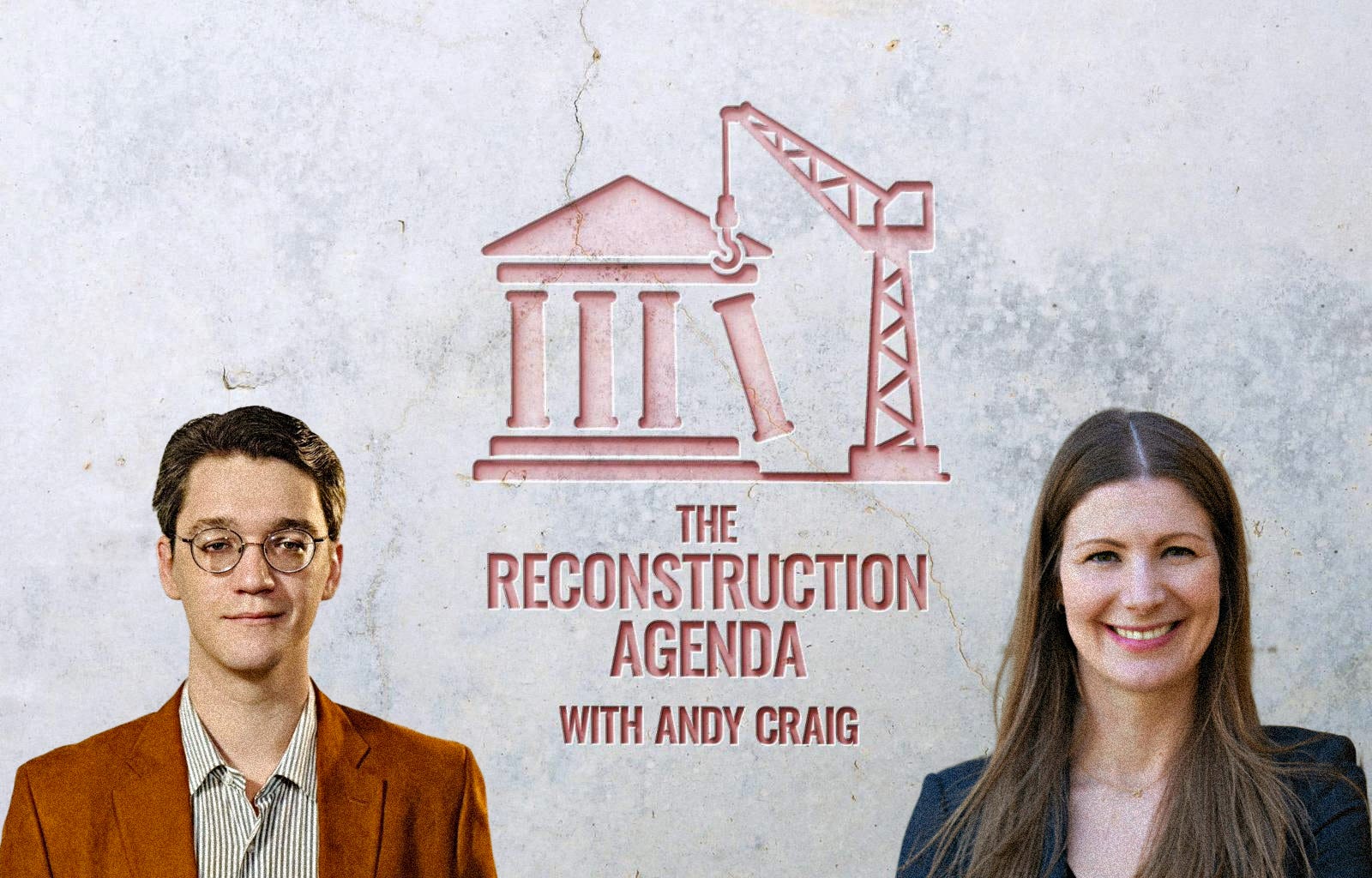
Andy Craig: Welcome to the Reconstruction Agenda, I’m Andy Craig.
Today’s Supreme Court justices like to insist that they stand above politics, calling balls and strikes, an objective and independent forum separate from the give-and-take of partisan politics. But for the Court’s first hundred years, nobody really expected that of them, and they certainly didn’t act that way. Justices wrote for party newspapers, drafted legislation, campaigned for their political allies, and sometimes even ran for office while on the bench. How that Court was forgotten, and what replaced it, is the subject of a new book, The Political Supreme Court: A Forgotten History. Its author, Rachel Shelden of Penn State, joins me today.
Rachel, thanks for joining us.
Rachel Shelden: Thanks so much for having me.
Craig: I want to start with how we tend to think of the Supreme Court as, like I said, something that’s above politics, or at least something that claims to be above politics. But that wasn’t how it was for most of the 19th century. My particular specialty is the history of elections and election laws. And as you’re reviewing that history, all of a sudden it’ll pop up: here’s a Supreme Court justice who was running for president or something. And you think, “that’s kind of odd.” But it doesn’t get a lot of focus. So what was the context for that, and how was it seen as something normal and pretty unobjectionable?
Shelden: I had the same experience, because my first book is about Congress in the 1840s and 1850s, and I kept seeing all the justices and thought to myself, “what’s going on here? This is odd. This is different from what you might expect.” Like many people, I was taught in high school and as an undergraduate that Marbury v. Madison in 1803 changed everything: Chief Justice John Marshall issues a decision that was really important for giving the Supreme Court independence, particularly independence over the Constitution, and fully separates the Court from the other two branches. That’s the standard story, and it’s still told in many law school classrooms, and still in college and high school.
But lots of scholars have already pointed out that this is not the case, that the Court did not operate as a final authority on the Constitution for most of the 19th century and even into the 20th century. So one of the questions I wanted to ask was, what was the Court doing if it wasn’t actually settling final constitutional meaning?
As I started researching it, I discovered that the Court was involved in all kinds of things, elections in particular. All of the justices were involved in campaigns, they were all writing for party newspapers, they were all engaged in some kind of policy discussion along the way. One of the things I thought was really interesting was that this happened at the same time that they were engaging in constitutional conversation on the bench. We imagine that must be separate from politics, whereas in fact early Americans thought that politics was an arena for constitutional conversation, so it made a lot of sense for the justices to be involved in both places.
Craig: And one aspect of that I think often gets glossed over, at least in the high school version of the history—maybe in law school and college you get a little more into it—is that with John Marshall in particular and Marbury v. Madison, there were aspects that we would now think of as pretty wild conflicts of interest on Marshall’s part. He was coming straight onto the Court from having briefly been secretary of state himself. He was Madison’s predecessor in that office, the office at issue in that case. And …
Shelden: … He was responsible for the commissions that were not delivered, yeah.
Craig: Right, exactly. He was the one responsible for not delivering the commissions that Marbury had sued over. But this was not entirely unremarked upon. Jefferson came in and there was the fight over rolling back the Judiciary Act, and part of that was an accusation of political bias. But it wasn’t what we would think of today, that justices have to be scrupulously nonpartisan.

So what was the counter-theory put forward in the pushback from the Jeffersonians during that early republic era, particularly in the aftermath of Marbury v. Madison?
[Editor’s note: As Adams’s acting secretary of state, John Marshall signed and sealed commissions for 42 last-minute D.C. justices of the peace but didn’t get all of them handed over before Jefferson took office, and Jefferson’s administration held back the rest, including William Marbury’s. As chief justice in Marbury v. Madison (1803), Marshall ruled that Marbury had a right to the job because the appointment was complete once the commission was sealed, but said the Court couldn’t order delivery because the law letting Marbury sue there was unconstitutional, and that ruling established judicial review.]
Shelden: It’s a great question, because Marshall was actually secretary of state and chief justice at the same time for a month. So when he was responsible for those commissions, he was already chief justice. We would find this pretty unacceptable today. But that element was not really remarked on at all. People were not offended by it. They didn’t think it was particularly a problem. What Jefferson was most frustrated with was the expansion of the judiciary to create these new positions, new circuit judgeships that didn’t exist before. So the Jeffersonian critique in this early period, even before Marbury v. Madison, is very often about whether the Court should be isolated and responsive only to people in Washington, in the capital.
The Judiciary Act of 1801, which created all of these commissions and positions that Marshall was involved in, including Marbury’s [via a companion law], got rid of a really essential element of the early judiciary, which is circuit riding. In the original Judiciary Act of 1789, the courts are set up in the familiar hierarchy of district courts, circuit courts, and the Supreme Court. But the act does not create any separate circuit judgeships. So Supreme Court justices had to go out on circuit and serve as circuit judges at the same time that they were serving as Supreme Court justices.
The idea was that they would have this connection to the people, that they would tie the people to the nation and the nation to the people by going out on circuit. So the biggest Jeffersonian critique of the Judiciary Act of 1801 was that it isolated the Court from the people. And the Court was meant to be responsive and responsible to the people.
So what they were fighting against was not the idea that there could be politics in the Supreme Court. Politics operated differently in this period, and the people needed to be able to engage with the Court and respond to the Court, and not have a bunch of justices who were tyrants, which is what they really disliked Samuel Chase for. That’s more of the context.
“The idea that the Court today looks like the Court in the 19th century, or that the fundamentals of how the Court is organized haven’t changed, is really not true. It has changed over time, and Congress has changed it over time. That’s also really important: Congress has been the one to adjust the Court.” — Rachel Shelden
I’ll say one other thing about Marbury v. Madison: at the time, there was not a lot of anger about it. There was not a lot of interest in it. It did not have the bombshell effect that we imagine today. Our current Court is obsessed with Marbury v. Madison. It comes up in almost every oral argument. That just was not the case then. Jefferson later expressed some fury over it in the 1820s. But in 1803, there were many other things he was worried about, especially the Louisiana Purchase, which was happening around the same time. Constitutional questions were already being worked out much more in Congress and the executive branch than in the Supreme Court, and Jefferson continued that thinking.
Craig: You just mentioned the other early incident that fueled a lot of later mythmaking: the impeachment of Samuel Chase, [a Supreme Court justice who had been a signatory to the Declaration of Independence]. It gets remembered as establishing a precedent that Congress shouldn’t impeach for anything other than personal misconduct, that impeachment shouldn’t be political. Was that how people thought of it at the time, or was it more that the political effort failed to get the necessary two-thirds because that’s a high bar? What was going on with that?
Shelden: I think it did actually make the case that you could not be impeached because of your political views. And we’ve read that to mean the Supreme Court is independent. But I think a better way to read it is that members of the Court are perfectly allowed to have their political views. Samuel Chase did not abandon his political perspectives just because he was impeached. If anything, I think it emboldened him, and it also made it possible for justices to continue that approach to politics through the 19th century.
Craig: One thing that’s a little hard for us today to get our heads around, because we’re so used to the idea that the Supreme Court is the final word on constitutionality, is that there were lots of live constitutional debates going on in Congress and in the public political arena. So how did that work when there wasn’t a single definitive final word? Were there cases where constitutional interpretations or ambiguities were settled by decisions of the political branches?
Shelden: The short answer is yes. Not that many constitutional cases went to the Supreme Court, because it was hard to get a case in front of the federal courts, and then it was hard to get a case in front of the Supreme Court. So the Court was not hearing all these constitutional matters; it only heard a few. And when the Court issued a decision on a constitutional issue, people would respond either in favor or in opposition. There was not necessarily this sense of, “we accept what the Court says.” People in the 19th century were way more comfortable with the idea of constitutional uncertainty. They did not expect that there was one final meaning to the Constitution based on, for example, the original intent of the Constitution. That was not how people thought about constitutional meaning.

Instead, they thought that they had a role to play in producing constitutional meaning, particularly in elections. Elections created a lot of change in the way people understood constitutional matters. And if the Court said one thing and an election produced leadership that differed from that opinion, that was a constitutional outcome.
To put some specifics on that, think about Dred Scott, which is one of the worst decisions in all of American history, totally anathema to the way we think about American society today. The ruling in Dred Scott from Roger Taney, the chief justice, was that Black people could not be citizens of the United States and that Congress had no right to legislate for the territories. The Western territories were expanding in this period, and there was a lot of interest among enslavers in bringing slaves with them to the West. So the idea behind Taney’s decision is that Congress can’t interfere with this, that it’s a violation of Fifth Amendment rights and a variety of other things.
Well, the Republican Party didn’t accept this. In 1860, they ran on a platform of ending slavery in the territories. Today we might find it very odd to have an entire political party respond to the Supreme Court by saying, “the Court can’t make a ruling on this. We don’t agree. We’re not going to go along with this.” It would be like a political party forming now to say, “we believe abortion is legal as a matter of national concern.” So it’s a slightly different way of thinking about it, although you could have similar pushback against the Supreme Court today if people were so inclined.
Craig: One aspect of that’s really interesting—and we’ll get a little into the current situation—is the idea of being qualified. As it stands now, that basically means you were a circuit judge or the solicitor general. We have eight former circuit judges and one ex-solicitor general on the Court today. But back then, it wasn’t just that they were politicians, though many of them were. Many had been newspaper editors. One thing that’s a little hard to get back into the mindset of is that the practice of law wasn’t this elite priesthood. It was something people came into much more casually, and it had a lot of overlap with other things. So how did that affect the kind of people who ended up getting appointed?
Shelden: This is a great question, because most people in the 19th century did not go to law school. They worked as apprentices in the offices of other lawyers, and there was an expectation that that is how you learned the law. Even if you went to law school, you needed to apprentice; it was much more of a practical profession. But also, most lawyers were politicians. It was good for your law practice to be a politician. You got more clients that way. Certainly Abraham Lincoln was successful in that way, although he was very much interested in being a politician.
“People in the 19th century were way more comfortable with the idea of constitutional uncertainty. They did not expect that there was one final meaning to the Constitution based on, for example, the original intent of the Constitution. That was not how people thought about constitutional meaning. Instead, they thought that they had a role to play in producing constitutional meaning, particularly in elections.” — Rachel Shelden
So you’re correct that it was not a matter of how good a lawyer or how good a judge you were. In fact, most people who joined the Supreme Court bench in this period were not judges before, and certainly not federal judges. There weren’t that many federal judges, of course, because there were only district judges and Supreme Court justices. As a result, most of the justices had their backgrounds in politics, both in elected positions and in the broad newspaper world.
Today we sometimes find our news networks to be very political themselves, but in the 19th century newspapers purposefully described themselves as partisan. Newspapers would call themselves, for example, the Richmond Whig. The Whig Party was very prominent in the late 1830s, the 1840s, and the early 1850s, and that paper was a Whig newspaper. Not all of them named themselves after political parties, but it was pretty common. So if you were a newspaper editor, you were engaged in promoting a particular view of American politics. You were a politician, maybe an even more effective politician than some others. That was good training for the Supreme Court. Lots of the justices had been newspaper editors before they got there, and they continued to be involved with newspapers once they got there.
It would have been surprising for someone in the early 19th century to say this person is not qualified because they don’t have any judicial experience or because they’re not a good enough lawyer. By the end of the 19th century, things start to change, but the first part of the 19th century is all about your political background and whether you can have a relationship with the people of your circuit that will produce good outcomes.
Craig: Right. And you still see that legacy in a few newspaper names, like the Arkansas Democrat-Gazette. A few of those have lingered into the present day.
Shelden: Yeah.
Craig: Before we get into the antebellum period and Dred Scott, you raised a really interesting point about circuit riding, which tends to get glossed over as an anachronistic or archaic thing they did because they didn’t have enough people, or just an old-timey thing. But you make the point that this relationship to the political side of the Court was actually really important for the early federal judiciary, because the justices showed up in these states and regions as, effectively, the representatives of the federal government, in places where you often wouldn’t have anybody else. You might have the local U.S. attorney, or its predecessor, and the post office, and that was pretty much it. In terms of tying together the political elites in these states and regions, that relationship was seen as important. And it also influenced the composition of the Court, because seats were allocated informally, but with a strong expectation of regional balance.
Shelden: That’s exactly right. Circuit riding was essential in the sense that the people expected to have representation on the Supreme Court. The concept of judicial representation is foreign to us today. But particularly in the 19th century, you have the development of each circuit having one representative, and that representative is meant to come from the circuit in question, to create that bond with each part of the country. Then the Supreme Court serves as a place where those interests are balanced.

The idea was to have real expertise in the laws and the norms and the ideas and the politics of the place you were coming from, so that the people there could trust that you were engaging in good faith on their behalf. Not that they would be able to determine the outcome of every case, but that they could have a voice in government beyond just Congress and the presidency, a voice in the Supreme Court too. This was important to people, because when a seat opened on the bench, the people of the region where that seat had been assigned were insistent that the replacement must come from their region.
The example I always like to give is the Third Circuit, because it’s an easy one: Pennsylvania and New Jersey. Pennsylvania is a far more important state than New Jersey, so it almost always got the nominee. And there was good reason for that. As a president, you wanted to give a sense that you were supporting that part of the country, and that you were allowing the people of that region to choose the person who was going to be best for the Supreme Court from that area. So there was a lot of input from local politicians about who were the best political voices to put on the bench.
Our understanding of circuit riding is really a product of the 20th century, and particularly of Felix Frankfurter and James Landis, who wrote in their famous book, The Business of the Supreme Court, that it was totally inefficient, totally useless, and that it took forever to get rid of. But it lasted for a hundred years because people thought it was really important. They wanted that responsiveness from the Supreme Court. They wanted to be able to see their Supreme Court justices and talk to them and give them feedback, and for the justices to be able to engage in political conversation at home.
So although the justices complained about it a lot, it was not this terrible thing that we just had to get rid of eventually.
Craig: On the topic of Dred Scott and the backlash to it, I have two questions. One is that there were a lot of charges that Taney was in effect conspiring with [President James] Buchanan and other politicians, that this was something internally and privately discussed among them. But it was also a real break in the Court’s assertiveness. It was very rare for the Supreme Court even to decide a constitutional issue in a way that struck down a federal statute, which is what Dred Scott effectively did. It struck down laws Congress had passed.
“[Abraham Lincoln] was promoting the idea that the people ultimately hold all the cards on the Constitution. The people get to decide what the Constitution means and what it looks like.” — Rachel Shelden
In response, Lincoln and the Republicans—Lincoln most famously—articulated a theory that seems really foreign to us today: that this is not the last word. So how did they make that argument, and how did the backlash against Dred Scott, running through the Civil War and the amendments that followed, shape the Court’s role?
Shelden: There’s a lot to that, so lots of good questions there. I’ll start with the relationship between Taney and Buchanan and what was going on behind the scenes. There’s a famous part of Lincoln’s House Divided speech where he accuses Taney, Buchanan, Franklin Pierce, who was president while the case was pending, and Stephen Douglas of conspiring to perpetuate slavery in the United States. This is quite a famous part of the speech, because a lot of folks have read it as evidence that people thought there was a problem with justices and politicians interacting.
But if you understand the context in which the Court was operating, it actually looks very different. There was so much interaction between justices and Congress and the president that it would have been quite normal for members of the Court to be talking to those folks. In my book I explain that this was so common that almost every single person on the Court was doing it around Dred Scott.
More broadly, there were what today we’d call leaks, though it’s almost unfortunate to call them leaks, because they happened so frequently. People on the Court constantly talked to other members of the federal government about what was going on. They did it sometimes on purpose, to try to change the way the president or Congress would respond, and sometimes just because they were in conversation and thought it was a useful piece of information. So I don’t think Lincoln was suggesting a nefarious conspiracy because it was inappropriate for these folks to have this conversation.
Instead, he was trying to tie his political opponent, Stephen Douglas, to the most extreme elements of the Dred Scott decision, to suggest that Douglas was also in favor of making sure slavery expanded into the territories. Douglas had for several years said that he didn’t care whether slavery was voted up or down in the territories. So as a political approach, this was quite useful for Lincoln, because he could paint his opponent as an extremist. That’s where the conspiracy idea comes from.

Lincoln, I think, was really stating the obvious to Americans and to the Republican Party, which is that this decision, as you suggest, went far beyond what the Court normally engaged in. In Dred Scott the justices were quite aggressively striking down a federal law. Taney certainly believed this was one way to solve the sectional crisis, but it was one suggestion of how to solve it, not the final authority. Even Taney, I think, understood that. So Lincoln was stating, quite eloquently, as he often did, why it would be a problem to take any argument of the Supreme Court as the final word on the Constitution. He was promoting the idea that the people ultimately hold all the cards on the Constitution. The people get to decide what the Constitution means and what it looks like. And they could respond to Dred Scott in exactly that way, and they did.
Lots and lots of Americans pushed back against Dred Scott, not just as a matter of rhetoric, but in their actions as well. In Wisconsin, there’s outright rejection of Dred Scott in a variety of ways. But this is true even among members of the Constitutional Union Party in 1860. That’s not a party most people are familiar with, but it was an important one, and most of its members tended to oppose the implications Dred Scott had for the territories. So there was a lot of pushback. And when the Republicans got into power, they did not take Dred Scott seriously. They immediately worked to eliminate slavery in the territories, and they didn’t pass a constitutional amendment to do it. We get the 13th Amendment eventually, but Congress acted well before that.
Craig: One of the fun tidbits about Wisconsin is the rescue of Joshua Glover, where a mob in Milwaukee freed a fugitive slave. The case worked its way through the courts to the state supreme court, which said the Fugitive Slave Act was unconstitutional. Then when there was an attempt to take it up to the U.S. Supreme Court, they refused to send the transcripts and records of the case to Washington. [Wisconsin’s defiance of the Supreme Court’s 1859 ruling in Ableman v. Booth] dragged on, and then the Civil War made it moot. But it would be unthinkable today for a state supreme court to engage in that kind of open defiance.
Shelden: But it was totally common in the 19th century, when people would engage in all kinds of obstruction to make sure the Court couldn’t do what it wanted to do. There are examples where people don’t show up to court, and examples where people flatly say, we’re not paying attention to what the Court is doing. This happens a lot in the 1830s, because a lot of people were unhappy with the Supreme Court in the 1820s and 1830s, and there were even efforts in Congress to strip the Court of its power, including by eliminating Section 25 of the Judiciary Act of 1789, which gave the Court the ability to review state supreme court decisions. So there’s not a lot of interest in a super-powerful Supreme Court until the end of the century.
Craig: In the immediate aftermath of the Civil War, one incident that’s gotten more interest today, as this is back on the table, is Congress messing with the number of seats on the Court. In particular under Andrew Johnson, they reduced and then later increased the number of seats in order to affect which president would be appointing justices. One interesting thing is that this got noticed, but it was not framed as some outrageous assault on the rule of law and the end of the republic. It’s a constitutional power Congress has. So how did that debate play out, and what was the thinking behind bouncing back and forth between seven and ten before it ended up at nine?
Shelden: It’s something people are very interested in today, because we’re so interested in questions of court packing. And court packing is actually a term that was used in the 19th century. We often associate it with FDR, but it meant something slightly different then. The way the circuits were set up, with each circuit having a corresponding justice, made people very protective of that arrangement. So if a president ever tried to get around it, as President Buchanan tried to in early 1861, people pushed back by saying this is court packing: it’s applying a sectional change to the circuits, imposing a justice from a different region on our region. That was a real problem, according to people at the time.
“Today’s Court has built its authority on the … idea, that the Court should not have any responsibility to the people, because otherwise it can’t make its decisions. I think the 19th century is a good example of how that’s not actually the case. The Court could have more interaction with the people and still maintain its authority and its independence, because that is the system we used to have.” — Rachel Shelden
People also used “court packing” when they thought there was an imbalance on the Court in terms of the circuits. In the period just before the Civil War, you have nine members of the Supreme Court, and five of them are from the South, even though the South has only about a third of the population. So Northerners would sometimes say the Court is packed, or Southerners have packed the Court, because of this sectional imbalance, when sectional balance had been accepted as part of the nature of American politics.
What happens in the Civil War is that Lincoln, who very much opposed the way the Supreme Court was operating before the war, does not come in and say, we’re going to tear up the Supreme Court. Instead, he says we need to rebalance the way the Court works. He’s lucky in a sense, because one justice from the South leaves to go with the Confederacy, and another dies just before the Civil War. That gives Congress the opportunity to rearrange the circuits. So by 1863, when they raise the number of justices from nine to ten, you have three circuits in the South, and then a variety of circuits across the North and the West. This is an opportunity to rebalance the Court and give more representation to people in the West, who’d been demanding it for many years.
That’s part of what happens in the period around Andrew Johnson. Once the Supreme Court justices from the South die, there are real questions about what to do. How are we going to replace these justices from the states of the Confederacy, which were almost universally opposed to staying in the Union? So for a while, Congress tries to get around that by not having as many justices. Then ultimately in 1870, after the number goes back up to nine, Ulysses Grant decides to nominate someone from New Jersey to serve in the Fifth Circuit, which is the Deep South. That’s the transition. But it wasn’t a matter of court packing during the Lincoln administration, or court shrinking during the Johnson administration. It was really a matter of reorganizing the way the Court operated to make it more representative of the people.
Craig: As we move forward in the 19th century, there are still lots of justices politically active, sometimes as candidates. I think the last of those goes into the early 20th century …
Shelden: … Even the mid-20th century, yeah.
Craig: So how did this evolve toward—professionalization would be the nice way to put it—the idea that law and the practice of law are separate and distinct from politics? In particular, how did the norms around the Court’s political involvement evolve?
Shelden: There are lots of reasons for this. I’ll try to give a few, and maybe we can talk about some of the others. One really important shift is that after the Civil War, there’s a professionalization of lots of different professions: medicine, journalism, and law is a big one. In the 1870s, you finally get the American Bar Association, and you get people who are focused on law as a career. There’s an expansion of law schools. And then at the end of the 19th century, you get the casebook method, which gives the sense that law is a science rather than something connected to the political world. That isn’t necessarily true, but it’s the way lawyers talked about it in the 19th century. So there’s that move toward professionalization.

At the same time, after the Civil War, you have the Reconstruction Amendments—the 13th, 14th, and 15th—and Congress passes quite a bit of legislation to support them. If you think about it from the perspective of a Black man living in the South, if you have the option under this legislation to take your case to the federal courts rather than the state courts, you’re more likely to do that, because you’re going to have a much more receptive audience. So as cases start going to the federal courts, the courts’ jurisdiction keeps expanding, and more and more cases go all the way up to the Supreme Court.
As a result, the docket of the Supreme Court and the lower federal courts explodes. And it’s very hard to contain all those cases, because more keep coming. Congress adjusts this in some ways on its own. In other ways, the Court takes that authority for itself. This is the era in which the Court declares corporate personhood, which makes it possible for corporations to take their cases to the federal courts. And this becomes a real issue around whether the justices, and the lower courts, can actually hear all these cases. There’s a good parallel to today. The lower federal courts are totally overloaded today, and that was true in the period after the Civil War too, when it could take a year or two to get your case heard in federal court. So some of the shift happens because the Court’s jurisdiction expands.
Then there are questions about how we fix this. How do we make it so these cases can get through? We ultimately get the end of circuit riding and the creation of new circuit judges. But that didn’t have to be how it worked. A lot of people had other ideas, including my favorite, just because it’s so different from what we would do today: 21 justices split up into three different areas of expertise in the law, who would then come together to decide constitutional questions. Some version of this plan was very popular, but it did not end up going forward. So a little bit of a lesson in what might have been.
Those elements are really important, and I’ll mention one more that maybe we can talk more about, which is the change in the way political parties worked. We’re really familiar with the two-party system today. We expect there to be Republicans and Democrats, and we expect those parties to be top-down. But that really wasn’t the case in the 19th century. Parties were really fluid.
They were federal, meaning they operated primarily at the state and local level. In almost every election, you would have at least three, and sometimes up to five, presidential candidates representing many different parties.
This changes at the end of the 19th century for a variety of reasons. One important shift is the Australian ballot, the secret ballot, which comes to the United States in the 1880s.
Before that, people voted in a different way. They mostly brought their voting choices to the polls from the newspaper. They would cut out a list of the candidates they wanted to vote for—what they called party tickets—and deposit it at the polling place. That structure, without a lot of law built into it, meant that parties could arise a week before an election. You could run somebody for a local office, especially, the day before, because there was nothing in the law saying you had to register or get a petition with a certain number of signatures, and there were no primaries. This was all a much more fluid situation. But at the end of the 19th century, this changes, and we really get a two-party system that creates a lot more discomfort with the idea of a justice being part of those large parties.
Craig: I really appreciate that point, because I’ve got right here on my wall a collection of old newspapers with party ticket ballots printed in them …
Shelden: … They’re so fabulous. Yeah, they’re wonderful.
Craig: They are wonderful. And one of the really interesting things is how that system made parties more fluid, because you could also have more fusion, where local parties would cross-endorse the same candidate. That was one of the things that eventually got banned in most states as the Australian ballot came in. So the secret ballot has some benefits, but there were some downsides as voting became a more bureaucratic process.
“Every time there’s a decision that involves history and you see headlines like ‘History wins at the Supreme Court,’ historians brace themselves, because of course it’s not really historical. It draws on some facts from the past, maybe, but historians as a rule think about history in very different ways from this Court.” — Rachel Shelden
Around the turn of the century, there was this process of—I don’t think it’s too disparaging to call it mythmaking—about the history of the Court, and about this idea of judicial independence, or what critics would call judicial supremacy. There was a lot of casting back to some of the early history we discussed and framing it in new ways: that Marshall was the hero who asserted judicial review, and all these sorts of things. But these were not part of the historical narrative until much later than they actually happened. So how did that come about?
Shelden: That’s exactly right. There were a couple of people who wanted to promote the idea that the Court had supreme, final authority over the Constitution, probably most famously Joseph Story, who was on the Court. But that was a minority view, a super-minority view. It took until the 1870s and 1880s for this to become more of a popular conception.
I think that has a lot to do with the fact that Americans were celebrating their centennial in the period from 1876 to 1890. There was a lot of interest in, and obsession with, the past. And you get that in combination with professionalization, including the professionalization of history and political science. As academia becomes more professionalized, you start to get lots and lots of new works on the past. And a lot of these folks rewrite the history of the founding and of John Marshall to suggest that the Court had had this authority from the very beginning.
My favorite of these is Hampton Carson, who was commissioned to write a history of the Supreme Court for the centennial of its first meeting. The Court first met in New York in 1790, and there was a big centennial celebration in New York in 1890. Carson writes this history of the Court that is just complete fiction. It’s totally wild. Amazingly, people still cite it today as something that tells you about the Court, but he just makes all this stuff up. And it becomes the most popular history of the Supreme Court. People across demographics are very interested in it. During this period, as people read more and more histories of the Court, and also of the federal government and the founding, it has a real impact on the way American society operates. And of course the Court itself is promoting the view that it is the final authority, seizing on the bit of power it had been given.

These things come together with the changes in professionalization, law, and party politics to really give legs to the Marshall myth. And then in the 20th century, a lot of opponents of judicial supremacy change the way they engage with the problem. Before, opponents of judicial supremacy would say, well, there is no judicial supremacy; it didn’t exist in Marshall’s time. But in the 20th century you get a different approach: yes, Marbury v. Madison created judicial supremacy, but that’s bad.
My book doesn’t go into the 20th century, but Daphna Renan and Niko Bowie have a terrific book that also just came out, which really deals with how this develops over the course of the 20th century.
Craig: And we see that today. It’s an increasing frustration for historians that Supreme Court justices like to play at being historians, particularly invoking the history of the early Court and of Marbury and all that. Aside from the question of what role that should play as precedent, there’s the more basic problem that they often have their facts wrong about what the history actually is.
Shelden: That’s right. Every time there’s a decision that involves history and you see headlines like “History wins at the Supreme Court,” historians brace themselves, because of course it’s not really historical. It draws on some facts from the past, maybe, but historians as a rule think about history in very different ways from this Court. The historical method that academic historians, and lots of other historians, practice says that you have to understand the context in which things operated. You can’t just pick things out from the past and say, “this is what matters here.” We spend our lives trying to get into the minds of the people who lived in a period, thinking beyond the single document or few documents you might draw on for an opinion, and instead thinking about the cultural milieu, about how people understood words and meanings. And that was very different in the 19th century. The past was very much a foreign country.
Craig: Your book mostly covers the 19th century, so we’ll skip over most of the 20th. There were a lot of continuing and interesting developments throughout it, through the New Deal era, the civil rights era, and the rise of the conservative originalist Court. But I do want to touch on one through line: the Supreme Court, as it was back then, is a political lightning rod these days. There are a lot of debates about the balance of the Court, the scope of its authority, and the degree to which it engages in policymaking. There’s also a bit of a revival of the question of whether the Supreme Court is really the final word on constitutional issues, or whether a political settlement can affect them. In light of that, how should a better understanding of this history, and overturning some of these myths, inform that debate today? Particularly because these things are more fluid than we tend to think.
“All of the justices were involved in campaigns, they were all writing for party newspapers, they were all engaged in some kind of policy discussion along the way. One of the things I thought was really interesting was that this happened at the same time that they were engaging in constitutional conversation on the bench. We imagine that must be separate from politics, whereas in fact early Americans thought that politics was an arena for constitutional conversation, so it made a lot of sense for the justices to be involved in both places.” — Rachel Shelden
There’s a tendency to treat all this as bedrock that was handed down on Mount Sinai at Philadelphia in 1787. But things are never really that fixed, and these things do change and can change.
Shelden: Right. Let’s start there, because I think that’s really important. The idea that the Court today looks like the Court in the 19th century, or that the fundamentals of how the Court is organized haven’t changed, is really not true. It has changed over time, and Congress has changed it over time. That’s also really important: Congress has been the one to adjust the Court.
The best example of this, of course, is that the Supreme Court didn’t have its own building until 1935. It was in the Capitol, on the first floor, which is also sometimes referred to as the basement. So it had a different life. There were no clerks in the 19th century. The justices didn’t have a team of law clerks to help them write decisions. The nature of the Court has changed over time, Congress has changed it, and it doesn’t have to stay the same. I think that’s a really key piece.
There are two other points in terms of how this might influence the way we think about today. I try to stay away from policy promotion, since I’m a historian. But one thing I think was really important about the 19th-century courts is that they were a federal system. When people thought about the Supreme Court, they also thought about the lower federal courts, because they were so integrated. Today we’ve really gotten away from that. So much of the conversation is about the Supreme Court that we’ve forgotten that the lower federal courts matter too. Maybe more interaction between the Supreme Court and the lower federal courts would be more like what we used to have. Not that we can go back. We can’t go back to the 19th century, and we don’t want to, but we can think more about that.
The last thing I’ll say is that people thought the Supreme Court should be representative of the people and responsive to the people. Today’s Court has built its authority on the opposite idea, that the Court should not have any responsibility to the people, because otherwise it can’t make its decisions. I think the 19th century is a good example of how that’s not actually the case.

The Court could have more interaction with the people and still maintain its authority and its independence, because that is the system we used to have. As the Court has gotten further and further from the people, that has changed the relationship between the Court’s legitimacy and average Americans, who would have participated in all of the processes that justices would have been familiar with, particularly jury trials. When the justices were out on circuit, they were hearing jury trials, which meant they were interacting with average voters on a regular basis. We’ve really gotten away from that idea today. Again, I don’t ever advocate going back to the 19th century, but that is a different way of thinking about the Court from how we expect the Court to act today.
Craig: Excellent. Rachel, thank you very much for joining us. I just want to say that while we’ve been talking about the grand sweep of these ideas, the book is excellently written. It has some compelling characters and stories and lesser-known anecdotes. Anybody interested in this period of American history, not just the philosophy of the role of the courts, will find a lot in there. I really appreciate it.
Shelden: Thank you so much for having me. This has been fun.

© The UnPopulist, 2026
Follow us on Bluesky, Threads, YouTube, TikTok, Facebook, Instagram, and X.
We welcome your reactions and replies. Please adhere to our comments policy.


