


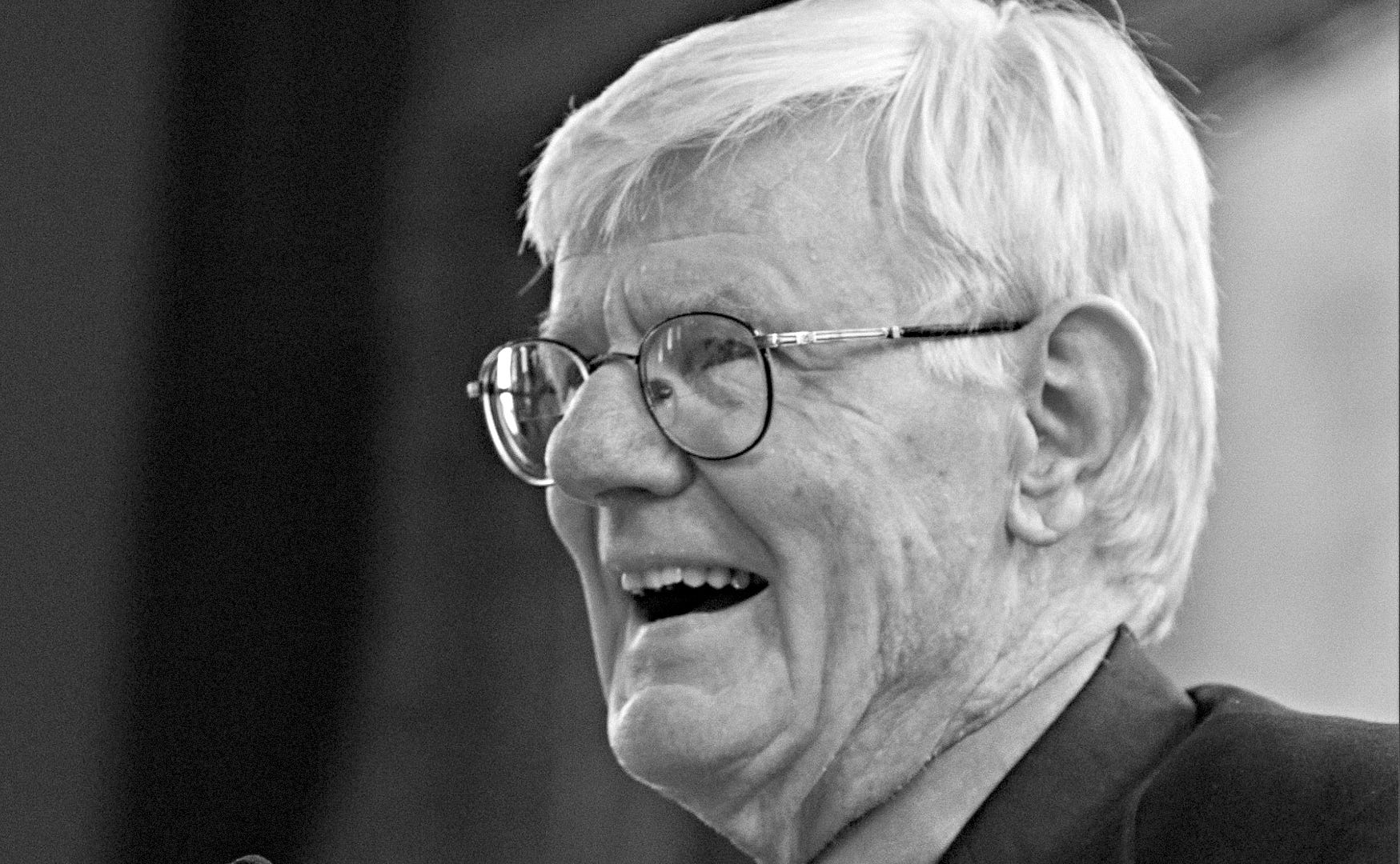
The famed historian Gordon S. Wood died on Sunday, struck by a car in a parking lot at the age of 92.
He was his generation’s foremost scholar of the American Revolution and the early Republic, and for decades he pressed a single argument with alacrity. The argument was this: the American Revolution was the most radical event in American history, and the men who made it neither intended nor controlled the radicalism they unleashed.
The real revolution, John Adams insisted in old age, was not the war. It was the thing that came before the war: a change in the principles, sentiments, and affections of the people, a revolution in the American mind that the fighting only ratified. Wood made studying that change his life’s work. Then he asked the harder question Adams did not: What happens once such ideas are loose in the world, and their authors can no longer call them back?
To understand why that was a fighting claim, you have to recall what came before him.
When Wood began his work, the reigning interpretation of the Revolution was the one Charles Beard, an early 20th-century historian, had bequeathed two generations earlier. It was a story of interests. Behind the high talk of liberty stood creditors, speculators, and merchants protecting their property. The Constitution was a counterrevolution by the propertied classes, and the soaring language of the Founding was mostly a screen for the cash beneath it. The ideological language was irrelevant window dressing, in this telling.
It was against that picture that Wood made his name, and he did not make it alone. His teacher and dissertation advisor at Harvard, Bernard Bailyn, had already begun to take the revolutionaries’ ideas seriously. They believed what they said; they genuinely feared a conspiracy against their liberties. An inherited political language from the Whiggish tradition in England, not merely the pursuit of property, drove them to rebel. Against Beard’s tale of economic interests and class conflict, teacher and student alike insisted that ideology was the engine of the Revolution. Wood’s first book set out to follow that engine further than anyone had.
In The Creation of the American Republic, 1776–1787, published in 1969 and awarded the Bancroft Prize the next year, he traced what happened to revolutionary ideology after the shooting stopped. He showed how the classical republicanism of 1776—a politics of virtue, of the people against the rulers, of fear that power forever conspires against liberty—buckled under the experience of actually governing.
The problem was not that the initial ideals of the Revolution were wrong, much less insincere. But how they were applied had proven incomplete, insufficient to the realities of a nation being catapulted into a radical new future. A government which could not sustain and defend itself, to uphold the rule of law and thus the people’s sovereign power, was unable to maintain their principles in practice. There was still the need for a “more perfect Union” to “secure the Blessings of Liberty to ourselves and our Posterity.”
The Federalists who wrote the Constitution did not restore order by dialing back the Declaration’s commitment to liberty. They invented a new way of thinking about politics. They relocated sovereignty itself, lodging it not in any legislature or magistrate but in the people, who delegated power to all branches and surrendered it to none. They made peace with factions instead and settled for a system in which competing interests would counteract them instead of pretending that virtue would suppress them. That is the central insight we call “Madisonian” and which became the fundamental principle of modern democracy.
Out of the crisis of the 1780s, when the new nation under the Articles of Confederation teetered on the edge of anarchy and dissolution, came an American science of politics that the men of 1776 would scarcely have recognized. The ideas that gave birth to the Constitution were not simply a continuation of the “Spirit of ‘76.” Nor were they a repudiation of it. They were that animating spirit’s first major evolution, one of many more to come.
Wood closed the book on a quiet, devastating note. This revolution, he wrote, “marked an end of the classical conception of politics,” whose project was to inculcate virtue. Instead, the new politics made the best of a flawed human nature whose “dark passions” it tried to curb, but did not otherwise aim for unobtainable moral perfection. For political philosophy, for the nascent notion of political science, the Revolution was the dawn of modernity, irrevocably planted at the heart of America’s identity.
That book changed the field. It is dense, demanding, and structurally beautiful, and it remains the work serious students reckon with first. But it was the sequel, in a sense, that reached everyone else.
The Radicalism of the American Revolution won the Pulitzer Prize in 1993, and it is the book that fixed his reputation outside the academy. Its claim was deceptively simple and, to many readers, counterintuitive. The Revolution, Wood declared, was “the most radical and far-reaching event in American history.” More transforming, in its way, than anything that came after, because everything that came after was always in its shadow. It was radical not because it spilled blood in the streets or redistributed estates—it did neither on the scale of the French Revolution—but because it dissolved and replaced old ways of thinking about society.
Colonial America was still a monarchical world, as Wood termed it. It ran on hierarchy, patronage, dependency, and deference. The Southern colonies were of course run by the aristocratic planter class, but even the Mid-Atlantic and New England colonies were firmly under the control of their own small elites. Ordinary men understood themselves as bound upward to patrons and downward to dependents, and they pulled off their hats to their superiors because that was simply how the world was arranged.
The Revolution broke that. It set loose ideas of equality, freedom, and independence that could not afterward be confined to the men who first spoke them. Within a generation the webs of deference had frayed, the language of liberty had escaped its authors, and a raucous, commercial, increasingly egalitarian, and fundamentally liberal democracy had grown up in place of the genteel elite republic the Founders imagined.
The change announced itself in small things, and Wood had a gift for the small things. “Mister,” an honorific once reserved for men of rank, came loose from class and spread to every man as ordinary courtesy. And Americans grew so averse to calling anyone “master,” with its taint of servitude, that they borrowed a word from the Dutch and took to calling the man they worked for their “boss.”
And here is the heart of Wood, the insight that animates nearly everything he wrote. The Founders were gentlemen of the 18th century. They were classically educated men who pictured a republic led by a natural aristocracy of talent and virtue. By people, frankly, like themselves. What they got instead was an America more radically different from the Old World than they had ever envisioned. Not simply a revival of the classical Roman republic they idolized, or the British constitution produced by the Glorious Revolution, but something fundamentally novel in human history.
They had lit a fire they could not put out, and they spent their last years watching it outrun their own ideas about how to structure society and government. Wood found that tragedy and comedy in equal measure, and he refused to resolve it. The Revolution was radical because it outran its makers.
His critics have faulted him for a Revolution whose radicalism somehow left the enslaved in chains and the franchise narrow, for a story of liberation that kept slavery and women and the dispossessed near its edges. But this fundamentally misunderstands Wood’s point.
The gap between the ideals the Revolution loosed and the men who would not honor them was never a blind spot in his account. It was the center of it. The Founders proclaimed an equality they could neither contain nor bring themselves to extend, and that distance between what they said and what they were willing to live by became the charge that powered everything after them. Abolitionists, suffragists, and reformers of every later generation reached for the Revolution’s own language and turned it against the unfinished republic. They could do so because the language was radical to begin with.
It was the language that could be invoked at Seneca Falls, by Frederick Douglass, by Martin Luther King, by Frank Kameny. Invoking the ideas of the Founders in ways that would have been unthinkable in their time, because those ideas demolished any grounds of opposition.
That is Wood’s central and most durable claim. The ideological radicalism of the Revolution unleashed forces far beyond anything the Founders imagined or intended. They set out to build a republic of virtuous gentlemen and instead put the most dangerous idea in the modern world into the hands of ordinary people. Their failure to live up to what they had loosed was never a refutation of his thesis. It was the proof of it.
He died a few weeks before the country marks 250 years since the Declaration. The timing could not be more poignant. We are engaged now, more than any time in decades, in debating the meaning of the American creed, under the tenure of a president who is radically hostile to it.
Wood himself was acutely aware of the contemporary relevance of this debate, and in his rejection of American identity as rooted in “blood and soil” accounts. As he said in remarks published in the Wall Street Journal last year, “To be an American is not to be someone, but to believe in something. That is why we are at heart a creedal nation, and that is why the 250th anniversary of the Declaration next year is so important.”
The lesson of Wood’s work is not that the Revolution was a finished achievement to be commemorated, but that it was never finished at all. The ideas it released kept working long after the men who spoke them were gone. The equality they proclaimed became a standing reproach to every arrangement that fell short of it. A standard the country has been answering to, and failing, and answering to again, for two-and-a-half centuries. The Revolution did not end in 1783, or 1789, or 1865, or 1964. It is still underway.
That is why he matters beyond the seminar room. A revolution founded on the rejection of arbitrary power, on the conviction that no ruler stands above the law, and no government holds any authority the people did not lend it, is not a relic. It is a resource, and never more so than when those principles come under pressure. The language to defend them is the language Wood spent his life recovering.
That was his real subject, in the end. Not the genius of the Founders but rather their unintended consequences. He was too clear-eyed for hagiography. The Revolution became something none of them chose and none of them could stop, a summons that outlived every man who issued it. He spent his career telling us that the most important thing about the American Revolution is that it could not be contained.

© The UnPopulist, 2026
Follow us on Bluesky, Threads, YouTube, TikTok, Facebook, Instagram, and X.
We welcome your reactions and replies. Please adhere to our comments policy.
There has been a flood of Wood pieces written since his tragic death, this has been my favorite.
Many warm encomiums on the internet, including not only praise for his insight and intellectual excellence, but personal stories of individual graciousness and humanity. What has been swept under the rug but should not be easily forgotten is how badly he was treated by the 1619 mob (we all know the names) following his book on the radicalism of the American revolution.