


Listen to The Reconstruction Agenda from The UnPopulist in your favorite podcast app: Apple Podcasts | Spotify | YouTube

Andy Craig: Welcome to The Reconstruction Agenda. I’m Andy Craig.
At the heart of our constitutional system is Congress, the first branch, Article I. We’ve spent a lot of time talking about the runaway presidency, the courts, executive overreach. But there’s a flip side to that story that gets much less attention: what has happened to Congress itself. Not in terms of who controls the majority or how our electoral system works, but the workaday functioning of Congress as an institution. Is it capable of doing the things we need it to do?
Congress is supposed to write the laws to govern a $7 trillion federal government and hundreds of agencies. It’s supposed to oversee the executive branch, scrutinize the budget, set policy on everything from welfare programs to nuclear weapons. To do all that, it relies on a workforce: committee staff, personal office staff, nonpartisan support agencies. And this has been shrinking for decades, even as the complexity and scale of the federal government has exploded. So the result is a legislature that increasingly can’t write its own bills, can’t evaluate the programs it funds, and can’t check the executive branch without relying on the very lobbyists and interest groups it’s supposed to be regulating.
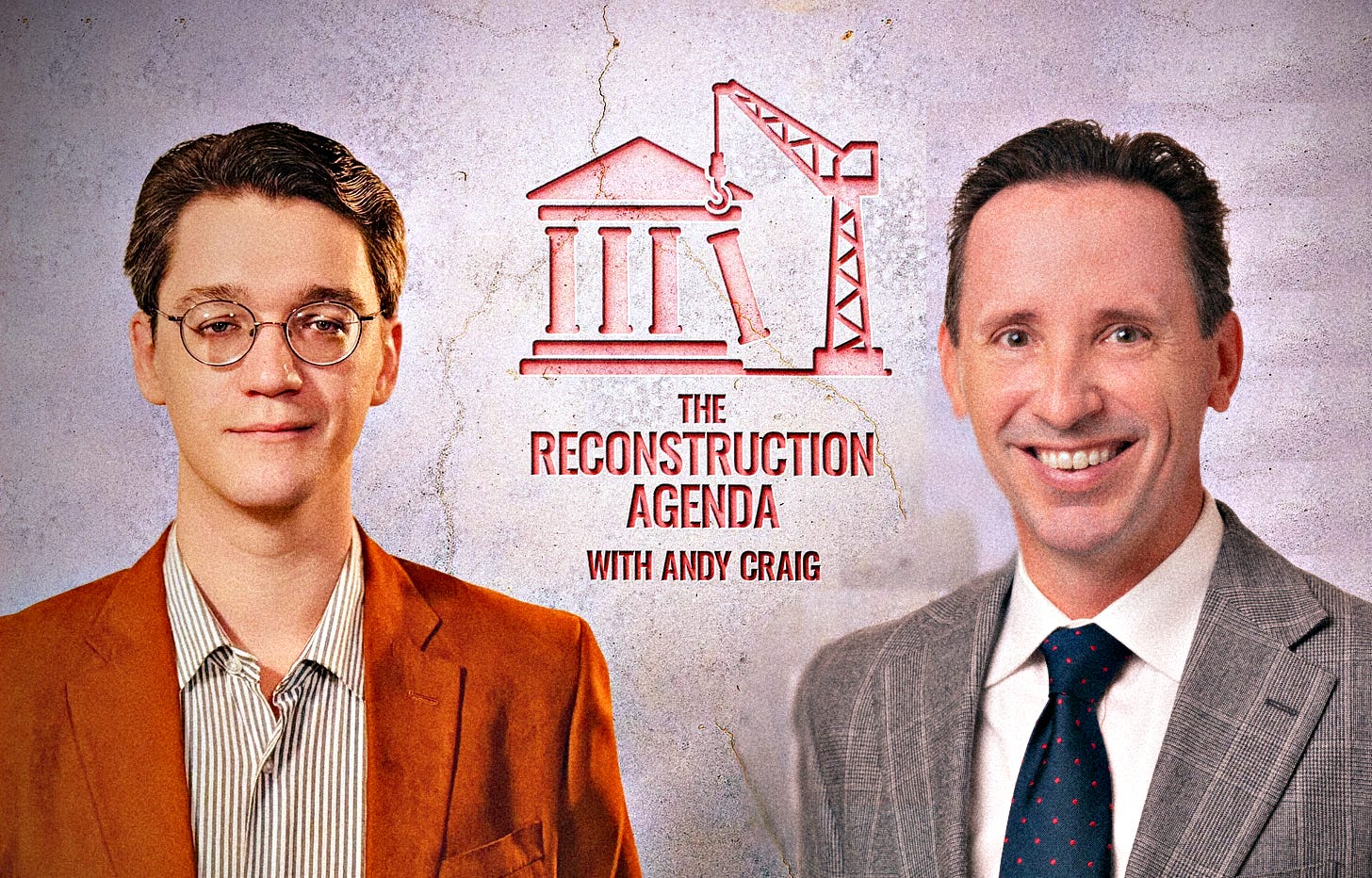
To help us understand what’s gone wrong and what it would take to fix it, I’m happy to be joined today by Kevin R. Kosar. Kevin is a senior fellow at the American Enterprise Institute where he studies Congress and the administrative state. He’s the co-editor of Congress Overwhelmed: The Decline in Congressional Capacity and the Prospects for Reform. He co-founded the Legislative Branch Capacity Working Group and also hosts the Understanding Congress podcast. Before all that, he spent more than a decade working at the Congressional Research Service. So he’s seen the problem from the inside.
Kevin, thanks for joining us.
Kevin Kosar: Thanks for having me, Andy.
Craig: So I think most people, even those who follow politics pretty closely, have a very incomplete picture of how Congress actually works on the inside. They see the floor votes, they might see some C-SPAN clips, maybe a committee hearing. But as I was touching on, the actual day-to-day process of legislating—who’s doing the research, who’s writing the bills, who figures out whether the numbers work—that’s mostly going on behind the scenes and doesn’t have the cameras on it. So before we get into what’s broken about all that and how to fix it, can you just walk us through what that process looks like when it is working? How is it supposed to work?
Kosar: Sure. I’m probably dating myself a bit by referring to the old video Schoolhouse Rock! But if you haven’t seen it, it’s worth Googling. Schoolhouse Rock! did a series of videos to improve civic education in America way back in the ’70s—and one of them was on how a bill becomes a law.

This is the so-called regular order process, where a member introduces a bill, and the bill is referred to the appropriate committee or committees. The committee will then look the bill over, perhaps gather information, maybe hold a hearing, mark up the bill, and report it out—at which point it can be put up for a vote in whichever chamber it’s been introduced. At that point, you can end up with a House bill and a Senate bill that are different. You would have a meeting, called a conference committee, where members of the House and members of the Senate get together and bargain it out. And then ultimately they take that draft bill and it gets to go through both chambers again and off to the president.
That’s the classic version of how legislation should get made. It still happens these days, but there’s a whole lot of what’s called unorthodox lawmaking going on. This is lawmaking that doesn’t really follow that pattern. So, you may have a member introduce a bill that could go to committee, and it could sit there and die in committee. This member could then turn around and go to House or Senate leadership and say, “Hey, you’ve got this big omnibus going through. Can we just slip it in there? It’ll be buried amongst the 2,000 pages.” Boom. Sometimes that works out.
We used to have a process by which Congress would authorize the government to do stuff in authorizing laws, and then they would separately appropriate money towards those authorized purposes. More and more, that process is blurring. We have lots of agencies and programs that are no longer authorized, but nonetheless there’s money being appropriated towards them. So everything has gotten very messy on Capitol Hill.
Craig: Part of that is individual members of Congress are not generally policy experts. A senator on the Armed Services Committee might be a former prosecutor or small business owner. They don’t have a background in defense procurement. They also, generally, will sit on three or four committees covering totally different subject areas. So, in practice, how much of that substantive policymaking work is really being done by staff? And, just for context, how many people does a typical member of the House or member of the Senate actually have working for them? And how does that compare to the breadth of what they have to do?
Kosar: Most of the legislative work is done with heavy reliance on staff. It is just not the case that you have a member of Congress sitting in their office writing out, “hey, I’m going to have a bill, I’m going to amend the current K–12 education policies by doing this, that, or the other.” No. They rely heavily on staff to do these things.
“If we accept the fact that we’ve got a large executive branch, do we want it doing most of the policy making, when it is in fact not directly accountable to voters? Or would you rather have more of the policy making being done by Congress, whom you can walk through the front door and go talk to? Which one is going to be more accountable to the average voter—the administrative state, or those silly people on Capitol Hill? You may say it’s a Hobson’s choice, but I think you’d better put your chips on Capitol Hill. There you have a real voice.” — Kevin Kosar
The staff themselves reach out to the Congressional Research Service. They may rely on GAO. If it has clear budgetary impact, they might contact the Congressional Budget Office. There are also lawyers inside the House—the Counsel’s Office—who inevitably are doing the work to turn rough text into something that can actually be introduced or moved through the chamber. So it’s definitely a group effort.
But congressional staffing, unfortunately, has declined since the 1980s. There are just fewer staff on Capitol Hill, particularly in the House of Representatives. The average member of the House has only 18 people. And seeing as the average member represents about 740,000 voters, that’s a mismatch. That number is only getting further and further out of kilter over time as the U.S. population grows, but also as the size of the executive branch grows.
There’s this problem of aggregation where over the last 100-plus years, the executive branch has gone from something that was manageable in size to something that is utterly unmanageable. It’s a gigantic conglomerate with hundreds and hundreds of agencies and thousands upon thousands of programs. Congress has built this beast inadvertently over time into a colossus, and that colossus is very difficult to control.
Craig: That kind of gets to the problem—this has been going back at least to the ‘80s and ‘90s—that Congress has hollowed out its own capacity to do that work. And it’s striking, the paradoxical quality of that. We have this image of the Madisonian scheme where their own ambition will motivate them to protect their own power, to defend the institution. But this is something different than the story of how Congress has lost power to the executive branch, or through court decisions, or presidents overreaching and grabbing new powers.
Congress has done this to itself. Congress controls its own budget, its own staffing levels. In the grand scheme of the massive federal budget, we’re not talking about busting the budget in order to have congressional staff. This is a tiny fraction. So why has Congress chosen to starve itself, and how has that played out?
Kosar: Well, Congress has plenty of incentives to grow the executive branch. Members roll into town, freshly arrived with all sorts of ideas about how they can use government to make things better. We also have an enormous number of interest groups in this town. Throw a rock and you’re going to hit some lobby or some group who’s pushing government to either do more or hoping that government is not going to cut back programs they like. So there are these natural forces that make the executive branch get bigger, that incentivize legislators to shovel more money there, to create more programs.

Those same incentives are not really at play when it comes to legislative branch spending. And members of Congress are also exceedingly afraid of being attacked for spending more on themselves. There’s this sort of populist element out there that thinks Congress should be a hair shirt: “You, as a human being in this country, should sign up to go work in Congress and you should have low wages, you should have very few staff, and you should just be good, earnest people who do the right thing. We don’t want any of this big spending.” That conception of what a legislator is goes back to the earliest years of this country. I can appreciate the desires there, but it’s really at odds with practical reality. And so Congress perpetually starves itself.
There’s also an asymmetric party aspect to this. Democrats tend to be happy to spend money on most things and are happy to spend more money on the legislative branch. The GOP, not so much. They are regularly against it or outright fearful of doing it.
Craig: That touches on something I’ve encountered, coming from a smaller-government intellectual space. If that’s one of your commitments—the idea that we need more congressional staff, more congressional capacity—it can get conflated with general big-government thinking. So what would be the case for improving and increasing congressional capacity if you’re coming from a right-of-center perspective, if you want generally smaller government, balanced budgets, reining in the bureaucracy, all that? Why does having more people working on the Hill actually serve that goal, or at least not undermine it?
Kosar: Yeah. I tell my many libertarian friends that they’ve got a tough choice to make. I know in your ideal world, we would pass laws that simply shrink the executive branch way down. Doing that is really hard. There are a lot of natural forces out there—interest groups and the like—that push back on that sort of thing. Voters often fall in love with government programs. They don’t want to pay for them, but they fall in love with them. So doing that is hard.
“Members of Congress shouldn’t simply defer to the Supreme Court, the federal courts, or the president to figure these things out. They are the final word on what the law means. They shouldn’t behave as if they’re members of a European parliament, lining up behind whatever the executive wants.” — Kevin Kosar
If we accept the fact that we’ve got a large executive branch, do we want it doing most of the policymaking, when it is in fact not directly accountable to voters? Or would you rather have more of the policymaking being done by Congress, whom you can walk through the front door and go talk to their staff? Which one is going to be more accountable to the average voter—the administrative state, or those silly people on Capitol Hill? You may say it’s a Hobson’s choice, but I think you’d better put your chips on Capitol Hill. There you have a real voice.
Craig: So, on the practical level, one of the things I hear a lot—I’m in D.C., I’ve worked on policy stuff, I have friends who work on the Hill—is that they are simply underpaid. A legislative correspondent might start at $45,000, and D.C. is not a cheap place to live. Meanwhile, there’s K Street that’ll offer them two or three times that. So you get this immense turnover of people coming in to do a few years in their 20s and then cashing out effectively to go do lobbying work, or sometimes to a think tank or other options.
It is hard to go to a voter and say: “we need to pay congressional staffers more.” People have exactly that populist instinct: “they’re already too coddled, too powerful, they get too much money.” I think people don’t understand that those doing this work are often struggling. They’re sharing apartments. They’re not able to afford a car. And part of this is also that it’s tied to congressional pay for the members, and nobody wants to campaign on having increased their own pay, but it’s awkward to have staffers paid more than you. How do we go about improving the payroll situation, the retention situation—just, if you were running a business and you had this kind of turnover problem, what would you do?
Kosar: This is an argument I’ve been making for some years: when you think of Congress, try to think of it as any other organization. It needs to have the right people, good technology, good internal processes that focus on producing outputs, and sound internal structures. Think about the human resources aspect of it and ask yourself: Do you think it’s a good situation that the average staffer who’s helping write these laws is 26 years old—and more than likely got to Congress because they were an activist who helped a person get elected, out there handing out leaflets or doing other sorts of things? Does that set Congress up to work well? And is it a great idea [to have a system where] the average staffer works there for four years or so and then quits, meaning you have to bring in some brand new fresh face to learn this job from scratch?

Obviously not. If you’re running a business—something other than an ice cream stand, something that requires a lot of expertise, a lot of knowledge, balancing a lot of variables on an unpredictable schedule, to say nothing of having to deal with all sorts of geopolitical stuff like, I don’t know, a war with Iran—you’d probably want people who are a little more seasoned and a little more qualified for it. And you’re not going to get those if you’re paying crummy money. Washington, D.C. … if you want to get a studio apartment even on the outskirts of the city, you’re going to pay north of $2,000. If you want people to stay here and ultimately start families, you’re not going to do that on $38,000 a year unless you are a trust-fund baby. So if you want a well-resourced Congress that has a chance at being competent, you’ve got to have well-paid staff.
Craig: I wanted to zoom in on where your experience in particular was—with CRS, the Congressional Research Service. This isn’t one that probably has a lot of public awareness. As a policy guy, I find that CRS reports are just immensely valuable, because they do things nobody else does. You’ve got a question, CRS has got an answer about some obscure precedent. How has this law been interpreted? Here’s the legislative history of this procedure. There’s really nothing else quite like it even in the private-sector think tank world. So, from your time there, what’s happened to CRS from the inside? Has it been shrinking? Has it been losing capacity? And what does that mean for members of Congress trying to do informed policy making?
Kosar: Well, the trend lines are not particularly good for the Congressional Research Service. If you look at just the raw number of employees, back in the ‘80s they had 900. Now they have a little over 600. Admittedly, some of those 900 people back then were typists, and you don’t really need those anymore. But the staff size still hasn’t kept up, and the scope of government has gotten bigger. There are more things to study and keep track of. That’s just a fact of what’s happened over the last 40 years. So that’s a real problem.
It’s also the case that with the rise of hyper-partisan competition between Democrats and Republicans on Capitol Hill, it’s created an environment where CRS wonks are anxious. Their funding comes through an annual appropriation passed by the House and the Senate. None of them get paid if that appropriation doesn’t happen, or if Congress gets mad at the agency for bringing inconvenient facts out in their reports. So this hyper-partisan environment where each side is trying to control the narrative, and doesn’t want any alternate facts out there, makes it really tough on CRS to do their job.
“There’s this sort of populist element out there that thinks Congress should be a hair shirt: ‘You, as a human being in this country, should sign up to go work in Congress and you should have low wages, you should have very few staff, and you should just be good, earnest people who do the right thing. We don’t want any of this big spending.’ That conception of what a legislator is goes back to the earliest years of this country. I can appreciate the desires there, but it’s really at odds with practical reality. And so Congress perpetually starves itself.” — Kevin Kosar
It’s been unfortunate. When I was at the agency—between 2003 and 2014—as the internet and hyper-partisanship ticked up, the writing in the reports became more tepid, because it was all about … just don’t make anybody mad on Capitol Hill. Do a lot of “on the one hand this, on the other hand that.” “Proponents say, critics say.” Which kind of dilutes the product, because, ultimately, CRS’s value-add is expertise, and expertise is not neutral. If you take a simple topic like “does gravity exist?,” you don’t want to cite somebody who says, “no, it’s fake.” But that’s the sort of pressure that an analyst at CRS feels, unfortunately.
Craig: In addition to CRS, there are a few other agencies I wanted to run through. There’s GAO. There was one that no longer exists—the Office of Technology Assessment—that you’ve written about, which was done away with in the ‘90s. And then there are some others. CRS is sort of the research arm, the in-house think tank. What are these others up to?
Kosar: Congressional Research Service, as you say, is Congress’s in-house think tank. It produces reports and legal analyses on just about every topic under the sun. They also provide trainings to legislators and staff: how do you introduce a bill, how does the budget process work. CRS staff are available to help committees prepare for hearings, doing research support, identifying good witnesses. CRS is kind of an all-purpose utility tool for the legislature.
Government Accountability Office—like CRS, they’ve been around more than a century. They are the people who, for the most part, follow the money. They used to be known as the General Accounting Office. They’re now the Government Accountability Office, and they’re the folks who go in and audit agencies. They tell you where the money is being spent. They’ll tell you if the money is being misused. They also do program analyses. They consider bid protests if some private-sector company thinks they got screwed in the course of the awarding of a contract. So GAO does a lot of important stuff.
The Congressional Budget Office was created in 1974. They directly advise Congress on the budget. They supply the numbers on what’s going on, the economic assumptions, all that sort of stuff, so that Congress can use real numbers—or something close to real numbers—in their budgeting.

And you mentioned the Office of Technology Assessment, which was an early-’70s creation. Its job was to take a long view of technological developments—everything from medical testing to space travel—and produce these over-the-horizon reports about where things might be leading. And yes, unfortunately in 1994, the Republican-led Congress defunded the agency, which was right at the cusp of the eruption of the World Wide Web. This was most unfortunate.
Otherwise, we have one other legislative branch support agency, which is the Library of Congress. They have a law library and provide subject-area support for members and staff who request it.
Craig: And one aspect of this is the committee system, which I think is another thing that is inscrutable to the general public. When something gets to the floor, that’s at the tail end of the process. You have all these committees—the budget committee, armed services, oversight, all the rest. What does their capacity look like? Because we have these hearings where it’s kind of just a sound-bite competition for the cameras. Everyone gets their two minutes or whatever to speak, and they’ll have witnesses. But are the committee staff helping individual members know what’s worth asking about, what would be a substantive question? What’s the division of labor between committee staff and members’ individual office staff?
Kosar: If you are watching a hearing, the vast majority of the work that was done to produce that hearing was done by the committee staff. They’re the ones who pick the witnesses. They pick the subject matter. They screen the people who may come in and serve as witnesses. They’re requesting information ahead of time so they can write briefing memos for the legislators who will be sitting up on the dais and asking the questions. They frequently write the questions themselves.
If you watch C-SPAN, you will see sometimes legislators up on the dais being handed papers by somebody behind them. They sit down there and say, “well, my first question is … ”—and then they look down and read the question that was handed to them. So it’s a little bit like the relationship you would see in a C-suite: you’ve got the CEO or some high executive, and you’ve got the support people who are basically cueing them in on the specifics of the issue. The staff there are absolutely essential.
And unfortunately, the staffing situation in the Senate has gone up a bit since the ‘80s, but it’s not clear to me that it’s sufficient. Meanwhile, in the House, the staff level has gone down. And one of the underappreciated things is that when you’re talking about committee staff, you can put them into two buckets. There are professional staff—these are the ones who are not assumed to be partisans. Yes, they have partisan affiliation, but the idea is we need these people on committees who stay there for a long time, who are not getting fired just because Democrats took over the chamber or Republicans took over the chamber and swapped out the chair.
“When you think of Congress, try to think of it as any other organization. It needs to have the right people, good technology, good internal processes that focus on producing outputs, and sound internal structures. Think about the human resources aspect of it and ask yourself: Do you think it’s a good situation that the average staffer who’s helping write these laws is 26 years old—and more than likely got to Congress because they were an activist who helped a person get elected, out there handing out leaflets or doing other sorts of things? Does that set Congress up to work well? And is it a great idea [to have a system where] the average staffer works there for four years or so and then quits, meaning you have to bring in some brand new fresh face to learn this job from scratch? Obviously not.” — Kevin Kosar
Then there’s the political ones. And unfortunately, the House in particular has a habit of having way more political types serving as staff on committees than professional types. This is not to say long-serving political staff can’t be professional—many of them are, they’re super smart—but just the nature of it brings the whole red-shirts-versus-blue-shirts competition to the committee level, in a way that I feel is a bit more intense than it needs to be. Some committees will run better than others. They really are like little businesses unto themselves. If you have a competent chair who knows how to create a collegial environment, you’re going to have a committee that has a better chance of being successful.
Craig: There has been, I think, a sense—and we’ve talked about this a lot—that there is an escalating crisis of Article I or congressional functioning. Obviously a lot of that has to do with dealing with this administration. So how do you make the case to voters or to members of Congress? To a degree, maybe voters aren’t even paying much attention to this. So how do you frame that in a way that’s palatable? And then what are the specific reforms you would pursue? In a general sense, we have to increase capacity. If you had a legislative wish list, if you were writing the bill, what would you have in it?
Kosar: Yeah, well, the first great challenge is to help lawmakers understand that the Constitution wants them to be lawmakers, that they are a separate branch from the presidency, and that they are the final word on what the law means. That they shouldn’t simply defer to the Supreme Court or the federal courts, defer to the president to figure these things out.
Moreover, they should not behave as if they’re a member of a European parliament, where it’s, “okay, I’m a Republican, we have a majority in the House, and we have a Republican president, therefore I shall do whatever the executive wants and line up. He shall state whatever our priorities are and we’ll just start lining up legislation to do what he wants.” That’s a whole mindset, and it’s a relatively new mindset in American politics. It’s one I think we probably first saw most intensely during the Franklin Roosevelt years, when you had massive Democratic majorities in both chambers and there was this crisis—the Great Depression, World War II—where legislators kind of lined up behind the executive. And the executive branch got bigger and executive power grew, and that’s the dynamic. So there’s the mindset thing that you first have to break through.

And then you just tell them: if you want to be successful at this, think about what you need. Do you really have enough staff? Do you have the staff you need? How about the IT? How’s that going? The answer is: not good. How about the way we structure committees and what they do? Do you really want to sit up on a dais and do these three-minute speeches and then listen to expert witnesses for only three minutes? Is that the smartest way to learn something? No, there are other models. Just ask yourself what you want to achieve and what you’re going to have to put in place to do that. And there are so many things you can fix down there. Really, throw a rock and you’re going to hit something that’s outdated or broken.
Craig: For folks looking to learn more about this, where can they find your work and what are some good ways to get informed?
Kosar: Take a look at understanding congress.org. That’s a nonpartisan website with all sorts of useful information and data. It also houses the Understanding Congress podcast, where each episode I talk to an expert about some niche aspect of Congress and what’s working and what’s not. Or you can find me on X, Bluesky, and Substack.
Craig: Thank you very much for joining us, Kevin. Making Congress work better is so essential to everything else in the Reconstruction Agenda. We can’t rein in the presidency, we can’t reform the court system, we can’t get better lawmaking unless we have a Congress that works.

© The UnPopulist, 2026
Follow us on Bluesky, Threads, YouTube, TikTok, Facebook, Instagram, and X.
We welcome your reactions and replies. Please adhere to our comments policy.


