


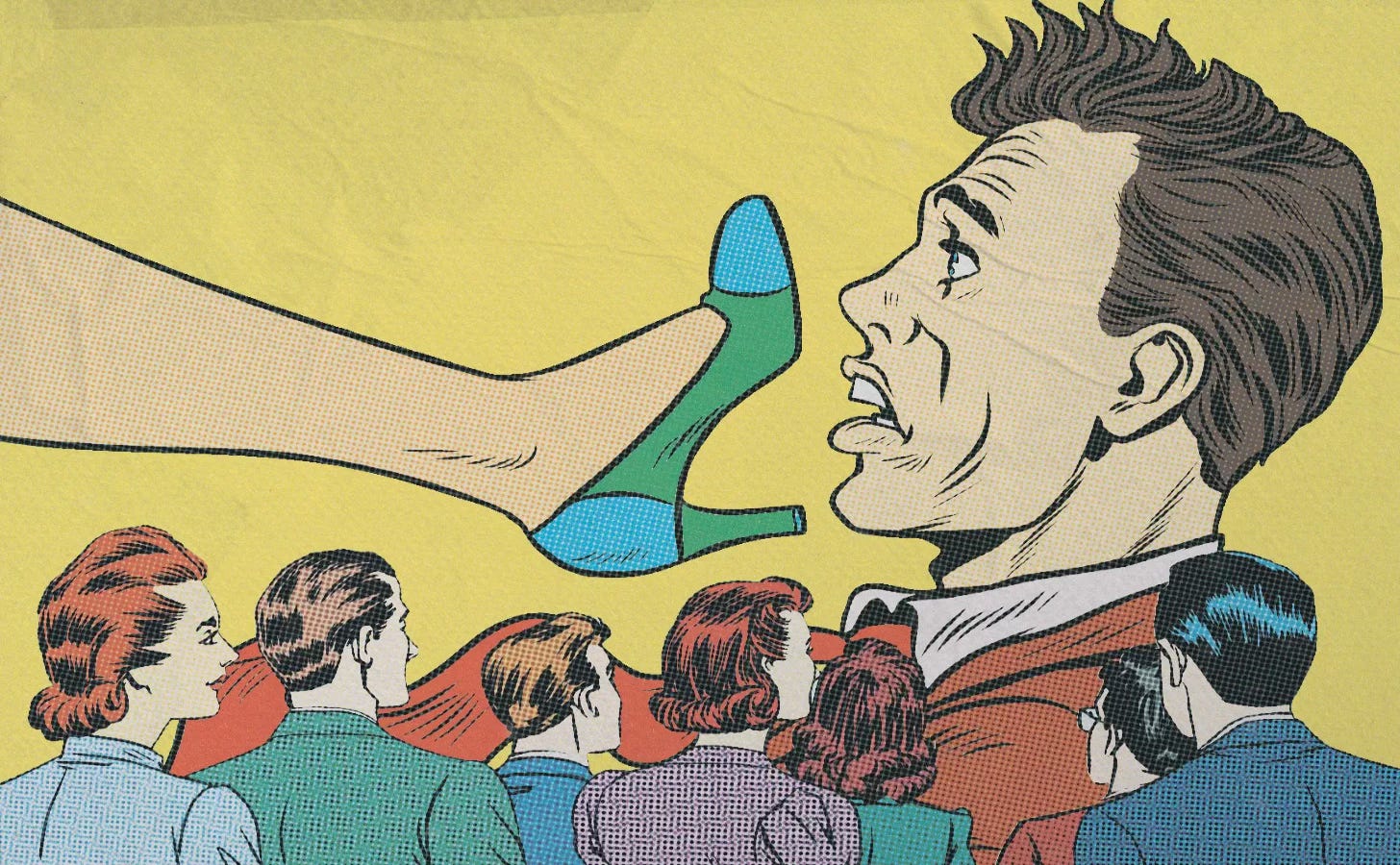
In “The Great Feminization,” the much-discussed recent essay by the pugnacious conservative political commentator Helen Andrews, we are treated to the vaguely pathetic spectacle of a woman arguing that women are too empty-headed to make reasoned political arguments. Not all women, of course. And most certainly not Andrews herself. Just most of them—enough that the increasing presence of women in the workforce, especially in prestigious fields like law, media, science, and academia, is a civilizational emergency. In fact, in Andrews’ telling, the Great Feminization is a social reconfiguration on par with the scientific and industrial revolutions. Unlike these prior revolutions, however, Andrews says the Great Feminization is a disaster.
What Is the Great Feminization?
Let’s start with what Andrews gets right: the Great Feminization is real and it is historically unprecedented. We should expect this to mark a break with the past. And we should not shrink from talking about it. But really understanding it and its implications will require a bit more than goofy cliches.
Her essay, based on a talk she delivered at a recent National Conservatism conference, explains:
A political system in which men predominate will tend to operate according to rules of facts and objectivity. And one in which women predominate will tend to operate by the rules of emotions and subjective facts.
This, she suggests, is the result of average differences between men and women based in evolutionary biology—“back on the savannah” men and women were selected to have different social strategies, and these innate tendencies have direct correlates with contemporary politics. Free speech is male, censorship is female; the rule of law is male, personalist rule is female (a claim countered on both sides by the man who currently occupies the White House); closed borders is male, pro-immigration is female—and so on.
There is a certain unreality to this litany. In paragraph 15 of the essay, men jockeying aggressively for talking time is a demonstration of the superiority of the male ethic of combativeness; by paragraph 23, women jockeying aggressively for talking time (and interrupting their male colleagues) is a demonstration of women’s emotionality and lack of concern for rules.
It’s even stranger to equate, as Andrews has, cancel culture with supposed feminine strategies of gossip and backbiting. If you’ve ever been on the receiving end of a cancellation campaign, you would instantly recognize that there is nothing indirect about it. This isn’t subtle social ostracism, but 10,000 people screaming in your face. They might even make long-form videos, write blog posts, and publish essays in prestigious magazines about you—all quite public and visible.

'Abundance’ Offers a Sounder Way Forward for the Left than Degrowth or Redistributive Progressivism
Indeed, it seems more that Andrews has simply produced a list of things she likes and called them masculine. This is in keeping with such screeds, which actually have a long history. Andrews’ innovation is in taking tired stereotypes and elevating them to the status of a civilizational emergency. As women enter politics and historically male-dominated professions, the idea goes, they bring their innate politics with them, corrupting everything that had been achieved through masculine virtues. If we don’t get women back in the kitchen ASAP, Western civilization will fall just like Rome.
A Bizarre Solution
The funny thing is, given the scale of the danger, Andrews’ proposed solution is so small bore as to be delusional. Andrews believes that we can get women out of the workforce simply by tweaking antidiscrimination law. As she puts it:
Feminization is not an organic result of women outcompeting men. It is an artificial result of social engineering, and if we take our thumb off the scale it will collapse within a generation. ... The most obvious thumb on the scale is anti-discrimination law. It is illegal to employ too few women at your company.
The first flaw in Andrews’ solution—and it is not a small one—is that it is not, in fact, illegal to employ more men than women. Just look around you. Her “solution,” in other words, is to repeal a law that does not exist.
Perhaps there is a steelman argument to be made here: the “thumb on the scale” are those parts of antidiscrimination law that sanction “hostile work environments.” But this just leads to a deeper question. Even if you grant that Andrews is right about everything else, none of these solutions make sense. It is not unlike leftists who insist that climate change is a civilizational emergency and also that we should solve it by buying organic tomatoes. If the problem is genuinely that severe, then a Band-Aid won’t do. If women in the workplace are a civilizational emergency, can we really wait around for nature to self-correct? But one supposes Andrews only wishes to wink at the idea of bringing back explicit, even de jure, antiwoman discrimination rather than proposing it directly.
Why does she shy away? She doesn’t say. Perhaps either because she doesn’t feel the time is yet ripe despite the permission structure created for reactionary longings like hers by the postliberal right—and their man in the White House. Or because, somewhere deep down, she can sense the venality of the draconian and oppressive program that would be required to successfully force women to quit work and go back home to bake cookies and make babies.

Zooming out a bit, Andrews’ approach reflects a familiar form of conservative conspiratorialism. As Eric K. Ward explains, the traditional reactionary conspiracy theory—antisemitism—is necessary to answer a basic problem: “If we’re so superior, why aren’t we winning?” If men are so inherently stronger, more competitive, and more rational than women ... how did women ever get into the workforce in the first place?
A conspiracy is needed—in this case, the society-wide delusion that is “wokeness.” Andrews minces no words here: “If you want to put it in a single sentence, feminization equals wokeness.” But where did wokeness come from? Curtis Yarvin, the court philosopher of the neoreactionary circles Andrews runs in, argues that this delusion has been inculcated by the “Cathedral,” a loose collective of bleeding-heart liberals, Marxist professors, and various others in positions of intellectual authority.
The resulting picture is hardly believable: Men are the strongest and most rational sex, who have been effectively swept aside by insidious female ideas, which have permeated every level of society and pose an existential threat to civilization, but which also can be easily reversed, after which everything will go back to normal. “By a continuous shifting of rhetorical focus, the enemies are at the same time too strong and too weak,” as the old saying goes.
A Dark Mirror?
She is correct that her own antifeminist take on women is simply the mirror image of a recognizable progressive, pro-woman vision: “More women in politics is good, because women are more caring than men”; “more women in science is good, because women have better interpersonal skills than men”; “more women in business is good, because women are better team players than men.” When Andrews distinguishes between men’s “ethic of justice” and women’s “ethic of care,” she is simply repeating the typology of feminist philosopher Carol Gilligan.

The parallel goes further. Delve a bit deeper into the fever swamps Andrews is wading in and you’ll find characters like L0m3z (real name: Jonathan Keeperman) ranting about the stifling female culture of the “longhouse,” an essay-length meme depicting female prioritization of community, safety, and comfort over “overt ambition” and “the drive to assert oneself on the world, to strike out for conquest and expansion.” The originator of the longhouse theory is Bronze Age Pervert—real name Costin Alamariu—whose book Bronze Age Mindset lies somewhere between an evolutionary psychology diatribe and a knockoff installment of Conan the Barbarian. Andrews avoids mentioning Keeperman and Keeperman avoids mentioning Alamariu—but the intellectual heritage is clear in both cases.
But here’s the thing: Bronze Age Mindset itself is once again a dark mirror of feminist theorizing, in this case that of Marija Gimbutas, who argued that Europe was once dominated by a prehistoric woman-worshipping culture that was conquered and subjugated by invading male “Kurgans.”
Is There Any There There?
So? Is any of it true?
When we look back at the savannah, do we see distinct male and female cultures, one hard, rational, and competitive, the other warm, emotional, and cooperative? Well, no. To put it bluntly: any familiarity with human history will tell you that history is not full of hard, cold, rational free speech defenders. Most men spent most of history standing against the ideals of free inquiry and rationality. The “masculine energy” Andrews and her ilk exalt was, for most of history, devoted not to reason, invention, and friendly competition, but the ruthless quashing of internal rivals.
The fact is that new ideas are a threat to those already in power, men or women. Free inquiry is a threat to the idea that their thrones are divine benefice; new inventions are a threat to the steady rents that accrue to entrenched interests. Reason, which is neither male nor female, is the light that scours away tradition; it lets us see through the self-interest motivating those who are protective of it.

The modern world, powered by reason, is weird. A historical anomaly. The ideas of the rule of law, of freedom of speech and expression, of the valuation of commerce over conquest—these are not ancient, but shockingly new. And they changed the world. Joel Mokyr recently received the Nobel Prize in Economics for precisely this argument: modern economic growth—and thus modern industrial might—is the product of these intellectual, cultural, and institutional changes. He is hardly alone: a broad swath of economic historians, including Deirdre McCloskey, Mark Koyama and Jared Rubin, and Douglass North, John Wallis, and Barry Weingast have come to the same conclusion.
Modernity Is Weird
And now perhaps we are in a position to actually understand the Great Feminization. There is an inclination—again, shared by reactionaries like Andrews as much as anticapitalist feminists—to see the success of feminism as a political movement, a phenomenon separate from the rise of modern industry. Yet this is wildly implausible. It is true that the proportion of women in prestigious careers is historically unprecedented, as Andrews notes. Yet far from being an artifact of the peculiarities of American employment law, this is a global phenomenon. With perhaps the signal exception of China (and here the state-issued economic statistics are themselves quite dubious), modern economic growth, open societies, and women’s rise have gone hand in hand.
Here is the reason women are entering the workforce: it pays well. And it’s historically unprecedented not because we put our thumbs on the scale through “misguided antidiscrimination policy.” It’s also not because of the “two-income trap,” as Andrews suggests. (As the economist Maia Mindel has argued, the “two-income trap” is itself an illusion. A heterosexual couple today could have a 1950s breadwinner-housewife model ... if they were willing to accept a 1950s standard of living.) Women are entering the workforce in droves because they make too much money for it to be worth staying at home. This, too, is a result of modern economic growth—a result not of “bullshit jobs” (another bullshit concept) but the rapidly increasing productivity of individual labor, a world built by brains instead of biceps.
Most American antidiscrimination laws were passed in the 1970s. But women’s labor force participation began climbing long before that, increasing steadily from 32% in 1948 to 57% today, with no sharp inflection point in the ’70s.

Andrews’ theory thus has no basis in reality. None! As Nobel-prize winning economist Claudia Goldin has noted, “Gender equality and economic development share a synchronous existence.” Liberalism did not put a thumb on the scale. It is Andrews and her ilk who wish to forcibly undo what free choice and an open society have wrought.
The success of our peculiar world does not require a return to a male-worshipping “bronze age mindset.” Equally, it does not require us to reinvent some imagined “divine feminine” to worship; it does not require us to make a fetish of “care over justice.” The archetypes of the past do not suffice. Modernity requires its own model: competition and cooperation, reason and empathy—a liberal mindset that can compete in the rough and tumble of the marketplace and the agora, without ever losing track of one’s fellows as equal citizens deserving of equal respect and equal rights.

© The UnPopulist, 2025
Follow us on Bluesky, Threads, YouTube, TikTok, Facebook, Instagram, and X.
We welcome your reactions and replies. Please adhere to our comments policy.

Geez. The very first paragraph from her you quoted was breathtaking in its utter lack of historical knowledge. The YouTube algorithm has been feeding me vids on British monarchical history and “logic” and “rationality” are not characteristics of these manly men rulers.
The women hurt most by the spread of female group psychology are the non-conformists - women who resist the tribal pull.