


Book Review
What is the most worrying threat to liberal democracy today? Donald Trump’s kleptocratic, would-be authoritarian presidency? The semi-fascist MAGA movement’s capture of the Republican Party? Both are strong contenders, but my nominee is Alternative für Deutschland. After a recent breakthrough election win in the state of Saxony-Anhalt, this extreme-right party leads the German opinion polls and has a discernible path to national power.
AfD proposes to expel millions of people (including naturalized German citizens), take Germany out of the European Union, side with Russia against Ukraine, crack down on “anti-German” art, withhold state benefits from LGBTQ and other “deviant” families, and reconstruct the state on ethnonationalist lines. “The AfD’s legislators in the new state parliament include a former pornographer convicted of theft and men under investigation for ties to right-wing extremist groups,” writes the Brookings Institution’s Constanze Stelzenmüller in the Financial Times. “The state AfD leadership has consistently refused to disavow staffers with links to a banned neo-Nazi organization.”
That’s right, folks. We are talking about an extreme-right party rising meteorically in Germany.
Given Germany’s geographic and strategic centrality and its not-so-ancient history, can you think of anything quite as disturbing, or as bizarre? After all, Germany today is not the Weimar Republic in the 1920s, where people used wheelbarrows as wallets. Whatever challenges it faces, Germany is a brilliant national success story: rich, secure, strong, democratic, peaceable.

What in the world is going on? Why are Western publics so disillusioned with liberalism? Why gravitate to authoritarian populism, which is invariably corrupt, repressive, and incompetent? Why now, when Western countries are objectively richer and safer than any time before the end of the Cold War—if not ever?
We liberals are rightly obsessed with those questions, and a stream of recent books addresses them. I have reviewed some of them here, here, here, and here. Now come two more, one by a Nobel Prize-winning economist, the other by a British historian. One of them is a tour de force that will change the way you think about the problem. Spoiler: it’s not by the Nobelist.
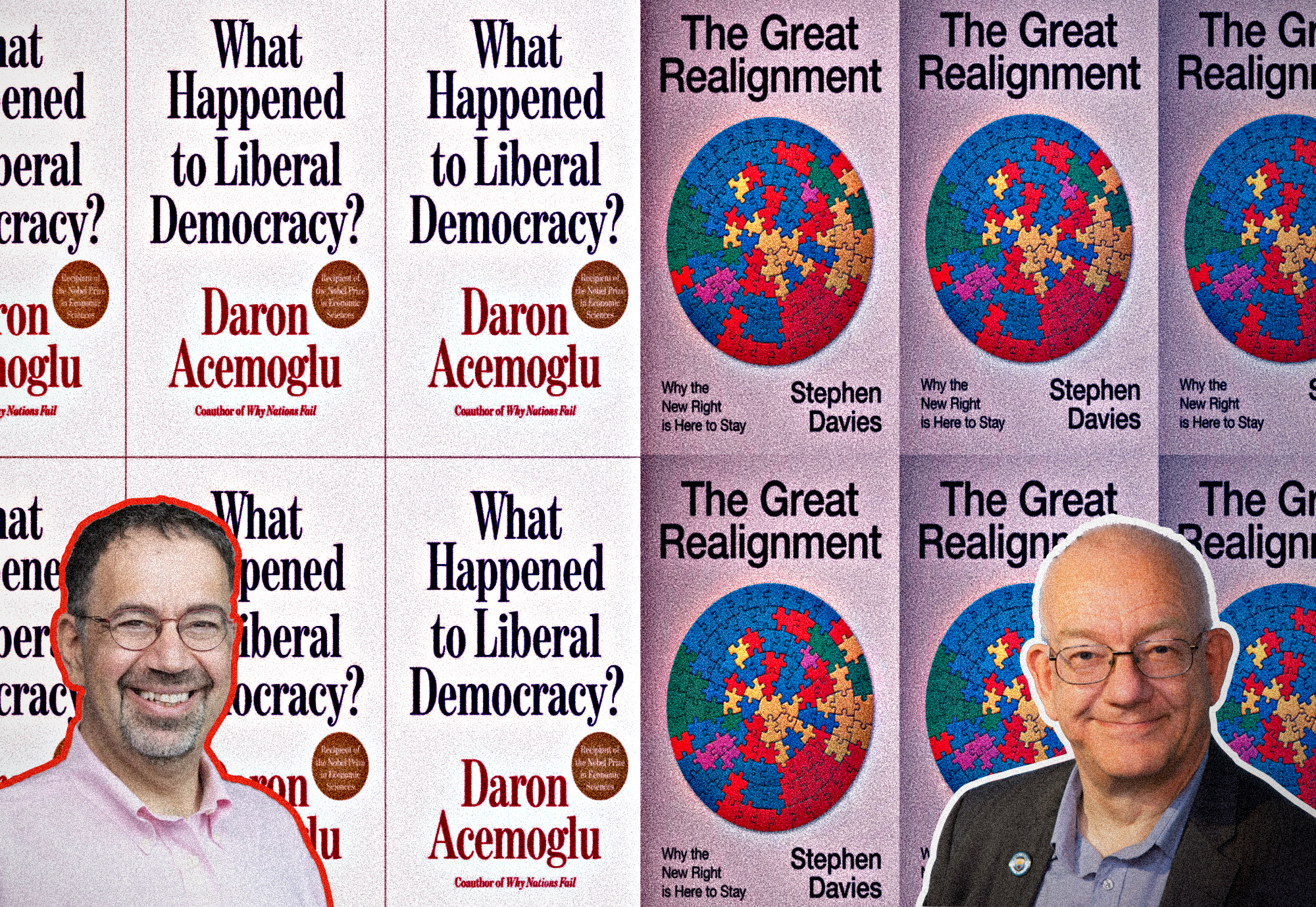
Daron Acemoglu is an economist at MIT. He and collaborators Simon Johnson (a LibCon2026 panelist) and James A. Robinson won the Nobel in 2024 for their work showing how a “narrow corridor” of institutional arrangements generates conditions for prosperity. In What Happened to Liberal Democracy?, Acemoglu, writing solo, tackles the global political crisis.
In the 20th century, he argues, liberal markets and politics succeeded by dismantling “absolute power of certain groups over the rest,” creating conditions for self-government, and sparking a virtuous cycle in which technological progress, markets, and wage growth bolstered social mobility, economic prosperity, and participatory democracy.
Unfortunately, the cycle went into reverse. What he calls the “industrial compact” (“the combination of industrial-era economics and politics”) struggled while inequality, mass migration, and globalization heightened social tensions. Automation, deregulation, and the decline of unions added to the pressure on working-class well-being; and then, of course, China stormed into world markets.

As if that had not damaged the postwar industrial compact enough, liberalism “completely turned its back on the economic priorities of the less educated and has come to focus on cultural and global issues.” Worse still, liberals lost their “moral fire.” Neglecting their legacy as economic and social reformers, they became a technocratic establishment that was too smug and insular to command a mass following.
So where are we now? “History shows that when liberalism falters, its enemies rush in,” Acemoglu writes. “We are only at the beginning of this unraveling.” In his last chapter, Acemoglu argues that “if liberalism is to endure, it must be rebuilt”—and “it must rise with the working class at its heart.” To that end, he ticks off programs and ideas, such as more apprenticeships, “appropriately targeted” redistribution, “pro-worker AI,” “a common narrative” that can “bring people together,” “renewed understanding of the value of community,” and—I guess you get the idea. Every author dreads the “solutions” chapter, and this grab-bag exemplifies why.
Acemoglu has written a commendable account of the economic changes that have riven and challenged Western societies. Like many liberal critics of liberalism, however, he seems too eager to blame liberalism for—well, everything. “I believe that these noxious [antiliberal] currents are alive only as a result of liberalism’s crisis and weakness.” My italics, because ... only? It’s all our fault?
While no one disputes that liberal governments committed mistakes and oversights, none of their failings explains, much less justifies, the movement of an enviably privileged electorate like Germany’s toward a party like AfD. Up to a point, I’m all for self-critical introspection by chastened intellectuals; but when, one wonders, does self-criticism shade into self-absorption? Sure, liberals need to reform and improve; but when we see a global political wave empowering the worst kinds of opportunists and demagogues, maybe it’s not always our fault.
So it is refreshing and revelatory to turn to The Great Realignment: Why the New Right Is Here to Stay, by Stephen Davies, the author of books about Brexit, economic innovation, and empiricism (and a contributor to The UnPopulist). He, too, tackles the question of why liberalism is under threat everywhere and all at once, but he is most interested in the specific nature of the threat. “The pattern almost everywhere in the developed world is increasing success for a new kind of right-wing politics,” he writes. The question is “why this kind of politics has sprung up now and in so many places” (his italics). That, it seems to me, is the right place to start.

Like Acemoglu, Davies takes note of the disruptions that liberal democracies and markets have struggled to cope with: social media, economic globalization, mass migration, growing gaps favoring big cities over the countryside and college-educated over non-college workers, and anxiety about demographic and cultural change. Also like Acemoglu, he dings liberals for losing touch with ordinary people by prioritizing “ideas and perspectives generated in the academy” that “tended to serve the interests of a class of qualified professionals.” All of that, you’ve heard before.
Davies’ contribution is to put those developments in a much larger context. Where others see a concatenation of mistakes or failures that strained liberal democracies to the breaking point, Davies sees a playing out of political forces that nobody could have prevented or preempted. In other words, even if liberals had done everything right, it might not have mattered.
Why? Davies’ central concept is that of alignment: the organization of politics around issues that define what are usually binary debates. An alignment establishes political alliances and arguments in ways that are more or less stable, often for several generations. During these stable periods, “political identities are known and persistent.” Every so often, however, a defining conflict is resolved or becomes obsolete and a new conflict supplants it. The result is, per Davies’ title, a “great realignment.”
Major realignments have several characteristics, Davies thinks. One is that, after a while, they settle down into predictable political patterns; but in the meantime, they seem chaotic and frightening, especially to those whose mindset is stuck in the old order. For a while, nothing makes sense: radical actors and ideas come out of nowhere and surge from the margins of politics to the center; “friends and allies become enemies while deeply divided opponents suddenly find themselves allied.”
Another characteristic is that major alignments can be delayed or obstructed, but they cannot be prevented. They are driven by structural changes in societies and economies and by tectonic changes in public sentiment—not by the to-ing and fro-ing of everyday politics. When a realignment happens, politicians arise to meet the moment. If not for Donald Trump, Nigel Farage, and Marine Le Pen, someone else like them would have emerged.
Third, and a point Davies is at pains to stress: realignments are not random events or ephemeral disturbances that burn themselves out. They are about something. Even if the disrupters seem disreputable, they speak for millions and represent substantive positions on fundamental issues. Whether or not you like the new combatants and battle lines, they are (as the book’s subtitle says) “here to stay.”

What are those battle lines? Writes Davies:
The core of the present realignment is this. We are moving on from a world in which the aligning issue is how large a role government should play in the economy and in redistributing resources—capitalism versus social democracy or socialism. ... Instead, there is a new one. This is about identity and the nature of governance; the choice now is nationalism versus cosmopolitanism and globalism.
Crediting and extending David Goodhart’s 2017 book distinguishing between localist “somewheres” and cosmopolitan “anywheres,” Davies argues that recent decades saw the world divide into two groups with different sources of identity. On one side are people who see themselves as rooted in their place, nation, job, and faith; on the other, denizens of globally connected metropolises who identify with liberation from local and national constraints. In the United States, he says:
the realignment is complete. Instead of a division between Republicans and Democrats based on support for tax cuts and deregulation and smaller government on one side versus redistribution and more regulation on the other, there is now one between a nationalist party that is conservative on a range of cultural questions and a more globalist party that is more relaxed about immigration and radical on cultural questions.
We see the same divisions everywhere: multilateralism and internationalism versus nationalism; progressive versus conservative values; globalization, free trade, and relatively liberal immigration versus economic nationalism, trade protection, and reduced immigration and even mass deportation. According to Davies, this conflict will frame world politics for decades to come.
His argument, rich and fascinating as it is, has its blind spots. While Davies is right to take populist nationalism seriously as a worldview, he does not take seriously enough the populist threat to the very existence of democracy and the rule of law. (See: U.S.A., January 6, 2021.) He also takes too little account of the fact that the prescriptions of the populist right—such as protectionism, cronyism, nativism, and anti-intellectualism—are ruinous and oppressive. (See: everywhere.) His breezy confidence that “politics is not in chaos” and “will soon stabilize” seems, shall we say, premature.
Nonetheless, the implications of Davies’ argument deserve attention. One is that the conservative-libertarian alliance in support of free markets is dead. “In the new politics the dominant ‘right’ position will be one that combines nationalism and anti-globalism with economic interventionism,” he says. “To be a Thatcherite today is like being a Gladstonian Liberal in the 1920s—charming and admirable but ineffectual and unrealistic.”

Another implication is that the realignment has no reverse gear. Now that it is in place, it has redefined politics and superseded its original causes. As a result, “technocratic economics will no longer work politically.” Fattening voters’ pocketbooks can help win the next election but will not change the fundamental partisan loyalties of voters who are asking not “How am I doing?” but “Whose country is it?”
If Davies is right that the political paradigm has shifted, then it’s no longer the economy, stupid! Building more houses and improving health care, while worth doing, will not catalyze a new majority for Democrats and other parties of the center-right and center-left. Instead, the main battle is over culture and identity. Germany’s AfD is betting on that, and as of now it is winning.

© The UnPopulist, 2026
Follow us on Bluesky, Threads, YouTube, TikTok, Facebook, Instagram, and X.
We welcome your reactions and replies. Please adhere to our comments policy.

I love these book reviews.
From what is presented here I am not sure either of the authors "get it" and I am sure they both "get some of it." But as noted Davies seems to have the best, and I think most accurate, read on what's going on.
The objection that Davies "...does not take seriously enough the populist threat to the very existence of democracy and the rule of law." may simply be because it is part of the process that may be slowed but not stopped. I agree with you "He also takes too little account of the fact that the prescriptions of the populist right—such as protectionism, cronyism, nativism, and anti-intellectualism—are ruinous and oppressive." But again perhaps an unavoidable consequence of the process. Politics may in fact stabilize--- though we may not fully like that stability.
I have had some intense interactions with the MAGA minds that seem to be embracing this shift and I sometimes wonder if they just aren't "early adapters" of the changed environment.
George Orwell talked about the future where a boot is stomping on a human face forever. What these far right populists have in common (and sometimes share with their opponents) is that they all believe that what Orwell said is the truth. They just want to make sure THEY are wearing the boots and doing the stomping and not the people they have been taught to loath and fear. Therefore disenfranchising, disempowering and marginalizing their "enemies" is an existential necessity which inevitably must discard liberal democracy. They are here to stay.
Lots of interesting ideas here. I certainly agree that the fundamental argument in politics has ceased to be Keynesianism vs. Thatcherism and is decidedly now more along the lines of national identity and belonging. In that frame, though, I still think that there is a lane for a muscular liberalism to compete. The blood-and-soil nationalists want us to define our identity as something mean, tribal, and small. A vision of liberalism that argues from first principles—rule of law, individual rights, separation of powers, separation of church and state, free expression, free enterprise, and fair play—offers something much more life-affirming and inspiring. We just need to gather up the courage to make the arguments in the face of this reactionary tide. To give people faith that, in the face of rising global instability, technology and social change, and climate crisis, liberalism is still up to the task and they don’t need to hire fascists to protect them.