


Book Review
Let’s agree that liberalism is in a global crisis.
By liberalism, I mean the ideas and institutions underlying the modern social operating systems of capitalism, democracy, and science. By global, I mean throughout the WEIRD world: western, educated, industrialized, rich, and democratic. By crisis, I mean that electorates are chronically unhappy and turning to populist demagogues, authoritarian movements, and other illiberal alternatives.
Let’s also agree that the crisis is multicausal and overdetermined—meaning that there are more than enough plausible explanations to go around. They include disappointing economic growth, skewed income gains, mass migration, urban-rural and college-noncollege economic and cultural bifurcation, antisocial media, religious decline, calcified governments, rickety political structures ... well, you get the idea.
Finally, let’s go out on a limb. Let’s stipulate that the crisis has a spiritual element. Let’s agree that many people feel the want of more than material goods and political voice. They feel an absence of meaning in their lives. Call it God, call it purpose, call it transcendence; call it the desire—no, the need—to make a difference during our short time on this little ball of rock. Philosophers, drawing on Aristotle and the Greeks, sometimes use the term eudaimonia, a state of flourishing that arises from striving toward the good for its own sake (as opposed to hedonism, the pursuit of comfort and pleasure). Perhaps that has gone missing?
If the first two things are true, then much of what ails liberal societies can be addressed, at least in principle, with political, economic, and institutional reforms. But if all three of them are true, then we have a gap which economic and political measures cannot fill. Call it a meaning gap. We would need to answer—or at least better answer—the timeless question posed by philosophers: what is the good life, and how can we find fulfillment pursuing it?
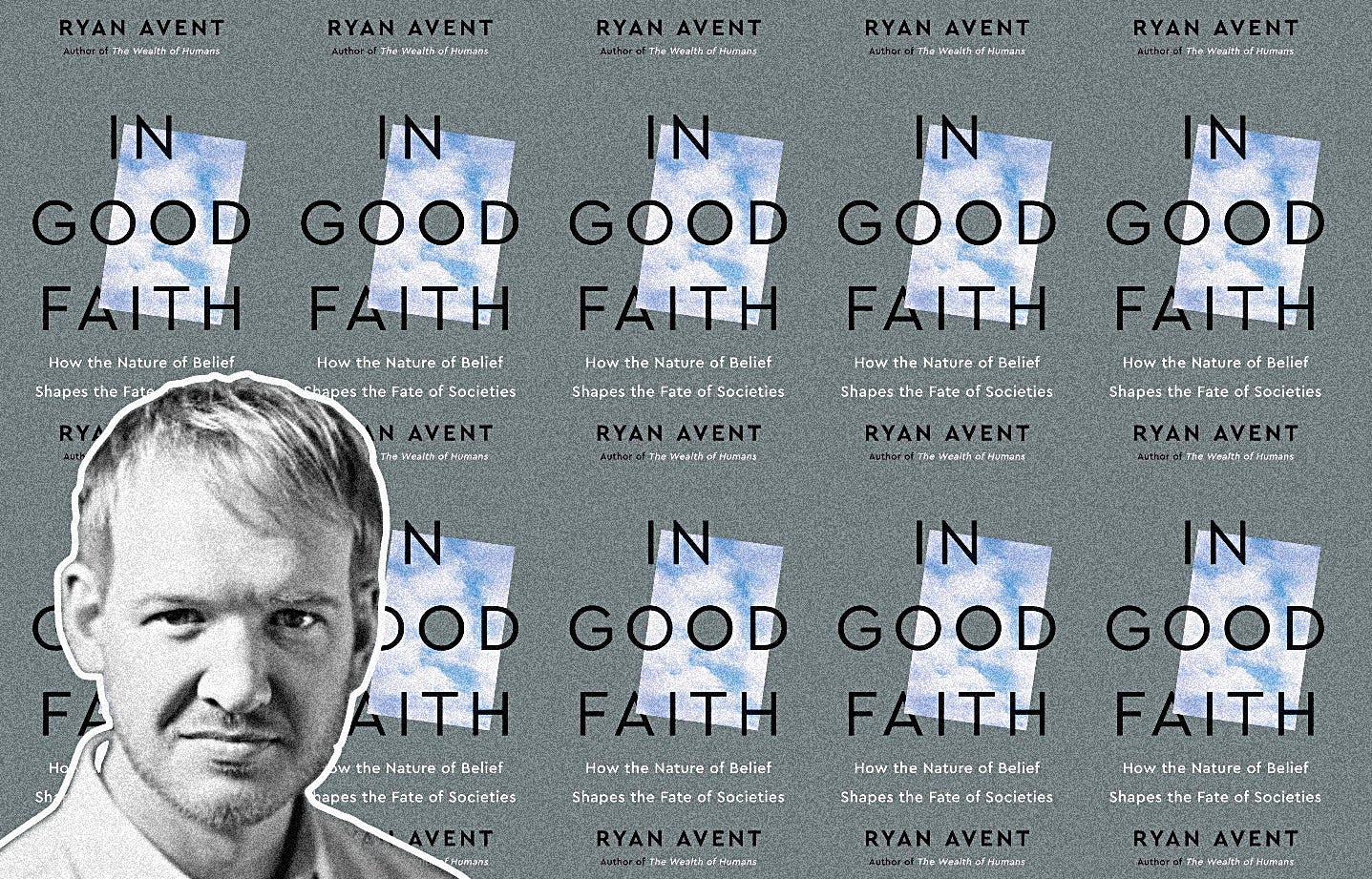
That gap is the subject raised by Ryan Avent, a former journalist for The Economist, in his new book, In Good Faith: How the Nature of Belief Shapes the Fate of Societies. Introducing his ambitious thesis, Avent begins (a bit peculiarly) with himself. Prone to depression, he felt a painful absence of meaning and faith. “I don’t think I’m alone here,” he writes (his italics). “I don’t think I’m the only one who has become aware of an absence.”

Avent came to think that the modern West suffers from a similar problem: it no longer tells an inspiring story. Busy careers and bulging supermarket shelves are not enough. “We have a deep need, a biological need, to coordinate our actions through grand stories that help us understand why the world is the way it is and what we are trying to do, that imbue life with meaning and purpose,” he writes. “We want sensations and answers liberalism does not provide.”
Individuals need motivating stories, but Avent claims—his most interesting point—that societies need them even more. Shared moral narratives are a critical social technology: “The world has gotten better because the meaning shared across it has evolved in ways that have expanded our collective capabilities.” Shared meaning allows trust and cooperation on an otherwise unattainable scale; it inspires “great sacrifice for each other”; it structures our markets and institutions. “The stories we tell ourselves about what we are doing here and why shape our collective capacities, and our collective capacities determine everything.”
Pre-liberal faiths, such as tribalism and Christianity, provided meaningful stories—sometimes for better, though often for worse. In the recent past, liberalism, too, had a story: of a grand human endeavor of progress, equality, and liberation. Yet today, the author says, mass consumerism, fragmented media, tech-driven sociopathy, and cultural nihilism have taken a wrecking ball to meaning. In its own way, careerism has been just as bad; what Avent calls the Modern Faith “has no guidance for people in our situation” beyond urging that we “achieve professional success, make money, job done.”
If any of this sounds familiar, that might be because the charge that individualism, industrialization, and consumerization lead to anomie and nihilism has roots that go back to Plato among the ancients and Rousseau and Marx among the moderns. Modernity never fully recovered from the attacks of Nietzsche, who claimed that secularism (which he despised) had demolished Christianity (which he also despised) and left behind only stupefying consumerism (which he also despised).

In the first half of the 20th century, the meaning critique faded amid two global hot wars and one cold one, but in the Me Generation era it rebounded with a vengeance. Think of President Carter’s “malaise” speech of 1979, in which he decried “a crisis of confidence ... that strikes at the very heart and soul and spirit of our national will. We can see this crisis in the growing doubt about the meaning of our own lives and in the loss of a unity of purpose for our nation.” (Fun fact: Carter did not use the term “malaise” in the malaise speech.) Think of Hillary Clinton’s 1993 “politics of meaning” speech:
We realize that somehow economic growth and prosperity, political democracy, and freedom are not enough—that we lack meaning in our individual lives and meaning collectively; we lack a sense that our lives are part of some greater effort, that we are connected to one another. ... [T]he signs of alienation and despair and hopelessness … are all too common and cannot be ignored.
Today, postliberals, many of them conservative and Christian, have (without apparent irony) embraced a version of the very not-conservative and not-Christian Nietzschean critique, claiming that liberalism attacks faith, family, nation, and tradition, thereby undermining its own foundation and opening the way to the very authoritarianism that liberals abhor. (The postliberals are less than forthcoming about their preferred governing regime, which would arrive at authoritarianism a lot faster.)
Can thoughtful liberals meet these critiques? They are certainly trying. In fact, the most thoughtful analyses of liberal shortcomings come from liberals. Thinkers like Francis Fukuyama, James Davison Hunter, Alexandre Lefebvre, Brink Lindsey, Adrian Wooldridge, Alexander Zakaras, me, and Avent are engaged in something like a family argument, dividing in more or less three ways.
Classical liberalism argues—with Locke, Mill, and modern libertarians—that providing meaning is not liberalism’s job. Rather, liberalism’s founding principle and distinguishing strength is precisely that it sidesteps questions about life’s purpose and the nature of the good, allowing a multiplicity of moral visions to coexist and thrive. If you want to know the meaning of life, ask your pastor or guru.
Values liberalism agrees that liberals embrace no single vision of the good, but it rejects the notion that liberalism is value-neutral. To the contrary, liberalism presupposes and promulgates a hefty bundle of values, such as empathy, reciprocity, fairness, equality, lawfulness, truthfulness, forbearance, and (of course) freedom. Values liberalism draws inspiration from (among others) the philosopher John Rawls and the political theorist William Galston—and, more recently, from Alexandre Lefebvre, who writes, in his feisty 2024 book Liberalism as a Way of Life, “I propose that liberalism is a good way of life.”

Deficiency liberalism accepts many premises of the other two schools, at least in theory; but it argues that neither classical liberalism nor values liberalism has, in practice, risen to today’s real-world challenge. In fact, they have objectively fallen short, which is why we’re in a crisis. If liberalism does not find a meaningful story to tell about itself, and if it cannot find a way to provide inspiration and purpose, it will be abandoned in favor of worse alternatives—which, guess what, is exactly what’s happening.
Avent is in the deficiency camp. Liberalism “is the best way to preserve peace and to foster prosperity, to understand the cosmos, and it provides ample room for each of us to find meaning where we can,” he writes. It is “the best we’ve come up with so far” and “gets us much of the way toward where we want to be.” But: “It does not get us all the way there.” In italics, he writes: “We need a story that tells us why we should care where humankind ends up.” Not one to understate, he adds, in a heading: “Our Survival Depends on the Discovery and Embrace of a New and Better Faith.”
With a buildup like that, the reader might wonder what kind of new and better faith the author has in mind, but he declines to make suggestions. “I don’t know what the right stories are,” he says. “There are ideas out there,” he assures us. “There are many versions of many stories, stories that build on each other, adding twists and variations and inspirations, and if we all keep sharing them we may wind up somewhere new and thrilling.” And there the book ends.
Avent’s non-answer is, to say the least, anticlimactic, but it does have the (liberal) virtues of candor and humility. I closed the book feeling more grateful than disappointed that it does not offer any grand and horrible “new” ideas. There’s something to be said for framing a problem without pretending to have solved it. I felt more let down by the book’s lamentable lack of empirical data and research; vast troves of polling, reporting, and scholarship on everything from politics to happiness are ignored in favor of generalizations and opinions.
Regardless, Avent’s main point—that, like it or not, liberals need to get into the meaning-making business—demands thought. Is he right? Maybe. I see merit in all three theories of the meaning gap.
I still incline most toward the classical liberal school, though. If you want to know why meaning went missing, look first to meaning-making institutions and leaders. Look to schools that teach left-wing pablum instead of civics and history; to churches that embrace culture wars and partisan politics; to media companies that algorithmically trash institutions and norms. Look above all to political leaders who choose demagoguery over moral leadership. Demand that they do better.

Don’t get me wrong, I would love to see today’s liberals propound an inspiring new story, and I hope we can. That is what Jefferson did in the Declaration, what Lincoln did in the Gettysburg Address, and what King did in his speech at the Lincoln Memorial. Lefebvre is right: to those searching for the good life, we have plenty to offer.
Even so, filling the meaning gap is not our primary problem, and it is not primarily our problem. Avent is right to say that we can and should help to fill the meaning gap, to whatever extent we can. But we cannot succeed without support from responsible and civic-minded churches, schools, business and media leaders, politicians, and—especially—voters. If they do not step up, then yes, the liberal experiment will fail.

© The UnPopulist, 2026
Follow us on Bluesky, Threads, YouTube, TikTok, Facebook, Instagram, and X.
We welcome your reactions and replies. Please adhere to our comments policy.

Liberalism is not going to survive in its current form nor with mass immigration and hollowing out of domestic infrastructures via neoliberal austerity economics. These mouthpieces for Davos and Wall Street are like rats on a sinking ship.
Leave it to Jonathan Rauch to clearly sum up the crisis of liberalism in a few excellent paragraphs