


Book Review
Trump 2.0 is a nightmare for liberals, but in one respect it has been, so to speak, liberating: it has stimulated a rethink unlike anything seen since the 1970s. Back then, Wall Street Journal supply-siders fixated on economic growth, Friedmanite libertarians on smaller government, Naderite progressives on corporate accountability, and neoconservatives on cultural norms and renewal. Today, in America and around the world, WEIRD (Western, educated, industrialized, rich, and democratic) electorates are grumpy about their economies and angry at their governments; if all that we liberals offer is more of the same, we will fail.
Answering that challenge are two books declaring that contemporary liberalism is in crisis. Or, I should say, two more books. New volumes by Adrian Wooldridge and Alex Zakaras follow books by Francis Fukuyama (Liberalism and Its Discontents, 2022), James Davison Hunter (Democracy and Solidarity: On the Cultural Roots of America’s Political Crisis, 2024), and Brink Lindsey (The Permanent Problem: The Uncertain Transition from Mass Plenty to Mass Flourishing, 2026, reviewed by me here). All seek to diagnose the maladies that have led to populist anger and democratic backsliding. All are thoughtful contributions by distinguished members of the liberal camp. While their scopes and specifics are different, they have in common the claim that contemporary liberalism has swung too far toward individualism, elitism, and technocracy, with the result that economic security, social solidarity, and interpersonal connection have been shortchanged. No wonder folks are unhappy!
The Revolutionary Center
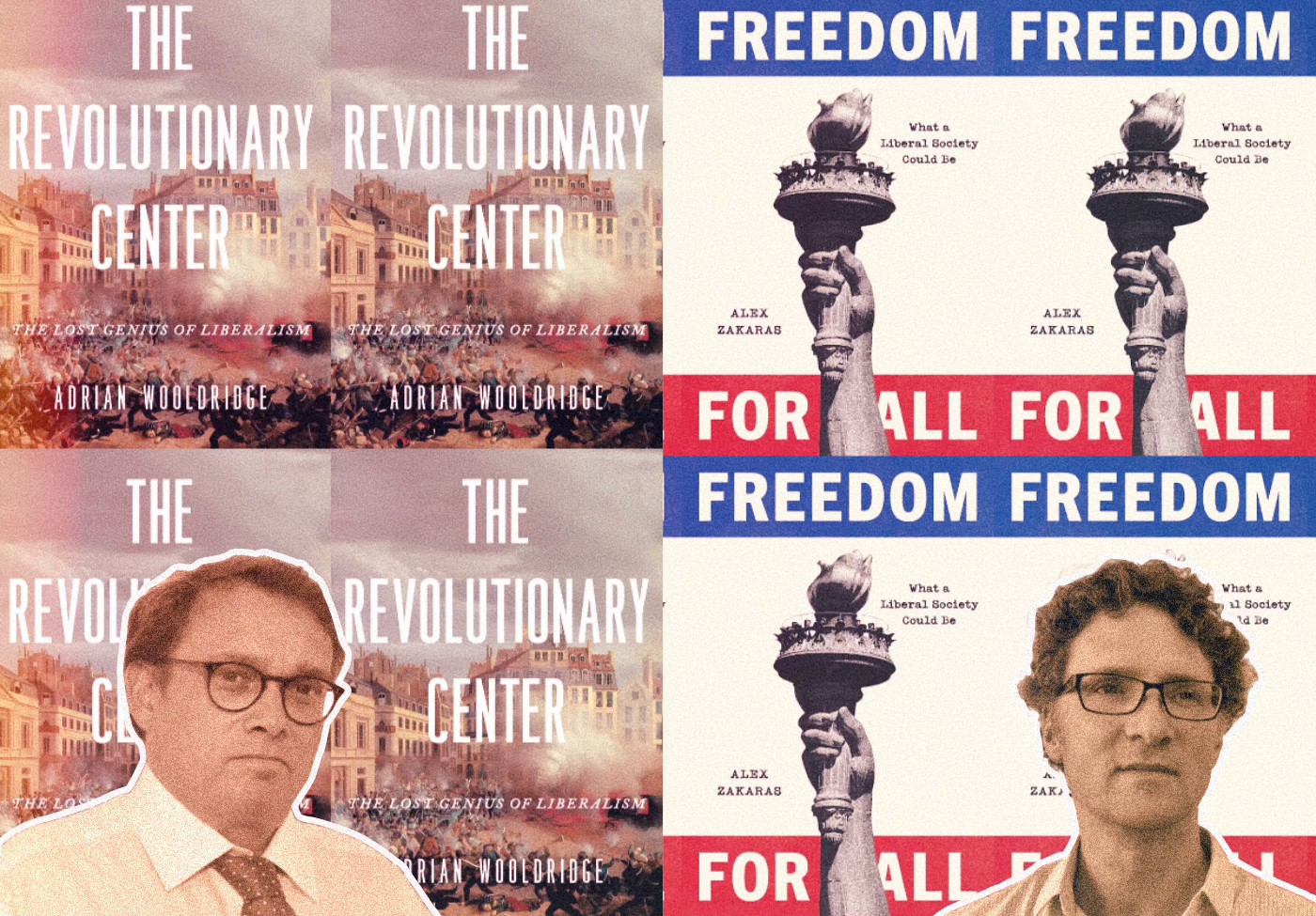
Wooldridge, a prolific journalist and vividly readable writer, hails from the center-right and has authored books on management, economics, government, psychometry, and more. (We have been acquainted since working together at The Economist in the 1990s.) In his ambitious new book, The Revolutionary Center: The Lost Genius of Liberalism, he traces the path of the social idea which, as he rightly puts it, both made and saved the modern world. For a one-volume history of a rich and complicated subject, you can’t do better.
By “liberalism” he means (as I do throughout this review) not left-leaning progressivism but humanity’s most revolutionary and successful social idea: the replacement of authoritarian and hierarchical social decision-making with the rules-based, decentralized systems of capitalism, democracy, and science. Beginning from the pre-modern world of tribes and monarchies, he argues that liberalism started as a revolutionary idea and then periodically reinvented itself to avert stagnation.

Today, he argues, liberalism is again “under mortal threat,” but as much from within as from without. He argues that liberal elites have become degenerate, self-serving, and out-of-touch—thus courting the populist reactions that have taken America and Europe by storm. “Today’s liberal elite cries out for reform not only because it is visibly failing but also because, in all too many ways, it deserves to fail,” he writes.
Liberals, he argues, need to jettison the laissez-faire nostrums, identity-politics obsessions, and technocratic smugness which have blinded them to runaway individualism, predatory elites, and chaotic streets. They should condemn instead of coddle self-destructive behavior, crack down on crony capitalists and greedy oligarchs, and get serious about controlling crime and the border. In that way, he argues, liberalism can meet its most urgent challenge, which is “to cease seeing society from the eyes of the people in charge and instead recover both its original radicalism and its latent popular appeal.”
The Progressive’s Liberalism
Like Wooldridge, Alex Zakaras proudly identifies as liberal, but he hails from the progressive wing. A political scientist at the University of Vermont, he has written books on American individualism and the thinking of J.S. Mill. In Freedom for All: What A Liberal Society Could Be, he outlines what he calls “radical liberalism,” which places less emphasis on individualism and negative liberty and more on collective provision and positive liberty.
Like classical liberals, he holds that “liberalism treats freedom as the highest human value.” But people cannot be free if their real-world agency—their “power to choose from a broad range of secure and desirable options”—is denuded by “corporate tyranny,” self-serving elites, and corrupt institutions and politicians.

Zakaras’s book, like Wooldridge’s, is crammed with policy suggestions. Zakaras’s, however, are inspired not by 19th-century moralists but by European social democrats and the American progressive movement. Although he rejects the totalistic strains of the “woke” left, he embraces eye-wateringly ambitious environmental, economic, and political agendas. For instance, he wants to overhaul labor law (“a huge, multi-faceted task”), “recognize both healthcare and paid family leave as fundamental rights,” and “widen access to secure, affordable housing, strengthen unemployment benefits, and provide access to free bank accounts and publicly subsidized microloans to preempt the financial exploitation of the poor.” And that is just on pages 131 to 135!
Two Diagnoses, One Disease
Although none of Zakaras’s policy suggestions—or, for that matter, Wooldridge’s—is particularly original or challenges liberal fundamentals (which is fine if you think that successful reform is usually incremental), one thing that is radical about “radical liberalism” is the price tag. Even assuming Americans wanted a huge expansion of government, Zakaras does not explain how to pay for it, beyond suggesting higher taxes on corporations and the wealthy and asserting that “in the wealthiest society in human history, there are plenty of potential answers.” Those of us who toil in Washington policy shops, and who task ourselves with thinking about how to finance and implement the reforms we recommend, are entitled to wonder if hand-wavy talk of “potential answers” meets the bar for seriousness.
Still, practical objections aside, and despite their divergent prescriptions—Wooldridge wants to steer to the cultural right, Zakaras to the economic left—they agree on a fundamental critique of the status quo. Both believe that liberalism is better than the unworkable and illiberal alternatives of the left and right; that liberalism went wrong when it veered too far toward laissez-faire, individualism, and technocracy; that the establishment has become complacent, bureaucratic, and corporate. Both draw inspiration from liberalism’s history as an insurgency against entrenched interests and calcified hierarchies; both call for a liberal style that is anti-elitist and scrappy. Both remind us that the prevalent liberal concepts of the late 20th century—the anti-government libertarianism of Ronald Reagan and Margaret Thatcher and the meliorating Third Way of Bill Clinton and Tony Blair—do not exhaust the possibilities.

I won’t try to sort through and evaluate the many proposals floated by Wooldridge and Zakaras. Instead, I’ll make two larger points.
The Case for Liberal Confidence
The first is that the liberal rethink to which Wooldridge and Zakaras contribute is a good thing. No serious person can afford to dismiss problems like inequality and unaffordability, personal anomie and social isolation, working-class pain and government underperformance. (I’ll add that policy wonks at the Brookings Institution, where I work, started writing and warning about those problems years before today’s postliberals “discovered” them.) Liberals did not create nihilistic tech lords, truth-impaired right-wing media, outrage-addicting algorithms, and fascistic demagogues—but now, somehow, we must contend with them.
The second point is in tension with the first, but it is also true: liberal intellectuals, including Wooldridge and Zakaras, are overdoing the self-criticism and making ourselves neurotic. For reasons that are both substantive and strategic, we should apologize less and brag more.
Substantively, the foundational moral idea of liberalism—that all people are born free and equal and are endowed with unalienable rights—remains as true and essential as ever, if not more so. The foundational social idea of liberalism—the commitment to impersonal, rules-based, non-coercive ways of organizing societies and resolving conflicts—remains indispensable and astonishingly successful. The three great liberal social systems—liberal democracy, liberal markets, and liberal science—have brought the world unparalleled stability, dynamism, prosperity, freedom, human rights, knowledge, and peace. No other system, past or present, comes anywhere close. Reagan and Thatcher were right about one thing: If liberals do not make the case for liberalism, proudly and plainly, no one else will make it for us.

Strategically, too, we blunder if we lead with our chins. While liberalism’s in-house critics have worthwhile things to say, they are too naive about the opposition we confront. If WEIRD publics have soured on liberal democracy, markets, and science, that is in very large measure because those institutions have been relentlessly and cynically attacked by antagonists who are more than willing to bend and break the truth, heighten conflict and anger, block efforts to solve problems, and then exploit the anger they create. (Think, in this context, of how Republicans inflamed the immigration issue by repeatedly torpedoing bipartisan reforms; a cynical strategy, but it worked.)
In that respect, the most important of the recent crop of books about liberalism is William Galston’s Anger, Fear, Domination: Dark Passions and the Power of Political Speech, a revelatory account of how demagogues use ancient techniques to manipulate modern publics—and why liberals have been painfully slow to understand what has been going on. (I reviewed it here.) My own book, The Constitution of Knowledge, shows how authoritarians exploit cognitive vulnerabilities and short-circuit rational defenses—including those of college-educated liberals who think we are too smart to be fooled.
So, yes, we in the liberal camp should correct errors and propose reforms. Our willingness to do that is precisely what distinguishes us from authoritarians of every stripe. Yet we should also insist that many of our critics are charlatans and cynics, and we should reject their efforts to blame us for their civic vandalism.
We should begin and end our conversations by reminding the public, and ourselves, that liberalism offers tangible material, social, and moral progress, whereas the other guys—beginning with the one in the White House—offer nothing but snake oil.

© The UnPopulist, 2026
Follow us on Bluesky, Threads, YouTube, TikTok, Facebook, Instagram, and X.
We welcome your reactions and replies. Please adhere to our comments policy.

Great essay. Just restacked
Sort of good faith attempt, but still assumes that mass immigration is an issue only because those evil Republicans lied about it. Still in denial of how dishonest “liberal” institutions have become.