


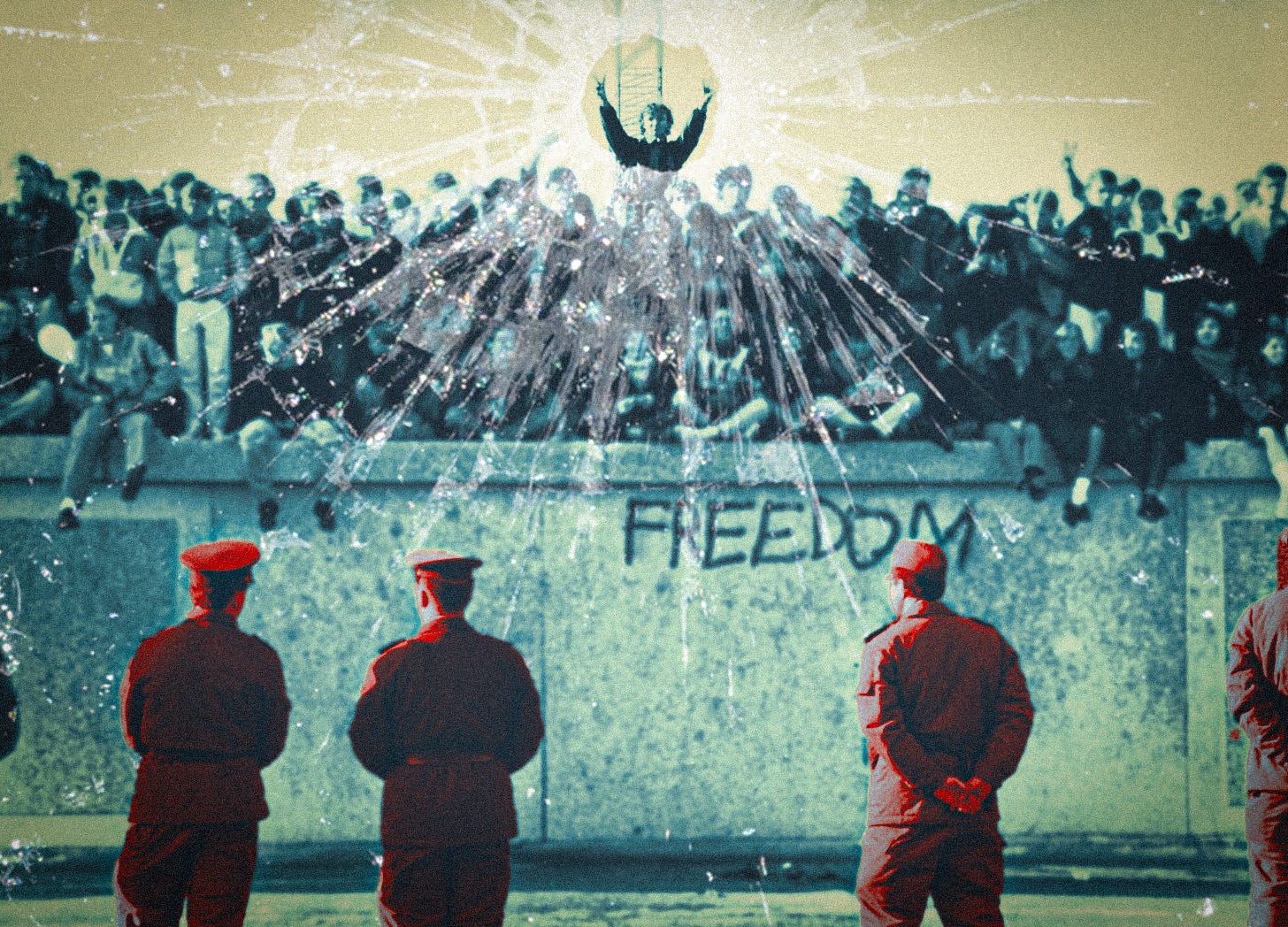
The history of the 20th century is, in large part, the story of competing totalitarian ideas put into practice, and the destruction, immiseration, and death they produced. It is a rarity in human history, perhaps unprecedented, that the lives of four generations could be told primarily through the lens of a clash of ideas that touched every corner of the globe and every facet of society, politics, and economics. That contest was fought in the pages of journals and newspapers, at the ballot box, and in wars both traditional and undeclared.
Most of these ideas, of course, were bad ones. An optimistic or perhaps Whiggish interpretation of 20th-century intellectual history would highlight how Marxism, Communism, socialism, Nazism, fascism, postmodernism, and Islamism all rose up and were brought down, at times by their own failures and internal contradictions, and at others by the moral and martial forces of freedom.
None of these ideas were small or for the faint of heart. All sought to reorder society along radical lines, fundamentally change human nature, and extirpate root-and-branch the evolved institutions of private life and the liberal democratic order. The grandiosity of these ideas and their totalizing tendency stirred the souls of their followers, calling them to a mission to build a new society—and to destroy an existing one.
A quarter of the way into the 21st century, the difference between then and now could not be more stark. While ours is a moment racked by popular discontent, the diminution and desecration of formal and informal institutions (often at the hands of these institutions’ ostensible leaders), and a significant increase in the breadth of ideas in circulation, there has been very little in the way of legitimately new ideas this century, either at the level of ideology or public policy. Indeed, most of the bad ideas in circulation today are old bad ideas, not new bad ideas.

For those of us who care about a free society, this is a reason for optimism. During the long 20th century, when anti-liberal ideas from Marxism through fascism were new, liberals faced four challenges. First, responses to these challenges were under-theorized, and it took decades of work by thinkers like F. A. Hayek and Wilhelm Röpke to address them head-on. Second, liberals had a thin intellectual bench, and aside from a few times and places like fin de siècle Vienna, they were seldom found in close regular contact. Third, the empirical record of high modern illiberalism had yet to develop. And fourth, the opponents of liberalism had the energy of true believers who believed they could remake the world anew.
Today the story is quite different. We have a much more thorough theory of a free society and its attendant institutions; put simply, the task of updating those principles and their applications, while significant and challenging, is of a qualitatively different scale than the problem facing our forebears. We have robust polycentric networks of scholars, intellectuals, journalists, politicians, entrepreneurs, business leaders, and philanthropists dedicated to advancing a free society. And we have a hard-earned century of data from grand social experiments that resulted in historically unprecedented human tragedy.
Put simply, fighting old bad ideas is a very different task in terms of scale, scope, and challenge than fighting new bad ideas.
The online new right is awash with intellectual energy, but it is almost entirely placed into service of revanchist efforts to re-popularize old bad ideas, or in the American context, to take various strains of foreign conservatism that have never had purchase in the United States and bring them to our shores. Among the more prominent of the online right philosophers is Curtis Yarvin, the Pied Piper of the so-called Dark Enlightenment. Yarvin has certainly been prolific over his decades of blogging and popular writing. But his underlying idea—that America needs to replace the constitutional order with an unelected CEO-king—is simply a pre-modern absolutist, non-hereditary monarchy with 21st-century characteristics.
Yarvin’s affect is novel, no doubt. Rather than writing for clarity, he seems to relish purple prose, non-sequiturs, and halting transitions. As John Horvat wrote for Law & Liberty, “He is brash, sarcastic, skeptical, and cynical. His style is irreverent and vulgar. He cares little for rules and formality.” No doubt he’s a good marketer to the very online set. But adopting the cocky, rebellious mien of a very online 21st-century Mick Jagger doesn’t make his ideas original.

The Catholic integralists similarly embrace an explicitly medieval view of the relationship between temporal authorities and religious ones; to wit, they believe as a normative proposition that the former should be directed by the latter. Not only is there nothing new about this idea (it was, of course, the pre-modern status quo throughout most of Europe), but it is also, as Law & Liberty contributing editor James Patterson has shown, based on a conception of Catholicism with no historical background in the United States. The story of modern Christian nationalism, to the extent it’s even a discernible ideology, is largely the same.
The less intellectual corners of the new right offer something even less novel; ideologically, they present a grab bag of racial essentialism, ethnic grievance, and antisemitism of varying degrees of gentility. As with Yarvin, novelty here is restricted to the realm of presentation and promotion, in particular, a delight in subverting social norms of decency.
The left is likewise in thrall to old bad ideas occasionally gussied up in ambitious rhetoric. Doctrinaire Marxism having fallen out of favor, the body count of communism still too fresh in historical memory, the left’s economic ideology is primarily a kinder, gentler “democratic socialism” or “social democracy.” On questions of identity (which now regrettably carry more political salience than do matters of political economy), there’s the same mishmash of postcolonialism, critical theory, third-worldism, anti-white racial resentment, and anti-Americanism that characterized much of leftism in the 20th century. “Wokeism,” the only significant left-wing ideological innovation of the past quarter-century, had no new intellectual underpinnings; it was novel only in its rhetoric and internet-optimized political tactics.
This ideological stagnation leads to policy stagnation. The mayor of New York City, a self-described democratic socialist who during the campaign clearly relished his portrayal as a radical and never missed an opportunity to take a swipe at the successful, has little economically to offer besides slogans about government-run grocery stores, rent control, free bus passes—along with the promise of replacing rugged individualism with the “warmth of collectivism.” His promises of free child care and $30 minimum wages are unlikely to go anywhere in Albany, meaning his actual fiscal impact may not be that significant.

'Abundance’ Offers a Sounder Way Forward for the Left than Degrowth or Redistributive Progressivism
This in itself does not counsel optimism: Zohran Mamdani’s policy ideas are terrible and will be deleterious to New York as a city, especially its less well-off. Nor should we discount Hizzonor’s bully pulpit; the vibes and pronouncements from mayors and governors matter more than cold rationality may admit.
But Mamdani’s bad ideas are also old bad ideas, not new ones. What he proposes is simply rehashing policies that have been tried and found wanting again and again. As with Yarvin, a slick front man and an affect custom-made for the zeitgeist can’t overcome the underlying poverty of the ideas. Socialism, even in its more urbane manifestations, doesn’t have a marketing problem; it has a reality problem.
The right is suffering from a similar policy stagnation. Tariffs, industrial policy, welfare statism, clientelism, protecting incumbent firms and favored sectors, and nostalgia-based grievance rhetoric all have significant purchase among elected officials. All are ideas that have been tried and failed.
When ideas have been tried and they succeed, societies do well to continue them. When they are tried and found wanting, however, it is seldom a good idea to resuscitate them and see if they work better on a second go. Yet that is what too many societies across the West are engaged in today. Their expositors and advocates are ensconcing these old ideas in new rhetoric and marketing them through digital channels that are distinctively 21st century. But the underlying ideas remain essentially unchanged—and unimproved.

None of this is to say that there won’t be a new intellectual or ideological innovation on the order of Marxism that emerges in the coming years or decades. The first quarter of the 21st century may yet be seen as an ideological lacuna, after which we could resume our regularly scheduled programming. Nor does this argue for complacency; after all, old bad ideas put into practice are no less harmful than new bad ideas put into practice, even if their consequences are more predictable.
It does however serve as a reminder that no ideas are ever truly so disreputed as to be placed permanently out of circulation. Those with sufficient wisdom and erudition may see through the disguises donned by old bad ideas and see the simulacrum of originality for what it is. It may be easier to repudiate bad ideas in their second and third comings than when they were truly novel, but it is still a task that requires diligence and persistence.
F. A. Hayek wrote that “old truths … must be restated in the language and concepts of successive generations.” So too must the critiques of the old falsities. In this regard, we find ourselves at least somewhat fortunate: old bad ideas may be making a comeback, but we stand on the shoulders of giants as we square up to the task of placing them back on the ash-heap of history. We cannot desist from the battle of ideas, but our task is qualitatively different than when we were facing genuine intellectual innovation and foment from illiberals on the left and right.

An earlier version of this article was first published in Law & Liberty.
Follow us on Bluesky, Threads, YouTube, TikTok, Facebook, Instagram, and X.
We welcome your reactions and replies. Please adhere to our comments policy.

I find it interesting that the "new" Right phrases its philosophy as "postliberalism" when in point of fact it's actually PRE-liberalism, based on the idea that some people are supposed to have absolute and unaccountable authority just because, with even less reason to back it up without a Divine Right of kings.
Thank you for this summary, though strangely, given it's pervasiveness, the summary overlooks the reach and impact of transgenderism--which is much more than mere wokeism. This is an authoritarian, homophobic, misogynistoc ideology driven by billionaires, which acts as an onramp to transhumanism (see Jennifer Bilek). It has global as well as national reach and operates strategically within a "gender industrial complex", including: Online advocacy and community building to upend the so-called "gender binary" through marketing, propaganda and institutional capture (i.e., schools, media, professional associations, including medical; "gender medicine" (i.e.,
pharmaceuticals to medicalize puberty and pharmacy and surgery to modify sex traits); and policies and laws, backed or opposed by our two political parties, demanding entitlements based on subjective identity, and that denies material reality, which undermines womens' sex- based rights. This "gender industrial complex" has made deep inroads into our polity, likely influenced the 2024 election ("Kamala is for they/them...") and will likely be hard, if even feasible, to uproot. IMHO.