


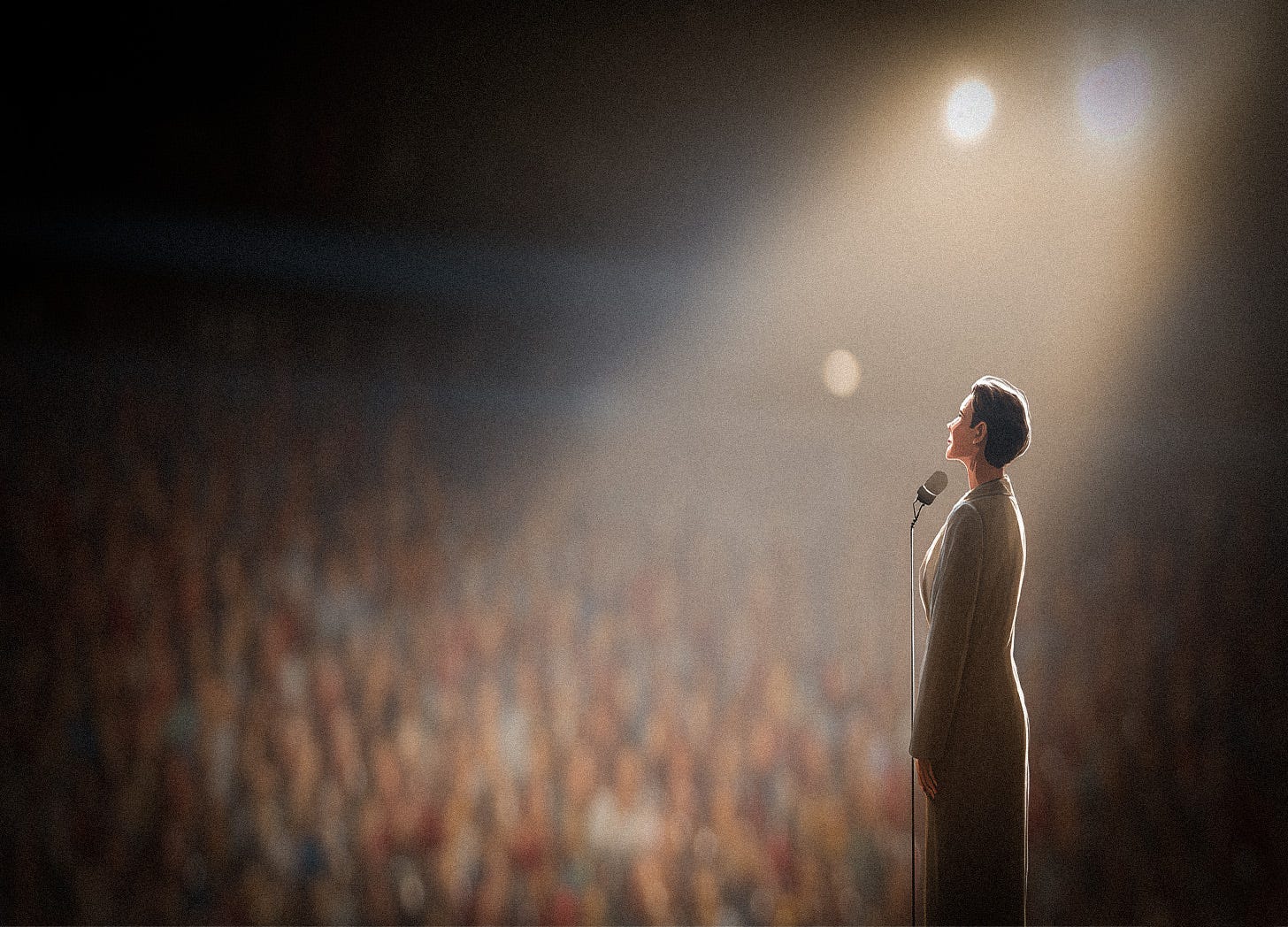
Last weekend, we published a conversation featuring William Galston hosted by the Institute for the Study of Modern Authoritarianism—the publisher of The UnPopulist—and the Institute for Humane Studies. ISMA President Shikha Dalmia and IHS’ Matthew Kuchem asked Galston questions centered around his new book, Anger, Fear, Domination, a fascinating dive into our “dark passions,” as the book’s subtitle puts it, that our politicians are tapping into to divide and polarize us.

Toward the very end of that conversation, Dalmia, editor-in-chief of The UnPopulist, asked Galston to concoct an antidote to what he diagnosed in his book, as the clip below shows. She commissioned him, on the spot, to write a speech that a hypothetical new president would give modeling the ideal kind of rhetoric that, instead of stirring our dark passions, does the opposite: appeals to our common ground rather than cynically exploiting our grievances.
Galston enthusiastically promised to pen such a speech and we present it below.

My Fellow Americans,
Today does more than inaugurate a new president; it begins a new era for America—a time of healing for our country.
For too long we have waged war against one another. As we have squandered our energy in fruitless strife, our foreign adversaries have gained ground while our domestic problems have languished unsolved.
In our national tug-of-war, we have pulled as hard as we could in opposing directions. Our labor has yielded little save exhaustion.
We have learned a hard lesson: We cannot move our country forward unless we work together. We cannot work together unless we acknowledge one another, despite our differences, as citizens of one country engaged in a common enterprise.
This is what healing means for us, and what it requires of us.
After the struggles of the past generation, national reconciliation may seem an impossible dream. But it is what you have demanded, my fellow citizens. If you had not, I would not be standing before you today.
Healing was the central theme of my candidacy, it will be the foremost goal of my presidency, and it is my promise to every American, regardless of party or creed.
How can I redeem this promise, you ask? Let me tell you, as directly as I can.
The waves of strife may have eroded the shores of our Republic, but the high ground—our common ground—remains intact. We still believe in the Declaration of Independence, with its promise of liberty and equality and rights for every individual that no individual and no government can take away from us without losing legitimacy.
We still believe in the Constitution, whose checks and balances are designed to be a bulwark against tyranny. We still believe in the Bill of Rights, which seeks to safeguard us from arbitrary power and allows us to participate in political and social life, free from public orthodoxy, secular or religious. And we still believe in the rule of law, the only alternative to the rule of arbitrary will backed by naked force.
I believe in this, our common ground, with my whole heart and whole mind. And I will endeavor to build on this ground in everything I undertake.
As president, I wield executive power under the Constitution. But it is Congress, not the president, who is invested with legislative power. And it is the judiciary, not the president, who determines the limits of the law that Congress enacts. I will respect these constitutional branches of government as partners in governing a constitutional republic, not treat them as nuisances to be ignored or trampled.
I believe that over the past generation, under presidents of both parties, the presidency has grown too strong, distorting the appropriate constitutional balance between the branches of government. I will work to reverse this trend. But I cannot succeed unless Congress resumes its vital legislative role. To begin this process, I call on Congress to work with my administration to rein the vast trove of emergency powers—unexploded ordnance at the heart of our legal system—that the legislative branch has unwisely conferred on the president.
In this as in all other matters, I will follow the law—not distort it to advance my agenda. I will be a strong president—within the law. If the judiciary tells me that I have exceeded my authority under the law, I will stop and—if necessary—ask Congress to change the law. I will not act as if I am the law.
The government of the United States is a giant enterprise, and the president cannot run it by himself. I will pick senior officials, many with the advice and consent of the Senate, to help me carry out my constitutional duty to faithfully execute the laws.
But faithfully executing the law requires the active cooperation of every branch of government. Congress has the constitutional power to oversee the conduct of the executive, and I will respect that power. When error is suspected—in a cabinet department or executive agency or even the White House—I will not withhold or hide the documents or witnesses needed to determine what has happened. If mistakes have been made, they will be corrected. If wrongdoing has been committed, it will be punished.
The judiciary too plays a critical role in executing the law, and I will respect it, as befits a coequal branch of government, even when I disagree with its rulings. Interpreting the law is an art, not a science, and interpreting the Constitution calls upon judges to offer their best understanding of the document’s nature and purpose. On such matters they are likely to differ among themselves, and with me. I will neither take it personally nor attack them personally.
Governing well takes more than government. Since the beginning of our Republic, a free press has been essential for the never-ending process of self-correction. Journalism is not always balanced or fair. Just ask John Adams or Thomas Jefferson, both of whom experienced a level of vitriol and calumny sometimes equaled but never exceeded.
But far worse than the errors of the unfettered press are government efforts to muzzle it by bogus defamation lawsuits, jawboning, by abusing executive regulatory powers, or by restricting legitimate access to government officials. My administration will not prevent journalists, however critical of my administration or me, from doing their job.
No government has been, or will be, without flaw, and it is unreasonable to expect perfection in any human endeavor. But you, the people, have the right to expect the truth from your government—and ceaseless effort to do better. And when you decide that it is not doing a good enough job, you have the right to elect another one. I will never challenge your verdict. Ever.
But what about the partisan zeal that has disfigured our politics and hampered progress in so many areas that affect your lives, you may ask? Faced with passionate division, will a new era of healing not be stillborn?
These are fair and necessary questions, my fellow citizens. I know that the task will not be easy. But I have a plan to tackle it.
It is no secret that I have belonged to the same political party all my life. But I have never imagined that my party, or any party, has a monopoly on wisdom or virtue. The majority always has something to learn from the minority, and vice versa.
Here’s what this means in practice. I will meet face to face, regularly, for serious consultations with the congressional leaders of both political parties about solutions to our most pressing ills. For example, the American people want housing and healthcare and groceries they can afford. I will look for the best ideas, regardless of party, to further these goals. We need a new immigration policy, based on a just and humane policy that faithfully enforces our laws and respects the rights of every individual while serving the needs of our economy and promoting the flourishing of our communities. And consider this: Within the next four years, both the Social Security and Medicare trust funds will be depleted and we’ll need to ensure that current as well as future beneficiaries who have paid into these programs and are counting on them to get by in their old age aren’t confronted with huge cuts in payments. But without the full cooperation of both parties, they will.
With progress stalled for decades, I will ask members of Congress to put aside ancient quarrels and start fixing our problems. Our citizens need—and deserve—no less.
For two decades, my fellow Americans, narrow majorities have tried to impose their will on aroused minorities. You have seen the results of this politics, you have rejected it, and you have given me the chance to try a new way of doing our country’s business.
This is my promise to you: I will do everything in my power to find common ground. In some cases, I may fail. And when I do, I will level with you. I will tell you what I tried to do, explain why it didn’t work, and lay out how I intend to proceed in the absence of the consensus I sought.
No president can succeed without the support of the people. But to usher in a new era of healing, I need more than your support; I need your active cooperation. Whether you are conversing online or talking face to face with your neighbor or speaking at a school board meeting, I ask you to pause and ask yourselves: Are my first thoughts my best thoughts? Is the most forceful statement of my position the most likely to achieve a good result? Have I impugned the motives and character of others, dissolving a promising conversation into useless rancor?
If the spirit of polarization had not entered our hearts, it could not suffuse our politics. We must not only restrain the excesses of our leaders; we must better govern ourselves.
This does not mean that every opinion is equally acceptable. We must draw—and protect—the line separating legitimate differences from hatred and calumny of every kind. As George Washington wrote, in America we give “to bigotry no sanction [and] to persecution no assistance.” This is the America in which I believe. And my fellow Americans, I am confident that it is the America in which you believe as well.
Near the end of America’s bloodiest war, which we fought among ourselves, Abraham Lincoln summoned us to act “with malice toward none, with charity for all,” to “bind up the nation’s wounds,” and “to do all which may achieve and cherish a just and lasting peace among ourselves.”
While our current divisions run deep, we have not yet descended into pitched and murderous battle with our fellow countrymen. With God’s help and yours, my fellow Americans, we will never do so again. We must face the future in Lincoln’s spirit of healing and reconciliation. If we come together and act together, our greatest days will surely lie ahead.

© The UnPopulist, 2025
Follow us on Bluesky, Threads, YouTube, TikTok, Facebook, Instagram, and X.
We welcome your reactions and replies. Please adhere to our comments policy.

And who among us might utter such a brilliant speech?
This speech is not merely NOT a cure, it is a symptom. At bottom, the speech is at war with itself. It starts with a lot of "we." But it soon devolves, Obama-like, into a litany of "I" and "my." The fundamental problem we face is the guy in the mirror, not the guy in the White House. Sixty-five years ago, we were called upon to "ask NOT what your country can do for you." Since then, we have spent nearly 40,000,000,000,000!!! more than we have earned. What will be required to right the ship is a generation or two of tighter belts. This speech is not going to get us there. I am not sure any speech can. I fear a big dose of misery is the purgative that will be required. In the words of Dr. Franklin, "Experience is a dear teacher, but fools will learn from no other." We are experiencing what happens when we waste time and treasure, deny reality, and listen to liars; and we are about to experience more.