


Dear Readers:
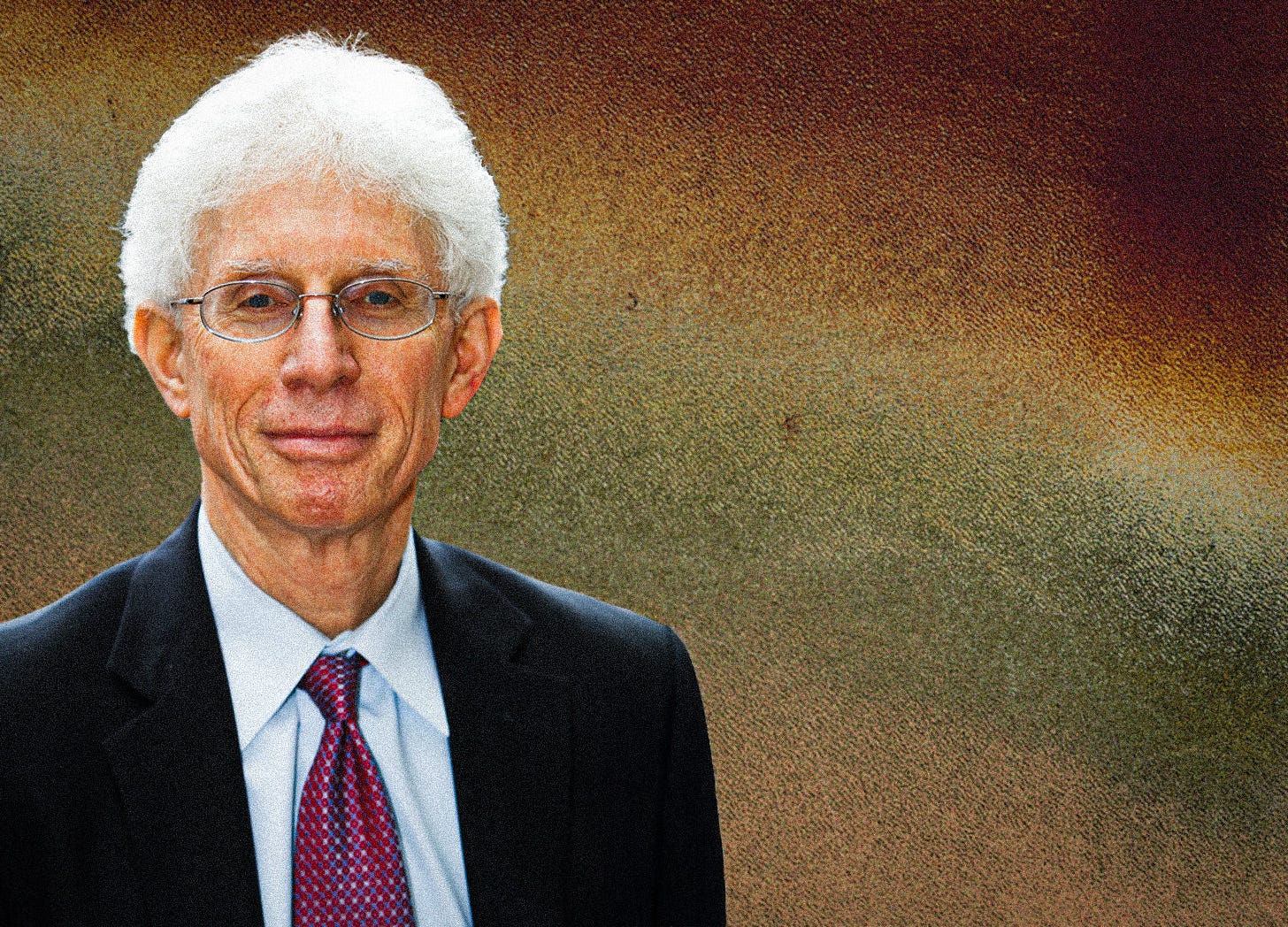
In October, the Institute for the Study of Modern Authoritarianism President Shikha Dalmia, editor-in-chief of The UnPopulist, along with Institute for Humane Studies’ Matthew Kuchem, led a live discussion with William Galston of the Brookings Institution delving into his latest book, Anger, Fear, Domination. They probed Galston about why dark passions often move citizens more powerfully than reason, empathy, or solidarity and how demagogues exploit them. A lively discussion with the audience ensued.
As part of a brilliant triple review in our pages, Jonathan Rauch called Galston’s book a “masterpiece” and described it this way:
If Aristotle and George Orwell had a baby, it would be this book. Combining the philosopher’s lucidity with the essayist’s realism, Galston centers something Aristotle and Orwell both well understood: political rhetoric does not merely reflect a democracy’s character, it also shapes it—and can distort, corrupt, and even destroy it.
In what follows, you can watch Dalmia and Kuchem’s conversation with Galston, or read a transcript of it that has been edited for flow and clarity—or both! And if you listen/read right to the end, you will discover that we left the conversation with a new assignment for Galston.

Shikha Dalmia: Bill Galston, our guest this evening, has just published an important and timely book called Anger, Fear, Domination: Dark Passions and the Power of Political Speech. We have all been struggling to understand the forces of illiberal authoritarianism that have engulfed our country and other democracies around the world. In America, it’s particularly perplexing that this 250-year-old democracy, with no tradition of monarchy or tyranny, has elected someone like Donald Trump, not once but twice. So the question is not what’s wrong with him, but what’s wrong with us, the voting public.
Dark Passions offers a very simple explanation that is so obvious it has been widely ignored: there are always dark passions lurking inside us humans that demagogues can tap into with the right words and the right rhetoric. Yet liberal democrats are losing to the demagogues because they have drunk so much Hegelian Kool-Aid about the arc of history always bending towards moral progress that they have stopped taking these dark passions seriously. So they had no rhetorical defenses against a smooth-talking demagogue like Trump.
The book’s thesis may be simple, but the book is very erudite. It is steeped in political theory, and in the course of making its arguments, it takes on many contemporary theorists like Samuel Moyn and Martha Nussbaum. I think Bill would agree that this book is a sequel to his 2018 book on populism, Anti-Pluralism: The Populist Threat to Liberal Democracy. In it, he argued that populism is essentially the majority’s backlash against pluralism and the elites who champion it, because its promise of inclusion has made too many in the dominant majority feel excluded. Dark Passions builds on that, but suggests that policies to address the majority’s concerns are not going to be enough. Liberals need to understand that people have this darker side, and find words and rhetoric to acknowledge and pacify that side rather than simply ignore it.
So, Bill, the premise of your book is that modern liberal democracies are in trouble because they are ignoring the dark passions that demagogues are tapping into. They have developed much too sunny an anthropology of human nature—a very beautiful phrase that you use—and they’ve lost sight of the dark passions that are always within us.

But you also note that the various thinkers of liberal democracy, right from the start, whether it was Hobbes or Locke or the Founders, saw liberal democracy as a system that is needed precisely because they don’t think human beings are always ruled by their better angels. They saw liberal democracy, to use Aristotelian terminology, as something that is not reaching for the summum bonum: the highest good in social life. It’s just seeking to avoid pain and suffering: summum mallum. So how is it that the system that was constructed with this idea—to guard against the dark passions—[has now] succumbed to the dark passions or lost sight of the dark passions? Where did we go wrong?
William Galston: The current of what might be called “anthropological realism” that characterized some of the early theorists of liberalism is not the only strain of liberal thought that has been historically powerful and influential. There were liberal theorists in the 19th century who were much more optimistic about the ability of human beings to make not only material progress but also moral progress. Many 19th-century British liberals, for example, were much influenced by Kant and even more by Hegel, and imbibed that thought. They were also influenced, as you suggested, by a theory of inexorable historical progress from the worse to the better. That was not the view, I believe, of the earliest liberal thinkers of the 17th and early 18th century. I think it was not exactly the view of America’s Founders, the people who drafted the Constitution and wrote the Federalist Papers. Although if you wanted to make that argument, you could find some evidence for it. But it was an emerging view, and what bolstered that was what I’ll call the “great liberal hope.”
The great liberal hope is that the dark passions can be reduced in their effect—perhaps even eliminated—as motives for public action, through the growth of commerce and commercial relations, the softening influence of commerce on the passions. There’s an early expression of that, which I quote, in Voltaire’s famous description of the London Stock Exchange, where it turns out that people who are engaged in commerce no longer think so much about their political, and especially their religious, differences. If you care enough about money, you care much less about the Trinity, and you stop fighting about it. There have been episodes, long cycles, in the practical development of liberal governance, where that hope has gotten stronger and stronger; where what I will call “liberal peace” went on and on.
It’s no accident that between 1815 and 1914, that idea gained power. In 1913, a Brit by the name of Norman Angell published a book, the gist of which was that because the development of dense commercial relationships within Europe had created such great benefits for Europe, a European war would be irrational. And because it would be irrational, it wouldn’t happen. 1913 was a particularly unfortunate year to publish such a book, but it was widely acclaimed. It did not get the Nobel Peace Prize in 1913, but 20 years later, in another inapt year, 1933, it did. An entire generation of liberal thinkers, reflecting on the rubble of early 20th-century hopes, adopted a much more realistic view of human nature, progress, possibility, etc.
“I view Donald Trump’s rallies as not just a political technique, but actually—if you want to get Hegelian about it—turning a populace ‘in itself’ into a populace ‘for itself,’ and creating and amplifying a kind of collective consciousness of grievance, that ‘all of you are being mistreated, scorned, downgraded in exactly the same way. And I can be your collective voice, which means I can speak for all of you. Why can I speak for all of you? Because I understand you. And not only do I understand you, I share your sentiments. I’m as angry about this as you are. But unlike you, if you support me, I can do something about it. And you’ve learned that, as individuals, you can’t.’” — William Galston
However, there was another long period of peace and economic growth after the Second World War, and so history repeated itself. There was more and more of an argument to the effect that the growth of liberal democracies who don’t fight each other, plus the growth of commercial relations—this time extending worldwide—would create a new zone of progress, such that it would once again be irrational for this order to be broken up, and for wars or conflicts to take place. Which is why the outbreak of conflict on the European continent, starting with the breakup of Yugoslavia in the 1990s, came as such a shock. And why, as late as 2022, when Russia invaded Ukraine, no less a personage than Condoleezza Rice, the former secretary of state, gave an interview to David Sanger of The New York Times in which she professed her incredulity. She said this wasn’t supposed to happen; we were supposed to be past all of this. This is the 21st century, nations don’t try to change boundaries by force anymore. So the long peace after the Second World War brought back and then reinforced the progressivist illusion, which led, I think, to an understandable but very unfortunate forgetting of some of the darker truths that mid-20th century liberal theorists had embraced and developed.
Matthew Kuchem: I wonder if that emphasis on thinking about what’s rational, especially what’s rational for individuals and their economic pursuits and what’s rational for leaders, comes from beginning with the assumption that individuals are making these calculations as individuals. One of the questions that kept ringing through my head as I was going through this book is that you framed it largely in terms of individual passions: anger, resentment, fear, and the drive to dominate. But if you look out at the political landscape, passions never operate in isolation. They’re amplified, they’re sustained, they’re transformed by groups. A slight to an individual becomes collective humiliation when a community interprets it as shared exclusion; resentment becomes a political identity when it is organized and reinforced socially. Doesn’t this mean that the greater danger lies not merely in individual psychology alone but also in group dynamics, the ways in which communities frame grievances and sustain antagonisms? What would it look like to shift the analysis somewhat—and the remedies, potentially—away from thinking merely about individuals qua individuals, but also towards the social conditions that might actually magnify these passions into political movements?
Galston: I spent a lot of time on that second question in my earlier book on the rise of populism in the modern West. I absolutely agree that group dynamic and modes of communication can amplify these passions and turn them into an effective political force. It’s also one of the pillars of the book that we’re talking about this evening: that political speech can help to crystallize this shared sense. People encounter a kind of shock of recognition, that there are lots of other people who feel just the way I do. Why? Because we’re all listening to the same person, we’re all reacting as one to what that person has to say.
I view Donald Trump’s rallies as not just a political technique, but actually—if you want to get Hegelian about it—turning a populace “in itself” into a populace “for itself,” and creating and amplifying a kind of collective consciousness of grievance, that “all of you are being mistreated, scorned, downgraded in exactly the same way. And I can be your collective voice, which means I can speak for all of you. Why can I speak for all of you? Because I understand you. And not only do I understand you, I share your sentiments. I’m as angry about this as you are. But unlike you, if you support me, I can do something about it. And you’ve learned that, as individuals, you can’t.”

So what you’re saying is absolutely consistent with my argument. The extended analysis of collective humiliation, in the book, is meant to indicate that this is more than an individual phenomenon. When I talk about resentment as the almost-inevitable outgrowth of collective humiliation, and the power of resentment to trigger retaliation and revenge, I meant that discussion to be a collective and political discussion. Obviously I talked about Othello, and Iago’s individual resentment at having been passed over for something he thought he deserved translating into resentment and then revenge and then catastrophe. I don’t see a big gap between the individual and the collective. But I think it’s useful that you pointed that out.
Dalmia: You give us a wonderful tour of the dark passions: it’s psychological, it’s philosophical, it’s anthropological, and you identify a whole bunch of them. But not all dark passions are prevalent in equal quantities in every time and every society. And so if we are going to correct the dark passions, we need to understand which particular dark passion is operative in which society at any given time. So let me throw this out to you: In FDR’s time, this was a period between war and depression, there was a great deal of fear, and he addressed himself to the passion of fear.
You can point out that after World War II, we did have the outbreak of the Serbian war, and now we have an outbreak of the Ukrainian war. But by and large, we’ve seen a period of peace and prosperity. And Steve Pinker has been pointing out just how much violent crime has gone down. We can talk about crime in Western societies, but it’s really not that bad by historical standards. Great powers haven’t gone to war with each other. Democracies never go to war with each other—I think that’s still true. So fear is not a factor. So that leaves us two contenders: humiliation and hatred.
Humiliation, I would say, is a phenomenon of the East, where you mentioned China and the century of humiliation from 1840 to 1940. That very much shapes China’s self-understanding right now, and a lot of its foreign policy is directed at ameliorating this humiliation. India, I would put in the same camp. You can’t be in India without really being steeped in the grievances against the Mughal rulers and the Western colonialists. But I don’t see that humiliation as a factor so much in Western countries, in the rise of populism, whether it is Hungary or France or the United States. Hungary is interesting—if Hungary were to be motivated by humiliation, it would really be orienting itself against Russia right now, given how much brutality it suffered during Soviet times. But Orbán’s quarrel is with trans people and immigrants, and he sees himself as a defender of Western civilization, which has echoes here in the U.S.
“The fact that there are dark passions doesn’t mean that there aren’t lighter passions, more productive passions. If all passions were dark, I wouldn’t have had to use the adjective. So now that we’re aware of the damage that the dark passions could do, why don’t we try encouraging their counterweight? Because that also corresponds to fundamental human urges. … Someone who knows how to articulate that with public effectiveness could make a lot of progress, even in our current difficult circumstances. I can’t prove that, but I would rather gamble on that hopeful possibility than to foreclose it by assuming that it doesn’t exist as a possibility.” — William Galston
So, hatred of these groups—and the elites who are defending them— seems to be the big motivating factor in the West. Do you agree that hatred is the operative dark passion in the West? What are the other contenders there?
Galston: I think you’re absolutely right to say that different passions are dominant at different times, different places, different circumstances. What I’ve offered in this book is a kind of static analysis or, if you will, a kind of x-ray of the dark passions. When talking about anger and fear here, my model was Aristotle’s treatment of those issues in the Rhetoric. That is a treatment of these passions that is decoupled from particular situations, and I cheerfully acknowledge that in different situations, different passions are dominant and pose different kinds of risks, not only to liberal democracy, but to civic order itself and certainly to decent politics.
When FDR stepped before the country on the day he was inaugurated in 1933 and told his fellow Americans that the only thing they had to fear was fear itself, that entire speech rested on his analysis of what the dominant emotion in the country was, and how important it was to abate that emotion and to transmute it into something that might be the basis for moving forward. Similarly, Donald Trump picked up on the fact that the people he was talking to were angry and resentful, felt that they had been deprived of their dignity and disrespected by governing elites, and wanted someone who could retaliate against those oppressive elites on their behalf. A good politician, and certainly a good rhetorician, will understand the particular circumstances in which he—and it’s almost always he—is placed.
One example of collective humiliation that you left out was Russia. Putin—there’s lots in his biography to suggest this—experienced a huge sense of personal humiliation as an intelligence officer as the world was crumbling around him. He talks vividly about what it was like to be in East Germany as Russians were withdrawing from East Germany, and how suddenly he was powerless. He could do things, and people no longer paid any attention to them. They weren’t afraid of him anymore; they didn’t respect Russia anymore. An enormous amount of what he’s been doing ever since then, having dubbed the collapse of the Soviet Union the greatest geopolitical catastrophe of the 20th century, is that he was determined to get his revenge. I think you can’t understand what he’s been doing in Ukraine on the basis of a cost-benefit analysis, because this has been an enormously costly venture. But that’s not why he’s doing it. Understanding what it is that’s really driving him, as opposed to what the rational choice theorists assume must be driving him, is a very instructive example to try to think through.
I would go farther and say that the model of neoclassical economics has had a negative impact on liberal democrats’ understanding of the circumstances in which they’re placed and the forces with which they have to contend. The idea that rational self-interest is the principal driver in human affairs is a massive and restrictive oversimplification of the kinds of beings we actually are.

I am preoccupied with the early weeks of the outbreak of World War I, particularly in the U.K., where a lot of young British men leapt eagerly into the fray. One of the great English war poets, Rupert Brooke, wrote vividly about how contemptible he found the peace, where people’s souls withered in the market economy. Their aspirations are low, all sense of nobility and elevation is lost, and he viewed military conflict as a form of the re-elevation of the soul—a soul that had been deadened and reduced by life in bourgeois society. And that entire theme, which you can see working out in 19th-century European thought, juxtaposed the nobility of conflict against the contemptible narrowness and lowness of bourgeois life. That is rooted in many of the passions I’m describing in my book, and has had an enormous impact, whether you’re talking about Nietzsche, Heidegger, a lot of the other European thinkers of the period and their moral critique of bourgeois life. Carl Schmitt would be another excellent example of this: if the great liberal goal is peace, he put a minus sign in front of that and said that the great goal of human life is the kinds of virtues and the kinds of realization of our real circumstances that can come only in war. That’s there as part of us, this love of peace and a drive for war at the same time.
Dalmia: Where does that leave us, in terms of our diagnosis of which of these dark passions is ailing us right now? You had a very nice distinction between anger and hatred in your book. Anger is, you said, a reaction to something somebody has done to you, whereas hatred is a reaction to you, who you are. Like I said, humiliation is not an emotion I’m witnessing here. There’s nothing for the West to be humiliated about. It’s been the victor of the last hundred years. Does that leave us with anger and hatred?
Galston: Let’s take a look at the premise of the question you just asked. The thesis is that the West has been dominant and China, India, Russia, have been on the receiving end of humiliation, of defeat, of colonial occupation, you name it. But when you apply that analysis to individual countries, I think it breaks down, because within countries there are winners and losers. If the losers believe that they are losing or have lost in part because the winners have low regard for them—pay no attention to them, don’t care what happens to them, regard them as deserving of the fate that modern economy and society and public opinion have handed to them—then within countries, you get a dynamic very much like the one that occurred between countries, between those with power and those who feel (rightly or wrongly) that they are powerless.
Don’t underestimate the capacity of that feeling of subordination and powerlessness, particularly if you once held a respected and even central position in society. I think that you can have an experience that generates a sense of humiliation at being ignored. This is something I didn’t talk about in the book, but I’ve been thinking a lot about lately: that paying attention to someone is a way of showing respect for that person. And, similarly, ignoring someone will almost always be taken as a sign of disrespect: you don’t think that I’m worth even 10 minutes of your time. And my analysis of the past 30 years is that there were classes in American society, particularly the industrial working class, that felt increasingly ignored by those whom they saw as having the power in society.
“I attended JFK’s commencement address to the graduating class of Yale. Go back and read that address. The central thesis was: the age of ideology is over. We no longer disagree about moral things. We no longer disagree about our vision. All of that has now been replaced by technical questions, which the experts that government can summon, can help government officials solve. Did that mean that we were a better people in 1965 than we are now? No. I think we were people who had enjoyed unbelievably fortunate circumstances for a full generation. But when those circumstances changed, then the darker side of our nature had an arena and an occasion to express itself.” — William Galston
To put some meat on those bones, let me just give you some statistics. I know I’m moving from theory to economics, but in the 10 years between 2001 and 2010, the United States lost 5.3 million manufacturing jobs, which was almost a third of the manufacturing employment base that we had in the year 2000. Now ask yourselves: were American politicians talking about that as it was happening? This was an unprecedented catastrophe for the industrial working class in the country, and I don’t recall that being a very important theme. 2004 was about other things. 2008 was about other things. 2012 should have been about that, but wasn’t. And then we were all surprised when a group that had legitimate grievances to which they felt nobody was paying attention—clearly, the elites of both political parties were talking to other people, thinking about other questions—felt ignored, disrespected. Resentment grew. And there’s a lot of excellent sociology on the resentment that grew during that period, not only in the industrial working class, but also in rural America. And then we were all dumbfounded when somebody figured that out in 2015 and rode it to victory in 2016.
That’s not a complete history of the rise of Donald Trump, but it does suggest to me that it would be unwise to assume that because the West was winning, everybody in the West was winning. That is exactly the mistake that the governing elites made: that globalization is good for the country as a whole, and therefore it must be good for everybody.
Kuchem: I’d like to pivot back to the book, and specifically I’d like to take up the concept of rhetoric and leadership. You pointed out, in the book and in our discussion just now, particular leaders who might be driven by their own desire to dominate or out of their own humiliation. But if we set aside those paradigmatic examples that leap off the pages of the history books, I wonder if we could look at leadership more broadly. Throughout your book, you really stress that political speech matters. It can tame the dark passions, or it can unleash and activate them. You suggest at one point, later on in the book, that leaders simply underestimate and don’t have a sense of awareness and understanding of just how powerful their rhetoric is, for good or for ill.

That’s probably true for some, but that also seems inadequate to explain the present crisis, at least to me. Our leaders are not merely ignorant. Many of them are cynical, even setting aside the paradigmatic examples. They know their words work. They use them deliberately because political incentives for polarization and outrage are really, really strong. Isn’t the problem not merely a lack of awareness about the effects of rhetoric? Isn’t it that we have a profound deficit of good leadership at the end of the day, both in the character of those who rise to power but also in the incentive structures that tend to elevate demagogues over statesmen and stateswomen? How do we rebuild a politics that can once again generate and sustain leaders of genuine integrity, who then go on to use rhetoric not to activate the dark passions, but to tame them?
Galston: That’s a fair question. It’s easy to swing from optimism to despair, and leaders are not exempt from that. I have a counter-story to tell. I used to be a political theorist full time. I no longer have that luxury: events have deprived me of it, at least as I’ve interpreted those events. But as I read contemporary public opinion surveys, and listen to the tonality of what people are saying, I think there’s growing evidence that not all people, but people in what I’ll call the center of American politics—which is quite wide—are getting fed up with this. They’re getting fed up with a politics of nothing but argument and contestation, disagreement, and mutual vituperation of one party addressed to the other and vice versa. I think there’s a rising appetite for a peacemaker. I really believe that, and I think there’s evidence for it.
Obviously there are people who are deeply committed to this polarized debate, either because they find it emotionally satisfying, or because they think it’s the simple truth of the matter and people who are interested in compromise are just sticking their heads in the sand. There are people who genuinely believe that, and I don’t mean to disrespect that belief because you can find evidence for it on both sides, on the long tails of the American political spectrum. But I don’t think that most people are happy to be living in these sorts of circumstances. I very much hope that to test my proposition, someone will arise—more likely in the Democratic Party than in the Republican Party as it’s now constituted—and [say] “enough is enough.” Compromise is not dishonorable. The Constitution of the United States sets forth, as one of the great objects of our governance, domestic tranquility, of which we have almost none. It’s time to start thinking of our fellow citizens as just that: as friends with whom we disagree, and not as mortal enemies. Let’s give that a try.
The fact that there are dark passions doesn’t mean that there aren’t lighter passions, more productive passions. If all passions were dark, I wouldn’t have had to use the adjective. So now that we’re aware of the damage that the dark passions could do, why don’t we try encouraging their counterweight? Because that also corresponds to fundamental human urges. Let’s see how far we get. Someone who knows how to articulate that with public effectiveness could make a lot of progress, even in our current difficult circumstances. I can’t prove that, but I would rather gamble on that hopeful possibility than to foreclose it by assuming that it doesn’t exist as a possibility.
Dalmia: I’m going to go back to the previous conversation a little bit and tie it into my next question. In your book on populism, one of your theses was that what we are witnessing right now is not the result of material anxiety, but actually social anxiety. Yes, there were losers of globalization in the U.S., but if you look at the numbers on social mobility, they weren’t deeply hurt. A lot of the manufacturing jobs were replaced by machines and not by immigrants, or even outsourced to the Third World. There were dynamics that resulted in productivity increases, which actually benefited the working class in the U.S. There was some stagnation, but it wasn’t a catastrophe by any stretch of the imagination.
“When you walk down the street of a city where you were born and you don’t hear a lot of English being spoken anymore—you hear a lot of other languages being spoken, whether … Yiddish on the east side of New York, or Spanish in many Midwestern cities that, until 30 years ago, were 95% white—it comes as a shock to some people. What we call diversity, they think of as a challenge to the culture they’d always taken for granted, a culture in which they were the dominant majority. I could go on in this vein for quite some time, but just looking at the raw numbers is not, I think, the most revealing way to look at the political circumstances in which we find ourselves.” — William Galston
So if you take status anxiety seriously, as you did, it ties in with another dark passion that you identify in the recent book, which is Augustine’s libido dominandi. If that’s the case, it seems to me that’s got more to do with moral decay. If we are going to take dark passion seriously, we have to take the question of moral decay seriously. And if we take moral decay seriously, then can it really be cured by rhetoric? Or do we actually need to take on the project of rebuilding civic virtue? Maybe in your schema, the rhetoric itself will serve some pedagogical function of a moral renewal. Is that the case? How do we build back our moral reserves?
Galston: I wonder whether there ever was a golden age of civic virtue in the United States. I remember I was astounded some years ago when I ran across an account of an article on the front page of The New York Times in 1941 that deplored the fact that very few Americans could name the three branches of government, let alone their own representatives or senators. And I said to myself, “plus ça change.” The idea that there was some period of civic knowledge and civic virtue from which we have declined is a historical construct, but I’m not sure what the evidence for it is. It is easier to be virtuous in times when everybody is moving forward.
What the French call the 30 glorious years, from 1945 to 1975, was a period which (with the exception of the explosion in 1968, which was quickly tamed) was very un-French in its stability and tranquility. The same was true for Europe as a whole. I think it’s fair to say that, especially if you’re looking at 1945 to 1965, the same was true in the U.S., and people were wringing their hands about consensus politics. At the age of 16, because my father was a Yale professor in 1962, I attended JFK’s commencement address to the graduating class of Yale. Go back and read that address. The central thesis was: the age of ideology is over. We no longer disagree about moral things. We no longer disagree about our vision. All of that has now been replaced by technical questions, which the experts that government can summon, can help government officials solve. Did that mean that we were a better people in 1965 than we are now? No. I think we were people who had enjoyed unbelievably fortunate circumstances for a full generation. But when those circumstances changed, then the darker side of our nature had an arena and an occasion to express itself.
I spend a large chunk of my life trying to promote civic education, in universities but especially in K-12. I started a whole research center at the University of Maryland, addressed to the problems of the civic and political lives of young adults and teenagers in this country. I have to say, I have lost a little bit of confidence since then that I was picking up the problem at the right end. Many friends of mine are, honorably, once again re-addressing themselves to the issues of the civic life of Americans, the civic virtues, civic associations. I honor them, but I can no longer go in that direction. I think we have a political problem that can only be solved politically. And that means that, yes, I have returned to an emphasis on leadership as a way of pulling us out of this mess. There are ways in which preparatory action can increase the odds that the kind of leadership we need will emerge. But I’m not sure that preparatory action takes the form of civic education. I can’t prove that, but that is a somewhat despairing profession of changed faith.
Dalmia: Not necessarily civic education in the sense of, “We have three branches of government and one of them deliberates…,” but more in the sense of a renewal of a faith in liberal democracy and its commitments and what it does for us. Reminding people that life on the other side of liberal democracy is indeed nasty, brutish, and short.
Galston: Well, I agree with that. But I’ll also repeat something that I said at the first liberalism conference that you organized: that few people cherish liberal democracy for itself, for its principles, for its innate virtues and superiority over other forms of government. For most people, it’s a tree that’s known by its fruits, and if the fruits are scanty or bitter, then people will look in other directions. So I am not looking to persuasion about the superiority of liberal democracy to get us out of this; I am looking to people who can convince their leaders, who can convince their fellow citizens, that the best path for them as individuals, the one that is most likely to conduce to peace and prosperity, will come through a renewed dedication to liberal democracy. But then they have to go out and prove it.

If young people are turning against liberal democracy and turning towards undemocratic socialism because they can’t afford a place to live, then, to quote someone I don’t ordinarily quote, Bertolt Brecht: “grub first, then ethics.” There is something to that. If we can convince a new generation that American democracy can produce a place that they can afford to live, and if they get married and have small children, move out of into something larger—I’ll take that. I think we’d better be thinking very hard about the practicalities of renewing faith in liberal democracy as something that can deliver the basics that people really want.
Audience Question: I’m having trouble understanding how the numbers add up here. From what I know about the research on trade and immigration, it’s produced widespread benefits for many people. I understand there are communities where it has not been effective, but how is it that there are enough of them in those communities to constitute a democratic majority? How do the numbers work out here?
Galston: In politics, I’ve learned—and I’ve been in and out of six presidential campaigns and actually served in the Clinton administration—it’s not a matter of raw numbers. Intensity matters a lot, and if the people who are on the losing end form an intense minority, that can create a kind of a political force field. If I look at my own life, I can see the many ways in which immigration has benefited me. So right down to the fact—and I take no particular pride in this, but I’m just stating it as a fact—it is a lot easier to find people who are willing to do lawn work at an affordable price than it was 40 years ago. The professional upper middle classes have enjoyed nothing but benefits from immigration. If you look a little bit down farther down the income and the social spectrum, you’ll find people who feel very differently about that.
Let me give you another example: If you live in cities that are dense with immigrants, you will find places where, at least in the short term, the stresses on social services and particularly on the educational system are very intense. That’s especially the case because immigrants as a group are much younger than the rest of the population, and when you’re younger, you need more. Somebody has to pay for that, and a lot of Americans have been looking at places where immigration is particularly dense and they are noticing the short term costs. They’re not looking at the long-term benefits. In the long term, no nation on earth has ever benefited more from immigration than the United States of America. That’s not necessarily true in the short term. We’ve been through periods where public resentment of immigration outran any economic analysis of their actual impact: in the 1840s and then again in the period of an immigration spike in the 1890s and the first two decades of the 20th century, leading to the immigration law of 1924 that slammed the gates shut on immigration for nearly 40 years in this country.
Couple that with a sense of cultural challenge, when you walk down the street of a city where you were born and you don’t hear a lot of English being spoken anymore. You hear a lot of other languages being spoken, whether it was Yiddish on the east side of New York, or Spanish in many Midwestern cities that, until 30 years ago, were 95% white. It comes as a shock to some people. What we call diversity, they think of as a challenge to the culture they’d always taken for granted, a culture in which they were the dominant majority. I could go on in this vein for quite some time, but just looking at the raw numbers is not, I think, the most revealing way to look at the political circumstances in which we find ourselves.
“A zone of permission has been created by the changing politics of the U.S., such that they can now say what used to be unsayable. One of the things that I’ve noted about Trump, if you’ll permit me this comparison, is that like a lot of stand-up comics he gets a huge effect out of saying the allegedly unsayable. That sense of liberation, when somebody stands up and says something that you didn’t have the courage to say but you’ve always secretly thought, is a source of power for the speaker but empowerment for the listener. These young, college-educated postliberals are now basking in their new freedom to say what was previously unsayable.” — William Galston
Besides which, one more consideration: Americans, for the most part, really do believe in the rule of law. It may not always look that way, but as I read public opinion, they really do. And it makes a big difference, not only whether large numbers of immigrants are arriving in the U.S., but how they’re getting here. If they’re getting here, despite our laws, rather than through our laws, that also has an impact on what people think about them.
Audience Question: In this conversation, the topic of humiliation was brought up. And I agree: if you talk to Chinese nationalists, as I have, humiliation drives so much of their ideology. But I want to ask a bit about America and Europe, because as you mentioned, humiliation does not seem to be a driver. It seems to be something else. And I want to ask, are many people who are anti-liberal in the West just bored? The reason I ask that is because whenever I talk to many postliberals, both on the left and the right, here in D.C., they’re not children of factory workers who lost their jobs because of globalization. They’re not victims of police brutality. They’re all rich kids. Is the end of liberalism mostly incredibly bored rich kids?
Galston: It’s a good question. I would say, don’t be led astray by the educated postliberals that you’re meeting here in Washington, D.C. They may be a small stratum, but if that’s all there was, we wouldn’t be having this conversation. A lot of them revel in the shock value of what they’re now saying. I wouldn’t exactly call that an antidote to boredom, but shocking other people turns out to be, for some people—and I don’t profess to understand them—a remarkably enjoyable experience. Furthermore, lot of educated young conservatives, including postliberals, came through a higher education system where they felt deeply marginalized and disrespected. I think we have to try to understand how that experience of being—as they interpret it—an oppressed minority within colleges and universities throughout the country, has contributed to this triumphal sense of turning the tables and using shocking ideas, which they felt unable to express in the university milieu, as a form of asserting their new cultural dominance.

A zone of permission has been created by the changing politics of the U.S., such that they can now say what used to be unsayable. One of the things that I’ve noted about Trump, if you’ll permit me this comparison, is that like a lot of stand-up comics he gets a huge effect out of saying the allegedly unsayable. That sense of liberation, when somebody stands up and says something that you didn’t have the courage to say but you’ve always secretly thought, is a source of power for the speaker but empowerment for the listener. These young, college-educated postliberals are now basking in their new freedom to say what was previously unsayable.
But if you look at the structure of support for populists in the U.S., but also throughout Western Europe, we’re not talking, for the most part, about college-educated professionals. We’re talking about people with less education, less social status, who are revolting against a political system that is dominated by educated professionals, whether you’re talking about the center-left or the center-right.
Audience Question: This is all really fascinating, and what’s been worrying me a lot lately is that I feel like I’m somebody who’s spent my whole life believing in the cause of Enlightenment liberal civilization. And I look at the title of your book—Anger, Fear, Domination—and it seems to me that I’ve been getting a rude awakening lately, that I vastly underestimated the extent to which rational thought, the cause of Enlightenment civilization, is able to overcome what I now come to see as sort of hardwired evolutionary drives that were tied to the millions of years that tribalism was the primary way of human beings surviving and flourishing: anger, fear, domination, tribal loyalty, xenophobia of whatever stripe you want.
Part of me thinks that human nature is just way too hardwired in that direction for the flimsy several thousand years that we have of trying to cultivate Enlightenment thinking and the values—even if it’s in our material self-interest, which I’m convinced that it is. But the fact is you can be rich, materially well-off, and still be miserable. Obviously, everybody is struggling to find a meaningful life. You will choose an easier, more comfortable, more physically abundant life over destitution, but pretty quickly you’re going to trade off a sense of meaning. You’re going to value that more than incremental changes in your physical well-being. There is the perennial critique of bourgeois life as being inferior to the warrior ethos, to quote our secretary of defense. So I’m just worried that the dark passions are actually too deeply rooted in human nature to be overcome by rational thought.
Galston: The Founders of this country, I think, were painfully aware of this. They wouldn’t have to read my book to be aware of everything that I said, and if you read the Federalist Papers, you’ll find discussions of all of these things there. They recognized that, and they didn’t think that good institutions and wise leaders could expunge this part of our nature, but they thought it was manageable. And we have to acknowledge that in the main, they haven’t been catastrophically wrong. It’s been 250 years, and here we are.
“Can I imagine a set of circumstances that will just overwhelm our institutions and leave us with something different, which I’m afraid will be something worse? Yeah, absolutely. And if it happens, it would be because of this more than anything else. I’m much more afraid of us than I am of global warming. I’m much more afraid of us than I am of the Russians and the Chinese. Which is not to say we should overlook any of those threats, but we should realize that right now, in the famous words of Pogo, ‘We have met the enemy and [it] is us.’” — William Galston
This book is not a council of despair, it is intended to be a splash of cold water, to help the defenders of liberal democracy to defend it, preserve it, and improve it with full knowledge of the forces that pull in the other direction. Forewarned is forearmed, and all of that, so I would be very disappointed if this somewhat vivid cover—which, believe me, was not my idea, but it was the marketing department of Yale University asserting its dominance in its sphere of alleged competence—and this book were read as a council of despair. Reason always has a place in politics, but it would be unwise to believe that it’s always the dominant force, which is why we need what James Madison called “auxiliary precautions.” Virtue is great where you can find it, but you can go broke betting on it if you’re not careful. So let’s think about what we need to do instead.
Now, to make the obvious point, we can also fool ourselves about the extent to which individual institutions can last if they are really buffeted by an outbreak of the dark passions organized into an effective political force. And I think we’re going to survive this. We’ll be battered and bruised, but not broken. But if you’re asking me: Will this system last forever? Probably not. Can I imagine a set of circumstances that will just overwhelm our institutions and leave us with something different, which I’m afraid will be something worse? Yeah, absolutely. And if it happens, it would be because of this more than anything else. I’m much more afraid of us than I am of global warming. I’m much more afraid of us than I am of the Russians and the Chinese. Which is not to say we should overlook any of those threats, but we should realize that right now, in the famous words of Pogo, “We have met the enemy and [it] is us.”
Dalmia: I’ve got a suggestion. What I would advise you to do is write an epilogue for your book that we’d be happy to publish at The UnPopulist, where you write a speech for your imaginary politicians with the kind of rhetoric they should use to push back against these dark passions. What would they say?
Galston: You won’t have to ask twice. That’s a promise!

Follow us on Bluesky, Threads, YouTube, TikTok, Facebook, Instagram, and X.
We welcome your reactions and replies. Please adhere to our comments policy.
Thank you! Superb conversation.