

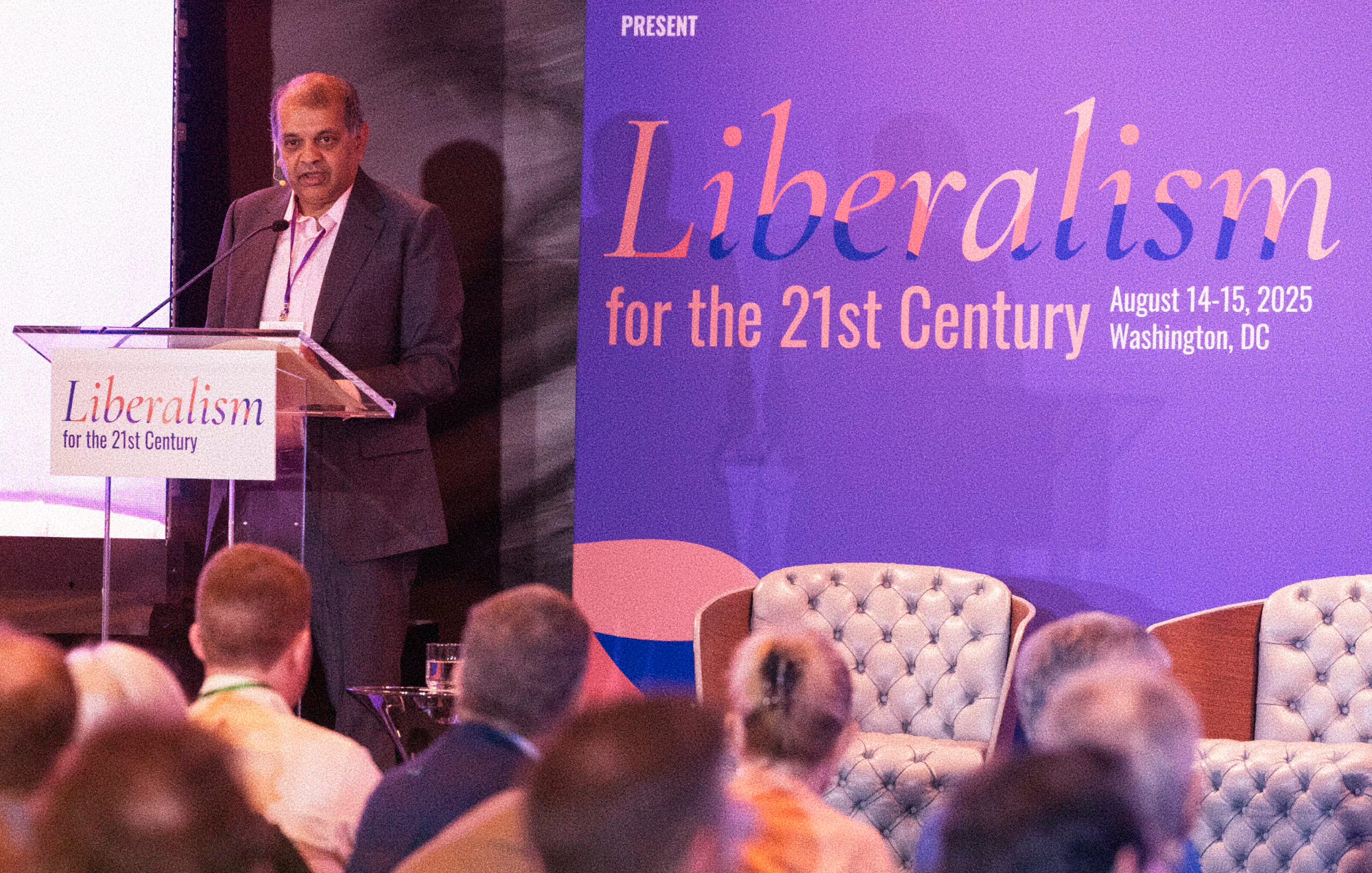
We’re thrilled to share with you today the full video and transcript of LibCon2025’s opening address, delivered by literary icon and liberal luminary Suketu Mehta. His charge was to speak about what the transition from liberalism to illiberalism feels like, on the inside, for individuals—and how they cope with it. But he took things in a different direction and talked about how, even under creeping totalitarianism, people retain the inner freedom to write their own narratives that defy the ones the regime peddles.
To explore other content from the last two ISMA conferences—LibCon2024 and LibCon2025—go here.

Shikha Dalmia: It gives me great pleasure to introduce to you my friend, my accent buddy, a great American and a celebrated writer, Suketu Mehta. When I met Suketu at a mutual friend’s Brooklyn townhouse over 13 years ago, his book Maximum City: Bombay Lost and Found had been sitting on my bookshelf for a few years. A work of narrative non-fiction, the book was based on Suketu’s time in Bombay. It had catapulted Suketu into the star-studded galaxy of writers from the Indian subcontinent, but it was 560 pages long, so it required a commitment. After meeting Suketu, I decided to make it, and suffice it to say, it was an excellent decision. It is one of the best works of contemporary literature I have read. The book is epic in its scope, but not because of the author’s literary ambitions. It is because there was no other way to comprehensively capture the complex and contradictory reality of a bustling metropolis like Bombay.
Suketu recounts the stories of real-world Bombayites that include Bollywood stars and film directors; Monalisa, a trans woman who, disowned by her family, made a living in Bombay’s dance clubs; and a Jain diamond merchant who, along with his family, renounces his wealth and becomes a wandering monk. To me it is a gritty ode to cosmopolitanism—a much maligned ideal right now. It shows that only in a diverse, polyglot, multi-religious, multi-ethnic, tolerant city can individuals find the space to shape their own destiny in vastly divergent ways without risking conflict among each other. After I finished the book—a Pulitzer finalist—I sent a personal Facebook message to Suketu: “I spent the last several weeks lost in your book. I usually race through books, but this one, I forced myself to slow down so that I could stay immersed in the world a little while longer. And I’m not sure I’m not alone in wondering how all the stories of your characters ended. If we meet again, I’d love to find out.” This message is still sitting unread. Suketu, I’m not the only one who procrastinates on her reading.
He is working now on a book on New York, where he has lived for decades, teaching journalism at New York University. This time, I’ll read it immediately. Today, Suketu will tell us different stories about how, even when authoritarians are in control and using their megaphone to fill the airwaves with their suffocating narratives, individuals always retain their inner freedom to write their own stories. These uncontrollable narrative spaces are a great foil to totalitarian designs. Take it away, Suketu.
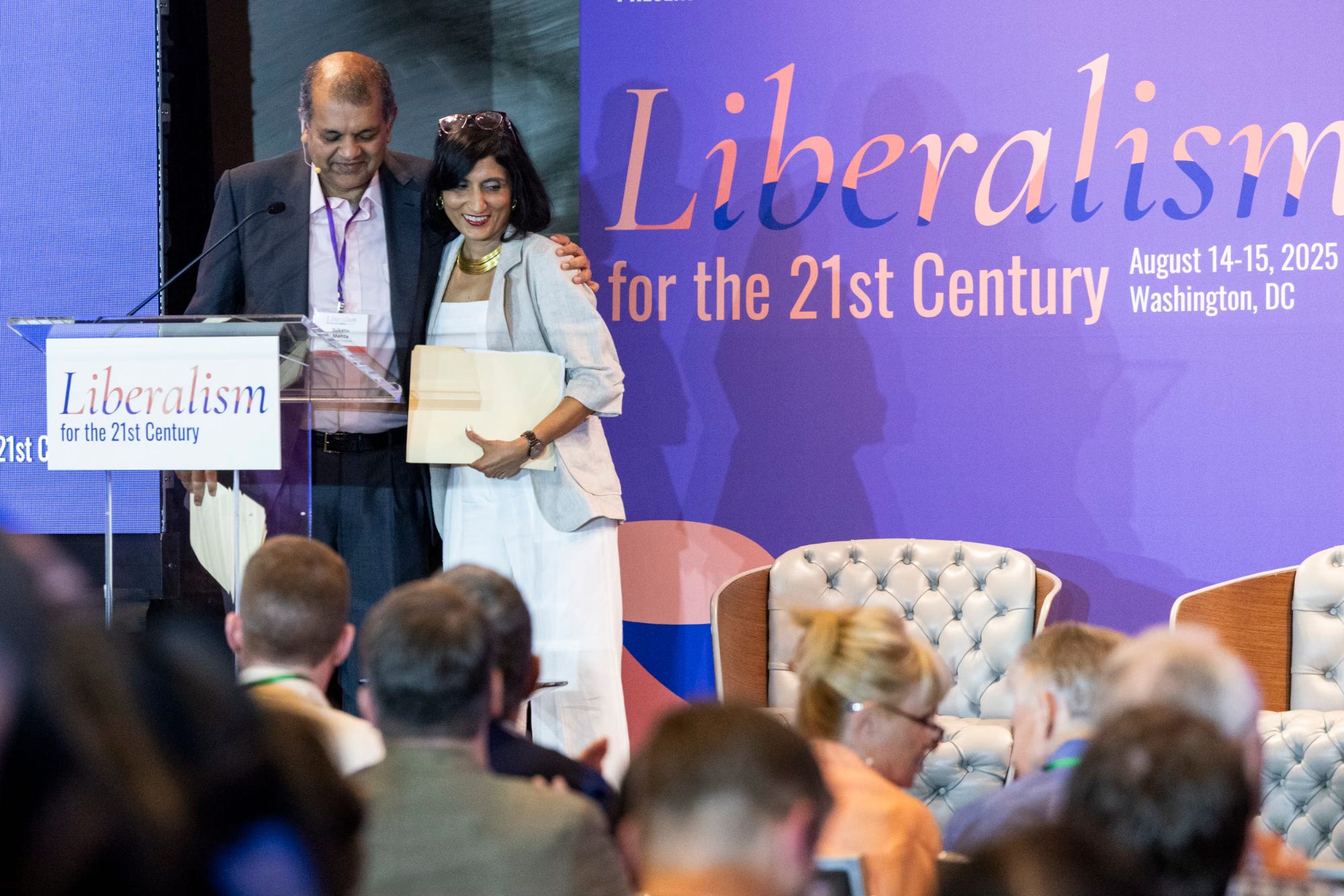
Suketu Mehta: Thank you so much, Shikha, for that incredibly generous introduction. I really owe you a reply to that message. And thank you all for coming here. I was here last year, and I’m deeply honored to be invited to give this talk today. The title Shikha proposed was “Boiling the Frog.” I’d like to change it: it’s more like throwing the frog in the boiling pot. There’s nothing slow about this boil. We’re in the midst of evolution. In the last six months we’ve seen, as Shikha mentioned, ferocious and sustained attacks on habeas corpus, universities, journalists, immigrants—everything that has made America great. And now, Trump has taken over this city, the capital of the nation, and sent in troops to drive home the message: he is the Emperor, and can do whatever he wants.
Dante wrote that the “greatest sorrow is the memory of earlier good times when we are going through a bad time.” We live in fear of the tyrant’s dungeon, but we remember a time when we weren’t even aware of the existence of the dungeons. We may never have been as free as we supposed, but at least we felt free. And when you feel free, you act as if you were. You speak, you write, you protest. Can you still do that today? I am an immigrant, a journalist, and an academic: the bullseye in the Venn diagram of everything this administration hates. As a writer, I ask myself, what is my dharma?—which is Sanskrit for duty.

Trump is exactly what the Founders were thinking of when they warned against a monarch. But the current Supreme Court seems to think they were wrong. Never before in American history has the president been granted so much power, including advanced immunity for any crimes committed while in office. As Justice Sotomayor wrote in her dissent in Trump v. United States, if the president “orders the Navy’s SEAL Team 6 to assassinate a political rival ... immune, immune, immune.” The law is supposed to protect the citizen against the tyrant.
But among the most gutless cowards have been the nation’s most prestigious law firms, who have explained their abject surrender to the despot by citing their obligation to continue making money for their partners, who pull in an average of $20 million a year. These are not people who are afraid of being sent to the gulag if they defy Trump. They are concerned that, if they do the right thing, they might have to settle for a 40-foot instead of a 60-foot sailboat. Some law firms bent with the wind. Paul Weiss bent with the zephyr. Their statement of principles, still up on their website, reads: “We are committed to achieving our objectives without wearing any client’s collar or any political party’s livery.” They have now committed to doing $40 million worth of free legal work while wearing Trump’s collar in Republican livery.
There’s got to be a better word that describes this than authoritarianism. As an author, I take umbrage. “Fascism” might be a bit of a stretch, since Trump is not a person that Gabe D’Annunzio and the Italian futurists had in mind when the term was first coined. He’s not holding up a bundle of sticks in his small hands. There’s nothing martial about a man who dodged the draft due to his bone spurs. So what other words fit? “Tyranny” is good. So is “despot.” But the word that most describes someone like Trump is “bully”—a bully who believes that, on the world stage as in the playground of the school he was expelled from in Queens, the strong rule over the week. We’ve all known bullies. That nasty kid in school who grows up to be your manager, your neighbor, your ex. Bullies aren’t shy about being bullies; they brag about it and hold kindness in contempt. JD Vance has publicly ridiculed empathy as un-Christian. He seems to have read a different Bible than the one I have.
“A populist—like Trump, like Modi, like Putin—is, above all, a gifted storyteller who can tell a false story well. He specializes in a false narrative, a horror story about ‘the other,’ well-told. That ‘other’ can be Mexicans, or Muslims, or Ukrainians, or trans people. The only way a populist can be fought is by telling a true story better … Recent elections have been about the triumph of stories over numbers. Hillary Clinton had the most sophisticated algorithm spitting out numbers in her Brooklyn command center. Trump went with his gut. He got up on the stage and told stories, ripping yarns. The audience laughed, they cried, and then they voted him in. We respond with our head to numbers. We respond with our heart to stories. God speaks to us in stories, not in studies.” — Suketu Mehta
The bully sees the world in terms of power, might, acquisition: What can I get for myself and my tribe, and how fast can I get it? Literature, on the other hand, is first and foremost about empathy, the exercise of imagination about the life of the other guy, no matter how different their life is from yours. It is every novelist’s birthright to appropriate the lives of others, recreate them on the page in whatever fashion they choose. I’ve always bridled at this idea that you can’t write about people you don’t know. Tolkien wasn’t a hobbit, so how could he write Lord of the Rings? Tolstoy wasn’t a woman, so how could he have written Anna Karenina? There’s a great battle of storytelling that’s taking place all over the world. This battle is being fought in the public squares, in the political conventions, on television, in the op-ed pages, in social media. And it is a battle that we, my friends—and I, and most of you in this room—are losing.
A populist—like Trump, like Modi, like Putin—is, above all, a gifted storyteller who can tell a false story well. He specializes in a false narrative, a horror story about “the other,” well-told. That “other” can be Mexicans, or Muslims, or Ukrainians, or trans people. The only way a populist can be fought is by telling a true story better.
The problem is that lies can be wildly entertaining. Which surrealist novelist could dream up a cabal of Satanic pedophiles headquartered in the basement of a pizza parlor in Washington and a butterfly refuge in Texas led by a mysterious administration official who periodically drops messages in runes? These are the central fantasies of the QAnon conspiracy, which has millions of followers—so much more entertaining to follow than an analysis of systemic inequality and the historical issues which have led the country to its present plight. I personally love watching conspiracy thrillers—The Manchurian Candidate, Three Days of the Condor, because all the evil lies in one person or cabal. Once he or they are vanquished, we can all rest easy. It’s that simple.

Recent elections have been about the triumph of stories over numbers. Hillary Clinton had the most sophisticated algorithm spitting out numbers in her Brooklyn command center. Trump went with his gut. He got up on the stage and told stories, ripping yarns. The audience laughed, they cried, and then they voted him in. We respond with our head to numbers. We respond with our heart to stories. God speaks to us in stories, not in studies. The scriptures of every faith are collections of stories, not assemblages of data. Just imagine if the golden rule had been rephrased as: “In a recent poll conducted by St. Peter, 65% of people surveyed believed that they should behave with others as they might wish others to behave towards them, 13% disagreed, and 22% had no opinion.”
This is not to say that numbers don’t matter at all. Without the data, the stories are mere anecdotes. But a good data scientist also knows this. A spoonful of story helps the data go down. Trump understands the elemental power of stories and speaks not in policy, but in parables: “I met a fellow in Paris who told me there are no-go zones for the cops there.” And because he says outrageous things, people vote for him. He often departs from the script on his teleprompter to do a kind of improv comedy at the podium, with insults, imprecations, bizarre shit that has freshly entered his head. His voters say approvingly: “Trump doesn’t speak like a politician. He says what’s on his mind.” They confuse the art of outrage with honesty.
The most hateful stories being told today are about people like me—immigrants. When you move from one country to another, are you less human? Much of the world now seems to think so. That they are coming not to work, or to chase the same American dream that all our forefathers did, but to rob and to rape. That they have no family values. “They’ll walk into your kitchen, they’ll cut your throat,” screamed Trump.
I found another kind of story about immigrants when I went in 2018 to a place called Friendship Park. For years, if you didn’t have papers or lacked the authorization to leave the U.S. without the right to come back, the only place along the 2,000-mile U.S.-Mexican border where you could meet your family face to face was at the end of the line, a small patch of land adjoining the Pacific Ocean between San Diego and Tijuana. It was inaugurated by First Lady Pat Nixon in 1971 as a Friendship Park between the two nations, and originally didn’t have a fence. Families on both sides could meet, give each other a hug, even have picnics together without hindrance. “May there never be a wall between these two great nations,” Nixon said, “only friendship.” Over the years succeeding administrations, including Democratic ones, put up walls at Friendship Park. By the time I went there, there was a thick, ugly industrial mesh fence at the park, and families could only meet for 10 minutes under the watchful eye of the Border Patrol.
“Who are the storytellers today who have captured the imagination of those who are in power? Curtis Yarvin is arguing for a return to monarchy. Yoram Hazony and the National Conservatives are singing the stories of the virtues of ethno-nationalist states: a Christian America, a Hindu India, a Jewish Israel. There’s one God, one culture, that is the center of a nation. Not an idea, but an ethnic group. What can this lead to but tyranny, incarceration, and the expulsion of anyone who doesn’t subscribe to this unitary idea of the culture? ‘Ein Volk, ein Reich, ein Führer.’” — Suketu Mehta
I spent two weeks reporting in Friendship Park. I met a Mexican construction worker from Colorado who had left his village 17 years ago because his mom needed money to go to the hospital. He crossed the border without papers and found work as a carpenter—exhausting, underpaid work. Every week—17 years—he sent a large part of his paycheck home to his mother. Every week, he called or Skyped with her. And now, for the first time in 17 years, he was going to be able to meet his mom here, face to face. I watched as he walked toward the fence and put his face up to it. And on the other side, there was his mom’s face. “Mama, I miss you,” he said. “I wish we could be together for Christmas.” “Mi hijo,” she said, “I miss you too. You look too thin,” she said. “You’re not eating enough. I wish I could give you a hug.” But she could not. There was a fence between them.
But there was something else she could do. The holes in the fence were only big enough to stick your pinky finger through. So she put her pinky finger through the fence and her son put his pinky finger. After 17 years, he was able to touch his mom, give her what they call in Friendship Park “the pinky kiss.” And all along the fence, there were mothers and sons, brothers and sisters, friends and lovers, doing this dance of the fingers—the pinky kiss.
If you’ve ever stopped speaking to someone in your family, go to this park and watch the families separated by a government trying to talk to one another through the wire mesh, trying to force their fingers into the little holes to touch their mother’s or their grandmother’s finger. Friendship Park is at once a monument to nationalistic stupidity as well as to the power of love and family to surpass it. It is the cruelest and the most hopeful place I have ever seen.
Who are the storytellers today who have captured the imagination of those who are in power? Curtis Yarvin is arguing for a return to monarchy. Yoram Hazony, as Shikha mentioned, and the National Conservatives are singing the stories of the virtues of ethno-nationalist states: a Christian America, a Hindu India, a Jewish Israel. There’s one God, one culture, that is the center of a nation. Not an idea, but an ethnic group. What can this lead to but tyranny, incarceration, and the expulsion of anyone who doesn’t subscribe to this unitary idea of the culture? “Ein Volk, ein Reich, ein Führer!”

Who has permission to narrate that story? Free speech warriors like Bari Weiss have railed against woke speech, but they’ve been not just conspicuously silent about the suppression of pro-Palestinian speech—the greatest attack on the First Amendment I’ve seen in my 50 years in America—but actively supportive of government efforts to stifle such speech, deport people who utter such speech.
The false stories the populists tell are often fueled by hate, because hate has emotional power. Hate is also very sure of itself. It admits no doubt, no ifs, ands, or buts. “Haters gonna hate.” They don’t do nuance. But that hate doesn’t stand the test of time. It feeds on itself and burns itself out. But before it does, it might burn everything else with it. To understand how to fight it, we have to understand its appeal. Can you be forcefully nuanced? In the West, we are enthralled to the Aristotelian law of the excluded middle, which is one of the foundations of Western logic. A proposition is either true or false, P or not P. You believe in my God or you are an unbeliever. “You are with us or you are against us,” quote Bush the younger, summoning the princes and potentates of the planet to declare where they stand or be branded a terrorist.
Humanity has now splintered off into a divide as absurd and arbitrary as left- and right-hand drive, or 110 and 220 volts. We’ve lost the ability, which great literature gives us, to differentiate between individual human beings in a group and class. We classify people in huge binary categories: Blacks, whites; migrants, natives; male, female; straight, queer; police, criminals; Democrats, Republicans. And then each member of the category has to walk around with the heavy weight of their classification on their head. In our current discourse, we are all assumed to be fungible. But the individual human being is complex. Each one of us is a variant. Complexity, diversity, heterogeneity will save us; unpredictability, eccentricity.
“We classify people in huge binary categories: Blacks, whites; migrants, natives; male, female; straight, queer; police, criminals; Democrats, Republicans. And then each member of the category has to walk around with the heavy weight of their classification on their head. In our current discourse, we are all assumed to be fungible. But the individual human being is complex. Each one of us is a variant. Complexity, diversity, heterogeneity will save us; unpredictability, eccentricity. It’s an exhilarating moment when the human being escapes the history set out for him.” — Suketu Mehta
It’s an exhilarating moment when the human being escapes the history set out for him. I remember a huge rally against police brutality in New York in the 1990s in the wake of the shooting of Amadou Diallo, an unarmed Senegalese immigrant. It was a beautiful morning and there was a massive crowd in front of police plaza. Speaker after speaker, from organizations ranging from Maoists to immigrant rights organizations to anti-war groups, got up to the stage to denounce the tactics of the NYPD. Then, a nervous young man named Saleem got up. He was the representative from the Lease Drivers Coalition, a taxi drivers’ group. Saleem was Pakistani, and he had never addressed such a huge crowd before. He walked up to the stage with a wave of applause. He looked at the huge applauding crowd which expected him to talk about how the cops abused the rights of the cabbies; and Saleem, feeling empowered like never before in his life, burst out, “I, I am gay.” There was an astonished pause from the crowd. “I am gay. I can finally say it now, that I never could in Pakistan.” And then an even louder round of applause, including from the cops in front of police plaza. “I am gay, I am gay,” Salim said over and over. He had just come out, and he had just addressed what was most powerfully human in himself. He just stepped out from underneath the burden of the message he was expected to deliver, and it was a beautiful moment to watch.
Where Aristotelian logic admits only two possible states of being for a proposition, there is another system of logic that the Jain religion created 2,500 years ago in India which expands these to no fewer than seven possibilities. Something can exist; not exist; both exist and not exist; be indescribable; exist and be indescribable; not exist and be indescribable; and exist, not exist and be indescribable. It’s the most exquisitely nuanced system of conditional logic the world has known, and you know what it’s called? Syādvāda, the science of maybe-ness. It does not connote doubt or skepticism, it just means the truth is many-sided. It seems to me that the essence of liberalism, what we’re all here to talk about, is maybe-ness. It’s against the binary logic of the excluded middle, a sort of quantum epistemology, a Schrodinger’s cat that allows you to be in two mental places at once.

Trump’s philosophy was shaped above all by the crooked lawyer Roy Cohn: never admit error, never apologize. But I question myself, do I not? I admit doubt, I say I’m sorry when I’ve screwed up. I’m willing to entertain the possibility that the other side is right and I am wrong. I do not lack conviction, but I am not convinced I am right all the time. I find maybe-ness to be an accommodative framework for understanding many phenomena, including love. Love makes you morally complex, sometimes in ways that are uncomfortable for others and for yourself. The heart wants what it wants. Love exists, does not exist, and is indescribable. Maybe-ness is a great way of understanding gender and sexuality. Am I male? Am I female? Maybe I’m non-binary. All over the world there’s a giant overthrowing of romantic binaries, a giant choosing. Never in the history of the world have so many people chosen their own lovers: older lovers, younger lovers, other sex, same sex, richer, poorer, taller, shorter, lovers for a day or lovers for a lifetime, lovers of all different races, castes, creeds. And now different species including beings that have no corporeal existence like AI chatbots. There’s a gigantic experiment underway in the human race, a gigantic cross-pollination. This is why the bullies in all countries, all religions, all political persuasions, are engaged in squashing this choosing; declaring this or that form of love taboo, beyond the pale, immoral, godless, an existential danger to the future of the species.
But is there such a thing as absolute truth? The late columnist and provocateur Alex Cockburn made fun of this kind of moral relativism by mimicking The MacNeil/Lehrer Report, a PBS news show that was studiously neutral about everything. “Tonight, on The MacNeil/Lehrer Report, we look at cannibalism: good or bad? Some people say it is wrong to eat your fellow man. Others say human flesh is a cheap and readily available source of protein.” There’s no maybe-ness about genocide, the veteran Sri Lankan human rights lawyer Radhika Coomaraswamy pointed out to me. True—this is one thing that is absolutely evil. There is no complexity about it, no other side to genocide. But I think it can be accommodated in syādvāda, because one of the seven states is absolute truth. Moral complexity doesn’t mean not taking a stand, but it is also important to recognize my truth can be your falsehood. That’s why the notion of genocide is so contested right now.
“All over the world there’s a giant overthrowing of romantic binaries, a giant choosing. Never in the history of the world have so many people chosen their own lovers: older lovers, younger lovers, other sex, same sex, richer, poorer, taller, shorter, lovers for a day or lovers for a lifetime, lovers of all different races, castes, creeds. And now different species including beings that have no corporeal existence like AI chatbots. There’s a gigantic experiment underway in the human race, a gigantic cross-pollination. This is why the bullies in all countries, all religions, all political persuasions, are engaged in squashing this choosing; declaring this or that form of love taboo, beyond the pale, immoral, godless, an existential danger to the future of the species.” — Suketu Mehta
As the Israeli writer Etgar Keret pointed out in an interview with The New York Times shortly after the Oct. 7 attacks:
We’re living in a very binary world. I don’t like the terms ‘pro-Israel’ and ‘pro-Palestinian,’ because when you speak to somebody and he says that he’s pro-Israel or pro-Palestinian, then it doesn’t matter what argument you’re going to give, he’s going to stay in the same opinion. It’s like, being ‘pro-Israeli,’ are you pro-children dying in Gaza from bombing? The idea that reality is complex, and, for me, the primal responsibility is a human one. And when I see people watching the horrible tragedy that is happening here as if it were a Super Bowl of victimhood, in which you support one team and really don’t care about the other, empathy becomes very, very selective. You see only some pain. You don’t want to see other pain.
To go forward, we could all use a little maybe-ness: banish the binary, include the middle and the fringe and the top and the bottom. The universe is not forever a Manichaean fight to the death.
I was once on assignment for Harper’s Magazine in the holy Indian city of Varanasi—Benaras—studying a brutal outbreak of Hindu-Muslim rioting. Benaras’ main industry is exquisite silk saris. Muslims weave them, and Hindus sell them. They’ve been co-existing for centuries. But in the early 1990s, the compact broke down and the city erupted. Dozens of Muslims were killed by Hindus affiliated with the BJP party. I sought an appointment with the Hindu leader of the BJP, a sari merchant who had fomented the riots, and he asked me to come over to his house one morning. As I went into his house, I passed two old Muslim men who were sitting on his veranda talking among themselves. During the interview, the Hindu merchant spewed hate against Muslims, telling me nothing I hadn’t heard before: “Muslims are outsiders, they should have gone to Pakistan after partition, why do they cheer for Pakistanis during cricket matches, etc. etc.”
As I was wrapping up this not-very-valuable interview, I asked him what the two Muslim men were doing on his balcony. “Oh, they’ve come to me to settle a property dispute,” he said. “What’s your dispute with them?” “Oh, no, not with me. The property dispute is between them. They’ve come to me to judge it.” “Why you?” I asked, “I thought you hate Muslims.” “Yes, but I hate them all equally,” he responded. If the Muslims went to someone in their own community to adjudicate the dispute, that person probably would be related to, or biased against, one or the other. But since they knew this Hindu merchant hated them all equally, he could render fair judgment in the matter of the property dispute. No wonder India drives foreign journalists mad.
I found this maybe-ness flourishing here in America, too. I live part of the year at the end of a dirt road in rural North Carolina. My neighbors are, by and large, Trump supporters. We are the only non-white family on the block. We disagree with most of our neighbors about most political issues. But when my father died a couple of years ago, the couple next to us, who manufacture handcrafted assault rifles and whose yard is festooned with a giant Trump flag, flew up to stay with my bereaved mom in New Jersey. The entire neighborhood signed a condolence card and bought us a Rose of Sharon tree in memoriam, which is now festooned with white blossoms. Over Gujarati food and Kentucky bourbon, we discuss faith and family with the evangelical military veterans across from us. Their grandkids swim in our pool, they replenish our log pile in the winter with wood from their yard. We have rarely met kinder, more welcoming people anywhere on the globe.

How can I convince these good people that the story they’re getting from Fox and Newsmax and X is not the whole truth? What is the alternative? Certainly not the weak Democratic tea of Chuck Schumer and Hakeem Jeffries. Nobody’s bothering to break into the DNC headquarters these days. According to Masha Gessen, who wrote in The New York Times, “The only thing that can possibly work is a visionary, loud, appealing alternative rather than a milder form of the same thing that the very charismatic aspiring autocrat is offering.” Enter Zohran Mamdani, possibly the next mayor of my city.
New York is the antidote to America. In the age of Trump, it looks like it will elect a socialist, pro-Palestinian, 33-year-old as its next mayor. We’re witnessing an epic battle of the two Queens’: the Archie Bunker Queens of Trump—son of a racist slumlord who grew up in the all-white Jamaica Estates, which, by the way, is now predominantly Bangladeshi—and the Indian-Ugandan assemblyman from Astoria, Zohran Mamdani. They’re so different, it’s a wonder they’re of the same species. It’s the closest you can come to a binary in American politics, but they appeal to the same voters who can’t afford to live in New York or in North Carolina. People are scared because they can’t afford to pay the rent, and eggs cost too much. They will vote for anyone who will acknowledge these fears. Have you tried to go out to dinner in Manhattan, felt the lurch in your stomach when you see the check? Looked for an apartment where your child doesn’t have to sleep in the bathtub? There’s political tyranny, and then there’s economic tyranny, the tyranny of loving a city so much and being told that you can’t afford that love.
Because it’s a contest of storytelling, the sworn enemies of the populists are people like me: journalists, writers, filmmakers. This is why all over the populist world—in America, Russia, India—there’s a war against the free press. All over the world, writers are being attacked, imprisoned, censored, like never before; our funding threatened, our taxes audited, our university jobs taken away. Israel alone has killed, according to the U.N., 242 Palestinian journalists since the Gaza genocide began. In India, the movie adaptation of my book, Maximum City, was dropped six days before production, because Netflix considered my book—and the director, Anurag Kashyap—too politically radioactive. It censored itself before the Modi government asked it to do so. It crawled when it had not even been asked to bend.
A friend in London recently wrote a book about Gaza. After reading a hatchet job of a review of this book by another friend, I invited the author to do a talk at NYU. Two weeks before the event, the author wrote to me that he was cancelling his whole U.S. trip. He was too scared to come to America, lest he be tossed back across the Atlantic or worse. This is an author whose name most of you probably know. He has access to every big-name newspaper and magazine in the English-speaking world, but he’s scared of coming to America. I understand his fear. There’s something worse than being silenced: being killed. As Woody Allen said, “I don’t want to achieve immortality through my work. I’d rather have immortality by not dying.” I know plenty of writers … and there’s nothing heroic about most of us. We’re always hustling for our next gig, our next free meal. We love to be noticed, except by the eye of Sauron.

The Czech writer Jaroslav Hašek, author of The Good Soldier Švejk, wrote about a private in the Austro-Hungarian army during World War I who’s fighting not for a cause, but simply to be able to eat, drink, and sleep. Hašek wrote his novel in chunks. When he needed money to drink, he would take a few pages to his publisher, who would pay him a few coins, and then Hašek would go to the pub and go on a three-day bender with the money. After passing out on a bench in front of the pub, he would wake up and have to write another chapter so he could buy more beer. This is how the masterpiece, The Good Soldier Švejk, was created.
A predecessor to Švejk is Ivan Goncharov’s indolent Russian nobleman, Oblomov, who can’t even get out of bed for the first 50 pages. Italo Calvino’s Marcovaldo, an impoverished migrant from southern Italy to Turin in the 1950s, is motivated by very basic urges: to capture a pigeon for his dinner, to fill up his cart in the supermarket with things he can’t afford. There’s a direct line from Oblomov and Švejk and Marcovaldo to Yossarian in Catch-22 to Agastya, the gormless rookie Indian civil service officer in Upamanyu Chatterjee’s English, August to Ricky Gervais in The Office. These characters, like the mass of humanity, have no interest in nationalism or ideology. They just want to get by, get pissed, eat a good meal, go to sleep.
The individual human is unclassifiable, obdurate, ornery. Like The Good Soldier Švejk, you can be unheroically patriotic because a tyrant, a bully, can only enjoy power if people obey. Power rests with the subordinate, upon the bully’s ability to force the subordinate to do his will. They are powerless if we say, like Melville’s Bartleby, the Scrivener, “I would prefer not to.”
But as a writer, I don’t have that luxury. I can’t prefer not to write. As the Czech poet Jaroslav Seifert noted, “For anybody else, not to tell the truth can be a tactical maneuver. But a writer who is not telling the truth, even if he is just staying silent, is lying.” And telling the truth means doing your dharma, bearing witness to a terrible times. It is the dharma that the Russian poet Anna Akhmatova best described at the beginning of her greatest poem, “Requiem,” which is about her loved ones who were killed by Stalin. Her poems were banned by the Soviet Union, and so millions of people memorized them and recited them to each other. Akhmatova writes, “In the terrible years of the years of terror, I spent 17 months in the prison lines of Leningrad. One day, someone recognized me. Then a woman with lips blue from the cold standing behind me, who had never heard me called by name before, came out of the stupor so common to us all and whispered in my ear—everyone spoke in whispers there—‘Can you describe this?’ And I answered, ‘Yes, I can.’ Then something that looked like a smile passed over what had once been her face.” This is what gave the old woman eating in the freezing Siberian winter a measure of comfort, that the writer was there bearing witness and could describe this.
“The individual human is unclassifiable, obdurate, ornery. Like The Good Soldier Švejk, you can be unheroically patriotic because a tyrant, a bully, can only enjoy power if people obey. Power rests with the subordinate, upon the bully’s ability to force the subordinate to do his will. They are powerless if we say, like Melville’s Bartleby, the Scrivener, ‘I would prefer not to.’ But as a writer, I don’t have that luxury. I can’t prefer not to write. As the Czech poet Jaroslav Seifert noted, ‘For anybody else, not to tell the truth can be a tactical maneuver. But a writer who is not telling the truth, even if he is just staying silent, is lying.’ And telling the truth means doing your dharma, bearing witness to a terrible times.” — Suketu Mehta
In most countries at most times, writers are defenseless. We are the easiest to attack because words are not bulletproof. We do not have a vote bank. We do not command blind loyalty from our followers. We question and urge our readers to question. We are soft targets, but tyrants and bullies be warned. We become more powerful with time, and our words will outlast your mobs. Threaten us, and we will sing the truth louder. Imprison us, and others will take up our chance. Kill us, and we will come back with 10 new heads.
Daniel Drezner: Just to be provocative, you said that writers have no armies—writers can’t mobilize. Unfortunately, there do seem to be some that actually do have that power, and use it in a very illiberal way. And I’m wondering, how do you distinguish the writer as you’ve defined it from, let’s say, the Jordan Petersons of the world?
Mehta: Sure. I’m talking about the good writers ... I mean, there have been plenty of examples of ... Hitler was a writer.
I think the point is about storytelling, that there is this one kind of storytelling which, like the Jordan Petersons of the world and the long line of these writers who are able to use the power of a false story, there are writers—in a sense—who are also populists, who can use the power of a false story to motivate people into ... the difference between these writers and the ones that I like, the ones that I’ve cited, is that my kind of writers aren’t very sure of themselves. They’re like Walt Whitman in “Crossing Brooklyn Ferry,” who says, “It is not upon you [alone] that the dark patches fell. The dark fell upon me too. I too knew what it was to be evil. I too lied, felt the touch of young men.”

So, these are writers who are capable of self-doubt, and I think the ones who mobilize these armies, like the Petersons, are very sure of themselves. The difference is between that simplicity, that unanimity that they seek and the heterogeneity, the maybe-ness that the writers that I read, that the writers that I admire traffic in.
J.K. Putnam: I’m a writer—I was affected by mass layoffs in May—and you talk a lot about telling a true story better, and combating lies with effective, many-sided, truthful storytelling. What exercises do you look to when you are trying to tell truthful and impactful stories to counter those more destructive narratives?
Mehta: That’s a great question, and I’m sorry you were affected by layoffs. I teach long-form non-fiction writing at NYU, and my students come to me to learn how to tell a story. They want to tell a story, when they come to my classes. They want to write books or magazine articles; and I really don’t believe in all these writing guides that are floating around—“How to be a great writer in 10 easy steps”—but over the years I’ve come up with, you might call it, a formula for what makes for a good magazine article, or book, certainly. It needs three things: stories, statistics, and a statement.
As I mentioned, human beings are moved by stories. You need to come in with—if you were to tell your story, we would need to understand who you are as a human being, how you are affected, how the quality of your life changed with these mass layoffs, how your conception of yourself as a person in 21st-century America changed. But that’s not enough, because then they’re just anecdotes. We all have stories; your stories need to be backed up by statistics. Here we get into what is sometimes the boring stuff, but it’s also the policy stuff; it’s what scholars do to understand the economic engine that shapes whatever industry you’re in, the wider numbers of taxation, of tariffs, what’s causing these layoffs. And the two have to come together to make a powerful statement or argument. When I read a piece of non-fiction I look for these three things and how they interplay, and if you do these three things well, if you interweave them, then you will have grabbed both the readers’ head and their heart.

© The UnPopulist, 2025
Follow us on Bluesky, Threads, YouTube, TikTok, Facebook, Instagram, and X.
We welcome your reactions and replies. Please adhere to our comments policy.
Well, no one has commented yet, but I think it must be because a comment feels inadequate, as mine will to me. I wish I could 'Like' this wonderful statement twice. It is filled with humility, humanity, and concrete guidance.
I live in a Red state and in a Red neighborhood. Like Mr. Mehta's neighbors, my good neighbors do not think the way I do and I don't have the ability to change their commitments -- their perspective comes from a different place. But I do hope that by recognizing the complex persons they are and engaging over and over with them in acts of mutual support which we all share as neighbors they will at least feel that not all the people they are taught to hate are hateful. I hope too that they will sense there is an open door nearby, one that looks out on the world with a different view, if they feel the need for a fresh look. And if anyone ever does come over, I'm prepared to welcome them without any hint of recrimination, looking only forward, as if they too were immigrants to a new world.
This was deeply thoughtful, wise, and above all, filled with forward-facing solutions and hope. I would drive a long way to hear this kind being. Thank you! 🙏🏽