


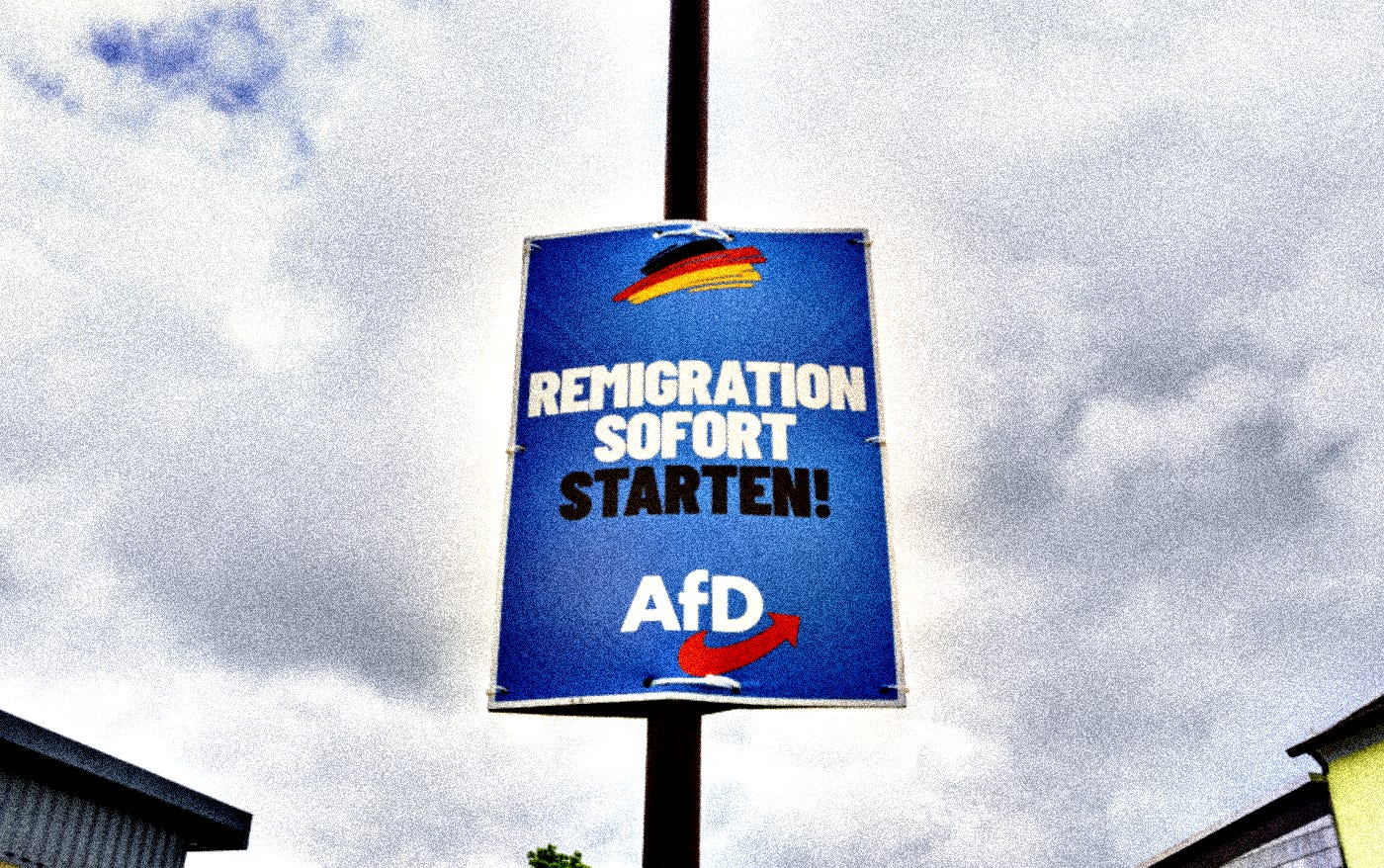
In March, Germany’s far-right party Alternative für Deutschland (AfD) won over the industrial working class in one of the country’s wealthiest, most moderate states—the last place anyone expected it to win. In Baden-Württemberg, home to auto giants Mercedes-Benz and Porsche, and a longtime stronghold of Germany’s political center, 37% of manual laborers voted for the AfD. Just 5% voted for the Social Democrats (SPD)—the party that for most of the postwar era represented exactly those workers. That inversion, in a prosperous western state rather than the formerly Communist east where the far right first took root, is the clearest sign yet that Germany’s AfD problem is no longer regional, no longer a passing protest, and no longer something anyone can assume will stay small.
Some 65% of the AfD’s voters in Baden-Württemberg said the party’s platform, not individual candidates, drove their decision. Unlike a protest vote, that kind of support tends to be durable. Research on young AfD voters in eastern Germany backs this up: their identification with the party is rooted in nativist attitudes, not short-term frustration.
Nationally, the AfD now leads Chancellor Friedrich Merz’s Christian Democrats 29% to 22% in the latest polls—a near-inversion of the last federal election. Baden-Württemberg wasn’t a one-off: in the same March elections, the AfD hit 19.5% in Rhineland-Palatinate, more than double its previous result there. In both states, the AfD emerged as the strongest party among workers, younger voters, and previously non-voting citizens.
The AfD didn’t really out-campaign the SPD. As the SPD reoriented toward educated, urban, culturally progressive voters, it left its traditional working-class base up for grabs, and the AfD moved in with a simple pitch: “your country was taken from you—by immigrants, by Brussels, by politicians in Berlin who don’t answer to you—and we’ll take it back.”
Rise of an Extremist Party
The party wasn’t always this radical. It began as a vehicle for discontent with then-Chancellor Angela Merkel’s fiscal policies, as I chronicled for The UnPopulist. But when the 2015 migrant crisis sent anti-immigration sentiment surging across Europe, the AfD rode it, radicalizing into a hard-right ethnonationalist party whose leaders trivialized the Holocaust, chanted unambiguous Nazi slogans at rallies, called for mass deportations of German citizens of non-German descent, and held a secret meeting to plan what they called a remigration “masterplan.”

The dark passions it has stirred are palpable—a relative reciting anti-Muslim talking points at a family gathering, an acquaintance asking how I can still feel safe walking home from a bar in Stuttgart “with all those immigrants loitering about.” This, despite the fact that researchers trace the crime-rate gap not to religion or origin but to age and unemployment, the same factors that predict crime among young German men. Transparently xenophobic views used to carry social consequences in this country. Increasingly, they don’t.
But what’s also palpable is the countervailing anxiety among those who still cherish a liberal-democratic Germany: on a cold night last October, I stood in my hometown square as the organizer of a “Long Night of Democracy”—a rally against the far right—told some 2,000 people that “the defense of democracy has to become a permanent task.”
How did Germany, a country so acutely shaped by the memory of its own fascist catastrophe, arrive at this point—with a right-wing extremist party standing on the threshold of governing? The proximate causes are real: the fight over the party’s designation as an extremist outfit, which only redounded to its benefit; the aid and comfort it received from abroad, particularly from America; and the government’s own missteps. But none of that explains why so many Germans wanted what the AfD was selling in the first place.
Designated Dangerous
In May 2025, after a three-year investigation, Germany’s domestic intelligence agency, the Federal Office for the Protection of the Constitution (BfV), formally designated the AfD a “confirmed right-wing extremist entity,” finding that the party “aims to exclude certain population groups from equal participation in society, to subject them to treatment that violates the constitution, and thereby assign them a legally subordinate status.” The BfV’s June 2026 annual report counted 58,700 people nationwide as right-wing extremists, up from 50,250 the year before—and said the increase was driven almost entirely by the AfD itself, whose membership has topped 73,000 and now accounts for a growing share of that tally.
The stakes of this designation are serious: expanded monitoring, the dismissal of civil servants affiliated with the party, the loss of public funding, and ultimately, a prerequisite for an outright ban under Article 21. But with the AfD moving from one electoral win to the next, the appetite among Germany’s political class for actually pursuing that ban appears to be shrinking rather than growing.

A Cologne court in February ruled that the BfV could not treat the AfD as a “confirmed” right-wing extremist entity while its legal challenge proceeds, and the agency has reverted to classifying the party as “suspected”—the category it held before the 2025 upgrade—though Germany’s interior minister has said the BfV will keep watching the party regardless.
The country’s sensitivity to far-right extremism is understandable, even admirable—and, given its history, no country has better reason to take the warning signs seriously. But monitoring the AfD is not the same thing as beating it. Indeed, efforts to go from watching to banning will only bolster its claim to victimhood and make it more popular.
More to the point, even when a genuine constitutional violation justifies designating a party right-wing extremist or even eventually banning it, leaning on those tools as the answer to a party this many voters keep choosing sits uneasily with liberal-democratic instincts. It does nothing to address why those voters chose it, and it risks validating the AfD’s own story: that a threatened establishment is trying to silence it to keep itself in power, not defend liberal institutions and values. Germany’s political class understands the perils of this option, which is why it doesn’t seem eager to exercise it.
Fellow Travelers
But damage has already been done with the mere attempt, especially since powerful reactionaries abroad, such as Elon Musk, stand ready to exploit any misstep to aid the party. Six weeks before Germany’s February 2025 federal election, Musk hosted AfD leader Alice Weidel on X for a live conversation watched by nearly 200,000 people. He told viewers that “only AfD can save Germany” and that without the party’s success “things are going to get very much worse.” Musk also published an op-ed in a major German newspaper endorsing the AfD and made a surprise virtual appearance at a 4,500-person AfD rally. AfD engagement on his platform increased eightfold in the week after his initial endorsement. That May, Weidel was invited to headline CPAC Hungary in Budapest alongside Viktor Orbán and other global hard-right leaders.
The Trump administration and its backers have been no slouches either, lending the party a hand of their own. After the AfD’s extremist designation last year, Secretary of State Marco Rubio criticized the move as “tyranny in disguise.” Sen. Tom Cotton of Arkansas pressed the director of national intelligence, Tulsi Gabbard, to pause intelligence-sharing with Germany, arguing the party’s platform echoed values that appeal to American voters.

This was rich coming from an administration that at that very moment was going after its own domestic critics—targeting law firms for representing Trump’s political opponents, stripping billions in federal funding from Harvard and Columbia over their refusal to ideologically fall in line, and extracting multimillion-dollar settlements from CBS and ABC over coverage it didn’t like. Yet it had no compunction about appropriating the language of liberal concern to help a decidedly illiberal party abroad. By early 2026, U.S. officials were reportedly weighing sanctions against senior BfV officials over what they cast as the misuse of intelligence powers against an opposition party that voters support. Each intervention reinforced the AfD’s own narrative: that an establishment threatened by its popularity is out to silence it.
The alliance has since cooled, thanks to Trump’s war on Iran, which cuts against the AfD’s own platform: the party has spent years arguing that Germany should lift sanctions and restore cheap Russian energy, and a new Middle East war does nothing for that cause. The war also risks fresh refugee flows into Germany, something that the AfD has built its brand opposing.
But even as the AfD distances itself from Trump, Trump hasn’t distanced himself from the AfD—and that only strengthens its appeal.
An Assist from Berlin
German governing parties have helped, too. Their stumbles let the AfD run a two-pronged attack: accusing the government of ignoring voters on policies it dislikes, and claiming the government is only caving to AfD pressure on policies it likes.
Chancellor Merz’s coalition government has frequently appeared slow and divided. Confronted with the war in Ukraine and wavering U.S. support for NATO, Merz needed to rapidly scale up defense spending. But Germany’s constitutional “debt brake” limits annual deficits to 0.35% of GDP. Because altering it required a two-thirds majority the 2025 election denied him, Merz struck a deal with outgoing Chancellor Scholz to pass a debt brake reform—exempting defense spending and creating a 500-billion-euro infrastructure fund—through the outgoing parliament before the new one could be seated. The AfD, styling itself the last defender of fiscal discipline, opposed the maneuver—not the higher defense spending itself, but financing it with new debt—and has been calling the whole exercise undemocratic ever since.

When the Merz government has tacked right, it has played into the AfD’s hands just as surely. Merz himself has used dog whistles when discussing immigrants, and his government has pushed harsher measures still: his interior minister ordered the rejection of asylum seekers at German borders and continued enforcing the policy despite a Berlin court ruling that it was illegal. The coalition suspended family reunification for certain protected migrants, passing the measure with AfD votes it didn’t need.
The AfD’s playbook is simple, and it keeps working: it takes credit for whatever the mainstream concedes, then asks for more—a dynamic that would look familiar to anyone who watched Britain’s Labour government handle the far-right Reform UK.
Underneath the tactics is a messaging mismatch. The AfD has become genuinely skilled at building a narrative—villains, betrayal, restoration—in a media environment built for exactly that kind of story. Merz’s government, by contrast, communicates like the bunch of technocrats it is: white papers, coalition-management statements, incremental concessions. It’s a style suited to managing, not persuading.
But September is where that mismatch could stop being an abstraction.
Setting Up a September Surprise?
In Saxony-Anhalt, part of the formerly Communist east where the AfD’s support runs deepest, the party leads the Christian Democrats 42% to 24% ahead of the state’s September 6 election, and could win an outright majority if the BSW (Sahra Wagenknecht’s left-nationalist splinter party), Greens, and FDP (the pro-business Free Democrats) fail to clear the 5% threshold. Two weeks later, on September 20, Berlin votes too—and a recent Insa poll put the AfD in first place there for the first time ever, ahead of the CDU, in a city that has been the party’s toughest ground in the country.
No firewall can stop the AfD from taking power if the trend holds, even though it is showing no signs of toning down. On July 25, a 21-year-old German citizen drove a van into a crowd at Berlin’s Christopher Street Day celebration, killing one person and injuring 29—despite having been convicted two months earlier of plotting an Islamist attack and given a suspended sentence. The AfD wasted no time in calling for remigration and for stripping citizenship from people like him—exactly the kind of story that plays well in a state where the party is already this far ahead.
In April, the party held its state congress and adopted a 150-page campaign manifesto its opponents have correctly deemed extremist. The party’s lead candidate, Ulrich Siegmund, told 250 delegates what AfD rule would actually look like. “We say yes to consistent deportations, we say yes to remigration,” he declared. The manifesto calls for lifting sanctions on Russia, withdrawing funding from public broadcasting, and framing the state’s declining birth rate as “the extinction of the German people.” It defines family as “a father, a mother and as many children as possible” and plans to prohibit gay pride flags in educational institutions.

Siegmund plays the part of the charismatic, youthful influencer well, with more than 350,000 Instagram followers. But his anti-corruption promises haven’t stopped him from using his AfD position for his own family’s gain. A ZDF investigation revealed that his father received up to 92,000 euros (about $105,000) a year at the arrangement’s peak—drawn from the Bundestag office of a fellow AfD lawmaker—though Siegmund later said the rate had since been reduced. For a party that built its brand on denouncing the “old parties” for self-dealing and cronyism, the hypocrisy is notable. Yet the AfD’s polling in Saxony-Anhalt has improved, not worsened, since the revelations came to light—scandal doesn’t work against a party whose voters already assume all politicians are corrupt. Facts that cut against the story bounce off it.
Scandal, court rulings, extremism designations—none of it has slowed the AfD down. Nor has the establishment’s tilt toward nativism and xenophobia. The AfD’s gains stem from having a vision and an action plan to address the core concerns of constituencies the mainstream parties have abandoned. Winning them back will require more than half-measures—it will take a compelling account of how liberalism can work for them.
The October square organizer was right that defending democracy is a permanent task. And that task lies squarely in the political arena: provide a compelling social and political vision to stave off the populist tide.

© The UnPopulist, 2026
Follow us on Bluesky, Threads, YouTube, TikTok, Facebook, Instagram, and X.
We welcome your reactions and replies. Please adhere to our comments policy.

This leftist analysis is weak. Ignoring that islamist violence has skyrocketed since 2015 as well as antisemitism imported from the global south. Before this influx of imigrants mainly from the arab world the AfD was literally dead.
This is literally entirely unavoidable. Denmark's social democrats got tough on immigration and their far right party evaporated.