


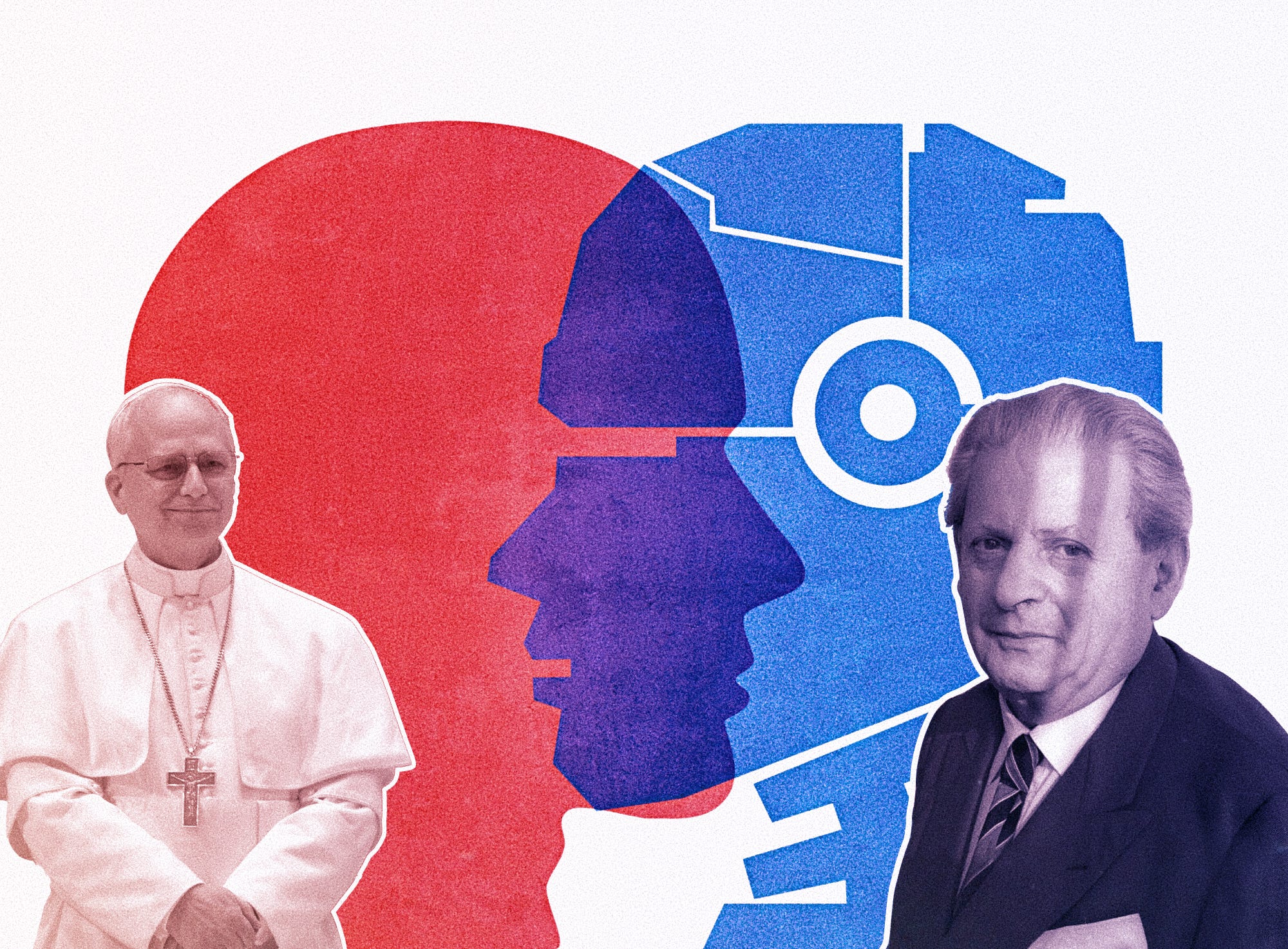
Pope Leo’s recent encyclical on AI—Magnifica Humanitas (“Magnificent Humanity”)—brought back a memory from when my synagogue reopened our religious school in September 2022. We were in the latter days of the pandemic, and I found myself standing outside the front door of the building with an angry father. He had come in mid-morning because his seventh grader had called, panicking and withdrawn, asking to go home. When his dad arrived, the class was engrossed in a lesson on the book of I Samuel, taught through a game of capture the flag. The son no longer wanted to leave. His dad was fuming.
As we stood there watching the kids playing in the parking lot, I said the first words that came to mind: “I know you are upset. But look at the children. They are all broken.”
I remember early on during the shutdown, when everything shifted to Zoom, feeling simultaneously relieved and spooked. Something amazing was happening, a global experiment. But I could also feel my own screen-fatigue and watched my high-school-aged kids retract emotionally. At Brady Bunch online “meetings,” nobody was meeting anything or anyone.
When groups began to regather in person, masked, I was even more concerned. I could see eyes and hear voices, but I also felt an acute, strange, unrequited love. We were so close to connecting, to being in fellowship, but I could not feel a hand, see the smile-creases around someone’s mouth and nose, or smell pretty much anything. We were together, but apart.
I remember wondering at the time what all this would do to our souls. What would happen to our moral and spiritual formation? What would this bring to our society? These questions have only become more urgent with the advent of AI, and Pope Leo’s recent encyclical is the most sweeping attempt yet to address them at the level they deserve.
The Face as Foundation
But there is another thinker who can also help us tackle them: Emmanuel Levinas, a theological North Star for my spirituality.

It was the work of this French-Jewish philosopher, who survived the Holocaust and participated in the great postwar debate over the metaphysical meaning of mid-century events, that triggered my dread during the pandemic.
Like other critics of modernity, he saw how the promise of moral and rational progress was so easily corrupted by evil. Progress and technological development brought the atom bomb and death camps, too. To some extent the mid-century crisis led to an expansion of liberalism under the umbrella of U.S. global hegemony. The question of the 1940s Civil Rights Movement—“How can we fight for human equality overseas and then return home to Jim Crow?”—became the philosophical underpinning for massively expanded access to the liberal project. The universal message of human dignity was on the march, literally and figuratively. It extended its reach across lines of race, religion, sex, and sexuality in ways that would have been practically unimaginable a generation before.
But even as liberalism expanded it was being undercut. In response to both the perverted turn of modernity and the creeping spread of a postmodern nihilism, traditionalism grew, and people began to give up on progress and retreat into pre-modern bubbles of ritual, isolated community, and centralized authority. Levinas, however, proposed something different. As a Jew he could not accept a postmodernism that saw humanity as hopelessly evil; nor could he adopt a traditionalism which led back to medieval Crusades, Inquisitions, or pogroms. Instead, he demanded we find a new foundation for moral authority. Civilization still needed the ingenuity and creativity of the human spirit, but it also needed a check on human corruption.
Liberalism’s core institutions—courts, legislatures, schools, civic associations, religious communities—have always depended on something they cannot produce on their own: citizens who feel genuine obligation to strangers, who experience something beyond self-interest when they look at another human being. The social contract is not self-sustaining. It rests on a moral formation that precedes and exceeds it. This is not a flaw in the liberal project; it is a feature of any civilization serious about human dignity. What Levinas gave me was a way of naming that foundation: not a rational argument, but an encounter. You do not reason your way into obligation. You see a face.

Levinas taught the power of the face. He said that the human mind naturally attempts to control its environment—to categorize, manage, and contain—leading to what he called “totality.” In contrast, he taught, the source of ethics was what exceeds that control: the encounter with something that cannot be managed or reduced. He called this “infinity.” The experience of seeing a human face completely can become a bridge between the two forces. He wrote, “In front of the face, I always demand more of myself; the more I respond to it, the more the demands grow.” The face imposed impossible obligations. To gaze at it was to see the true worth of our meager lifetimes: we are measured in how we serve one another.
This became the basis of my belief in liberalism. Human individuality is both a gift and a burden, because we do not exist alone. To be a self is already to be in relation—already to owe something to the other person standing before you.
In short, in confronting a face we learn ethics. Institutions and communities—the same structures upon which liberalism depends—are the places we find this education, relying upon the external structure of the preexisting social container to mitigate our failures while we experiment and make mistakes. But the philosophical, psychological, intellectual, and emotional experience hinges on confronting the face.
What Faces Do
In my rabbinical ministry I have seen this power hundreds if not thousands of times. One could press mute on all the sermons and scriptures and simply grapple with the Truth of God’s presence as experienced in faces for the real message. And lest I overstate the power of sightedness, the face is both a physical experience to behold, and a metaphor for the intimate and idiosyncratic humanity of the other, heard in song and laughter, felt in arms, hands and tears, smelled in food and breath, all made more palpable without sight. For me, Pope Leo’s elevation of humanity comes out of these manifestations of the face.

First, faces expose how messy and vulnerable we are. No matter how popular the teen or polished the professional, they still know the inevitability of illness, loss, confusion, error, hardship, and loneliness. (I remember hearing Jon Stewart joke that if he ever had a chance to talk to Jeff Bezos he would whisper, “Death will be victorious.”) Seeing each other we feel the empathy of fellow sufferers, and we know that when we suffer, we will find the support of others who, momentarily, might share some of their strength.
Second, faces reveal the subtle mystery Rudolf Otto called “the numinous.” Who cares about the neurotransmitters in the middle of a good joke or aria? Imagine the energy in an auditorium, then pan your mental camera left and right and observe the faces of humans delighting in the creative expressions of other humans. The same art fails when experienced alone. When we observe other faces we know something intimate and infinite.
Last, we encounter a powerful sense of obligation in the faces of others. This is the common heroism of the one who rushes into danger to save strangers, and when interviewed by the TV reporters later looks confused and says, “I only did what anyone would do.” Peril brings that out, but so too does a good stare into a face. This is why we are tempted to look away when approached by a panhandler in the street. This is also why sitting at a hospital bedside, celebrating a wedding, or teaching children can be so spiritually nourishing. Levinas taught that to look in a face is to hold someone’s life in your hands.
These little things are sources of enormous meaning, providing a sense of life’s purpose that extends beyond the grave.

Liberalism depends upon this source of meaning. Transcendent experience gives liberalism a foundation that precedes and exceeds any purely human system—this is what resolves, for me, the problem of authority. Our human dignity is absolutely equal, but we must also live with some power differentials in some domains of our lives for society to function. The far left wishes to deny the need for such structures (see the Occupy movement), and the right wishes to harden and embolden them (see Doug Wilson).
Liberalism responds by creating systems to hash out our differences, and those systems work because they live in institutional containers where we meet faces. Proximity and encounter with the other trains us to accept the encumbrance of the face’s moral claims, and learn how to navigate the tensions between God-given equality and the need for human hierarchy.
The Aspartame of Spirituality
Watching AI unfurl across the population, I feel all this unraveling with the same dread I felt watching Zoom during the pandemic. While most discourse has focused on AI’s threat to the economy, security, or even psychology, Magnifica Humanitas strikes at something deeper: the threat AI poses to the human capacity for authentic encounter itself. Pope Leo frames the choice facing humanity in terms of the Tower of Babel—a civilization that mistakes technological achievement for genuine human community—and warns that technologically mediated interaction offers a simulacrum of presence, something that can feel like relatedness but comes without what he calls “the mystery of the person” that transforms a human encounter into a genuine meeting of souls.
The trouble is that the hermeneutic of an LLM is a function of math instead of the wisdom of a human religious tradition. All text depends upon context and subtext; religion creates a circle of readers with a constitution of meaning between them—an inherited, living tradition in which every reader is also a participant, accountable to the community and to the dead. Long before Marshall McLuhan, religions discovered that the substance of information matters less than its method of delivery. The Truth of the transcendent cannot be captured with mere words. Instead, religion impresses the awesome and ineffable through metaphor, ritual, contradiction, intimation, direct speech, and innuendo. The community, over centuries, translates. AI appears to do this, but it is fake.

What an LLM actually does is pattern-match across the entire corpus of human expression and return a probabilistic average. It has no stake in your question. It responds without responsibility, answers without the possibility of being changed by the encounter. In Levinasian terms, the face is not merely a physical surface but the place where another consciousness breaks through and makes an ethical claim. An LLM can be trained to read facial expressions, but it cannot receive that claim—because there is no one behind the interface who can suffer, be changed, or be held responsible. It can describe obligation. It cannot feel it. The danger is not that AI gives wrong answers, but that it gives right-feeling answers through a process that structurally excludes the one thing that makes answers morally formative: the vulnerability of the one speaking to you.
The theological risk of modern technology is that even as it does genuine moral good—like how Zoom enabled the continuation of so many social interactions, or how science created vaccines that saved millions of lives—it also creates spiritual fragility. The argument here is not against AI, but against the assumption that what AI offers can substitute for what only human encounter can provide. We gain a semblance of the experience of seeing the face, but our souls are left confused. When the face is truncated by a mask, flattened by Zoom, or replaced by a friendly chatbot or character.ai, we get an illusion of the fullness of human connection whose harm lies in the false promise of meaning. During the pandemic this was hard enough for adults, but for developing youth, something inside broke. Now, with the power of AI, the damage will not be limited to the kids.
We have already begun to anthropomorphize AI by giving it names, referring to our interactions as “chat,” and describing our use of the tool as a form of collaboration. As the technology improves and becomes more intelligent even than the human brain, it will improve upon the relatively basic anthropomorphic behaviors in its current programming, eventually stretching and surpassing our ability to recognize its essence as non-human. And as it becomes more useful, even essential to our economic lives, how much more of our waking minutes will we spend with this semblance of the human that lacks a face?
As a congregational rabbi I can say “Amen” to this encyclical, which Pope Leo chose to present not through the usual Vatican channels but alongside a co-founder of Anthropic (an atheist, no less!). This is not a document that fears technology—rather, it’s one that insists technology cannot replace what only human encounter provides. The danger is that it will provide a misleading taste of human meaning, sweet but potentially harmful—the aspartame of spirituality.

Pope Leo and Levinas, separated by tradition and half a century, are describing the same rupture from different angles. One speaks of the mystery of the person; the other of the face that imposes infinite obligation. What they share is the insistence that authentic moral and spiritual formation requires an encounter that cannot be simulated—because the simulation, however sophisticated, has no skin in the game. It is not vulnerable; it cannot suffer; it has no face.
In addition to the economic, psychological, and political dangers of AI, we need an AI-resistant theology. While AI can already deliver treatises on theological doctrines and descriptions of religious practice, an AI-resistant theology conveys the Truth of God’s presence as implanted in the human through embodied encounter. Such a theology would lead us to recommit, with new urgency, to the institutions and practices that put us face to face and place limits on the ability of AI to penetrate those human spaces.
Very soon, if not already, AI will be able to regurgitate centuries of theological creed in convincing ways, checking religious boxes as if encounter with God is just another algorithm. If theological leadership, from the heights of seminary scholarship to the pastor in the local pulpit, does not catechize humans to recognize the face of our humanity, AI will quickly become not an idol, but a false prophecy as described by Deuteronomy 13:1-4, which describes the one who makes factually accurate predictions, but leads the people away from God.
I recently read an op-ed about the epidemic of plastic surgery in Silicon Valley. I could not stop thinking about it: the people building tools to simulate human connection are, at extraordinary rates, smoothing and stiffening their own faces—erasing the creases that grief leaves, the asymmetries that illness carves, the sag that comes from decades of laughing and crying and aging in proximity to other people. They are, in other words, removing from their faces the very evidence of a life lived in encounter. Levinas taught that the face is the site of infinite obligation precisely because it is vulnerable, mortal, and marked by time. These are not two unrelated trends. Both are attempts to escape the vulnerability that makes a human face what it is.

The core of liberalism is based on the singular notion that every individual has moral worth and therefore rights. But experiencing that moral worth requires the kind of embodied encounter with another person that no technology can fully replicate. AI may not be stoppable but if liberal polities are to survive, they will have to make extraordinary efforts to not let this technology crowd out face-to-face encounters between living, breathing humans.
While reading, I heard my own voice from five years ago:
“Look at the children. They are all broken.”

© The UnPopulist, 2026
Follow us on Bluesky, Threads, YouTube, TikTok, Facebook, Instagram, and X.
We welcome your reactions and replies. Please adhere to our comments policy.

We often speak as if consciousness lives inside individual minds. Yet much of what makes us human seems to emerge between people. A face is not just something we see. It is a reminder that we do not become ourselves alone.
Thanks for this thoughtful reflection. I am not sure about every detail but the general point is so well taken and articulated.
I have been reading Pope Leo's encyclical which is probably the most relevant document produced by the Vatican since the Second Vatican Council itself. All the Popes from Leo XIII have struggled to lead their Church through the spiritual and intellectual challenges of "modernism" without simply retreating back into reactionary rejectionism. Sometimes they have gotten it right and sometimes wrong (Humanae Vitae) but they have not refused to engage with the world as it is.
I would not be concerned with AI if it wasn't joined at the hip with the antisocial media. I have enjoyed the impact it has had on my own digital searches. It also seems to make most of the online interactions I have with businesses more efficient. But in conjunction with the antisocial media it takes on a corrosive power by those who use it to harm others. Much of that harm is generated for financial gain. Dehumanization for fun and profit.
It is just a fact that, unless one is a total psycho/sociopath, one simply does treat others more as they would like to be treated themselves when they stand before a living human face.