


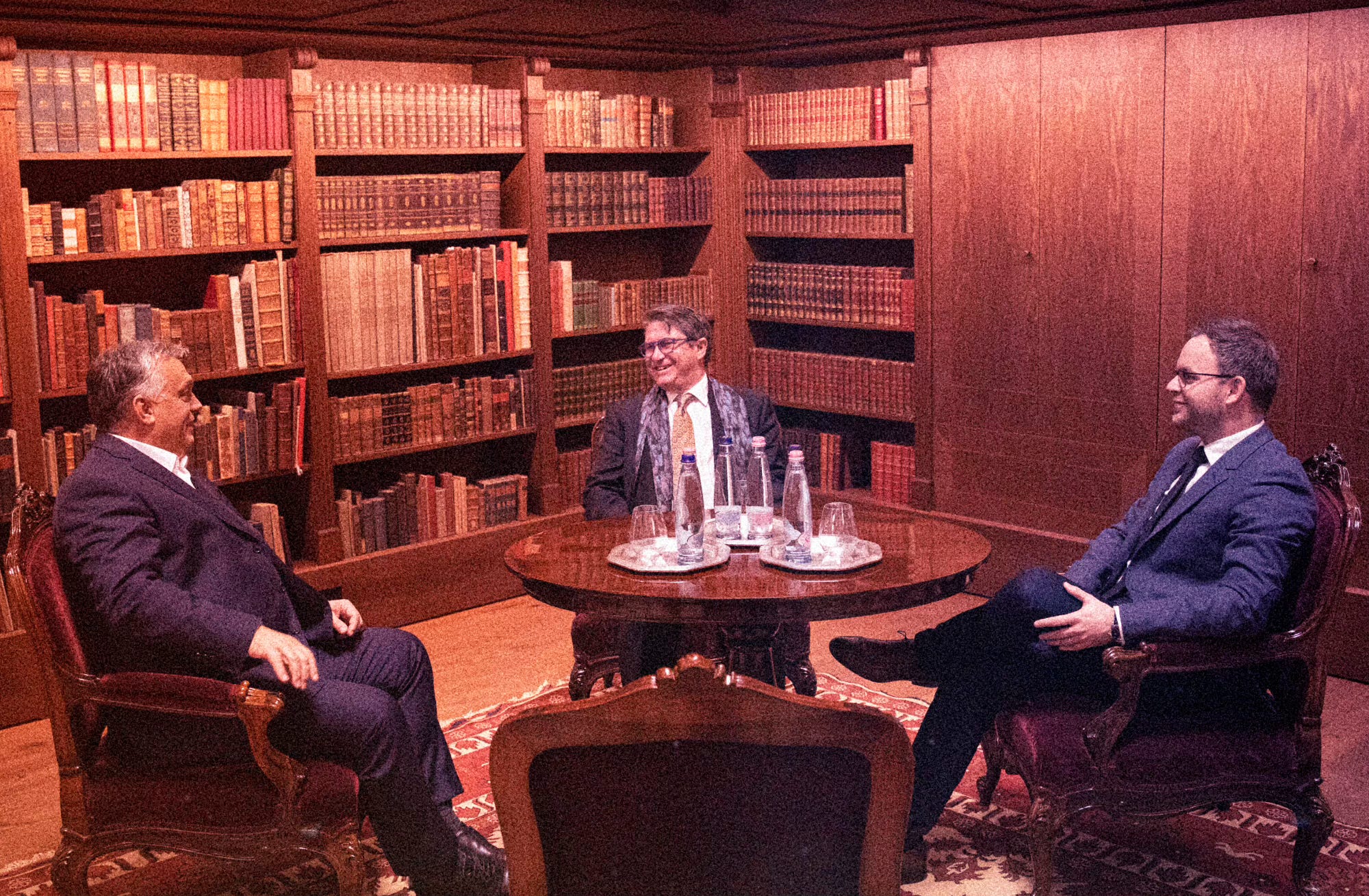
I was surprised to be invited to speak at the Danube Institute, the postliberal think tank in Budapest. I’ve written a harsh critique of the distorted account of liberalism in the writings of Patrick Deneen and Adrian Vermeule, two of the most prominent postliberal theorists. Neither of them has deigned to respond, so I appreciate Danube’s willingness to engage. The event was a model of liberal disagreement—you can hear a podcast that I and the other participants recorded—but I am now surer than ever of this: Postliberalism is so undertheorized that it is hard to give an intelligible account of its claims.
The question we debated was: “Is Liberalism a Threat to Religious Liberty?” It became clear in our discussions that it is motivated by some genuinely troubling recent events. An abortion protester convicted in England for holding up a sign near a clinic. A Finnish politician prosecuted for quoting a Bible verse condemning homosexuality. A comedian arrested at Heathrow Airport for anti-trans tweets.
But the formulation is strange. All these episodes are grotesque invasions of free speech, a core liberal right. None have happened or are likely to happen in the United States, precisely because it has unusually strong free speech protection and is to that extent more liberal. The notion of religious liberty is an artifact of liberalism, which beginning in the late Renaissance supplanted the then-common notion that heretical religious beliefs were intolerable and needed to be forcibly suppressed by the state. It is part of the larger liberal commitment to allowing people to live as they like.
Yet the danger liberalism allegedly presents to religion is a central theme in postliberal writing, including that of my interlocutors at the event, Philip Pilkington and Jacob Williams. The core critical claim of postliberalism is that liberalism inevitably turns into its opposite; that what begins as an ideology of tolerance and free speech ends in repression.
The most prominent proponent of this idea is Deneen. In his most recent book, Regime Change, he points to a “tyrannical liberalism … that is not a contradiction of liberalism but its fulfilment.” The Millean liberal idea of experiments of living sounded tolerant, but “embedded in its deepest logic was its potential, and inevitability, of being wielded as an aggressive tool of domination and even tyrannical power.” Liberalism seeks “the forced imposition of radical expressivism upon the population by the power elite;” “the outright political, cultural, economic, and social suppression of its opposition.” Its “political order becomes devoted—with white-hot fervor—to the eradication of any law, custom, or tradition that has as its premise that there are objective conditions of good that require public support.” All this involves claims about the psychology of liberals, yet the book’s chapter on “The Power Elite” (like his earlier Why Liberalism Failed) says little about the psychology of the class he is purportedly analyzing. Later he becomes outright conspiratorial, describing “the elite adopting the banner of ‘democracy’ and egalitarianism as cover for the further advancement of their status.”
Likewise, Pilkington’s book, The Collapse of Global Liberalism, defines liberalism as “the Enlightenment political ideology par excellence that sought to level and ‘rationalize’ social and political relationships. Liberalism’s target has always been hierarchical structures in politics and society at large.” He summarily declares: “Religion is inherently illiberal in that it imposes a completely hierarchical, non-liberal worldview on its adherents—which is why liberals tend to either hate or distrust religion.”
I can’t think of a single liberal philosopher or politician who understands their project this way, and there are plenty of religious liberals. The theorists do test hierarchies with something like John Rawls’s difference principle, asking that inequalities be justified—but many inequalities can meet that test.

The classic Lockean liberal response to diversity is to draw clear boundaries, to create a private sphere where citizens are free to exercise their religion in ways that other citizens find repugnant. John Locke argued that diversity need not produce conflict so long as there were clear boundaries of property. A congregation could do what it liked within its own building. Those who regarded its activities as heretical were free to assemble in a different building of their own. (The relation between Locke’s theory of property and his theory of religious liberty deserves more exploration than it has gotten.)
Hierarchical structures within religion are largely acceptable to liberalism so long as they are based on consent rather than coercion. Hierarchy must be justified, but consent suffices to justify. Shifting our focus from theory to practice, American law has never questioned the right of the Catholic Church to confine the priesthood to males, or to impose on the priesthood difficult demands such as celibacy, or to condemn as immoral homosexual sex and contraception. Liberals often harshly denounce and stigmatize these ideas, putting painful social pressure on those who hold them, but the postliberals claim more than this: outright coercion and censorship. Liberals believe in free speech, even for ideas we don’t like.
Williams worries, for similar reasons, that liberalism may be headed toward “the mass removal of children from gender-critical homes, the forced closure of conservative religious schools or churches that do not conduct same-sex weddings, and the repeal or rewriting of the First Amendment to permit draconian hate speech legislation.” No politician or leading writer on the left is proposing anything like this.
So the question the panel was asked is strangely paradoxical, something like asking whether soccer is a threat to the practice of scoring goals.
Williams helpfully elucidated the nature of the postliberal claim. He thinks that the issue is not what liberal theory envisions, but liberalism’s consequences in practice. He writes: “the implicit thought seems to be that the voluntarist assumptions embedded in the regime are progressively extended to new domains of human life and stripped of their hedges and qualifications,” and that thus “citizens who merely wish in their private lives or freely chosen associations to hold and teach more traditional beliefs about human flourishing—especially beliefs that harbour reservations about sexual autonomy—are increasingly targeted by the state for coercive correction.”
He observes that the postliberal critique of liberalism consists of two claims: that the liberal valorization of choice presupposes and tends increasingly to insist upon “an antiteleological metaphysics, whereby human fulfilment is achieved through the exercise of choice rather than conformity to a normative natural order” (which he calls the Structural Radicalization Thesis) and that this in turn produces a tendency to increasingly restrict the liberty of traditionalists (which he calls the Coercive Liberalism Thesis). Deneen says he has “written in imitation of the classical explorations of the ‘logic of a regime.’” Williams proposed, on this basis, a hypothesis:
Implementing liberal theory in a state—a regime—tends to cause that regime to decay into one that is not liberal, a regime ordered around coercive progressivism—in other words, around compelling citizens to embrace a particular progressive vision of the human good.
The claim here is of a familiar kind, structurally similar to one that Plato develops in Book VIII of the Republic (which is surely one of the “classical explorations” that Deneen refers to). There Socrates considers the various types of regimes and explains how each of them tends to manifest internal tensions that cause it to degenerate into a different and worse kind of regime. (Which cannot in itself be a criticism of any particular form, however, because “for everything that has come into being there is decay.”) For instance, a timocracy, a regime based on the heroic pursuit of honor, tends eventually to produce status competition based on wealth, and so generates a new and unattractive kind of citizen: “Instead of men who love victory and honor, they finally become lovers of money-making and money; and they praise and admire the wealthy man and bring him to the ruling offices, while they dishonor the poor man.” The regime then becomes an oligarchy.

This kind of tension within a regime generates what Marx called a contradiction: the regime itself generates forces that undermine it. Marxism itself offers a cautionary illustration. Lenin’s revolutionary vanguard bears some resemblances to Plato’s timocracy. Both are led by a class of people who define themselves by their devotion to a demanding ideal. Both regimes, however, create tempting opportunities for wealth—and so corrupt the ruling class. Lenin was always already on the path to Brezhnev. There was a similar effect when the papacy was given political power: it attracted people who wanted such power.
The Structural Radicalization Thesis is a claim of this kind. Liberal theorists may not intend to produce a regime that restricts traditionalists’ rights to freedom of association and freedom of speech. They in fact would defend such rights. But, the thesis claims, the regime they bring into being produces people who do not respect such rights, just as Brezhnev and his minions did not give a damn about the well-being of the working classes. And such people tend to invade those rights. That’s the Coercive Liberalism Thesis.
Pilkington, in The Collapse of Global Liberalism, seems to have a similar dynamic in mind when he writes that “when liberal ideas start to dissolve ‘arbitrary’ hierarchies, they tend to go all the way: while liberals start with critiquing the lord-serf relationship, soon they are critiquing the parent-child relationship, and soon after that they are questioning whether gender exists.” Such notions “tend to disrupt society because they corrode natural social bonds and replace them with contractual arrangements.”
As I’ve said, episodes of left authoritarianism have certainly occurred. But authoritarianism is illiberal. The postliberals don’t seem to notice that the authoritarian left has produced a reaction by the liberal left, with new organizations of liberals fighting for free speech. My own work builds on liberal premises to advocate for accommodation of conservatives like them. I’ve been arguing for years that liberalism, properly understood (in both theory and practice), protects religious liberty as one of its core commitments, and calls for prudential accommodation of the gay rights/religious liberty conflict (which is an issue postliberals tend to focus on). Liberalism, William Galston has written, aims at “maximum feasible accommodation of diverse legitimate ways of life”—or, as Hunter S. Thompson put it, the “right to be weird.” Very little is as weird as other people’s religions.

Why think that the authoritarianism originates in liberalism? The only one of these writers who offers a reason to trace the coercion to liberalism itself is Deneen, who offers grotesque misreadings of classic liberal writers such as Locke and Mill and then claims that their ideas have repressive implications.
In my critique in the Notre Dame Law Review, I observed that Deneen and Vermeule both claim a quasi-Marxian inevitability. The comparison is to Marx’s advantage. Unlike Marx, they are reticent about the causal processes by which this alleged inevitability comes about. My interlocutors in Budapest never did much to fill this gap.
Tolerance for diverse ways of life, including conservative religiosity, is one of the core commitments of liberalism. Liberal regimes don’t always achieve that. No regime fully realizes its ideals. But the accomplishments of actual liberal regimes are impressive.
The Danube Institute cheerfully agreed to my request to set up a PowerPoint presentation. I surprised them by offering a presentation with only one slide. It showed an image drawn, not from theory, but from an actual existing liberal society—specifically, New York City. In March 2017, a right-wing Twitter user posted this:
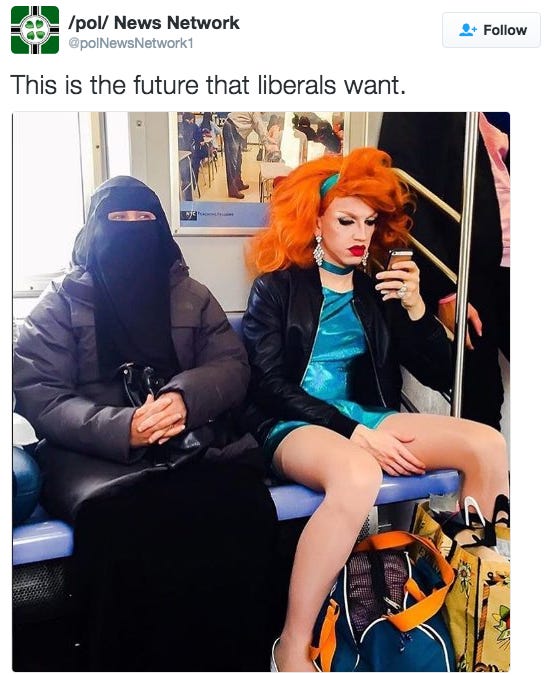
Evidently, the intention of the Twitter post was to arouse fear and revulsion toward both of the people in the photo, and toward the regime that let such people into public spaces. It backfired spectacularly. The post quickly became the object of viral ridicule. One user commented: “religious freedom, kicky daytime drag looks, and a robust public transit program? SIGN ME THE FUCK UP.” BuzzFeed tracked down Gilda Wabbit, the drag queen in the photo, who said, “I won’t speak for all liberals, but my goal is for everyone—white, brown, drag queen, soccer mom, cisgender, trans, heterosexual, queer, working class, middle class—to be able to exist as they choose without judgement [sic] or fear.”
Postliberals are clearly not among the enthusiasts. They broadly fall into two categories. One group, broadly consistent with the person who made the original post, is troubled that in this case liberalism succeeded: two people, each of whom appears to be committed to a view of the world that doesn’t leave much room for the other, nonetheless coexist peacefully, evidently by presuming that the other has a right to be there. In the future that some postliberals want, one or both of them would somehow be made to disappear. (The ubiquity of that kind of postliberal is voluminously documented in Laura K. Field’s impressive new book, Furious Minds: The Making of the MAGA New Right). If this is what you hope for, I haven’t got a lot to say to you. Aristotle is right that people need minimal decent socialization before they can even begin to think about ethics. I find this ideal terrifying and sickening. We can’t be friends.

A second variety of postliberal, however, doesn’t dispute that it might be nice for such different people to coexist, but they think it just isn’t possible. Sooner or later one tribe will attack another. That claim gives me hope. Gilda is really harmless. (Liberals will worry about whether women in burkas face communal coercion. Some do and some don’t.) The fear of Gilda is empirical and susceptible to refutation.
The coercive liberalism thesis is that, in a society that lets Gilda ride the subway, religious traditionalists are bound eventually to be repressed. But the purported inevitability is unexplained. More than that: one can’t even tell what the causal hypothesis is. (Williams delicately writes: “The postliberals tend to avoid providing highly detailed mechanisms for this process.”) All we get is ominous claims about inexorable logic, with the logic unexplained. Plato offered an account of the psychology of the timocrats that led them unawares toward oligarchy. Marx offered an excruciatingly detailed hypothesis about the crisis tendencies in capitalism. Where’s the corresponding account here?
One of the closest studies of coercive wokeness, Greg Lukianoff and Jon Haidt’s The Coddling of the American Mind, concludes that this tendency became widespread around 2015. But liberalism has been around for a lot longer than that. Why did coercive liberalism take so long to get there? If liberalism persisted so long without it, perhaps there is a different cause for recent illiberal developments?
So I end with a challenge for the postliberals. I still find your claims mysterious. If the logic of the regime really produces structural radicalization and coercion, can you spell out the causal processes you are alleging? (As I noted above, the authoritarian left has produced vigorous resistance from the liberal left.) If not, then all your critique of liberalism offers is the post hoc ergo propter hoc fallacy—the notion that, if one event happened after another event, the first event caused the second. The result is intellectually lazy scapegoating. And it’s counterproductive. As the title of the panel reveals, postliberals are happy to invoke liberal ideas when they need them. Right now they do need them. Let us help you.

© The UnPopulist, 2026
Follow us on Bluesky, Threads, YouTube, TikTok, Facebook, Instagram, and X.
We welcome your reactions and replies. Please adhere to our comments policy.

I wonder if the postliberal critique of liberalism could be partially, even substantially, explained by psychological projection.
Ideologues and extremists seem to view rest of the world as having opinions as strong as their own. Deneen and Vermeule are either being deliberately deceptive, lying about the extent and form of negative motivation on the part of those of us who believe in liberalism, or they are grossly mistaken. I can’t say whether they are deliberately lying, but if they are not, then what could explain their hostile and negative beliefs about the moral character and motivations of people who believe in liberalism? Projection would explain it. We have to consider that these people are projecting their own judgmental disdain on to the rest of us.
And speaking of assertions without evidence, there is a glaring hole in the postliberal assertion that liberalism is inherently flawed, and will always trend towards coercion and repression. This belief could be correct, but what system are they offering as an alternative that hasn’t already demonstrated itself as being worse? One of the primary motivations for liberalism is a desire to avoid the coercion and conflict that emerged virtually every time that a state was governed in the name of a traditional religion.
The attack on Liberal Democracy provides a lot of information about the mental frame of the attackers. Ultimately, their message is the same as that of all demagogues, populists, political extremists, and cult leaders: trust us. Just let us impose our system on you, and it will be better for you in ways that you are not capable of understanding, and not qualified to criticize.
Their argument that liberalism is a tyranny and a threat to religious liberty is pure gaslighting. And of course, they want religious liberty for their religion only. Where on this planet would they get more freedom, tax free and with automatic access to the political leadership, than here? Hungary? Russia? The government here coddles churches.