


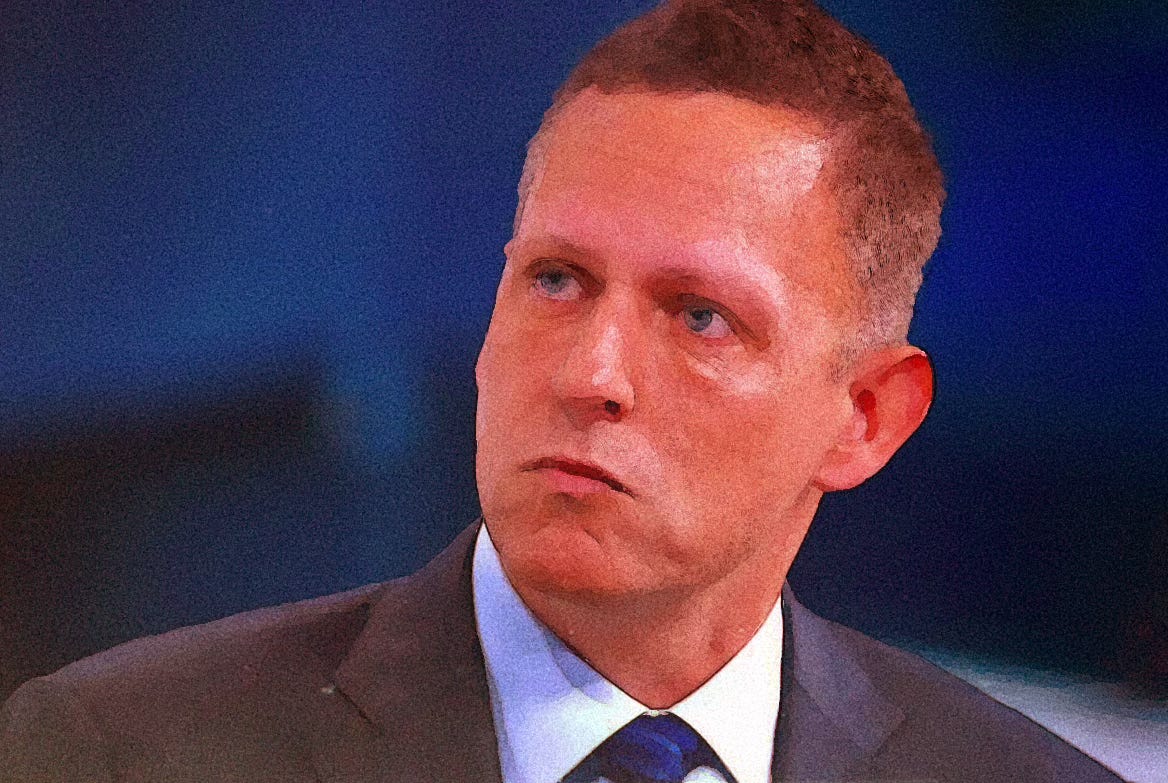
When droves of tech bros donning Patagonia puffers queued up opposite neo-Pagans, Satanists, and witches outside the Commonwealth Club in San Francisco last fall, it wasn’t just another day of conventions in the City by the Bay. The occasion was the fourth and final installment in PayPal co-founder Peter Thiel’s lecture series on “The Antichrist.” This was no address to the huddled masses—tickets for the series were $200 a pop. As Thiel packed the house with polished Silicon Valley socialites, dozens of demonstrators waved signs reading, “EMBRACE DARKNESS, HAIL THIEL.” As one protestor who called herself Satan’s babygirl, sporting an upside down cross as part of her goth ensemble, told reporters: “We believe Peter Thiel is the Antichrist we’re looking for.”
The irony was apparently lost on Thiel himself. In a four-part lecture series delivered at Oxford, Harvard, the University of Austin—Bari Weiss’ anti-woke university that he partly funds—and, finally, San Francisco in September, the billionaire technologist and reactionary superfunder has positioned himself as a prophet warning against the apocalyptic dangers of climate activists demanding government action, AI safety advocates calling for regulation, and the specter of a “one-world government.” Yet in his search for the Antichrist lurking in college protests and international institutions, Thiel never glances at the mirror. The real threat to his eschatological vision may be staring back from it.
The Katechon and the Antichrist
Thiel’s lectures reveal a worldview that is unequivocally Christian, American, and techno-millenarian. Thiel is a self-styled “libertarian, or classical liberal” who believes in limiting the state’s role. That’s why he’s “worried about the Antichrist,” which he defines as “an evil king or tyrant or anti-messiah who appears in the end times.” For Thiel, this figure is interchangeable with an emergent “one-world state,” potentially represented by the United Nations, the International Criminal Court, or the “Brussels Bureaucracy” that threatens scientific innovation. “One world or not,” he asserted, “in a sense is the same as the question, Antichrist or Armageddon?”

The signs of the end times are everywhere in Thiel’s panorama of current events. Quoting the Book of Daniel’s prophecy—“many shall run to and fro and knowledge shall be increased”—he draws parallels to globalization and technological progress. AI skeptic Eliezer Yudkowsky, philosopher Nick Bostrom, and climate activist Greta Thunberg emerge in his speeches as “legionnaires of the antichrist,” whose central belief is weaponizing government or supranational bodies to “stop science,” especially AI research.
Against this threat, Thiel invokes the concept of the “katechon”—from Greek words meaning to “withhold” or “restrain.” In the New Testament book, Thessalonians, an unspecified katechonic force restrains the “secret power of lawlessness” that would bring forth the Antichrist. This fragile barrier between order and apocalypse has captivated thinkers from Nazi jurist Carl Schmitt, whom Thiel quotes extensively (and favorably), to contemporary millenarian tech rightists. For them, America is today’s katechon—what Rome was to early Christians—keeping the Antichrist forces at bay. So it needs to be defended tooth and nail.
Thiel catalogs America’s katechonic functions: Cold War anti-communism, the “petrodollar regime,” and its own status as a Christian “City on a hill.” But he acknowledges a troubling paradox: “If something is not powerful enough to potentially become the Antichrist, it probably isn’t that good as a katechon.” The implication is stark: “America is, at this point, the natural candidate for katechon and Antichrist, ground zero of the one-world state, ground zero of the resistance to the one-world state.”
This contradiction haunts Thiel’s project. If the Antichrist could capture the U.S. government to create his “one-world state,” what does it mean that Thiel himself has spent decades equipping that same government with cutting-edge surveillance and data analysis technology?
An Old Story in New Clothes
Thiel’s apocalyptic framing of technological progress is hardly novel. As historian of technology David Noble observed, the idea of technological advancement in the West has always been “suffused with religious belief.” From medieval clockmakers to atomic scientists, Western technologists have consistently cast their work in millenarian terms—either as humanity’s salvation or damnation.

Today’s tech culture overflows with religious tropes. Eric Raymond’s influential essay in the late ‘90s on open source software bore the title The Cathedral and the Bazaar. The Silicon Valley guru Curtis Yarvin uses “cathedral” to describe the constellation of forces supposedly restraining visionary founders from remaking the world. Beyond explicit religious iconography, tech culture has developed its own vernacular of spiritual experience: AI chatbot revelations, startup accelerators as modern monasteries, the “Grindset” as spiritual discipline in service of venture capital acquisition.
This religious framing permeates virtually all commentary on artificial intelligence. For decades, technologists have painted the emergence of “artificial general intelligence” as a millenarian event—by turns the second coming or arrival of the Antichrist. The “singularity,” as this moment is often called, has even inspired religious organizations. The successful founder becomes charismatic apostle, spreading the gospel of disruption and the hacker ethic.
Thiel’s lectures simply make explicit what has long been implicit in Silicon Valley’s self-conception. He positions technological progress itself as sacred work, and any attempt to slow or regulate it as heresy. Here there’s a resonance with the cohort that The UnPopulist’s Shikha Dalmia has described as the “red pilled anarcho bros” who believe in technological disruption as a “law of history,” ex-tech CEO Mike Brock notes.
Thiel is an important ideological actor for the Bros, but he ministers a broader political coalition we might call the “Tech Right.” And while Thiel too draws on language that evokes technologically driven creative destruction as an important political economic law of history, his religious vernacular coats the issue in a different veneer. Themes of providential purpose, divine knowledge, and heretical creed become tools of Thiel’s rhetoric—even if they are poorly defined or put to contradictory uses—and provide the basis for a cosmological law of history. Appealing to the popular religious imagination imports prophetic eschatology into our thinking about technology: either we approach a moment of profound blessing bestowed by AI, or corruption hastens a dark rapture.
The Devil’s Party
The tension between Thiel’s stated concerns and his actual work is roughly mirror-sized. Consider Palantir, the data analytics company he co-founded, which provides surveillance and analysis tools to governments worldwide. If the Antichrist could plausibly capture the U.S. government as a vehicle for creating the “one-world state,” isn’t Thiel complicit in arming that future tyrant with unprecedented technological power?

In his fourth lecture, Thiel suggested his work at PayPal was a “guerilla libertarian attempt” to thwart the Antichrist from emerging “in the context of the world financial architecture.” Yet PayPal became precisely the kind of centralized financial infrastructure that fits his own definition of potential antichrist territory—a global system through which transactions and identities flow, monitored and controlled.
Thiel himself may be, as William Blake quipped about John Milton, “of the Devil’s party without knowing it.” His structured riffing style—entertaining as it is, drawing on sources from Francis Bacon to manga to Lord of the Rings—hardly lends itself to profound self-reflection. This gap in his thinking reflects a broader blindness within Silicon Valley’s culture of techno-millenarian prophesies.
The theologian Eric Voegelin famously warned against utopian politics with the phrase “Don’t immanentize the eschaton.” His point was that we shouldn’t try to usher in the end times. The world is careening toward its final culmination, in this view, but we shouldn’t accelerate its coming. Thiel’s crude techno-eschatology, however, does exactly that. If we take his framework at face value, aggressive AI development is a race to trigger the eschaton because the ultimate aims of a divine plan may well be achieved with AGI or other world-altering technology. If this technology fell into the wrong hands, however—perhaps those of the one-world technocratic state—the arrival of AGI would be forestalled by secular powers seeking to bolster their position, and the immanentization would be aborted. Thiel’s not entirely clear on this point, but he seems to suggest that hastening the end times will be the only time to thwart that political future.
More likely, the apocalyptic framing serves Thiel’s self-interest: that is, the profits and power he stands to gain in a relaxed regulatory environment. By casting AI safety advocates and climate activists as servants of the Antichrist, he delegitimizes any democratic attempt to shape how transformative technologies develop. The kingdom of God becomes synonymous with the kingdom of unfettered innovation, and Thiel its high priest.

Outside the Commonwealth Club that September evening, the protestors waving “HAIL THEIL” signs understood something the tech bros filing past them missed. When you spend years warning about the Antichrist while building the very systems of centralized technological control you claim to fear, when you fund political movements to capture state power while decrying “one-world government,” when you demand freedom from regulation while your companies surveil millions—perhaps you’ve found your Antichrist after all.
Thiel’s lectures reveal less about the dangers of AI regulation than about the peculiar blindness of Silicon Valley’s prophet class. They can see apocalypse everywhere except in their own creations, enemies in every direction except their own reflections. The end times, should they come, may arrive not through the machinations of climate activists or international bureaucrats, but through the unchecked ambitions of billionaires who mistake their own power for divine providence.
The Antichrist may be like Patricia Highsmith’s Tom Ripley, who changes clothes and identities wherever he goes. Perhaps, in the 2020s, he wears Patagonia.

© The UnPopulist, 2026
Follow us on Bluesky, Threads, YouTube, TikTok, Facebook, Instagram, and X.
We welcome your reactions and replies. Please adhere to our comments policy.

A funhouse mirror of this piece is Thiel’s whole project: denounce a one‑world techno‑Leviathan while spending decades wiring exactly that Leviathan together, then launder it as providence and “katechon.” The religious language here isn’t just cringe, it’s a political technology—turning anyone who wants to democratically constrain his surveillance stack into a “legionnaire of the Antichrist,” and anyone who lets him rip into a defender of civilization.
The essay gets the key asymmetry right: climate regulators and AI‑safety people actually *reduce* concentrated, unaccountable power, whereas Palantir, Anduril & co. concentrate it and lock it in. When your theology conveniently says “the only way to save the world is to give my friends and me maximal unchecked control over code, capital, and the security state,” you’re not doing eschatology; you’re doing branding.
Very well put, but consider this a summary: Thiel is full of inflated self-regard and like Donald Trump, who is less intellectually gifted but every inch as narcissistic, sees anyone and anything that gets in the way of his self-enrichment 'the enemy.' Does it really matter that he cloaks this business in theological conspiracy theories as opposed to political ones. I mean, good grief.