


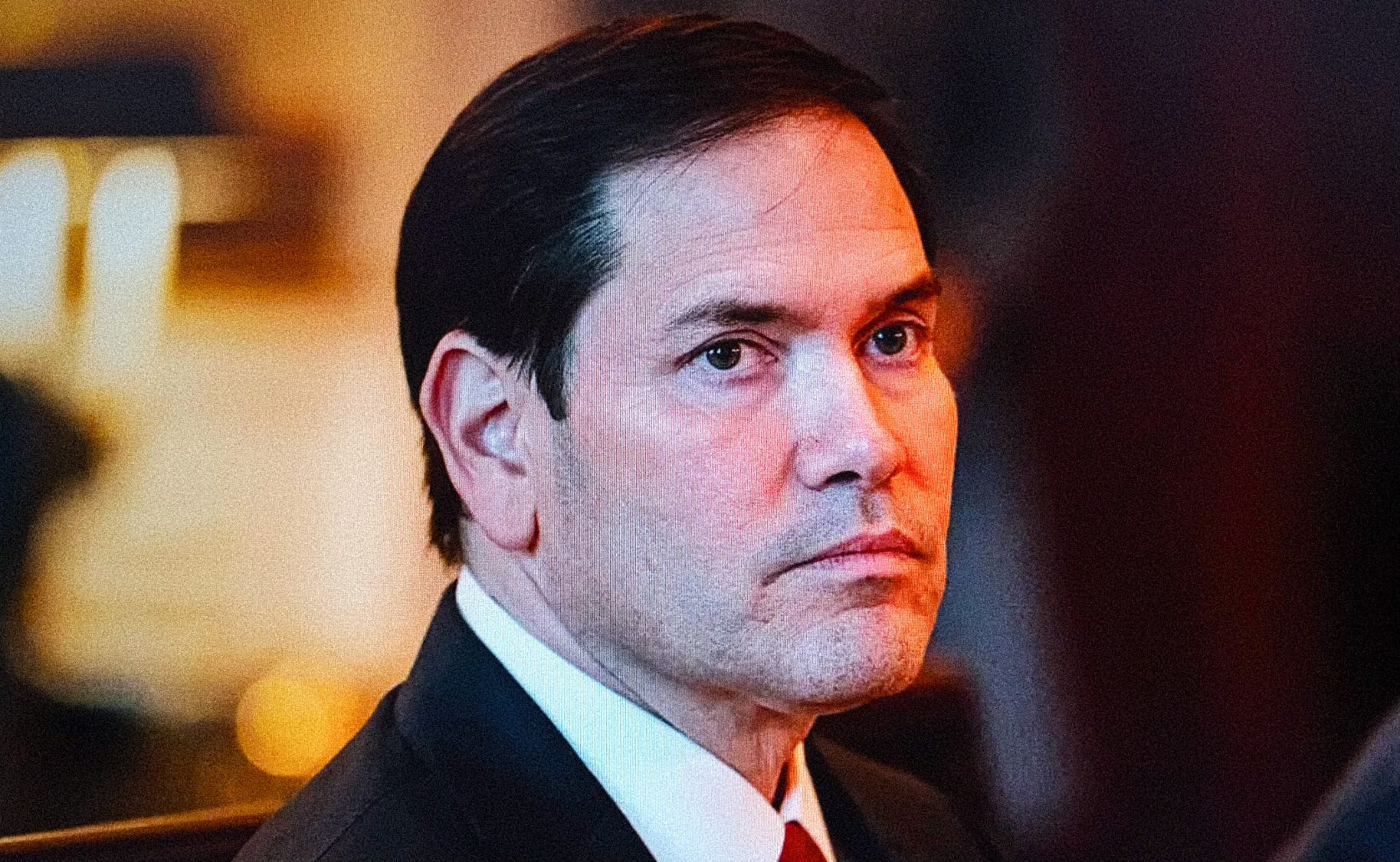
We are part of one civilization—Western civilization. We are bound to one another by the deepest bonds that nations could share, forged by centuries of shared history, Christian faith, culture, heritage, language, ancestry, and the sacrifices our forefathers made together for the common civilization to which we have fallen heir.
— U.S. Secretary of State Marco Rubio at the Munich Security Conference, Feb. 14, 2026.
U.S. Secretary of State Marco Rubio got a standing ovation at the end of his talk at the Munich Security Conference in February, largely for his assertion, quoted above, that the United States and Europe are all part of a single “Western Civilization.” His listeners were doubtless gratified that he backed away from the aggressive nastiness towards Europe displayed by Vice President JD Vance the year before, and that he seemed to be anchoring the trans-Atlantic relationship in values, as countless American leaders had done in the years before the rise of Donald Trump.
But what is the “Western Civilization” to which Rubio was referring? His version of it is likely to be quite different from the understanding of most contemporary Europeans, and from mine as well. (Rubio did manage to get in a dig at me and the “end of history.”)
For an important group of American conservatives, “Western Civilization” denotes a specifically Christian civilization, and a culture built around active Christian belief. Rubio alludes to this by speaking not of “Christian heritage” but of “Christian faith” in his remarks. His list of shared aspects of common civilization also includes the words “heritage” and “ancestry,” which echo Vance’s use of the term “heritage Americans” to imply, it would seem, that our culture is based on a common ethnicity as well as shared religion.

There is no question that Western civilization is rooted in “Christian heritage.” One of the deepest Christian values is belief in the universal equality of all human beings in the eyes of God. National Conservatives mock the liberal belief in universal human equality, and Rubio himself argues that no one fights for an abstraction, but for a particular way of life. But there’s one important abstract idea that lies at the core of Christianity and of Western culture. It was expressed by the Apostle Paul in Galatians 3:28: “There is neither Jew nor Gentile, neither slave nor free, nor is there male and female, for you are all one in Christ Jesus.”
Many important thinkers, from Alexis de Tocqueville to G.W.F. Hegel to Friedrich Nietzsche, have understood that Christianity spawned modern liberal democracy. Most people who defend human rights today do not do so in religious terms, but there is no question that modern understandings of rights descend from Christian religious beliefs.
But in making this transition, Western civilization detached itself from any overt identification with religion. The reasons for this were historical: following the Protestant Reformation, Europeans spent the next 150 years killing each other over differing interpretations of Christian doctrine, over ideas like transubstantiation or childhood baptism. Since Medieval times, there has been no monolithic Christian doctrine; Protestantism spawned a “way of life” quite different from Catholicism.
As a result of this disagreement over final ends, the Enlightenment founders of modern liberalism agreed to push religion into the realm of private belief, and to focus politics on life itself rather than the good life as defined by a particularly religious doctrine. In addition, early natural scientists were engaged in a prolonged struggle with the Catholic Church; it was only with the separation of empirical inquiry from religious dogma that modern natural science, and the economic world it made possible, emerged.

So there is in fact a very different understanding of Western civilization from the one that Rubio advances, one that is built around liberalism itself, encompassing Enlightenment values like openness, tolerance, and skepticism about received ideas. This version of Western civilization downgraded the role of religion in politics. We can fully acknowledge the Christian origins of many of our ideas about democratic rights without defining our shared civilization in religious terms. Indeed, societies were very diverse with regard to religious belief not just in the current era of mass migration, but all the way back to the 16th century.
Even worse than shared religion is an effort to define our civilization in terms of “heritage” or “ancestry.” I hate to remind Rubio, but his particular heritage and ancestry lead back to an authoritarian and Catholic Habsburg Empire, while that of James Monroe and Thomas Jefferson lead to a very different and more liberal Protestant part of Europe.
Last month saw the passing of the civil rights leader Jesse Jackson. Jackson played a critical role in keeping alive the struggle for racial equality begun by his mentor Martin Luther King. But Jesse Jackson was decidedly unhelpful in one respect. Back in 1987 he came to Stanford University and participated in a march where students chanted “Hey, hey, ho, ho, Western Civ has got to go.” As a result of these sorts of pressures, Stanford and other elite universities got rid of their Western culture core courses, and replaced them with an incoherent mishmash of multicultural offerings. This was a big mistake.

Jackson apparently disavowed this rejection of Western culture, as well he might. His own life was completely framed by Western civilization, under either of its definitions. He was a Christian minister in a Civil Rights Movement that was led by other Christian ministers like King, who preached succor for, as Jesus put it in Matthew, “the least of these.” And he was also an advocate for universal human rights, someone whose advocacy was protected by a rule of law established by his nation’s Declaration of Independence and Constitution.
This protection will not survive unless students in the West learn the history of their own culture. The only way to counter reactionary ideas like those of Rubio or Vance is to have a proper understanding of how Western civilization evolved and is today defined by liberal Enlightenment values that were originally rooted in Christian belief. It is these “abstract ideas” that define our way of life, and for which we should be willing to struggle and die today.

An earlier version of this article was first published in American Purpose in Persuasion.
Follow us on Bluesky, Threads, YouTube, TikTok, Facebook, Instagram, and X.
We welcome your reactions and replies. Please adhere to our comments policy.

This is an intelligent, well-argued piece, nothing less than what one has come to expect from Frank Fukuyama. Yet, something about it left me feeling uncomfortable -- or at least vaguely dissatisfied. I am a product of a (largely) European background and education, though I have lived in the US for over 40 years. The words "Western" or "West" were hardly ever used in those years -- the 1970s and early 80s -- both at the English boarding school I attended and the university where I spent many years as an undergraduate and research (graduate) student.
Both the school and the college (within the collegiate university system) of which I was a member were Anglican foundations. We talked of an European civilization and of a Christian belief and the two were often equated.
Yet, interestingly, the European civilization of which we were heirs was always seen to have "Mediterranean" roots. It was Graeco-Roman and avowedly classical. The Christian identity was without a doubt that which drew from the New Testament. The Old Testament might have been seen a source of inspiration for great Baroque music that we heard in chapel or many of the paintings of the Old Masters from the Renaissance. But the notion of a Judeo-Christian civilization (or heritage) would have been risible. The idea of Christendom, on the other hand, would have sounded archaic but would at least have been recognizable. Somehow, this synthesis of a Graeco-Roman secular culture and a pre-Religious Wars Christian belief system was made coherent and it was called European.
Once again, the background I'm describing is High Anglican without an iota of non-conformism or evangelicalism to it. And therein lies the answer to the rantings of Vance and Rubio. The idea of the "West" is a very American one (notwithstanding Spengler) and that too is about 50 years old. Even a racial and cultural supremacist like Tom Buchanan in the Great Gatsby would talk about the European races and those that did not belong to that group, included Jews, blacks, Mexicans, Asians, and whichever other group came within his range of sight.
Why Marco Rubio had to launch into an encomium to the plundering, rampaging "West" is a mystery. He invented his own background, claiming he was of Spanish and Italian heritage, from Seville and Casale Monferrato, Kingdom of Piedmont. In the show "Finding Your Roots", the host Henry Louis Gates Jr. told Marco Rubio that his mother's side has indigenous ancestry traceable to Cuba going back around 4,000 years, saying "your family on your mother's side has been there a long, long time." (Vance too has lied about his own background, but I won't go into that here.) What is shameless was the conduct of the Europeans (the Ruttes, the Merzs and others, descendants of Mitteleuropa middle class) who were just relieved to hear that Rubio had pointed to enemies that did not include them.
I am somewhat amused by the people who think they can take on Francis Fukuyama as if he were some antisocial media influencer leaking methane into the atmosphere. What he has written here needs no defense.
The same buzzwords that rang for Professor Fukuyama rang for me when I heard Rubio say them in Munich. Shared faith, heritage and ancestry coming from the mouth of an American seemed ludicrous. It might have made sense in the 18th century but not in the context of the 21st. I am sure he believes those cultural attributes belong to him and therefore makes him one of JD Vance's "legacy Americans."
Maybe I am lapsing into cultural Marxism here but I think the whole concept of "The West" and "Western Civilisation" (Kenneth Clark's spelling) while a convenient part of a larger classification system (like the Dewey Decimal System) really is not a "thing" at all. At least it is not an autonomous, organic or unified being that can be defended by launching a crusade, ethnic cleansing or kept pure from distinctly alien influences. Civilization is a tree and Western Civilization a branch of that tree. DNA has no borders just proximity and opportunity.
I am sure that Marco Rubio had some discomfort in realizing that his distinctly European ancestry was mixed with indigenous blood. Latin American Eurotrash are just as racist as North American Eurotrash can be.
The Enlightenment was the intellectual decision to choose reason over irrationality. Not to displace religion so much as to perfect what was ethically significant in religion. The ethics of religion were universal not because they came from a revealed source but because they were inherently rational. The Golden Rule is not true because Jesus (or any number of sages in many times and places) said so but because it was completely rational. Now the rabbis and theologians could argue about what it means and how that is lived out and come up with various answers. Jesus had one and Buddha had another and Confucius another but the rational truth remains unchanged.
For centuries Christianity had only ever embraced the liberal notion of equality as something that can exist only in the afterlife. The only right a human being has in Christianity has is the right to accept Jesus as their Lord and Savior and join the "right" established or orthodox church. Until the enlightenment Christians did not have the language, or rational justification for equality, the abolition of chattel slavery, the enfranchisement of women or all those things about which the Scriptures are silent, ambivalent or even opposed. Christians (using Christian Scriptures) justified slavery, then segregation and now voter disenfranchisement.
The Enlightenment has given us so much culturally, economically and politicly. It has tamed the fires of irrational religion and given us the flowering of speech and thought. It has given us market capitalism and prosperity (for some) the world has never seen before. It has given us the tools to govern ourselves with fewer civil wars and fewer autocrats and dictators. Sure it is has not given us an earthly paradise and never will.
Liberal democracy is "the worst form of Government except for all those other forms that have been tried from time to time". We have the Enlightenment to thank for that not faith, heritage and ancestry.