


Every few years, the same kinds of stories blow up. A new housing or tenant-screening algorithm quietly rolls out—then tenants discover it is disproportionately rejecting applicants with old evictions or minor criminal records, and everyone starts talking about “digital redlining.” A model for checking credit that was supposed to be race-neutral turns out to approve white borrowers at much higher rates than Black borrowers with similar incomes, sparking fresh accusations of systemic bias. Police departments adopt “predictive” tools to decide where to send patrols, only to be accused of sending even more police to poor or minority neighborhoods that already see too much of them.
Institutions insist their rules are neutral and applied equally. Critics point to unequal outcomes and say the rules are broken. Some consensus is brokered. Then, just when the reforms are implemented, a new controversy hits and the whole conversation must start again.
But what if that instability isn’t a failure of liberal democracy but a feature of it? That is, not evidence the system is rigged, but evidence it’s still capable of correcting itself.
Why Accountability Keeps Changing
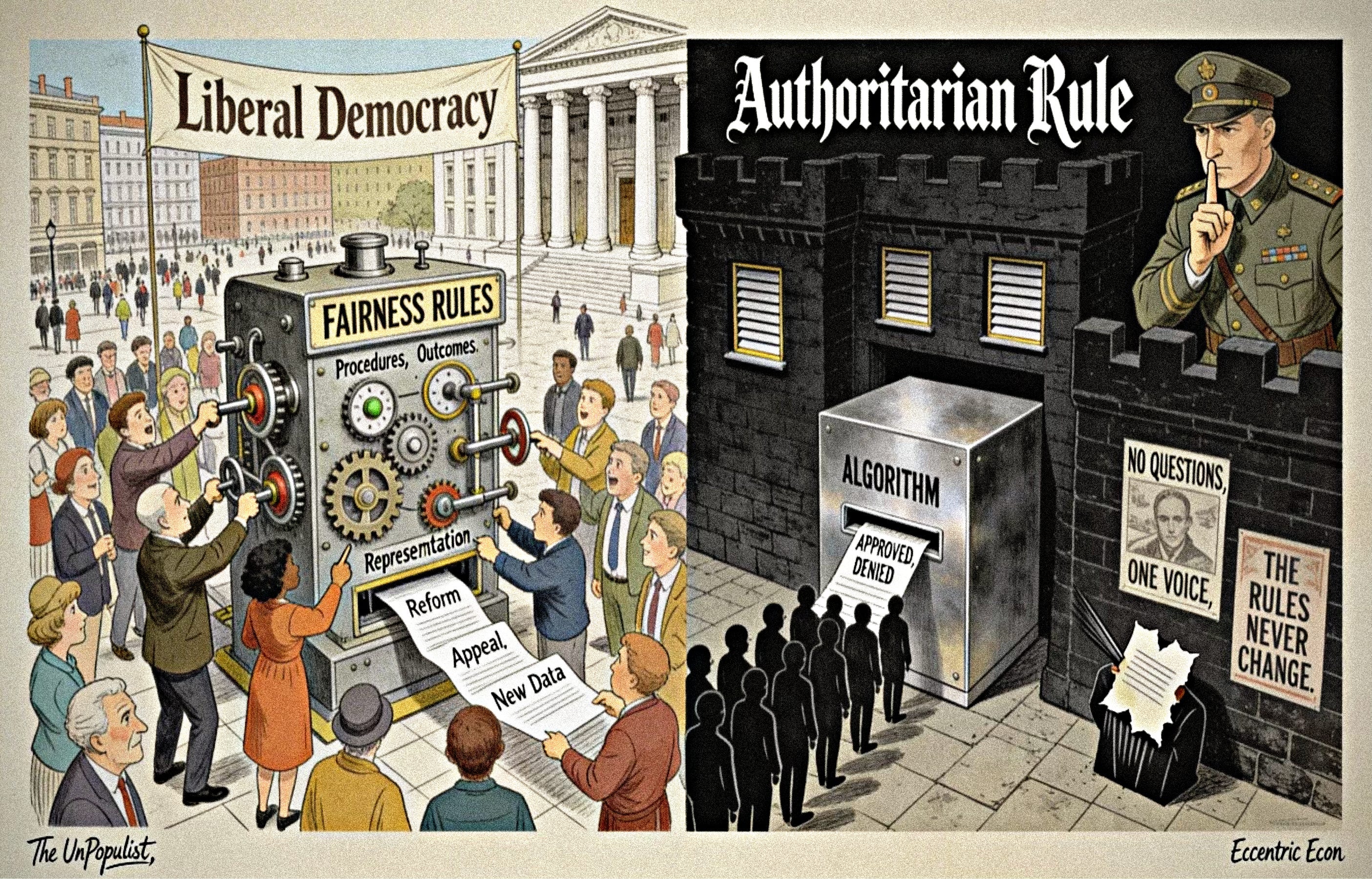
The recurring fights over “fair” algorithms, admissions policies, or policing practices are not just about one institution choosing the wrong value tradeoff. They reflect something deeper: in a liberal democracy, the standards by which we judge institutions change over time as new information comes to light.
You can think of those standards in three broad stages:
Stage 1: Procedural Fairness
This is where we start by asking whether the rules are clear, general, and the same for everyone, guarding against explicit discrimination, favoritism, and arbitrary discretion.Stage 2: Outcomes and Performance
Once the rule is in place, we turn to whether it actually does its job—whether it is accurate, effective, and reasonably calibrated to the real-world behavior it is supposed to govern.Stage 3: Representation and Long-Run Patterns
Over time, as we see who wins and who loses under the rule, we begin asking whether it entrenches inequalities that trace back to differential treatment; not simply whether outcomes are unequal, but whether that inequality has a paper trail—a history—of people explicitly sorted by group.
Liberal institutions don’t settle fairness disputes because the criteria themselves change as we learn more. A mortgage algorithm that looked fine when we only checked whether it treated like cases alike may look very different once we see its error rates, and different again once we map those errors onto neighborhoods that redlining explicitly excluded from credit.
Why This Looks Like Instability
From up close, this process looks like whiplash. First, we demand strict, formally neutral rules: no explicit race variables in a credit model, one set of underwriting standards for all borrowers, no special overrides for the well-connected. That’s procedural fairness doing its job.
Then we start to notice that the “neutral” rule is denying a lot of people who actually pay their bills, or approving borrowers who default at higher rates. Now the complaint shifts: the system isn’t just unfair, it’s bad at what it claims to do. We push for better data, more accurate models, and more empirical checks on performance.
Once those performance tweaks are in place, the distributive picture comes into focus. If the revamped algorithm, while more accurate overall, still concentrates denials in the neighborhoods redlining explicitly excluded from credit and homeownership, people understandably take that as a justice problem. That claim carries weight because it traces to redlining’s documented history of race-based exclusion, not merely an observed gap in outcomes. They press for constraints that limit how unequal approval rates can be across groups, or for new kinds of information (like successful rent payment histories) to be fed into the model.

Each move to satisfy one standard tends to unsettle another. Tightening group-level fairness constraints can mean denying some low-risk borrowers and approving some higher-risk ones, which offends both procedural purists and performance-minded critics. Relaxing those constraints to improve predictive accuracy can worsen racial disparities. The structure looks like a triangle of tradeoffs, but real institutions move around its edges over time.
From the inside, that motion feels like constant rule-changing. From the outside, it is what it looks like when a society with diverse values subjects its own rules to recurring, multi-sided accountability.
Populist Exploitation of the Cycle
For defenders of liberal democracy, this cycling is familiar, even if frustrating. Courts reinterpret statutes, agencies revise regulations, legislatures revisit policy designs, public opinion shifts as people see how rules work on the ground. None of those moves is inherently illegitimate. In fact, they are the mechanisms by which a fragmented society corrects itself. Incrementally advances toward ever-fairer outcomes without too much disruption.
Populists tell a simpler story. They take the normal process of revision and turn it into evidence of bad faith—what Emily Chamlee-Wright has brilliantly called “freeze-frame storytelling”: pointing to a single moment in an ongoing correction and presenting it as proof the whole system is rigged. When an algorithm is amended to incorporate new civil rights constraints, they say, “The goalposts are moving—elites are cooking the books.” When a court strikes down one fix and sends policymakers back to the drawing board, they say, “The system refuses to listen to the people.” When long-run distributive concerns finally get traction, they portray that as a conspiracy to punish the “real” public and reward undeserving groups.
On this telling, each new fairness controversy proves the same point: the system is rigged, the experts are lying, and the only solution is to empower a strong leader to stop the games and “enforce common sense.” It is no accident that contemporary authoritarian movements, left and right, are obsessed with institutions they claim have been captured in this way—courts, central banks, universities, media, and now algorithmic regulators.

What looks like rule-changing from a distance is often the normal correction process of liberal institutions encountering new information. But that distinction is hard to see in the heat of a controversy, and populists are skilled at blurring it.
The Liberal Payoff: Motion Versus Rigidity
Liberalism’s instability isn’t a bug in the system; it’s what happens when power is dispersed and institutions are allowed to learn. A regime with independent courts, professional bureaucracies, a free press, and competitive elections will not produce the same fairness story decade after decade. It will be pulled between different accountability moments. Sometimes the movement is jerky.
The opposite of institutional cycling isn’t stability—it’s rigidity. Authoritarian governments can keep algorithms opaque, freeze rules in place, punish whistleblowers, and demonize critics who point out unequal consequences. They can suppress the very feedback that would trigger a new fairness fight. That kind of order looks quiet for a time, but its apparent stability rests on people losing the ability to demand better.
Liberal systems, by contrast, leave the door open for new claims: from renters challenging black-box screening tools, from borrowers documenting unequal treatment, from communities drawing connections between today’s outcomes and yesterday’s injustices. That openness guarantees recurring conflict. It also makes genuine correction possible.
Keeping the Argument Alive
Liberal democracies do not end fairness fights. They keep them alive. As societies learn more about how their rules operate in practice—and who wins and loses under them—their standards of accountability change, and institutions are pushed through new cycles of justification.

That motion can be exhausting, and populists are quick to turn fatigue into resentment. But a liberal order that stopped moving would not be one in which fairness had finally been achieved. It would be one in which people had lost the power, or the permission, to argue about fairness at all.
The system’s restless quality is not the symptom of a rigged game; it is what it looks like when institutions take citizens’ complaints seriously enough to keep revising themselves. Liberal democracy’s fairness fights don’t prove it is broken. They are what it looks like when institutions are still allowed to learn.

© The UnPopulist, 2026
Follow us on Bluesky, Threads, YouTube, TikTok, Facebook, Instagram, and X.
We welcome your reactions and replies. Please adhere to our comments policy.

There is a difference in fairness at an individual level and ‘fairness’ at a group level. It seems to me that the moving goalposts issue was a redefinition of fairness from the individual level to the group level - and in too many cases a redefinition of fairness in terms of outcomes. As an old classic liberal, I strive for fairness at an individual level - and let the chips fall where they will.
Populists have the same problem understanding how science works. Science, like the systems described by Tarnell Brown, is designed to be self-correcting. You make an observation or a series of observations from which you derive a hypothesis, then you design experiments or plan additional observations to see whether the outcomes support the hypothesis. You can never say with absolute certainty that a given hypothesis -- or if there's enough evidential support, a theory -- is true as stated. You can't prove it; you can only falsify it. If someone finds evidence that disagrees with it, you may have to start over from scratch, but more often you just need to tweak the theory to incorporate the new data. Populists go nuts over this. You lied to us! You're changing the rules! If it's not entirely correct, then to them it's complete bunk. This is why they're still accusing Dr. Anthony Fauci and other scientists who tried to help officials formulate rules to keep us safe during the COVID-19 pandemic of chicanery. No matter how many times they're told we were dealing with a new virus about which nothing was known and so we had to base our early advice on educated guesses, then update it if those guesses proved not to be entirely correct, the MAGA crowd cannot wrap their heads around it. That's why these people belong to religions that tell them exactly what to believe and how to live their lives and describe harsh punishments in the afterlife for violating those rules -- or perhaps thinking that way isn't inherent, but the consequence of being raised in such a religion. In either case, they need everything to be absolute, black or white. But reality as experienced isn't absolute; it's nuanced, its "truth" occurring in shades of gray that can shift and change with one's vantage point. So they don't trust science or institutions that create rules intended to make aspects of our society more fair because both modify their output as new information becomes available. I don't know whether it's possible to reason with such people, because it appears their minds are closed to even considering any perspective other than their own.