

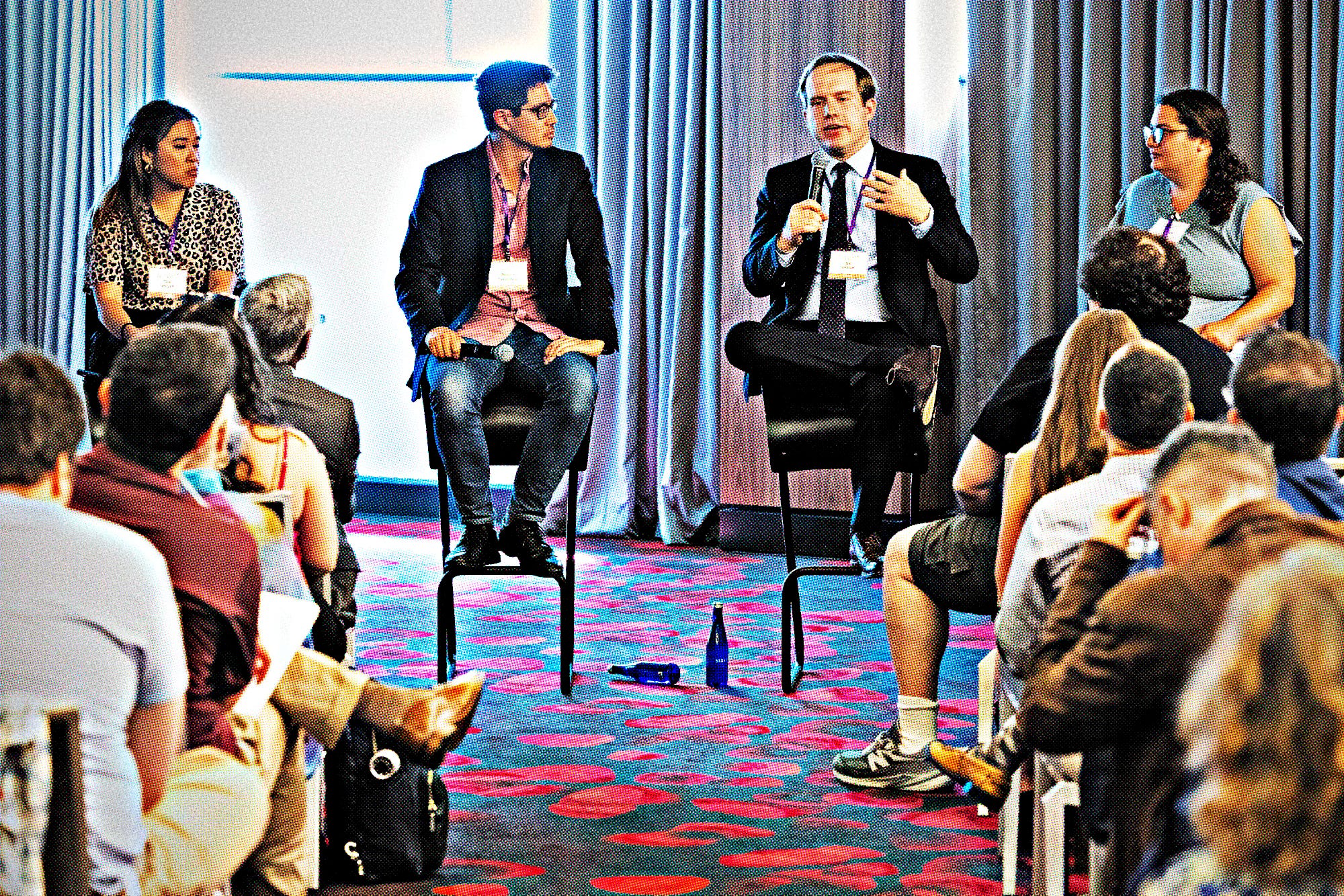
Today, we’re thrilled to share the full video and lightly edited transcript of LibCon2025’s breakout panel, “Subcultures of the Neo-Right.” Moderated by Asawin Suebsaeng, senior political reporter at Rolling Stone and co-author of Sinking in the Swamp: How Trump’s Minions and Misfits Poisoned Washington, the panel features Tina Nguyen, senior reporter at The Verge and author of The MAGA Diaries: My Surreal Adventures Inside the Right-Wing (And How I Got Out); Tal Lavin, author of Culture Warlords: My Journey into the Dark Web of White Supremacy and Wild Faith: How the Christian Right Is Taking Over America; and Will Sommer, senior reporter at The Bulwark and author of Trust the Plan: The Rise of QAnon and the Conspiracy That Unhinged America.
To explore other sessions from the last two ISMA conferences—LibCon2024 and LibCon2025—go here.
The following transcript has been lightly edited for flow and clarity.

Asawin Suebsaeng: This panel is dedicated to covering the cultures—particularly the subcultures—of the current American right and neo-right. So there’ll be very little to talk about and nothing that has any far-reaching consequences at all. I want to open with a question I’ll ask each panelist, and then give my own answer.
We’ve all, in our different (and sometimes vastly different) ways, been covering these subcultures for years—all the way back to when Obama was president, even. I want to ask each of you: Was there a moment when you started pinpointing that these freaks, or whatever you want to call them, on the extremely online reactionary right are something that needed to be taken seriously by traditional political media in ways we just weren’t grappling with? Was there a moment when you saw this was starting to have a significant influence, while your average editor at The Washington Post or AP or CNN was still missing it entirely? Will, I’ll start with you.
Will Sommer: I originally got into this as a Young Republican—a teen who loved Bill O’Reilly, all that stuff. And I would continue to listen to this stuff. But then, in the Obama administration, I’d look around and I’d be like: “Why is the press so obsessed with Paul Ryan and tax cuts when the base wants something else entirely?” I was listening to Michael Savage who was like, “We gotta nuke these dams in China.” I was like, “What?” These are the compelling interests among the grassroots.
I felt like there was a disconnect between what was being reported [and what the grassroots actually cared about]. I do think a lot of this was missed initially by the mainstream press. Obviously, we’ve been living in this Epstein moment; I was listening to someone who is a top congressional reporter at The Washington Post—sometime this week or last week—and he was like, “Yeah, I didn’t really know about this whole Epstein thing. I didn’t know Republicans cared about this.” I was like, “What?” They thought every Democrat was going to go to Guantanamo Bay.
In another moment, in 2017 or 2018, I went to a QAnon rally downtown. I thought, “QAnon’s so crazy, who could possibly be at this thing?” There were a couple hundred people, and they were chanting, “Where we go one, we go all” in the streets of D.C. I thought, “Well, the good news is this is probably the high-water mark. It won’t go further than this. Certainly it won’t be a few years later that we’re down at the Capitol.”
So I think there are all kinds of anecdotes to draw on. I mean, look, I think it’s going on even today. Nick Fuentes is gathering so much power. All these “Manosphere” people are saying he’s the hot new thing. Laura Loomer, as I was rushing over here, had RFK Jr. trying to defend himself against her. All these characters have gained so much power—and it’s not good.
Tal Lavin: The people I first knew as total freaks—as punchlines—are now in charge. Laura Loomer is a big one. She’s in the inner spheres of power. Jeanine Pirro, who I used to report on when I was at Media Matters as that drunk lady who says crazy stuff, and now she’s the attorney general of D.C. It’s just this sense of: the circus is being run by the freaks. (No denigration to circus performers—they’re wonderful, hard-working members of the community, and some of our best peanut purveyors. I don’t mean to insult them by comparison).

For me, the moment where I was, like, “Okay, what is going to be the task of my adult life?”, or the moment that shook me out of my rut—I was a fact-checker at The New Yorker at the time of the Charlottesville rally, Aug. 12, 2017—[was the] “Jews will not replace us” chant on the streets. I wound up becoming close to people who were there that day—in their reportorial capacity, in a community capacity—the people who were standing up against the people with the tiki torches. For me, from a distance, those chants shook something loose in me—a certain certainty I had. I was like, “Okay, my grandparents were Holocaust survivors. I came here, I went to Harvard, I’m fulfilling their dream of prosperity and security—we’re basically okay as Jews in America, right?” It wasn’t that I hadn’t been paying attention to Trump’s rise, the anti-immigrant rhetoric, the menace. But it suddenly became so earth-shatteringly personal, and I started writing about it.
The thing about being a Jewish woman writing about the far right is they take notice very quickly. I wrote an article about The Daily Stormer and they wrote that I was the reason there should be a second Holocaust—but a real one this time. I’m a very stubborn person. I attracted a lot of ire, including from ICE, that year. Fox News called me a terrorist for trying to teach a class at NYU. Very quickly, the abyss was gazing back at me, and the abyss was writing about my face, and how ugly it is, and my body. I doubled down and wrote a book, because fuck them, they don’t get to win.
Suebsaeng: My version of this is a little bit different. Back circa 2011-12, I was just a grunt, entry-level guy at Mother Jones magazine’s D.C. bureau. And there was this joke among national political media, particularly based in places like New York City and Washington D.C., that “GOP lawmaker says:” ... and there was just some mammothly-insane thing that they have to say that, in some cases, would sound a lot like QAnon or other far-right conspiracy theories today, or even something as older-school as, “Yes, of course human beings walked with the dinosaurs.” And the joke would be that you would get dinged for that, if you did a headline like that, as a reporter who worked at Talking Points Memo or CNN or Mother Jones magazine or wherever, because the plot twist would be, if you actually read the first paragraph of the story, it would always be some state lawmaker—not Paul Ryan or somebody, but someone dwelling in the New Hampshire House of Representatives or something like that. And it would get this snooty response from a whole bunch of editors, and extremely well-paid and well-sourced reporters based in D.C. and New York, on social media saying, “This isn’t really fair. You’re leading readers to believe they’re clicking on a story about a Republican with actual power.” I would hear this over and over and over again.

But I remember one of my colleagues at the time, Tim Murphy—he’s still working at Mother Jones magazine—I was sort of getting in on this young, impressionable, saying, “Oh, look at this fucking idiot at Talking Points Memo again doing the ‘GOP Lawmaker Says’ clickbait” ... and Tim just looks over at me and says, “Do you know how much influence and power these state lawmakers have?”
There’s this sickness in national political media where we don’t take that degree of extreme power over a lot of people’s lives seriously, and don’t take it as representative of the modern day Republican elite. And they keep telling you to focus on something that Paul Ryan, or Mitt Romney, or Chris Christie said in a very carefully curated speech. And I remember as an idiot, twentysomething kid who was just getting started in this business, that moment stuck with me, as you can tell, throughout all these years, thinking to myself, “I think he’s correct. There’s something to that.” We don’t want to admit that very soon the inmates, as you put it, [Tal], could be running the asylum—or, quite frankly, already are.
So I remember that moment, just sitting as a less-than-nobody, trying to figure out how to do this job right, thinking to myself, “I wonder how in the next 3, 4, 5 years, that that thought bubble will shake out?” And in that amount of time, a former game show host named Donald J. Trump ended up seizing the country.
“Literally on the right, people spend so much energy and time developing online followings and just generating content. They keep collaborating with each other on content. They’re online more than they’re knocking on doors. To get more attention onto positive community-building content, you’d have to solve the question of the first one: figure out how to engage people to stay on something for more than three seconds. This is the information environment that you’re living in. Instead of lamenting that people’s minds are reduced to this, figure out how to meet them where they are. Tell a story within three seconds that makes them say, ‘Oh my god, keep going.’ It’s possible.” — Tina Nguyen
Tina, tell the audience about your formative moment—maybe in your 20s, or just getting started out in this business, or when Obama was still president—when you started picking up on the strain, in these extremely online far-right subcultures, that you thought was going to be a massive deal, and people in national political media were just not paying enough attention and were covering the wrong thing.
Tina Nguyen: I’m going to go a little further back than all of you. In 2008, I transferred to Claremont McKenna College. I went there to study government, and I was really into the American Founding, and I was like, “Oh, my God. There’s an institute here called the Institute for the Study of Individual Freedom in the Modern World? That’s totally normal!” Turns out that was connected to the Claremont Institute—a right-wing think tank founded in the 1950s that is the intellectual root for a lot of what Trumpism is today: nativist, populist, anti-immigrant, anti-multiculturalism. All of that stuff was being written at Claremont at that time.

What really struck me was how powerful this network was—connected to a much broader right-wing infrastructure that’s been in the works since the 1960s, under Buckley and Barry Goldwater. The thing that you have to understand about the right-wing movement is: it is well-funded, it is old, and it is essentially a career network, the same way the Ivy League is a career network for the elites of society. Everyone knows everyone. Everyone helps everyone else get a job. The older people place the younger people into positions of power, wherever power resides. Initially, it started off with Mitt Romney in his 20s canvassing and learning how to run for public office. When I was brushing with the movement, it was libertarian think tanks giving journalism scholarships to young students who wanted to be reporters and appreciated liberty and needed to go to this seminar in the summer the free market to get the scholarship that came with a free internship. That’s how detailed and granular it was.
And there was so many crazy ideas floating around in it. For me, it didn’t matter who had the craziest, right-wingiest idea, as long as they were effective, and publicly had some way to chip away at liberals, at liberalism, they were rewarded. They got more money. They got to meet more powerful people over time. I was talking to someone who used to be in the Young Republicans world. He left; he was now working at a non-profit. We were getting drinks and he goes: “You know, I didn’t think until recently that it was super weird that I was a sophomore in college hanging out with Neil Gorsuch.” That was normal—that was totally normal!
Fast forward: I end up connected through that network to The Daily Caller. I run into Tucker Carlson—that’s a very long story; I wrote a memoir about it. But through 2015 and 2016, once Trump ran for president, I saw all of these people from that world start attaching themselves to him, or using the chaos he generated to push their ideas into politics, culture, what have you. That’s when I realized: “Oh, my God. The vast right-wing conspiracy I had personal connections with, that I personally witnessed, was attaching itself to Donald Trump and doing what it had always wanted to do—take over the institutions that make a country: culture, law, business, government.” It was all happening.
I think, to journalists who came up through the Ivy League, went to Columbia, ended up at The New York Times, thought that the world operated in a particular way, they were like, “These guys are fringe.” Absolutely not. What are you talking about?

I had a realization, though: The right believed so deeply that the left had captured all the major institutions in the country and, believing that they couldn’t infiltrate those institutions, they spent a lot of money creating their own. That’s how you got the Heritage Foundation coming up with all the academia stuff. You’ve got the Federalist Society training all the lawyers. The Claremont Institute teaching law enforcement agents how to enforce the Constitution.
As long as the mainstream people who came up through these institutions did not legitimize the people who were doing it on the other side, they had power. So, right now they’re just as strong, if not stronger, than the institutions that everyone here wants to protect. And they’ve been studying you for decades.
Lavin: So much of my gig for the last 10 years has been telling people: “Nope. These people believe what they say they believe. They believe it earnestly, they believe it powerfully, and they will crush you under the weight of it.”
Suebsaeng: What would you say is the hardest example of that—when you’re trying to explain to people that X is what they actually believe?
Lavin: Demons.
“How do you win those people back? That’s such a multifaceted question. I think one thing—easier said than done—is that you need a charismatic political leader. You need Democrats who suck less. It worked for the Republicans. They got Trump. You may not find his charisma appealing, but he is a once-in-a-lifetime, hugely charismatic political figure.” — Asawin Suebsaeng
Suebsaeng: Go on.
Lavin: Yeah, no, so, my latest book is about the Christian right. And, speaking of parallel institutions, there’s a book [about] the “7 Mountain Mandate,” written by a self-proclaimed prophet, who’s actually pretty close to the Trump administration, Lance Wallnau. It’s very loosely based on a verse from Jeremiah, but it’s about seven mountains—culture, economics, education, and so on—and these are the heights that the Christian right need to ascend and control.
So what you see the development of parallel institutions. You have not just Claremont but you also have this network of evangelical colleges, homeschool curricula, the HSLDA homeschool lobby, which has enormous amount of power, and which managed to quietly crush truancy laws throughout much of the country. So you can just withdraw your kid from school and not have to do anything about it, in most states.

I’m not a former Young Republican. I’m not a former right-winger in any way. And what’s interesting to me is that there is no analog on the left. There’s no support. If you drop off the golden escalator of a beautiful institution, you’re left to dangle. There’s no welfare, for you. There’s no think tank. You get a Patreon. And you get people to like you, or die. Or you leave—you leave the public sphere. There is no effort to inculcate young talent on the left. There are no parallel institutions where college students are hanging out with Sonia Sotomayor. That does not exist. This is an area where the right has far outflanked the left.
Anyway—demons. I was writing about the Christian right, and really reading a lot of stuff that wasn’t particularly fringe within that world. There’s a book called This Present Darkness by Frank Peretti that was very popular in evangelical churches in the ’80s and ’90s. They’d give it out in Sunday School and so on. It’s this very literal depiction of a right-wing Christian pastor, in a small American town—it’s written like an airport thriller—and it’s his battle with demons. Demons are infesting the town—infesting a liberal college professor, a feminist. There’s a climactic scene where a possessed woman tries to tempt the pastor, sexually, while his wife is out at the store, and an angel and a demon have a mortal struggle over her parking brake. The demon ends up dying, forever, in a burst of angelic fanfare. His wife gets home in time to rescue her husband from sexual temptation. Peretti was a bestseller in that world, and the literalism of his vision outstripped any sermon you can name.
There’s a whole body of literature like that. The Left Behind series literalizes and immanentizes the eschaton—it’s all about wanting to bring the apocalypse now. Everyone has these all-American names like Buck [Williams] or whatever. There were comics. There was a movie with Kirk Cameron. There are tens of millions of Americans who fully believe that national politics and demonology have a one-to-one overlap, and that people who oppose their political view are in league with the devil.
And I’m trying to explain that to you all, but why would you believe me? And I’ve read so much, and I promise you: They really believe you’re in league with the devil, and that this is an existential struggle for the literal soul of the country. So, you’ve been drafted into a spiritual war that began before your birth, and you are an enemy soldier, even if you don’t believe in any of the premises of the war. Unfortunately, that’s just how it works.
Suebsaeng: Will, I’m reminded of when we worked together at The Daily Beast and we would have arguments with other individuals working with us, also covering the first Trump era ... and you were the one telling people: “QAnon is a thing. This is not a 1 or 2%, miniscule thing you can sweep under the rug.” You would get pretty aggressive pushback in the office on that in the early Trump era.
Sommer: Yeah, I think there’s a very natural human instinct to see something that is so crazy—I mean, look, the government is probably going to ban chemtrails, it’s going to ban weather modification. It’s happening now, right? Obviously we’re seeing the mRNA vaccines get canceled. There’s an instinct to say, “These people can’t really believe in QAnon. They can’t believe in Pizzagate. They can’t believe in the Seth Rich saga.” Because you don’t want to grapple with that. That’s a lot to deal with.
And, again, what does it say about your fellow citizens? How are we supposed to be in a society with people who act as though these things are real? So there’s a very natural human instinct to say it’s all trolling. I was like: “They’re murdering people.” At that point, it’s not about whether they worship Pepe the Frog. These things are having real impacts.

Now that we’re living in the second Trump administration, I think a lot fewer people are having trouble believing what’s going on.
Lavin: Tina, I’m wondering—you’re also a woman on this beat. For me, the seriousness of it was so immediately obvious because people immediately said they wanted to murder and rape me. That was my first experience after writing my first article about the right wing. “I want to see her dead. I want to see her dead body. I want to rape her with a shotgun.” That was the feeling. The misogyny is so violent and so intense. With some male colleagues, I’ve had this sense that the far right treats them with something almost like a Batman-versus-the-Joker respect—“I hate you but I respect you.” But as a woman, I shouldn’t exist, I’m an abomination, I’m someone to crush under their feet, let alone the fact that I’m also Jewish, and you’re a woman of color. And I wonder: Has your experience been colored by misogyny in the same way, where it feels so visceral? For me there was never a moment when it was not serious.
Nguyen: Yes, but in the exact opposite way. As an Asian woman, I’m supposed to be submissive and not argue with anything—which does make me feel a little icky, but it’s also great for me as a journalist. I have this cultural familiarity with a lot of touchstones in the conservative movement. It’s like being a Lord of the Rings nerd who goes to a convention, and you don’t know anyone, and immediately you’re talking about the lineage of Aragorn. There is a level of cultural familiarity that I have with members of the right that skips through the, “Let me tell you what I believe.” We skip just multiple levels ahead to, “Ok, you understand what I’m talking about, so, anyways, let me tell you about what I want to do next.” And, like, “Oh, ok, sure! Yeah, the militia—that’s cool!”
I don’t know. I feel a little bit guilty sometimes that it’s quasi-easier to maneuver around this world just because of that—but then also the racial aspect of it. And it does make me feel really weird on the inside just to exist as the person that they want me to be.
Lavin: Don’t feel guilty about not getting soul-flaying hatred. It’s not a fun experience and I don’t wish it on anyone!
Suebsaeng: Let me ask one more question before we open it up to the audience. We’ve been talking about the road that got us here—hitting big-ticket items like QAnon and so on. What are you individually covering now that you think is underrepresented and underappreciated by our national political media that you are thinking, “This is or is going to be a big fucking deal in the coming years and we are not doing a good enough job warning people about this issue”?
Nguyen: I moved recently from pure political media to a tech publication, The Verge—I’m their first political journalist. What drew us together was this realization that the right became dominant because of their mastery of technology. They use technology to shape culture, as technology does. As Breitbart said, “Politics is downstream from culture.” So if you own the technology, you own the culture, you own politics.
“There are tens of millions of Americans who fully believe that national politics and demonology have a one-to-one overlap, and that people who oppose their political view are in league with the devil. And I’m trying to explain that to you all, but why would you believe me? And I’ve read so much, and I promise you: They really believe you’re in league with the devil, and that this is an existential struggle for the literal soul of the country.” — Tal Lavin
What terrifies me, and what I’m trying to get to the bottom of, and still have a hard time explaining to people, is what happens when the right realizes it can collect all your data? What does it do with the fact that it can now put all the IRS data into Homeland Security? What happens when RFK Jr. gets all of the data from your wearables into his cloud? What happens when someone who says the right right-wing things manages to get Trump to hand over everything in the Library of Congress? Which is a thing that’s actually happening right now, by the way. In order to understand what the right ultimately wants to do, and how it is going to get there, just imagine they want control over everyone and everything, and now there is a lot of technology and data that can make it happen. That’s what I’m covering right now.
Sommer: Jumping off of that—and this is maybe not as serious of an issue but it’s on my mind today—I think we’re already starting to see battle lines being drawn around 2028. Just over the past few weeks there’s been a lot of drama over: Is it JD Vance or not? Is he the Palantir-adjacent candidate? We’re seeing people like Nick Fuentes and Steve Bannon take sides against him; we’re seeing people like Milo Yiannopoulos jump on a pro-JD Vance train.

So, if you’re looking forward to the next presidential election—and who wouldn’t be?—that’s what we’re seeing. And it’s because of the Peter Thiel, Palantir of it all, there’s kind of this humanistic, atavistic right on the one hand, and a more technocratic JD Vanceism on the other. So that’s interesting.
Lavin: This is where it comes out that I’m the only unemployed one. I don’t have an institution; I just write a newsletter. I’ve felt a little bit lately like Orpheus at the moment he looks over his shoulder—I’ve been pursuing the goal, for so long, of warning people about the Christian right, about the neo-Nazi right, and I look over my shoulder and all the warnings that I gave didn’t matter. So it’s like, “What do I do?” So I’m trying to figure out what I do now.
Looking forward: writing about the Christian right and its history, the last 50 years of Christian right activism, was very clarifying in one way. I looked at how they used women—women like Phyllis Schlafly, women who I call “valkyries for submission,” women who are loud, powerful figureheads for the subjugation of other women. And I want to write about their contemporary analogues. A lot of them come through the anti-vaccine movement, a lot from former leftism, former crunchy granola—their questioning of received authority came through a kind of demi-post-hippie situation, and many have arrived into a frothing fervor. Whether that takes the form of a soft-voiced tradwife making dumplings very quietly on camera, or moving behind the scenes, or taking over school boards, I want to know what makes Moms for Liberty tick. That’s what I’m going to be writing about for the next couple of months.
Audience Question [Jeremiah Johnson, Center for New Liberalism]: One of the things I find really interesting about the right—that is covered up right now in their moment of ascendancy—is that, as Will was pointing out, the right is not unified. These are a bunch of really disparate groups. Your integralists do not play nicely with your rabid antisemites. They’ve joined together to all have power now, and power cures a lot of things. But how long does this alliance of very weird, different, fringe-in-very-different-ways groups stick together before it falls apart? What are some of the fault-lines you can see where it might fall apart?
Sommer: Probably as long as they keep winning. The JD Vance drama—we’re already starting to see some nips, a little, “Trump is a lame-duck guy,” some people breaking off. Candace Owens just held a funeral for MAGA, all in black. I think, once Trump is off the scene, do they break up? Probably. But it’s not like these people are going to love Democrats, either. But I think perhaps that fervor fades away.
“This is what the new right is. The whole point of the new right is that the Buckley right was too nice. ‘Now we have to crush people. We have to crush our enemies.’ They want power. This is JD Vance. This is Peter Thiel. This is Mencius Moldbug—who is apparently a serious intellectual in our government now. The whole point is taking power and crushing enemies.” — Will Sommer
Nguyen: Trump is the glue keeping everything together, and he’s the guy getting them the wins because he has all the executive power. There will be a big fracture once Trump is out of the picture. But does that really matter if everything they wanted was achieved while they were all together? At that point, it’s just people having petty fights over who gets the bones of what agency. No one will be in control, but they’ll all have control.
Lavin: They’re winning, and that’s power. But even when you’re talking about the 4chan right, the Christian right, and the natalist-technocratic right—they ultimately have a very similar vision of a patriarchal, white-led America. The commonalities in that vision override whatever fault-lines exist. They’re petty bitches and they love stabbing each other in the back in minor ways, but the fault-lines aren’t going to show before America breaks.
Audience Question [Michael Senters, PhD candidate, Virginia Tech]: The way you’ve all been talking, and the way I think about the far right online, is in terms of fandom culture. So, like, being petty bitches and gossiping has been at the core of fandom for a very long time. The various factions fighting internally—that’s something I’ve been studying. How much of what we’re seeing with the far right is an offshoot of the fact that so much of it formed online, from a fandom site like 4chan?

Nguyen: Fandom is a very good way to look at its origins. I wrote a piece for The Verge called “The Rise of the Infinite Fringe” that goes into an information theory I have about why everything is so disparate. A lot of it has to do with who is following whom, and who is supposed to be deplatformed, who is supposed to no longer have a following, but still is able to establish a following outside of Fox News. Tucker Carlson, for instance, had enough of a fandom that when he was deplatformed, he was able to continue having a voice.
The further these movements splinter into individual fandoms online, the less that the size of someone’s following matters the way it used to. I personally don’t know what happens to fandom culture as power dissolves into the ether, but whatever happens with the right does have to trend with how cohesive people are online. So, can’t really think that far ahead right now, but I think that would be a good way to start looking at it.
Audience Question [Elizabeth Rosen, Comms Director, Future Caucus]: Acknowledging that I’m not an objective third-party in the question I’m about to ask—my job in large part is to amplify stories of cross-partisan collaboration, particularly among young lawmakers at the state level—but there was a study came out in 2023 from More in Common showing that hyperpartisan lawmakers get approximately four times the coverage in political media that the people just rolling up their sleeves to work across lines of difference do. So, kind of a two-parter: (1) Doesn’t that contribute to a politics-as-good-versus-evil framing? (2) And how, from your perspective in media, can we shift that incentive for the most influential storytellers?
Nguyen: Why hyperpartisan content gets more following is basically algorithmic engagement. Political media tends to leap off of what they see on the internet, unfortunately. It is a good proxy sometimes; it is not a good proxy sometimes: but being able to look at someone’s online content, or online content of someone acting hyperpartisan, if it is engaging enough, either positive or negative, to keep someone’s eyes glued on it for more than three seconds, that’s how it shoots up in the algorithm. That’s how it becomes viral. That’s how people determine who is and is not powerful.
Literally on the right, people spend so much energy and time developing online followings and just generating content. They keep collaborating with each other on content. They’re online more than they’re knocking on doors.
To get more attention onto positive community-building content, you’d have to solve the question of the first one: figure out how to engage people to stay on something for more than three seconds. This is the information environment that you’re living in.
Instead of lamenting that people’s minds are reduced to this, figure out how to meet them where they are. Tell a story within three seconds that makes them say, “Oh my god, keep going.” It’s possible.
Lavin: I’d also say you would probably find more stories about successful bipartisan collaboration if one political party wasn’t actively seeking autocracy and trying to crush the other beneath its boot. I think it would be a colossal mistake for political media—which is already making the colossal mistake of pretending there are rational, equal actors, that both parties are analogous in this moment, which is simply not the case—so, to willfully ignore that, to wish for a gentle bipartisan bridge-building environment when that is simply not the one we live in, nor have lived in for the past decade: that would be myopic and criminally negligent.
Suebsaeng: I agree with the premise that the mainstream media is part of the problem.
Audience Question [Radley Balko, Journalist, The Watch]: So, Tina, interestingly, I know the exact summer conference that you’re talking about, and I was on the faculty at one of those conferences about 10 years ago. And the interesting thing is, as faculty, I gave talks that covered criminal justice—I was talking about those issues. But one of our jobs was to evaluate the students, and give feedback on what they were interested in—like who might be good for what positions. And I was talking to one student who mentioned to me that her favorite columnist was Joseph Sobran, the notoriously antisemitic, pro-Confederate columnist. To me, that raised a lot of red flags. And I told the conference director about it, in a way of, like, “This is not someone you want to associate with.” I would later find out that he used that as a sign that he should be recruiting her, because he himself was a white supremacist, and she was the one who then exposed Stephen Miller’s ties to the white supremacist groups. (And I should say, the sponsoring organization, did not know about this guy’s secret identity. And I don’t think they were implicated in any way.)
But here’s my question: So, Jonathan V. Last had an interesting column today talking about ... a lot of us don’t know this, because we weren’t alive then, but in the ’50s there was a very strong pro-fascist movement in the U.S. that almost pulled off a coup. And Last has this column about how what’s happening now may be the norm on the right, and that the Reagan-era liberalism was the exception, and the aberration, and the right is reverting back to normal, at this point, and being very pro-authoritarian and pro-fascist. What do you make of that? I do think there’s a tendency to assume that the political climate we’re born into is the norm—and what if what we’re seeing right now is the right going back to what it was before?
Sommer: I think that’s a great point. This is what the new right is. The whole point of the new right is that the Buckley right was too nice. “Now we have to crush people. We have to crush our enemies.” They want power. This is JD Vance. This is Peter Thiel. This is Mencius Moldbug—who is apparently a serious intellectual in our government now. The whole point is taking power and crushing enemies.
“I looked at how they used women—women like Phyllis Schlafly, women who I call ‘valkyries for submission,’ women who are loud, powerful figureheads for the subjugation of other women. And I want to write about their contemporary analogues. A lot of them come through the anti-vaccine movement, a lot from former leftism, former crunchy granola—their questioning of received authority came through a kind of demi-post-hippie situation, and many have arrived into a frothing fervor. Whether that takes the form of a soft-voiced tradwife making dumplings very quietly on camera, or moving behind the scenes, or taking over school boards, I want to know what makes Moms for Liberty tick.” — Tal Lavin
Lavin: When there were brownshirts in Nazi Germany, we had the Silver Shirts here. We had Father Coughlin on the radio. We’re sitting here at the Watergate Hotel, and I think Nixon resigning was the aberration. Right now we’re seeing what it looks like when 50 million Watergate-scale scandals unfold and they just hold on to power anyway, when shame no longer has power and power has power. I think the idea of seeking and holding power for its own sake is common to the authoritarian right-wing movements of the 20th century. It never fully went away. I think, certainly, there were a lot of people who suffered during the AIDS crisis, women who victims of unjust law, who do not see Reagan as a benevolent and avuncular figure. I think there is a streak of cruelty and authoritarianism that has been part of the right’s DNA. So, to say there’s no commonality between the past and the present is willful self-blinding.
Suebsaeng: There’s this old Norman Podhoretz quote about how 1980 was the election that Watergate postponed. I think very often of how ... and look, the Obama presidency was by no means perfect—at all. But I keep thinking that the crash of 2008, and the Obama era, postponed the grim, dark authoritarian slide we’re choking on now.
Audience Question [Osita Nwanevu for The New Republic and The Guardian]: We’re at a conference on liberalism. And I think that one of the prevailing understandings of liberal politics is that it privileges reason and rational argument, rational persuasion. How do you persuade somebody that Kamala Harris is not a demon? How do you fact-check the claim that Hillary Clinton is drinking children’s blood? And if you can’t do those things—and I don’t think you can—what resources do liberals have available to deal with this constituency?
Lavin: We have to fight. I’m sorry, but we have to fight. If we really care about the freedoms we think we care about, we have to fight. Anti-fascism is a mode of politics that has never been popular in America. We deported all our radicals around World War I. The American left has had its spine broken over and over again. But there has to be a moment where you stand at the fulcrum and say: “You may think I’m a demon, and my blood is tainted and corrupted because I want people to be free—fine. I’m going to stand and fight you anyway.” If not, all this rational debate, and all the freedom we want to create and enjoy, will simply be crushed while we sit back and let it happen.
Sommer: Not everyone on the right believes in demons or blood-drinking. In terms of people who voted for Trump, the answer obviously involves winning over people who don’t believe in the blood. The Adrenochrome crowd is more or less lost, as you said.
Audience Question: I’m a high schooler who reads way too much Substack. I do play a few video games, which I think is one of the really big communities on social media and the world today. I have met QAnon/really right-wing people in those communities—just saying racial slurs, and all of that. When I try to say with some other people that that’s not right, they retreat to their own circle and laugh it off. How do you fight back within these circles? If you look at the last few years, there was cancel culture, and from there many right-wing people voted at least partly based on that. So, what do you think is the best strategy for fighting within these subcultures.
Suebsaeng: This reminds me of something I reported for Rolling Stone—I asked a senior Kamala Harris 2024 official when he knew they were fucked. He said: “Actually, I started to get that impression over the past decade because I’m a gamer.” He was on those communities and saw in real time this crucial voting bloc of young men go from Obama voters, gradually but surely, toward exactly the archetype you’re describing. He had to change his old username—something like “Massachusetts Lib”—because he was constantly getting owned by 14-year-olds calling him the “R” word constantly and all these slurs.

How do you win those people back? That’s such a multifaceted question. I think one thing—easier said than done—is that you need a charismatic political leader. You need Democrats who suck less. It worked for the Republicans. They got Trump. You may not find his charisma appealing, but he is a once-in-a-lifetime, hugely charismatic political figure.
Lavin: Also, guard your heart. Take care of yourself. Maybe your job isn’t to beat the inner circle. But if you’re the person who, when someone says a racial slur, says “that’s not cool”—you’re being a hero every day.
Nguyen: There is a lot to be said for being louder on the internet than the people being hateful. That’s why influencers like Hasan Piker are effective, even though they’re not the traditional Democratic influencer. He can go toe-to-toe with Nick Fuentes and come out looking awesome and Fuentes looking dumb. And, sure, that is a victory that is contained within a small circle, but it is a victory nonetheless.
As for Swin’s point about the Democrats needing a charismatic leader point—that’s very true, but at a very broad level, young people take cues about what they believe and how they vote from older, powerful, more famous people. Trump is the guy at the very top of the food chain doing sexist, racist, horrific, unethical, inhumane stuff, and he’s now an example to millions of young men who are like, “Oh, the president is doing this. I can do this now, too.” Who is the counterpoint for the Democrats? Hopefully there is one.
Audience Question [Natasha Cowen]: You’re talking about the U.S., but it seems like, around the world, similar trends are happening. There are two theories. One, I just heard Anne Applebaum, who was talking about antisemitism in Poland, which increased tremendously. And she thought that it comes partially from the U.S. So one take on it is that, around the world, people are seeing what’s happening here and doing the same thing in various ways.
In another theory, it’s just a trend—a simultaneous trend arising in different places. What’s your take on this?
Sommer: There’s this global far-right populist wave rising, and has been rising for a long time now. And in terms of what’s causing it, you’re right, there is this amount of U.S. culture war that gets exported ... you have countries in Eastern Europe that suddenly care really passionately about opposing trans rights where it wasn’t really a flashpoint before. They’re saying, “We gotta stop the LGBT” or what have you.
“The right believed so deeply that the left had captured all the major institutions in the country and, believing that they couldn’t infiltrate those institutions, they spent a lot of money creating their own. That’s how you got the Heritage Foundation coming up with all the academia stuff. You’ve got the Federalist Society training all the lawyers. The Claremont Institute teaching law enforcement agents how to enforce the Constitution.” — Tina Nguyen
And then I also think it’s a reaction to global conditions: the outsourcing of jobs, the pandemic hangover, things like that. And, look, I think the U.S. pulling back from its commitments to liberalism abroad is a big part of that, too, because suddenly it’s like: “Well, what do we care if Hungary or Poland cracks down on civil society?”
Nguyen: I have a friend, Michelle Kahn, who is a Holocaust studies professor at Richmond. Fantastic academic. She was telling me about a man in Iowa who she was profiling—a rural Fuhrer, a Nazi in Iowa a farm—who had spent a lot of time corresponding with his analogues in Europe who were also trying to keep Nazi ideology alive. That failed for a lot of reasons. One was they did not have as much communication with each other as rapidly as they would have liked. It was the ‘70s, they wanted to do a fascist magazine, and those are hard to disseminate as quickly as a tweet of Trump rendered through Midjourney AI looking like Mussolini. These authoritarian impulses have always been present around the world. But now that communication is faster, now that coordination is faster, it’s just sped up the timeline.
Lavin: The example I always give when talking about the far right as a global network is: the Christchurch shooter had donated to a far-right European guy named Martin Sellner, who was married to Brittany Pettibone, who is American. You go from New Zealand to America in one fell donation swoop. This is a global network. These people are talking with each other at the speed of light every day and creating these ideological alternatives that have blood behind them.

© The UnPopulist, 2026
Follow us on Bluesky, Threads, YouTube, TikTok, Facebook, Instagram, and X.
We welcome your reactions and replies. Please adhere to our comments policy.
Some of us older liberals have been ranting at our peers to take Rush Limbaugh and Fox News seriously since the early '90s. It was always, 'How can anyone take that shit seriously? You're just wasting your time following it."
Sommer: "... you have countries in Eastern Europe that suddenly care really passionately about opposing trans rights where it wasn’t really a flashpoint before."
It wasn't much of a "flashpoint before", largely because the Left -- Democrats and Canadian Liberals -- had and have disappeared up their fundaments on the issue of trans-rights. Cases-in-point being Kamala -- "she's for they/them" -- Harris gushing over a transwoman, Dylan Mulvaney, "living authentically as a woman". And Canada's erstwhile fearless leader, Justin Trudeau, had endorsed the transgender article of faith -- i.e., "trans women are women (!!11!!)" -- from the Prime Minister's Office, and, adding insult to injury, on International Women's Day, no less.
No doubt there are some batshit crazy ideas on the Right, but their lizard people and UFOs pale into insignificance, into small potatoes in comparison to the barking mad idea that people can change sex. Which is another article of faith of transgender ideology, and some rather toxic if not fatal Kool-aid which Democrats and Canadian Liberals have swallowed -- hook, line, sinker, plus rod and reels -- as well as prescribing for the body politic and making matters of law.
Democrats and Liberals own that issue, one likely to be an albatross that they're going to wear for a very long time -- they'll be lucky to even survive as Parties because of that, and probably shouldn't as far as I'm concerned. And because of the "trans-gressions" in the crimes of various transgender ideologues and activists that Democrats and Liberals have given free rein to. For example, the assassination of Charlie Kirk by a fellow-traveler of those activists and ideologues; see:
Wikipedia: On January 21, 2025, Kirk praised President Donald Trump for revoking Executive Order 14004, which had allowed transgender individuals to serve openly in the U.S. military, and said, "Sorry, if you're Jeff and you think you're Jill, you are not going to serve in the U.S. military. Go find something else to do."
https://en.wikipedia.org/w/index.php?title=Charlie_Kirk&oldid=1311056624#LGBTQ_rights
Hard not to see that as the smoking gun laid at the doorsteps of Democrats and Liberals. For which there should be hell itself to pay.