


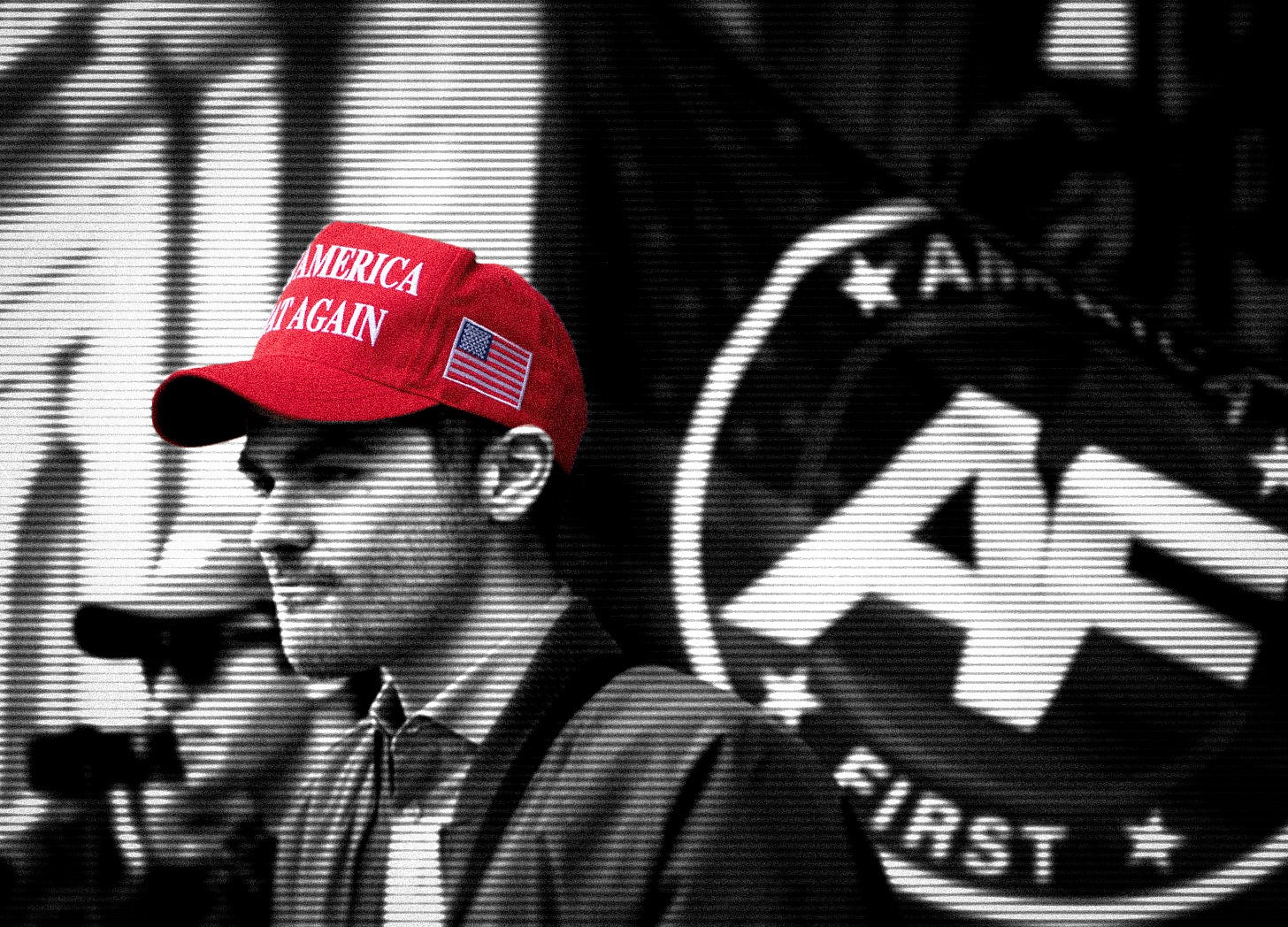
American conservatism has been rocked by the rise of “Groyper” antisemitism within its ranks, roiling both official Republican Party organizations and some of the right’s most influential intellectual organs. A bigoted movement spawned by far-right meme culture, Groypers derive their name from a racist variant of the Pepe the Frog cartoon and espouse white supremacist and antisemitic tropes. While critics of Trump-era conservatism have been warning about the Groyperization of the right for a long time, the conservative movement itself has only recently started to grapple with it. Even now, the debate over this issue has largely overlooked the source of antisemitism’s rise in conservative circles: the political right’s increasing turn towards nationalism.
Nationalism doesn’t just historically correlate with bigotry—it consistently drives antisemitism and other racial and ethnic prejudices. Indeed, nationalism intensifies preexisting antisemitic impulses. To the degree that today’s conservatives decide to embrace—or even just make peace with—nationalism and dispense with the universalist liberal principles of the American Founding, they will find it difficult to impossible to stem the spread of antisemitism in their midst.
Neo-Right Antisemitism
In October, Politico published an explosive report disclosing a selection of vile antisemitic and pro-Nazi messages from leaked group chats written by leaders of Young Republican chapters and various state GOP politicians and staffers. Later that month, Heritage Foundation President Kevin Roberts mired his organization in the controversy when he publicly defended prominent far-right podcaster Tucker Carlson—a longtime promoter of antisemitic ideas and conspiracy theories—after Carlson conducted a fawning interview promoting Nick Fuentes, an even more notorious antisemitic influencer who openly defends the Nazis. Heritage has long been one of the most influential conservative think tanks.
The Heritage incident provoked a wave of condemnations from prominent conservative intellectuals and politicians, including Sen. Ted Cruz of Texas, as well as several high-profile resignations from Heritage, including Princeton political theorist Robert George and George Mason University legal scholar Adam Mossoff.
I myself was a Heritage college student intern back in 1994. It was a very different institution then. I would not work with them today, a conclusion I reached years ago based on their descent into illiberal nativism and nationalism. In 2022, I turned down an invitation to contribute to the new edition of the Heritage Guide to the Constitution. In retrospect, I should have been more open about my reasons for refusing at that time, and have tried to rectify my mistake more recently.
But the response on the right to rising Groyper antisemitism inside the movement has been disheartening. As Cathy Young points out in The UnPopulist, Vice President JD Vance has defended Carlson, and President Trump has a history of associations with right-wing antisemites (including Carlson and Fuentes) and has appointed several to key positions in his administration. Moreover, as Young also notes, the rot at Heritage long predates this recent incident. Throughout the Trump era, the institution has increasingly cultivated relationships with right-wing bigots of various sorts and shifted its ideology to be more aligned with theirs.

The presence of antisemites such as Carlson or Fuentes in our public discourse is neither novel nor remarkable. The problem for the conservative movement—and, really, for America—is that they and others like them have a large and growing audience on the right. This is also why institutions like Heritage feel the need to accommodate them. Heritage and others fear that to repudiate them is to cast away an increasingly substantial part of their own base.
The Nationalist Roots of Right-Wing Antisemitism
The recent resurgence of right-wing antisemitism is rooted in the conservative movement’s turn towards nationalism. It is no accident that it emerged at the same time as the political right—led by Trump—has increasingly defined American identity not in terms of universal liberal values but in terms of ethnic and racial identity. Many in the movement privilege native-born white Christians over other groups—and often even privilege “heritage Americans,” defined as those (primarily whites) who can trace their ancestry in the U.S. over many generations all the way back to the Civil War or earlier.
Nationalist political movements—defined here as those that hold that the main purpose of government is to advance the interests of the nation’s dominant ethnic group—have a long history of antisemitism and other bigotry. As Cato Institute scholar Alex Nowrasteh and I explain in our 2024 article, “The Case Against Nationalism,” the Nazis are just the best-known of many examples. Antisemitism was also a significant element of almost every other modern nationalist movement to have emerged in a nation with a significant Jewish minority. Russian nationalist movements, such as the Black Hundreds, promoted antisemitic discrimination and perpetrated the massacres that gave the world the word “pogrom.” French nationalism promoted antisemitism that culminated in the Dreyfus Affair. Polish nationalist governments discriminated against Jews in many ways, as did fascist regimes in Italy and Spain. And so on.

The connection between nationalism and antisemitism is partly rooted in the specific histories of particular countries. But it also has a broader systematic basis. A movement that exalts the interests of the ethnic and cultural majority and believes that these interests are the true foundation of the nation is inherently prone to viewing ethnic and religious minorities with suspicion and hostility. That may be especially true of minority groups with a large diaspora in many countries, a history that is perversely used against them as a reason to doubt their allegiance to the nations they live in.
These prejudices are exacerbated by Jews’ disproportionate success in the commercial and intellectual worlds. Nationalists tend to believe such disproportionately successful minorities are encroaching on the rightful domain of the majority group. Such suspicion is heightened by the zero-sum worldview shared by most nationalists, under which one ethnic or racial group can only gain at the expense of others. Thus, if Jews are disproportionately successful, it must be at the expense of the ethnic majority.
Resentments are heightened by nationalists’ historic predilection for conspiracy theories. If the ethnic majority has been denied its supposedly rightful position of dominance, nationalists readily assume that the cause must be some nefarious plot. Thus the long history of bogus antisemitic conspiracy theories peddled by nationalists, such as the Protocols of the Elders of Zion—a forgery produced by the czarist Russian government, and later promoted by Nazis and other nationalists around Europe and beyond. Carlson, Fuentes, and others like them promote similar conspiracy theories today.
These tendencies are evident in the MAGA movement, and account for the growing acceptance of antisemitism among its adherents. Committed MAGA supporters view immigration and trade as a zero-sum game, and fear that immigrants will “replace” America’s white Christian majority. Carlson, Fuentes, and other prominent MAGA antisemites are also particularly fervent exponents of these more general nationalist precepts. As Noah Smith points out, the rise of antisemitism in the movement has been accompanied by growing hostility towards Indian Americans, another minority group notable for disproportionate success in commerce and the intellectual world.

Conservative political commentator Richard Hanania, a recovered white nationalist himself, emphasizes that openly antisemitic Groypers have much in common with more mainstream members of the MAGA movement, differing more in degree than kind. Both, he notes, agree “that policy and culture should be understood through the lens of zero-sum competition between Americans and foreigners, whites and nonwhites, Christians and non-Christians,” and that “[t]here is a hierarchy of Americanness in which people are ranked according to race, adherence to Christianity, and how long their ancestors have been in the country.” Both also have a strong tendency towards conspiracy-mongering. Once these premises are accepted, it is difficult to avoid applying them to Jews in the same way as other minorities and immigrant groups.
Yoram Hazony, an Israeli Jew who has become a leading intellectual defender of nationalism, recently stated that he has “been pretty amazed by the depth of the slander of Jews as a people that there’s been online the last year and a half,” in right-wing nationalist circles. He admitted he “didn’t think it would happen on the right. I was mistaken.” But if Hazony made this mistake, it was because he was unaware of—or chose to define away—the deep, longstanding connection between nationalism and antisemitism.
America’s Founding: An Antidote to Nationalist Antisemitism
Ultimately, right-wing antisemitism is a predictable outgrowth of nationalism. A movement that exalts ethnic particularism and sees the world in zero-sum terms is highly likely to turn antisemitic over time. Conservatives who seek to curb the growth of antisemitism on the right must reject nationalism and recommit to the principles of the American Founding.
In his resignation statement from the Heritage board, Robert George urged Heritage to be guided by the principles of the Declaration of Independence, especially the idea “that each and every member of the human family, irrespective of race, ethnicity, religion, or anything else; … is ‘created equal’ and ‘endowed by our Creator with certain unalienable rights.’” George is right. Unlike nationalist movements focused on ethnic particularism, the American Founding was based on universal liberal principles. That is why the Declaration of Independence argues that Americans deserve independence not because they are a racially or ethnically distinct group (a majority of white Americans had the same ethnic roots as the British they rebelled against), but in order to promote the universal liberal rights of “life, liberty, and the pursuit of happiness.”

In his General Orders to the Continental Army, issued on the occasion of the end of the Revolutionary War in 1783, George Washington stated that one of the reasons the United States was founded was to create “an Asylum for the poor and oppressed of all nations and religions.” Other leading Founding Fathers—including James Madison and Thomas Jefferson—expressed similar sentiments.
Washington sounded a similar theme in his famous 1790 letter to the congregation of the Rhode Island Touro Synagogue, in which he avowed that the United States has “an enlarged and liberal policy,” under which “All possess alike liberty of conscience and immunities of citizenship,” and that the U.S. government “gives to bigotry no sanction, to persecution no assistance.” America, he emphasized, went beyond “mere toleration” of Jews to granting them full equality. It could do so because American identity was based on universal liberal principles, not ethnic or religious particularism.
The United States has never been completely free of bigotry, including antisemitism, or fully lived up to its ideals. But it has never given up on these ideals either, as much of the right effectively wants it to do now. America has been relatively more free of such prejudices than many other nations, precisely because of its universalist roots. We have also been at our most successful when we reject zero-sum thinking, and instead recognize that the success of Jews, Indians, and other minorities and immigrant groups is beneficial to the majority, rather than harmful to it. Historically, immigrants—including those from these groups—have disproportionately contributed to American innovation and economic growth. Indeed, immigration restrictions cause greater harm to the liberty and prosperity of native-born Americans than virtually any other government policy.
A conservative movement that recommits to the universal principles of the Founding need not abandon all its differences with the left, or with libertarians like me. Conservative universalists like Robert George differ with me on many economic and social policy issues, such as abortion and the War on Drugs. But we can unite in rejecting racial and ethnic bigotry.

We must recognize that the far left has its own variants of antisemitism, rooted in factors such as hostility towards Jews for their real and imagined role in the capitalist system. But left-wing antisemitism is no excuse for the right-wing nationalist variety (and vice versa). Both right and left should work to constrain rather than mainstream bigoted elements within their respective movements.
Conservatives, liberals, and libertarians will continue to differ on many issues. But all would do well to reject ethnonationalism and embrace the universal principles of the American Founding. They are what made America great in the first place —and following them is the best way to make it greater still.

© The UnPopulist, 2025
Follow us on Bluesky, Threads, YouTube, TikTok, Facebook, Instagram, and X.
We welcome your reactions and replies. Please adhere to our comments policy.

Yoram Hazony might claim that he's been "amazed by the depth of the slander of Jews as a people that there’s been online the last year and a half" -- but he shouldn't be surprised. More likely, he's being disingenuous -- and so, too, is the author of this article. The problem is deeper (and the distinctions are skewed differently) than either of them fully acknowledge.
Hazony has made a point of opposing all varieties of universalism (including liberalism) -- which he views as a symptom of "empire." His brand of Zionism -- rooted in ethnonationalism -- has little sympathy (and ultimately, little place in its world) for universalist, Diaspora Jews.
We Jews face a deeper dilemma than either Hazony or Somin might be willing to acknowledge. Either we embrace the notion that self-determination is an individual right -- and that the State exists to provide equal protection to all people, regardless of ethnicity (including Jewish people, as individuals) -- or we embrace a notion of (collective) "self-determination" in a State that exists explicitly to provide protection to "THE Jewish People."
We can't have it both ways. This doesn't mean that by embracing liberalism, we cease to be Jews; it merely means that we're people (as individuals) in the political realm -- as members of a polity -- free to pursue our multi-faceted identities (including those we pursue as "members of 'a People'") in civil society.
Here's how it works:
Israel has a right to exist, and Jews have a right to live in our entire ancient homeland (from the river to the sea!) -- but not necessarily in a "Jewish State." "Next year in Jerusalem" doesn't require a demand for "Jewish sovereignty" or a "Jewish State" upon our Return. (FWIW, I'm equally opposed to any ethnonationalist "Palestine" whose very raison d'etre [and distinction from Israel] is "Jews not welcome here.")
In other words -- as opposed to Hazony -- Israel has a right to exist -- as a liberal democracy. If we've learned anything worthwhile about statecraft in 2,000 years of wandering the globe (most recently in America), THAT's a homeland worth defending.
But then, Hazony is part of a long-standing, particular (and particularistic) Jewish tradition. After all, these are the sorts of folks who excommunicated Spinoza, and they have little use for the insights of a Jewish liberal like Isaiah Berlin.
"Jewish sovereignty," my ass!
"Israel" and "Palestine" are the same (home)land -- embroiled in a bloody civil war, from the river to the sea -- and Israel needs a Lincoln.
PS: Liberal democracy and emancipation (as a manifestation of Enlightenment universalism) have provided the very situation in which Jewish Americans have flourished (even as a minority), both as Americans and as Jews.
I haven't given up on America -- at least not yet. But if Hazony's notion of "national conservatism" (side-by-side with "progressive" identity politics) fully takes hold in America (as I fear might well occur) -- and if American Jews must flee to Israel -- we'll be bringing our liberal notions of individualism and pluralism with us (along with our recognition of how "collective rights" [AKA the Oppression Olympics] ruined America).
Of course, with such an influx of Jews, full-fledged liberal democracy (as opposed to an ethno-state) will no longer pose a "demographic threat." If America has failed, perhaps it will then be up to us Jews to show the world how different people can get along.
So what else is new?
It's religious conservatism, specifically Christianity, that is the source of antisemitism as we know it. It stems from Jewish people being blamed for killing Jesus. This has resulted in thousands of years of persecution of Jewish people throughout countries where Christianity is the dominant religion. Even the Islamic Middle East today picked it up from Christian Europe in late 19th century.
Wealthy Arabs started sending their children to European Universities to learn why they were so far ahead, but at this time the Enlightentment was nice and dead. The Universities were overrun with anti-reason villains, and so all they learnt was military marching bands, fascism, and, of course, antisemitism.
Nationalism is also an irrational and collectivist ideology, that is profoundly un-American and anti-Western, but it's not driving antisemitism.