


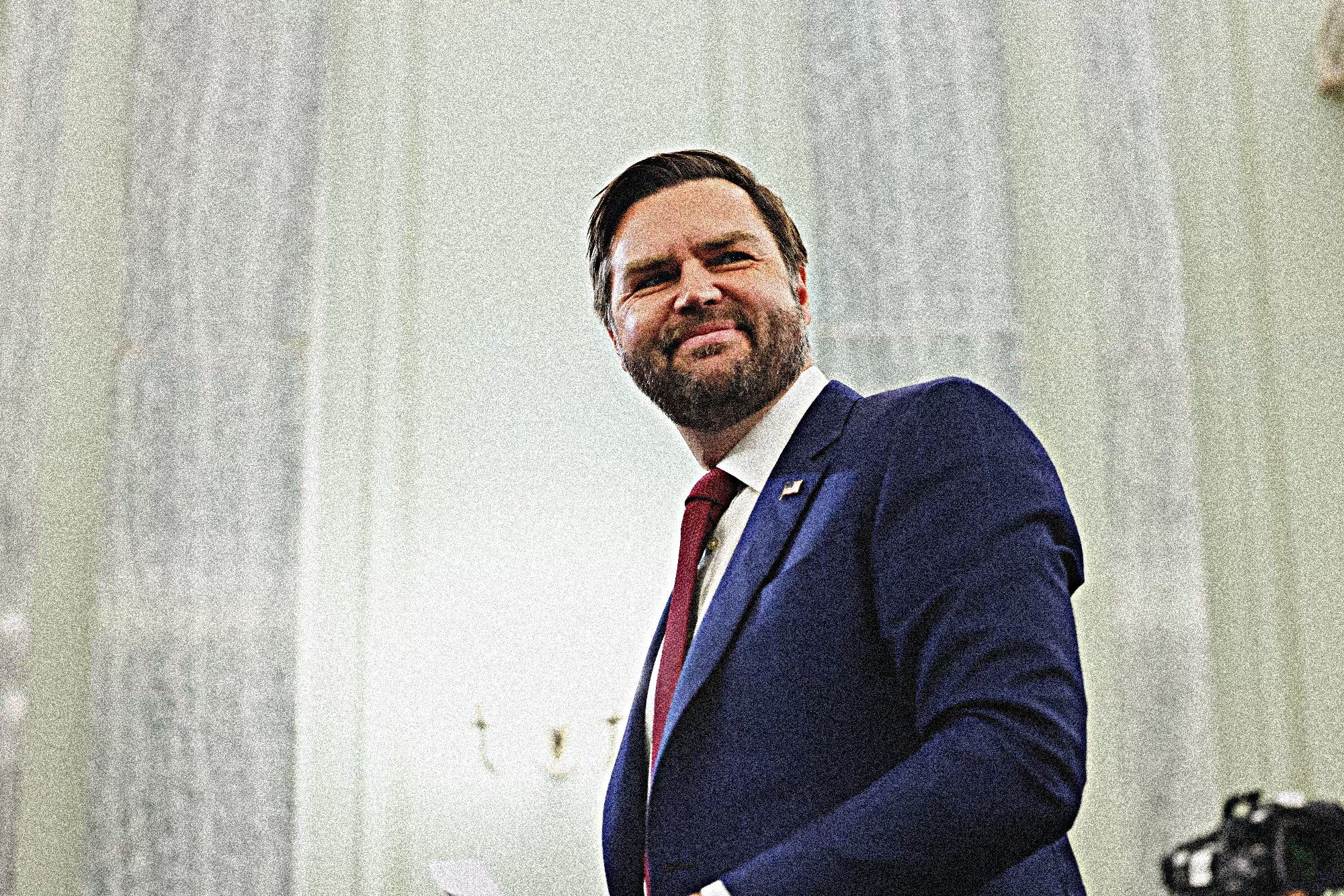
On Tuesday, The New York Times opinion columnist Thomas B. Edsall published an essay about JD Vance whose headline is a quote from The UnPopulist’s editor-in-chief, Shikha Dalmia. Edsall featured Dalmia prominently in his piece:
In a long phone conversation, Shikha Dalmia, the founder and editor of The UnPopulist magazine and the president of the Institute for the Study of Modern Authoritarianism, described Vance as an exceptionally complicated political and intellectual figure.
Dalmia, an Indian American, said: “A few years ago, I stumbled upon a Thanksgiving photograph of Vance with his family. It was him wearing his Indian garb, and he was holding his young toddler son with his wife and all his wife’s relatives, who look very much like my relatives.”
But, she continued, instead of following “the natural intellectual trajectory of a man who has opted to marry the daughter of immigrants, a woman who’s a practicing Hindu, has mixed-race children and a mixed-religion family to become a poster child for a Reaganesque shining city on the hill, an open society conservatism, he is the opposite.
I see him as a pretty thoroughgoing illiberal at this stage. This whole idea of a ‘heritage American’ is directly in tension with his wife’s claim to being an equal citizen in the United States. He’s a bundle of contradictions; his biography and his beliefs are in tension with each other.”
While Dalmia sees political opportunism playing a major role in this transformation, it’s not that simple. “He’s definitely ambitious,” she said. “You don’t do such a major, 180-degree turn on Trump if you are not ambitious. He is really trying to curry favor with Trump.” At the same time, she pointed out, “he’s trying to consolidate his power base within the Republican MAGA Party.”
But, Dalmia contended, “I also think that, unlike Trump, who is in it only for the power, Vance is an ideologue.” Vance, she argued, believes “American liberalism is on a bad path,” with the result that “he’s repudiated America in a way.
I don’t know if he wants a complete regime change, but he does want an America which is much more religious, much more closed. It’s not just isolationism in the Pat Buchanan sense; it’s a superreligious project.”
Because of this, Dalmia said, “I don’t think he’s seeking power for power’s sake. I think he is seeking power to remake America in some fundamental way.”
Vance’s ideological journey has taken him from outspoken Trump critic 10 years ago to loyal servant to the cause of crushing every vestige of liberalism in the public and private sectors.
JD Vance embodies MAGA’s corrosiveness. His wife, Usha, is the daughter of immigrants and a practicing Hindu. They have mixed-race children and a mixed-religion family. As Dalmia noted, Vance’s trajectory should have led him to embrace a Reaganesque vision of a shining city on a hill—his biographical background and intellectual formation should have made him a natural fit for a responsible conservatism that treats pluralism as a feature rather than a threat.
Instead, Vance has gone in the complete opposite direction. He is positioning himself as the leading figure in an administration mercilessly kicking out of the country people like his wife and children by trying to build a coalition represented by every faction of the neo-right, no matter how reactionary.
When far-right, white supremacist, antisemite Nick Fuentes, the leader of the “Groypers,” hurled racist epithets at Usha, Vivek Ramaswamy, another Indian American Republican, came out first and forcefully to condemn Fuentes. Ramaswamy declared without any equivocation that racists like Fuentes “had no place in the conservative movement, period.” Vance eventually defended his wife, too, but went out of his way to draw a contrast with Ramaswamy, rejecting “purity tests” for admission into the MAGA movement. “President Trump did not build the greatest coalition in politics by running his supporters through endless self-defeating purity tests,” he declared. Translation: Those who berate his wife and family are as welcome as those who defend her because, in Vance’s quest for power, he is an equal opportunity panderer.
Opportunist or Ideologue? Yes
However, as Dalmia noted, Vance is an ideologue who seeks power not for power’s sake but to advance an agenda. Trump is famously regarded as non-ideological; in fact, he’s seen as transactional in a way that is almost clarifying: he wants power and uses ideology as a tool to get it. Vance, a relatively recent convert to Catholicism, is more complicated—and precisely in a way that makes him more dangerous. He appears to genuinely believe that American liberalism is destructive, and that he must wield and deploy state power in order to counteract it. Vance offers the movement a proposition it never had with Trump: an intellectually capable exponent for the MAGA agenda.

Some continue to debate the extent to which Vance is a “true believer” of MAGA ideology. In a sense, this question is immaterial—whether he affirms the philosophical tenets of the MAGA movement or privately dissents and wants something somewhat different, he is actively serving the cause. And he is serving the cause in a specifically ideological role: providing the shiniest possible spin for everything that spills out of the Trumpian id.
I dissected this in a piece for The UnPopulist after his VP debate performance in 2024 against Tim Walz:
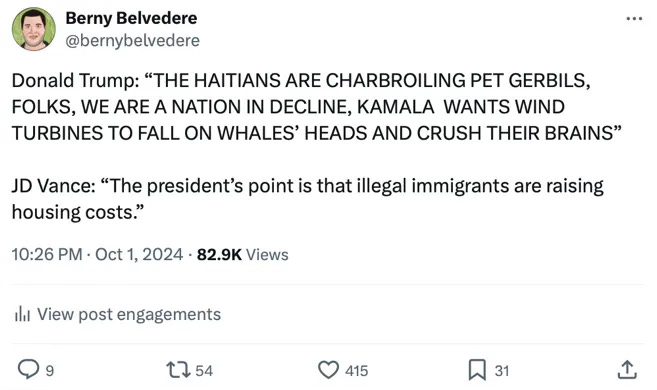
Since coming into office, Vance has done much more of this—not less.
The Articulate Authoritarian
His articulateness is arguably his most important contribution to the broader reactionary movement. Trump is fueled by resentment, not doctrine. His politics begin and end with the personal—who wronged him, who flattered him, who can be made to pay. Vance, by contrast, could spend an hour laying out the tenets of National Conservatism—the political ideology he most closely adheres to—capably and fluently. Trump is neither cognitively capable of assessing the merits of a full-blown ideological system, nor rhetorically capable of articulating it as a national vision. Vance can do both.
Vance’s conservative nationalism rejects the fusionism of the Reagan era—free markets, limited government, liberal-democratic norms—in favor of an interventionist state that uses power to impose a particular social vision. It is economically populist and opposes free trade and globalization. But his economic positions are secondary to the cultural and political core: hardline social conservatism, an explicit rejection of pluralism, and a conception of politics as zero-sum conflict between friends and enemies rather than as a cooperative enterprise among citizens with competing interests.

That last element is the most revealing. Vance is, in practice, a Schmittian—Carl Schmitt’s central thesis is that politics is fundamentally the drawing of a friend-enemy distinction, and that liberal attempts to transcend that conflict through law, procedure, and pluralism are a mistake. Vance doesn’t explicitly endorse this framework—and in fact preposterously charges his political opponents with embodying it—but he adopts it in practice. It justifies the aggressive use of state power against designated enemies, the subordination of courts and constitutional limits to executive will, and—as my colleague Andy Craig observed in his 2024 profile of Vance—a willingness to overturn election results that produce the “wrong” outcome.
One of the right’s key lessons from Trump’s first term was that Trump could galvanize heartland voters but lacked the intellectual infrastructure to implement a coherent MAGA agenda. There was no one to go on podcasts, news shows, or social media and provide a sustained, credible articulation of what the movement actually believed and why. Vance filled that gap, having erudite conversations with Edsall’s New York Times colleague, Ross Douthat, a fellow Catholic. He made Trumpism legible to people who wanted a reason to believe in it. I previously described him as a subtle and convincing propagandist whose mission was sugarcoating Trump’s lies and demagoguery in a responsible, sophisticated register. That’s still what he’s doing—and it’s how he’s preparing to eventually lead the movement outright.
Vance is Schmittian in his theory of politics, right-wing nationalist in his policy commitments, and MAGA in his tribal loyalties—with enough philosophical fluency to dress all three in the language of democratic accountability, national renewal, and moral restoration. That combination of genuine ideological conviction and rhetorical sophistication is what distinguishes him from other figures in the MAGA orbit.
Ideology as Cover
But what does all this tell us about Vance himself—not as a movement asset, but as a moral agent? Here Craig’s analysis adds an essential layer to this picture.
Vance’s moral restoration framing, as Craig pointed out—which includes limiting the free speech rights for pornography, criticisms of no-fault divorce, invocations of heritage and order—is something of a cover. The underlying commitment is ultimately to power: who controls institutions, who uses the laws against rivals, who gets to dominate whom.

I taught ethics at the college level for over a decade. One thing about moral reasoning is that it is paradigmatically principled: a genuine moral claim creates an obligation to follow it even when it is personally costly or inconvenient—that’s the whole point behind Kant’s distinction between categorical and hypothetical imperatives. Vance does not reason this way. His principles are deployed selectively, in service of his team. That is not moral reasoning; it is Schmitt with a theological veneer. And it is deeply at odds with his Catholicism, another example of the internal contradiction that Dalmia alludes to.
As Craig put it:
Vance has expressed in no uncertain terms that as vice president he would have rejected Mike Pence’s fidelity to the Constitution and instead assisted in Trump’s effort to steal the 2020 election. Vance cynically wrapped his willingness to help overturn a presidential election in the language of democratic accountability—endorsing “an alternative slate of electors” would have been “a much better thing for the country” because “at least we would have had a debate,” he said in an interview. But behind the appeals to making “an argument to the American people” is an animating conviction that his political movement deserves to be in power at any cost and that his opponents must be kept out of power no matter what. When politics is an existential battle for survival and domination, losing elections is only one more hurdle to be overturned, not a binding outcome to accept.
This is what makes the moral language so insidious. Vance deploys the frames of liberal democracy—accountability, debate, the will of the people—to obscure a project that is fundamentally at odds with liberal democracy. Schmitt himself understood this perfectly: the friend-enemy distinction requires no moral justification, only a designation of sides.
The gap between the man Vance’s biography suggests he could have become and the man he has chosen to be is the most revealing measure of what the MAGA movement really is at its core. He has elected to serve a “thoroughgoingly illiberal movement,” to use Dalmia’s phrase, and he has done it by translating its most repressive impulses into the vocabulary of the American tradition. He now spends every day of his life agitating for a society that sees the people he loves most in the world as undesirable foreigners who should be forcibly deported.

© The UnPopulist, 2026
Follow us on Bluesky, Threads, YouTube, TikTok, Facebook, Instagram, and X.
We welcome your reactions and replies. Please adhere to our comments policy.
If Vance has an anti-liberal ideology and wants to dismantle liberal democracy, my question remains, to what end? He's never articulated a vision for what he actually wants the country to look like. Rather, he's railing against existing institutions because he knows that people are unhappy with them.
I don't think he deserves the benefit of the doubt that this serves some larger political mission. Cynicism, in this case, is appropriate. Until proved otherwise, the most likely case is that he is seeking power for power's sake, and he doesn't have a coherent underlying belief or value system that is driving his behavior.
Well written!
I preface this by saying I find Vance to be a loathsome individual, but if the proverbial gun is put to my head, yes, I would choose Vance over Trump. But ONLY over Trump.
Fascism is in the gut, it isn't ideological. That's Trump's strength as a fascist and Vance's weakness. Fascist rank and file are not interested in ideological consistency. At the margin, Vance's attempt at that will cost him support.