


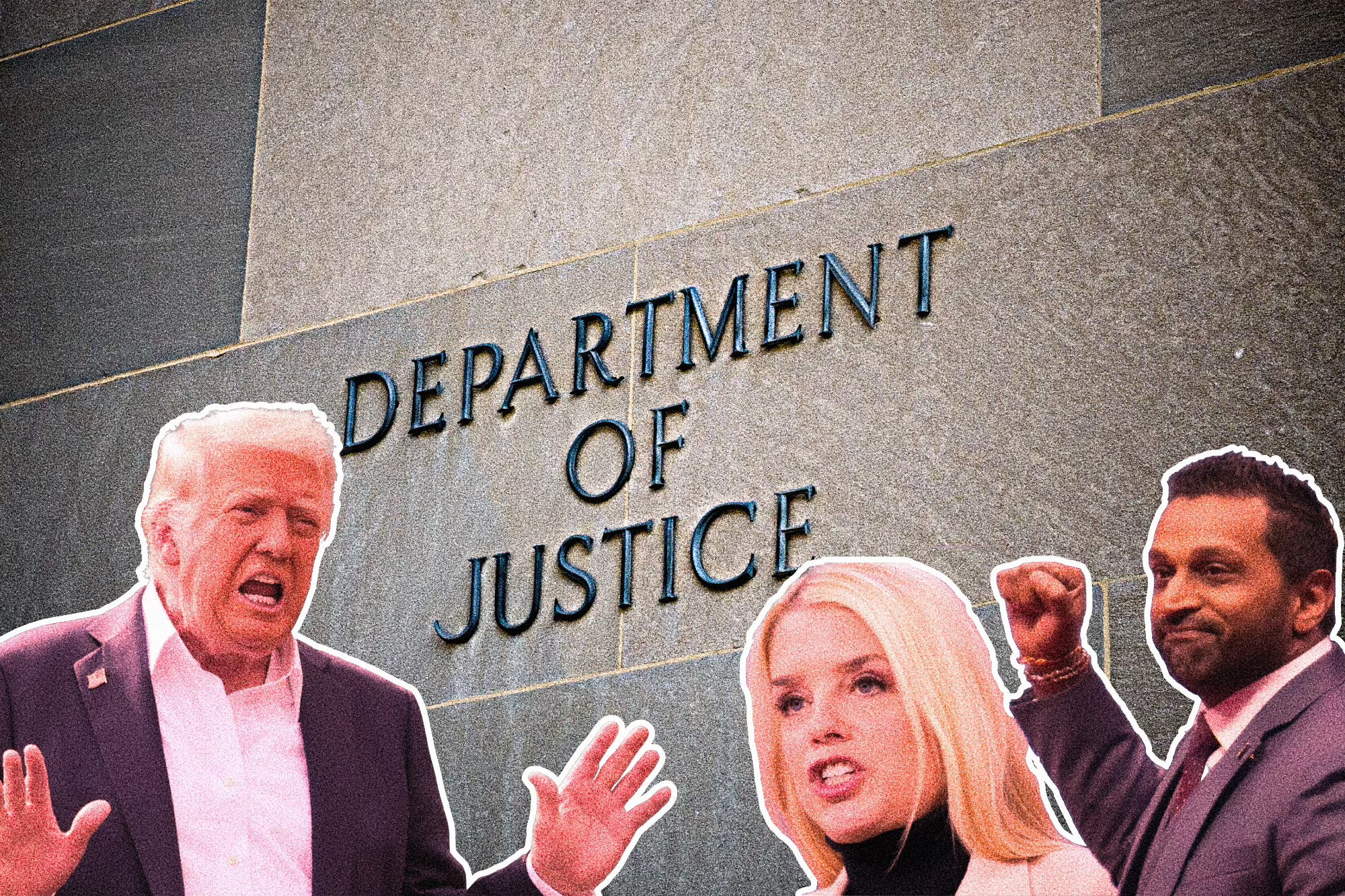
It would be difficult to determine which executive agency, aside from the presidency itself, Donald Trump has most distorted or disfigured. That said, the Department of Justice has a strong case.
This is a department boasting more than 40 different components and employing roughly 10,000 attorneys. Or, rather, it used to employ that many. Since the start of Trump’s second term, thousands have departed —either fired or resigned rather than carry out his policies. Over two-thirds of the attorneys who are responsible for defending federal programs (like most of Trump’s executive orders) have left the DOJ—many because they could not stomach the prospect. Trump has effectively gutted the DOJ and turned it into a shell of its former self.
But while the chaos has been unimaginable and the damage to personal careers immense, the real issue is that the toll on the American system of justice has been incalculable. That’s because this has not been a mere hollowing out. Trump has taken the nation’s central authority for federal law enforcement and repurposed it as a weapon for ideological combat and an instrument of presidential retribution.
This is a catastrophe, not a triumph of small government.
Institutional Exodus
Trump’s transformation of the department into a political weapon is the biggest source of both the firings and resignations. He has made it clear that the DOJ is no longer hospitable to career professionals who refuse to abandon their commitment to impartial justice.
The numbers, by themselves, are stunning. More than 6,400 employees have left the department since Trump’s second term began, according to Justice Connection, a network comprised of former DOJ alumni. Of those, over 230 lawyers, agents, and other employees were fired—some for simply working on cases they were assigned, some for criticizing Trump, and some for no discernible reason.

The FBI in particular has forced out an unprecedented number of senior executives, put thousands of agents under review for potential firing for their work on Jan. 6 cases, and reassigned a fourth of its agents to immigration enforcement. In New Jersey, where Trump’s personal lawyer Alina Habba was briefly in charge, about 50 of the office’s roughly 150 assistant U.S. attorneys departed.
Major metropolitan offices including Miami, Houston, and Denver have lost at least a quarter of their workforce.
The staffing at the Environment and Natural Resources Division (tasked with enforcing America’s environmental laws) has been cut roughly in half under Trump—what one analysis described as the division’s “most profound crisis since it was established in 1909.”
But the near-emptying of the 600-employee Civil Rights Division is perhaps the most drastic example of this broader exodus, itself not a one-time event but an ongoing purge since the start of Trump’s second term.
Examples of other forced political departures abound. Nearly a year ago, Emil Bove III—one of Trump’s former criminal defense lawyers now installed in a critical DOJ role—ordered that the corruption case against Eric Adams, then the Democratic mayor of New York, be abandoned in exchange for his cooperation with the administration’s draconian immigration enforcement. At least eight prosecutors in New York and Washington resigned in response, presaging the dismantling of anticorruption units within both the FBI and the DOJ.
Last Tuesday, at least six senior prosecutors resigned over the department’s decision to investigate the widow of Renee Good, the woman murdered by an ICE agent in Minneapolis—instead of the agent himself.
An Unserious DOJ
Predictably, this mass professional evacuation has produced a precipitous drop in competence. Not merely because the organization lost a lot of its brainpower, but also because those left are the ones most comfortable with reimagining their roles—and, indeed, the mission of the DOJ itself—as Trump’s official instrument of revenge. But it turns out that making, “help Trump get even” the core requirement of the job dramatically limits the talent pool so that, ironically and mercifully, the DOJ can’t even accomplish that task. The department is having a very hard time filling vacant positions. The upshot is that the sheer number of mistakes, errors, misrepresentations, and outright lies offered in courts by Trump’s DOJ is unprecedented.
Consider how Trump’s transparently punitive prosecutions of former FBI Director Jim Comey and New York Attorney General Letitia James have been dismissed on the grounds that the person Trump appointed Interim U.S. Attorney, Lindsey Halligan, was unlawfully occupying the office. In another case, when Maureen Comey (Jim Comey’s daughter), who had been serving as an assistant U.S. attorney for the Southern District of New York, was fired, she sued … and the DOJ struggled to find someone to represent it and respond.

It is, of course, difficult to parse exactly what the source of these errors is in any given instance: incompetence due to brain-drain? Or misinformation from its clients (like DHS)? Or deliberate misrepresentation? Be that as it may, there have been at least 40 instances in the past year where federal judges have taken the highly unusual step of publicly calling out the errors of DOJ attorneys—for actions such as submitting inconsistent affidavits or incomplete administrative records.
A Distorted Department
It’s not just that the department’s performance is worse—it’s that its mission has been transformed from upholding the rule of law, keeping America safe, and protecting civil rights to serving the ideological whims of the president.
Investigations and prosecutions of white-collar crime in particular have taken a hit in the second Trump administration, with U.S. Attorney General Pam Bondi deprioritizing the Foreign Corrupt Practices Act and Foreign Agents Registration Act. Prosecutions of cases under these laws have been paused, and the number of indictments are at record low for these and other similar crimes. A focus on immigration enforcement—often targeting immigrants with no criminal records—has led to a precipitous drop in prosecutions in other more pressing areas. (At the same time, Bondi’s decision to fire more than 80 immigration judges—because they lacked the right political orientation—has made the backlog of immigration cases soar.)
Trump’s transformation of the DOJ into his political instrument also means that there are not enough prosecutors to focus on what ought to be the government’s chief priorities: public safety and national security. In October, Trump fired a top national security prosecutor after a Jan. 6 apologist alleged he opposed targeting Comey for retribution.
As if the shortage of personnel wasn’t bad enough, the DOJ has undercut its core priorities by diverting remaining staff toward lesser threats. In Houston, white-collar crime squads were decimated by orders to put dozens of FBI agents onto immigration enforcement.
Perhaps less obvious is how the DOJ’s transformation will impact the everyday concerns of the public—the bread and butter of the department’s operations. The New York Times reports that rank-and-file prosecutors and agents have expressed serious concern that a “denigrated, distracted, and depleted work force hurts the government’s ability to identify and stop terrorist plots, cyberattacks, mass violence, and fraud.” “You’re making it more likely something is going to be missed,” said Samuel W. Buell, a former federal prosecutor on the Enron task force, about the impact of the administration’s overhaul of the DOJ. “The first question that happens whenever something horrific happens, whether it’s 9/11 or something like Bernie Madoff, is, ‘What did the Department of Justice and FBI know and why weren’t they in a position to stop this?’”
In offices across the country, the pace of new cases has slowed as the remaining workforce struggles to handle the many open prosecutions and investigations it has inherited from those who left.
As if hollowing of the workforce and diverting it from bigger to smaller threats wasn’t bad enough, consider how this process is turning the mission of various agencies on its head to advance a MAGA agenda, in contradiction to congressional aims.
Civil Rights In Reverse
Take the department’s Civil Rights Division. It was established 69 years ago under the Eisenhower administration, following the 1957 Civil Rights Act. As its name implies, the division was devoted to protecting the civil rights of American citizens and enforcing anti-discrimination laws to protect disadvantaged minority groups.

Under Trump, it has become an agent of conservative agitation. It has created a section to protect Second Amendment rights on the idiotic theory that gun owners are a persecuted minority whose guns are at risk of being confiscated. At the same time, the division has dismissed a lawsuit alleging rampant sexual abuse and harassment of unaccompanied immigrant children. It has also dismissed the DOJ’s lawsuits against Minneapolis, Louisville, and at least six other police departments across the country for illegal policing practices.
Given this transformation, it’s no wonder that over 75% of the career attorneys in the Civil Rights Division have left. As some of them put it in a December open letter, the department’s “core mission [has been turned] upside down,” abandoning nearly 70 years of work protecting civil rights. The division is now little more than a vehicle to redress right-wing grievances.
Of course, this division’s metamorphosis into a full-blown partisan vehicle is a microcosm of the wider department’s own shift. We’re only three weeks into the new year, and the DOJ has already launched two new ideologically motivated initiatives: the criminal probe of Fed Reserve Chair Jerome Powell and the creation of a dedicated welfare fraud enforcement division that answers directly to President Trump after a right-wing influencer’s misleading and misinformed allegations that Somalian childcare centers in Minnesota were engaging is such fraud.
Demolition as a Governing Ethos
Perversely, some demolition is being perpetrated just for demolition’s sake. Consider the unnoticed and tragic demise of the department’s relatively obscure Community Relations Service.
CRS was created over 60 years ago after the passage of the 1964 Civil Rights Act. The small office recruited mediators and conciliators, employing former ministers, teachers, veterans, and business executives. Its sole purpose was to defuse difficult situations and save lives; CRS mediators helped resolve racial conflict and de-escalate school harassment situations. In the aftermath of 9/11, President George Bush’s Attorney General John Ashcroft sent in CRS employees to prevent violence against Arabs, Muslim, Sikhs, and other South Asians. CRS is an almost unalloyed good—a neutral party that can be trusted by disputing sides to minimize conflict.
Now, the CRS is no more. Perhaps because of its role in quelling racial tensions in the wake of George Floyd’s death, it was targeted for elimination. According to a recent suit brought by several non-profits, CRS, which once had more than 300 staff, is virtually gutted today. The administration’s plan is for that number to reach zero. But in this time of increased political polarization, eliminating the role of conciliation will ultimately prove unwise: tensions will increase, violence will rise, and people will be harmed.

The torpedoing of CRS is just one such case—here are many more.
The overall impact of these reductions, reassignments, and reprioritizations, as Harvard Law’s Jack Goldsmith, a conservative who is widely respected in the DOJ, put it at LibCon2025, is as if “an atomic bomb [was] dropped on the Justice Department.”
In ancient Rome, decimation was a military punishment where every 10th soldier in a unit was randomly executed as a form of discipline and to encourage obedience. Today, the levels of destruction at the DOJ are not far off from that pace. There can be little doubt that we are witnessing the institutional equivalent of a Roman decimation—the arbitrary and violent imposition of discipline by a near-authoritarian ruler and his loyal minions. It will be a long time before the DOJ recovers from the assault. In the meantime, the American public will suffer the effects of this self-inflicted tragedy.

© The UnPopulist, 2026
Follow us on Bluesky, Threads, YouTube, TikTok, Facebook, Instagram, and X.
We welcome your reactions and replies. Please adhere to our comments policy.

As someone from the UK this reminds me a lot of Brexit, a country deliberately diminishing itself. Only this seems much worse, if Brexit was my country shooting itself in the foot the actions of the Trump administration, from domestic issues to foreign interventions and threats regarding Greenland, is like America committing suicide
Great column (but depressing). Question: with the exodus of so many attorneys in areas such as federal programs, will the strain on the reduced workforce erode the Department's ability to defend cases and protect existing programs effectively? For example, I imagine the number of FOIA suits will likely increase with fewer attorneys to effectively respond.