


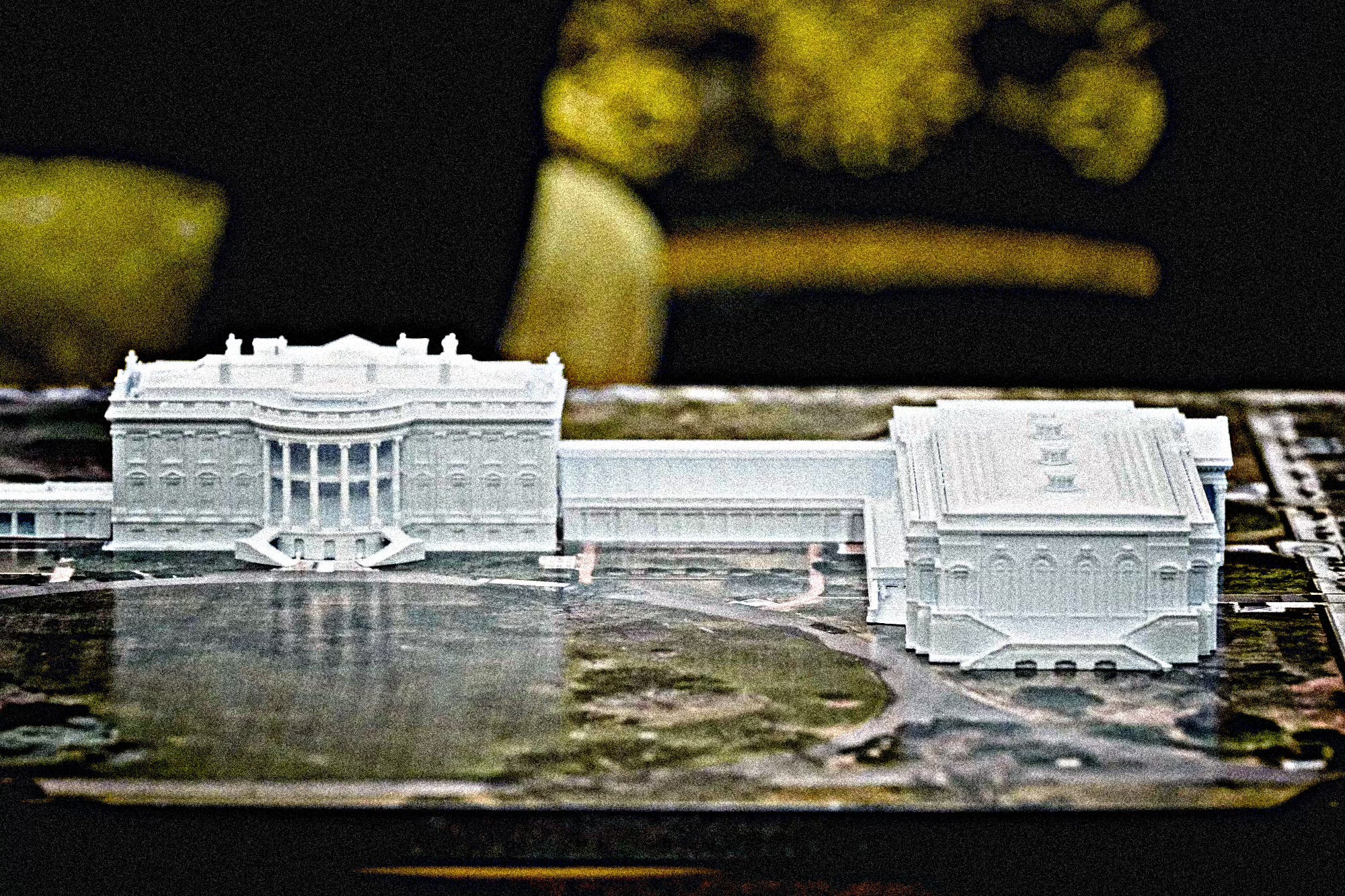
This past weekend brought Americans a familiar spectacle: a shooting followed by its immediate politicization. The right has long accused its political rivals of running a post-tragedy script, reflexively calling for preexisting preferences, such as gun control. Debatable as that sort of response is, it’s at least a sincere belief about a serious policy issue. MAGA influencers have now produced a funhouse mirror version that makes the left’s hastiest post-tragedy responses look like rigorous policymaking by comparison.
At around 8:30 on Saturday night at the White House Correspondents’ Association (WHCA) dinner, an annual tradition for over a century to raise scholarship money for aspiring journalists, 31-year-old Cole Allen, a California engineer with documented anti-Trump views, rushed a security checkpoint. Armed with multiple lethal weapons, he fired at least one shot before being subdued by law enforcement. Trump, seated at the head table alongside the First Lady, high-ranking Cabinet officials, and much of the presidential line of succession, was evacuated by Secret Service. One agent was shot but was unharmed, thanks to his vest.
Within minutes, before any comprehensive account of the attack or the motivation of the shooter, a strikingly uniform message started flooding social media.
Jack Posobiec: “Thank God President Trump is building a ballroom at the White House.”
Chaya Raichik (Libs of TikTok): “THIS IS WHY WE NEED TRUMP’S BALLROOM.”
Rudy Giuliani: “Maybe the haters can begin by supporting the WH much larger and more secure ballroom.”
Gov. Jeff Landry of Louisiana: “This event is yet another reason that President Trump’s ballroom should be built!”
Geraldo Rivera: “Build the Ballroom. Virtually the entire line of presidential succession was in that lame Hilton space. Way too freaky dangerous.”
Rep. Marlin Stutzman: “[T]his is one of those other reasons why we need a ballroom at the White House.”
Sen. Tim Sheehy of Montana: “It is an embarrassment to the strongest nation on earth that we cannot host gatherings in our nation’s capital without the threat of violence and attempted assassinations.”
Rep. Lauren Boebert of Colorado: “I’m working ... to draft legislation ensuring the White House Ballroom is completed. I don’t believe congressional approval is required for the project, but if it’ll keep activist judges on the sideline, so be it.”
Rep. Chip Roy of Texas floated attaching ballroom funding to the DHS reconciliation bill.
Speaker Mike Johnson: “The ballroom will be a solution for this.”
Rep. Mike Lawler of New York: “A ballroom is imperative.”
Andrew Kolvet: “This is why President Trump needs to build the WH ballroom.”
Mike Cernovich: “The Democrat judges who stopped the construction of a White House ballroom did so to enable an assassination of Trump. Which almost happened tonight. John Roberts needs to get these thugs into order. Everyone sees what they are trying to do!”
Such a uniform chorus cannot emerge spontaneously, and certainly not this fast; it needs to be orchestrated somehow. And Ashley St. Clair, a MAGA-influencer-turned-critic, confirmed just that. In a TikTok video released after the shooting, she noted that such campaigns are standard operating procedure for the administration. For nearly a decade she was part of similar coordinated group chats—including one of her own that had Trump administration officials among its members—whose express purpose was to rapidly synchronize messaging across the MAGAverse after something happened.

To be sure, not everyone who chimed in is a committed MAGA figure. Meghan McCain, not a Trump supporter but someone who loathes the left, said: “I don’t want to hear one more fucking criticism of Trump’s new ballroom at the White House.” Meanwhile, Sen. John Fetterman of Pennsylvania, a Democrat, wrote: “After witnessing last night, drop the TDS and build the White House ballroom for events exactly like these.”
And then there was Trump himself, still in his tuxedo at the White House podium a mere two hours after the shooting, telling reporters: “It’s drone-proof, it’s bulletproof glass. We need the ballroom.” The following day, he posted on Truth Social: “This event would never have happened with the Militarily Top Secret Ballroom currently under construction at the White House. It cannot be built fast enough!”
This campaign has two concrete institutional targets.
First, Congress. Federal law requires congressional authorization for any new construction on White House grounds—a requirement Trump ignored when he unilaterally, and illegally, demolished the East Wing and started the project. Several Republican lawmakers subsequently introduced fast-track legislation to retroactively approve the building project and give it a patina of legality.
Second, courts and litigants—specifically, the National Trust for Historic Preservation, the nonprofit organization whose lawsuit has been the primary legal obstacle to the project.
The Justice Department has also sent the Trust a letter, written by Assistant Attorney General Brett Shumate, demanding it drop the case because it was putting the president’s life at grave risk—a letter that, within hours of the shooting, acting Attorney General Todd Blanche amplified on X. That is not a legal argument, of course—just an effort to intimidate a private litigant into abandoning a legitimate legal challenge.
And now, just a little while ago, the DOJ submitted a shameless brief written in Trump’s voice to U.S. District Court Judge Richard Leon—the George W. Bush appointee who had originally ruled that Trump lacked unilateral authority to build his ballroom—asking him to recant and allow the project to go forward in the wake of the attack. (An appellate court has already put Judge Leon’s order on hold, allowing construction to continue as the case wended its way through courts, so the real purpose of this brief is to try to influence the outcome of ongoing litigation.)

Judge Leon had already anticipated such maneuvering when he wrote that “national security is not a blank check to proceed with otherwise unlawful activity.”
All of this takes “never let a crisis go to waste”-style cynicism to new heights. But seizing any pretext to circumvent standard democratic and legal processes is of course fully consistent with how this administration operates.
A Brief History of the Ballroom
The ballroom Trump has been obsessively pushing is a proposed 90,000-square-foot expansion on the former site of the White House’s East Wing, which was abruptly demolished in October 2025. This is the first major structural change to the White House complex since the Truman balcony in 1948. Announced in July 2025 at an estimated cost of $200 million, the price tag has since climbed to $400 million.
It is being funded through private donations by corporations and billionaires with substantial regulatory exposure to the Trump administration. Among the patrons are Apple, Google, Meta, Microsoft, BlackRock, and Nvidia. Notably, not among the funding sources is any budgetary authorization passed by Congress.
As if that is not bad enough, the administration secretly handed a no-bid contract to a Maryland company to build the ballroom, a recent New York Times investigation revealed. It also found documents showing that the government repeatedly used unusual procedures to bypass competition for the project and increase the price it expected to pay.
This kind of corruption and grift is precisely what a full public review by the proper authorities is supposed to prevent (more on that below).
Whatever one thinks of calls for tighter gun-control measures in the aftermath of a mass gun-related killing event, the proposal at least strives to fit the nature of the problem. MAGA world’s push to build a knock-off Versailles fails even that minimal test.

The planned venue would seat roughly 1,000 people; the WHCD hosts around 2,500. That’s why it has long been held at the Washington Hilton, one of the largest venues in town. The ballroom couldn’t have accommodated the occasion even if it had already been finished.
There is also the matter of the nature of the dinner itself. The WHCA is an independent organization run by the journalists who cover the White House, and its annual dinner is fundamentally a fundraising effort. Moving it onto White House property hands the administration effective control over the guest list—which correspondents get in, which outlets get seats. It would be a more extreme capitulation than the one WHCA already made in enticing Trump to show up by ditching the traditional comic roast in favor of a mind-reading magician’s act.
Beyond all that, Trump had never attended this dinner as president before. The ballroom was not designed around this event. This event is simply the most readily available crisis.
How This Should Work
Advocating for the ballroom through legitimate means requires nothing more esoteric than the ordinary operation of democratic governance as applied to federal construction on public land. Before any new structure can go up on White House grounds, four things are legally required: review by the National Capital Planning Commission; advisory review by the Commission of Fine Arts; explicit congressional authorization; and compliance with the National Environmental Policy Act, which mandates a public comment period.
This process is predicated on the White House belonging to the American people. To paraphrase Judge Leon: the president serves as steward of the White House for future generations, not its owner. That distinction carries real—historical, legal, even symbolic—weight.
Trump bypassed all of it. Demolition of the White House East Wing began in October 2025—but formal applications to the planning and the fine arts commissions weren’t filed until late December, after the historic structure was already gone. The proper procedural sequence is submit, get approved, and then carry out the construction work. This administration reversed that order to engineer a fait accompli.
It gets worse. Even before the fine arts commission could review the project after the demolition, Trump fired all six of its sitting commissioners, eliminating in one fell swoop any vestige of independence the body might have otherwise retained. Loyalists, of course, were brought in their place. The result: the Trump-stacked CFA approved the ballroom in under two months—despite public comments running 99% against the project, a record for the commission.

The planning commission was a harder nut to crack but crack it Trump did. Trump couldn’t reshape the NCPC outright in the same way as he could the fine arts commission. That’s because he had the right to fire all of the fine art commissioners but with the planning commission, he had the authority to fill only three of the 12 slots. Other presidents would’ve picked people with relevant expertise. Trump installed Will Scharf, a White House aide, as chair. He also placed James Blair, another administration official, as a voting member.
This meant that the NCPC, whose charge is to independently review a project, was actually now controlled by the administration’s own officials and it, too, gave its approval in three months. The first thing Trump appointees did was to amend the commission’s public-facing communication to make the plans for the ballroom seem less legally questionable than they were.
Having steamrolled every procedural constraint to protect a public-owned property that has stood as the symbolic heart of American democracy for over two centuries, the administration is now manufacturing a crisis to quash any remaining obstacle to this corrupt vanity project.
If Trump wanted his ballroom, he could have done it the right way. He could have made a public case for it (even though you’d think a president has more important things to worry about than build gaudy monuments for his personal aggrandizement). He could have submitted the plans to Congress. He could have disclosed every donor and the donation amounts—that is, if Congress approves this manner of funding for a government project. He could have let the reviewing commissions do their work. He could have let the public—you know, the true owners of the White House—weigh in. He could have gone through the process put in place to ensure that such projects don’t become a cornucopia of grift and public corruption.
But Trump’s MAGA minions don’t care for pesky things like democratic deliberation and good governance. The Dear Leader wants his building, and he’ll get it by crook or crook.

© The UnPopulist, 2026
Follow us on Bluesky, Threads, YouTube, TikTok, Facebook, Instagram, and X.
We welcome your reactions and replies. Please adhere to our comments policy.
The irony of the crowd who routinely justifies the current draconian immigration tactics by proclaiming "we don't mind them; they just need to follow the rules!" defending not following the rules is, well, not surprising.
After all, rules for thee and not for me, is the favorite MO.
he needs a secure bunker to hide in when he refuses to leave office.