


At the annual meeting of the World Economic Forum yesterday—which marks exactly one year since Donald Trump was sworn in as president of the United States for a second time—Belgian Prime Minister Bart De Wever warned that Europe can no longer assume America is an ally. Trump has crossed “so many red lines,” De Wever told the Davos crowd, that Europe must either “wake up and rearm” or risk becoming Trump’s “slaves.” The Belgian premier was responding to Trump’s escalating campaign to acquire Greenland, an autonomous territory of NATO ally Denmark. Trump has also threatened punitive tariffs against European nations that have come to the defense of Danish sovereignty.
On his trip to the WEF event in Switzerland, Trump has said he’s backing off the tariffs for now, but this might just be classic Trump deferring to the last person he talked to—in this case, NATO Secretary General Mark Rutte, with whom Trump also said he’d worked out an unspecified long-term framework for unspecified ends. But given Trump’s obsession with Greenland no one can be certain that this issue has been permanently resolved. Trump’s threat of military force, which has already resulted in a substantial Danish and allied military deployment to act as deterrence, is a bell that can’t be unrung.
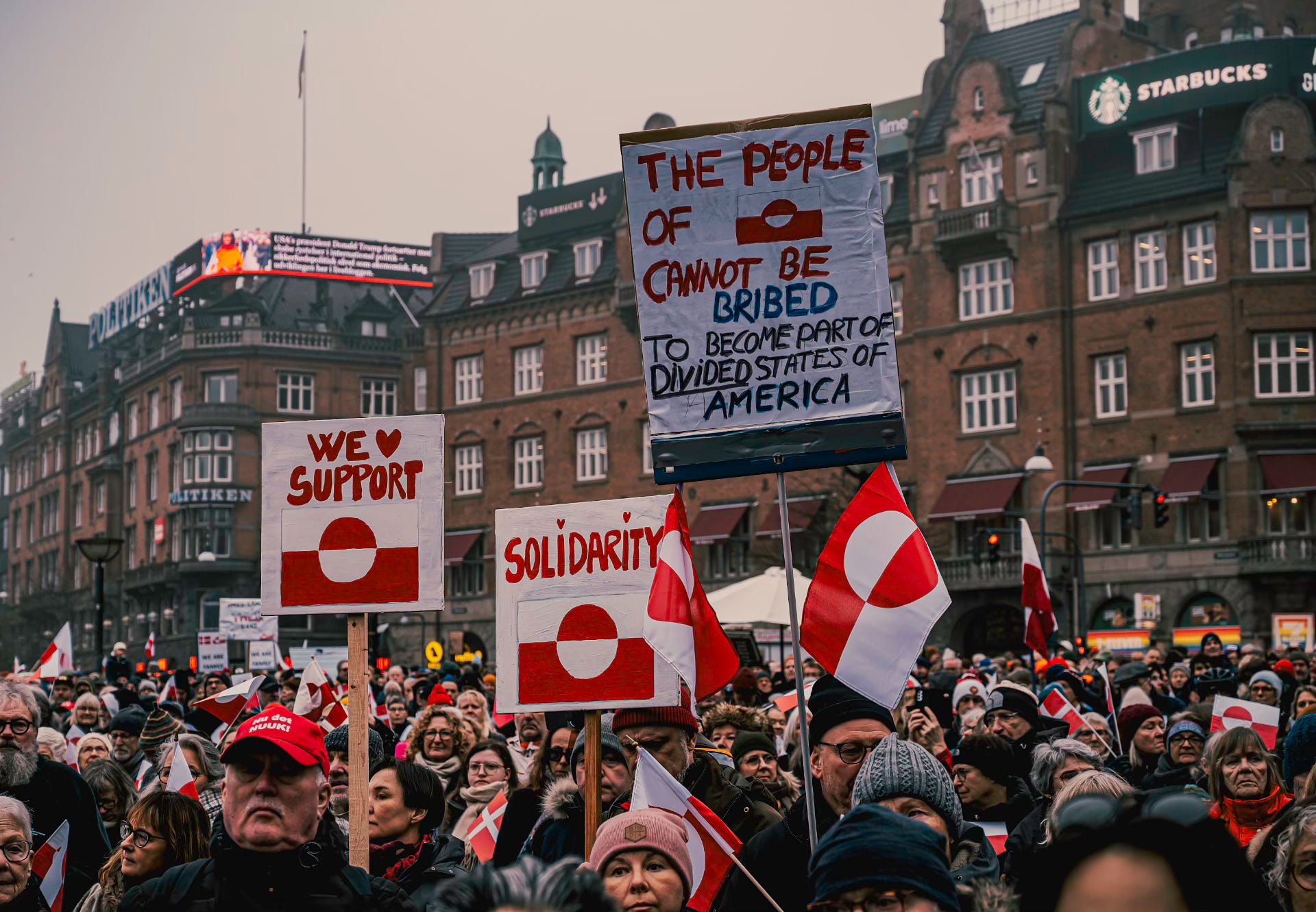
Thousands have protested in Copenhagen and Greenland, wearing red baseball hats that say, “Make America Go Away.” “We are not interested in being Americans,” one demonstrator told reporters. Even Americans overwhelmingly reject Trump’s territorial ambitions. Multiple polls show roughly three-quarters of voters oppose acquiring Greenland, with opposition to military force reaching 86% (including majorities of Republicans) in some surveys. Even in an era of relatively unpopular presidents, rarely has a major White House initiative been so broadly disliked by Americans across the political spectrum.

Territorial seizures are hardly novel phenomena in international relations. What makes this crisis different is that the aggressor is the United States, a close ally of Denmark’s and the architect of the very international order designed to discourage such brazen territorial acquisitiveness. It is particularly absurd since America has had unlimited military access, an open invitation to station whatever forces it wants on Greenland, since World War II. It’s understandable why the Danes and Greenlanders are bewildered at supposed security motivations for the Arctic Anschluss.
Throughout the postwar era, a defining tenet of American hegemony has been that military might does not confer territorial rights, and that America itself would resolutely defend weaker nations against the predations of their mightier neighbors. This president has reversed that mission entirely. Under Trump, on the international stage, the U.S. has gone from protector to predator.
In 1990, when Iraq’s Saddam Hussein invaded Kuwait, the U.S. assembled a coalition to expel Iraqi forces and restore Kuwaiti sovereignty—not to claim Kuwait for itself. In 2014, when Vladimir Putin’s revanchist imperialism drove Russia to annex Crimea, Washington led international condemnation and imposed sanctions, declaring that territorial conquest had no place in the modern world. The U.S. has maintained military alliances specifically designed to deter stronger powers from swallowing their weaker neighbors: NATO to protect Europe from Soviet and Russian aggression, defense treaties to shield South Korea and Japan, security guarantees throughout the Persian Gulf.

America, for all its missteps, had been the guarantor of a rules-based order in which smaller nations could trust that their sovereignty would be respected. American dominance was by no means faultless, but it was consciously unlike the empires of old, with a firm policy against pursuing territorial conquest. The system worked, in part, because countries believed the U.S. would honor its commitments. When the U.S. invoked NATO’s Article 5 after 9/11, Denmark answered, joining the war in Afghanistan and sending soldiers to die. It did so trusting that the mutual defense commitment ran both ways. Now that same ally finds itself threatened by Trump, who demands its territory and wields a neo-mercantilist version of economic coercion to take it. The message to every nation that has relied on American security guarantees is unmistakable: you are only as safe as Trump’s arbitrary whims allow. The United States, even for its closest allies, is now neither trustworthy nor honorable in global affairs.
Yet even this understates the scope of the transformation. If anyone had mused on Jan. 19, 2025, the day before Trump’s inauguration, that over the next year Trump would:
Obsess about absorbing Greenland, refusing to rule out the possibility of unprovoked military aggression against a NATO ally.
Cite his failure to win the Nobel Peace Prize as justification for no longer feeling obliged to “think purely of Peace” when pursuing Greenland.
Attempt to rename the Gulf of Mexico the “Gulf of America” and require recognition of this change as a prerequisite for White House access.
Repeatedly tease about annexing Canada, the U.S.’ number two trading partner—and even release a map depicting it as U.S. territory.
Threaten to “retake” control of the Panama Canal from Panama, a sovereign nation and longtime U.S. partner.
Propose to convert war-torn Gaza into a MAGA coastal resort, a plan that involves the displacement or expulsion of hundreds of thousands of Palestinians.
Militarily invade Venezuela, capture its president, and seize its oil.
… you would have thought they were describing a 19th-century imperial power, not the 21st-century leader of the free world. That would seem particularly impossible given that America has treaties with Denmark and other European NATO allies, duly ratified by the U.S. Senate. As such, as per its own Constitution, they are the supreme law of the land that the president must uphold, not violate.

The reality is that when the architect of the postwar order becomes its violator, the entire system collapses. If the U.S. can threaten NATO allies with impunity, why should China hold back from attacking Taiwan? Why should Russia stop at Ukraine? Trump’s territorial adventurism doesn’t just betray specific allies, it demolishes the principle that has prevented great power wars for much of the last century. Smaller nations are already recalculating their security arrangements, or accommodating regional bullies, and in some quarters there is even talk of acquiring independent nuclear deterrents. Canadian Prime Minister Mark Carney’s speech at Davos warned that mid-level powers like his country’s now have to band together to defend themselves from two “hegemons”—a.k.a. predators—China and America. That this country in 12 months of this presidency has moved from the sovereignty-respecting free world camp to the imperialist authoritarian camp is a remarkable transformation.
The American-led order has never fully lived up to its ideals, but it at least established that allied territory was inviolable and that borders could not be redrawn by force. Trump has abandoned even these basic rules, replacing them with raw coercion where America itself has become not just the aggressor but prospective colonizer, the very thing this country repudiated at its founding.

© The UnPopulist, 2026
Follow us on Bluesky, Threads, YouTube, TikTok, Facebook, Instagram, and X.
We welcome your reactions and replies. Please adhere to our comments policy.
Letting Putin take Crimea was the precursor to what we have become. Leaving Ukraine to suffer is a disgrace to the entire democratic community. Taking, and threatening to take, sovereign nations puts us squarely in the camp of the world's predators, leaving us with no claim to being a beacon of freedom.
I'm from the UK and whilst I haven't always agreed with American foreign policy and think that at times it has been hypocritical (such as over the Cuban missile crisis) I've always thought that in general it stood for something above it's own self-interest. Now it's foreign policy doesn't even seem to be guided by self-interest, just the whims of a deranged and dangerous president