


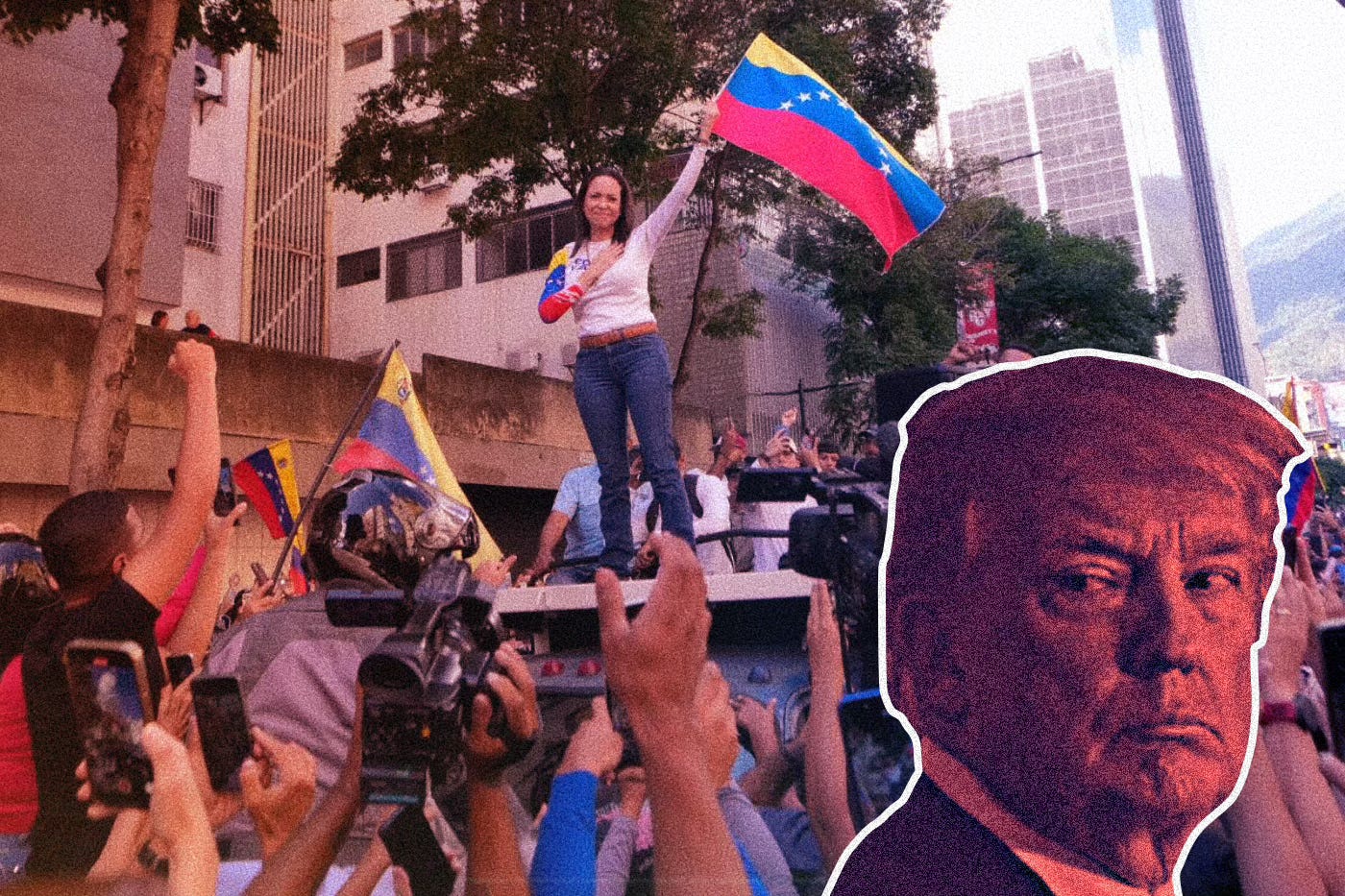
Few countries in the world have been dealt a sadder hand in the last quarter century than Venezuela. Sitting atop the largest oil reserves in the world (with a sixth of the global total), it has been run completely into the ground by a quarter-century of “Bolivarian socialist” one-party corruption, mismanagement, and repression. Only plunder can explain such misery: a quarter of the country’s population (at least eight million) living in exile and 80% of those who remain living in poverty.
But only a resuscitation of 19th-century imperial greed—evoking the worst caricatures of “Yanqui imperialism”—can explain why President Donald Trump would justify his lightning military strike to capture and remove Venezuela’s plunderer-in-chief with a single motive: oil. Unless Trump can be prevailed on to change the calamitous course he has announced, Venezuela’s tragedy will only compound.
Despite the viciousness of the Venezuelan regime, the country’s political opposition has repeatedly mobilized, against daunting odds, for a peaceful transition to democracy. Rich with talent and courage, Venezuela’s democrats have constantly surfaced political leaders like Leopoldo López, Henrique Capriles, and Juan Guaidó. Over the last two decades, they have rallied the country’s besieged citizenry to repeated apparent victories in electoral contests distorted and rigged by the left-wing populist dictator, Hugo Chávez, who ruled from 1999 until his death in 2013, and his successor Nicolás Maduro, who picked up the mantle of 13 more years until he was forcibly removed from power by U.S. special forces on Saturday. Maduro’s regime became so deeply insinuated with drug trafficking, illicit gold and human trafficking, and organized crime that it became in effect “a gangster state.”
Machado: The Gangster Regime’s Nemesis
Under both leaders, the Chavista regime’s claim to embody the popular will compelled it to demonstrate that through regular elections. Despite the regime’s ability to deploy patronage and repression to muscle its way to victory, that was becoming a harder and harder challenge for the deeply unpopular Maduro. As his six-year presidential term was coming up for renewal in July 2024, he also faced an unusually energized and unified opposition. On Oct. 22, 2023, under the banner of a Unitary Platform, Venezuela’s democratic parties staged a primary election in which a charismatic former congresswoman and longtime civic activist for democracy, Maria Corina Machado, won over 92% of the nearly two and a half million votes cast. Banned from contesting the general election by the increasingly desperate Maduro regime, Machado drafted a former diplomat, Edmundo González, to stand in her place. She then tirelessly (and at constant risk to her life) barnstormed the country to mobilize the electorate. And she led an unprecedented effort to preempt the theft of the election through a meticulously organized parallel vote tabulation, which collected the official vote tallies (actas) from 83% of the polling stations and securely transmitted them to an independent counting center. That independent count proved that González had won the election with two-thirds of the vote, belying Maduro’s claim of victory with a bare majority.

To understand the depth of Donald Trump’s betrayal of the democratic movement in Venezuela, it is necessary to appreciate the consummate courage, planning, and organization behind the opposition victory on July 28, 2024. For her valiant efforts to organize and lead the campaign for democracy, María Corina Machado was awarded the 2025 Nobel Peace Prize. In her moving acceptance speech on Dec. 10, read by her daughter (due to her late arrival in Oslo from a perilous escape from Venezuela), Machado described their year of preparation to defend the victory they were confident would come:
600,000 volunteers across 30,000 polling stations; apps to scan QR codes, digital platforms, diaspora call centers. We deployed scanners, Starlink antennas, and laptops hidden inside fruit trucks to the furthest corners of Venezuela. Technology became a tool for freedom.
Secret training sessions were held at dawn in church backrooms, kitchens, and basements, using printed materials moved across Venezuela like contraband….
And then the electoral tally sheets— the famous actas, the sacred proof of the people’s will—began to appear: first by phone, then WhatsApp, then photographed, then scanned, and finally carried by hand, by mule, even by canoe.
They arrived from everywhere, an eruption of truth, because thousands of citizens risked their freedom to protect them.
The regime ordered its soldiers to stop the collection and transmission of the tally sheets. “But the soldiers disobeyed,” she explained in her speech. The conclusive proof of the opposition’s victory was posted on the internet for all to see. “The dictatorship responded with terror. 2,500 people kidnapped, disappeared, tortured. Homes marked. Entire families taken as hostages.”
This is why millions of Venezuelans outside the country—and even (daringly) many inside—joyously celebrated the news of Maduro’s arrest. Whatever its international legality, the dramatic U.S. military intervention seemed to open a pathway to the departure of the gangster regime and a transition to its democratically elected alternative.
Yet, despite her countless previous efforts to shower Donald Trump with praise and gratitude, even to dedicate her Nobel prize to him—and despite the opposition’s fervent prayers and natural assumption that when Trump finally chose to unleash the might of the American armada gathering off the Venezuelan coast, it would be to topple the dictatorial regime of Maduro and not just the man—Trump, on Saturday, stabbed the heroine of Venezuela’s democratic struggle firmly in the back. With a visibly pained Secretary Marco Rubio looking on, Trump ruled out supporting Machado (and presumably her electoral designate, González) for a leadership role in Venezuela: “I think it would be very tough for her to be the leader. She doesn’t have the support within or the respect within the country.”
Making Things Worse
What does Donald Trump know of respect within Venezuela? What does he know of Machado’s skill in unifying a divided opposition, her tenacity in winning an impossible election, and her courage in defying and then daringly escaping a cruel dictatorship? Such facile ignorance could only flow from a narcissism consumed with resentment that it was Machado and not Trump who the Norwegian Nobel Committee rightly recognized for the Peace Prize, and an insatiable greed that cannot comprehend, much less value, something more precious than a windfall of new riches.

Now, in the wake of Trump’s lightning military strike on Saturday to capture Maduro and his wife, we are left with the worst of all possible worlds. Maduro is gone but his predatory dictatorship lives on, defiant. There is no sign of a plan or strategy to induce this awful regime to negotiate a transfer of power to González and the democratic coalition of which Machado is the political and moral leader. There are only the glib vows that the United States will “run” the country of Venezuela. Given that there are no American boots on the ground, that there is no prospect of the 100,000 or more U.S. soldiers it would take to “run” the country, and that the sinews of Venezuelan state security are well armed and deeply entrenched, the proposition is absurd.
In his rambling press conference on Saturday celebrating the military operation, Trump made no mention of democracy or political legitimacy. The only transition he had in mind was economic. He wants Venezuela’s oil that he has lusted after for years (just as he did Iraq’s after that invasion). “We’re going to be taking out a tremendous amount of wealth out of the ground,” Trump boasted on Saturday. Only such jaw-dropping arrogance by the U.S. president could enable the oil minister and interim leader of this dreadful regime, Delcy Rodriguez, to sound credible when she declared on Saturday that the one, true objective of Trump’s “aggression” was “the capture of our energy, mineral, and natural resources.”
The Trump administration is now thrust on the horns of a piercing dilemma. Trump wants the oil, and he doesn’t much care who he deals with to get it. Secretary of State Marco Rubio, one may speculate, wants regime change—a transition to democracy in Venezuela. But if there is no strategy to bring about a transition, the only way to get the oil is to deal with and thus enrich—and thus entrench in power, perhaps for decades to come—the Chavista regime that will regroup around a successor to Maduro. One industry analysis predicts it could take “tens of billions of dollars over multiple years” to significantly revive Venezuela’s oil production (which is now at a fraction of its potential). That will require a Big Bet on a Venezuelan government. An emerging democracy could justify that bet. A decrepit, violent, and hated dictatorship—which will likely continue to include other thuggish regime elites under U.S. drug trafficking indictments—cannot.
Is there way out of this mess?
Perhaps Republicans in Congress can convince the president that, setting aside all moral concerns, the only way to achieve his administration’s stated goals in Venezuela—an end to drug trafficking, a halt in illegal immigration to the U.S., and a vigorous restoration of oil production—is by restoring a competent, pro-American, rule-of-law state in Venezuela. That can only come through a transition to the government elected in 2024, and there has never been a more propitious moment to achieve that transition than right now.
The massing of U.S. forces off the Venezuelan coast, Trump’s mid-December declaration of “a total and complete blockade” of sanctioned tankers carrying Venezuelan oil, the stunning joint-force operation to capture Maduro, and other forms of economic and coercive pressure on the Venezuelan dictatorship provide considerable leverage that the U.S. could use to negotiate the departure of the regime leadership and a transition to democracy.

Venezuela’s democrats, led by María Corina Machado, are and have been ready to negotiate not only with the U.S. but with the regime that needs to exit. Given the world class expertise and technology that U.S. companies possess, they’d have a natural edge in landing lucrative contracts over other competitors, Machado can assure the administration. There would be a natural partnership between a new democratic government in Caracas and the U.S. that would deepen the commercial relationship between the two countries. The bigger challenge would be dealing with Maduro regime loyalists—inducing them to transfer power and preventing them from sabotaging the new democracy.
Hope Amidst Ruin
It is reasonable to assume that Machado would make painful and morally distasteful concessions—domestic and international amnesty for regime elites, and even some quiet deals that enable them to access their ill-gotten wealth abroad—in exchange for achieving the highest moral imperative, the return of democracy. The key to a bargain is what José Ramón Morales-Arilla terms “differentiated amnesty,” in which the worst of the regime elites would be offered (by international agreement) “safe conduct to protected exile” while “a wider class of regime insiders,” including military officers who do not bear responsibility for severe human rights violations, are given a general domestic amnesty to induce them to commit to the new democratic order. This would enable them “to see that their interests diverge from those of the regime’s more compromised figures,” and to “envision a future in post-transition Venezuela, not as hunted criminals but as participants in the country’s reconstruction.”
As Morales-Arilla and other analysts and policy-makers note, Venezuela is not post-invasion Iraq. It has a legitimate, democratically elected government in waiting. It has a prior rich history of democracy and civic pluralism. It has a homogeneous population, in contrast to Iraq’s complex ethnic, religious, and tribal divisions. The descent into state criminality has left Venezuelan territory riddled with the violent partners of that criminality—armed gangs, mafias, and guerilla groups bent on extracting the country’s wealth. But a legitimate, competently managed government, reviving the oil industry through U.S. and other international partnerships, attracting back human talent and international capital, and benefiting from security and intelligence assistance from the U.S. and other democracies, would have the resources to gradually rein in these nonstate actors and restore the sine qua non of political stability: a legitimate monopoly over the use of force.
As for die-hard elements of the regime’s informal network of coercion, they might, Morales-Arilla writes, “cause violence,” but after ravaging the country and being defeated in a landslide election, “they would struggle to claim legitimacy and recruit from broad segments of society.” Although he published his analysis in December, before the U.S. invasion, I think his essential truth remains valid today:
The choice … is between a turbulent but real democratic transition and the status quo of autocracy, economic collapse, mass emigration, and continued general suffering. By that standard, even an imperfect transition will amount to an enormous improvement.
The tragedy of Venezuela has been authored in Venezuela, but administrations of both parties in the U.S. have also failed that country in multiple ways. Any honest reckoning must acknowledge that while the Biden administration did impose economic sanctions on some 20 officials of the Maduro regime following the theft of the election, it never mobilized a concerted and vigorous strategy to compel the regime to negotiate an exit. One could argue whether it was possible without the threat of actual force, and without Brazil’s left-wing president, Lula da Silva, being willing to face down pro-Chavista elements within his own political coalition, but a tired and preoccupied Biden administration, worried about the danger of a new flood of Venezuelan immigrants in advance of the 2024 U.S. elections, never seriously tried.

Honesty also compels a reckoning with the core irony of the current moment. Among recent aspirants to the U.S. presidency, only Trump would have the audacity to launch such a daring, unilateral joint-force strike to capture a sitting president of Venezuela—with its questionable legality under both U.S. and international law, its dangerous precedents that Russia and China might later claim, and its damaging consequences for the liberal international order. Yet only Donald Trump would so brazenly squander this historic opportunity for true change on the altar of a chimeric windfall—oil, which a 1960s Venezuelan oil minister labeled “the devil’s excrement.”
Trump must be persuaded to not anoint himself Venezuela’s new overlord, but to help it to transition into the democracy for which its people clearly long.

© The UnPopulist, 2026
Follow us on Bluesky, Threads, YouTube, TikTok, Facebook, Instagram, and X.
We welcome your reactions and replies. Please adhere to our comments policy.

Mr. Trump and his mouth piece,Secretary of State Rubio, are not to be trusted. My humble opinion is to many "experts" won't take Trump at his word, as no respectable leader would act in the deplorable manner that is President Trump. But Mr. Trump and his administration will sellout any Allie to make a "buck." Remember, Trump cut the deal with the Taliban and sold out the Afgan people. The people of Greenland beware, Hegseth will gladly send his "special forces bros" to take over their country. Trump's National Security Strategy speaks only of money and spheres of influence. Democracy and human rights are of no value to Trump, Vance, and Rubio. Just my humble opinion. (I hope I haven't upset anyone. Just the rambling thoughts of an old hermit!)
It’s possible that he might work with the opposition but I sure wouldn’t count on it. He’s a typical macho politician that doesn’t respect women unless they play the bimbo . His greed for the oil and to dominate Latin America will prevent any kind of nuanced, intelligent decision that will be needed to get out of this new Iraq. And that’s exactly what it will be for him: a source of record low approval ratings that will allow the democrats to dominate for a long time if they get their ship together 😎