


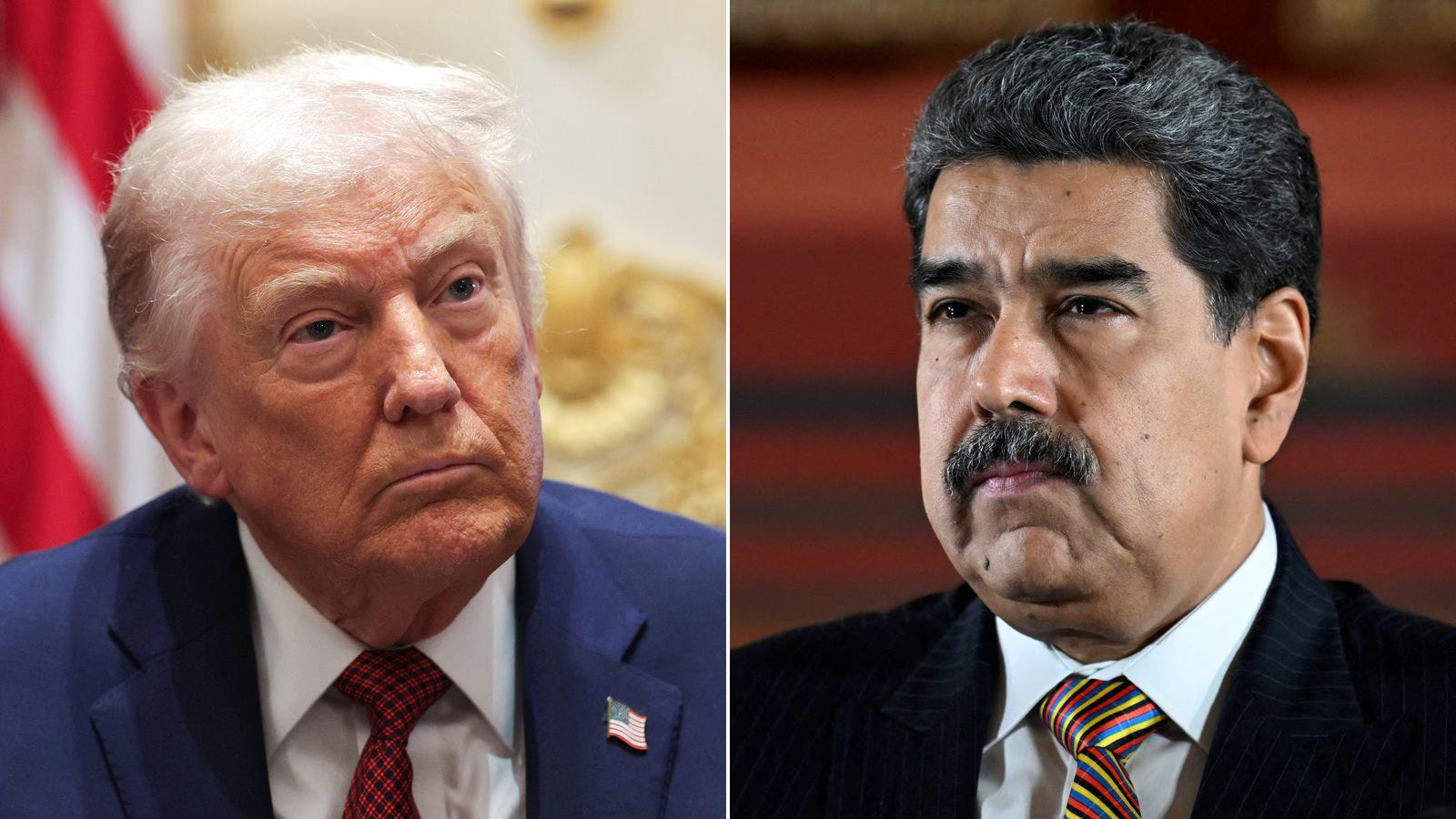
Briefly at 3.22 a.m. Saturday, as news broke of U.S. airstrikes in Venezuela, Mike Lee, the “constitutional conservative” senator from Utah, expressed concerns about the legality of the operation that are surely on the minds of many Americans too. “I look forward to learning what, if anything, might constitutionally justify this action in the absence of a declaration of war or authorization for the use of military force,” Lee posted on X.
Less than two hours later, Lee found a rationalization for looking the other way, his brief flirtation with principle abandoned. Again, taking to X, he posted:
Just got off the phone with @SecRubio
He informed me that Nicolás Maduro has been arrested by U.S. personnel to stand trial on criminal charges in the United States, and that the kinetic action we saw tonight was deployed to protect and defend those executing the arrest warrant
This action likely falls within the president’s inherent authority under Article II of the Constitution to protect U.S. personnel from an actual or imminent attack
Thank you, @SecRubio, for keeping me apprised
Taken on its own stated terms, this reduces congressional war powers to an easily evaded nullity. A mere grand jury indictment in a federal district court could replace the Congress on matters of war. It’s worth unpacking the stunning logic here.
Grand Jury War Powers?
From what we know right now, the United States conducted numerous airstrikes in and around Caracas while American special forces captured Venezuelan dictator Nicolas Maduro and his wife who are being flown to New York to stand trial.
This operation, an unambiguous act of war, was conducted without any congressional approval—or even any advance notification to key congressional committees, something explicitly required under the War Powers Resolution of 1973. Congressional approval, even with Republican majorities in both chambers, probably would not have been forthcoming since military action in Venezuela is overwhelmingly unpopular.
But Congress’ will is irrelevant if Rubio’s explanation that Maduro had been indicted on various drugs and weapons charges in the Southern District of New York during the first Trump administration is sufficient justification for the president of the United States to execute an “arrest” of a foreign head of state by bombing and invading his country.
If taken seriously, this would mean that a simple vote by a grand jury can replace congressional power to declare war and regulate the use of military force. In other words, a secret process by randomly selected citizens—not elected representatives—and so deferential to prosecutors that it could supposedly “indict a ham sandwich,” is sufficient to launch a war.
Lee’s endorsement of this logic is particularly galling because he is one of the handful of legislators who have previously professed to take war powers seriously. In 2011, he adamantly condemned Obama’s unauthorized war in Libya. In 2021, he was similarly critical of the Biden administration’s unauthorized airstrikes in Syria. That same year, he cosponsored bipartisan legislation attempting to reassert Congress’s constitutional role.
A History of Presidential Usurpation
As that history indicates, Trump is far from the first president to usurp the war powers vested by the Constitution in Congress. But, as with so much else, he has gone even further.
All of this would have dismayed the Framers.
George Washington, in declining to order an attack against hostile Indians, observed, “The Constitution vests the power of declaring War with Congress, therefore no offensive expedition of importance can be undertaken until after they shall have deliberated upon the subject, and authorised such a measure.” James Madison, the Constitution’s primary architect, was likewise adamant: “In no part of the constitution is more wisdom to be found than in the clause which confides the question of war or peace to the legislature, and not to the executive department.”
Vesting war powers in Congress was a very deliberate change from the British system, where declaring war was (and still is) a royal prerogative requiring no involvement from Parliament. Rejecting that template was one of the ways the new Constitution sought to ensure the president would not be king.
To be sure, it was recognized from the start that the president, as commander-in-chief, has the power to respond to sudden attacks before Congress can be summoned to respond. For example, American forces at Pearl Harbor did not have to wait for a congressional declaration of war before they could shoot back and defend themselves. But Roosevelt promptly requested, and received, a declaration of war the next day.
This arrangement mostly held throughout the 19th and into the 20th century. Presidents requested, and Congress granted, declarations of war against: Britain in 1812, Mexico in 1846, Spain in 1898, Germany in 1917, and the Axis powers in World War II. Some of these cases were more controversial than others, but in each instance the legislature openly debated and freely made a decision for which elected leaders were democratically accountable to voters.
This separation of powers began to break down with the Cold War when President Harry Truman insisted the Korean War was justified as a United Nations “police action” with no need for Congress. Vietnam proceeded under the factually and legally ambiguous Gulf of Tonkin resolution, vaguely authorizing force in response to a reported attack on a U.S. naval vessel, now known to have been spurious. This imprecise resolution then formed the basis of a war lasting nearly a decade and costing more than 50,000 American lives.
But after the disaster of Vietnam and Nixon’s illegal expansion of the war into Cambodia, Congress attempted to reassert control with the War Powers Resolution, passed into law over Nixon’s veto in 1973.
The War Powers Resolution allows the president to “introduce United States Armed Forces into hostilities” under only three conditions: “(1) a declaration of war, (2) specific statutory authorization, or (3) a national emergency created by attack upon the United States, its territories or possessions, or its armed forces.” It also sets requirements for consulting with and notifying Congress both before and after hostilities, and a timeline for a quick congressional vote on authorization.
Unfortunately, presidents since have repeatedly violated the War Powers Resolution. No approval was sought for various invasions and bombing campaigns in Grenada, Panama, Libya (repeatedly), Yemen, and the former Yugoslavia, among others, all of which involved unquestionable “hostilities.” Among America’s many wars and interventions in recent decades, Congress has only passed an authorization three times: for the Gulf War, the post-9/11 war against al-Qaeda and the Taliban, and the invasion of Iraq.
Presidents have often offered implausible contortions, such as the Obama administration’s argument that a months-long bombing campaign with thousands of airstrikes in Libya did not amount to “‘war’ in the constitutional sense.”
But Rubio’s theory is even more contorted. Any administration can obtain an indictment against a foreign head of state. Then when the foreign government fights back as we try to “arrest” its leader, its response is construed as an “attack” on American forces. It’s an inversion worthy of Orwell’s “war is peace” — defending against an attack is itself an attack. Under this logic, anybody can be the aggressor if they fight back against American aggression.
This is patently absurd. It’s not just wrong—it bears no good faith relationship to the plain meaning of words in the English language.
Mission Not Yet Accomplished?
As is so often the case with Trump, the man himself soon overtook the excuses enablers made for him. Lee’s posts included a supposed assurance from Rubio that he “anticipates no further action in Venezuela now that Maduro is in U.S. custody.” Apparently, the commander-in-chief didn’t get the memo.
In his press conference (after he’d first posted on Truth Social and called in to Fox & Friends), Trump made an astonishing assertion: “We’re going to run the country until such time as we can do a safe, proper, and judicious transition.”
In case there was any doubt, when pressed by reporters about how the U.S. could possibly “run” a country larger than Texas and with almost 30 million people, he elaborated, “We’re not afraid of boots on the ground if we have to have it.” And to leave no doubt he meant for the U.S. to occupy the country, he gestured to his cabinet behind him and said, “We’re gonna be running it.” He also dismissed the possibility of Venezuelan opposition and recent Nobel laureate María Corina Machado assuming power, instead issuing an endorsement of Maduro’s own vice president as a successor along with “people in the [US] military.”
As if that was not enough, he emphasized—repeatedly—that American war aims in Venezuela include seizing the country’s oil to pay for the U.S. occupation, potentially for years. War as a for-profit business is not a new theme for Trump. He has long faulted George Bush for not seizing Iraq’s oil to offset America’s expense of invading the country. And he threatened possible actions in Colombia (a democracy and longtime U.S.ally) as well as Cuba.
In Trump’s mind, the scope of this war then entails invading, occupying, and running Venezuela, potentially for years on end, never mind that this is wildly implausible since the U.S. has nowhere near enough troops deployed in the region to pull off such a massive operation.
The insanity of Trump’s press conference, and the massive scale of the catastrophe he is contemplating, may or may not prompt Lee to reconsider accepting a bad faith lie at face value.
Either way, Congress—regardless of party—has an obligation to push impeachment (which any member can force a vote on) and also pursue remedies under the War Powers Resolution. As flagrant as past presidential violations of congressional war powers have been, the scope of Trump’s apparent hallucinations about the facts on the ground, and the massive scale of the war he is purporting to launch, demand serious discussion of impeachment. There is ultimately no other remedy Congress has against a lawless president. Of course, this would only be one among his dozens of other crimes against the Constitution committed over the past year.
Congress could also tie appropriations restrictions to the looming government shutdown on January 30, explicitly denying funding for any further military action in Venezuela. It should also contemplate new legislation to fix the ways in which the War Powers Resolution has proven ineffective. Any such law would face the hurdle of a presidential veto. But even if two-thirds super-majorities for a veto override is unlikely (albeit not impossible, if this debacle proves unpopular enough), it is worth underscoring the reality that majorities in Congress disapprove. Eventual reform, and accountability, requires putting congressional opposition on the record now. Congress must attempt to use all the tools at its disposal to build momentum for a serious repudiation of lawless presidential war making in the future.
It is long past time that Congress gave real teeth to its constitutional power to declare war. As with so many things, Trump didn’t invent a bloated, power-grabbing presidency, but he has brought it to its inevitable conclusion, the very thing most feared by the Founders: A madman able to plunge the country into war on a whim.

© The UnPopulist, 2026
Follow us on Bluesky, Threads, YouTube, TikTok, Facebook, Instagram, and X.
We welcome your reactions and replies. Please adhere to our comments policy.
Trump & his admin have no idea what they could be in for. When we're running another country and un-nationalizing the oil industry, it's more than an intrusion. It's an invasion. There's bound to be conflict.
Plus, what great propaganda they created for one Mr. Vladimir Putin. So, yes, Congress needs to reclaim the full intent of the War Powers Act.
The irony here is that Trump wants to govern the USA like a South American dictatorship.
In fact, when Trump first came to power in 2016, many political scientists and analysts in the U.S. began arguing for the first time in modern history that Trump's ideas and rhetoric about governance, institutions, and law are similar to authoritarian regimes in parts of South America.
Moreover, Trump’s core supporters are not freedom-loving anti-authoritarians. They are right-wing authoritarians who oppose left-wing authoritarianism not because they reject authoritarianism as such, but because they see it as the wrong type of authoritarianism.