


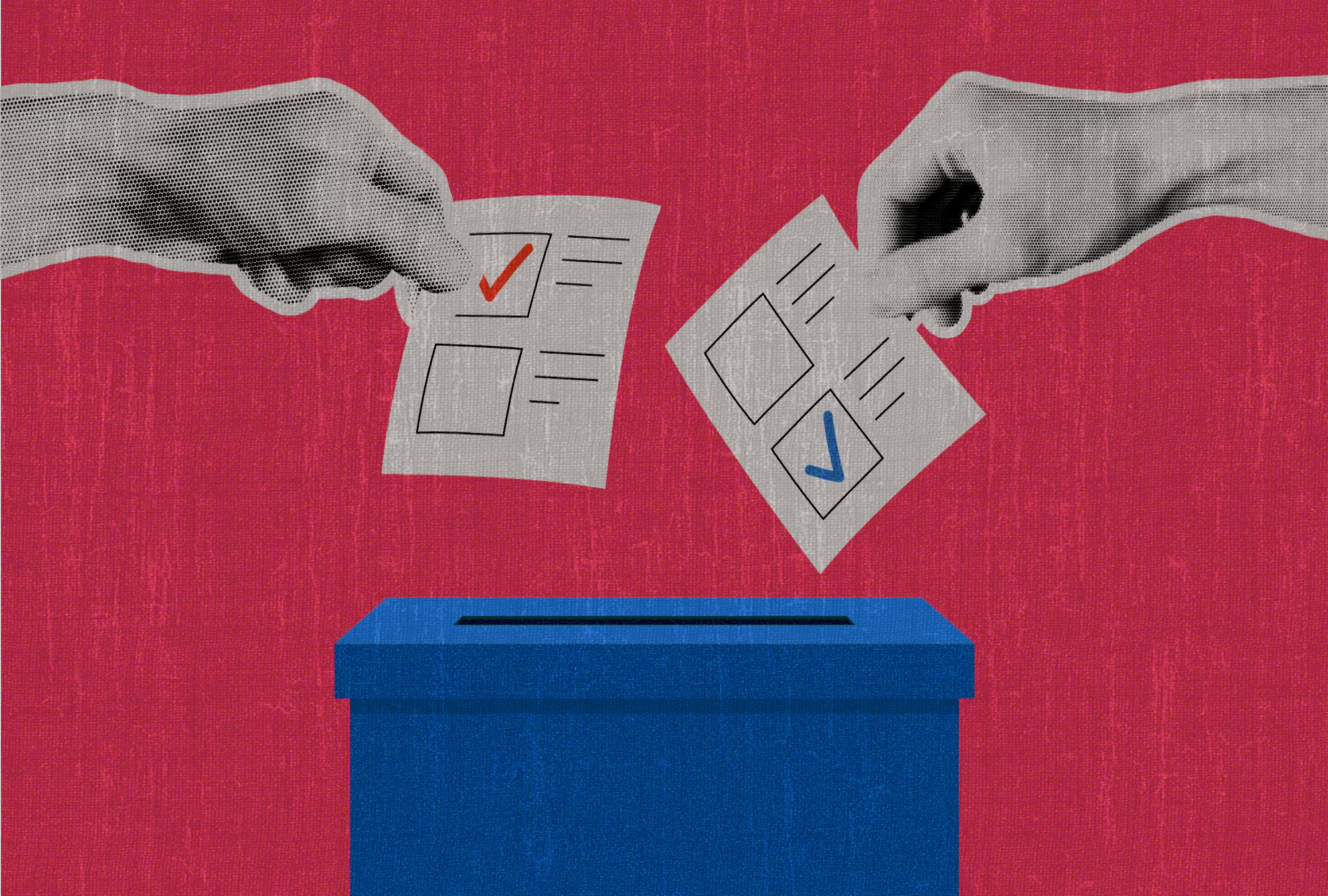
In a recent essay here at The UnPopulist, Harvard’s Danielle Allen vividly describes American democracy as a bear caught in a trap, with wolves circling and wildfire approaching. The metaphor captures the sense of urgency that many Americans feel about the state of the country’s politics. Congress struggles to govern, partisan conflict dominates public life, and a growing share of voters say neither party represents them well.
Allen’s proposed solution is to reform primary elections by opening them to all candidates, and all voters, with the top finishers advancing to a final round. In other words, all-party primaries or the “Top Two” system in versions where that many candidates advance regardless of party. The idea is intuitive: if candidates must appeal to a broader electorate earlier in the process, they will have incentives to moderate and cooperate.
The problem is that the evidence from states that have tried similar systems suggests that all-party primaries do not reliably produce the desired outcomes.
The dysfunction in American politics runs deeper than the mechanics of nomination contests. The United States operates under an unusually rigid two‑party system that compresses an enormous range of political views into two increasingly polarized coalitions. Adjusting the rules of primaries may change how candidates are nominated, but it does little to change the incentives created by the larger political environment.

If American democracy is a wounded bear, then the trap is only part of the story. The animal is also injured, starving, and surrounded by a damaged ecosystem.
Releasing the trap alone will not restore its health. What is needed instead is a broader rehabilitation of the political system itself—one that allows more parties, more coalitions, and more pathways for representation.
Why Primary Reform Falls Short
All-party primary reform is often presented as way to reduce polarization. The argument is straightforward. Because many congressional districts lean heavily toward one party, the decisive contest takes place in the primary rather than the general election. These primaries often attract relatively few voters, which means that candidates must appeal to a small and highly engaged electorate. Opening the process, reformers argue, would force candidates to compete for a broader coalition of voters and therefore encourage moderation.
Yet states that have adopted Top Two or similar primary systems offer little evidence that this dynamic works in practice. California and Washington have both used top‑two primaries for more than a decade. Louisiana has long operated under a version of the same structure. If top-two systems reliably moderated politics, these states should display less ideological polarization among their elected officials. They do not.
The political science literature on top-two primaries is extensive and remarkably consistent. For example, McGhee and colleagues, in a 2014 study published in the American Journal of Political Science, analyzed all 99 state legislative chambers and found that primary system openness has “little, if any, effect on the extremism of the politicians it produces.” The effect sizes for top-two systems were trivial—a few hundredths of a point on ideology scales where the partisan gap is nearly a full point.

A follow-up study by McGhee and Shor looked specifically at California and Washington. The findings were unflattering. In Washington, Democrats actually became more liberal after Top Two, the opposite of the predicted effect. In California, there was modest Democratic moderation, but it disappeared once the researchers controlled for a confounding factor: California adopted independent redistricting at the same time. This resulted in relatively more districts that are competitive between Republicans and Democrats in general elections. The moderation levels advocates might attribute to primary reform could equally follow from redistricting reform.
Alaska’s Top Four system, where four candidates advance from an all-party primary to a general election using ranked choice voting, is too new to evaluate rigorously, and the results are confounded by Lisa Murkowski’s unique circumstances. She won her Senate seat as a write-in candidate in 2010, after losing the Republican primary, a feat of personal brand-building that preceded the electoral reform by a decade. And while Democrat Mary Peltola managed to win a single term in the House in 2022, this was because her leading opponent was the exceptionally unpopular Sarah Palin. But Palin still won the most Republican votes in the primary and so would have been the Republican nominee under the more traditional system. In the general election, the more moderate Republican, Nick Begich (who would go on to claim the seat two years later and vote like an ordinary Republican in Congress), was in third place and so was eliminated ahead of Palin in the ranked choice tabulation, producing in effect the same Peltola vs. Palin contest in the end.
As the 2023 American Political Science Association report on political parties concluded, there is no statistical relationship between state primary rules and state legislative polarization. Closed primary states are, on average, no more polarized than all-party primary states.
Why don’t these reforms work as expected? One reason is that the theory rests on assumptions about voter behavior that do not consistently hold up. Primary voters are often portrayed as dramatically more ideological than general‑election voters, but research finds that the differences are usually modest at best.
Even when turnout expands under new rules, the ideological composition of the electorate often remains similar. Additional voters tend to resemble those already participating rather than forming a distinct moderate bloc that reshapes the results. To be sure, under the combination of the two-party system and single-member districts, the result is that most seats are safe seats for one party or the other to begin with. This means that a smaller subset of the electorate is in effect choosing the winner in the primary, rather than in the November general election when more people vote. But it is not the case these primary voters are generally choosing more ideologically extreme candidates. That theory might be intuitive, but it does not match the data.

Then there’s the question of which candidates even want to run. Political scientist Andrew Hall shows in his book, Who Wants to Run?, that a large share of the polarization we observe in American politics stems from candidate self‑selection. The people who enter races are increasingly partisan fighters, not cross-partisan compromisers.
Moderates are not simply losing elections—they often never run. Research by Danielle Thomsen in Opting Out of Congress likewise finds that politicians who fall between the parties’ ideological camps frequently choose not to pursue congressional careers because they expect to have little influence within highly polarized party caucuses.
If the candidate pool is already polarized, opening the rules of nomination contests cannot fundamentally change the options voters face.
But here’s the deeper problem, and it’s one that cuts against the entire all-party primary reform theory: even if voters wanted to select moderates, they would struggle to identify them. Colao, Broockman, Huber, and Kalla’s 2025 panel study of over 31,000 voters across 27 congressional districts found that primary voters know significantly less about candidate positions than general election voters. Why? In general elections, party labels do the work—you know roughly where a Democrat or Republican stands on the issues. In primaries, because every Republican wears the Team Red jersey and every Democrat Team Blue, voters can’t distinguish candidates from the party’s reputation. The information environment is too poor.
Cohen’s 2024 experimental work confirms this from a different angle: even when voters are given information about which candidate is more electable, they don’t vote strategically. They vote for who they like and use electability as post-hoc rationalization. Provide information that their preferred candidate is unelectable, and they double down rather than switch.
I’ve looked for peer-reviewed research, not funded by advocates pre-committed to any particular reform, demonstrating that all-party primaries produce more moderate or compromise-oriented legislators. I haven’t found it. And I’ve looked at a lot of research.

So we have a puzzle. The theory is intuitive. The mechanism is plausible. Yet it hasn’t worked.
The Real Drivers of Polarization
The forces that drive polarization lie deeper in the structure of American politics.
The most powerful force is the nationalization of politics. In earlier eras, congressional elections were often influenced by local issues and candidate reputations. Today those factors matter much less. Voters increasingly interpret politics through a national partisan lens, and election outcomes closely track presidential voting patterns. Presidential vote share now explains 98% of House outcomes, up from roughly 50% in the 1970s. (Even in non-presidential years, the pattern holds.)
When the partisan identity of a district largely determines the outcome of an election, individual legislators gain little advantage from cultivating cross‑party cooperation. Instead, they face tremendous pressure from both donors and fellow partisans to be good team players, which means not muddying the party brand and fighting the true enemy—the other party.
Geographic sorting reinforces nationalization. Over time Americans have increasingly clustered into communities where their neighbors share similar political views. Cities tend to lean strongly Democratic, while many rural and exurban areas lean Republican. Research on political geography, including work by political scientists such as Jacob Brown and Robert Enos, shows that this sorting has intensified over the past several decades.

Though many reformers want to blame gerrymandering for this problem—and gerrymandering is indeed a problem—the reality is that most congressional districts are politically homogeneous regardless of how district lines are drawn. Even without aggressive gerrymandering, large numbers of seats are naturally safe for one party. Redistricting reform can, at most, affect the competitiveness of only a handful of races. This might tip which party takes the majority in a congressional chamber in a close election, but it has only a marginal effect on the composition of each party’s elected members, because the overwhelming majority still represent red or blue safe seats.
Taken together, these forces create a self‑reinforcing cycle. Geographic sorting produces safe districts. Safe districts encourage ideological candidates. Nationalized politics rewards partisan loyalty. And polarized institutions discourage moderates from entering the system at all.
In this context, the fear of incumbents losing a primary is real but can be overblown. It’s still a rare occurrence: only about 2% of incumbents actually lose primaries, according to calculations by Robert Boatright. The advantages of incumbency are still immense, which is why the vast majority of members of Congress are first elected to open seats, not by defeating an incumbent.
Changing the format of primary elections does little to interrupt this cycle because the underlying incentives remain the same.
Building a Better Party System
If the real problem is the rigidity of the American two‑party system, then the goal of reform should be to expand the range of viable political choices rather than simply adjusting how candidates from the two major parties advance to the November election.
One promising reform is fusion voting. Under fusion systems, multiple parties can nominate the same candidate and appear on the ballot alongside one another. Votes cast on each party’s line are counted separately and then aggregated for the candidate’s total. This arrangement allows smaller parties to organize around distinct priorities while still cooperating with larger parties in elections. Or they can, if they choose, punish a major party that spurns their policy priorities, by instead withholding their nomination and running their own candidate. By putting a bloc of votes in play outside the usual strict Republican/Democratic binary, fusion can expand the number of competitive races.

Fusion voting has deep historical roots in American politics and still exists in places such as New York. In those contexts, smaller parties can influence policy by making their endorsement valuable. Candidates seeking office must negotiate with these parties, which represent organized constituencies with their own agendas. Even though fusion is primarily used by ideological “flank” parties on the right (Conservative Party) and left (Working Families Party), the overall effect is that Republicans and Democrats are more moderate than in states like California.
This structure encourages coalition building, while allowing voters to signal not only which candidate they support but also which political movement they want that candidate to represent. Rather than trying to artificially force outcomes to the center, fusion allows a positive sum game. More ideological voters can focus on their priorities—a progressive party might condition its support on increasing the minimum wage, for example, or a conservative party might prioritize its opposition to tax increases— while the two major parties can better balance these competing interests in their respective coalitions. Instead of trying to create a system where more ideologically motivated voters are marginalized, fusion allows all voters to be more accurately counted in the game of coalition-building.
Proportional representation would go further by transforming how legislative seats are allocated. In the current system of single‑member districts, representation is determined through winner‑take‑all contests. When voters with similar views cluster geographically, this structure translates that clustering into large numbers of safe seats.
Proportional systems allocate seats based on a party’s share of the vote rather than on which candidate wins each winner-take-all district. This makes it easier for new parties to gain representation and ensures that votes translate more directly into political power. The evidence for proportional representation is strong, and there is growing scholarly support, as indicated by the recent American Academy of Arts and Sciences report, as well as growing interest among policymakers and groups such as the American Bar Association.
Multiparty systems created by proportional representation also tend to produce more fluid coalitions. Parties can cooperate in different combinations depending on the issue or election cycle. Voters whose preferred party does not win overall majorities would still see their views represented in the legislature, which can help sustain trust in democratic institutions.

The United States would not need to abandon parties to achieve a more flexible system. On the contrary, a multiparty system would likely produce stronger and more responsive parties. Though the two-party system may feel like the “natural” American system, this is only because most Americans are ignorant of history. Prior to bans on fusion and other laws hostile to third parties (such as burdensome ballot access petition hurdles, which should also be relaxed), the United States long had a proliferation of electorally successful parties beyond just the top two.
Advocates of all-party primary reforms want the same thing as I do: a democracy that works. We’ve all watched Congress calcify, the parties polarize, voters grow alienated and distrustful, and the doom loop tighten. The instinct—to open the primaries, to let more voices in—comes from the right place.
Metaphors matter. They determine what solutions we can imagine. Allen’s bear-in-a-trap image is vivid. But maybe the trap isn’t the problem. Maybe the problem is the forest. A metaphor that turns politicians into wolves has already given up on democracy. Politicians are our representatives. If they are devouring us, it’s because the entire ecosystem has broken down. What we need is a bigger, more diverse forest, one where more species can live in interdependence. Diverse forests resist fire. Monocultures burn. So do two-party systems.

© The UnPopulist, 2026
Follow us on Bluesky, Threads, YouTube, TikTok, Facebook, Instagram, and X.
We welcome your reactions and replies. Please adhere to our comments policy.

That “top 2” idea is on the verge of destroying California. It’s destructive and anti-democracy.
Who gets to decide who or what is ‘extremist’?