


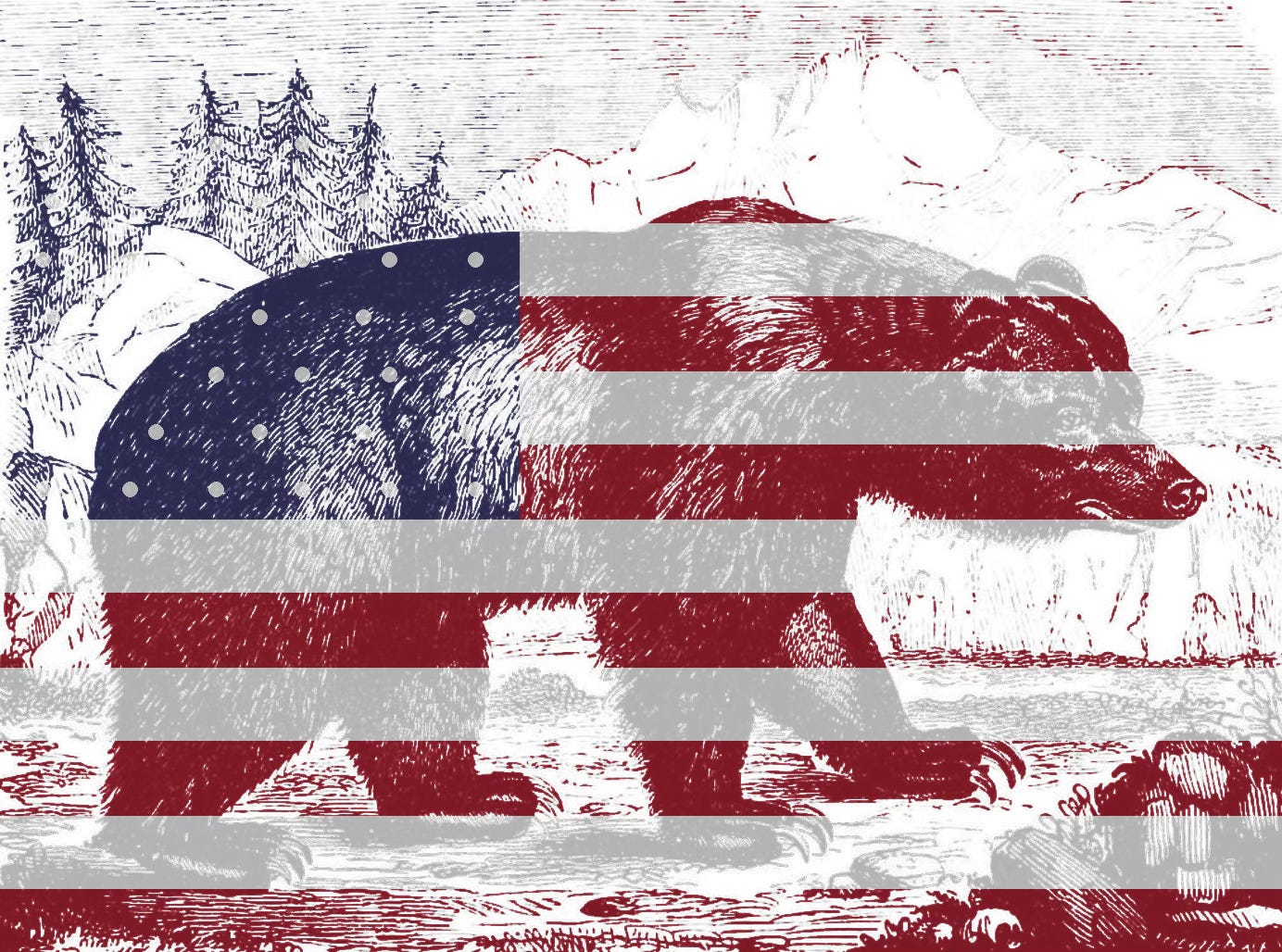
A good way to understand our current predicament as Americans is to imagine that we are a bear in the woods being attacked by hungry wolves. Our paw is caught in a trap, and a wildfire is raging our way. The wolves are politicians. Some are gray, some are black, but wolves are wolves. It doesn’t matter what side of America’s yawning political divide you stand on: both sides feel like they’re being attacked by wolves.
One side feels the shredding of safety nets, federal programs, and commitments to inclusion and honest history. The other side feels the destruction of traditional family mores, religion, and parental control.
So, we are driven to close ranks. Gallop found that, on average last year, a gob-smacking 90% of Republicans—the number getting as high as 93% for nearly a quarter of the year—approved of President Trump’s job performance. Just 3% of Democrats did. Such a historically wide gulf tells us that each side fears it will get torn apart whenever the other side is in charge.
Meanwhile, flames are bearing down on us from the edge of the forest. The wildfire is global economic turbulence fueled by globalization (and now de-globalization) and technological transformation. These fuel climate change and historically unprecedented levels of human migration, which in turn sparks cultural destabilization in societies around the globe. They also contribute to our nationwide housing crisis.
Maybe we could fend off those wolves once and for all and also do something about the flames—if we could just get our foot out of that dang trap.
But what’s the trap?
The trap is an election system that has been captured by party processes gone wrong. We’ve had decades of changes—some of them well-intentioned, some about accruing power—to how our political parties operate. They have left us in a place where most members of Congress are elected by only 5 to 8% of the electorate in their districts. Gerrymandering and low-turnout primaries mean that if a candidate appeals to the most intense and active members of their partisan base, they can sail into office.
Our members of Congress don’t work for the bulk of Americans, they work for that tiny sliver of partisans. Their incentive is to keep their base happy, so they have little reason to make deals that would compromise the ideological positions for which they were elected. Congress is now so split along ideological lines that it rarely gets any legislation past the Senate filibuster. What does a dysfunctional Congress give you? A power vacuum and a frustrated, anxious public. What happens when Congress stops legislating and leaves a power vacuum? Well, the executive will fill it.
Since FDR, the power of the president has only grown, but that growth accelerated with our last two presidents. Joe Biden leaned into the Covid emergency to cancel student loans, require vaccinations, and extend a ban on apartment evictions. Now, thanks to Project 2025, a unitary executive theory on steroids, and an assist from the Supreme Court’s presidential immunity decision, we have a president who is governing by executive order to an unprecedented degree.

Back in England in the 1760s and 1770s, the complaint in London was that Parliament had lost legislative supremacy. That is why people began to call King George III a tyrant.
The U.S. Congress has lost legislative supremacy.
How to Free the Bear
Democrats and Republicans have both learned that declines in membership needn’t diminish their ability to win control of the nation’s institutions. In 2004, according to Gallup, 34% of Americans considered themselves Republican, 34% considered themselves Democrats, and 31% considered themselves independent. Twenty years later, those numbers were 28% Republican, 28% Democrat, and 43% independent.
Has the power of the parties shrunk with the public’s declining affiliation with them? Not at all. Thanks to gerrymandering and low-turnout primaries, each of America’s two major parties can control the most powerful nation on earth with less than one-third of the population calling the party home.
Year after year taxpayers keep paying for party primaries, even though party enrollment keeps shrinking. The Republicans and Democrats are like companies with a declining customer-base but a guaranteed revenue stream, thanks to American taxpayers. This is corruption of the worst kind, because it distorts the fundamental distribution of power in our system of self-governance.
How can this two-party doom-loop, as political scientist Lee Drutman calls it, be broken? These problems with the parties have generated two reform strategies in democracy renovation circles. One seeks to end the two-party doom-loop by encouraging the formation of new parties and minor parties, or even the kind of multi-party landscape that operates in European parliamentary systems. Ranked-choice voting, or fusion ballots like New York uses, are the proposed solutions. The second takes an anti-party position, wishing to see parties diminished and replaced by centrist, problem-solving politicians who are able to forge bridge-building coalitions. The solution, on this view, is open or nonpartisan primaries where all candidates run on the same first ballot, and then some number of finalists moves on to the general election.
In my view, neither dream is realistic. Parties are necessary for healthy democracies. They are mediating organizations that connect people at the local level to larger national issues, and they serve as information clearinghouses. They simplify the job of thinking about the many issues a citizen might want to weigh in determining their vote.
America will never settle permanently into a European-style multi-party system. The combination of federalism and our elected executive will continually drive our politics toward a two-party equilibrium. The story of the 19th century reflects the natural state of our institutions. Two major parties emerge for a time; then they split, or else minor parties emerge, and the country goes through a period of realignment—as when the Republicans emerged from the Whigs—and eventually the chaos of multi-parties resolves back to two dominant parties.

At the end of the 19th century, though, the Democrats and Republicans began passing laws at the state level to make it much, much harder for new parties to form. Like any other monopolists, they acted to protect their turf. States set a minimum number of votes required for a party to maintain its status. Running a political party became a state-regulated activity, and diverse rules proliferated around the country. Today, to function nationally a new party must master 50 different sets of procedures. This remains a serious barrier even for well-known parties that have existed for decades.
We must change the operating conditions for our parties. They need incentives to work for the American people, not just for themselves and their shrinking number of members. Two reforms are needed to steer our parties toward health.
First, we need to abolish party primaries. Parties should have to compete for the whole electorate, rather than being able to claim power based on low-turnout, gerrymandered primaries.
Second, the barriers to entry for new parties need to be lowered. We should abolish taxpayer-funded party primaries and replace them with an all-party primary, where all candidates run on the same first ballot and the top vote-getters go on to a final round.
Four states already work this way: Louisiana, California, Washington, and Alaska. In the first three states, two finalists go on to the final round. In Alaska, four finalists move on and voters get to use ranked-choice voting in the general round. Two more—Massachusetts and Oklahoma—are working on getting similar reforms through.
Candidates from these states span the political spectrum. This reform seems to have brought Washington State a somewhat more progressive politics, while California has seen some moderation (possibly also the result of independent redistricting there). Louisiana and Alaska are both more conservative. But the crucial thing is that across the spectrum, these states have politicians who are more willing to make deals across party lines. They don’t have to live with the fear of being primaried for stepping out of line. And deal-making is good for doing work for America.
All-party primaries can be structured to make it easier for minor parties to compete. Parties can still hold endorsement conventions and candidates can carry those endorsements on the ballot. They can even carry more than one endorsement. Voters will routinely have actual choices, not the sparse subset of candidates one of the major parties puts forward. Public debate will be improved. Challengers will have a better chance of winning. Incumbents will be rewarded for figuring out how to work for, and run in relationship to, the whole electorate. Democrats will see more general election races pitting two Democratic candidates against each other, restarting the engine of ideas for the party. Republicans will see less blocking of pro-democracy Republican candidates in the primary process. Third-party candidates will have more opportunities to carry their message and potentially break through.

People often think that democracy renovation is a long-term game, but that’s wrong. Every two years, we have a chance to change the rules that govern how our parties operate. If we can clean up our party system a bit every two years, eventually we will have re-domesticated those wolves, turning them back into sled-dogs pulling together for the whole American people.
Don’t Be Afraid to Free the Bear
If we’re the bear, and the way to get our paw out of the trap is to get rid of party primaries, why haven’t we done it yet?
There are still those wolves after all, and their bites are excruciating. Maybe you run a labor union, and your members’ jobs are being hacked away by AI. You might reasonably think you must devote every ounce of energy to fighting off this threat. You would not be wrong.
But here is another question to consider: Wouldn’t you have a better chance of reining in the power of Big Tech if you could turn toward democratic institutions that were not captured by parties that have been captured by big money, including tech money, but that instead actually work for the whole American people? The urgent problems we face will be better addressed if our politicians view their responsibility as working together, for all of us. If another weapon of self-defense—through reform to political primaries—is within reach, maybe it makes sense to grab it?
The most paralyzing question of all is this: “If getting rid of primaries means politicians always have to campaign to the whole electorate, won’t they be less responsive to my particular needs and the needs of my community?” This question often comes from people who believe so much in democracy that they participate vigorously in our current primary system. They have correctly observed that sometimes the small turnout in a party primary makes it easier to overcome an incumbent politician and elevate a new voice in our politics. Our most activist lovers of democracy draw some real benefit from the current system.
All-party primaries put the whole electorate back in the driver’s seat. Yes, this does mean that, if you’re an activist with a cause, you’ll have to make your case to everyone. It won’t be possible to slip through with just a sliver of the voters. But if one prefers the primary process as it currently exists for getting one’s causes through, that suggests a surprising lack of confidence in the value of one’s policies for society as a whole. If a policy is good for the broad community, then one should be able to win elections by advocating for it.
Of course democratic majorities are not always right, but we should have confidence in being able to work with our fellow citizens. Democratic theorists have been worried about the tyranny of the majority since at least James Madison. Strong rights protections and fair courts are necessary. Yet the election system must be tethered to the whole people—that is the purpose of universal suffrage, after all.
Someone said, in the 19th century, that “you can fool all of the people some of the time, and some of the people all of the time, but you cannot fool all of the people all of the time.” Wrongly attributed to Lincoln, this quotation nonetheless captures Lincoln’s strong faith in the American people and his belief that self-government depends on the permanent attachment of our political institutions to the broad population. Lincoln did say, “The people ... are the rightful masters of both Congresses, and courts—not to overthrow the Constitution, but to overthrow the men who pervert it.”
Renovating democracy requires confidence in constitutional, rights-protecting democracy. The party primaries that dominate our current system have been created and sustained by interests that lack that confidence. The task of winning policy victories via a competition for the allegiance of the whole electorate is bracing and hard. Yet it is fundamentally the necessary work of constitutional democracy—even for activist causes. The work starts by shutting down fear of one’s fellow citizens and replacing it with curiosity.
The trap we’re in is not merely the institutional problem of party primaries. It is also fear of our fellow citizens. There will be cultural work to do to get ourselves out of our trap. But for now, let’s start beating back the fear by scenario-planning how to fight elections in new conditions. There is a better world on the other side of freeing the bear. Let’s not be trapped by fear itself.

An earlier version of this article was first published in The Renovator.
Follow us on Bluesky, Threads, YouTube, TikTok, Facebook, Instagram, and X.
We welcome your reactions and replies. Please adhere to our comments policy.

I'd take it a step further and repeal sore loser laws. We need to defang parties. We need to break up the outsized power party central committees have over whom the candidates are. Read George Washington's famous farewell address. When you read what he says about political parties, you'll think he had taken a time machine to witness the insurrection on 1/6/2021.
Thank you for this clear presentation of a solution to our hype-partisan quagmire. I have long thought this would be a helpful direction in which to go. But there is a problem.
Obviously parties that have a lock on their state governments will not support anything like this because they do not want to risk their control and power. Here in Florida, under the direction of Governor DeSantis, our Republican controlled legislature has outlawed any sort of open primary or ranked choice type voting system even for nonpartisan local elections. It will take a ballot initiative to make a constitutional amendment to change that. The threshold for passage here is 60%. Republicans are creating obstacles for ballot initiatives and when they are passed the Republican legislature will make every effort to substitute their interpretation of the amendment for the clear intention of the initiative for which the people voted.
They used to say that states were the laboratories of democracy--- however Florida has become the laboratory of autocracy in preparation for the campaign of Ron DeSantis to become the successor to Donald Trump.
Nevertheless, if enough states move in the direction you have suggested it may reduce some of the partisan constipation we are suffering now.