


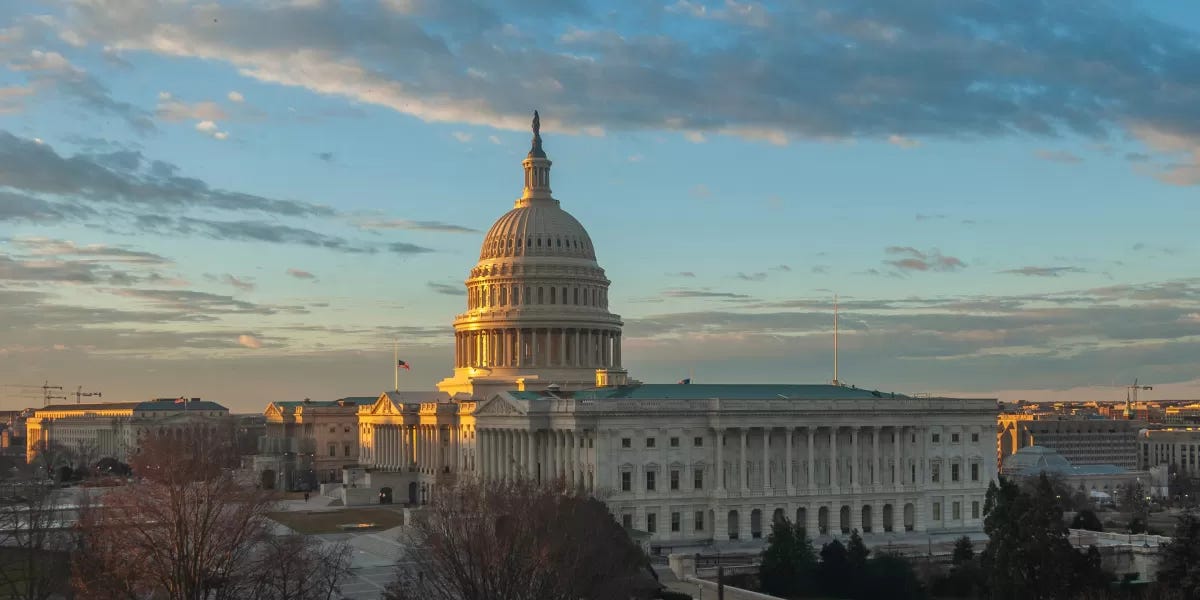
On April 22, Rep. David Scott (D-Ga.) died in office at the age of 80. He was the fifth member of the 119th Congress to die since it convened in January 2025, following Reps. Sylvester Turner (D-Texas, 70), Raúl Grijalva (D-Ariz., 77), Gerry Connolly (D-Va., 75), and Doug LaMalfa (R-Calif., 65). In this Congress and the preceding one, that is since 2023, nine members have died in office, all from natural causes. Of them, eight were Democrats. Two were in their 60s and the others were all in their 70s or older. The eldest, Sen. Dianne Feinstein (D-Calif.), was 90.
The House version of Trump’s “Big Beautiful Bill” passed by just one vote shortly after Connolly’s death. Two Republicans missed the vote, but even if they had been there, the three Democratic vacancies from deaths, as it stood at the time, would have been enough to defeat the bill on a tied vote. Eventually, the Senate returned an amended version, which the House passed 218 to 214. But the effort likely would have collapsed if the House had failed to pass its initial version. It wasn’t the first time this year Speaker Johnson’s (and thus Donald Trump’s) agenda has gotten a boost from the grim reaper.
Of course, Congress isn’t the only example. At the other end of Pennsylvania Avenue, the White House has been occupied by record-breaking elderly presidents for the past decade. Nobody needs a reminder of what happened to Biden’s reelection bid, and by the end of this term Trump will be older than Biden was when he left office.
Understandably, we don’t much like talking about death, and have an even stronger cultural distaste for criticizing the recently departed, or senior citizens for their declining health. But sometimes there are more pressing practical problems we have to confront. Many of us have been there at some point with our own aging relatives, and know how difficult it can be to take the necessary steps. But sometimes, it simply is necessary, and we are not doing anybody any favors by looking the other way.

America’s political gerontocracy is a genuine problem. It fuels dysfunction, distrust, and concrete negative policy consequences. We can’t sweep it under the rug any longer: too many of our high officeholders, including a disproportionate number of Democrats, are simply too old. It’s not unacceptable ageism to say so; it’s the cold, hard reality. And it’s time to confront it head on: we need a mandatory retirement age for politicians.
The Incumbency Racket
America’s electoral system is broken in ways that disproportionately benefit aging incumbents. Our uniquely absolute two-party system guarantees most congressional seats remain safely in the hands of the same party year after year, with little more than token opposition in the general election. Primary elections rarely pose a threat to individual incumbents, either, with entire party apparatuses dedicated to protecting sitting members above all else. For most people who manage to snag one of the rare open opportunities to become a member of Congress, the job is effectively theirs for as long as they want it. And the attitude of perpetual, personal entitlement shows.
One of the foundational principles of civic republicanism is that no man is indispensable. George Washington went out of his way to make the point, first in surrendering his military command at the end of the Revolution, and again in limiting himself to two terms as president. In this, as with many of the Founders, he was consciously emulating the classical virtues of the Roman republic. Suffice it to say, Washington had a much better claim to being an essential figure for the nation than any of today’s politicians, most of whom would not be recognized on the street by their own constituents. And yet egotism and hubris, fueled by a chronic lack of accountability, has allowed many to convince themselves that they are simply too good to retire in their 70s, or their 80s, or in some cases into their 90s. Thus our highest offices and most consequential decisions have come to hinge on the declining health and faculties of individuals clinging to office into unreasonably old age.
One example played out in the District of Columbia last year, while it is being subjected to a Trump takeover verging on military occupation. D.C.’s non-voting member of the House, Del. Eleanor Holmes Norton, was effectively incommunicado. Her brief public appearances have been painfully awkward, and her staff repeatedly had to “clarify” her insistence that she planned to run for another term before she finally conceded to reality.

At 88 years old, it is excruciatingly obvious Norton is debilitated precisely when her constituents need her most. Before that episode, Rep. Kay Granger (R-Texas) was revealed, after having been absent from Capitol Hill for several months, to be living in a facility for dementia patients at the age of 81. Sen. Feinstein had been publicly incoherent for some time until she died in office in 2023, age 90. The president pro tempore of the Senate, Sen. Chuck Grassley (R-Iowa), is currently third in line for the presidency at the age of 92. And these are just a few of the litany of examples.
Nor is this problem solely about an increased risk of legislators passing away before they finish their terms. As Feinstein, Norton, and Granger all make clear, sometimes there are members who are still alive but manifestly unable to do the job. For all intents and purposes, their voters are also going unrepresented for months and sometimes years at a time. As staffers and confidantes try to prop them up and cover up the reality, the situation often devolves into grotesque cases of outright elder abuse.
The practical impacts of this gerontocracy become starkly clear when viewed through the lens of razor-thin congressional majorities. In recent elections, control of the House and Senate has frequently hinged upon a mere handful of seats. When a member resigns or dies, seats in the House go vacant for months as they can only be filled by special elections.
The untimely death or serious incapacitation of even a single member of Congress can dramatically shift political power and alter policy outcomes nationwide. Fewer than 10,000 votes shifted across just three districts in 2024—the kind of margin so narrow it could have been flipped by the weather on election day—would have produced a Democratic House majority, one which would have since flipped from its own members dying in office. However understandably human it might be, this is unacceptable. Our ostensible servants are gambling with the public interest for nothing more than their own personal desires. It is shameful, and they should be shamed for it. But experience has shown electoral pushback and public dissatisfaction is not enough. As with so many other professions, from airline pilots to senior military officers, a hard and fast rule is the only workable solution.
Survey Says …
Public support for setting maximum age limits on members of Congress is overwhelming—a staggering 79% according to one Pew survey. Despite this, no current member has been willing to break the ice and say what more than three-in-four Americans are thinking. Republicans cower in fear of their own soon-to-be octogenarian president, and so are hardly in a position to make the point. Congressional Democrats similarly shy away from confronting their influential older members, and relatedly, any rehashing of Biden’s age-induced implosion (the recent Democratic National Committee autopsy of the last election pointedly avoided the issue). And many, perhaps most, have the direct personal conflict of interest that they also plan to hold office for the rest of their lives. Thus, even the modest gesture of proposing a popular constitutional amendment, one with bipartisan support across the spectrum, and which would have a reasonable chance of securing ratification by the states, goes unheard on Capitol Hill.

This disconnect highlights a broader democratic deficit. Politicians’ refusal to address age limits, as either a formal rule or even a normative expectation, exemplifies their prioritization of internal party dynamics and individual selfishness over responsive and responsible governance. It is absurd that a position supported by nearly four-in-five Americans can’t even get a hearing in Congress.
When directly confronted, too many aging politicians display shockingly selfish attitudes. Just a few months before his death last year, Rep. Gerry Connolly (D-Va.) resisted fiercely, and successfully, when Rep. Alexandria Ocasio-Cortez (D-N.Y.) challenged him for the role of Ranking Member on the House Oversight Committee. “Gerry’s a young 74, cancer notwithstanding,” declared Rep. Steny Hoyer (D-Md.), himself 86 years old.
Even more glaring was the petulance of Rep. Jim Clyburn (D-S.C.) on the subject when asked about it in May 2025. At 84, and having served in the House for more than three decades, Clyburn complained publicly, “Nancy left her seat. Steny left his seat. I left my seat. What the hell am I supposed to do now? What do you want—me to give up my life?” The sheer narcissism of this statement is astounding. None of these legislators have actually given up their seat in Congress; they merely passed caucus leadership positions to younger (as in firmly middle-aged) colleagues. Yet Clyburn reacted as if he has been unfairly relegated to obscurity, despite remaining among the country’s most influential politicians and a respected elder statesman in his party.
Such statements reveal an ugly truth: too many politicians view public office as a lifelong entitlement, divorced from the principle of service. They cling to power, prioritizing personal desires over public responsibility, displaying a staggering disregard for the democratic process and the constituents they supposedly represent. And there’s no reason to expect the situation will change unless there is a simple, objective limit which can’t be evaded by special pleading.
Public Office Is a Public Trust
It is understandable that elected politicians like Clyburn hesitate to relinquish their positions. For many, their political career represents decades of meaningful work, fighting for causes they deeply believe in. But these offices do not exist to satisfy personal ambitions or comfort. They exist solely to represent constituents and serve the public interest. When members of the House die in office, hundreds of thousands of citizens lose fundamental civic rights—representation, advocacy, and legislative input—for months at a time. Senate vacancies can be filled more quickly, but there is always the possibility that the governor with the power to appoint an interim senator will be from the opposite party, which undermines their democratic legitimacy—or that the special election itself could flip a seat, as happened in 2010 following the death of Ted Kennedy, with substantial consequences for the Affordable Care Act.

The harm inflicted by legislators refusing timely retirement is concrete, tangible, and fundamentally undemocratic. The same observation can be made of the Supreme Court, most notoriously in the case of Ruth Bader Ginsburg, who refused to retire when there was the opportunity for an ideologically aligned replacement. But she wasn’t the first. Before her, Thurgood Marshall made the same miscalculation, resulting in his replacement with Clarence Thomas.
Likewise, it is hard to deny that American politics would be in a better position than its current sorry state if Joe Biden (elected at 77) and Donald Trump (elected for the second time at 78) had been off the list of eligible presidential contenders. It is not unreasonable to insist the most powerful office on the planet should not repeatedly see occupants celebrating their 80th birthdays.
One common retort is that a mandatory retirement age for members of Congress would be undemocratic. After all, shouldn’t the voters have their choice, even if it’s an elderly longtime incumbent? But it is not reasonable or realistic to expect voters to judge the declining faculties of individual elected officials case by case. Voters aren’t interacting with them personally on a day-to-day basis. And as we have seen, staffers will often go to extraordinary lengths to hide the truth, carefully managing appearances and issuing dishonest denials.
Add to this the immense advantages of incumbency, including national parties determined to defend their incumbents by default, and how the vast majority of districts are uncompetitive in general elections, and it becomes plain “just vote them out” isn’t a workable solution.
Many states already impose mandatory retirement ages on judges, and we do likewise for a range of jobs where it’s a concrete practical necessity, for reasons of both physical condition and mental acuity. Federal elected offices already have minimum age requirements written into the Constitution—25 for the House, 30 for the Senate, 35 for president—which are far less justified than sensible maximums would be. Adopting a mandatory retirement age somewhere in the early-to-mid-70s would provide clarity, stability, and essential generational renewal.

Growing public frustration with gerontocracy is real, palpable, and justified. Politicians who continue disregarding this frustration risk eroding public trust further and deepening democratic dysfunction.
Ultimately, confronting America’s political gerontocracy means reaffirming that public offices exist to serve the nation and its people, not the personal ambitions of its politicians. It is also one of the few constitutional amendments which enjoys widespread supermajority support and thus a reasonable chance of ratification. And if the principle of the matter isn’t enough, it’s worth reminding our legislators that there is an immense political opportunity to claim credit for something voters overwhelmingly think is a good and necessary idea.

A previous version of this essay was first published at Liberal Currents, before the additional death of Rep. David Scott.
Follow us on Bluesky, Threads, YouTube, TikTok, Facebook, Instagram, and X.
We welcome your reactions and replies. Please adhere to our comments policy.
Kudos for this thoughtful piece.
In sports, age (of the body) determines a player's viability. Airline pilots must retire at a certain age for safety reasons. Other businesses have mandatory retirement ages.
And then there are the three branches of the Federal government...
I am 65, so I cannot be accused of not understanding the issue or being swayed by my own age. 70 should be the mandatory retirement age for ANY federal office.
Period.
These fossils like Feinstein, Grassley, Biden and Trump have no business in office - their very existence in office shows their selfishness and runaway egos run amok. Add to that poisonous combination mental decline, and you have a recipe for disaster.