


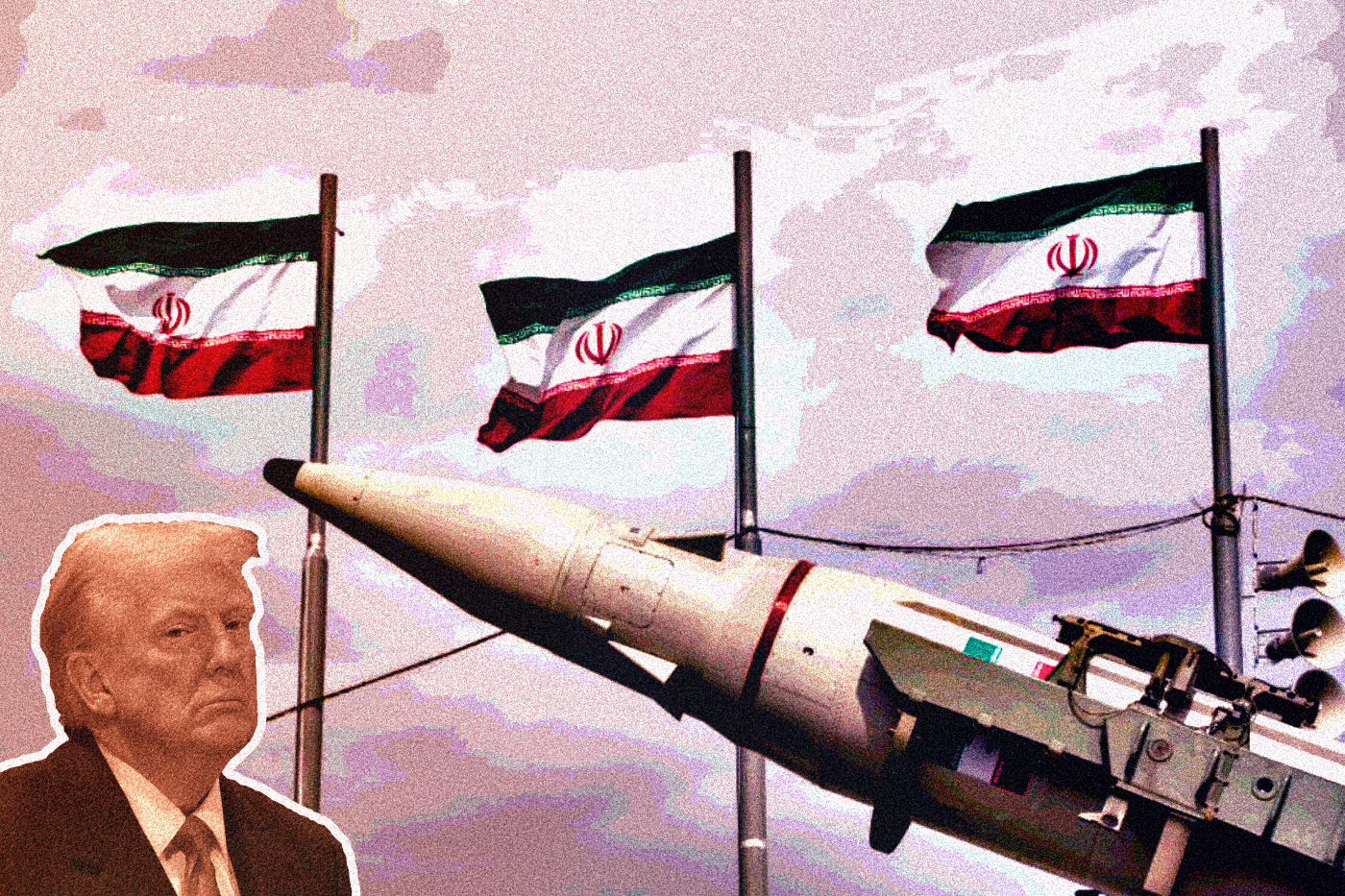
On Donald Trump’s orders, the U.S. military has massed around Iran, the largest build-up in the Middle East since invading Iraq in 2003. America’s intentions aren’t clear—regime change? damage? coerced negotiations?—as there’s been virtually no public explanation or debate. A bluff to generate leverage and preparation for a real attack look the same until someone starts shooting or backs down.
Trump expressed support for recent Iranian protests and promised “help is on its way,” then did nothing as government forces massacred thousands of people and reasserted control. In a long State of the Union address, he spent little time on Iran, declaring that Iran “will never have a nuclear weapon,” and saying “we’re in negotiations with them, they want to make a deal,” without offering specifics.
U.S. officials have held talks with Iranian representatives, but they’ve gone nowhere, surprising the White House. The New York Times reports, “as American warships and fighter jets mass off its shores, Iran has refused to concede to President Trump’s demands on its nuclear program and weapons—a stance that has bewildered U.S. officials.” Trump envoy Steve Witkoff expressed a similar confusion: Trump is “curious as to why they haven’t … I don’t want to use the word ‘capitulated,’ but why they haven’t capitulated.”
This confusion is unsurprising from people who approach the world as narcissistic, risk-averse bullies.

Trump and Co. seem genuinely surprised when the smaller side doesn’t give in to threats, even though it keeps happening. He recently declared that America would own Greenland, proceeding as if Denmark would hand it over since the U.S. is more powerful. They refused, Trump made more threats, but Denmark and allies deployed troops as a signal of commitment, and Trump backed down. At least for now.
When Russia invaded Ukraine in February 2022, Trump called it “genius.” That reflected his long-running Russia sympathy, yes, but also indicated he expected it to work. “Putin declares a big portion of the Ukraine—of Ukraine—Putin declares it as independent. Oh, that’s wonderful,” Trump gushed in an interview.
Trump appears genuinely confused that Ukraine didn’t capitulate. After becoming president again, he has tried to end the war by reducing support for Ukraine and berating the Ukrainians to accept the supposed inevitability of Russian victory. It hasn’t worked.
Asked about Ukrainian President Volodymyr Zelenskyy saying it’s unfair to demand concessions from Ukraine but not Russia, White House Press Secretary Karoline Leavitt snapped that Trump “doesn’t think it’s fair thousands of Ukrainians are losing their lives.” As if Russia aggressively invading means Ukraine should bow down—a remarkable claim from the leaders of a country and political party fond of Revolutionary War slogans such as “give me liberty or give me death” and “don’t tread on me.”
Trump has shown a willingness to use force—including without proper congressional authorization, against U.S. and international law—but only when it’s short, low risk, with little-to-no follow through.
He bombed Iranian nuclear sites for a few days last year, but only after Israel had been bombing for a week, taking down Iranian air defenses. Then Trump lied that Iran’s nuclear program was “completely and fully obliterated.”

He’s bombed small boats in the Caribbean and eastern Pacific, shooting at people who can’t shoot back. That’s killed at least 148 people, none of whom posed a national security threat, and hasn’t reduced drug trafficking either.
By contrast, the Houthis shot back, and Trump backed down. The Yemen-based, Iran-backed group fired on international shipping in the Red Sea and shot rockets into Israel, claiming solidarity with Palestinians in the Gaza war. Promising to stop it with force, Trump began bombing Yemen in March 2025, declaring that he’d hold Iran responsible for “every shot fired by the Houthis” and they’d face “dire” consequences. The U.S. dropped about $1 billion worth of bombs on Yemen, damaging some targets, killing some people, and losing two fighter jets—which fell into the sea in separate incidents, possibly from their carrier turning quickly to avoid Houthi fire—but failed to end Houthi attacks.
Then in early May, Trump stopped the strikes, claiming he forced the Houthis to make a deal. The group kept attacking Israel, and two months later fired on Red Sea shipping again. In response, Trump did nothing, acting as if it didn’t happen.
That recalls when the U.S. killed Iranian general Qassem Soleimani in Trump’s first term. The impetus was attacks by Iran-backed militias in Iraq; Trump officials claimed killing Soleimani stopped it, but everyone below Soleimani moved up a spot and Iranian support for proxies continued. Militia attacks in Iraq did, too—Trump just didn’t talk about it.
Something similar happened in Venezuela. U.S. special forces removed president Nicolás Maduro, but left the rest of the regime intact. There’s minimal follow through, no apparent advancement of U.S. national interests, nor improvement for the Venezuelan people.

Iran poses a bigger version of that problem. Threats won’t make the regime give up its nuclear or missile programs, bombing can’t end them, and removing top leaders probably won’t change things. It’s a bureaucracy full of ideologues, not a personalist dictatorship. You can’t bomb knowledge, and Iran already rebuilt some of the capacity Israel and America damaged last year.
This is a failure of Trump’s own making. The U.S. had a deal curbing Iran’s nuclear program, but Trump scrapped it in 2018, letting Iran out of restrictions in exchange for nothing while promising that “maximum pressure” would get Iran to accept a “better deal.” It didn’t work, and Iran ramped uranium enrichment back up. Iranian officials who argued that the U.S. can’t be trusted got a big “told you so.”
That makes it even harder for Tehran to make a deal, since it cannot trust that American pressure will ease in response. It saw Trump back down from confronting the Houthis, but respond like a stereotypical bully to domestic and international institutions that give in, treating concessions as a sign of a soft target and demanding more.
Iran won’t capitulate under threat, forfeiting major national interests because Trump told it to. His track record suggests he doesn’t have the stomach or strategic foresight for protracted conflict, and will back down if things get difficult, which makes Iranian leaders think they can weather an assault. And they have strong domestic political incentives to resist, fearing that weakness against foreign pressure could fracture the regime or encourage domestic opponents.

That leaves the U.S. choosing between another round of limited bombing that accomplishes little, a bigger campaign to collapse the regime with no apparent plan for what comes after, backing down in embarrassing fashion, or an empty “deal” Trump can lie about that, at best, kicks the can down the road and makes the problem even harder to solve. It’s easy to predict which option he’ll pick.

An earlier version of this article first appeared in Arc Digital.
Follow us on Bluesky, Threads, YouTube, TikTok, Facebook, Instagram, and X.
We welcome your reactions and replies. Please adhere to our comments policy.

Trump has a unique opportunity to topple the Shia Theocracy that rules Iran.
Agreed that he can’t do it on the cheap. The Mullahs won’t negotiate their own destruction. So he has to make sure he has enough military force on hand to decimate the Mullahs and their supporters. It has to all be done by air and sea, with no mass ground troops. The US has to first take out whatever is left of Iranian air defenses and communications systems. Then decapitation strikes to destroy most of the leadership. Then the next wave will take out ports and naval assets. Perhaps one or two oil facilities but no more - to make it clear to China it really should not intervene. Finally there will be several waves to destroy the Iranian missiles and drones. Iran will launch a thousand missiles or so, but they will cause relatively little damage. Maybe a few smaller US ships will be hit and also a few bases. This is not on the cheap. However it is not all that expensive either.
The CIA and Mossad can let key commanders know of ways to surrender their units and stage a coup. Civilians are demonstrating and will take US strikes as a signal to attack the regime. Many in the Iranian apparatus will find a way to disappear and end up in Moscow.
The regime is weaker now that it’s ever been. Inflation is over 35%. Unemployment is high. There are shortages of water and oil. The regime is deeply unpopular and is holding on by a strategy of mass repression. Neither Russia nor China will really do much to bail it out.
This is a regime that has been screaming “Death to America” from its inception. It is completely dedicated to the concept of Martyrdom in pursuit of jihad against the Great Satan, which of course is the US. If this opportunity is squandered and Iran gets a nuclear weapon, no one knows whether deterrence through mutually assured destruction will work. It would be incredibly imprudent to let the future unfold with this threat when we have a chance to eliminate it now. Toppling this regime will lead to a safer future for the US, for Europe, for Israel, and for moderate Sunni Arabs.
Venezuela was never about regime change every time an administration bootlicker like Lindsey Graham or Rubio waxes eloquently about freedom for the Venezuelan people Trump standing right next to him brings the conversation back to the only thing that matters to him which is the OIL.
If Trump can get a "deal" on nukes with no regime change he will be happy and have bragging rights for his Nobel aspirations. The deal he cuts will be more or less the same outline as the agreement Obama made but baptized with his name it will something like no one has ever seen before. Just as he will be just as pleased to give Putin half of Ukraine and walk away declaring victory.
It is not for nothing that America is called the "Great Satan" and at this time even considering pretending that Trump is a normal President running some sort of normal foreign or military policy is bonkers. Someday a war with Iran MIGHT be necessary but letting the "great Satan" himself run that war is a disaster.