


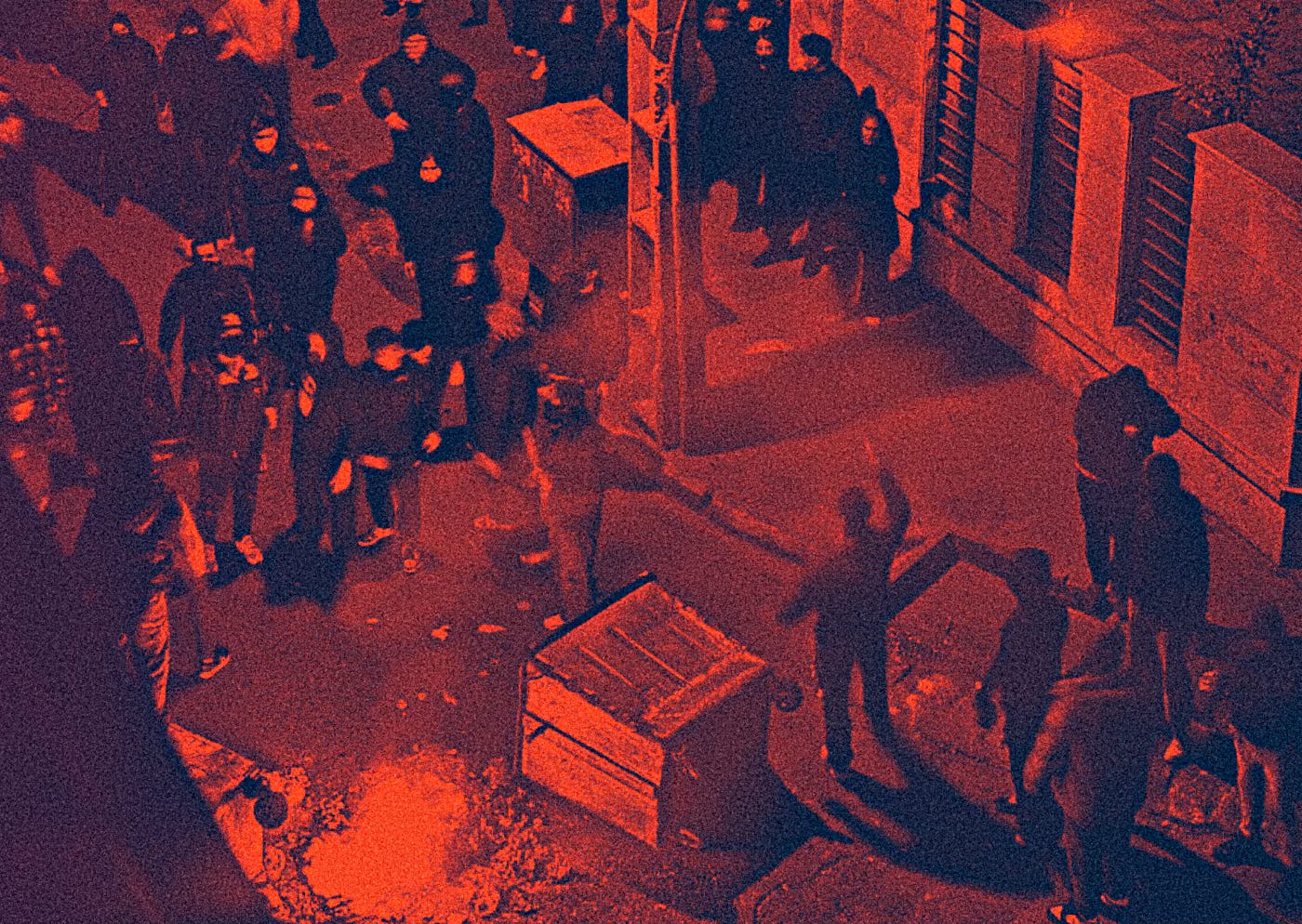
From Dec. 28 into January, Iran once again witnessed nationwide protests. As in the past, they started over economic grievances in one city and swiftly became politicized—complete with anti-government slogans and regime change demands—and spread across the country. As they intensified, the regime responded with brutality unprecedented in the 47-year history of the Islamic Republic.
The statistics are staggering: While a complete picture is not available due to ongoing internet and telecommunications outages by the state, as of Feb. 1, somewhere between around 6,800 and 18,000 people have been killed, another 42,000 arrested, over 350,000 injured, and hundreds face death penalty charges. These figures far eclipse past protests. The previous high was 1,500 deaths in 2019-20 and 19,262 arrests in 2022-23.
The regime’s tactics this time have been particularly indiscriminate, brutal, punitive, and vindictive. Aside from using live ammunition that littered the streets with dead bodies and inundated hospitals with injured individuals, state security forces blinded hundreds, possibly thousands, of citizens by deliberately shooting them in the eyes. To add insult to injury, the regime reportedly required the families of dead protesters to pay for the ammunition used to kill their relatives before receiving the body for burial.
Iranians who seek a democratic future are caught in a difficult bind: they are stuck with a deeply authoritarian and repressive regime at home. And the leaders in Washington and Tel Aviv supposedly championing their cause are themselves illiberal and morally compromised—and reflexively fickle. It is abundantly clear that they are only performatively interested in supporting democratic uprisings.
The real victims of these intersecting axes of authoritarian interests are the Iranian people—and no one is coming to their rescue.
Encouraging Martyrdom From Mar-a-Lago
Throughout the protests, President Donald Trump threatened Iranian Supreme Leader Ali Khamenei and other leaders with military action if they killed protesters. He also called on Iranian citizens to come to the streets and “take over your institutions”—which some protesters interpreted as a call to attack police stations and government buildings—while claiming that help was on the way. Trump started making these statements after meeting with Israeli Prime Minister Benjamin Netanyahu. And Netanyahu, who has been on trial for corruption since 2021 and has an International Criminal Court (ICC) arrest warrant for alleged war crimes and crimes against humanity in Gaza, is hardly a disinterested party.

Trump himself is hardly taint free. While he was inciting Iran’s population and threatening its regime during the latest protests, he was also deploying federal immigration agents to Minnesota. These agents not only surveilled and harassed anti-ICE activists and observers but also killed Renee Good and Alex Pretti—executions that Trump initially supported (though he has back-tracked somewhat on Pretti). But more revealing—and damning—is that the rhetoric Trump used to discredit the anti-ICE protesters by calling them agitators, insurrectionists, and “domestic terrorists” has remarkable similarity to that employed by Khamenei and other Iranian officials against protesters in their country.
Return of the King
Alongside Trump, Iranian political dissident Reza Pahlavi urged Iranians, from his home in suburban Washington, D.C., to join the protests—which contained pro-monarchy slogans. Pahlavi, who did not rule out a return to monarchy, was the son of the Shah who had ruthlessly ruled Iran by detaining and torturing tens of thousands of political prisoners during his reign. His security forces—which received funding and training from the U.S. and Israel—killed anywhere from several hundred to a few thousand protesters during the Iranian Revolution of 1979 before he was deposed and forced to flee the country.
During the 12-day war between Iran and Israel in June 2025, Pahlavi angered some Iranians, including prominent political prisoners, by failing to condemn the Israeli strikes that killed at least a dozen nuclear scientists and senior commanders, claimed the lives of 1,190 people, and wounded and displaced thousands more—all while Pahlavi joined Netanyahu in imploring Iranians to rise up against the regime.

After the conflict, Israeli investigative journalists uncovered an Israeli influence operation that promoted Pahlavi—who had officially and controversially met with Netanyahu while visiting Israel in April 2023—to Persian speakers on social media as the next leader of Iran. Pahlavi’s connection to the operation, combined with his conduct during the war, called into question his viability as a unifying figure and opposition leader.
All Talk, No Action—and Thousands Dead
Though some Iranians did not take Pahlavi seriously, that was less the case with Trump and his promise to come to their rescue. After all, during the 12-day war, he had approved Israeli airstrikes against Iranian military and nuclear personnel and infrastructure, as well as deployed American B-2 bombers and bunker busters to bomb three Iranian nuclear sites. So his statement that he would be willing to intervene again during the latest protests was credible.
On Jan. 3, several days into the protests, Trump ordered the U.S. military to capture the ruthless dictator and longtime ally of the Islamic Republic, Venezuelan President Nicolás Maduro. This affected the Iranian situation in two ways. First, Trump caused the Iranian regime to perceive the protests as a serious, if not existential, threat and crack down on them harder than ever. Second, more Iranians came out to join the protests in the hope that he would intervene in Iran just as he had done in Venezuela.
At first, it seemed Trump was going to take military action against Iran when he evacuated personnel from Al Udeid airbase in Qatar—the largest in the region. However, he subsequently backed off due to a lack of preparedness, even as he claimed he had done so after convincing Iranian officials to refrain from executing 800 protesters on death row—which the officials vehemently denied.

Trump has belatedly dispatched an armada of the U.S. Abraham Lincoln Carrier Strike Group and three naval destroyers toward Iran in the Indian Ocean, but, so far, the situation remains at a standstill. Meanwhile, regional allies and partners, including some that host American bases and could be targeted by Iranian missiles, are desperately appealing to Trump to deescalate tensions in the region.
Trump’s Confrontation Meets Iran’s Resistance
It remains to be seen whether Trump will listen to them, but this was not his first confrontation with Iran.
In 2018, he withdrew from the Iran nuclear deal and reimposed sanctions. And then, in 2020, Trump ordered the assassination of Tehran’s top commander, Qasem Soleimani. The operation brought both countries to the brink of war, as Iran retaliated by launching missiles and injuring troops at the American Al Asad airbase in Iraq.
Early in Trump’s second term, five rounds of nuclear negotiations between the U.S. and Iran stalled over his maximalist demands of zero enrichment and full dismantlement—conditions Tehran categorically rejected as a signatory of the Nuclear Non-Proliferation Treaty. The sixth round was scheduled to take place when it was abruptly disrupted by the Israeli strikes against Iran that started the 12-day war with Trump’s support.
Now, Trump says he wants to make a deal with Iran. However, it is unclear what would comprise the starting point or end game of new negotiations, especially if Iran’s nuclear program was completely obliterated by the U.S. during the war, as Trump confidently declared—an assessment domestic and international agencies disputed.
At the same time, Trump has not taken the military option off the table. Speculation about an American attack against Iran ranges from interdicting its oil tankers or imposing a naval blockade to conducting punitive strikes against its military and political personnel and infrastructure to decapitating the regime by assassinating or apprehending Khamenei, as the U.S. did with Maduro.

Such scenarios come with two major risks that might deter Trump from intervening. The first is Iran’s deterrence capability in the form of a robust arsenal of combat drones and cruise and ballistic missiles. During the 12-day war, they increasingly penetrated Israeli airspace, with several targeting Al Udeid, as American and Israeli interceptors dwindled and Trump called for a ceasefire. Throughout the latest protests, Tehran has clearly communicated it would respond to another attack by targeting American assets in the region.
Also, Iran could destabilize global energy markets by following through on its threat to close the Strait of Hormuz, through which 20 to 30% of the world’s total oil consumption is transported. Such an action by Tehran, particularly in the long term, would adversely affect its already fragile economy, not to mention that of its allies and partners like China that import Iranian oil. But if desperate enough, Iran might go through with it.
The second risk is the complicated and unintended consequences of regime change in a country of over 90 million people in one of the world’s most strategically consequential regions. Netanyahu has favored that outcome because a fragmented and weakened Iran could no longer challenge Israel. Trump seems to have less appetite for that, as evidenced by his limited intervention in Venezuela.
Betrayed by All Sides
Trump’s ultimate objective in mobilizing military assets to the region right now remains unclear.

What is clear is that Iranians are left to confront the trauma of a massacre while caught between a brutal regime at home and illiberal actors abroad who put their own agenda ahead of the Iranian people’s wellbeing. They include an American president who subordinates democracy to dealmaking; an Israeli prime minister who wants to replace a hostile regime with a weak and divided state; and an Iranian political dissident who wants to restore the pre-revolutionary monarchy, even if it means sacrificing national security and sovereignty.
For the Iranian people, these morally compromised and weak champions have dimmed the prospects for a democratic future.

© The UnPopulist, 2026
Follow us on Bluesky, Threads, YouTube, TikTok, Facebook, Instagram, and X.
We welcome your reactions and replies. Please adhere to our comments policy.

Agree with those who note that this is a brilliant analysis. Not stated in full is the US's history in Iran, which is one of repeated mistakes. The overthrow and murder of Mohammad Mosaddegh engineered by the CIA and the UK's MI6 led to the Shah, whose rule was counter productive. This led directly to the overthrow by the hard line theocrats that have turned Iran from a relatively progressive Middle East nation into a pariah. The current administration has escalated the level of mistakes to new heights.
The Iranian people are trapped by the same structural problem facing much of the world: there is no coherent, credible alternative to authoritarianism being offered in the mainstream. That’s why the Arab Spring failed, and it’s why the Iranian uprising is likely to fail as well.
Simply invoking “democracy” (a term people can't define today) and calling for elections is not a serious political program. It’s a slogan. Without politically literate and competent experts in this field, we either have chaos or return of authoritarian rule.
This isn’t just a Middle Eastern problem. It’s why what’s coming in the US over the next few years is likely to be unprecedented and genuinely frightening.
At root, we’re facing a massive crisis of expertise in politics. We no longer know how to govern complex societies due to a lack of familiarity with political philosophy.
We're running out of time to learn it. It’s much later than most people think.