


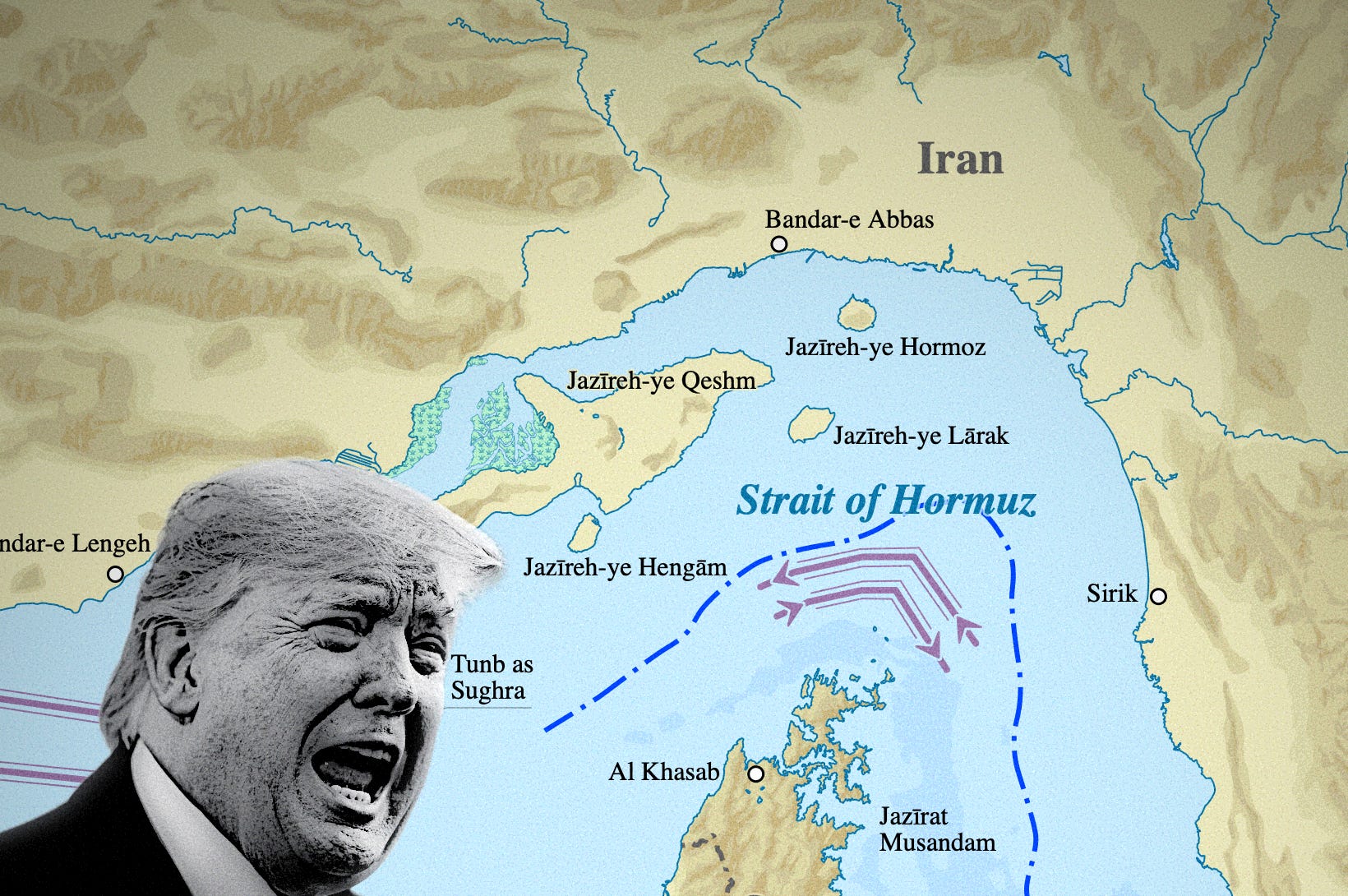
The most consequential thing that the war between the United States and Iran revealed has nothing to do with missiles or centrifuges. The war has shown just how much of the world’s economy now turns on the unchecked decisions of individual men: an American president who could start the war without asking Congress, and a Tehran regime that could respond by putting a fifth of the world’s oil beyond anyone’s reach.
The rest of the world got no say in any of it. On June 14, the United States and Iran reached a framework agreement to end their war and reopen the Strait of Hormuz, though the ceasefire has since broken down in an on-again off-again cycle of retaliations. (Right now, it is off!)
The largest oil and gas supply disruption in history is far from over, but its strongest legacy might well end the dominance of fossil fuels. Unlike the climate argument, which requires policymakers to minimize the economic costs of transitioning and therefore slows the process of adaptation, the Iran shock’s immediate economic costs for three-and-a-half months might change the oil and gas markets forever.
The 1973 oil embargo resulted in the interstate highway speed limit and research that eventually led to the lithium-ion battery. The aftereffects of this shock will likely be even stronger, shaped by three things the 1973 crisis lacked: actors that are ready to move, market forces already pulling in the right direction, and material conditions conducive to change. What people, businesses, and policymakers seek is protection from the disruption of oil and gas supply shocks, and they are harnessing market forces and technological progress to build the energy security architecture the world has never had.
A Waterway One Man Can Close
The closure of the Strait of Hormuz, Iran’s major point of leverage in response to joint U.S.-Israeli attacks, cut off more than four times as much oil supply as the 1973 crisis did. At its peak, it stopped up to 20 million barrels a day from reaching global markets. The narrow strait between Iran and Oman is the only available major waterway for the major oil producers in the Gulf—Saudi Arabia, Iraq, the United Arab Emirates, Iran, Qatar, Bahrain, and Kuwait—to export their oil.

This is a physical chokepoint and not, as in Ukraine, a sanctions-driven disruption. It is also a reminder of how much leverage a single unaccountable and authoritarian government can exert over the democratic world’s energy supply without consulting any legislature, court, or its own people. Nor was the attack on the nation any more accountable than the response: U.S. strikes that triggered the closure were ordered without a congressional vote—lawmakers tried on nine occasions to force one under the War Powers Resolution and lost every time.
Only about 3.5 million barrels can be rerouted through oil pipelines, leaving a gap of over 16 million barrels. As a result, oil prices surged as high as 55%, and gas prices at the pump increased 50%. In response, the 32-nation International Energy Agency (IEA) released over 426 million barrels from its strategic reserves across two tranches.
With traffic now disrupted again in spite of the on-again off-again memorandum of understanding (MOU) to reopening the strait till a final treaty is made, the developed economies face the equally consequential task of restocking those reserves, a process that will require approximately one million barrels per day of surplus supply for the next three years. As IEA Executive Director Fatih Birol put it, “[The] $110 trillion global economy can be taken hostage by a couple of hundred men with guns across a 50-kilometer stretch of strait—it doesn’t make sense at all.”
The ceasefire announced on April 8 raised hopes of relief, heightened by the June 17 MOU. But the situation remains deeply unstable. The two sides have exchanged fire repeatedly, and right now Iran has again announced a blockade of the strait and the United States a counter-blockade. Even the sanctions relief has proven fragile: Treasury’s 60-day waiver for Iranian oil exports was revoked within weeks, after Iranian attacks on shipping, and replaced with a wind-down order barring new purchases. The ceasefire has kept collapsing since then, with more strikes and more closures, and Trump declared the truce “over” at a NATO summit on July 8. As of this writing, the United States is reinstating its naval blockade, effective this afternoon, after Iran fired missiles at two UAE tankers early Tuesday, killing one crew member and wounding eight others. Hormuz crossings fell to just 22 ships last week, an 85% drop from pre-war levels.

All of this is a vivid illustration of energy analyst Rory Johnston’s warning, “There is no normal going forward.” Reopening the strait is a months-long process, not a switch to be flipped. The roughly 200 tankers stranded in the Gulf hold 160 million barrels of stockpiled oil, not fresh supply.
Who Pays, and Who Profits
Asia is the region most severely affected. Japan gets 90% of its crude oil from the Middle East—South Korea, 70%. China, less exposed at 40%, is the wild card—its response will matter more than any other country’s.
Europe faces soaring liquid natural gas (LNG) prices and inflation. The United States, as a net oil exporter, is relatively insulated—the 30% increase in gas prices is painful but not existential. This asymmetry means that the countries with the most urgent incentive to act are Asian democracies and European allies—not, perversely, the country that started the war. Iran itself, along with other Gulf oil producers, has profited from the price spike its aggression triggered—a reminder that oil wealth insulates authoritarian and illiberal regimes from the kind of accountability that constrains everyone else, a dynamic political scientists call the resource curse.
But that doesn’t mean that other countries won’t look for ways to avoid becoming collateral damage.
Pakistan had already grown its clean electricity share from roughly 26% in 2018 to over 55% currently through rapid wind, solar, and hydro expansion, and has been measurably more insulated from the Iran shock than its neighbors who made no comparable investment. India, with heavy dependence on Middle Eastern crude, faces a harder version of the same calculation: higher energy prices are feeding inflation, weakening the rupee, and threatening growth, while its neighbor Pakistan’s transition presents an uncomfortable lesson in the cost of delay.

The picture is more complex in Africa and Latin America, where the shock divides along the fault line between exporters and importers. African oil producers like Nigeria are experiencing a revenue windfall, while energy-importing nations like Kenya and Egypt face fuel shortages, and Gulf-dependent fertilizer supply chains are straining further still. For the world’s poorest economies, this supply shock is a food security crisis more than an energy crisis.
The Ukraine Lesson: Why Shocks Get Squandered
The 2022 Russia-Ukraine shock was supposed to be Europe’s wake-up call—proof that one autocrat’s gas valve could hold a continent hostage—but the crisis was not an inflection point in Europe’s energy transition.
The shock was primarily a gas crisis. That made it less menacing than an oil crisis. Natural gas also functions as a bridge fuel rather than an obstacle to the transition: it burns roughly half the carbon of coal, and it can ramp up or down quickly to cover for intermittent solar and wind. Political pressure defaulted to short-term relief, such as LNG terminals and coal restarts, rather than long-term investment. The window of urgency closed before investment decisions were locked in, and no coordinating institution stepped up to turn the crisis into a broader strategy. The 2026 shock is already showing a different pattern.
Unlike Pakistan’s transition, which was already underway before this war began, this shock is generating its own record. South Korea’s president, Lee Jae Myung, called the crisis “a great opportunity” to accelerate the country’s transition. The Philippines declared a national energy emergency built around faster renewable and EV rollout. Germany suspended fuel taxes at a cost of 1.6 billion euros, while other governments rolled out subsidies for household solar, batteries, and heat pumps aimed at cutting reliance on the grid mid-crisis. And April 2026 was Europe’s strongest month for EV sales on record.

One important question is whether the Iran shock is producing a coal comeback of the kind that partly characterized Europe’s response to the 2022 Ukraine crisis. The evidence suggests not. Coal prices have surged. In response, several Asian countries including Japan have delayed coal plant retirements and increased utilization as emergency fuel-switching measures. But, according to analysis from Carbon Brief, a UK-based climate and energy outlet, these actions will likely result in only “a small rise at most” in global coal generation. The IEA’s investment data tells the story: Of the $3.4 trillion in global energy investment in 2026, $2.2 trillion is going to clean energy, grids, and electrification. A second gas shock in less than five years is ultimately strengthening the case for renewables, not coal.
After the 1973 oil crisis, President Nixon launched Project Independence, with the goal of achieving energy independence by 1980. That effort, however, failed to reduce oil consumption, and reliance on foreign suppliers actually increased from 36% in 1974 to 50% in 1979. The United States did not become a net oil and gas exporter until 2019. When independence finally arrived, it came not from a plan out of Washington but from a price-driven shale boom no bureaucrat ordered up.
The Market Has Already Decided
Even before the Iran shock, market forces were driving the energy transition without waiting for anyone’s permission. Globally, renewables accounted for 85.6% of all new power capacity added in 2025. According to Ember’s Global Electricity Review, fossil fuel’s share of global electricity generation peaked in 2007 and has been falling ever since. In 2025, for the first time in history, renewables overtook coal in global electricity generation—with renewables contributing more than a third of global electricity and coal falling below a third.
The United States is not an outlier in this, either—it’s actually slightly ahead of the global pace. In 2025, 88% of all new domestic generating capacity was renewable despite Trump signing the One Big Beautiful Bill Act rolling back clean energy incentives in July. In 2026, that figure is still projected to reach 93%, a new record. In March 2026, for the first time ever, the United States generated more electricity from renewables than from natural gas—the single most significant milestone in the American energy transition to date.

Texas, governed by Republicans who have been openly hostile to clean energy policy, now accounts for 40% of all planned U.S. utility-scale solar additions and 53% of all planned battery storage capacity for 2026. This did not happen because of mandates or subsidies, but simply because renewables are cheaper and more profitable.
There is a lesson in that for the larger fight: the liberal answer to authoritarian energy leverage is not a grand plan but millions of dispersed decisions responding to honest prices.
The growth in renewables is driven not just by falling solar prices but by falling battery prices. Battery prices for stationary storage fell 45% in 2025 alone to $70 per kilowatt-hour, 93% lower than in 2010.
Why the 2026 Iran Shock Is Different From the 2022 Ukraine Shock
Over 90% of new renewable projects are now cheaper than fossil fuel alternatives.
The geography of the pain has also shifted. The 2022 shock fell on a Europe ill-suited to rapid transition; the hardest-hit countries in 2026—South Korea, Japan, the Philippines, India—are in many cases better positioned for rapid solar deployment. Governments from India to Chile have tied new renewable pledges and EV tax cuts directly to the crisis.
China’s position is more complex than either its boosters or critics suggest. Coal-heavy, renewables-rich, and holding roughly four months of oil imports in reserve, it is less exposed than its neighbors—and the crisis will boost demand for its dominant clean energy exports.
China’s response turned out to be the most consequential single factor in the entire crisis—and the one least anticipated. According to Johnston, China cut its seaborne crude imports from 11.5 million barrels per day before the war to just six million barrels per day by June. We still do not know exactly how Beijing did this. Johnston offers three possibilities: economic self-interest, regional altruism to spare Asia and Europe a wider calamity, or a quiet arrangement with the Trump administration trading energy stability for geopolitical concessions in Asia. That we are left guessing is itself the point: the world’s second-largest economy moved global energy markets by fiat, and no one outside Beijing knows why.

The IEA’s own director has signaled that this time will be different. Speaking at the Atlantic Council on April 13, Birol said he expects “a major response to this crisis” across multiple energy technologies, including an accelerated return of nuclear power.
Every major energy shock has produced a policy and technological response proportional to the pain. The 2022 Ukraine shock was a mostly squandered opportunity, but the 2026 Iran shock struck in parts of the world already in the midst of a transition—the alternative is cheaper, deployment timelines have compressed, and countries bearing the most pain are precisely the ones best positioned to act.
That oil prices have cooled from their highest peaks, only to spike again within days of a new flare-up, does not diminish the lesson. The vulnerability is real, the damage is done, and the next shock is now more likely, not less. Every barrel the world no longer needs is one less hostage to any single man’s or regime’s temper. And the conditions for transformation are better than they have ever been. The rest is a matter of will.

© The UnPopulist, 2026
Follow us on Bluesky, Threads, YouTube, TikTok, Facebook, Instagram, and X.
We welcome your reactions and replies. Please adhere to our comments policy.

This article posits a future that is technically not possible. Fossil fuels today make up 80% of the global total energy supply.
Uses not electrifiable in the foreseeable future (steel, concrete, ammonia, mining, heavy transportation, non-energy such as asphalt) total ~40% of the global energy supply and thus 50% of the fossil fuel supply.
Most of these require extreme heat. Energy-dense, combustible fuels are the only thermodynamically practical source of such heat.
All one can accomplish by driving down fossil fuel use in one country is de-industrialization, as we are seeing across Europe. But what this does is to push fossil-fuel use for the above purposes into countries that care much less about consequences.
To find more details, search on “statistical distribution of uses of energy globally” citations to Our World in Data and the IEA. To get full context, read “The Way the World Really Works” by Vaclav Smil.
To see why what will actually happen will be decades of increasing oil use, read the Substack by Arjun Murphy.
There is a great deal in this article that is factually wrong. I am disappointed in the Unpopulist for publishing it.
"The war has shown just how much of the world’s economy now turns on the unchecked decisions of individual men."
This is the inevitable result of big government concentrating total power in the hands of central planners. This is precisely the dystopian reality that left-wing political ideas have engineered.
"An American president who could start the war without asking Congress, and a Tehran regime that could respond by putting a fifth of the world’s oil beyond anyone’s reach."
The American President didn't start this war. Iran initiated this conflict back in 1979, and the inability of the US to secure a decisive victory is just another glaring symptom of the true crisis facing the West: a complete lack of competent political professionals.
"The largest oil and gas supply disruption in history is far from over, but its strongest legacy might well end the dominance of fossil fuels."
As any functional adult should be able to tell you, eliminating fossil fuels would cause the death of billions of people. Demanding an end to fossil fuels is MAGA-level delusion.
Describing the highly subsidized, unreliable products of solar and wind as "clean"—while celebrating the authoritarian policies forcing these waste products on us as "market forces"—is a spectacularly broken take.
In short, you cannot complain about a global economy turning on the unchecked decisions of individual men while actively advocating for exactly that type of central planning.
It is baffling how such a confused, pro-authoritarian piece got published on a platform that claims to be "liberal."