


Book Review
In the spring of 1778, with the war in America going badly, a member of the House of Lords proposed that Britain withdraw its forces and recognize American independence. Charles Lennox, the third Duke of Richmond, was a great-grandson of King Charles II, one of the wealthiest men in the country, and about as well-placed in the British establishment as anyone could be. He was also, for 15 years, its most persistent critic.
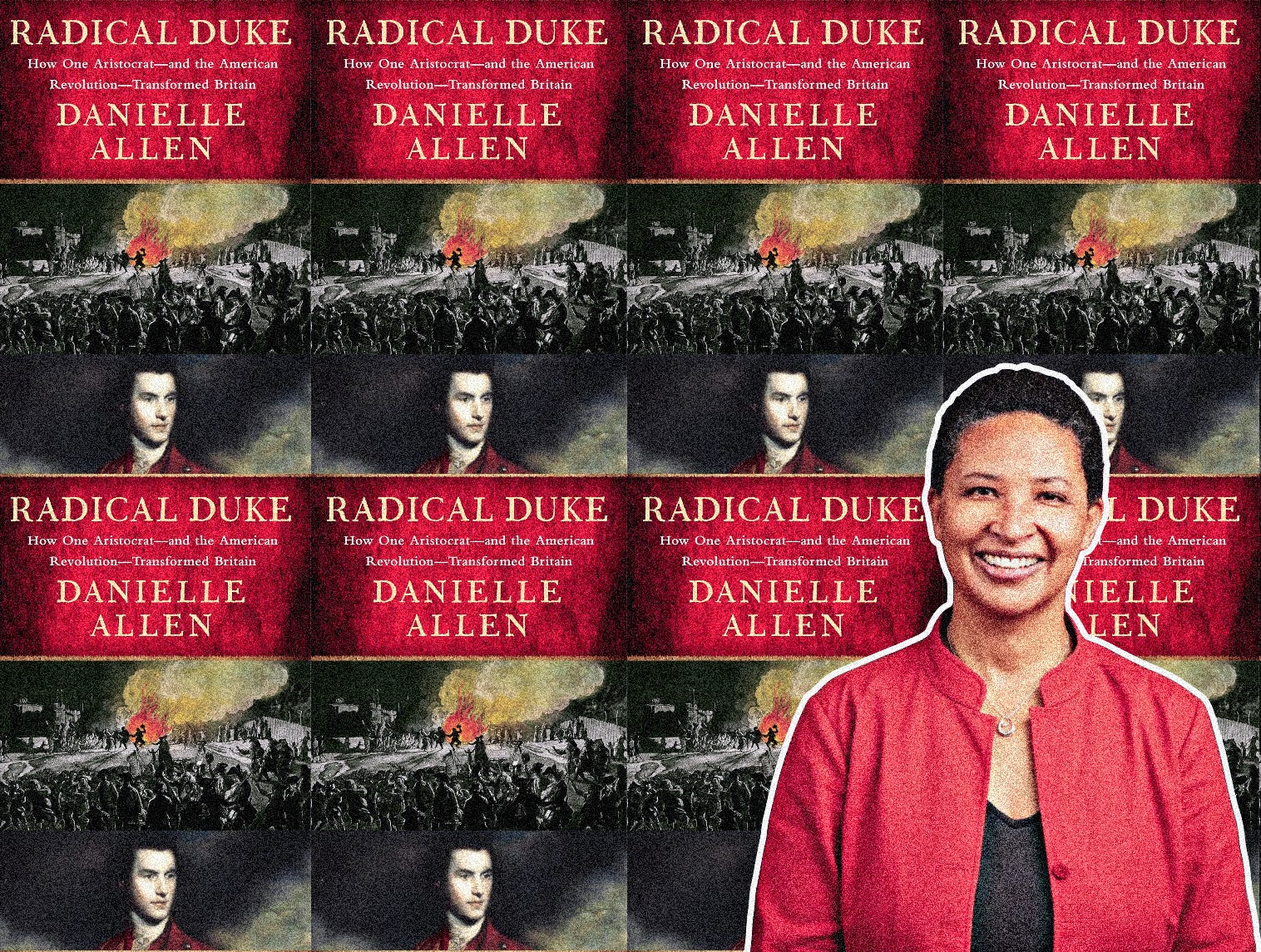
Richmond is not a name most Americans would recognize. Danielle Allen’s Radical Duke makes a good case that he ought to be.
Allen is the Harvard political theorist best known for Our Declaration, a close reading of the Declaration of Independence, and that document led her to Richmond. (She was also Ezra Klein’s fireside chat partner at LibCon2026.) Her research team came across a rare parchment copy of the Declaration in a county archive in the south of England. Tracing how it got there took her to the duke’s library, long neglected by historians.
From the late 1760s until the end of the war, Richmond was the leading opponent of the king’s ministers in the upper house of Parliament. He defended newspaper printers prosecuted for criticizing the government, argued that juries rather than judges should decide whether a publication was criminal, supported religious toleration, and backed the American cause openly while Britain was at war with it. Then, in June 1780, in the fifth year of America’s war the name of consent of the governed, he introduced a bill to give the vote to every adult man in Britain. He also required a new election every year, and—most radical of all—divide the country into voting districts of equal population. The House of Lords rejected it the same day.
Britain did not extend the vote to all adult men until 1918. On paper the United States reached that milestone in 1870 with the 15th Amendment, but the reality did not arrive until the Voting Rights Act of 1965. But we did not require legislative districts of equal population until the Supreme Court imposed the “one person, one vote” rule in the 1960s under the 14th Amendment’s equal protection clause. Richmond was proposing both ideas more than a century before.
The Same Problem on Both Sides of the Atlantic
The central argument of the book, and its most valuable contribution, is that the reformers in London and the rebels in America were reacting to the same problem, and that the problem was not taxation as such. It was that Parliament had stopped functioning as an independent check on the Crown.

Parliament, and particularly the House of Commons, existed in large part to hold the king accountable, above all by controlling the money. By the 1760s, the king had found a way around this. He could offer members government jobs, pensions, and in some cases outright cash, and he used these to secure their votes. Something like 200 of the 558 members were beholden to him (and, in practice, his preferred ministers) one way or another. The body that was supposed to restrain the king had become an extension of his administration.
There were other grievances. The government was prosecuting publishers, fighting expensive wars for no good reason, and, in the case of a popular radical named John Wilkes, repeatedly refusing to seat a man the voters kept electing. Readers familiar with the Declaration of Independence will recognize the list. These complaints had been circulating in London for a decade before Jefferson wrote them down.
The Americans concluded the system could not be repaired from within—and left. Richmond concluded it could be and had two remedies in mind. The first was to cut off the money. If the king had no secret funds and no jobs to hand out, he could not buy Parliament. A reform along these lines was enacted in 1782, championed by Edmund Burke, the man now remembered as the founder of modern conservatism, though in his day he was a proto-liberal Whig.
The second remedy was more fundamental. Richmond wanted to change whom members of Parliament answered to.
Most seats in the Commons were attached to boroughs, old towns whose boundaries had not changed in centuries, and many had dwindled to a handful of voters. The most notorious of these rotten boroughs, a place called Old Sarum, returned two members of Parliament from a hillside on which nobody lived, and whoever owned the land effectively chose them. Meanwhile new, fast-growing cities like Manchester had no members of their own. A seat like Old Sarum belonged, in effect, to its owner, and was bought and sold for prices vastly exceeding the value of the land itself. Richmond’s answer was to give every man a vote and place every vote in a district of the same size, so that a member would owe his seat to the voters and not to whoever had purchased his borough.

Many parts of the U.S. Constitution read as a reply to the same problem. The Framers had watched the king buy Parliament with jobs, so they wrote a rule that no member of Congress can hold an executive branch job, strengthening the separation between the two branches. They had watched him govern out of a private treasury, so they explicitly reserved the power to spend money to Congress alone. Richmond wanted elections every year; the Framers (in a much more sprawling country) settled on every two. The duke and the Framers were reading the same books and drawing many of the same conclusions.
The exception was equal districts. Allen makes a point about this in an interview that is exactly right. The idea that a country should be divided into districts of equal population, so that every vote counts the same, seems obvious today. In 1780 it was new, albeit with some faintly similar ancient precedents. Somebody had to think of it, and Richmond was among the first.
The Constitution divides House seats among the states by population but says nothing about how they are drawn within a state, nor about how the state’s own legislature is constituted. As a result, the American version of the “rotten borough” persisted. Legislative bodies in which a rural county of a few thousand people carried the same weight as a city of a hundred thousand survived the Revolution by nearly two centuries, until the Supreme Court struck such schemes down in the 1960s. On this question, Richmond’s bill went further than anything the Founders put on paper.
Allen aptly describes representation as a kind of technology, something that can be redesigned when it stops working. Her preferred redesign for the United States is a larger House elected from districts that each send several members, so that a party’s share of seats tracks its share of votes. In short, proportional representation. That is the right lesson to draw from Richmond, and one I have argued for in these pages.
Today, a map can have districts perfectly equal in population but still hand a majority of seats to whichever party draws the lines. Gerrymandering is the rotten borough by another name. There is little doubt Richmond would have recognized the problem instantly, and seen it as what it is: a question of political engineering.
Reform Rather Than Revolution
Once the Americans had gone all the way to revolution, radicals in Britain had to decide whether to follow, fighting to overthrow the monarchy rather than reform it. Richmond decided to follow the latter course, and the vast majority of his fellow travelers in the United Kingdom shared the conclusion. He spent the early 1780s working within the existing constitution, and Allen credits him with helping to lay the groundwork for the arrangement Britain eventually settled into, in which an elected Parliament governs and the monarch reigns. However, Richmond himself drifted from the reform cause after joining Prime Minister William Pitt the Younger’s government.

There is a good deal to be said for that choice, more than admirers of Thomas Paine, the era’s great radical and a critic of Richmond, usually admit. Britain reached universal male suffrage without a revolution and abolished slavery without a civil war. The two countries took different routes out of the same crisis, and it is not obvious, looking at Washington in 2026, that our route ultimately did the job better.
The book’s most striking claim concerns Paine himself. The Letters of Junius were anonymous newspaper essays attacking the king’s ministers, published from 1769 to 1772, and their authorship has been debated ever since. Most historians who have taken up the question have settled on a single author, Sir Philip Francis, a War Office clerk with a grievance against the ministry and a talent for invective. Allen argues instead that the letters were the work of a small group, Paine and Burke among them, organized and financed by Richmond. If she is right, Paine had been writing against the Crown for years before emigrating to America and publishing Common Sense. The two nations’ paths to constitutional democracy shared not just grievances but, quite possibly, an author.
It would also mean that Burke and Paine began as collaborators. Yuval Levin’s The Great Debate casts the two men as the founding antagonists of modern politics, the conservative defending inherited institutions and the radical appealing to first principles. But that quarrel came later. Both took the American side in the 1770s, and it was the French Revolution, nearly two decades after Junius fell silent, that finally drove them apart. Allen would push their alliance back further still, into these pseudonymous pages.
This is also where the book is most exposed. Allen is asking readers to set aside a consensus that has held for the better part of two centuries, and the evidence for group authorship of the Junius letters is circumstantial, as evidence about an anonymous author almost has to be. Readers who come to the book for the duke rather than the detective story may find the case suggestive rather than settled.
Whatever historians conclude about that claim, the 1780 bill stands on its own. Universal suffrage is now the democratic norm and equal representation its accepted standard, and Allen has recovered one of the first men to ask for both. We could do well to follow his example of thinking critically about how to create a more representative and well-balanced constitutional order.

Deep Cuts is a weekly column by Andy Craig exploring the constitutional, philosophical, and historical roots of current events and the ongoing crisis of American democracy. To read past entries, go here.

© The UnPopulist, 2026
Follow us on Bluesky, Threads, YouTube, TikTok, Facebook, Instagram, and X.
We welcome your reactions and replies. Please adhere to our comments policy.