


Dear Readers:
I am very excited to announce the launch of Deep Cuts, a new weekly column by Andy Craig, The UnPopulist’s resident constitutional sage and the head of our Reconstruction Agenda. Every Monday, around noon, Andy will draw on his deep knowledge of history, constitutional law, and politics to, among other things, take the measure of our republic: how it got here and what it will take to save it. Expect him to dig beneath the daily headlines to the deeper currents and precedents that tell us where we’re really headed.
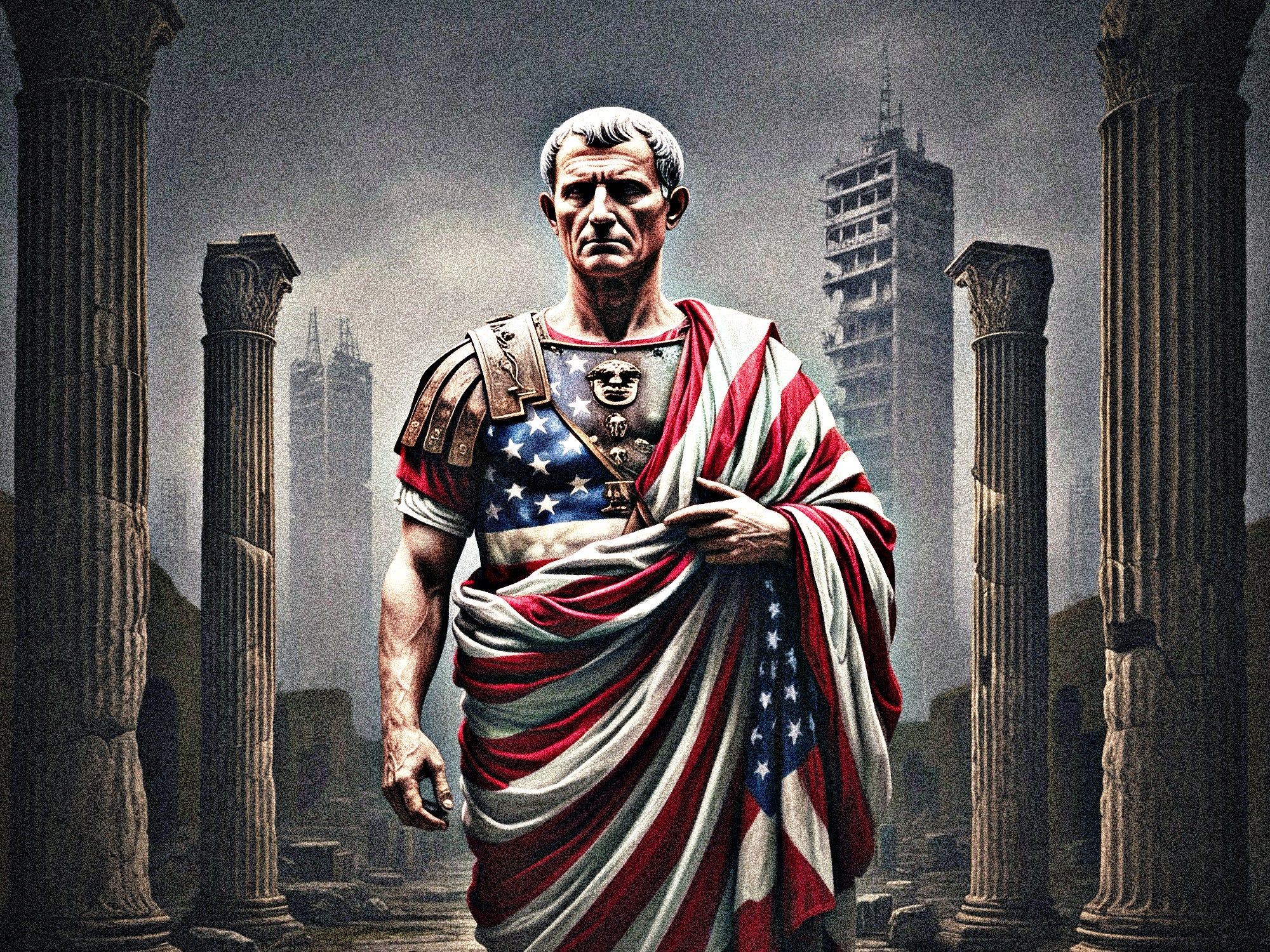
He opens with a characteristically erudite piece on Rome, arguing that Trump is less our Caesar than Sulla: not the man who ends the republic but one of the men who start its unraveling. This is both good news and bad. Bad because Sulla was the harbinger of Rome’s dictatorial turn. Good because we are at the beginning stages of Rome’s decline and have room, as well as stronger tools, to reverse course.
Enjoy this piece, and going forward, set your clocks for noon, Monday.
Also, upgrade to paid if you appreciate Andy’s work.
Shikha Dalmia
Editor-in-Chief

Rome has provided both inspiration and warnings for Americans since our founding. Roman influence is in the names of our institutions (Senate, Capitol, republic, plebiscite, tribunal, census, veto, candidate, magistrate, quorum, et cetera) and in the very architecture of Washington, D.C. The Framers studied Roman history closely and built a formal Constitution to avoid Rome’s mistakes. Most importantly, they made it a higher law that ordinary legislation could not override, a concept Rome never quite developed, to their detriment. Unfortunately for us, that innovation alone is not enough.
Americans have been comparing ourselves to the Romans since 1776 and before. The first volume of Gibbon’s Decline and Fall was published the year of America’s founding. The fall of the Roman republic, and of the later autocratic empire, were ideas with real purchase in the political and intellectual life of the era. The theme has been played with so much that it’s a well-worn cliche, the fodder of Star Wars among others. Because of that, we perhaps set it aside too lightly.
The historians’ objection to such comparisons is more serious than just that they are overdone. The trend in recent historiography has been to emphasize how alien the ancient world was to our sensibilities, and that is true enough. Roman ideas about morality, sexuality, society, religion, and the natural world are often deeply weird and sometimes rather horrible by our lights, and that is before one gets to the vast gulf in technology. Even at its best, the classical world was by orders of magnitude crueler and more violent than modern society. Nobody trying to make sense of the Roman world can afford to lose sight of the differences.
But there is a danger in overemphasizing the distance. In many ways, similar people in similar institutions have similar motives and incentives, and our own government and politics are heavily modeled on theirs. Consciously in some ways, but also in subliminal ones. We cannot understand ourselves without understanding the echoes of Rome all around us.
The Republic’s Decline Predated Caesar
The dramatic ending is familiar, at least in broad brushstrokes. Julius Caesar crossed the Rubicon with his legions, won the ensuing civil war, made himself dictator for life, and was stabbed on the Ides of March by senators calling themselves liberators. In the aftermath, Caesar’s adopted heir Octavian, later known as Augustus, won the power struggle and became Rome’s first true emperor. It’s a compelling story with vivid characters, but zooming in on those years misses the bigger picture.
The republic was already dying well before Caesar, and the question for Americans is not whether Trump is our Caesar. Our bigger concern should be if this is more like our age of Marius and Sulla, the generals and magistrates (Rome had no clean division between the two roles) who inflicted wounds on the republic that proved fatal in the long term. They did this even as they thought, or at least convinced their supporters to think, they were acting to defend the system against traitors and enemies.
The decline of Rome’s republican system began in the decades before Caesar partly because Rome went on a conquest binge whose wealth flowed to a narrow class of aristocratic elites. This had a serious consequence on the stakes of political competition, as the profit extracted from one position was plowed back into buying off both the elites and the masses in order to climb the next rung on the ladder. Those who failed to secure an office or command they had expected to win often found themselves deep in debt and driven to extreme measures, such as trying to overturn the result or illegally seizing another income stream.
The corrupting effect of this foray into empire-building on Rome’s republic cannot be overstated. The legions came to look to their generals and favored politicians, not the state as an institution, to provide for their needs. Elections, which had never been free of manipulation, became largely predetermined, including by gaming electoral rules and procedures to tilt the outcomes. The Senate found it easier to hand its powers to individual magistrates, only to then ineffectually complain about the results, much like Congress does now after delegating away its powers to the executive branch.
War and Empire-Building Undermined Rule of Law
Gaius Marius was the first to break the long-settled norm on how often a man could hold the top office, the consulship, and how long he could retain a military command. By doing this, he was able to consolidate military units under his personal control. His former lieutenant turned enemy, Sulla, went further: faced with the loss of power, he marched an army on the capital, which no Roman had done before. He then (after taking the city a second time) took emergency office as a dictator with no time limit, published lists of enemies to be killed on sight, and remade the republic’s institutions to suit himself. Under the guise of restoring the powers of the Senate, he purged those who had opposed him, stuffed it with newly elevated loyalists, and disempowered the tribunate, whose powers had been used against him. After all that, he retreated to a brief but peaceful retirement before his natural death.
The constitutional reforms, such as they were, of Sulla’s tenure were undone within a generation by men who had learned from his example.
There was no single moment of catastrophic rupture. Instead, there was a series of increasingly despotic and mostly unsympathetic figures who launched escalations built on the precedents of their allies and opponents alike. Over a span of five decades, from the time of Sulla in the 80s BC to the final victory of Octavian in 31 BC, Rome suffered through an interminable series of convoluted civil wars and escalating constitutional crises.
By the end, there were no factions truly fighting for rule-of-law republicanism, the traditional system built on the rejection of monarchy and determined to prevent too much concentration of power in any one man’s hands. The bloody struggles were simply between competing would-be autocrats.
The traditional elite, the Roman aristocratic political class that might have led a lawful correction, did not help. They could not remedy the popular grievances that gave the strongmen their followings, such as the perennial struggles over land reform, the grain dole, how to fund the legions and their veterans, and similar economic concerns. A cost-of-living crisis was no metaphor at a time when the ordinary people, even in wealthy Rome, were never that far from starvation. The conservative patricians were no less quick to resort to lawbreaking when it suited them. In the struggle between optimates (aristocratic elitists who claimed to defend the traditional republic) and populares (populists, more or less, as the cognate suggests), there were no liberals in our sense of the word, and credentials as a principled republican were more propaganda than reality.
The Self-Neutering of the Senate
On the eve of Caesar’s civil war against Pompey, initiated with the famous crossing of the Rubicon, the Senate voted overwhelmingly for both sides to stand down. The body, whose powers were theoretically more executive than legislative, was simply ignored in its impotence.
Nobody in Rome ever explicitly voted to end the republic. Senators and the popular assemblies voted for land bills, tax levies, grain allocations, infrastructure projects, emergency powers, and honors for victorious generals. But step by step, the republic became, as Caesar put it more honestly than was wise, a “nothingness, a mere name without body or form.”
When Augustus finally won, the official line was that he had restored the republic. The offices were still filled and the Senate still met, but they served at one man’s pleasure. Romans and their overseas subjects alike, after so many years of chaos, preferred the relative peace of what had become an absolute monarchy in all but name.
It does not help to sort the story into heroes and villains. Cato and Cicero, the senators remembered as the republic’s noble but doomed defenders, did as much as their enemies to bring about constitutional collapse. Cato, a steadfast defender of the republic and opponent of Caesar, was uncompromising to a fault, rejecting every proposed deescalation and sabotaging attempts to form a stabilizing political coalition. Cicero, the great orator, for his part was as quick as anyone to break the rules in pursuit of his own power, including most notoriously putting citizens to death without trial after pioneering the use of conspiracy theories as a political weapon. In his telling, he had suppressed an attempted coup by would-be monarchists. Whether this plot was real, or what its actual motives were, is still debated. Despite his self-glorifying claims to have acted heroically, Cicero was temporarily exiled for these illegal actions.
No Clear Good Guys at a Time of Political Breakdown
Popular traditional accounts often treat this period as a simple battle of right against wrong, but this obscures how it was always more complicated than that. As Shakespeare put it in Coriolanus, set in the semi-mythical days of the early republic, “rights by rights falter, strengths by strengths do fail.” True of individual human nature, but also true of the body politic.
Everyone had an argument for why they were in the right, for why virtue was on their side. Sulla could point to how armed gangs had coerced the vote to strip him of command before he marched on Rome. Marius could plausibly claim the backing of the people, whose will was being subverted by corrupt and greedy senators. Cicero claimed to be defending the republic against its treacherous internal enemies, acting as a tyrant to defeat the threat of tyranny. Caesar could point to the Senate’s vote for both sides to stand down and how it was ignored by his enemies. Most such claims weren’t entirely baseless, which is what made them all the more deadly.
The reforms attempted along the way were not ill-considered. The franchise was expanded. Sulla imposed what would be, in our language, term limits (for everyone but himself of course) and stripped offices of powers he thought had been abused. The Senate was refilled after each purge and the powers of the assemblies and the courts were adjusted back and forth. All of it is recognizable in the structural reforms we debate today.
They failed because they addressed symptoms but not the underlying cause. These reforms were imposed by men who had already won by force, illegality, and corruption, which meant the next man to win by the same methods could do as he pleased.
Trump Isn’t Caesar, and That Might Be Worse
Trump is Caesarian in obvious ways, including the self-aggrandizing aesthetic. It’s no coincidence he’s obsessed with building himself a triumphal arch. But calling him our Caesar or Augustus flatters him. Both were, if nothing else, vastly more intelligent and serious men.
More generally, it’s a mistake to try to map individual personalities onto direct equivalents. Nobody is a carbon copy of a particular person, we should not try to force too granular a set of comparisons. Rather, the point is certain broad patterns are recognizable as political actors struggled within a system that was breaking down around them across multiple generations.
The more worrying possibility is that Trump belongs near the beginning of the story rather than its end: not the time of Caesar or Augustus but the era of Marius and Sulla, the men who brought force and corruption into Roman politics on a scale nobody had yet seen. Whether their motives were noble or selfish is unknowable, but the means by which they pursued their ends involved turning brute force against the constitutional order itself. Crucially, some came out of it remembered as winners by the next generation.
If we do the same, the aftershocks will continue for decades to come, each building on the new precedents for how far one can go. Today we primarily remember the dramatic denouement, but the republic was already mortally wounded long before Julius Caesar. If America ends up an autocracy, Trump will not be its culmination but something closer to its forerunner.
America Can Beat Rome’s Fate
What we have is what the Romans did not: knowledge of why and how they failed, plus two millennia of experience that have given us tools Rome never managed. A Constitution entrenched above ordinary law, democratic representation, parties that can accept losing an election, a military that is sworn to serve the Constitution instead of the leader, and ways to change law and policy short of violent conflict. Those are also the institutions now under the most strain.
As Washington said in his Farewell Address, “The disorders and miseries which result gradually incline the minds of men to seek security and repose in the absolute power of an individual; and sooner or later the chief of some prevailing faction, more able or more fortunate than his competitors, turns this disposition to the purposes of his own elevation, on the ruins of public liberty.” The implicit invocation of Rome’s precedent was so deeply ingrained it didn’t need to be explicitly stated.
People get fed up with chaos and dysfunction, and Trump will not be the last to offer himself as the solution, nor the last who turns out to simply be another agent of chaos. How far the next one feels they can go depends on how thoroughly Trump is repudiated now, while it is still possible to make him a disgraced aberration rather than the new normal.
© The UnPopulist, 2026
Follow us on Bluesky, Threads, YouTube, TikTok, Facebook, Instagram, and X.
We welcome your reactions and replies. Please adhere to our comments policy.
Yes. We can. Here’s how: https://thomascolt.substack.com/p/the-five-things-the-next-president