


Discourse about antisemitism in America has become a hopeless, meaningless mess. Particularly in the last few years, pro-Israel and right-wing organizations and politicians have insisted that anti-Zionism is a form of antisemitism, minimized the threat on the right while exaggerating the threat on the left, used the charge of antisemitism to deflect legitimate criticism of Israeli actions, and weaponized Jewish fears in their kulturkampf against higher education, the press, and progressive activists of all kinds.
It is thus understandable that progressives’ reflexive response to accusations of antisemitism is to dismiss them. But to do so would be a mistake. Antisemitism does exist on the left; ask any Jewish person active in progressive spaces. Moreover, the failure to condemn and root out real antisemitism enables nationalists, racists, and fascists to defame and delegitimize progressive movements. It is also a betrayal of progressive values.
What is needed is both a rejection of the right-wing Antisemitism Industrial Complex and of antisemitism itself.
This is easy enough in obvious cases—violence against innocent Jewish people, overtly antisemitic rhetoric, and so on. Last week’s attempted mass murder at a synagogue outside Detroit might have been politically motivated by the perpetrator’s own sense of personal loss—but targeting innocent Jewish people is still obviously antisemitic.
But often it’s not so easy. Is it antisemitic to protest a political (or semi-political) event at a synagogue? When do sharp, legitimate criticisms of Israel and Zionism cross the line into bigotry and bias?
Having written and worked on this subject for nearly 30 years, I intend to offer some provisional answers to these questions. I speak as a rabbi, journalist, American Jew, and longtime LGBTQ+ activist. I also still believe in what I call “pragmatic Zionism” based on the fact that two peoples occupy the land between the Jordan and the Mediterranean and that the most realistic, imperfect solution is two states for two peoples, equal rights for all Israeli citizens regardless of nationality, and a just peace recognizing the rights of all 16 million people in Israel/Palestine to self-determination, safety, and human dignity.

I also speak as someone witnessing profound mental health crisis within the American Jewish community. Nearly every American Jew I know, on every point along the ideological spectrum, is afraid, burned out, and deeply unsettled by the rise of antisemitism in America. Close friends of mine are afraid to “look Jewish” on the streets of New York City. I have personally faced antisemitic attacks since October 2023. None of this excuses the use of antisemitism to deflect criticism or attack others. But it is the emotional reality that underlies this conversation—and if you have Jewish friends, I promise you most are feeling it. We can do better.
When Anti-Zionism Becomes Antisemitic
AIPAC, the Anti-Defamation League, the Republican Party, and the Antisemitism Industrial Complex claim that anti-Zionism is antisemitism. They claim that to oppose Zionism is to say that, alone among all the nations in the world, only Jews should not have a state of their own. This, they say, is inherently antisemitic.
This is clearly false. Many anti-Zionists are non-bigoted—in fact, it’s their commitments to human dignity that underlie their anti-Zionism. Moreover, it is reasonable to evaluate Zionism by what it has wrought for Palestinians, not merely what it means in the abstract.

That said, it is worth understanding that most American Jews do indeed define “Zionism” as the movement for Jewish self-determination, not settler-colonialism or Jewish domination. They do not define it as requiring that Palestinian society be eradicated, hospitals in Gaza bombed, or settler thugs allowed to conduct pogroms in the West Bank. Of course, it is the official policy of the current Israeli government to do all of these. But to many American Jews that is the result of the Netanyahu regime, not “Zionism” itself. As such, many liberal Zionists and anti-Zionists are talking past one another.
One way forward has been proposed by the Nexus Project, an initiative which seeks to clarify when anti-Zionism crosses into antisemitism. I will address two of their conclusions here.
First, anti-Zionist rhetoric becomes antisemitic when it makes use of antisemitic motifs. Sometimes these are obvious, like these antisemitic caricatures at a pro-Palestine rally in Toronto this past weekend.


Other times, the motifs can be more subtle: for example, as the Nexus Project describes it, “characterizing Israel as being part of a sinister world conspiracy of Jewish control of the media, economy, government, or other financial, cultural, or societal institutions.”
To take a recent example, observing that Benjamin Netanyahu and his American supporters have been pushing for war against Iran for decades is factually accurate. Claiming that America is merely his puppet, pushed into war by the “Israel Lobby” or a powerful Jewish conspiracy, is conspiratorial antisemitism.
Here is another example. Jeffrey Epstein well may have been working with the Mossad, though there are more signs he was working with Russia, and probably was working all sides. But this image (reposted by the Nexus Project) of Epstein and Netanyahu drinking the blood of dead children is antisemitic and draws directly from the Medieval blood libel.

This and other such images are no more neutral than racist caricatures; they exist in a lineage and have been used for centuries to attack Jews.
Here is a third example. When Trump invaded Venezuela, some on the left said Israel and Zionists were behind it, despite no non-circumstantial evidence and ample evidence of other motives. This is antisemitic conspiracy-mongering.
In all these cases, the process for avoiding antisemitic rhetoric and imagery is the same as that for avoiding racist stereotypes: learning what the offensive themes and images are and their history—and checking oneself before reaching for a particular metaphor, image, or symbol.
If nothing else, all of these uses of antisemitic motifs harm Palestinians as well as Jews, because they validate the worst claims of the right. As WBAI radio host and podcaster Rafael Shimunov put it: “Progressives claiming Israel’s behind Trump crimes in Venezuela seem to have little understanding of Western imperialism, are hitching a ride with the far right, and are handing right-wing Zionists clear examples of actual antisemitism that will be used against Palestinians.”
Targeting Jews
A second set of elements within the Nexus definition of antisemitism deals with the targeting of individual Jews. The definition defines as antisemitic:
holding individuals or institutions, because they are Jewish … culpable of real or imagined wrongdoing committed by Israel; us[ing] symbols and images that present all Jews as collectively guilty for the actions of the State of Israel; attack[ing] and/or physically harm[ing] a Jew because of her/his relationship to Israel; and convey[ing] intense hostility toward Jews who are connected to Israel in a way that intentionally or irresponsibly … provokes antisemitic violence.
Put another way: any time Jews are targeted as Jews, that is antisemitic. Individual Jews cannot be blamed for the actions of the state of Israel, even if the government of Israel asserts that it is acting on behalf of them. It is antisemitic to terrify, intimidate, or threaten Jewish people (who may or may not support the actions of the Israeli state), to vandalize their homes, or spit on them on college campuses. It is antisemitic to use the Jewish star as a symbol for Israel—the entire Israeli flag must be represented. It is antisemitic to unleash violence against Jews as revenge for the hideous acts of violence committed by Israel.
There are many “easy” cases of such targeting: a “Bring Them Home Now” vigil in Boulder firebombed because it was perceived to be pro-Israel (though in Israel, that slogan is used by anti-government protesters); multiple synagogue shootings in Toronto; the blockade of Jewish students in the Cooper Union library in New York, with protesters banging on doors.

But there are more subtle cases, too: Jews presumed to be Zionists and being driven out of arts organizations, or being required to not only disavow Zionism but dutifully raise their hands to acknowledge the genocide—a requirement not imposed on members of other groups (such as Christians who may be Christian Zionists, for example).
And then there are the harder cases. For example, synagogues often host real estate fairs for congregants considering retiring or buying second homes in Israel. These fairs often, but not always, include settlements across the Green Line, areas that all but Israeli hardliners believe would legitimately belong in a future Palestinian state. Lately they have become a favorite target of protest: Are they political events meriting protest, or is protesting outside synagogues always antisemitic?
Perhaps the answer really depends on what is meant by “protest.” At a recent protest outside a synagogue in Queens, antisemitic slurs were shouted and attendees were verbally and physically harassed. The protest also included pro-Hamas shouts (the real kind, not the imagined right-wing variety). Was this protest really a targeted action against the real estate fair at the Young Israel of Kew Gardens Hills, or was it, as Rep. Alexandria Ocasio-Cortez (N.Y.) suggested, an act of intimidation against the entire local community? Is there no meaningful distinction between opposing the sale of apartments in Efrat and chanting “we support Hamas”?
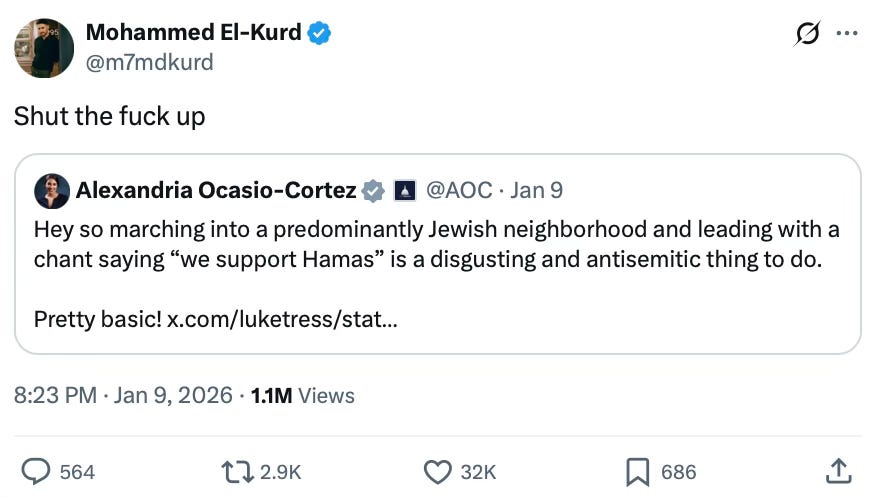
That STFU in the above post, by the way, comes not from some troll but Mohammed El-Kurd, one of Time’s 100 Most Influential People in the World in 2021 and Palestine editor of The Nation.
For the record, January’s protest in Queens was met by a vicious, racist, Islamophobic, genocidal counter-protest by far-right Jews, which received far less media coverage. And while the anti-Zionists may have frightened some Jewish people in Queens, far-right Israeli Jews are committing horrifying acts of violence against Palestinians throughout the West Bank. Arguably, that should be de-normalized but when I am personally afraid to wear a kippa while walking down the street in Brooklyn—just as I’m afraid to hold my husband’s hand when we vacation in Florida—perhaps progressives should check themselves. Do we not see who we resemble, with whom we are “hitching a ride”? Do we really think that targeting Jewish people and Jewish institutions with ugly iconography, even when their actions are problematic, is the way to advance justice and liberation?
Jews are not even the right constituency to target. First, Christian Zionists and Christian nationalists are more numerous, more influential, and more extreme than are Jewish Zionists. Second, most Jews opposed Israel’s war in Gaza: according to a Washington Post poll conducted last October, 61% of American Jews said Israel has committed war crimes and about 4 in 10 said the country is guilty of genocide against the Palestinians. Yet we have been shunned by the coalitions of which we were once a part, thanks to the maximalist stance against Zionism as such, rather than against the subset of Zionists who support Israeli war crimes, the majority of whom are Christian. Even if it were appropriate to target Jews and Jewish institutions—which it is not—it is simply inaccurate to assume that all Jews are Zionists or that all Zionists support the war crimes in Gaza, the Occupation, or the Netanyahu regime. And it is unconscionable to tolerate the overt, unambiguous antisemitism present at many pro-Palestine actions.

I even wonder if the relentless targeting of Jews as Jews might call for a reexamination of some of the ambiguous rhetoric used in pro-Palestine circles. Clearly, for example, the phrase “Globalize the Intifada” can be interpreted to mean both “globalize the nonviolent struggle for Palestinian liberation” and “enact violence against Jews.” Might the actual targeting of Jews counsel more hesitation? I’m not saying the phrase is intentional dog whistling, like the right’s anti-immigrant and anti-trans rhetoric that has inspired stochastic terrorism against immigrants. I’m saying it is irresponsible—and disclaiming that responsibility is a form of disregard for the lives of Jewish people who are harmed by those acting on the “wrong” interpretation of ambiguous words.
A Dark Mirror
In my view, the destruction of Gaza ought to provoke rage in any human being who witnesses it. Anger is not only justified, but I would argue a necessary part of any moral response. Yet the same rage that motivates the moral conscience can also harm others if not wielded with care. Progressives know this about anger: how it energizes and how it destroys.
When we choose the strongest rhetoric, the most confrontational acts of protest, the most concentrated expressions of rage, and when the target of that hate is a vulnerable population already under attack from the right, this is not a wise use of anger. On the contrary, it betrays progressive commitments to protect the persecuted and the powerless.
For hundreds of years, antisemitism has been the handmaiden of ethnonationalism. And as ethnonationalism rises in a MAGAfied Republican Party and elsewhere in the world, Jews are once again being accused of engaging in global conspiracy, ritual murder, corrupting racial purity, and manipulating finance and the media. Progressives should not contribute to this persecution.
Progressive Jews, including Zionist ones, have long been part of coalitions working for social justice, from protesting ICE and marching with Black Lives Matter to a previous generation’s support for civil rights and LGBTQ equality. Most of us care deeply about the plight of Palestinians, and are outraged both by the Netanyahu government’s actions and the right’s weaponization of antisemitism to vilify the left. But we are trying to tell you something about the hostility, hatred, and condemnation we are experiencing from our former allies. Please hear us.

© The UnPopulist, 2026
Follow us on Bluesky, Threads, YouTube, TikTok, Facebook, Instagram, and X.
We welcome your reactions and replies. Please adhere to our comments policy.

The difference between Antizionism and antisemitism is mostly an academic one. Irl it’s a get-out-of-jail-free card for progressives who want to justify something anyone would plainly understand as antisemitic.
Just the fact that you would suggest “globalize the intifada” means “globalize the non-violent struggle for Palestinian liberation” in any possible case makes me extremely dismissive of much else that you have to say. No self-respecting Palestinian in Gaza or the West Bank (or London or New York) would EVER agree with your interpretation, except in English to gullible westerners.