


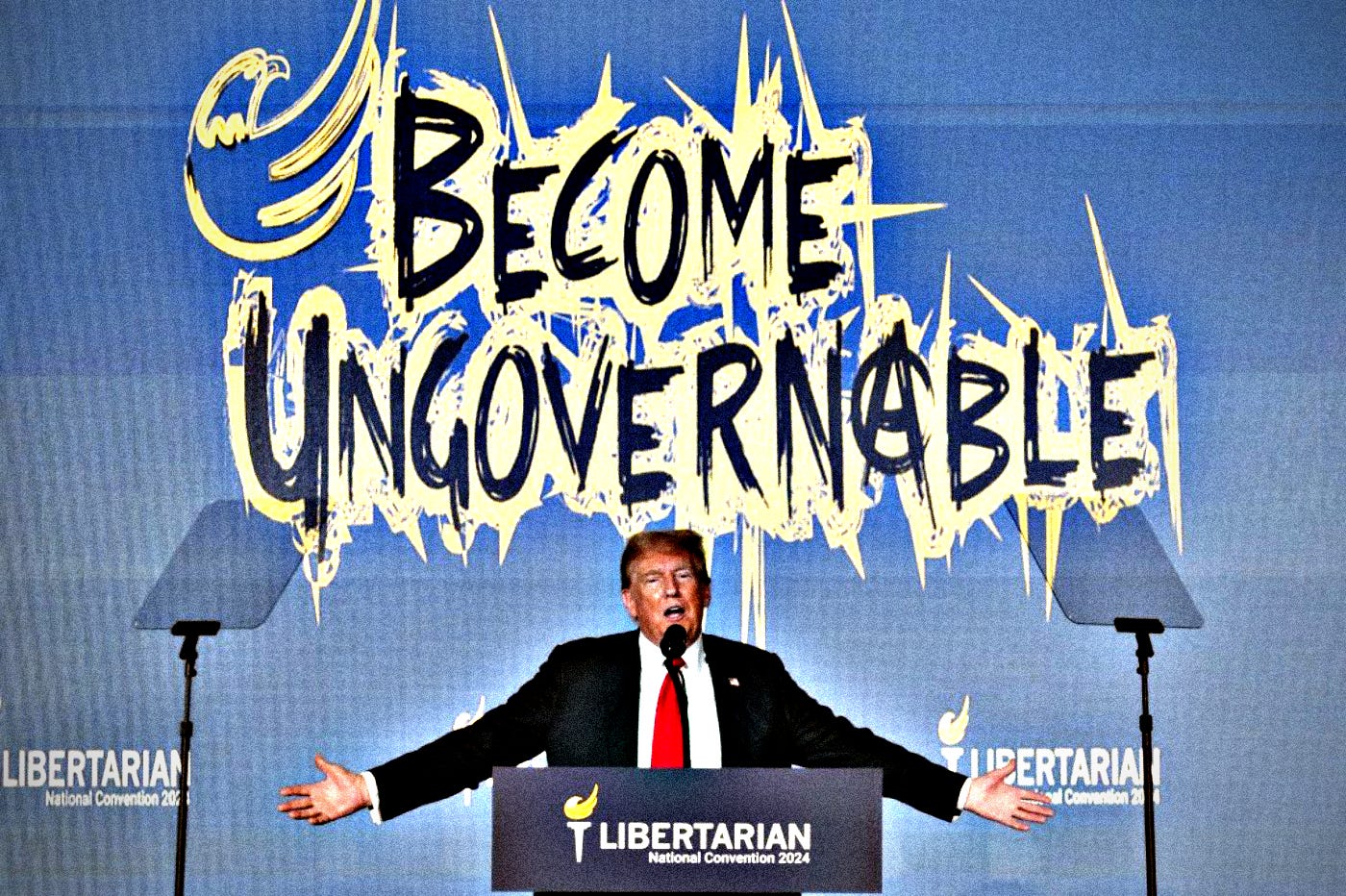
Marlene Laruelle of George Washington University’s Illiberalism Studies Program recently sat down with our own Shikha Dalmia for a wide-ranging conversation on her break from libertarianism, the relationship between libertarianism and liberalism, and what it would take to build a durable pro-liberal political coalition in America today. What follows is a transcript of the convo, lightly edited for flow and clarity.
Illiberalism Studies Program: Shikha, thank you for joining us for this Agora interview. I wanted to open with a personal question about your own ideological journey: Why did you leave libertarianism? How do you dissociate libertarianism from liberalism and which elements do you still believe are important?
Shikha Dalmia: My break with libertarianism happened when Trump arrived on the scene. I was working at Reason magazine at that time and, the minute Trump came down the golden escalator, it was clear to me that he was a different kind of politician: he was a demagogue and an authoritarian, he didn’t really understand liberalism, and he didn’t understand America’s core commitments. He was closer to demagogues that I had seen in India, like Narendra Modi, who preceded Trump by a few years. Given this, I was a little bit more sensitized to demagogues in general and Trump in particular, so it was pretty clear to me that the libertarians around me were just not seeing him as the same kind of threat as I was.
In fact, there was general chuckling at the way he was sticking his finger in the eye of the left and going after liberals. It is not that libertarians were completely unconcerned about Trump; it’s that they were just not taking the threat seriously. They were treating him as a normal politician, just bad in a different kind of way and, at best, maybe a corrective to the excesses of the left. This chasm between me and libertarian circles just kept growing, and it was getting hard to get my point of view taken seriously.

This was particularly perplexing given that libertarians are born to fight authoritarianism! They put the danger of state tyranny at the heart of their political project. Every school of political thought has different end goals. Integralists, for example, believe in a Catholic state built around Catholic idea of virtue; virtue politics is important to them. For communitarians, some kind of thick-knit community is important. And for libertarians, it is state tyranny that is important. So, when you see the closest thing to an authoritarian come along, you would expect libertarians to be up in arms!
Before Trump, libertarians would start warning of slippery slopes at a president’s use of the state for any goal. I, personally, wrote a gazillion pieces about Obama and Obamacare and how it represented a “road to serfdom,” in Hayek’s famous phrase, because it involved forcing people to buy healthcare. I wrote a piece encouraging a civil disobedience movement against Obamacare’s mandate. The thought was if a president can force you to do this, what else would be required?
But Trump was infinitely worse than any of them—in a league of his own—and I just didn’t see the alarm. He didn’t even bother to couch his agenda in some high-minded language. He divided the population into “us versus them” and promised to use the draconian powers of the state to help “us” and hurt “them”—a complete violation of the fundamental neutrality of the state, which is a basic commitment of liberal governance—and libertarians merely shrugged.
That got me thinking: Why is this? The reasons are partly political, partly sociological, and partly theoretical. Politically, since libertarianism arose in the heyday of the Cold War and made an alliance with socially conservative traditionalists and neo-conservative foreign policy hawks, it got inflected with a certain right-wing flavor. Libertarians became so attuned to fighting the leftist threat abroad that, once Communism fell, like the rest of the right, they had to find a new leftist threat at home, which primed them to be receptive to Trump’s message and his preoccupation with the leftist enemy.

It was partly sociological because, in this Cold War context, all of libertarianism’s social networks were on the right: whether it was their audience, their donors, or the policy issues they were discussing, all of it was inflected to the right.
The theoretical reason is something I’m still grappling with. Did libertarian theory just take a wrong turn or is there something fundamentally wrong about it? I am certain that it took a wrong turn, partly because of its fusion with the right. Libertarianism is a deductive school of thought that tries to derive all its commitments from a defense of individual rights, specifically property rights. Ownership of your own self and your own labor without fearing external aggression is central to that. But, if you’re trying to derive everything from this one axiomatic commitment, it actually becomes easy to end up defending completely opposite views. You can take the same principle of absolute ownership of your labor and property and use it to defend the little guy or the big guy. I think they went in the direction of defending the powerful because they were mixed up with conservatives.
So, they clearly took a wrong turn—but whether it was necessary for them to do so remains an open question for me. My guess right now is that it is—because, at some point, when you start developing an entire political philosophy based on one axiom, you get cut off from the core human commitments that are needed to keep balancing what you really stand for. At some point, they lost sight of what their normative goals were—namely, to defend the equal dignity of all human beings and create a pluralistic, open, and tolerant society.
They lost sight of the fact that they were liberals in a broader sense of the term and not just libertarians based on some dogmas and the policy commitments that followed from them. In other words, instead of beginning with a normative framework and then trying to figure out the right principles to advance it, they started with a narrow set of principles without answering broader questions about what values these principles were in the service of.
ISP: When you speak about classical liberalism, you often dissociate it from more progressive forms of liberalism—namely, those associated with identity politics. How do you see the link between these two? Do you see the latter as a kind of normal evolution of classical liberalism? Or do you think there was a moment when liberalism took a turn that transformed its nature?

Indeed, there is still a big discussion among liberals about what they mean by “liberalism”: the classic philosophical definition or the kind of contemporary progressive one we have.
Dalmia: “Liberalism” is such a difficult and confusing term. Even though I describe myself as a liberal, it’s because there is really no other word to describe what I am and, even then, I often find myself using the word “liberal” in many different ways in the same sentence. Of course, well-read, sophisticated political theorist types will understand what the various connotations of the term are. But for ordinary humans, it’s very difficult to separate and tease out its various meanings.
Furthermore, liberalism has meant one thing in America and something completely different in Europe. In Europe, liberals were those who stood against monarchies and feudal systems. In America, classical liberals started off as just constitutional Republicans who stood for self-government and freedom from colonial rule, with state power carefully constrained by system of checks and balances and a clear delineation of its scope and responsibilities.
Overall, liberalism is about holding rulers accountable to the rule of law, defending individual rights, and creating space for individuals and society to flourish by keeping the role of the state to a minimum. Government should defend the preexisting rights of people, but must be constrained so as to not become a threat to those rights. That’s the sense in which I am a liberal.
ISP: You have said that we have to create a broad coalition with people from the left and right to fight authoritarianism. What factors and institutions do you envision in that coalition? Coalition-making necessarily means compromises, so on what issues do you think liberalism can compromise with parts of the right and left and where should it not? How do you envision the coalition in the specific American context we are now?
Dalmia: The liberal coalition that I’m visualizing is a response to the illiberal coalition that we have seen develop. As Laura K. Field has written, there are many factions on the postliberal right. You have the integralists, Yoram Hazony’s ethno-religious nationalists, the folks at the Claremont Institute who are so preoccupied with the liberal enemy that they see no alternative to a right-wing authoritarianism to do a reset. Then you’ve got the Silicon Valley types—the hyper-individualists and anarcho-corporatists who want a quasi-monarchy. They’ve all come together in this authoritarian coalition, which is fundamentally hostile to the kind of American, constitutional liberalism that I’m in favor of.

To fight this, liberals need to set aside their old policy disagreements, whether on tax cuts or climate and energy policy. If you believe that the government should be constrained by the rule of law, if you worry about the concentration of power, if you defend individual rights, then you are a liberal. We don’t need purity tests to form a liberal coalition; we just need moral clarity about who it is that we are fighting and what it is that we really want to defend. The basic compromise is that we give up on our old policy commitments for now and come together in defense of core principles of good and just government. We should stop thinking of ourselves in terms of our political identities as left and right and start thinking of our identities as liberal and illiberal.
I actually feel like we’ve got more natural affinity and alignment on principles than the illiberal coalition does. The Peter Thiels of the world have nothing in common with the Patrick Deneens of the world, and yet they have come together. We haven’t.
ISP: How would you engage with social justice movements, given that you consider them to also be part of the problematic transformation of liberalism? More philosophically, how do you see the notion of the self-actualization of the individual as a core principle of liberalism when the social justice movement says that self-actualization in the realm of gender or sexuality is rooted in the same kind of self-actualization as private property. Do you see a tension there?
Dalmia: When I was in my libertarian days, I wrote my share of columns against the progressive left, arguing that there have been so many excesses and stupid notions that they have flirted with. I remember, at one time, there was this push for something called “affirmative consent,” the idea that, given the differential power structure between men and women, men can never assume that women are consenting at any stage of the sexual act until they have obtained affirmative consent. I wrote a piece pointing out how stupid this whole idea was, and I got attacked in Jezebel as somebody who likes being raped, so I’m very familiar with these leftist excesses.

However, I still think that leftists very often have the right cause; their means are just over the top and illiberal. Whereas with the right, I think both their ends and their means are illiberal. Basically, the progressive insight is that individual self-actualization requires certain conditions to be achieved. In societies riddled with say, class, caste, gender, and racial hierarchies, members of those groups can’t actualize themselves without first jettisoning systems of oppression and exploitation. Moreover, in any society, no matter how lofty its principles, the initial distribution of rights and privileges always favors dominant and powerful groups. So, the important task for any liberal society is to dedicate itself to creating a level playing field by dismantling these structures and make the systems work in a neutral, impartial, fair, and non-oppressive fashion for all.
America has been constituted on the notion of freedom and individual liberty for all. Yet racial slavery continued for 100 years after its founding and the structures and legacies of racism persist to this day. To the extent that groups have been subjugated and oppressed by virtue of immutable characteristics, whether that is race, gender, sex, or sexuality, this discrimination has to be challenged collectively, otherwise we cannot achieve individual freedom or actualization. So, progressives are right about that. Where the problem emerges is when they embrace illiberal means or they don’t want to make the political case for their cause and bring people along. They are in a hurry because these injustices are so intolerable that they want results now.
But, for all the social levers that the woke left has used to accomplish its causes, it has never become powerful enough to control the levers of the state in the way the right has. Hence, the excesses of these progressives can be fought through normal liberal channels, and we have seen that happen repeatedly. For example, on the issue of gay rights, religious conservatives have won a number of victories, like obtaining religious exemptions for businesses who wish to refuse baking cakes for gay marriages because doing so goes against their conscience. The left can be a problem but, until you’ve got a Jacobin takeover of this state, I’m less worried about them.
ISP: I want to ask about immigration because you have been working on that topic for a long time. What kind of policy proposals and vision of immigration do you think can reconcile liberal values with the realities of contemporary border politics, considering how much both in the U.S., but also in Europe, public opinion is increasingly worried about it?
Dalmia: In the U.S. and in Europe, something that I have written about—and that classical liberal scholars had warned about—has been vindicated: the idea that draconian border enforcement is simply not compatible with a liberal society. This kind of enforcement would require handing the state significant police—and even military—powers that will not just violate the human rights of immigrants, but also the fundamental constitutional rights of their citizenry. In the United States, you now have masked agents who are just picking up people from the streets without even asking them if they are citizens or not. In the name of enforcing restrictive and unworkable immigration policies, which created the undocumented problem in the first place, they are shooting American protestors in their face.

It’s not illegitimate that people would want to know who’s in their country and have controlled border flows. But I think that can only happen when a country creates a rational and humane immigration system that is consistent with the larger pull and push factors that determine flows into the country. The main reason people come to America, apart from fleeing persecution, is due to economic considerations. There are jobs and opportunities over here. Therefore, the levels of legal immigration are somewhat attuned to the demand for labor in this country. However, the more out of sync immigration policies are with these larger pull and push factors, the more need there is for a stronger state and illiberal and authoritarian methods to control the flows. I think our goal should be to have more regulated flows which are based on official immigration channels.
ISP: Is the U.S. a unique case in this regard? Given its geographical proximity to areas of conflict, Europe has more asylum-seekers, whose movement does not necessarily adjust to economic conditions in the countries they go to. As such, even though many European countries have aging workforces and need young labor, it may be harder to sync policies with pull and push factors, like you suggest.
Dalmia: The U.S. is blessed with oceans on two sides and friendly and peaceful neighbors on the other two. If it put in place rational immigration policies—for example creating usable and workable visa programs for low skilled and high-skilled workers—immigration flows would become remarkably self-regulating. When there are jobs in a country, immigrants come and when there are no jobs in a country, they don’t. During recessions, immigration from Mexico and Central European countries to the United States falls significantly. When the economy is booming, they increase.
I think Europe actually has a different problem. It gets more asylum seekers and refugees than the U.S. But then it makes it harder for them to assimilate. My understanding is that in Germany, and to a very large extent in France as well, the labor market for new immigrants is very restricted. They have a hard time obtaining a work permit as the governments fear that they’ll disadvantage natives. So, immigrants come but are then frozen out of work and forced to depend on the state’s safety net, which are quite generous compared to the United States. That creates a dual political problem: natives resent being taxed to support immigrants and, given that jobs are the best assimilation programs, immigrants have a harder time assimilating and become ghettoized.
ISP: Our last question is about the relationship between capitalism and liberalism. How do you think liberal democracy today can still be considered legitimate citizens, given the structural inequalities that have been rising over the last 30 years? How do we distinguish between legitimate grievances and the fact that these grievances have been taken over by illiberals who don’t offer adequate answers to them?
Dalmia: First, I think the populist authoritarian backlash that we have seen is caused less by economic factors and more by cultural anxieties: people feel threatened by cultural change, especially if it threatens their social status. They also have a fear of other people who don’t look like them and who are culturally dissimilar. Then, when demagogues come and play up those fears, you get the explosive populism that we’ve seen.

The one element of my libertarianism I do retain is that I think, by and large, free markets are better than the alternative, whether it’s a centrally planned economy or a heavy-handed industrial policy. The case for free market made by Adam Smith and Frédéric Bastiat was squarely against feudalism, mercantilism, cronyism, royal privileges, and monopolies. They envisaged markets that allowed anybody to compete on a free and fair level, thus breaking down hierarchies and bringing about a more equal and egalitarian society. I think that view has been borne out by history. We’ve seen the Great Enrichment and a general increase in living standards: ordinary people in Western societies have a better lifestyle than French kings of the 16th and 17th centuries. I would even that say, in the wave of globalization since 1990, living standards all over the world have risen, especially in the Third World, where billions have been lifted out of poverty.
To the extent that there are people who have not profited from globalization, there are two reasons for that. One is automation: vast numbers of people have lost manufacturing jobs due to automation, not globalization. America’s manufacturing output has grown by 70% and its labor participation in the manufacturing industrial economy has fallen by roughly 30%. It’s not that Western countries are not manufacturing. They are. It is just that things have been automated.
So, I think this whole rap against globalization, trade, and immigration causing a loss in native wages and jobs is overblown. This is not to deny that there are some losers. We need a better and even more generous safety net that diminishes economic precarity. That is not inconsistent with capitalism. In fact, the economic growth that capitalism generates makes a properly funded safety net sustainable. The problem is that it is extremely difficult to have a safety net that is targeted toward those who need it and does not create moral hazards, on the one hand, and is insulated from politicians who want to expand it to buy the votes of specific constituencies, on the other.
But once we get back to a day when we are just discussing policy, to me, the primary question would be how do you constitute a properly functioning state-managed safety net that doesn’t lapse into entitlement spending on one hand, or produce unintended inequalities on the other, like the U.S. with Social Security and Medicare, which has become a large transfer scheme from the young and the poor minorities to the rich and the old. It is quite regressive.
Right now, however, we have a populist authoritarian wolf at the door who wants to tear down the liberal democratic edifice. And we have to focus all our energies on fending it off.

An earlier version of this interview first appeared on Illiberalism.org.
Follow us on Bluesky, Threads, YouTube, TikTok, Facebook, Instagram, and X.
We welcome your reactions and replies. Please adhere to our comments policy.

The deepest political question is not which principles we defend, but whether we still remember why we created them.
"He [Trump] didn’t even bother to couch his agenda in some high-minded language."
I'd argue he's just incapable of high-minded thinking. PERIOD. He's a street-fighter. Look at how he ran his business.