



Listen to Zooming In at The UnPopulist in your favorite podcast app: Apple Podcasts | Spotify | YouTube

Shikha Dalmia: Welcome to Zooming In. I’m Shikha Dalmia, and my guest today is Francis Fukuyama, whom his friends call Frank. He’s quite simply one of the most serious intellectuals of our time. He has studied and worked with some of the biggest and most brilliant names in modern political thought: Allan Bloom and Harvey Mansfield, Samuel Huntington and Seymour Martin Lipset, even Jacques Derrida, briefly in Paris.
What makes him so unusual is that his thinking has been shaped not just by deep study of political philosophy, but by hands-on experience of statecraft and policy implementation. That includes analyzing Soviet policy at RAND, serving at the State Department, and advising governments on how to build states that actually work, including, apparently, Muammar Gaddafi.
He’s now a senior fellow at Stanford’s Freeman Spogli Institute for International Studies. Frank’s first book, The End of History and the Last Man, made him about as close to a household name as anyone who writes about thymos can possibly get. Its argument was that with the collapse of communism, liberal democracy had emerged as the final form of human government with no serious ideological rival left standing.
When the original essay ran in The National Interest in 1989, legend has it that copies at one Washington newsstand outsold everything, pornography included. But what I admire most about Frank is something rarer than fame. He’s willing to rethink his core assumptions and do so openly.
Few intellectuals of his stature ever admit they got something wrong. But Frank does it to a fault, because of his deep intellectual humility. Frank is also a dear family friend. I met him through my husband, who, like Frank, studied under both Bloom and Mansfield. Frank has also been a friend of ISMA and The UnPopulist right from the start, and he is a LibCon veteran. He’s a man of eclectic passions: woodworker, furniture maker, computer builder, amateur coder, photographer, and drone pilot.
Since Trump arrived on the scene, Frank has been among the staunchest defenders of liberal democracy against the rising tide of authoritarianism, both at home and abroad. All of which brings us to his new memoir, In the Realm of the Last Man. It traces his intellectual journey across five decades.

It begins with his family history, including his Japanese American relatives’ internment during World War II, and moved through his years with Allan Bloom, his time in government, the end of history moment, and his break with conservatism after the Iraq War. It ends with his reflections on why liberal democracy is under siege. It is such a rich account, touching on so many big ideas, that when I sat down to prepare for this conversation, I genuinely didn’t know where to begin. So I’m going to begin with the news, Frank. Welcome.
Francis Fukuyama: Thanks very much, Shikha. It’s great to talk to you.
Dalmia: Likewise. So Frank, we have just received the midterm results. On a scale of 1 to 10, and 10 being sheer joy, how exhilarated are you? And what do you think they mean? Did Americans deliver a rebuke to Trump and authoritarianism? Or was it a gas price and affordability election?
Fukuyama: Well, my reaction is definitely a 10. I was hoping for the Democrats taking both the House and the Senate, but they did it at such a scale—in fact, we’re not even done yet, because you still could get Alaska and Mississippi, which would mean 56 senators, which is just so beyond what I think anybody was anticipating before the election.
So that was great. In terms of interpreting it, I think we’re gonna have to wait a little bit for more analysis to happen about why people voted the way they did. I think that, for example, clearly these bread-and-butter issues like inflation and unhappiness over the war and the tariffs were the core of why many former Trump supporters, or people who had voted for Trump in ’24, switched sides. But there are other issues too.
So, for example, in Texas, which has now turned blue statewide, which is really unprecedented, that seems to have been driven largely by a shift among Hispanic voters, who are like a third of the population of the state. They had broken for Trump in 2024. You know, a lot of immigrants that were there in the country legally don’t actually like open borders. They really want to make sure that people come in, as they did, through the right processes. But the way that Trump proceeded to go after undocumented people was so cruel and so militarized and violent that I think that a lot of them turned against the administration. So, for example, the Republicans had gerrymandered voting districts in Texas, and they were assuming that the Hispanics that lived in the border counties would vote Republican, but it turned out they all voted Democratic because they hated the immigration policy so much.
“I think that the videos of masked ICE agents whisking people off the street really turned a lot of people off. That was one of the important turning points when people began to see the administration for what it was: a pretty ugly, authoritarian takeover of a rule-of-law country.” — Francis Fukuyama
So I think that there’s a lot of complicated reasons. I think what we learned in ’24 was that most Americans who are not kind of intellectuals don’t actually vote on the basis of, “Let’s defend democratic institutions.” But there are other things that matter, like corruption. So it was very interesting. Corruption emerged as a really big issue for a lot of people, including a lot of Republicans, as we got closer to the election. So I think it’s not just gas prices and tariffs. I think there really were a lot of other factors motivating people to vote the way they did.
Dalmia: Right. And you know, the fact that a Democrat, and an African American Democrat, has come so close to winning in Mississippi says something. And Colom’s campaign was squarely targeted at reminding Black and even white voters about the Voting Rights Act and how it had been gutted by the Supreme Court. And he just squarely mobilized the Black population on grounds that we won this right to vote through a very, very arduous struggle, and we can’t lose it. And he’s actually running a little bit ahead. So clearly, people do care about their rights. They may not care about abstract concepts like institutions and checks and balances, but when their rights are taken away from them, it seems like they genuinely care about that.
Fukuyama: Yeah, and I also think that what happened in Minneapolis last winter was an important turning point, because ICE came into that city as if it was an occupying army. It began to arbitrarily stop people, used force against protesters, and then shot two American citizens. And it led to this incredible mobilization of citizens of Minneapolis to resist this. And I think that the videos of masked ICE agents whisking people off the street really turned a lot of people off. That was one of the important turning points when people began to see the administration for what it was: a pretty ugly, authoritarian takeover of a rule-of-law country.
Dalmia: So looking forward, now, what are your hopes and fears of this Democratic Congress over the next two years? What should they do and what should they avoid doing to strengthen liberal democracy, but also deliver on some of their promises to the American public in terms of inflation and improving the quality of their lives?
Fukuyama: Well, I guess one of the optimistic things that came out of this election is that it has produced a whole new generation of Democratic leaders that are young and vigorous and smart and so forth. I think I was asked many times in the years preceding the election, well, who do the Democrats have that can possibly win in 2028? We now have an answer to that. There are a lot of them. I think that watching Talarico’s victory speech—it was an amazing speech. He really hit all the right notes with very charismatic delivery. Jon Ossoff is another one, a real star. And both of them coming from red states, I think, are much more plausible national candidates than the DSA folks that won in Los Angeles or New York or other very blue districts.

There is gonna be a fight in the Democratic Party over this. But I think it’s interesting, because a lot of the people coming out of the DSA have actually proven to be fairly moderate when actually governing, right? So Mamdani has actually been quite successful as mayor. There are ideological things that a lot of people don’t like about him, such as support for the Palestinians and so forth. But he fixes potholes. And you see a similar evolution in AOC. She’s also an extremely talented politician. A lot of her positions are to the left of what I would prefer. But I wouldn’t be surprised if she continues to gravitate more towards the center just to be a viable national candidate.
So that’s one great thing: that the Democrats now have a bench that’s pretty deep. And it’s going to get deeper as these people gain more experience. You have a lot of governors. A majority of states now have Democratic governors. That’s always been a training camp for presidential candidates. And so that’s very encouraging.
I think that the problems—well, there are several. First of all, on the Trump side, although he’s been fairly subdued—it was weird. He spent the first press conference after the Republican defeat talking about his stupid ballroom. And it kind of makes you think that he’s kind of given up and he’s kind of retreated into this personal world, so he’s only going to do stuff that makes him happy. But that’s not in character. What is in character is to be really angry and nasty and so forth.
But that’s just a prelude to this huge fight that’s gonna open up within the Republican Party. You saw JD Vance already trying to distance himself from Trump by blaming the defeat on the war. I don’t think he can get out of this really, because he’s taken both sides, right? He can say, well, I was privately against the war, but then he spent the next several months defending the war. And I don’t think people are gonna buy that. So I think his stock has fallen.
There’s a really big split over Israel in the Republican Party—it’s also a big split for the Democrats as well. But there is a big faction that blames the war on Netanyahu and the close relationship with Israel that even led Donald Trump to say we’re gonna end aid to Israel. I don’t know whether that’s actually something he’s gonna carry through on, but it does show how the winds have shifted on that issue.
“Trump has given permission to a lot of nativists, a lot of racists, a lot of misogynists, to openly express views that they were probably feeling but felt embarrassed to say earlier. And that means that these gains are more fragile than I had imagined, and that going backwards is very possible.” — Francis Fukuyama
And then there’s other issues like data centers, where there’s a big split in the party. One of the things that Trump did to not help himself was to go all in on AI and data centers and basically castigate anybody that was against them. That’s obviously become a big issue for a lot of people. I think it’s not just the data centers. It’s basically angst about the way that these big tech oligarchs have taken such a big role in American politics and in society without really getting permission from anybody. And so I think that’s also going to be something that’s gonna rile the Republicans.
So I don’t know. In the end, the net of this is still—I’m fairly optimistic. I do think that the Democrats are gonna have a problem trying to figure out how to end this war in the Middle East. They’re gonna have to carry through—well, some of this stuff will be fairly easy. If you just back off of all these stupid tariffs, that takes care of some of the inflation woes. In terms of prices in general, that’s a much harder thing to get under control. But the Trump administration was deliberately adding to this. If they could actually get a settlement and draw down in the Middle East, that would help things. But that’s gonna be pretty tricky to manage for the Democrats.
Dalmia: Right. You know, to your point about how the Democrats are on the streak of moderating themselves—even somebody like Abdul El-Sayed, who has been castigated as fairly radical and DSA-adjacent, if not DSA. I was watching an interview that Morning Joe did with him the day after his victory. And he only wanted to talk about affordability and what he was going to do in order to deliver lower prices, more housing. And now, of course, he favors Medicare for All. But I don’t consider that an extreme lefty position. That’s a policy position which we can disagree on.
Fukuyama: No, I don’t either. In fact, I think you can make an argument that we’re gonna have to eventually go to something like Medicare for All, ’cause you’re really not gonna be able to get health care costs down unless you do something like this. And that is such a big item in the long-term fiscal health of the United States. So yeah, I think that the Overton window is changing on these kinds of issues. And Medicare for All eight years ago was seen as an extreme left position, but I don’t think it’s gonna be in the future.
Dalmia: And I think efforts to depict it as an extreme left position are going to fail after you’ve had a president in office who’s busy nationalizing companies, right? Like, he’s taken equity stake in 33 companies. After that, trying to make the label of socialism stick on somebody who wants to lower health care costs—I don’t think that is going to be a winning strategy for Republicans.

Moving on to your book, but sticking with the subject of liberal democracy, let me ask you this. You’ve been an unflinching opponent of MAGA and defender of liberal democracy since Trump arrived on the scene. I think you saw what bad news this man was right from the get-go. And I think, frankly, this resistance would have been a whole lot weaker without you speaking so forcefully against all of this. So I want to understand where this is coming from. Is it all theoretical? Or is it: your parents immigrated to America at the turn of the 20th century, or your grandparents did. And except for your father and one of his sisters, your entire family was sent into internment camps in Colorado.
And there are excerpts that you have in the book from your Uncle Hiro’s diaries about what it meant for him to lose freedom that he had got used to. And even though people were telling him, well, you have it better than the Jews in concentration camps in Germany, he writes very movingly about what it meant to lose his freedom at a very basic, day-to-day level. So did that history make you particularly protective towards liberal democracy, and especially protections for minorities?
Fukuyama: If you’re asking why was I so opposed to Trump from the beginning, that’s a massively overdetermined issue. There’s so many reasons why I thought he would be a terrible president, and he’s actually turned out to be worse than I expected. But on this particular issue, yes, I think that the experience of Japanese Americans, Japanese immigrants to the United States, was very important in my understanding of the importance of the rule of law and rights, because their rights were violated. The Supreme Court actually supported the internment in the 1940s. And my family suffered. My grandfather lost the hardware store that he had spent the whole Depression trying to build up. It wasn’t really possible to get the family restarted after the internment, because they had lost so much.
I thought that really the country by the 1960s had changed very fundamentally, though, as a result of the civil rights movement and the greater inclusion of African Americans and then women and then other marginalized groups that had formerly been excluded from Americanness. And that was very important to me personally. I would get teased for being an Asian when I was in elementary school. And I’d asked my father: “How should I respond?” And he said: “Just say that you’re an American, and you are as good an American as anyone else.” And I always took that to heart. And that’s part of the reason that I don’t like referring to myself as a Japanese American.
It seems to me that being an American should not be racially or ethnically based. And it’s a great achievement that you move to a national identity that is based on essentially your loyalty to certain ideas and not your skin color, not your gender, so on and so forth. But I guess that one of the things that’s been particularly disturbing about the rise of MAGA and some of its ideologists is the way that they are going back on that understanding, that post–civil rights era understanding. One of the leading figures in this backsliding is JD Vance—this whole idea that there are “heritage Americans,” that your Americanness is really determined by how many generations your ancestors lived in the United States.
I think these are all really toxic ideas. Incidentally, it means that he’s more American than his wife. I mean, it just leads to some pretty weird outcomes. And Trump has given permission to a lot of nativists, a lot of racists, a lot of misogynists, to openly express views that they were probably feeling but felt embarrassed to say earlier. And that means that these gains are more fragile than I had imagined, and that going backwards is very possible. So that’s one reason.
The Trump effort to overturn birthright citizenship would have affected me directly, because if we didn’t have birthright citizenship, I wouldn’t be a citizen. My mother was in the country when I was born on a student visa and actually had to take me back to Japan because the visa expired and she couldn’t get in through the quota system that they had for immigrants at that time.
Dalmia: They allowed what? Only 100 visas a year?
Fukuyama: 100 Japanese, yeah, a year.
Dalmia: That is just amazing, astonishing. Like you, my son is a birthright citizen, right? So for a lot of us, we take this personally.
“The experience of Japanese Americans, Japanese immigrants to the United States, was very important in my understanding of the importance of the rule of law and rights, because their rights were violated. The Supreme Court actually supported the internment in the 1940s. And my family suffered. My grandfather lost the hardware store that he had spent the whole Depression trying to build up. It wasn’t really possible to get the family restarted after the internment, because they had lost so much.” — Francis Fukuyama
And way back when Trump first arrived on the scene, I had written that it’s minorities who are going to save America from itself. They are going to defend its constitutional traditions and its commitment to civil liberties, because they are the most directly affected by it. And actually, this election has shown that to be the case, given the great numbers in which Hispanics and Blacks and other minority voters came out.
This is not to knock on our white fellow citizens. They too have come out in droves, and they have put their lives on the line, as Alex Pretti and Renee Good did. But really, people who are most affected by the abrogation of these liberties directly are the ones who are going to fight the hardest for these ideas, and we are seeing that play out.
But to move on to some of the intellectual influences on your life, one of whom is Leo Strauss, right? And you have some very lovely chapters about Leo Strauss, very nicely written and very accessible, even for those who are not initiated into his thought. But there is a basic schism among Straussians: the West Coast Straussians, whose dominant figure was Harry Jaffa, and East Coast Straussians, who were shaped by Allan Bloom and Harvey Mansfield.
Now, West Coast Straussians, as you well know, have taken it upon themselves to be the biggest intellectual champions of MAGA and Trumpism, and they have gone out of their way to think of intellectual arguments for all of it. And Michael Anton famously wrote “The Flight 93 Election” essay in the Claremont Review, which was published in September 2016, just before the first election when Trump got elected. And his essential argument was that the democratic left poses an existential threat to the country. And if Hillary Clinton wins, then basically mass immigration and the administrative state she’s going to unleash is going to mean permanent left-wing rule. And so either conservatives can charge the cockpit and take over, or they will die. That was essentially his formulation.
And until Anton’s essay came on, many conservatives had been a little bit sitting on the fence. They were a little bit confused about what to make of Trump. And then this essay helped to turn reluctant backers into enthusiasts, willing to do anything to defeat the left. And then the line runs through John Eastman in 2020, who was also at Claremont, and tried to come up with all these constitutional theories for overturning the election.
I saw something similar play out in the libertarian world. West Coast Straussians had become so preoccupied with the leftist democratic enemy that they would do anything in order to defeat it. And there was an analogue to this in the libertarian world.
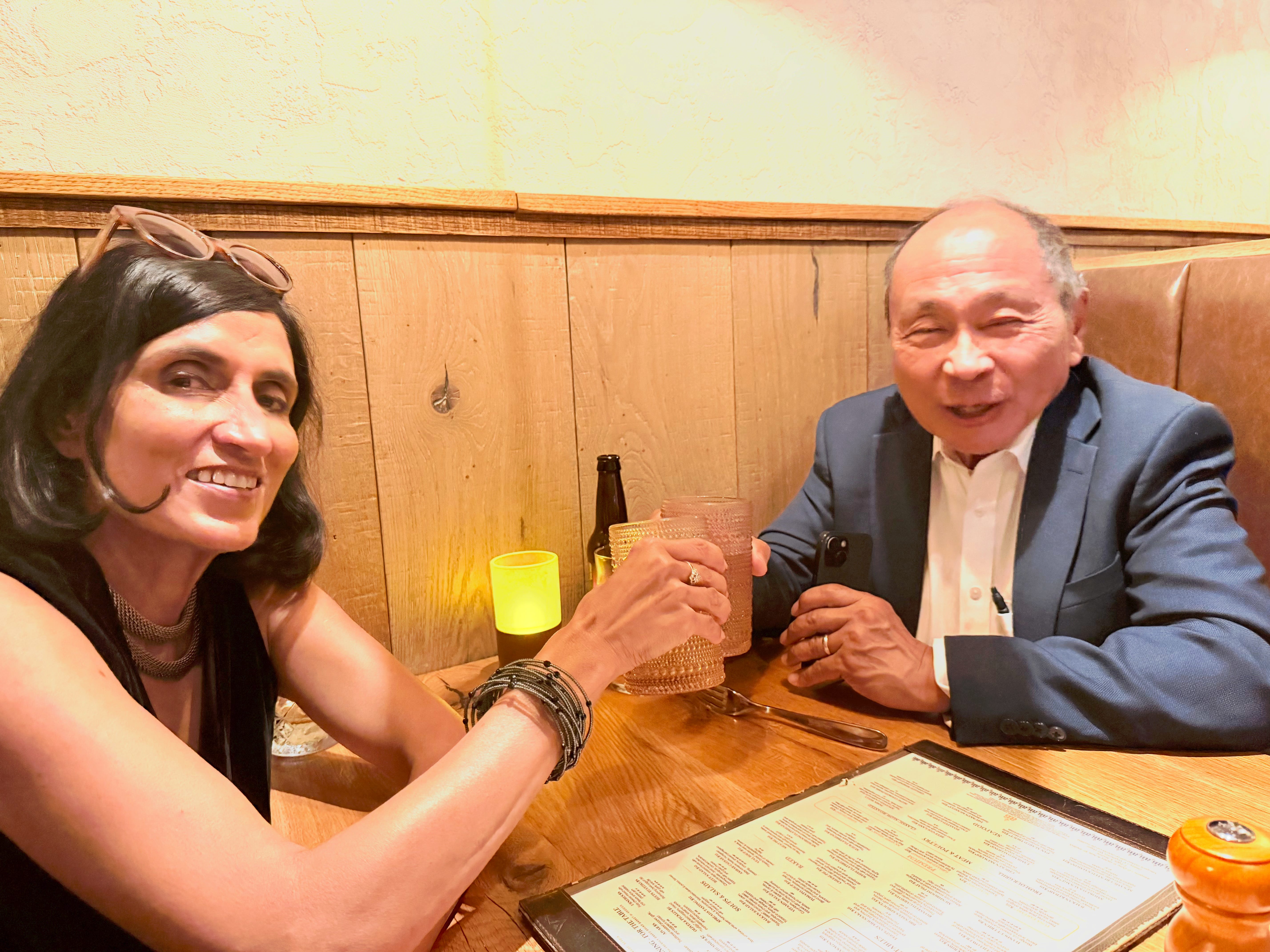
The East Coast Straussians were a more mixed bag. My husband is one, and so is Harvey Mansfield, under whom you both studied, and then Bill Kristol, who helped to lead the Never Trump resistance movement, at least in the popular press. But Bloom, who was your mentor, wrote The Closing of the American Mind, which was the first systematic critique of relativism, historicism, and multiculturalism that he believed was eroding faith in Western civilization. He thought the West was in decline. And as you put it in your book, it was a response to the first wave of identity politics and postmodernist critiques of the Western canon.
Now, do you think that critique also contributed to radicalizing conservatives against the left and clearing at least some of the path to MAGA and Trumpism?
Fukuyama: Yeah, well, there’s no question that identity politics has been a big target and has really stimulated a lot of people on the right, including me. I mean, I wrote a whole book on identity and basically why that form of identity politics is not compatible with liberalism—that liberalism is based on individuals and the equal dignity of individuals. And if you start categorizing people by their ethnicity or race or gender, you’re violating a basic liberal principle. You’re judging people on their group membership rather than on their individual characteristics.
So the reason for the parting of ways of the East Coast and West Coast ones is something that I puzzle over. Laura K. Field has written a very interesting book on this. I think that part of the answer is that the students of Harry Jaffa, right from the beginning, were basically American nationalists. That was their deepest commitment. Jaffa wrote a very, very good book on the Lincoln-Douglas debates, Crisis of the House Divided. And it’s a little bit interesting, because a lot of conservatives have said liberals are undermining the Constitution and the basic constitutional order, by which they mean essentially states’ rights—that Washington was usurping the right of states to make decisions on their own behalf.
Jaffa argued against that point. He said, in that fight between Lincoln and Douglas, Douglas was saying voters in each state should have the right to legalize slavery if they wanted. And what Lincoln was saying was, no, there’s a higher principle than anything in the Constitution, which is the assertion of the equality of all human beings in the Declaration of Independence.
“The problem is that there’s such a natural human tendency to favor friends and family that every modern state is in danger of regressing and repatrimonializing. And you can see that happening in the United States, where Trump seems to think of the U.S. government as basically a family enterprise that he can use to enrich his family.” — Francis Fukuyama
And so it’s actually quite a liberal interpretation of the Constitution. And so how these Claremont people can then say Washington is usurping the right of states—they’re just going back as if Jaffa had never written this book. However, in his later years, Jaffa became in a way more conservative and focused really on America as the apotheosis of classical virtue. And I think that’s a questionable view. But I think in his mind he melded the Straussian respect for the ancients, Plato and Aristotle, with American nationalism and said they’re basically all the same thing. And if you believe in America, you believe in the classic virtues and so forth.
And that, I think, was part of the original split. There are other things, I think, that intervened, like the fight between Athens and Jerusalem. I remember Bloom was always quite critical of religious conservatives. He felt that that was really not an acceptable basis for a kind of conservatism. His conservatism was really the preservation of a Western tradition of rationalism, that you could philosophically interrogate questions like, what is the best way to live, or what is justice? And that that was really what was represented by the whole Western philosophical canon.
I think Strauss’s fundamental insight, the thing that was the most important about his writing, was what he called the crisis of modernity, because he saw that that Western rationalist effort to do philosophy had by the late 19th century resulted in the thought of Friedrich Nietzsche and then in the 20th century of Martin Heidegger, who are fundamentally relativists. Nietzsche had this famous aphorism: “There are no facts, only interpretations.” And declaring that God was dead basically opened the gates to other doctrines, including fascism.
And one of the problems I had with—most French postmodernists were basically descendants of Nietzsche and Heidegger. They accepted the relativist premise. Foucault inveighed against master narratives, including the one on which liberalism was built. But they all had pretty left-wing commitments. Many of them remain Stalinists or communists. And if you are a true relativist, there’s no reason why you think that Marx doesn’t suffer from the same critique that every other philosopher suffers from. And I think that, if they were honest, they would see that fascism then becomes as equally plausible an ideology as Marxism.
If God is dead, then anything goes. And I think, in fact, historically, the ground for fascism was laid by these relativist attacks on the Christian doctrine of equality. That was thrown out the window. So I think these are all issues that divided this world of conservative intellectuals.

And part of it, I think, also just was personal, that a lot of Claremont people saw big opportunities in climbing on the Trump bandwagon, and they took it. Whereas Bill Kristol lost his backer for The Weekly Standard as a result of the stand that he took.
Dalmia: To discuss Bloom’s role in our contemporary moment, either way—on one hand, he powered the intellectuals who are at the vanguard of the Never Trump movement, right? On the other hand, his critique of the left, the relativistic left, did politicize a question that we were grappling with at that time. As you pointed out, relativism is not merely a phenomenon of the left. It can be a phenomenon of the right. In fact, the postliberal right is in many ways relativistic. It is contending that there are no absolute truths and you have to judge polities by their own standards, and they need not be universalistic liberal standards. So, in that sense, to particularize the critique of relativism to the left at that time and not really see that this is a phenomenon on both sides, radicalized the conservative right against the left.
Fukuyama: Yeah, but I wouldn’t blame Bloom for that. I mean, first of all, there was no real conservative—I mean, the conservative right back in the 1980s was Ronald Reagan, which was completely in line with American values, accepted democracy, accepted fundamental equality of human beings. And so I don’t think that there was a danger at that moment in American history that the right would fall into the kind of toying with authoritarian ideas that characterizes it now.
I oftentimes wonder, if Bloom were still alive, what he would make of the current world. A lot of this gets personal, because a lot of the support for Trump wasn’t that they liked Trump, but they just hated the cultural left so much and they’d vote for anybody that stood up against it. And I don’t know how Bloom … given his personal background and his tastes, he was very cosmopolitan, and he would not have gone in for this stupid, jingoistic nationalism that characterizes a lot of the Claremont people. But in the end, we don’t know.
His critique of left-wing relativism I thought was very good. And I agree with a lot of it. I think that this was a time when Jesse Jackson was in a march at Stanford saying, “Hey hey, ho ho, Western culture’s gotta go.” And that was really the dominant—it was the first wave of wokeness, really. They didn’t call it wokeness at the time, but that’s essentially what it was. And…
Dalmia: Let me push back a little bit on this, which is that you say you don’t identify yourself as a Japanese American. And I have a lot of sympathy for that. But at least for those groups in the country who have faced discrimination based on their ethnic or other attributes of birth or their religion, they have to mount a defense of themselves and stand up for their rights as a collective that has been oppressed. And so in that sense, it’s a political strategy to push back against some of the oppression and the lack of liberties that they have enjoyed.
“I thought that really the country by the 1960s had changed very fundamentally … as a result of the civil rights movement and the greater inclusion of African Americans and then women and then other marginalized groups that had formerly been excluded from Americanness. And that was very important to me personally. I would get teased for being an Asian when I was in elementary school. And I’d asked my father: ‘How should I respond?’ And he said: ‘Just say that you’re an American, and you are as good an American as anyone else.’ And I always took that to heart. And that’s part of the reason that I don’t like referring to myself as a Japanese American.” — Francis Fukuyama
I mean, the Black American culture has emerged the way it has in response to slavery and Jim Crow. And they don’t at this stage want to lose it and just become part of the big, bland American nation. They want to hang on to those traditions, which have been hard-won through a very, very tough encounter with America. Was it so wrong for Jesse Jackson to say what he said?
Fukuyama: Yeah, no, I think it was terrible, because he was denigrating the Western tradition.
Dalmia: Well, for not admitting some of, say, the African contributions?
Fukuyama: No, no, he wasn’t qualifying it in those terms. Well, it’s complicated what Jesse Jackson himself thought, but many of the people at that time that wanted to get rid of the Western canon basically thought that the West itself was evil. It was a source of colonialism and racism, and it basically didn’t have anything of value to offer. No, there was a radicalization, I think, just within these different minority communities. So I would say Martin Luther King was a classical liberal. And what he was demanding was that African Americans be treated equally as white people, right? He’s got some very moving passages in his speeches about little Black children and white children really ought to have the same opportunities, and that’s liberalism.
But I think that it progressed in the years after that into a more radical position that said that we’re actually determined by our ethnicity, right? That this is the lived experience, that you can’t appreciate even the feelings and the perspective of other people because of this barrier of either race, gender, ethnicity. And that the solutions to this are not liberal solutions. They’re basically putting the power of the state behind actively supporting one particular marginalized group over the majority community. And I think that that’s really the problem I have with identity politics.
I think that the hard-won gains that I had talked about in terms of juridical equality that was really at the core of the civil rights movement—that was a tremendous achievement. As I said, that’s really what allowed my family to really be fully integrated as Americans. So Reagan said the internment was bad and they paid compensation, but they didn’t go on to say Japanese Americans therefore need to be supported by the state in employment, in starting businesses, in a whole range of activities that would treat them as a group and not as individuals. And I think that’s the direction that identity politics then went into.
And I guess the thing that really annoyed me the most is this whole effort to categorize Plato, Aristotle, Rousseau, Hobbes as just dead white males, and you don’t have to listen to them, you don’t have to take them seriously, because they’re the wrong skin color and ethnicity and gender.
Dalmia: You and I have some disagreement in this. Let me just point out: You yourself said that because of your family’s experience during World War II and their internment made you a little bit more alert to the abuses of authoritarian rule right now and what it meant. And so to that extent, I think lived experience does shape you. There are things you can see because you’ve lived through some situations that those who have not can’t see. Now, I don’t think it is a complete epistemic obstacle to seeing the other side, but it does prime you a little bit differently to process any given political moment.

And so to that extent, Jesse Jackson is much too crude a figure, but some of the more sophisticated interlocutors of, let’s say, critical race theory, were not wrong about that. They were pointing to something that was worth thinking about. And some of their insights, I think, got somewhat mangled because of this somewhat right-wing and conservative prism that we used to look at them and interpret them.
But I’ll move on from there and actually talk about your intellectual evolution out of conservatism. You were a conservative at one point, but I think you don’t classify yourself as one. You are actually very, very hard to pigeonhole at this stage, which is what I appreciate about you. But your break from the conservative establishment came over the Iraq War, long before Trump actually arrived on the scene. And you had initially supported that war, but then you turned against it because you saw how badly it was going, and you saw no understanding of that within the immediate conservative circles that you inhabited. What it also showed to you was how ill-equipped the United States was for nation-building.
And it made you question all the assumptions of conservative orthodoxy. And there were two pillars of that. There was neoliberalism, which was domestic policy, and then neoconservatism, which was foreign policy. I want to ask you a little bit about your shift from neoconservatism and also your shift from neoliberalism, but let me ask you this first.
Because America was born in revolution against a tyrant, it treats the central problem of politics as limiting government. And you think that’s the wrong place to begin. And that’s where you had been beginning, because you were a conservative. And your view changed to: The real problem of human living is not limiting government or limiting the state, but how to create a functional state in the first place. And that inquiry led you to write a two-volume history of all of the world. It’s a very, very comprehensive account. What is the main lesson from that inquiry of yours?
Fukuyama: Yeah. Well, this has a longer prehistory. It really started with Afghanistan and Iraq, where we collapsed the state in these two countries and really had no clue as to how to rebuild a state, because Americans just don’t focus on state-building. They focus on limiting the state. And that was true not just of the officials in the Bush administration; it’s true in political science. So very little attention is paid to the executive branch, bureaucracies, and so forth, because of this fundamental American unhappiness or discomfort with state power.
In the 1990s and the early 2000s, I was running the International Development program at SAIS after 2001. And if you look at development theory as to how economists think about what are the causes of growth, what makes poor countries rich, there was a big revolution that took place that went under the heading of the new institutional economics. This was Douglass North initially, but then people like Daron Acemoglu and Jim Robinson got on this train. And I think it was a fundamental progress, because, amazingly enough, none of the growth theories in development economics prior to North took politics into account at all. It was simply a matter of capital and labor and how it was deployed and technology, but they didn’t say anything about institutions.
“One of the optimistic things that came out of this election is that it has produced a whole new generation of Democratic leaders that are young and vigorous and smart and so forth. I think I was asked many times in the years preceding the election, well, who do the Democrats have that can possibly win in 2028? We now have an answer to that. There are a lot of them.” — Francis Fukuyama
And I think that there is a big awakening among economists sometime in the 1990s that, yes, actually, if you don’t have a state that can protect property rights, if you don’t have a judicial system that can adjudicate disputes, you’re not going to have economic growth. And from that point, there was increasing attention among economists to institutions and their importance.
And I saw this for myself, because I went to a lot of countries where you either had an almost absent state, like in Melanesia, in Timor-Leste, Papua New Guinea, the Solomons. I mean, these are tribal societies that really just had a state imposed on them by their colonial masters, but had no indigenous state that anchored them. Or in Latin America, where I spent probably the most time of all, where you do have states, but they’re extremely weak. Classic Weberian definition of a state is a monopoly of violence, and Mexico to this day does not have a monopoly of violence. You have narco gangs that basically run certain Mexican states. In Colombia, you go outside of the big cities and you have narcotraffickers basically providing the public goods, and this is really bad. This is a big obstacle to any kind of economic development.
So this is what made me kind of recognize that having a modern state with enough capacity to provide the basic public goods that states are supposed to provide is a precondition to growth, and it’s much more important than natural resources. If you look at the difference between Norway and Nigeria, they both have oil, but Nigeria is a total mess and it still has incredible amounts of poverty. And the reason for that is Norway has a competent state. It has a modern, impersonal state that can look into the future and make plans and allocate resources effectively for the long term, and Nigeria just doesn’t.
Dalmia: Yeah. Well, you wrote a two-volume account of this, but what is the reason that Norway was able to engineer this shift but Nigeria was not?
Fukuyama: Well, there’s an underlying story. So the biggest transition is from what Max Weber called a patrimonial state to a modern state. Patrimonial state is basically an extension of the ruler’s family, and state power is basically used to enrich that family. And so it is really a kind of parasitic, extractive institution. And frankly, most states in human history have been like that. You have a ruling elite, they’ve got a monopoly of violence, and they use that to extract resources from the population. A modern state is impersonal. The people running the state look to public interest rather than their own personal interest. And that’s the most important transition.
A lot of it has to do with getting beyond the family. This has been a theme, started in my book Trust, but it continued in the political order books, where kind of the natural mode for human political organization is based on kinship. Sometimes it is based on tribal structures, as in the Middle East. Sometimes it’s based on kind of families, aristocratic families. But you can’t break into real modernity, either economic or political, unless you can create impersonal state institutions, in which the prime minister is not in it to enrich himself, but basically is a minister to the public.
And I began to realize that that is the most difficult transition. So my political order books looked at several countries, civilizations that had made that transition. So that was the Ottomans, it was France, it was China. I argue that China was actually the first country to create a modern state. But the problem is that there’s such a natural human tendency to favor friends and family that every modern state is in danger of regressing and repatrimonializing. And you can see that happening in the United States, where Trump seems to think of the U.S. government as basically a family enterprise that he can use to enrich his family. So that’s not a new phenomenon. That’s been going on for centuries, but modernity requires getting past that. And so the question is, how do you do that? And that’s a pretty tough issue.
Dalmia: So let me ask you this. If the problem of the state is how to create a functional state, America started with the wrong premise, right? I mean, it was born out of a revolution against a tyrannical monarch in England. And the central problem for the Founders was how do we limit the state and how do we limit the tyranny of the state. So how did it start from a wrong premise and still become one of the most successful polities in history?
Fukuyama: Well, no, it didn’t start from a wrong premise. You have to have a balance. So you need state power, but you also need to limit and circumscribe that state power. The reason that they shifted from the Articles of Confederation to the Constitution was there was a recognition that there was no state and America needed a state. It needed an army, it needed some way to adjudicate disputes between the existing states. And so they created a state in recognition of that importance. But there’s always been great suspicion of state power, and that, I think, has limited, in a way, the capacity of the American state to do the things that people expect of it.
Dalmia: This is where my lingering libertarianism will come out. I mean, America is the most successful polity of all time, right? Like, it has delivered untold prosperity, quality of life, freedom to its inhabitants. So it got something right. It got the mix of a functional state and then limits on the functional state—that balance—somehow right. I mean, how did it accomplish that?
Fukuyama: Well, there’s a very good book by Marc Dunkelman called Why Nothing Works that was published, I think, a year or two ago. And he looks at American history through a slightly different lens. So he says that there are basically two approaches, where you have a Jeffersonian approach that’s extremely suspicious of state power and seeks to push power as far down as possible, into civil society, into the states, and so forth. And then there’s a Hamiltonian view that regards the state itself as an engine of progress. And in his account, the United States has been alternating between these two understandings of the role of the state. So most of the 19th century was Jeffersonian; we had an extremely weak federal government, and power was held in civil society and state governments and so forth.

Beginning in the Progressive Era in the 1880s and continuing really through the Second World War, you shifted to a Hamiltonian position. And really the emergence of the United States as a modern great power was really done under Hamiltonian circumstances. You create regulatory institutions like the ICC, you create taxing authority, you create the ability to regulate food and drugs, stocks, and you also create the ability to mobilize a gigantic army that goes on to win World War II. And so the internal American thinking about what’s the appropriate role of the state is not a constant. It’s shifted.
And I think the argument that I and certainly Dunkelman and many others would make is that beginning in the 1960s, we shifted to a Jeffersonian position, where we wanted to empower public interest law firms and civil society groups and so forth to resist the state, and no longer saw the state as an engine of progress. And I think that part of the reason we can’t build stuff right now is because of that Jeffersonian mindset. We’ve empowered basically every organized group in the United States to sue the government, to stop it from doing stuff. And that leads to this situation that I call vetocracy, where the government is really not empowered to do things.

© The UnPopulist, 2026
Follow us on Bluesky, Threads, YouTube, TikTok, Facebook, Instagram, and X.
We welcome your reactions and replies. Please adhere to our comments policy.


