




Listen to Zooming In at The UnPopulist in your favorite podcast app: Apple Podcasts | Spotify | YouTube

Welcome to Zooming In. I’m Berny Belvedere for The UnPopulist. The World Cup is finally here! It’s hosted by the United States, Mexico, and Canada. It’s the largest World Cup in history. On Thursday, Mexico kicked off the competition by beating South Africa 2-0, and the U.S. followed that up the next day with possibly its best-ever performance in the World Cup, a thoroughly convincing smackdown of Paraguay. Both Mexico and the U.S. started really strong and have their fanbases dreaming of World Cup glory.
On Wednesday, the eve of the cup, I sat down with León Krauze, contributing columnist at the Washington Post and host of the Boca de León podcast, to discuss the great tournament. Our focus wasn’t so much the soccer aspect of it all—but rather how this World Cup, thanks to Donald Trump’s anti-immigrant maximalism, has in some key ways betrayed its own promise.
What makes León the perfect guest for this episode is that not only has he extensively covered the sport of soccer, including the history of Mexican soccer—but he’s also a leading commentator on U.S.-Latin American relations.
In our time together, we covered a number of incidents that are quite troubling. A FIFA referee from Somalia was detained at a U.S. airport and sent home. Iran’s federation had its ticket allocation pulled days before their first match—and the squad has had to relocate its base in Mexico. The acting ICE director [Todd Lyons] told Congress he wouldn’t rule out arrests at stadiums, contradicting the assurance that Secretary of State [Marco Rubio] had given Miami’s own host committee a week earlier. And Amnesty International published a report calling the United States, on the eve of the world’s party, a country facing a “human rights emergency.”
There was so much to cover we didn’t even get to everything. Iran’s players were issued visas only after being warned not to abuse the system, then ordered off American soil the same day as each of their matches. These are professional athletes that the U.S. is telling: “Don’t stay the night on U.S. soil.” In another instance, a Moroccan player was held up and nearly denied entry at a U.S. airport, reportedly due to his father’s appearance—specifically, his beard. Although DHS says ICE won’t be deployed for immigration enforcement at venues, its new secretary, Markwayne Mullin, said before the cup that “ICE is always going to do immigration enforcement.” Germany’s football federation has actually issued an official advisory to its own players to stay quiet on politics at this tournament. And looming over all of it: FIFA, under Trump’s personal friend Gianni Infantino, invented a “FIFA Peace Prize” out of thin air and handed it to Trump, who was sad over not winning the Nobel Peace Prize.
In our conversation, we hope the following comes through: We couldn’t be more excited for our favorite sporting event to get underway, but we couldn’t be more disappointed in how the build up to this tournament has in some ways proceeded in direct contradiction to how it was initially sold.
We hope you enjoy.

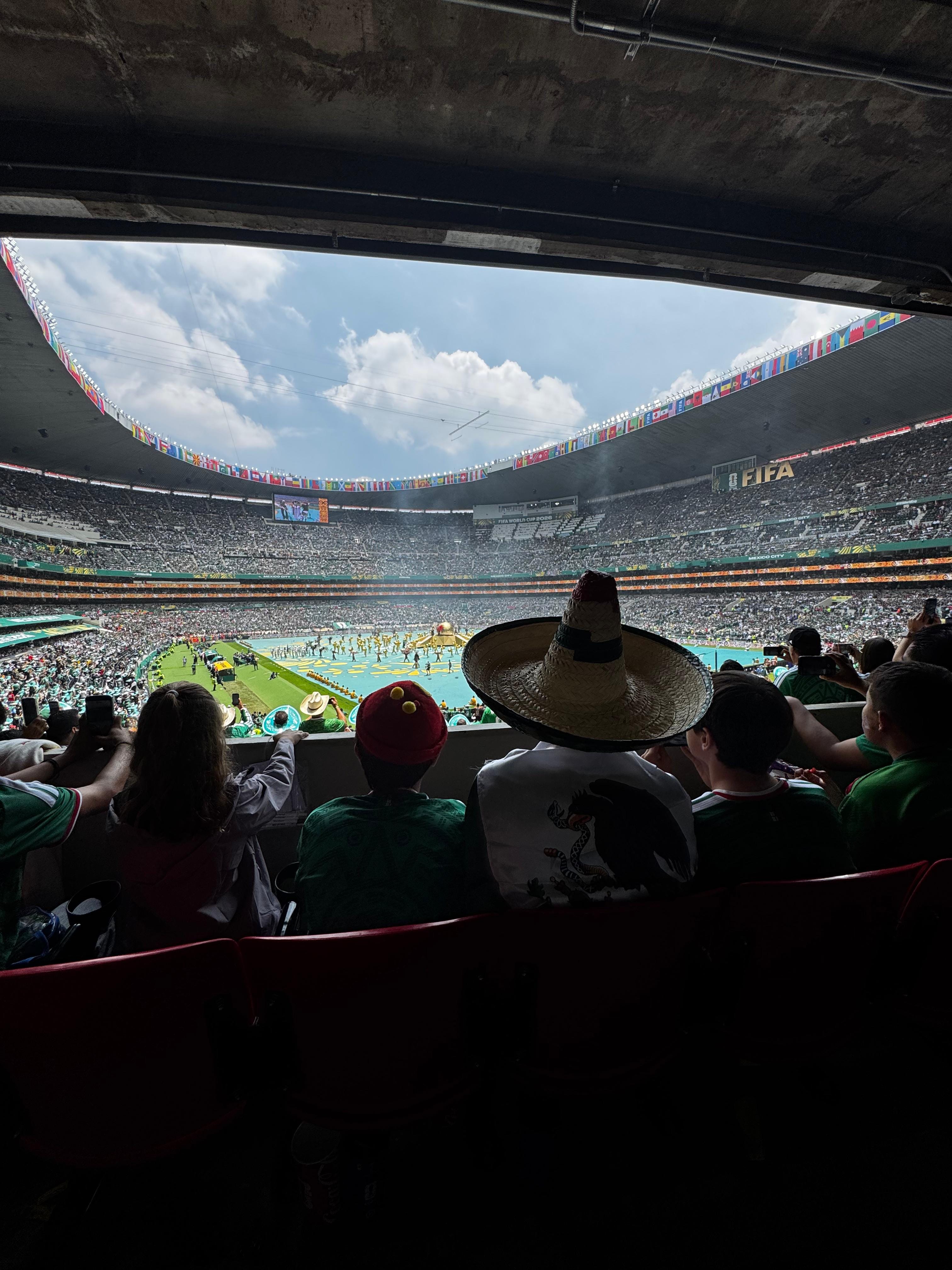
Berny Belvedere: León, Mexico opens the tournament at the Estadio Azteca in Mexico City. It’s the third World Cup opener at the Azteca. That stadium also kicked things off in the 1970 and 1986 World Cups. No stadium on earth has that history. Eduardo Galeano, the Uruguayan journalist, once wrote that from the depths of the Azteca, “you can still hear the ceremonial chants of the ancient Mexican ball game.” And, of course, as an Argentine American, the Azteca has great significance for me as well. It’s the site of probably the most immortalized moment in Argentine soccer history—it’s where Diego Maradona, one of my native country’s two great GOAT candidates, produced the greatest goal the tournament has ever seen. Brazil’s Pelé, another GOAT candidate, also lifted the World Cup trophy at the Azteca.
So, there are lots of folks out there—lots of them casual fans, to be sure—who had maybe heard that the U.S. is hosting the Cup, but they weren’t aware that the U.S. is actually a co-host. That is, Mexico and Canada are also hosting this World Cup alongside the U.S. And that must fill you with immense excitement. So tell me, what are you feeling as this great event gets underway?
León Krauze: Wow, I got goosebumps listening to the way you just described Estadio Azteca. You know, for me personally, it really is a sacred place. And it’s not only because I’ve been in love with football since I was a little boy. I also began my career as a sports journalist. But it also has to do with the fact that it’s a fortress for Mexican football. It’s a very virtuous representation of the best that Mexico has to offer. It’s a magnificent architectural jewel, an old stadium by modern standards from the 1960s. And, as you pointed out, it’s the cathedral, or one of the cathedrals, of the game. If you run down the list of stadiums in the world, I think it’s probably the most renowned and revered stadium in all of football.

So, for it to host, in its currently revamped version—because it was remodeled, probably not as it could have been remodeled but still remodeled—a third World Cup, and given that it’s home to tens of thousands of crazy Mexican fans … when you close your eyes, you go down the place’s history and how it’s been a witness to some of the most amazing moments in the sport, and also, again, so important for Mexican identity … it’s just very emotional for me. It’s one of the reasons why this World Cup, for me personally, and for many people, is really, really emotional.
Belvedere: So the World Cup is the planet’s great festival of free movement. You have in this World Cup, because it was expanded, 48 nations; you have around six million traveling fans—think about that number!—and you have the one month every four years when the whole world physically just shows up somewhere.
Now, think back to the last World Cup in November and December of 2022. And, for listeners who are noticing a contrast there, that one was held in the winter for weather reasons, because Qatar in the summer … I don’t know that it’s way worse than some places in the U.S. in the summer, but it’s as if everywhere in the U.S. were Miami. That’s what it would have been like in Qatar in 2022.
Krauze: That’s a good way to describe it.
Belvedere: So they moved it to November and December. And for that month, the entire world descended on Qatar. That’s not an exaggeration. You can see footage of a kind of cosmopolitan festival there for nearly the entire month. It was Disney’s “It’s A Small World” ride come to life.
So, the U.S., along with co-hosts Mexico and Canada, won the bid to host this super-event way back in June of 2018. We did it at the FIFA Congress in Moscow. That’s what I want to establish here as we delve into the main thing, which is how this tournament was sold back in 2018. It was billed as a kind of celebration of North American openness. Three countries, one seamless festival, one continent throwing its doors open to the world. That’s the premise. And that premise was betrayed.
“[In some ways we’ve been] betrayed—absolutely. When you look at the original premise of how this World Cup was sold to the world and how North America won the bid, what’s happened is really the complete opposite. We have seen the main host threatening to annex one of the other hosts—to turn Canada into the 51st state. And we have also seen it attack militarily and unilaterally the other host, Mexico. That’s how the World Cup has begun. … Beyond the World Cup, the trilateral relationship and each bilateral relationship is going through probably the darkest period in decades and decades. I would argue that, with Mexico, we haven’t had this sort of animosity in more than a century. So it’s disappointing. And in a way, it’s tragic.” — León Krauze
What do you think about this terrible situation we find ourselves in where what we’re seeing from the White House, and how they’re presiding over the tournament, is the very opposite of what it was presented as?
Krauze: Betrayed, I mean, yeah, to say the least, absolutely. When you look at the original premise of how, like you just explained, this World Cup was sold to the world and how North America won the bid, what’s happened is really the complete opposite. We have seen the main host threatening to annex one of the other hosts—to turn Canada into the 51st state. And we have also seen it attack militarily and unilaterally the other host, Mexico. That’s how the World Cup has begun.
Among many other things, you have the Iranian national team sequestered in Tijuana because they have been forced to [train in] Mexico in inadequate facilities, because the administration hasn’t really granted them the right to be in the United States—not respecting the spirit of the World Cup, which I’ve always said has always reminded me of what the ancient Olympic games were for the classical world: a time in which, however romantically, all hostilities were paused or set aside for what was a celebration of the human spirit, the human body—human strength and athletic capacity. So it’s really sad to see how North America—primarily due to the United States and the Trump administration—has lost the possibility of conveying this openness, this integration, this collaboration.
Beyond the World Cup, the trilateral relationship and each bilateral relationship is going through probably the darkest period in decades and decades. I would argue that, with Mexico, we haven’t had this sort of animosity in more than a century. So it’s disappointing. And in a way, it’s tragic.
Belvedere: Yeah, and I want to stay on Mexico piece for a second, because as everyone [now well knows], we’re under such a constant torrential downpour of scandal and scandal-adjacent stuff from this administration that it’s hard to keep track—but if you look at a timeline of some actions that the administration has taken against Mexico, you would think it’s in a competition with Mexico, as rival bids to host the World Cup, when they’re actually supposed to be locking arms together. It’s a really bizarre way to treat your closest trading partner and ally. But before I get to the Mexico piece of it, I want to pick up on something you mentioned with the Iran situation, which is absolutely crazy.

Let me say at the outset that I have no love whatsoever for the Iranian regime. And, of course, war complicates everything. But people need to remember: In March, Trump posted on his favorite social platform that while Iran’s team is technically welcome, they perhaps shouldn’t come “for their own life and safety.” Just think about the host head of state publicly discouraging a team—one that literally qualified for the tournament—from attending. It’s crazy stuff. The team understandably relocated its training base to Mexico, as you noted. This month, more than a dozen staffers and federation officials, including the federation president, were denied visas. And the U.S. official told reporters that the government wouldn’t let Iran “sneak terrorists into the country.” These are people who are a part of the soccer federation of this nation.
Just yesterday, the federation said FIFA had revoked its [Iran’s] entire supporters’ ticket allocation—so, the 8% of stadium capacity every federation gets. It did so days before kickoff, after fans had already bought tickets and booked travel in some cases. The ones who were brave enough to try [to attend], they’re just told: “Nope. Not allowed.” That’s a crazy way to treat a country that had qualified and should be given a place in this tournament and not made to feel like their fans can’t come. And Haiti faced a similar thing, but the way that the Iranian team and its cohort has been treated is really shameful.
Krauze: I think that it’s … that side of the story that you mentioned about Iranian fans, I disapprove. I don’t understand [why they would do that to them]. But when you think of the Iranian Soccer Federation, and the team itself, and the way it’s been treated, that’s beyond—that’s almost sinister. It goes back to that phrase that applies, I think, to many of the administration’s policies: cruelty is the point. What is the point of subjecting this team to this treatment? You are actually threatening a source of joy. Not for the regime that famously disapproves of parts of what soccer entails—for example, when it comes to women’s soccer in Iran. So, it’s not about the regime. It’s about the 90 million Iranians who see this World Cup and approach this World Cup as every other nation that takes part—as a source of potential joy. And joy just because they’re taking part in it.
“When you think of the Iranian Soccer Federation, and the team itself, and the way it’s been treated, that’s beyond—that’s almost sinister. It goes back to that phrase that applies, I think, to many of the administration’s policies: cruelty is the point. What is the point of subjecting this team to this treatment? You are actually threatening a source of joy.” — León Krauze
So it’s really impossible to understand from a diplomatic perspective. It’s a mistake. And I hope that Iran has a successful World Cup—very unlikely, because to abide by the rules that the U.S. government has set for them, they’re going to have to take off from Tijuana very early in the morning and go to their matches and then come back that same day. So it’s going to be very difficult for them to really perform.
And there are other examples, right? There’s the case of this Somali referee, a professional referee, who was denied entry into the United States. And he said, “Listen, the only thing I wanted to do was reach my dream. I’ve always had the dream of refereeing in the World Cup.
Belvedere: Just consider how implausible it is. Their public reason for denying a referee entry is: “for security purposes.” They think that it’s plausible to tell you that this person has been a sleeper agent training as a referee for years. They treat the people who are supposed to listen to these rationales with contempt, because the rationales don’t make minimal sense to begin with. It would be one thing to say, “Maybe radicals are sneaking in with fans.” But, like you said, these official players—whether it’s a physio for a national team, an assistant coach, or a referee—clearly we should be able to say that these people can come in.
And just in case someone thinks that it’s only because of the Iran war stuff, consider the case of Haiti. So, here’s a nation that is competing in this World Cup. The nation qualified for the tournament for the first time since ’74. It did so under extraordinary circumstances. It didn’t get a chance to play a single home match. Tell me what other country faces that, right?
Krauze: Ukraine. Only Ukraine.
Belvedere: Yeah, that’s right. Haiti’s soccer federation operates against a truly insane backdrop of gang violence and state collapse. Haiti’s one of the great sporting stories of the decade, actually. And I don’t think they will advance from the group or anything. I’m not betting on them as a dark horse or anything like that, but that’s missing the point. Getting to the Cup is already a massive W for Haiti. So here’s the thing: Haitians coming from Haiti are fully banned from entering the U.S. for the World Cup.
And that’s not all. The administration also moved to strip Temporary Protected Status from roughly 350,000 Haitians already living here. A judge blocked that, but the administration has pursued an appeal all the way up to SCOTUS. So Haitians with deep roots in America are living in legal limbo and at the very least can’t enjoy their team’s incredible, almost miraculous entry into the Cup.
The nation is set to play its first match against Scotland on [Saturday] in Foxborough, Massachusetts. Massachusetts is home to nearly 90,000 Haitians. It’s one of the largest Haitian communities in the country. The match is happening in the diaspora’s backyard, as it were. An Al Jazeera report found that Haitian fans in the U.S. are saying they’re afraid to attend this once-in-a-lifetime opportunity to watch their team.
So León, tell me, what do you think it does to a community to realize that celebrating in public—celebrating something that is deeply important to its identity—is too great a risk to take? At the very least it psychologically conveys that they are unwanted and that they cannot be who they are here. That’s at the very least. What else do you think it does to these communities?
Krauze: Well, that’s another reason why you could argue, Berny, that the U.S. should have been disqualified as a host, to be honest with you. I mean, for the government to say brazenly—this makes my blood boil, as you know, because this really touches my heart—that they were going to deploy ICE agents during the World Cup, and they were going to do the same thing before and during the Super Bowl, and Kristi Noem was just enjoying it so much, right? This is probably one of Stephen Miller’s very devious and sinister wet dreams. It should be disqualifying, honestly. It should be disqualifying for the United States to host. If [FIFA Chief Gianni] Infantino—and maybe we have to touch on the man—had been brave enough to say: “This is one of the few events that really goes beyond politics, so if you’re going to treat the fans and the teams this way, and your local communities this way, you are not hosting the event.”
But, of course, Infantino … that requires enormous courage. And we all know that not only in soccer, but in general, this is a time of cowards. There aren’t many courageous people in the world, especially when it comes to facing Donald Trump. But the truth is, what you’re describing is and should be disqualifying as a host nation. The persecution of a fan base? People, by the way, who live in your country. I mean, it’s just incredible.
Belvedere: Yeah, it’s beyond anything you would expect any decent country to do as they host the world for this event. There was a German [soccer official] who was proposing just that—that the U.S. has sort of morally disqualified itself because of the way that it treats, in nakedly punitive ways, regimes, countries, and even extends it, scaffolds it down, to their fan bases and the people, in ways that are just unbecoming of a host.
Krauze: Correct.
Belvedere: You brought up ICE. In February, the acting director of ICE testified before the House. And he was asked, pretty much directly, will you commit to just pausing immigration enforcement during the World Cup? Nobody asked him to reverse his ideological commitment, but just [to pause] for a moment that is supposed to be an expression of joy globally. He refused.
Krauze: Of course.
Belvedere: Andrew Giuliani—Rudy’s son—runs the White House World Cup task force. He was asked whether ICE would operate at stadiums and fan festivals, and his answer was that the president “never rules anything out.” I mean, you have a chance to send a signal to the world that, for a brief period, this is just going to be a celebration for everyone. But you have to be your anti-immigrant maximalist self, even in this moment.
“In the end, exclusion of a fan base is just an extreme measure that is actually disguising the incompetence of America’s immigration system and the unwillingness of the administration to do the right thing and fix it. Because if there’s a problem with screening of individuals, so be it. But to take that—you used a word that I really like, and I think it’s very elegant—specific issue and turn it into a maximalist proclamation that immediately threatens a large amount of people, and of course threatens the vitality of the tournament, of the celebration—once again, it should have been disqualifying for the United States as a host nation. You don’t hear any of these kinds of complaints with Mexico or Canada. We had Germany, and coming up [in 2030 we’ll have] Spain, Portugal, and Morocco. A bunch of countries on earth have had to[, and will have to,] deal with this influx of tourists from all over the world. If you can’t handle that, then don’t be the host, man!” — León Krauze
I do want to get back to the way that the U.S. has treated its co-host Mexico. I think it’s telling—it explains why this World Cup had so much promise in terms of the openness [it was supposed to project] to now what it’s become, with constant conflagrations and conflicts and issues having to do with the flow of people to this tournament. I think the U.S.’s posture toward Mexico is a kind of microcosm, or at least explains how things descended to the point that it did.
So here’s the timeline of Trump’s actions: On day one [of his presidency], January 2025, he signed an executive order renaming the Gulf of Mexico the “Gulf of America.” The month after, he ordered 25% tariffs on Mexican goods, pausing them only after Mexico’s president sent 10,000 National Guard troops to the border. That same month, still in February, still very early, his administration designated Mexican cartels as foreign terrorist organizations. It sounds like a technical thing, it sounds fine, but it’s a sort of legal scaffolding [to pave the way for] more aggressive U.S. military action. In March, the tariffs hit anyway, even though the Mexican president did what she could to delay them. Then came the on-again, off-again whiplash that has defined the tariff stuff ever since. Twenty-five percent tariffs were slapped onto fentanyl, 25% on cars, 50% on steel and aluminum, with deadlines extended every few months or who knows when. In the summer, his megabill imposed a new tax on remittances—the money Mexican workers send home to their families, one of Mexico’s largest sources of foreign income.
I remember, as a worker at Circuit City in Kansas City, since I knew Spanish, they would ask me to interact with a lot of Mexican customers—some of the most decent people you’ll ever meet. They just wanted to make their money, buy their goods, and send a whole bunch of money, the majority of what they had, back home. And this now complicates that. On top of that, the U.S. military was, by last year, blowing up alleged drug-trafficking boats at sea, the CIA was flying surveillance drones over Mexican territory, Trump was openly musing about military strikes inside Mexico—your own co-host [for the World Cup]!
And here’s the thing that makes this so deranged, León. Mexico is not some adversary. This is the thing: Mexico is the United States’ largest trading partner. More than $850 billion in goods and services move between the two countries every year. So this is how he treats not just our co-host, our neighbor, but also, if you want to put it this way, our best customer and our best supplier. Crazy stuff.
Krauze: Absolutely crazy stuff, but it’s been going on for 11 years. I mean, you should have begun your timeline in 2015, because it’s been 11 years since Trump descended that horrendous golden escalator and then got to the podium and began attacking Mexicans. You know how long it took him? I know because I counted. It took him 100 seconds to begin attacking Mexicans. With that famous phrase: “they’re criminals, they’re rapists, they’re not sending their best, and some, I would think, are good people.” Those words that are now part of our shared history—that has been such a complicated, difficult, painful and also wonderful one, the relationship between Mexico and the United States, of which I could just go on and on and go back in time to talk about. But it’s incredible. And it’s been very sad to see.

On the other hand, I have to say, the Mexican government hasn’t helped its cause in any way. We don’t have a liberal government in Mexico. The Mexican government is not a democratic one—or at least it doesn’t respect the rules of democracy. It has eroded democratic governance and the rule of law and the separation of powers and freedom of the press. The list is very long. And now the current situation in the bilateral relationship couldn’t be worse, because the United States is pushing Mexico, the Mexican government, to act against a certain number of figures within its own structure—the movement’s structure. And I use the word “movement” because they—and when I say “they,” the Mexican government, the Morena party—they don’t refer to themselves or to the party as the party. They call it “the movement.” And they call López Obrador not the leader or former president; they call him “the founder.” Words matter. We’re talking about a populist messianic leader, allergic to democracy and basic freedoms, who has built a movement that has threatened to really erode Mexican democracy.
So Mexicans are now caught—both Mexicans in Mexico and Mexicans in the United States—between truly a rock and a hard place: between an American government that has persecuted them in every possible way for 11 years now, and a government in Mexico that has eroded many of the conquests—[achieved,] however, in a manner that can be flawed, and we could talk about that at length—the very concrete conquests and steps of progress that Mexican democracy had taken and achieved over the last few decades. The situation couldn’t be more difficult, more dire.
For me, it is obviously not a coincidence that the State Department once again published, 24 hours before the World Cup began, its travel risk map for Mexico. It sends a message. “You guys are under our magnifying glass, under our microscope, and you should pray to God that nothing happens during the World Cup, because if it does, that would open the way and the door for more severe measures.” I think that’s the message that the White House is sending just as the [tournament] was beginning. And it’s a harsh message. And that’s where we find ourselves.
At the moment, I’m praying—I’ll tell you, I’m praying that nothing happens, not even the smallest incident or kidnapping. I don’t want anything to happen. I want the Mexican team to succeed. And immediately after, my next wish is for the tournament to just end for Mexico as a host with no important visible crime-related incident. Here’s hoping. Here’s hoping.
Belvedere: Absolutely. This administration is ready to exploit any possible thing they can get their hands on to advance the ball on their agenda, in a way that’s cynical and craven. We saw it with Charlie Kirk, whose death was obviously a tragedy, but then it was weaponized into a kind of punitive instrument in order to hit people. I mean, people were detained, they lost their jobs over criticism of a certain type. This is the way that this administration operates.
“It’s been 11 years since Trump descended that horrendous golden escalator and then got to the podium and began attacking Mexicans. You know how long it took him? I know because I counted. It took him 100 seconds to begin attacking Mexicans. With that famous phrase: “they’re criminals, they’re rapists, they’re not sending their best, and some, I would think, are good people.” Those words that are now part of our shared history.” — León Krauze
I want to actually take some of this administration’s anti-immigrant actions—actions that are of course relevant to the World Cup—in a kind of item-by-item way. The first one is the travel bans that we had hinted at. We had two presidential proclamations that restrict entry from 39 countries. These were issued last year. Four of those 39 countries qualified for this World Cup. You have Haiti and Iran, which have full bans. You have Senegal and Ivory Coast, two African nations, and they were added in December, in the second proclamation rather than the first. And their restrictions … what they block are new tourist visas. So … fans. Players and coaches, they get a carve-out. But fans get no provisions.
Krauze: By the way, Senegal are the African champions. We’re talking about a contender.
Belvedere: Yeah, that’s right. We’re talking about a team who has players who have played at the highest of highs in world football. The African champions, huge team. Senegal plays France on June 16, and it has [its] traveling supporters locked out of that game. For people who don’t know, this is a significant loss. In Qatar—we mentioned the last World Cup—the Senegalese were among the best fans around. They had endless drummers and dancers in the stadiums and in the streets of Doha. They were part of the celebration of it all, and the U.S. has said, “you can’t come.”
And here’s the cynical point that I keep coming back to. Look, obviously, we have to ensure that our system is orderly and effective. It can’t be an unchecked revolving door, obviously. But I think it’s just as obvious that this administration will offer the pretext of orderliness to underwrite its exclusionary preferences. As I mentioned, Senegalese people were kept out, and part of the public justification for that was, “we’re having screening and vetting deficiencies with their fan base.” Like, you should be able to handle that! These are fans.
Krauze: That’s what I was going to say. You read my mind. In the end, exclusion of a fan base is just an extreme measure that is actually disguising the incompetence of America’s immigration system and the unwillingness of the administration to do the right thing and fix it. Because if there’s a problem with screening of individuals, so be it. But to take that—you used a word that I really like, and I think it’s very elegant—specific issue and turn it into a maximalist proclamation that immediately threatens a large amount of people, and of course threatens the vitality of the tournament, of the celebration—once again, it should have been disqualifying for the United States as a host nation.

You don’t hear any of these kinds of complaints with Mexico or Canada. We had Germany, and coming up [in 2030 we’ll have] Spain, Portugal, and Morocco. A bunch of countries on earth have had to[, and will have to,] deal with this influx of tourists from all over the world. If you can’t handle that, then don’t be the host, man! If you don’t think you can treat people with respect and organize this the way it should be organized, then step aside and let Mexico—who would be more than glad to welcome everyone, with all its deficiencies and craziness—and Canada. Step aside if you think you can’t. That’s why I find it, like you were just describing, so incredibly frustrating and unfair to so many.
Belvedere: Yeah, and here’s another item that I think is worth calling out. Trump suggested that he could move games out of Democratic-run cities, so-called blue cities. He threatened to pull matches out of Boston, Seattle, San Francisco—
Krauze: Los Angeles.
Belvedere: Los Angeles, right. Cities that he claims are run by “radical left lunatics.” This is how strongmen work, of course—with a kind of mobster mentality. He threatened to call Gianni Infantino—you mentioned him earlier, he’s FIFA’s president—and say, “I could have these games moved.” Just economically, it’s insane that he would hurt his own country’s revenue stream that way by suggesting that. Because those matches absolutely belong in those places. So, just on economic grounds, it’s asinine. But it’s also this kind of Schmittian frame in politics that he’s infused, which is: my friends, the red states and red municipalities, are the ones who get everything. And the ones who I have a beef with … it’s closer to, “nice World Cup game you got there. It’d be a shame if something happened to it.” You’re not supposed to be able to just move a game like that. He’s acting like a mobster [for whom] the World Cup is his personal plaything, right?
Krauze: And then it clashes, Berny, with the reality of it all. Of course, I agree with you about how Trump has read America and has forced that interpretation of the country onto so many people, sadly. I think that there’s hope, and I think that the polls show that, but this idea that Ron Brownstein always talks about, how Trump is a war president, but the war is internal; red America versus blue America. And that’s just so tragic and unfair to the country. But I was thinking as you were explaining this last argument about these videos that keep popping up on social media in these last few days of people in Kansas.
Belvedere: I’m from there, by the way.
Krauze: Just normal folks in Kansas. They would interview this man, an older gentleman, and then a younger kid closer to being a teenager, about Algeria, who are in the World Cup. And they’re there—that’s where they’re training, in Kansas. And they were thrilled. They said, “We love that the Algerians are here. Welcome to the United States. Welcome to Kansas. Thank you for coming.” That’s the United States. That really is the United States. Without being overly romantic, I think that’s what the country is about and what it’s always been about—versus this other idea of exclusion, suspicion, closed doors. And that’s where I hope, frankly, that the World Cup shows the country and the world—but the country—that it can be inclusive. It can open itself. It can live up to its highest virtues and highest founding ideals. Not only from the Founding Fathers, but as time went by, how open it was to immigration and how it has been a safe harbor and a home for your family and my family and millions of other families from other places—not just Latin America, but from other places. That’s the United States I believe in and, frankly, the United States I belong to as my adoptive country.
Belvedere: That’s beautifully put, León. And in an immigrant nation, when you think about it, for many people, the stadium is kind of out of reach anyway—and there’s a whole episode we can do on the economic dimensions to the fans and people get[ting] to interact with the sport. They’re basically [priced] out of, or locked out of, the stadiums. For them, the deepest pleasure might instead be the watch party.
Krauze: Yes.
Belvedere: Everyone with their flags out the window for the month—just everyone hanging together. So with that in mind, consider what was announced in Chicago just this week. There is an invite-only, “ICE-free World Cup watch party.” And it’s protected by these wonderful people, these rapid-response volunteers, so that immigrant families can watch a soccer game on TV. Not even at the stadium—the TV.
Krauze: My God.
Belvedere: On the TV, together, without fear of federal agents. And I just want to pause on that. We have lookouts—not for gang activity, not for a criminal enterprise—for a watch party, for an athletic competition. And that’s the state of America today.
Krauze: Incredible. And, again, I was thinking, the last time the country had one of these world athletic events, in 1996, there was a terrorist attack in Atlanta—but it didn’t come from outside. It came from within. There’s so many moral inconsistencies that are truly tragic to me. And the way the United States—not the United States, I should not generalize, because certainly, I keep going back to this idea when it comes to my own country: Mexico is not its government, and the United States is certainly not its government—but the way the current U.S. government has criminalized the other (not only immigrants, but the other) and has constantly tried to criminalize the other’s presence as a legitimate presence in the United States, is so deeply un-American. So deeply un-American. Because it really contradicts not only the better angels—I love that phrase, “the better angels”—it’s there on the most quintessential foundation of the country.
“So Mexicans are now caught—both Mexicans in Mexico and Mexicans in the United States—between truly a rock and a hard place: between an American government that has persecuted them in every possible way for 11 years now, and a government in Mexico that has eroded many of the conquests—[achieved,] however, in a manner that can be flawed, and we could talk about that at length—the very concrete conquests and steps of progress that Mexican democracy had taken and achieved over the last few decades. The situation couldn’t be more difficult, more dire.” — León Krauze
I keep going back to just telling the stories of the people who have built this nation, and the people who have built this nation are precisely the people who have come from all these nations that are represented in the World Cup, funnily enough. The World Cup, in a way, it’s a brief, very representative, and very clear mosaic of the melting pot of America. Hopefully it has that virtuous outcome after seeing all of these people convene.
We are having an Olympic Games in the United States as well, in that most Latino of cities, L.A., in a couple of years. There’s two chances to celebrate the virtuous side of the United States and try to sideline the worst part of the United States. Sadly, I think Trump will still be in office in 2028 for the Olympic Games. It’s incredible that he has a chance to celebrate the World Cup, the 250th anniversary of the country, and the Olympic Games. I mean, it’s so sad.
Belvedere: Do you remember, from last summer during the Club World Cup final celebration, when Chelsea won it and President Trump put himself front and center? Chelsea players afterwards were like, “What was he doing? Why did he stay there with us?”
Krauze: Yes. Cole Palmer was looking at him like, “What’s this guy doing?”
Belvedere: And I’m sure that he’s going to find a way this time around to insert himself as much as he can. Though I’ll say this: New York gave him a proper welcome in Madison Square Garden in the NBA Finals.
León, let’s end on a positive. You and I are both so excited for this World Cup. Are you willing to give me your pick for the final match—who makes it to the final and who wins—or are you keeping that close to the chest?
Krauze: I hope that it’s Spain versus Portugal in the final. And I think Spain will prevail, but just barely, because Portugal has the most talented, amazing midfield of the whole World Cup. Both teams, I think, are lacking a really, really powerful striker. I know that people who love Cristiano Ronaldo are now probably asking, “What is this man saying?” But I think Ronaldo, who has been incredible—he’s now older, even though he looks 25, he’s not. And that could hinder Portugal’s possibilities. But I think those are the best two teams in the tournament, and I think Spain will win it in the end.
Belvedere: I think that is a great pick. And it actually shows how much you know, because Portugal is one of those teams that, as they say, real heads know how good they are. But they’re kind of unheralded, because they’ve never won it. They’ve never even sniffed it. They haven’t gotten close. But they’re coming in with the best midfield in the world, in my opinion. They have the starting midfield for PSG, which just won the Champions League two years in a row, and on top of that you add the Premier League player of the year, Bruno Fernandes, in the midfield, and Bernardo Silva, who’s been one of the best Man City players in history. That’s a midfield for the ages. If they can put it together, wow. Perversely, as you said, one of their weaknesses is maybe the second-greatest player of all time on their team. That’s literally the only thing that could stop them—the fact that Father Time is undefeated and that at 41 years old, even the greatest, or the second-greatest or the third-greatest, wherever you have Ronaldo, even he would have a hard time playing against a 22-year-old [player] in the prime of their athleticism.
I’m going for Spain-Argentina. And I hope Argentina can run it back. But Spain is looking so strong. I really love your pick. Great pick. We’ll see who’s right.
Let me just say—and I’m not just saying this because you’re on with me—anything can happen with host nations. You remember 2002 with Korea and Japan, how far the host nations got? Mexico as a kind of mini-Spain, if things start going their way, or the U.S., maybe. Canada has never won a World Cup game—maybe they go farther than they ever have before by winning a game. So, lots of possibilities for the hosts too.
Krauze: I think that as long as Mexico plays in the Azteca, we can beat quite literally anyone. That place is a fortress. My dream is, Mexico vs. England in the round of 16, July 5, in the Azteca stadium. That’s my dream. That would be our most important match [ever], if we get there, if that happens.
Belvedere: Yeah. It’s like having an extra player, [playing there].
Krauze: And if we win, then we face Vini Jr.’s Brazil, I think in Miami.
Belvedere: That is the one place in the U.S. where Mexico might not fill out the stadium more than the rival team, right? When I watched the Brazilian club Flamengo play against Bayern Munich—the top team in Germany—in Miami …
Krauze: I was there!
Belvedere: … there were way more Flamengo fans, right? Way more Brazilians than Germans. So I think that one would be a hard one for you guys to win the fan battle. But yeah, we’ll see what happens. Thanks for chatting with me, León!
Krauze: We’ll see, man. We’ll see. Thank you.
© The UnPopulist, 2026
Follow us on Bluesky, Threads, YouTube, TikTok, Facebook, Instagram, and X.
We welcome your reactions and replies. Please adhere to our comments policy.


